Luminescence characteristics of europium-ion doped BaMgAl
10
O
17
phosphors prepared via a sol–gel route employing polymerizing agents
Chung-Hsin Lu
a,∗, Wei-Tse Hsu
a, Chien-Hao Huang
a, S.V. Godbole
a, Bing-Ming Cheng
baDepartment of Chemical Engineering, National Taiwan University, No. 1, Sec. 4, Roosevelt Road, Taipei, Taiwan bNational Synchrotron Radiation Research Center, Hsinchu, Taiwan
Received 30 May 2004; received in revised form 29 September 2004; accepted 30 September 2004
Abstract
Europium-ion doped BaMgAl10O17phosphors were prepared via both a sol–gel route and the conventional solid-state route. The effects of
various preparation conditions on the optical properties of BaMgAl10O17based phosphors were investigated. The position of charge transfer
band and emission characteristics of europium ions in Ba0.9Eu0.1MgAl10O17are observed to be different between those prepared by the sol–gel
route and those derived from the solid-state route. The sites occupied by europium ions in BaMgAl10O17are found to depend upon the method
of synthesis. The ratios of the intensity of 610 nm emission (5D
0→7F2) to that of 590 nm emission (5D0→7F1) suggest that Eu3+ions are located
in a more asymmetric environment for the sol–gel-derived phosphors as compared to that in phosphors prepared via the solid-state route. VUV-excited emission characteristics indicate that the prepared phosphors generate intense emission at 458 nm under excitation at 147 nm. In addition, the luminescence intensity of the sol–gel-derived phosphors is greater than that of the solid-state-route-derived phosphors. The sol–gel method employing polymerizing agents is demonstrated to be suitable for the synthesis of phosphors used in plasma display panels. © 2004 Elsevier B.V. All rights reserved.
Keywords: Sol–gel; Phosphor; Luminescence; Barium magnesium aluminate
1. Introduction
BaMgAl10O17is one of the important phosphors utilized in luminescent devices[1,2]. Recently, increasing attention is being paid to BaMgAl10O17: Eu2+phosphors owing to their application in plasma display panels (PDP) as the blue-light components. It is reported that UV light and temperature-induced degradation is more predominant for BaMgAl10O17: Eu2+phosphors as compared to the red and green emitting phosphors in the tri-color blend[3–5]. The results of Moss-abauer spectroscopic studies and theoretical calculations of energy levels based on molecular orbital approach indicate that Eu2+ ions occupy three sites in BaMgAl10O17 [6,7]. Thermal degradation in BaMgAl10O17is also noted to vary among the three sites[7]. The different sites for Eu2+ions are also supported by the luminescence investigations of Sm2+
∗Corresponding author. Tel.: +886 223651428; fax: +886 223651428.
E-mail address: [email protected] (C.-H. Lu).
doped BaMgAl10O17[8]. Due to the different heating condi-tions, Eu3+are also possibly existent in BaMgAl10O17. How-ever, the influence of heating conditions on the luminescence properties of BaMgAl10O17has not been investigated in de-tail. The investigation of the spectra of Eu3+ions can provide structural information of the host.
For investigating the luminescence properties of BaMgAl10O17 phosphors, two synthesis processes viz. the sol–gel route incorporating polymerizing agents and the solid-state reaction route are adopted in this study. The synthesis and characterization of Ba0.9Eu0.1MgAl10O17 phosphors prepared by both processes are reported. The influence of the heating conditions and preparation meth-ods on the phase formation is explored. The effects of heating atmosphere on the luminescence properties of the phosphors are investigated. The luminescence properties of the phosphors prepared via the above processes are compared. To further examine the feasibility of the prepared phosphors for the applications to PDP devices, VUV-excited 0254-0584/$ – see front matter © 2004 Elsevier B.V. All rights reserved.
luminescence is investigated employing high-intensity syn-chrotron radiation facilities.
2. Experimental
Analytical grade barium oxide (BaO), magnesium ox-ide (MgO), aluminum oxox-ide (Al2O3), and europium oxide (Eu2O3) were used as the starting materials in the solid-state reactions. The above four oxides were mixed according to the chemical formula Ba0.9Eu0.1MgAl10O17. These oxides were ball-milled with ethyl alcohol using zirconia (ZrO2) balls for 48 h. The slurry was subsequently dried in a vac-uum dryer. The dried precursors were fired at 1500◦C for 4 and 12 h in air. Ba0.9Eu0.1MgAl10O17powders obtained after 4 and 12 h calcination in air via the conventional solid-state reaction route are henceforth called as C-A-4 and C-A-12, re-spectively. The phase purity of the obtained powders was con-firmed via XRD analysis. The reduction of Eu3+ions to Eu2+ ions was achieved via heating the precursors in the reducing atmosphere of N2 (95 vol.%) and H2 (5 vol.%) at 1400◦C for 4 h. The powders derived from the precursors C-A-12 af-ter reduction is henceforth called C-R-12. The preparation conditions and the nomenclature used for identification for Ba0.9Eu0.1MgAl10O17 phosphors obtained via the conven-tional solid-state route and the sol–gel route involving various stages of heating are listed inTable 1.
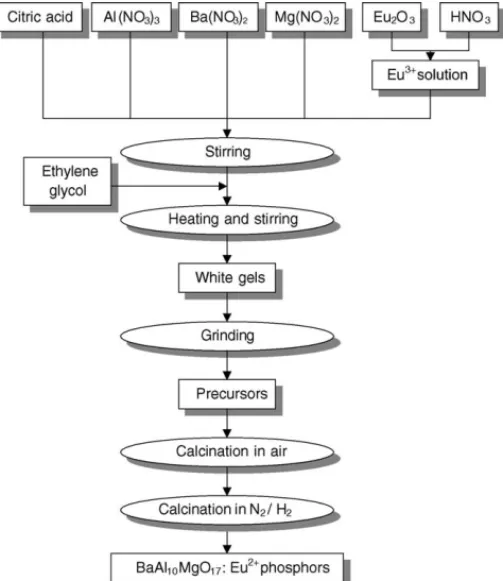
The synthesis procedures in the sol–gel process employ-ing citric acid and ethylene glycol are summarized in the flowchart illustrated inFig. 1. Analytical grade nitrates dis-solved in deionized water were used as the starting materials for Ba2+(0.09 M), Al3+(1.0 M), and Mg2+(0.1 M) ions. Eu-ropium nitrate solution was obtained by dissolving analyti-cal grade Eu2O3in dilute nitric acid. Citric acid was used as chelating agent; while, ethylene glycol was used as poly-merizing agent. Homogeneous colorless solution was ob-served after continuous stirring for 1.5 h. After adding ethy-lene glycol into the clear solution, the mixture was contin-uously stirred and heated at 130◦C. At this stage, excess water was evaporated from the mixture. When the mixture was heated at 300◦C for 1.5 h, white gels were obtained. The powders obtained via grinding the gels were further calcined at select temperatures for 4 h in air. The sol–gel-derived precursors after heating in air at 800, 1000, 1200, and 1400◦C are henceforth termed as 8, 10, S-A-12, and S-A-14, respectively. The formation of Eu2+ions in the phosphors was achieved by heating the sol–gel-derived precursors in the reducing atmosphere as mentioned in ear-lier section. Ba0.9Eu0.1MgAl10O17phosphors obtained from reducing the precursors S-A-8, S-A-10, S-A-12, and S-A-14 are henceforth named as S-R-8, S-R-10, S-R-12, and S-R-14, respectively. To investigate the effect of thermal degradation, the sol–gel-derived (S-R-14) and conventionally prepared (C-R-12) Ba0.9Eu0.1MgAl10O17 phosphors were heated further in air at 500◦C for 1 h. Ba0.9Eu0.1MgAl10O17phosphors ob-tained from the precursors S-R-14 and C-R-12 after the third
Fig. 1. Flowchart for the synthesis of sol–gel-derived Ba0.9Eu0.1MgAl10O17
phosphors employing citric acid and ethylene glycol.
stage heating in air are henceforth named as S-T-14 and C-T-12, respectively.
X-ray diffraction patterns for the prepared powders were detected via a X-ray diffractometer (MAC M03 XHF) us-ing Cu K␣. A field emission scanning electron microscope (Hitachi S-800) was used to observe the microstructures of the prepared powders. UV-induced luminescence studies were conducted using a fluorescence spectrometer (Hitachi F-4500). VUV-induced luminescence studies were performed using synchrotron radiation facility (National Synchrotron Radiation Research Center, Hsin-Chiu, Taiwan). The syn-chrotron radiation facility enabled recording of VUV excita-tion spectra in 120–200 nm and VUV-excited emission spec-tra in 300–800 nm.
3. Results and discussion
3.1. Sample characterization and morphology of the prepared phosphors
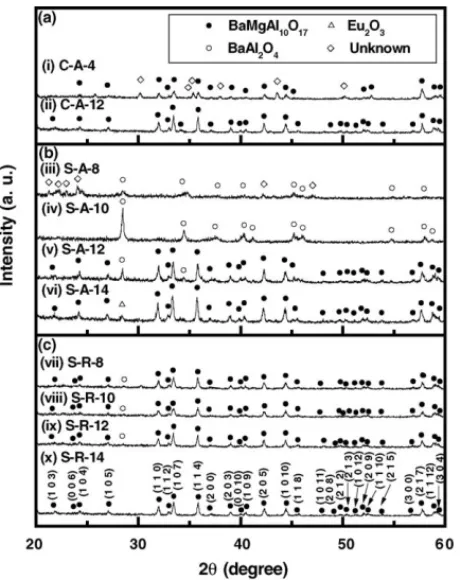
Fig. 2illustrates the XRD patterns for the representative powders obtained during synthesis. In particular,Fig. 2(a)–(c) illustrate the XRD patterns for Ba0.9Eu0.1MgAl10O17 phos-phors prepared via the solid-state reaction, the derived powders after calcination in air, and the sol–gel-derived powders obtained after the reducing treatment, re-spectively. Fig. 2(a) demonstrates that powders (C-A-12)
Table 1
Preparation conditions and sample nomenclature for identification in three stage preparation via different routes for Ba0.9Eu0.1MgAl10O17phosphors
Preparation conditions for samples
First-stage heating (in air at selected temperatures)
Second-stage heating (in reducing atmosphere at 1400◦C)
Third-stage heating (in air at 500◦C)
Solid-state route C-A-4 (1500
◦C for 4 h)
C-A-12 (1500◦C for12 h) C-R-12 (via heating C-A-12) C-T-12 (via heating C-R-12)
Sol–gel route
S-A-8 (800◦C for 4 h) S-R-8 (via heating S-A-8) S-A-10 (1000◦C for 4 h) S-R-10 (via heating S-A-10) S-A-12 (1200◦C for 4 h) S-R-12 (via heating S-A-12)
S-A-14 (1400◦C for 4 h) S-R-14 (via heating S-A-14) S-T-14 (via heating S-R-14)
obtained via the solid-state route after heating at 1500◦C for 12 h (curve ii) are corresponding to pure BaMgAl10O17 (ICDD No. 26-0163)[9]; while, an unknown phase is present in the powders (C-A-4) derived after heating at 1500◦C for 4 h (curve i). For the synthesis of pure-phase BAM phosphors via solid-state reactions, prolonged heating is required.
Fig. 2(b) depicts the XRD patterns for the sol–gel-derived Ba0.9Eu0.1MgAl10O17 phosphors obtained after heating in air for 4 h at selected temperatures. The XRD patterns for Ba0.9Eu0.1MgAl10O17 powders obtained via heating at 800◦C (S-A-8), 1000◦C (S-A-10), 1200◦C (S-A-12), and 1400◦C (S-A-14) are illustrated in curves iii, iv, v, and vi, respectively. Curve (iii) indicates the formation of BaAl2O4 (BAL) during the first stage of heating in air at 800◦C[10].
Fig. 2. XRD patterns for Ba0.9Eu0.1MgAl10O17phosphors obtained via (a)
the solid-state route by heating at 1500◦C in air (i) for 4 h and (ii) 12 h; (b) the sol–gel route obtained after calcination in air at (iii) 800◦C, (iv) 1000◦C, (v) 1200◦C, and (vi) 1400◦C; and (c) heating in the reducing atmosphere for the sol–gel-derived precursors calcined in air at (vii) 800◦C, (viii) 1000◦C, (ix) 1200◦C, and (x) 1400◦C.
Powders obtained via heating at 1000◦C reveal an increase in the crystallinity of BaAl2O4phase and absence of secondary phases. In the sol–gel-derived phosphors, BaMgAl10O17 is obtained as the product (curve v) along with the impu-rity phase BaAl2O4. Ba0.9Eu0.1MgAl10O17 exhibiting the diffraction patterns corresponding to BaMgAl10O17 is ob-served to coexist with a trace of Eu2O3[11]phase after cal-cination at 1400◦C in air (curve vi).
Fig. 2(c) illustrates the XRD patterns for the sol–gel-derived powders obtained after heating the precursors shown inFig. 2(b) at 1400◦C for 4 h in the reducing atmosphere. Owing to the heat treatment at 1400◦C, all powders con-tain BaMgAl10O17 phase (curves vii–x); however, S-R-14 (curve x) is the only sample that resulted in single-phase BaMgAl10O17powders without traces of BaAl2O4and Eu2O3. These observations suggest that raising the calcina-tion temperature in the first stage of heating can facilitate the synthesis of Ba0.9Eu0.1MgAl10O17phosphors for obtaining pure-phase compound.
Fig. 3 illustrates the microstructures observed for the
sol–gel-derived Ba0.9Eu0.1MgAl10O17powders prepared via (a) calcining precursors at 1400◦C in air (S-A-14) and (b) powders (S-R-14) obtained via heating in the reducing atmo-sphere of the precursors (S-A-14). The samples prepared via the sol–gel route exhibit irregular shapes. In general, particles of 4–6m in size are obtained via the sol–gel route incorpo-rating polymerizing agents. In comparison with the reported particle size for powders synthesized via the sol–gel route without polymerizing agents, the particle sizes observed in the present studies are relatively smaller[12].
3.2. UV-induced luminescence characteristics of Eu3+ and Eu2+ions in BaMgAl10O17
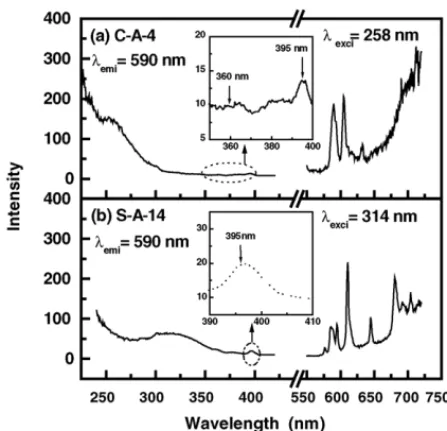
Eu2+doped BaMgAl10O17phosphors are known to emit in blue region on excitation with UV light [6,12]. For the sol–gel-derived precursors heated in air, the emission in blue region is not observed. This observation indicates that for the samples prepared in air, europium ions do not incorpo-rate as Eu2+ions in the host.Fig. 4shows the excitation and emission spectra recorded for Ba0.9Eu0.1MgAl10O17 phos-phors prepared in air via the solid-state reaction route and the sol–gel route. Based on the emission characteristics shown inFig. 4, it is revealed that europium ions are present as Eu3+
Fig. 3. SEM micrographs for Ba0.9Eu0.1MgAl10O17obtained via (a) the
sol–gel route after calcination in air at 1400◦C (S-A-14) and (b) heating in the reducing atmosphere for the sol–gel-derived precursors calcined in air at 1400◦C (S-R-14).
ions in the prepared phosphors. Curve (a) illustrates the lumi-nescence characteristics for sample C-A-12 prepared via the solid-state reaction route. The excitation spectra for the sam-ple were recorded by monitoring emission at 590 nm; while, the emission spectra were recorded by exciting the sample at 258 nm. For the sample prepared in air, emission peaks are observed at 578, 589, 605, and 632 nm. The excitation spec-tra reveal broad excitation with a strong peak at 258 nm and a weak excitation peak at 395 nm (seen in the inset). From the nature and intensities of these excitation peaks, the strong and broad excitation at 258 nm can be identified as the charge transfer band; while, the weak excitation peak at 395 nm is due to intra-configurational 4fntransition[13,14].
Fig. 4. Excitation (λemission= 590 nm) and emission (λexcitation= 258/
314 nm) spectra for Eu3+ions in Ba
0.9Eu0.1MgAl10O17prepared in air via
(a) the solid-state reactions route (C-A-12) and (b) the sol–gel route after calcinations at 1400◦C (S-A-14).
Curve (b) in Fig. 4 illustrates the excitation (λemission= 590 nm) and emission (λexcitation= 314 nm) spec-tra recorded for the sol–gel-derived Ba0.9Eu0.1MgAl10O17 phosphors obtained via calcination at 1400◦C (S-A-14). The inset in curve (b) illustrates the excitation spectra for powders S-A-14 in the 360–420 nm region. The excitation spectra reveal a charge transfer band at 314 nm and a weak excitation peak at 395 nm due to f–f transitions. The excitation spectra of S-A-14 samples reveal that position of the charge transfer band shifts to 314 nm. A number of emission peaks with increased intensities are observed for the sol–gel-derived phosphors in comparison with those obtained via the solid-state route. The prominent emission peaks are found at 585, 588, 594, 610, 645, and 681 nm. The luminescence characteristics, including the position of charge transfer band and the emission characteristics such as the number of emission peaks and their relative intensities, reveal structural information regarding the sites occupied by Eu3+ions in the host matrix.
The position of charge transfer band is known to be strongly dependent on the environment of Eu3+ ions in the host [15–17]. In particular, the distance between eu-ropium ions and oxygen ions, and the co-ordination num-bers in different matrices both influence the positions of charge transfer bands. The differences in charge transfer bands between the sol–gel-derived and conventionally pre-pared Ba0.9Eu0.1MgAl10O17phosphors reveal that Eu3+ions are located at sites with different anionic environments in the host.
The emission peaks corresponding to5D0→7FJ transi-tions (where J = 0, 1, 2, 3, and 4) for Eu3+ions are observed in Ba0.9Eu0.1MgAl10O17phosphors—S-A-14. The emission spectra of the sol–gel-derived samples shown in curve (b)
are different from those observed for the conventionally pre-pared sample illustrated in curve (a). The emission at around 590 and 610 nm can be identified to be due to5D0→7F1and 5D0→7F2transitions, respectively. The intensity ratio (R) of the intensity of5D0→7F2transition to that of5D0→7F1 transition is known to provide structural information such as asymmetry of the average coordination polyhedron of Eu3+ ions[18,19]. As calculated from the data illustrated inFig. 4, the ratio R is 0.97 for Ba0.9Eu0.1MgAl10O17phosphors pre-pared via the solid-state reaction route and the value of R increases to 5.25 for the sol–gel-derived phosphors calcined at 1400◦C. The significantly large value of R for the sol–gel-derived samples suggests that Eu3+ions are incorporated in phosphors having asymmetric distorted environment during synthesis via the sol–gel route.
The changes observed in the luminescence characteristics of Eu3+ions in the samples prepared via the solid-state route and the sol–gel route reveal that methods of preparation in-fluence the incorporation of Eu3+ions in BaMgAl10O17 by changing the sites at which Eu3+ions are incorporated in the matrix. On the other hand, after C-A-12 and S-A-14 phos-phors are subject to reducing treatment, the luminescence characteristics of Eu3+ions are not detectable. The absence of Eu3+ions in the phosphors subjected to the reducing treat-ment in contrast to their presence in the phosphors prepared in air suggests complete conversion to Eu2+ions during heating in reducing atmosphere.
Fig. 5 illustrates the excitation (λemission= 458 nm) and emission (λexcitation= 330 nm) spectra for the sol–gel-derived Ba0.9Eu0.1MgAl10O17phosphors obtained via reduction by heating at 1400◦C in the reducing atmosphere (S-R-8 (curve a), S-R-10 (curve b), S-R-12 (curve c), and S-R-14 (curve d)). A strong blue emission with a peak at 458 nm is observed
Fig. 5. Excitation (λemission= 458 nm) and emission (λexcitation= 330 nm)
spectra for Eu2+ions in sol–gel-derived Ba0.9Eu0.1MgAl10O17phosphors
obtained via reduction of the precursors calcined at (a) 800◦C (S-R-8), (b) 1000◦C (S-R-10), (c) 1200◦C (S-R-12), and (d) 1400◦C (S-R-14).
Fig. 6. Excitation (λemission= 458 nm) and emission (λexcitation= 330 nm)
spectra of sol–gel-derived phosphors prepared in reducing atmosphere from the precursors calcined at 1400◦C. (a) Ba0.95Eu0.05MgAl10O17, (b)
Ba0.9Eu0.1MgAl10O17, and (c) Ba0.85Eu0.15MgAl10O17.
for these samples. The excitation spectra reveal a main peak at 330 nm. Similar excitation and emission spectra are re-ported for Eu2+ doped BaMgAl10O17 phosphors [6,12,20]. The curves (a–d) indicate that the emission intensities in-crease with the calcination temperatures of the precursors. The results of XRD investigations presented inFig. 2(c) re-veal that pure-phase Ba0.9Eu0.1MgAl10O17 phosphors are formed only for S-R-14 sample obtained via calcination of the precursor at 1400◦C. On the other hand, for samples S-R-8, S-R-10, and S-R-12, for which the precursors are calcined at temperatures lower than 1400◦C, the impurity phases are detected. The presence of impurity phases in these samples is considered to be responsible for the reduction in emis-sion intensity. It is necessary to provide a reducing atmo-sphere during synthesis to produce divalent europium ions in BaMgAl10O17phosphors.
To understand the effect of europium content on sol–gel-derived phosphors, luminescence studies are carried out for BaMgAl10O17 with different concentrations of europium ions. Fig. 6 illustrates the excitation (λemission= 458 nm) and emission (λexcitation= 330 nm) spectra recorded for Ba1−xEuxMgAl10O17containing different amount of x where x = 0.05, 0.1, and 0.15. The sol–gel-derived samples are ob-tained via heating the precursors in air via two-stage heat-ing at 1400◦C in reducing atmosphere. Similar excitation and emission spectra are observed in the above three phos-phors. UV-induced luminescence increases with elevated concentration of Eu2+ions up to 15 at.% in BaMgAl
10O17 phosphors.
Fig. 7 illustrates the excitation (λemission= 458 nm)
and emission (λexcitation= 330 nm) spectra recorded for Ba0.9Eu0.1MgAl10O17 phosphors obtained via the sol–gel route and conventional route after two-stage and three-stage
Fig. 7. Excitation (λemission= 458 nm) and emission (λexcitation= 330 nm)
spectra of Ba0.9Eu0.1MgAl10O17phosphors prepared in the reducing
at-mosphere via (a) sol–gel route (S-R-14), (b) sol–gel route after third stage heating in air at 500◦C for 1 h (S-T -14), (c) solid-state route (C-R-12), and (d) solid-state route after third stage heating in air at 500◦C for 1 h (C-T-12).
heating. The luminescence characteristics of Eu2+ ions in BaMgAl10O17phosphors are elucidated based on the spectra. The sol–gel-derived Ba0.9Eu0.1MgAl10O17 (S-R-14) phos-phors (curve a) exhibits maximum intensity amongst sam-ples shown in Fig. 7. Phosphor S-T-14 generated from all the precursor S-R-14 by heating at 500◦C for 1 h in air re-veals a reduced luminescence (curve b) in comparison with that of sample S-R-14. The thermal degradation of Eu2+ doped BaMgAl10O17 phosphors has been reported [3–5]. The sol–gel-derived phosphors prepared with polymerizing agents are not exceptional. Curves c and d illustrate the spec-tra for Ba0.9Eu0.1MgAl10O17 phosphors prepared via the solid-state reactions after two-stage heating (C-R-12) and three-stage heating (C-T-12), respectively. For the samples prepared via the sol–gel route, emission intensities are greater than those of the sample prepared via the solid-state reac-tion route. Similar observareac-tion of increased luminescence for the phosphors synthesized via sol–gel route in comparison with those prepared by solid-state route has been reported by Zhang et al. [12]. The emission intensity of phosphors prepared by the conventional method also reduces due to heating in air at third stage. It is noted that sol–gel-derived Ba0.9Eu0.1MgAl10O17phosphors exhibit more intense lumi-nescence even after thermal degradation (S-T-14 (curve b)) as compared with that of phosphors prepared via the solid-state reaction (C-R-12 (curve c)). The luminescence char-acteristics demonstrated in Fig. 4 for the sol–gel-derived powders clearly reveal that Eu3+ ions are incorporated in BaMgAl10O17phosphors at the sites having pronounced de-viation from symmetry in comparison with the phosphors prepared by the solid-state route. The incorporation of Eu2+
Fig. 8. Emission (λexcitation= 147 nm) spectra for sol–gel-derived
Ba0.9Eu0.1MgAl10O17phosphors derived from reduction of the precursors
calcined at (a) 800◦C (S-R-8), (b) 1000◦C (S-R-10), (c) 1200◦C (S-R-12), and (d) 1400◦C (S-R-14).
ions at different sites in the precursor powders prepared by the sol–gel route facilitates an increase in the luminescence from Eu2+ions.
3.3. VUV-induced luminescence characteristics of sol–gel-derived Ba0.9Eu0.1MgAl10O17phosphors
For sol–gel-derived Ba0.9Eu0.1MgAl10O17 phosphors, VUV-excited luminescence was investigated employing high intensity synchrotron radiation facilities. The Xe gas based discharge lamps are widely used in PDP devices as an exci-tation source and emit intensely at 147 nm. In order to under-stand the feasibility of applications in PDP devices, the emis-sion spectra of those phosphors upon 147 nm excitation were recorded.Fig. 8illustrates the emission (λexcitation= 147 nm) spectra recorded for sol–gel-derived Ba0.9Eu0.1MgAl10O17 phosphors (S-R-8, S-R-10, S-R-12, and S-R-14). A broad and intense emission is observed at 458 nm for all phosphors. Similar to UV-induced luminescence shown inFig. 5, VUV-excited emission intensity also increases with a rise in calci-nation temperature (curves a–d). The emission characteristics of Eu3+ions are not observed upon VUV excitation for the samples obtained after the reducing treatment.
Fig. 9 illustrates the excitation (λemission= 458 nm) and emission (λexcitation= 147 nm) spectra for sol–gel-derived BaMgAl10O17phosphors with different concentrations of eu-ropium ions after calcination in the reducing atmosphere at 1400◦C. An intense VUV-excited emission in the blue region with emission peak at 458 nm is observed in all samples. The emission intensity increases with elevated concentration of europium ions up to 15 at.% in the phosphors (curve a–c). The excitation spectra reveal a strong excitation peak at 164 nm and a weak peak at 230 nm. The band-to-band excitation of
Fig. 9. Excitation (λemission= 458 nm) and emission (λexcitation= 147 nm)
spectra of sol–gel-derived phosphors prepared in reducing atmosphere from the precursors calcined at 1400◦C. (a) Ba0.95Eu0.05MgAl10O17, (b)
Ba0.9Eu0.1MgAl10O17, and (c) Ba0.85Eu0.15MgAl10O17.
the host material results in excitation at 164 nm; while, the weak peak around 230 nm is due to 4f7→ 4f65d1transition associated with Eu2+ions[20,21]. Based on the above results, it is evident that the heating conditions and the method of preparation are critical to obtain Ba1−xEuxMgAl10O17 phos-phors with intense luminescence intensity under VUV exci-tation for probable applications in PDP devices.
4. Conclusions
BaMgAl10O17 phosphors doped with europium ions are prepared via the sol–gel route using citric acid as a chelat-ing agent and ethylene glycol as a polymerizchelat-ing agent. The sol–gel route leads to the synthesis of pure-phase BaMgAl10O17 phosphors on calcination at 1400◦C for 4 h. The variations in the anionic environment of Eu3+ ions occupying different sites are reflected in the positions of charge transfer band, as well as the intensity ratios of 610 nm (5D0→7F2) emission to 590 nm (5D0→7F1) emis-sion for the sol–gel-derived and conventionally prepared Ba0.9Eu0.1MgAl10O17. The europium ions of the sol–gel-derived phosphors are in a more asymmetric environment in comparison with those phosphors prepared via the solid-state route. The brightness of the sol–gel-derived phosphors is higher than that of the phosphors obtained via the solid-state route. The emission intensities of the sol–gel-derived
phos-phors after thermal degradation are also greater than those of the phosphors obtained via the solid-state route. The phos-phors prepared via the sol–gel method employing additional polymerizing agent are found to be suitable for PDP applica-tions.
Acknowledgements
The authors would like to thank National Science Council, Taiwan, Republic of China, for partial financial support of this study under Contract No. NSC 92-2214-E002-036. We would also like to thank Hong-Kai Chen and Hsiao-Chi Lu in National Synchrotron Radiation Research Center for their assistance in the measurement of VUV spectra.
References
[1] M.P.J. Verstegen, D. Radielovic, L.E. Vrenken, J. Electrochem. Soc. 121 (1974) 1627.
[2] J.L. Sommerdijk, A.N.L. Stevels, Philips Tech. Rev. 37 (1977) 221. [3] S. Oshio, T. Matsuoka, S. Tanaka, H. Kobyashi, J. Electrochem. Soc.
145 (1998) 3903.
[4] S. Zhang, Y. Hou, T. Onishi, M. Kokubu, M. Obata, H. Tanno, T. Kono, H. Uchike, Jpn. J. Appl. Phys. 42 (2003) 477.
[5] K. Yokota, S.X. Zhang, K. Kimura, A. Sakomoto, J. Lumin. 92 (2001) 223.
[6] K.C. Mishra, M. Raukas, A. Ellens, K.H. Johnson, J. Lumin. 96 (2002) 95.
[7] P. Boolchand, K.C. Mishra, M. Raukas, A. Ellens, P.C. Schimdt, Phys. Rev. B 66 (2002) 134429.
[8] A. Ellens, F. Zwaschka, F. Kummer, A. Meijerink, M. Raukas, K. Mishra, J. Lumin. 93 (2001) 147.
[9] ICDD Powder Diffraction File, Card No.26-0163. [10] ICDD Powder Diffraction File, Card No. 17-0306. [11] ICDD Powder Diffraction File, Card No. 43-1009.
[12] J. Zhang, Z. Zhang, Z. Tang, Z. Zheng, Y. Lin, Powder Technol. 126 (2002) 161.
[13] G. Blasse, B.C. Grabmaier, Luminescent Materials, Springer-Verlag, 1994, p. 27.
[14] T. Kano, in: S. Shionoya, W.M. Yen (Eds.), Phosphor Handbook, CRC Press, Washington, DC, 1998, p. 181.
[15] V. Jubera, J.P. Chaminade, A. Garcia, F. Gullien, C. Fouassier, J. Lumin. 101 (2003) 1.
[16] G. Blasse, J. Solid State Chem. 4 (1972) 52. [17] H.E. Hoefdraad, J. Solid State Chem. 15 (1975) 175.
[18] S. Polizzi, M. Battagliarin, M. Bettinelli, A. Speghini, G. Fagherazzi, J. Mater. Chem. 12 (2002) 742.
[19] W.J.L. Oomen, A.M.A. van Dongen, J. Non-Cryst. Solids 111 (1989) 205.
[20] J. Zhang, Z. Zhang, Z. Tang, Y. Tao, X. Long, Chem. Mater. 14 (2002) 3005.
[21] T. Kunimoto, A. Daud, I. Ozki, K. Okamoto, K. Ohmi, S. Tanaka, H. Kobayashi, Inst. Electronics, Information and Communication Engi-neers (IEICE) Trans. Electron E83C (2000) 1608.