科技部補助專題研究計畫成果報告
期末報告
台灣高教擴張對年輕世代職業地位及薪資的影響:反事實的分
析
計 畫 類 別 : 個別型計畫 計 畫 編 號 : MOST 104-2410-H-004-109-執 行 期 間 : 104年08月01日至105年07月31日 執 行 單 位 : 國立政治大學社會學系 計 畫 主 持 人 : 關秉寅 計畫參與人員: 博士班研究生-兼任助理人員:彭思錦 報 告 附 件 : 出席國際學術會議心得報告中 華 民 國 105 年 10 月 15 日
中 文 摘 要 : 本研究計畫以反事實分析的角度及方法,探討台灣高教擴張前後 ,大學學歷對於年輕世代之初職及現職職業聲望與工作收入的影響 。本計畫將高教擴張前後的兩個世代,分成三類群體:「必為者」 (不管是否高教擴張都會上大學者)、「順勢而為者」(沒有高教 擴張的話,無法上大學,但高教擴張後因機會增加而上大學者 ),以及「必不為者」(不管高教是否擴張,都不會上大學者)。 本計畫使用華人家庭動態資料庫第5年計畫(RI2003)與第11年計畫 (RI2009)蒐集到的兩世代樣本為研究對象。分析策略有二:一為 模擬方法,另一則為配對方法。以此二方法區別高教擴張前後年輕 世代的三類人後,再以差異中之差異法來估計高教擴張對年輕世代 這三類人之職業地位聲望及薪資的影響。研究結果發現,兩種分析 策略得到的結果相近。主要研究發現為:1、雖然必為者比其他兩類 人在不論是在初職或現職的職業聲望及薪資上都有優勢,但高教擴 張會減少其初職之優勢;2、高教擴張對順勢而為者的初職及現職之 聲望及薪資都有正面影響力。 中 文 關 鍵 詞 : 高教擴張、反事實分析、年輕世代、職業聲望、薪資
英 文 摘 要 : This project proposes a counterfactual analysis to estimate the causal effects of college expansion on earnings and occupational prestige of young people in Taiwan. The rapid expansion of higher education in Taiwan in mid-1990s is attributed by the public to be the main cause of stagnant wage growth and high unemployment rates of college
graduates in recent years. A crucial question that needs to be answered is whether close to universal access to higher education in Taiwan would be beneficial to those can now attend college thanks to the expansion in the same way as those obtained college degrees before the expansion. Using both simulation strategy and matching method to examine a unique dataset collected by Panel Study of Family Dynamics in Taiwan, this project is able to identify a pre-expansion cohort and a post-expansion cohort and then estimated the change in earnings and occupational prestige due to
expansion for three groups: “compliers” (who would not have attended before the expansion but would do so after the expansion), “always-takers” (who would be predicted to go to college before and after expansion), and “never-takers” (who would not go to college in either period). The findings show that while always takers have advantages in both earnings and occupational prestige, college
expansion decreases their advantages at least for the gains in the first job. Compliers, on the other hand, are clearly gained from expansion by earning more and having higher prestige in either their first or current jobs.
英 文 關 鍵 詞 : College Expansion, Counterfactual Analysis, Occupational Prestige, Earnings
I
科技部補助專題研究計畫成果報告
(□期中進度報告/期末報告)
台灣高教擴張對年輕世代職業地位及薪資的影響:反事實的分析
計畫類別:個別型計畫 □整合型計畫
計畫編號:MOST 104-2410-H-004-109-
執行期間:104 年 8 月 1 日至 105 年 7 月 31 日
執行機構及系所:國立政治大學社會學系
計畫主持人:關秉寅
計畫參與人員:彭思錦(兼任博士生研究助理)
本計畫除繳交成果報告外,另含下列出國報告,共 _1_ 份:
□執行國際合作與移地研究心得報告
出席國際學術會議心得報告
□出國參訪及考察心得報告
中 華 民 國 105 年 10 月 15 日
I
中文摘要
本研究計畫以反事實分析的角度及方法,探討台灣高教擴張前後,大學學歷對於年輕世代之初職 及現職職業聲望與工作收入的影響。本計畫將高教擴張前後的兩個世代,分成三類群體:「必為者」(不 管是否高教擴張都會上大學者)、「順勢而為者」(沒有高教擴張的話,無法上大學,但高教擴張後因機 會增加而上大學者),以及「必不為者」(不管高教是否擴張,都不會上大學者)。本計畫使用華人家庭 動態資料庫第5年計畫(RI2003)與第11年計畫(RI2009)蒐集到的兩世代樣本為研究對象。分析策略 有二:一為模擬方法,另一則為配對方法。以此二方法區別高教擴張前後年輕世代的三類人後,再以 差異中之差異法來估計高教擴張對年輕世代這三類人之職業地位聲望及薪資的影響。研究結果發現, 兩種分析策略得到的結果相近。主要研究發現為:1、雖然必為者比其他兩類人在不論是在初職或現職 的職業聲望及薪資上都有優勢,但高教擴張會減少其初職之優勢;2、高教擴張對順勢而為者的初職及 現職之聲望及薪資都有正面影響力。 關鍵詞:高教擴張、反事實分析、年輕世代、職業聲望、薪資II
Abstract
This project proposes a counterfactual analysis to estimate the causal effects of college expansion on earnings and occupational prestige of young people in Taiwan. The rapid expansion of higher education in Taiwan in mid-1990s is attributed by the public to be the main cause of stagnant wage growth and high unemployment rates of college graduates in recent years. A crucial question that needs to be answered is whether close to universal access to higher education in Taiwan would be beneficial to those can now attend college thanks to the expansion in the same way as those obtained college degrees before the expansion. Using both simulation strategy and matching method to examine a unique dataset collected by Panel Study of Family Dynamics in Taiwan, this project is able to identify a pre-expansion cohort and a post-expansion cohort and then estimated the change in earnings and occupational prestige due to expansion for three groups: “compliers” (who would not have attended before the expansion but would do so after the expansion), “always-takers” (who would be predicted to go to college before and after expansion), and “never-takers” (who would not go to college in either period). The findings show that while always takers have advantages in both earnings and occupational prestige, college expansion decreases their advantages at least for the gains in the first job. Compliers, on the other hand, are clearly gained from expansion by earning more and having higher prestige in either their first or current jobs.
1
Introduction1
The present study proposes a counterfactual analysis to estimate the causal effects of college expansion on earnings and occupational prestige of young people in Taiwan. The rapid expansion of higher education in Taiwan in the mid-1990s is attributed by the public to be the main cause of stagnant wage growth and high unemployment rates of college graduates in recent years.
In the last three decades, one of the most important social changes in Taiwan has been the expansion of higher education. Tsai (2004) maintained that the first wave of expansion of higher education in 1985 had changed higher education in Taiwan from an elite system to a much more accessible one. The number of 4-year colleges and universities in Taiwan increased from 13 in 1984 to 41 in 1990. Taiwan further expanded its higher education in 1997 following the massive educational reform carried out by the government. Between 1997 and 2002, the number of colleges and universities drastically increased from 78 to 139. On average, a new college or university was established every month during the 5-year time. In 2014, the number of four-year colleges or universities is 159. According to Ministry of Education (2014), the net enrollment rate of the tertiary education before 1990 was mere 19.4%, which rose to 70.4% in 2013.
Whether the rapid expansion of higher education in the last three decades is a miracle or a disaster has been debated fiercely since the 1990s. Critics of the expansion point out the fact that during the corresponding decades, the economy in Taiwan has been rather sluggish. The GDP growth rate in 1990 was about 6.87% and the rate was only 2.09% in 2013. Similarly, the growth rate of personal income (i.e., GDP per capita) in 1990 was about 6.92% and in 2013, the rate was 2.68%.2 In short, increasing supply of highly educated in Taiwan has encountered decreasing economic performance, which is inadequate to accommodate the expansion of higher education in the last two decades or so.
Many previous studies have examined the impact of college expansion from various perspectives (Breen 2010; Hannum and Buchmann 2005; Lange and Topel 2006; Shavit et al 2007). The primary concern in evaluating the policy consequences of college expansion should, however, be on those who would respond to or comply with college expansion from the entire cohort of high school graduates. It is a challenging task methodologically because the analysis requires us to think counterfactually.
Obviously, the expansion of higher education in Taiwan may have not fulfilled the expectation that completing more education would result in increased personal income for all during the period of economic downturn. A crucial question that needs to be answered is whether close to universal access to higher education in Taiwan would be beneficial to those can now attend college thanks to the expansion in the same way as those obtained college degrees before the expansion. A corollary question is whether the expansion impacts negatively on economic and social rewards of those who would have been college graduates even
1 This report is based on the conference paper prepared for the 2016 Summer Meeting “Economic inequalities, deprivation, and
poverty” of the Research Committee on Social Stratification and Mobility (RC28) of the International Sociological Association (ISA), University of Bern, Switzerland, August 29–31, 2016. The conference paper was co-authored with Ssu-Chin Peng (the research assistant of the present project) and Dr. Seongsoo Choi (Assistant Professor of Sociology, Higher School of Economics, St. Petersburg, Russia). Ssu-Chin Peng was mainly responsible for data analysis and Dr. Choi provided the initial R program for the simulation method used by the present project.
2 These statistics were based on the website of National Statistics, R.O.C. (Taiwan),
2
before the expansion. Answering these questions has both theoretical and policy imports.
The present study follows the methodological strategy developed by Choi (2015) as well as a matching method to examine a unique dataset collected by Panel Study of Family Dynamics in Taiwan. With the dataset, we are able to identify a pre-expansion cohort and a post-expansion cohort and then estimate the change in earnings and occupational prestige due to expansion for three groups: “compliers” (who would not have attended before the expansion but would do so after the expansion), “always-takers” (who would be predicted to go to college before and after expansion), and “never-takers” (who would not go to college in either period). By comparing the change in earnings and occupational prestige of compliers with always-takers and never-takers allows us to make causal inference about the impact of college expansion on earnings and occupational prestige in Taiwan
Literature Review
Economically developed countries have achieved universal primary and secondary education since the middle of the 20th century. With the increasing demand in the labor market for better human resources and heightened educational expectation, tertiary education is also expanded quickly in these countries. The intended policy goal of the educational expansion at all levels has always been offering equal opportunities in education and lowering the influences of ascribed attributes such as race, gender and social-economic status on education attainment. Individuals are expected to use their own efforts and abilities to enhance their socio-economic status through education. In this vein, both sociologists and economists are interested in issues of the impact of educational expansion on social stratification structure and inequalities in socio-economic rewards (Shavit and Blossfeld 1993; Pascharopoulos and Patrinos 2004).
Sociologists, on the one hand, often consider about the connection of education, occupational prestige attainments, and social mobility. Economists, on the other hand, focus on the relationship between wages or incomes and education (Bills 2003). However, cross-national comparison studies have shown that that educational expansion in most industrialized countries did not reduce inequalities in educational opportunity among students from different social and economic strata since the early 20th century (Shavit and Blossfeld 1993). The privileged groups still have higher chances of getting into the next level of education and the underprivileged groups would get the chance for a better education until the need of privileged groups have been fulfilled. In recent time, sociologist started to explore in particular the impact of expansion of higher education on social stratification and social mobility (Walter and Rubinson 1983; Tsai 2004; Shavit et al. 2007; Alon 2009). This study intends to contribute to the exploration. The ensuing discussion begins with the review of literature on different theoretical perspectives of the relationships between education and the socio-economic returns and the review of different analytical strategies investigating this relationship follows.
The Effects of Education on Social and Economic Returns
Two main theories compete in explaining the possible effects of education effect on social and economic returns, such as occupational prestige and income attainment. One is the human capital theory and the other is the positional goods theory (Bills 2003; Choi 2015). The human capital theory, a dominant approach in economics, argues that people can gain working skill and professional training through school education. The theory supposes that workers’ marginal productivity can be enhanced with more education, which in turn is reflected in their income level (Becker 1962, 1993; Beaulieu and Mulkey 1995). Hence, if income or salary is determined both by the supply and demand of the labor and if the demand for skilled workers is constant in
3
the labor market, the expansion in higher education is expected to upgrade the human capital of compliers and raise their economic returns. It is also expected to lower the average economic return for all college graduates. In other words, the economic return of always-takers may suffer due to increasing supply of college graduates (Choi 2015).
Position good theory offers a very different viewpoint from human capital theory concerning the value of education. In contrast to human capital theory, which argues that education is a good with absolute value, the perspective argues that education is a relative good, whose value is contingent on historical and social conditions. In general, such a view is further articulated by two theoretical approaches: one is signaling theory and the other is credentialism. The signaling theory argues that the value of school education is not the skills individual learned, which may be deemed useful in the labor market, but the non-cognitive ability or the ability that one cannot observe or measure directly. Hence, one’s educational level reflects the status of such ability and income is to reward such ability rather than skills learned (Spence 1973, 1974; Taber 2001). The credentialist approach, a view based on the conflict theory in sociology, argues that education process is less concerned about conferring work skills but rather credential qualifications, which may help privileged professional or occupational groups to recruit those with similar cultural dispositions and keep their access and prestige through restricted entry. In other words, the value of educational credential is social and cultural construction and has no clear connection with enhancing marginal productivity (Collins 1979; Brown 2001; Bills and Brown 2011).
While these two theoretical perspectives can both be categorized as the position goods theory, two camps differ in their views about the connection between educational expansion and social and economic rewards for those who have college degree. Since the signaling theory believes that for those who have college degree, they may have certain ability, which cannot be directly observed, the college expansion may help the compliers to attain higher social and economic rewards. However, if the demand of highly educated remains the same, then the college expansion may have negative effect on social and economic rewards both for always takers and compliers. We argue that this negative effect only exists when they first enter the job market since college graduates would offer the similar signal of unobserved ability and employers would not be able to differentiate among them who are more capable. The signal of ability, however, would become clearer with increasing work experience and performance. In short, along this line of reasoning, the signaling theory would expect the social and economic rewards of always takers be higher than those of compliers in the long term, if always takers are assumed to have better ability and these abilities would gradually be demonstrated with the accumulation of working experience.
In contrast to the signaling theory, the credentialism argues that the educational background is mainly the criterion for the privileged occupational groups to select those who can fit in with these groups. With increasing supply of those who have college degrees, they will demand for their chosen employees to have even higher educational level. In this case, compliers would not gain positively from the college expansion. Always taker would remain unaffected by the inflation of college graduates since their relatively advantaged background may still get them into more selective universities and maintain their privileged status.
Empirical Studies in the Past
Social scientists have used various analytical strategies with different data sets to test these different theoretical perspectives. Based on the human capital theory, economists explore relationships between college expansion and income with the demand-supply model. According to such a model, the effect of college
4
expansion is determined by two factors: one is the supply of skilled labors which would be increased by college expansion, and the other is the demand for such skilled labors in the labor market. Economists in the U.S. have shown that the relationship between individual investment in education and their incomes generally reflects such a supply-demand model in the past 100 years (Katz and Murphy 1992; Card and Lemieux 2001; Goldin and Katz 2008). For instance, Goldin and Katz (2008) maintain that the salary gap between those who have the college degree and those who don’t became wider and wider, which can be attributed to the condition that the demand of skill level increased while the supply of such skilled labors is relatively stagnated (Goldin and Katz 2008). The supply-demand model is also believed to be applicable to the effects of higher education in other societies, such as the U. K. (Walker and Zhu 2008), Germany (Gerbel and Pgeiffer 2010), South Korea (Choi and Jeong 2005) and Taiwan (Lin and Chu 2002).
Notwithstanding the broad appeal of the model of supply and demand, we argue that the model may fail to distinguish the difference in rewards from those who is always taker to those who is complier. Furthermore, there may have some important unobserved differences or self-selecting factors causing those who go to college and those who do not to have different social and economic returns.
Several studies have taken into account the possibility of unobserved difference and self-selection between those who attend college and those who do not. Their findings, however, are mixed in results (Hout 2012). For instance, Brand and Xie (2010) use the method of propensity score matching to investigate the potential outcomes of attending college. With two different data sets, National Longitudinal Study of Youth and Wisconsin Longitudinal Study, Brand and Xie (2010) find that those who have less chance for attending college may benefit more than those who have higher chance for attending college. Carneiro, Heckman, and Vytlacil (2011) using the same datasets and the method of instrumental variable to estimate the marginal treatment effect of attending college on income, have reached a conclusion which is totally the opposite to the Brand and Xie’s. Tsai and Xie (2008, 2011) using the data of Taiwan Social Change Survey also find that the results are inconsistent with different methods. They use both propensity score matching and the instrumental variable approach to estimate the return rate of higher education on income. In an early study, Tsai and Xie (2008) find that those who have less chance in attending college would have higher rewards in the 1990s or 2000s in Taiwan. In their later study, Tsai and Xie (2011) find that the rewards are different between genders. Only females would gain positive rewards by attending college.
Without doubt, the aforementioned studies which take into account of unobserved difference or self-selection factor have made considerable advances in our understanding about the different rate of returns for those who have different chances of attending college. These studies, however, still have their limitations. They often use the cross-sectional data to estimate the returns of those who have and have no college degree without being able to really estimate the returns of college graduates before and after college expansion. In order to better assess the relationship between college attending and their returns, we believe it is more suitable to use the counterfactual framework and data which cover both the period before and after college expansion. Devereux and Fan (2011)’s research is one of such examples. They use “generation” as the instrumental variable to analyze the effect of college expansion on individual’s income in the 1990s’ Britain. Their study shows that the compliers gain higher income after college expansion (Devereux and Fan 2011). Atteweel and Lavin (2007), using the method of propensity score matching also reach a similar finding in the U. S. They analyze the effects on those who attend the college when the CUNY system lowered their standard of the entrance. They find out that attending college has positive effect on their incomes (Atteweel and Lavin 2007). With the data of Korea Labor and Income Panel Study, Choi (2015) examines the relationship between
5
higher education and income in two different cohorts, 1965-1971 and 1976-1982.
Choi’s approach differs with past studies by differentiating three group based on the survey data of these two cohorts. He differentiates them into three different counterfactual groups: always takers, never takers and compliers. Then, he uses the DID (difference in difference) model to estimate the effect of college expansion respectively on income and occupational prestige of these three groups. He finds that the effects of college expansion have gender differences. The male compliers’ income is closer to always takers’, while the female compliers’ income increase and the female always takers’ income decrease. Choi’s analytical strategy is better than approaches used by past studies so far since it can estimate the effect of college expansion on different groups rather than only on compliers. Therefore, we will follow such strategy to analysis the effect of college expansion on income and occupational prestige of younger generation in Taiwan.
Research Hypotheses
Following the discussion above and based on Choi’s (2015) approach, we argue that to better understand the impact of higher education on social and economic returns of college graduates, we need to differentiate three different groups: always takers, never takers, and compliers. Based on different theoretical perspectives, we further propose two sets of contrasting research hypotheses focusing on always takers and compliers respectively.
The first set of contrasting research hypotheses concerning compliers are as follows:
H1A According to human capital theory and signaling theory, the college expansion will have positive effects on compliers’ income and occupational prestige of the first job. This positive effect, however, will be diminished with increasing work experience and hence, college expansion would have little effect on income and occupational prestige of the current job.
H1B According to credencialism, the college expansion will not bring any positive effects to compliers no matter on first or present job incomes and occupational prestige.
The set of contrasting research hypotheses regarding always takers are as below:
H2A According to signaling theory, the college expansion will have negative influences on first job income and occupational prestige of always takers, while this negative effect will disappear through accumulation of work experience and the expansion is expected to have no effect on income and occupational prestige of the present job.
H2B According to credencialism, there will be no negative effect no matter on always-taker’s first or present job income and occupational prestige.
Data
The present study used the so-called “new” samples gathered by Panel Study of Family Dynamics (PSFD)3 in the 5th wave and the 11th wave to analyze the impacts of expansion of higher education in Taiwan on earnings and occupational prestige. The new sample of the 5th wave of the PSFD, called by the project as RI2003, was collected in 2003. The population targeted by the RI2003 was adults born between 1964 and 1976 in Taiwan and the sample size is 1,152. The new sample of the 11th wave of the PSFD, called by the project as RI2009, was collected in 2009. The population sampled by RI2009 was adults born between 1977 and 1983 and the sample size was 2,092. The cohort of RI2003 was exposed to the college system before the
3
The PSFD is a longitudinal study sponsored by Project for the Study of Family in Chinese Societies, Research Center for Humanities and Social Sciences, Academia Sinica since 1999.
6
2nd wave of the higher education expansion started in 1997 and the cohort of RI2009 was exposed to the much expanded college system when it was of the age of entering colleges. Hence, these two PSFD samples are ideal for analyzing the impacts of the higher education expansion on young people in their 20’s and 30’s in the last two decades in Taiwan.
Analytical Strategies
Our analysis adopted a counterfactual approach by first identifying within two PSFD samples those who entered college regardless of the expansion (always-takers), those who would never have entered college regardless of the expansion (never-takers) and those who would not have entered college but for the expansion (compliers). Always-takers include respondents of RI2003 who were admitted into colleges and respondents of RI2009 who shared with always-takers of RI2003 similar demographic characteristics, family backgrounds and high-school performance and predicted probabilities of being admitted into colleges. Never-takers include RI2009 respondents who did not enroll into colleges and respondents of RI2003 who shared with never-takers of RI2009 similar family backgrounds and high-school performance and predicted probabilities of not enrolling into colleges. After always-takers and never-takers were identified, the rest of RI2003 and RI2009 were taken as compliers.
In short, we assume that those who were admitted into colleges pre-expansion would also be admitted into colleges after the expansion. Those who did not enter the college in the pre-expansion era could be divided into compliers and never-takers. Compliers of the pre-expansion era would have entered the colleges if they had been given the opportunities offered after the expansion. Likewise, those who entered the college in the post-expansion era could also be divided into always-takers and compliers. Of course, compliers and never-takers of the pre-expansion and compliers and always-takers of the after-expansion period could not be observed and could only be predicted counterfactually. Since always-takers of the pre-expansion era were students of public universities and a few reputable private colleges and universities, it is not unreasonable to assume that always-takers of the post-expansion era would also have a higher chance to be admitted into these colleges and universities. Compliers of the post-expansion era, however, would probably be more likely to be students of less prestigious colleges and universities.
Based on the discussion above, we use the following steps to differentiate three groups:
(1) The first step uses logistic regression to estimate the predicted probabilities of respondents’ college enrollment status for each PSFD cohort. The regression predictors are respondent’s demographic characteristics, family socioeconomic background, and high school types. Then, the coefficients of two logistical regression models are exchanged to estimate counterfactually the probabilities of college enrollment of each PSFD cohort. In short, we use the estimated coefficients based on the pre-expansion PSFD cohort as the coefficients of the logistic regression model for the post-expansion PSFD cohort to predict probabilities of college enrollment if the cohort were to enroll colleges before expansion and vice versa. The operation of the first step for the binary choice of either attending or not attending college is summarized by the following two equations:4
Pr(D=1│X, t=2)t=1 = F(βt=2X) (1)
4 Other than the binary choice of attending or not attending college, we also analyze the impact of higher education expansion on
multiple choices of attending public college, private college, and no college. For the simplicity of discussion, we present only equations for the case of the binary choice model.
7
Pr(D=1│X, t=1)t=2 = F(βt=1X) (2)
Where “t” indexes two cohorts with t=1 indicated the cohort before the expansion and t=2 the cohort after the expansion. X are covariates of the logistic regression model used to predict probabilities of college enrollment and. β are estimated coefficients.
In short, we assume that those who were admitted into colleges pre-expansion would also be admitted into colleges after the expansion. Those who did not enter the college in the pre-expansion era could be divided into compliers and never-takers. Compliers of the pre-expansion era would have entered the colleges if they had been given the opportunities offered after the expansion. Likewise, those who entered the college in the post-expansion era could also be divided into always-takers and compliers. Of course, compliers and never-takers of the pre-expansion and compliers and always-takers of the after-expansion period could not be observed and could only be predicted counterfactually.
(2) The second step involves the construction of three counterfactual groups. Table 1 illustrates the binary choice model for constructing three counterfactual groups. We first identify “always takers” of the pre-expansion cohort as those who actually went to colleges. Since always-takers of the pre-expansion cohort were students of public universities and a few reputable private colleges and universities, it is not unreasonable to assume that these always-takers would also have a higher chance to be admitted into these colleges and universities.
For those who did not attend colleges before the expansion, we need to construct two counterfactual groups, “compliers” and “never takers”. For the pre-expansion cohort, compliers were those who might take the opportunities of expansion and attended colleges as opposed to never-takers who would not go to college with or without the expansion. Conversely, we can easily identify those who did not attend colleges even after the expansion as “never takers” since these respondents would not go to college before the expansion either. Hence, we also need to differentiate counterfactually “always takers” and “compliers” for those attended colleges after the expansion.
[Table 1 is about here]
We use specifically two methods to construct counterfactual groups from cases of two cohorts other than those identified as always takers of the pre-expansion cohort and those identified as never takers of the post-expansion cohort. The first method is a simulation method proposed by Choi (2012). Choi’s method assumes that for each respondent, we draw a random binary variable from the Bernoulli function where the probability parameter is set to the counterfactual propensity score estimated, so that those with higher propensity scores are more likely to get 1 (attend college) and those with lower propensity scores are more likely to have 0 (no college). Based on this method, we can assign counterfactual college-decisions to those without college education in the pre-expansion period and to those with college education in the post-expansion period. We repeat this procedure for 500 times and then use the DID (difference in difference) model each time to estimate the impact of the expansion on outcomes of different groups.
8
Mahalanobis distance measure.5 With the same strategy as the first method, we first identify always takers of the pre-expansion cohort and never takers of the post-expansion cohort. We then use pre-expansion cohort observations as the “treated” first and match it with the “control” observations of the post-expansion cohort with a set of matching variables which include the regression predictors of the first method plus the above-mentioned estimated propensity scores of college enrollment to calculate Mahalanobis distance. Based on the first matching result, we can differentiate always takers and compliers of the post-expansion cohort. The same matching procedure is repeated with the post-expansion cohort as the “treated” and the pre-expansion cohort as the “control.” We then can differentiate the compliers and never takers of the pre-expansion cohort based on the second matching result. With these results, we then use the same DID model to estimate the impact of higher education expansion.
(3) After identification of these three groups for both RI2003 and RI2009 samples, a difference-in-difference model is used to estimate the effects of college expansion on monthly income and occupational prestige of the first full-time job and the current job.
The DID model is usually used to analyze pooled cross-sectional data over time. Instead of pooled data over time, we combine two PSFD cohorts with constructed counterfactual groups as if they were measured over time to estimate the impact of higher education expansion is formulated with the following equation (Wooldridge 2002):
Yi = α + β1tic + β2tia + γTi + δ1(tic.Ti) + δ2(tia.Ti) + βXi + εi (3)
Where tia, tic are always-takers and complies of two cohorts. Ti indicates periods before and after the higher
education. X are control variables. β1 andβ2 are main differences of outcome (Yi) between never-takers and
each of two other groups. γ shows the impact of the expansion on never-takers’ outcome. The interaction of either tia or tic with Ti would estimate the gain or loss of these groups after the expansion.
With the first method, we can average coefficients and calculate standard errors of the impact of college expansion on different groups’ outcomes based on 500 estimated results of the DID model. The estimation of the DID model is much straightforward with the second method. We just need to combine the matched results and proceed with the DID analysis.
Measures
We include two sets of variables to estimate the propensity scores of attending college and to conduct the analyses of the DID model.
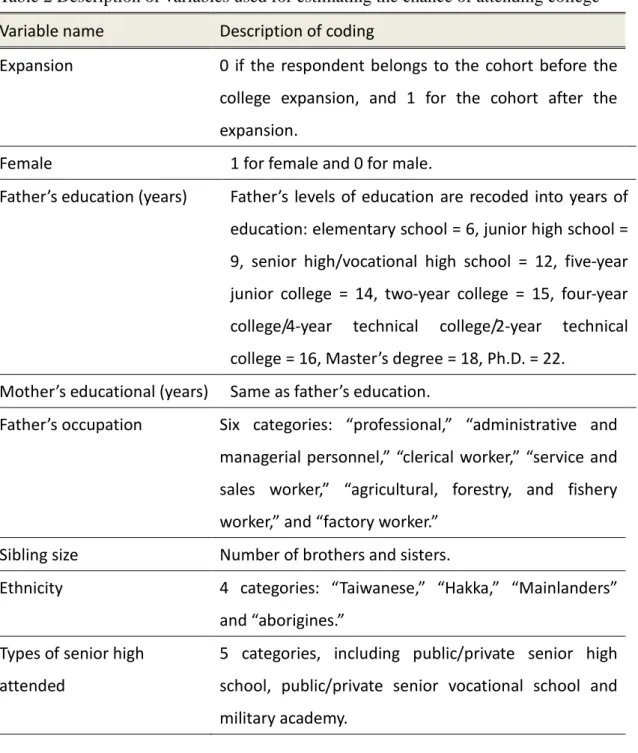
Other than the dummy variable indicating the cohort before and after the expansion of higher education, we use respondent’s gender, indicators of family demographic and socioeconomic background (such as parents’ education, ethnicity, and sibling size), type of high school attended to estimate the chances of going to college. Table 2 presents a summarized description of variables used in estimating the chances of attending college.
[Table 2 is about here]
9
For the estimation of the DID model, we use four outcome variables: monthly income (in NT$) of the first job and the current job as well as the occupational prestige of the first job and the current job. The monthly income is adjusted into the currency value of 2011 and taking the log in the DID analysis. The occupational prestige score is the ISEI (International Socio-Economic Index of occupational status) estimated for respondents’ ISCO-88 (International Standard Classification of Occupations) coding.6
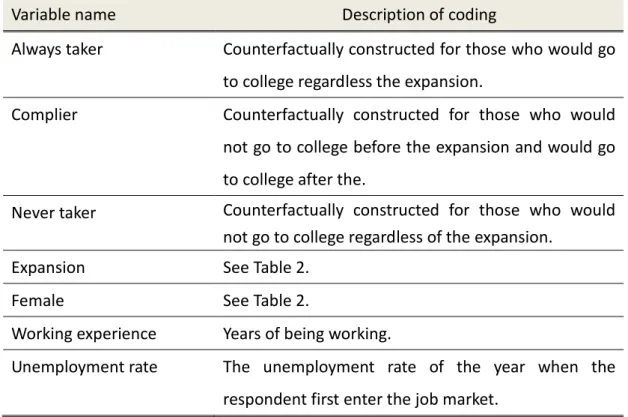
Other than the variables constructed to indicate three types of counterfactual groups based on either simulations or matching, the explanatory variables used in the DID analyses include the dummy variable indicating the college expansion, respondent’s gender, working experience, and unemployment rates of the year when respondents first entering the job market. Table 3 describes variables used in the DID analyses.
[Table 3 is about here]
Findings
The Profile of Counterfactual Groups
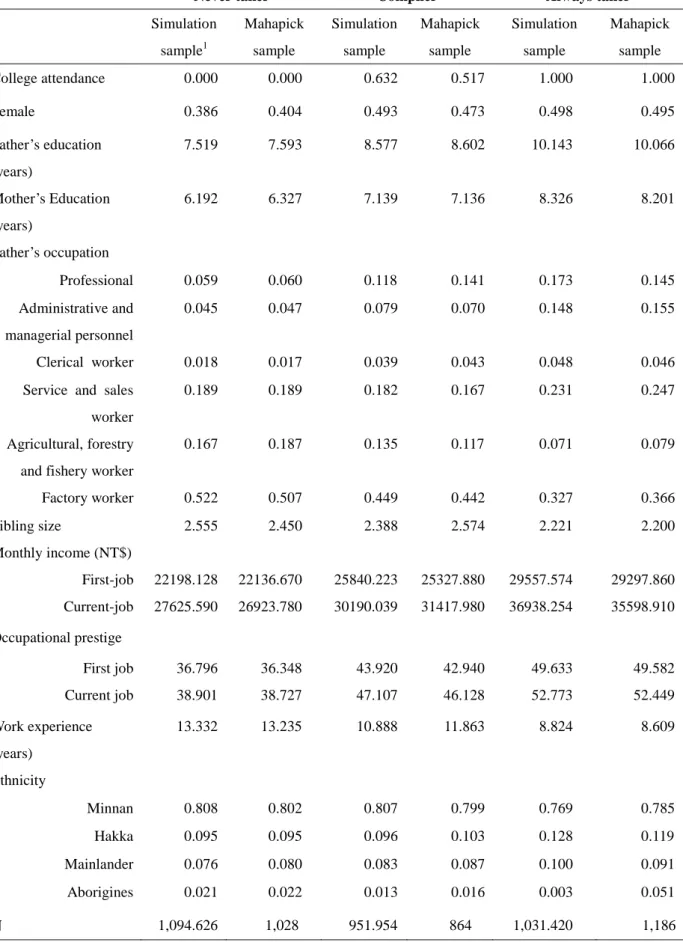
The estimated sample sizes of three counterfactual groups differ in terms of the approaches used in constructing these groups. Table 4 shows that Choi’s simulation method would estimate the size of the never-takers to be around 1,094, which is slightly larger than the size of the always-takers, which is around 1,031. The smallest group is the compliers, which is around 952. The size of the complier group is also the smallest based on the Mahapick matching method, which is 864. The largest group constructed by the Mahapick matching method, however, is the always-taker group, the size of which is 1,186. The size of the never-taker group constructed by the Mahapick matching method is 1,028. Always takes also have smaller average sibling size than that of compliers or never-takers.
[Table 4 is about here]
Table 4 also indicates that no matter which approach is used to construct these three counterfactual groups, always-takers, on average, have the best socioeconomic background in terms of parents’ education and father’s occupation and compliers come in second. As far as gender is concerned, always-takers and compliers have roughly the same percentage of female and male. The percentage of female never-takers, however, is estimated to be around 39% to 40%.
According to Table 4, three counterfactual groups have apparent differences in the grossly estimated monthly income and occupational prestige. No matter which method is used to construct the counterfactual groups, always-takers have the highest average monthly income and occupation prestige in either the first or current job and never takers have the lowest average in these social and economic returns for their first or current jobs.
Main Effects of College Expansion on Earnings and Occupational Prestige
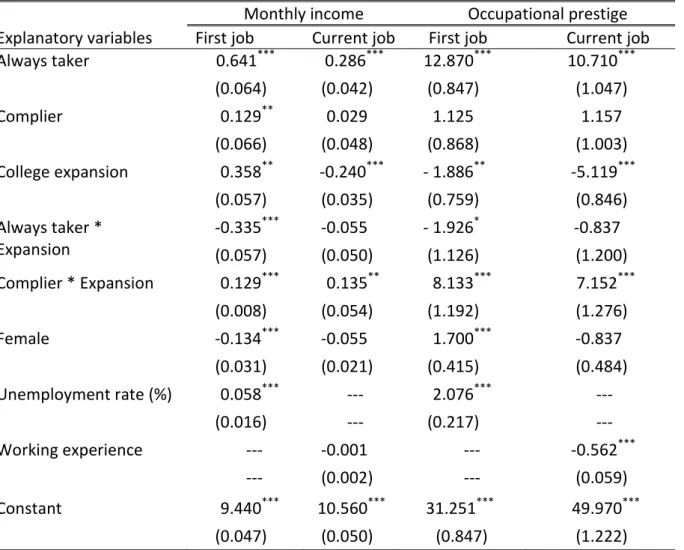
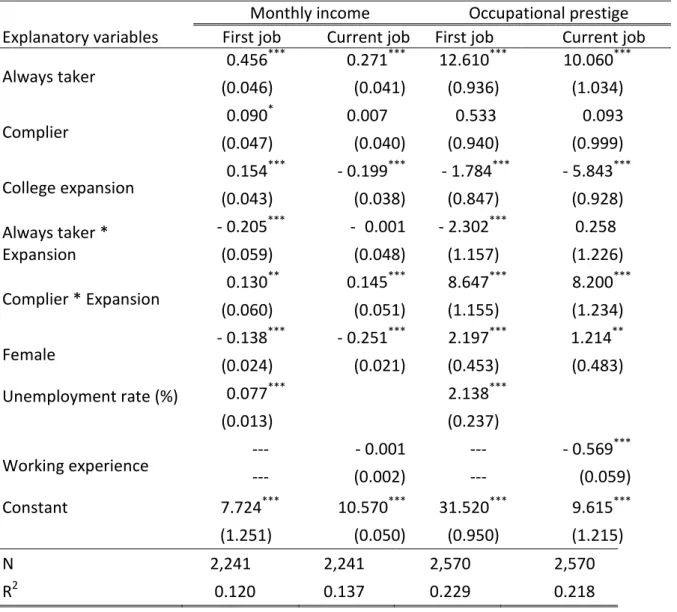
Table 5 and Table 6 show that, no matter which sample is used for the DID analysis, the main effect of college expansion would first increase everyone’s average monthly income of the first job and depress the
10
monthly income of the current job. The sizes of the estimated main effects, however, differ between two different constructed samples. The simulation sample estimates the increase for the first job income to be about 36% and the decrease for the current job to be about 24%. The Mahapick sample gives more moderate estimates. The increase of the first job income is estimated to be about 15% and the decrease of the current job is about 20%.
Both samples also offer similar patterns in the estimation of the main effect of college expansion on occupational prestige. The expansion not only decreases occupational prestige score of the first job but decrease even more the prestige score of the current job. Two samples also offer rather similar estimation about the impact of college expansion on occupational prestige. The estimation of the simulation sample for the decrease in first job occupational prestige is about 1.9 and the estimation of the Mahapick sample is about 1.8. The simulation sample estimates the decrease in the current job is about 5.1 and the Mahapick sample is about 5.8.
Impacts of College Expansion on Compliers’ Earnings and Occupational Prestige
We propose two contrasting hypotheses to test the impact of college expansion on compliers’ earnings and occupational prestige. One hypothesis, H1A, following the argument of the human capital theory and the signaling theory, argues that the college expansion helps compliers to gain more earnings and occupational prestige than what they would get before the expansion, but the positive impact would decline with the increasing working experiences. The other hypothesis, H1B, following the argument of credentialism, proposes that compliers would receive no positive gain from the college expansion. Table 5 and Table 6 presents the findings of the DID model, testing the impacts of higher education expansion on monthly income and occupational prestige of two cohorts of college graduates in Taiwan.
[Table 5 is about here] [Table 6 is about here]
Table 5 and Table 6 show that compliers’ earnings and occupational prestige are lower on average than those of always takers as far as the main effects are concerned. The interaction effects between compliers and college expansion, however, reveals that college expansion brings statistically significant positive effects on compliers’ monthly earnings and occupational prestige of either the first or the current job. Both samples offers very similar estimated increase of the first job income, which is about 14% and the estimated increase in the income of the current job is about 13% to 15%. Both samples also offer similar estimated increase in occupation prestige. The estimated increase for the first job is about 8 to 8.6 and for the current job is about 7 to 8. In short, college expansion does bring positive benefits to compliers’ first job as predicted by H1A. The H1A, however, is not supported since the positive effects remain still for compliers’ current job.
Impacts of College Expansion on Always-takers’ Earnings and Occupational Prestige
We also propose two contrasting hypotheses to test the impact of college expansion on earnings and occupational prestige. One hypothesis, H2A, following the argument of the signaling theory, stipulates that the college expansion will hurt always-takers’ social and economic return as far as their first job is concerned. This negative effect, however, would disappear with increasing work experience and always-takers’ current job should found no negative impact of the expansion.
11
Both Table 5 and Table 6 show that the main effects of always takers, comparing to never takers, enjoy a premium on earnings and occupational prestige. Always takers are estimated to have about at least 46% more in the monthly income of the first job, as estimated by the Mahapick sample, and the premium can be as high as 64% as estimated by the simulation sample. The DID analysis of two samples give quite similar estimated gains of always takers in the monthly income of the current job. The estimation based on the simulation sample is about 29% and the estimation of the Mahapick sample is about 27%. Both samples also give similar estimated premium given to always-takers in their first job and current job occupational prestige. For the first job, the gain in prestige score is about 13. For the current job, the gain is about 10 to 11.
Both Tables also show that the premium of being always takers is somewhat depressed by college expansion. The interaction effects between always takers and college expansion show the return of always takers has decreased after college expansion as far as income and occupational prestige of the first job are concerned. The decrease in first job income estimated by the simulation sample is about 34% and the Mahapick sample estimates the decrease to be about 21%. Both samples estimate the decrease of first job occupational prestige to be about 2 points.
Both Tables further show that always taker’s advantage on income and occupational prestige of the current job is not affected by college expansion. Hence, the negative impact of college expansion on always takers would not last. This pattern of change in either monthly incomes or occupational prestige of always-takers clearly supports H2A.
Conclusion and Discussion
In order to investigate the effect of college expansion on college graduates’ earnings and occupational prestige in Taiwan, we first divide our analytical sample of two cohorts of young people born before and after the expansion of higher education into three different groups, which are always takers, compliers and never takers, based on the counterfactual analytical framework and their propensities of attending college before and after the expansion. We then use two different approaches, simulation and matching, to examine the effects of college expansion. The results of these approaches are quite similar. We found that college expansion does bring positive benefits to compliers’ first job as predicted by H1A, i.e., the college expansion will have positive effects on compliers’ income and occupational prestige of the first job. The H1A prediction that the positive effect would be diminished with increasing work experience, however, is not supported since we found a lasting positive effect of college expansion on compliers’ current job. As to always takers, the pattern of change in either monthly incomes or occupational prestige, clear supports H2A, i.e., the college expansion will have negative influences on first job income and occupational prestige of always takers and this negative effect would disappear through accumulation of work experience. Apparently, the impact of college expansion in Taiwan is to reduce the inequality of income and occupational prestige of always takers, who were more motivated and academically more achieved students in Taiwan, and compliers, who took the chance of college expansion and were able to get college degrees after the expansion.
We believe this study has offered a more convincing analysis of the impact of college expansion on social and economic returns of college degree in Taiwan, it still has its limitations. In the future, we would like
12
to advance our study in several ways. First, since public universities and colleges are in general considered to be more prestigious and favored choices among students and parents, we can differentiate counterfactual groups in our future study. We may also explore in more details the gender differences. Finally, comparing to Choi’s research (2015), college expansion in Taiwan and South Korea seems to have different pattern of impacts. In South Korea, a small insignificant increase for compliers and a comparably slight increase for always takers in income and occupational prestige were found, while in Taiwan, we find a significant increase for compliers and significant decrease for always takers in income and occupational prestige as far as the first job is concerned. Hence, a further questions could be asked is why the general pattern of the impact of college expansion differ between Taiwan and South Korea and what are mechanisms contributing to the difference between these two societies.
13
References
Alon, Sigal. 2009. “The Evolution of Class Inequality in Higher Education: Competition, Exclusion, and Adaptation.” American Sociological Review 72: 478-511.
Beaulieu, Lionel J. and David Mulkey, 1995. “Human Capital in Rural America: A Review of Theoretical Perspectives.” Pp. 3-22 in Investing in People, edited by L. J. Beaulieuand & D. Mulkey. Boulder: Westview Press.
Becker, Gary, 1962. “Investment in Human Capital: A Theoretical Analysis.” Journal of Political Economy 70: 9-49.
Becker, Gary, 1993. Human Capital: A Theoretical and Empirical Analysis, with Special Reference to
Education. Chicago: The University of Chicago Press.
Bills, David. 2003. “Credentials, Signals, and Screens: Explaining the Relationship between Schooling and Job Assignment.” Review of Educational Research 73(4): 441-469.
Bills, David B. and Brown, David K., 2011. “New Directions in Educational Credentialism.” Research in
Social Stratification and Mobility 29: 1–4.
Brand, Jennie E. and Yu Xie. 2010. “Who Benefits Most from College? Evidence for Negative Selection in Heterogeneous Economic Returns to Higher Education.” American Sociological Review 75: 273-302. Breen, R., 2010. Educational Expansion and Social Mobility in the 20th Century. Social Forces 89: 365–388.
Brown, David K., 2001. “The Social Sources of Educational Credentialism: Status Cultures, Labor Markets, and Organizations.” Sociology of Education 74:19–34.
Card, David and Thomas Lemieux, 2001. “Can Falling Supply Explain the Rising Return to College for Younger Men? A Cohort-Based Analysis.” Quarterly Journal of Economics 116: 705-746.
Carneiro, Pedro, James J. Heckman, Edward J. Vytlacil, 2011. “Estimating Marginal Returns to Education.”
American Economic Review 101: 2754–2781.
Choi, Kang-Shik, Jinook Jeong, 2005. “Technological Change and Wage Premium in a Small Open Economy: the Case of Korea.” Applied Economics 37: 119–131.
Choi, Seongsoo, 2015.“When Everyone Goes to College: The Causal Effect of College Expansion on Earnings.” Social Science Research 50: 229-245.
Collins, Randall, 1979. The Credential Society: An Historical Sociology of Education and Stratification. New York, NY: Academic Press.
Gebel, Michael and Friedhelm Pfeiffer, 2010. “Educational Expansion and its Heterogeneous Returns for Wage Workers.” Schmollers Jahrbuch 130 (1): 19–42.
Goldin, Claudia Dale and Lawrence F Katz, 2008. The Race between Education and Technology. Cambridge. MA: Harvard University Press.
Hannum, E., Buchmann, C., 2005. Global Educational Expansion and Socio-Economic Development: An Assessment of Findings from the Social Sciences. World Development 33: 333–354.
Hendrickx, John, 2004. ISKO: Stata module to recode 4 digit ISCO-88 occupational codes. Statistical Software Components, Boston College Department of Economics. Retrieved August 14, 2016 (http://EconPapers.repec.org/RePEc:boc:bocode:s425802).
Hout, Michael, 2012. “Social and Economic Returns to College Education in the United States.” Annual
Review of Sociology 38: 379–400.
14
on a Mahalanobis distance measure. Statistical Software Components, Boston College Department of Economics. Retrieved July 12, 2016 (http://econpapers.repec.org/software/bocbocode/s456703.htm). Katz, Lawrence F. and Kevin M. Murphy, 1992. “Changes in Relative Wages, 1963-1987: Supply and
Demand Factors.” The Quarterly Journal of Economics 107: 35-78.
Lange, F., Topel, R., 2006. “The Social Value of Education and Human Capital.” Pp. 459–509 in Handbook of
the Economics of Education, edited by E. Hanushek & F. Welch. Amsterdam: Elsevier.
Lin, Ching-Yuan and Yun-Peng Chu. 2002. “Intertemporal Changes in Wage Income Inequality in Taiwan: An Application of Factor Analysis”. Acdemia Economic Papers. 30 (3): 341-361. (in Chinese)
Ministry of Education. 2014. The Major Process of Educational Policy Development. (PinYin: zhòng dà jiào
yù zhèng cè fā zhǎn lì chéng). Retrieve July 12, 2016 (http://history.moe.gov.tw/policy.asp?id=7).
Psacharopoulos, George and Harry A. Patrinos, 2004. “Returns to Investment in Education: A Further Update.” Education Economics 12(2): 111–134.
Shavit, Yossi and Hans-Peter Blossfeld (eds.), 1993. Persistent Inequalities: a Comparative Study of
Educational Attainment in Thirteen Countries. Boulder Colorado: Westview Press.
Shavit, Yossi, Richard Arum, Adam Gamoran, and Gila Menahem (eds.), 2007. Stratification in Higher
Education: A Comparative Study. Stanford, CA: Stanford University Press.
Spence, Michael, 1973. “Job Market Signaling.” Quarterly Journal of Economics 87(3): 355–374.
Spence, A. Michael, 1974. Market Signaling: Information Transfer in Hiring and Related Processes. Cambridge, MA: Harvard University Press.
Taber, Christopher R., 2001. “The Rising College Premium in the Eighties: Return to College or Return to Unobserved Ability?” The Review of Economic Studies 68(3): 665–691.
Tsai, Shu-Ling. 2004. “Effects of Higher Education Expansion on Inequality of Educational Opportunity”.
Taiwanese Sociology No.7 p.47-88. (in Chinese)
Tsai, Shu-Ling and Yu Xie, 2008. “Changes in Earnings Returns to Higher Education in Taiwan since the 1990s.” Population Review 47: 1–20.
Tsai, Shu-Ling and Yu Xie, 2011. “Heterogeneity in Returns to College Education: Selection Bias in Contemporary Taiwan.” Social Science Research 40: 796–810.
Walker, Ian and Yu Zhu, 2008. “The College Wage Premium and the Expansion of Higher Education in the UK.” Scandinavian Journal of Economics 110: 695–709.
15
Table 1 The construction of always-takers, compliers, and never takers for the pre-expansion cohort and the post-expansion cohort
Pre-expansion Cohort Post-expansion Cohort
Pre-expansion decision (Actual) Post-expansion decision (Counterfactual) Pre-expansion decision (Counterfactual) Post-expansion decision (Actual) Never-takers Compliers Always-takers
0
1
0
1
1
0
0
1
1
0
16
Table 2 Description of variables used for estimating the chance of attending college
Variable name Description of coding
Expansion 0 if the respondent belongs to the cohort before the
college expansion, and 1 for the cohort after the expansion.
Female 1 for female and 0 for male.
Father’s education (years) Father’s levels of education are recoded into years of education: elementary school = 6, junior high school = 9, senior high/vocational high school = 12, five-year junior college = 14, two-year college = 15, four-year college/4-year technical college/2-year technical college = 16, Master’s degree = 18, Ph.D. = 22.
Mother’s educational (years) Same as father’s education.
Father’s occupation Six categories: “professional,” “administrative and managerial personnel,” “clerical worker,” “service and sales worker,” “agricultural, forestry, and fishery worker,” and “factory worker.”
Sibling size Number of brothers and sisters.
Ethnicity 4 categories: “Taiwanese,” “Hakka,” “Mainlanders”
and “aborigines.” Types of senior high
attended
5 categories, including public/private senior high school, public/private senior vocational school and military academy.
17
Table 3 Description of variables used in estimating the DID model
Variable name Description of coding
Always taker Counterfactually constructed for those who would go to college regardless the expansion.
Complier Counterfactually constructed for those who would
not go to college before the expansion and would go to college after the.
Never taker Counterfactually constructed for those who would
not go to college regardless of the expansion.
Expansion See Table 2.
Female See Table 2.
Working experience Years of being working.
Unemployment rate The unemployment rate of the year when the
18
Table 4 Means of variables used in the analysis
Never taker Complier Always taker
Simulation sample1 Mahapick sample Simulation sample Mahapick sample Simulation sample Mahapick sample College attendance 0.000 0.000 0.632 0.517 1.000 1.000 Female 0.386 0.404 0.493 0.473 0.498 0.495 Father’s education (years) 7.519 7.593 8.577 8.602 10.143 10.066 Mother’s Education (years) 6.192 6.327 7.139 7.136 8.326 8.201 Father’s occupation Professional 0.059 0.060 0.118 0.141 0.173 0.145 Administrative and managerial personnel 0.045 0.047 0.079 0.070 0.148 0.155 Clerical worker 0.018 0.017 0.039 0.043 0.048 0.046 Service and sales
worker
0.189 0.189 0.182 0.167 0.231 0.247 Agricultural, forestry
and fishery worker
0.167 0.187 0.135 0.117 0.071 0.079 Factory worker 0.522 0.507 0.449 0.442 0.327 0.366 Sibling size 2.555 2.450 2.388 2.574 2.221 2.200 Monthly income (NT$) First-job 22198.128 22136.670 25840.223 25327.880 29557.574 29297.860 Current-job 27625.590 26923.780 30190.039 31417.980 36938.254 35598.910 Occupational prestige First job 36.796 36.348 43.920 42.940 49.633 49.582 Current job 38.901 38.727 47.107 46.128 52.773 52.449 Work experience (years) 13.332 13.235 10.888 11.863 8.824 8.609 Ethnicity Minnan 0.808 0.802 0.807 0.799 0.769 0.785 Hakka 0.095 0.095 0.096 0.103 0.128 0.119 Mainlander 0.076 0.080 0.083 0.087 0.100 0.091 Aborigines 0.021 0.022 0.013 0.016 0.003 0.051 N 1,094.626 1,028 951.954 864 1,031.420 1,186
19
Table 5 The DID estimation of the impacts of expansion of higher education on income and occupational prestige of the first and the current job using the simulation sample1
Explanatory variables First job Monthly income Current job First job Occupational prestige Current job
Always taker 0.641*** 0.286*** 12.870*** 10.710*** (0.064) (0.042) (0.847) (1.047) Complier 0.129** 0.029 1.125 1.157 (0.066) (0.048) (0.868) (1.003) College expansion 0.358** -0.240*** - 1.886** -5.119*** (0.057) (0.035) (0.759) (0.846) Always taker * Expansion -0.335 *** -0.055 - 1.926* -0.837 (0.057) (0.050) (1.126) (1.200) Complier * Expansion 0.129*** 0.135** 8.133*** 7.152*** (0.008) (0.054) (1.192) (1.276) Female -0.134*** -0.055 1.700*** -0.837 (0.031) (0.021) (0.415) (0.484) Unemployment rate (%) 0.058*** --- 2.076*** --- (0.016) --- (0.217) --- Working experience --- -0.001 --- -0.562*** --- (0.002) --- (0.059) Constant 9.440*** 10.560*** 31.251*** 49.970*** (0.047) (0.050) (0.847) (1.222)
1. Coefficients and standard errors presented are averages of DID estimations using 500 simulated samples. *** p<0.01, ** p<0.05, * p<0.1
20
Table 6 The DID estimation of the impacts of expansion of higher education on income and occupational prestige of the first and the current job using the Mahapick sample
Explanatory variables First job Monthly income Current job First job Occupational prestige Current job
Always taker 0.456 *** 0.271*** 12.610*** 10.060*** (0.046) (0.041) (0.936) (1.034) Complier 0.090 * 0.007 0.533 0.093 (0.047) (0.040) (0.940) (0.999) College expansion 0.154 *** - 0.199*** - 1.784*** - 5.843*** (0.043) (0.038) (0.847) (0.928) Always taker * Expansion - 0.205*** - 0.001 - 2.302*** 0.258 (0.059) (0.048) (1.157) (1.226) Complier * Expansion 0.130 ** 0.145*** 8.647*** 8.200*** (0.060) (0.051) (1.155) (1.234) Female - 0.138 *** - 0.251*** 2.197*** 1.214** (0.024) (0.021) (0.453) (0.483) Unemployment rate (%) 0.077*** 2.138*** (0.013) (0.237) Working experience --- - 0.001 --- - 0.569 *** --- (0.002) --- (0.059) Constant 7.724*** 10.570*** 31.520*** 9.615*** (1.251) (0.050) (0.950) (1.215) N 2,241 2,241 2,570 2,570 R2 0.120 0.137 0.229 0.218 *** p<0.01, ** p<0.05, * p<0.1
1
科技部補助專題研究計畫出席國際學術會議心得報告
日期:105 年 09 月 25 日
一、參加會議經過
國際社會學會(International Sociological Association,簡稱 ISA)是目前台灣學界少
數仍擁有國家級會員身份,且為在 UNESCO 支持下的國際性學會。國際社會學會的
組織十分龐大,學會之組成方式,除了以國家級學會身份參與外,一般成員參與 ISA
學術性活動的方式,主要是參與由 56 個研究委員會(Research Committees)所舉辦
的國際性學術會議。這些委員會除了以社會學研究領域有實際的名稱外,也慣以簡
稱加編號稱之。本人長期以正式會員身份參與的研究委員會為 Research Committee on
Social Stratification and Mobility,也簡稱為 RC28。RC28 為 ISA 最為活躍之學術社群,
每年舉辦春夏兩次學術會議。
本年(2015)夏季會議由位於美國東岸費城(Philadelphia)的賓州大學(University of
Pennsylvania)舉辦,會議主題為“Demographic Perspectives on Inequality”,賓州大學
為美國屬長春藤聯盟之名校,其社會學系有多位知名社會學者,如知名社會理論家
Randall Collins,以及知名量化研究學者如 Paul Allison 及 Herbert Smith。與社會階層
及教育社會學研究相關之知名學者則有如 Emily Hannum、Grace Kao、Annette
Lareau、Hyunjoon Park 等。此外,該校著名的人口研究中心也與社會系及其他相關
學系一起合作培養研究生。
本次正式會議時間為 8 月 17 日至 8 月 19 日。有意參加此次會議並發表論文者,需
先於半年前投論文摘要,然後經由該會審查選擇入選後,方能參加,並需於正式會
議前提交論文全稿。本人此次經賓州大學社會學系 Hyunjoon Park 教授事先邀請投
稿,以組成與補習效果相關論文的場次,故本次會議投稿論文為 “Peer Effects of Cram
計畫編號
MOST
104-2410-H-004 -109-
計畫名稱
台灣高教擴張對年輕世代職業地位及薪資的影響:反事實的分析
出國人員
姓名
關秉寅
服務機構
及職稱
國立政治大學社會學系副教授
會議時間
2015 年 8 月 17 日至2015 年 8 月 19 日會議地點
美國費城賓州大學
會議名稱
(中文) 國際社會學會 RC28 (社會階層研究委員會)2015 年夏季會議
(英文)
ISA RC28 (Research Committee on Social Stratification) 2015 SummerMeeting
發表題目
(中文) 同儕補習對台灣國中生學習成就的影響
(英文) Peer Effects of Cram Schooling on Academic Achievement of
Junior High Students in Taiwan
2
Schooling on Academic Achievement of Junior High Students in Taiwan”。此論文利用
「台灣教育長期追蹤資料庫」國中生樣本,並以反事實分析方法來探討國中生班級
同儕補習普遍程度對於國中生國三學習成就的影響。本人於會前一日凌晨抵達賓州
費城,並於次日起全程參與正式會議。本人此次除於會議第一天 8 月 17 日的下午發
表論文外,也聆聽多場次之會議論文發表。以下列表簡要說明此次於正式會議期間
出席聆聽及發表之各場次與活動:
日期 時間 場次主題 8/1708:45-10:25 1-1 Immigrant Children’s Education 10.45-12:25 2-1 Access to Higher Education
13:30-14:45 3-3 Educational Stratification in Comparative Perspective
15:05-16:20 4.1 Shadow Education; 發表論文
16:30-18:00 Plenary Session: Linking Demographic Process to Inequality
8/18
08:45-10:25 5-4 School to Work
10.45-12:25 6-3 Returns to Education and Certification 15:20-16:35 8-4 Teachers and Peers
17:00-21:00 Social Events
8/19
08:45-10:25 9-1 Completion of Higher Eduation
10.45-12:25 10-1 Student Performance in Cross-National Comparative Perspective
11:45-13:15 Plenary Session: Interdisciplinary and Comparative Perspective on Inequality
二、與會心得
1、本次參加之第一場次會議之主題為 “Immigrant Children’s Education”。此場次主題
之安排乃為特別追思剛過世之 Pennsylvania State University 之 Pong Suet-ling
(龐雪玲)
教授。龐教授為舊識,為教育社會學知名學者,著作豐富。其配偶 David Post 教授
亦為同校教書之知名比較教育學者,曾擔任比較及國際教育學會(CIES)官方期刊
Comparative Education Review 多年。兩位教授都曾數次訪問台灣,不少台灣相關研
究領域學者均與他們熟識。龐教授也曾指導過數位台灣畢業之學子,並取得碩博士
學位。她因癌症英年早逝,另好友們不勝唏噓。此場次參與者眾,發表之論文均提
及龐教授之相關著作,可見學界對其學術成就之推崇。
2、此次會議有多位台灣赴美於各大學攻讀社會學博士學位之年輕學子參加,其中有
五位曾於政大求學或修過課,本人即曾教授過四位。歷來參與 RC28 會議,常感台灣
對社會階層研究相關領域有興趣者不多,故甚為憂心。此因社會階層研究雖屬社會
學傳統研究領域,但卻是社會學核心領域,有興趣者需有良好之量化研究基礎。見
到這次有多位年輕學子參加會議,自感振奮,希望他們能承續台灣學界此領域之發
展。
3、如同過往,參與此會議主要心得之一是國際學界從事社會階層研究如同軍備競
賽,除要有眾多人才外,還要有充分之研究經費,以便能蒐集大量之資料。此類資
料包括長期追蹤及跨國比較資料,乃至於跨國長期追蹤資料。此類資料蒐集自需政
府能提供足夠經費,也要能適當開放官方統計資料供學界使用。就此方面言,台灣
因國際地位因素,無法加入重要國際組織,故無論是政府或學界之統計無法與國際
同步,進而影響與他國做比較。再者,政府目前對各類統計資料蒐集專業及國際性
3
不足,或對資料開放採較保守態度,也增加社會學界做出可與國際抗衡並有特色之
研究的困難。
三、發表論文全文或摘要
本人此次於 RC28 夏季會議發表之會議論文全文可由國立政治大學機構典藏
(http://nccur.lib.nccu.edu.tw/)搜尋而得。以下僅呈現論文之摘要,以節省篇幅:
Abstract: The present research attempts to assess the impact of student’s own cram
schooling and the prevalence of cram schooling among student’s junior high classmates on
student’s learning achievement in 9th grade. Based on the extant literature on peer effects
in educational research, the prevalence of cram schooling might have either positive or
negative effects on students’ learning achievement. Since both the behavior of
participation in cram schooling and the prevalence of cram schooling are endogenous
variables, it is important to use appropriate statistical methods to analyze observational
data in order to identify the causal effects of these variables. The present study used
multilevel linear model and doubly-robust estimation to assess the causal effects of
student’s own cram schooling and the prevalence of cram schooling among student’s
classmates. The study used data of junior high panel samples gathered by Taiwan
Education Panel Survey (TEPS) in 2001 and 2003 to answer the research question. The
analytical sample is limited to those students who were classmates since 7th grade. The
research found that based on the average treatment effect (ATE) estimated by the
multilevel linear model or by the doubly-robust estimation model, the effect of student’s
own 9th grade cram schooling would increase only about 0.4 point in his/her learning
achievement. The ATE estimate, however, is not significant in the doubly-robust
estimation model. The estimate of the average treatment effect on the treated (ATT) based
on the doubly-robust model indicates statistically significant increase for about 1 point for
students who participated in cram schooling in 9th grade. The research also finds that the
prevalence of cram schooling among student’s classmates in general has no significant
effect of student’s 9th grade learning achievement.
四、建議
無。
五、攜回資料名稱及內容
1、大會議程(紙本)
2、參與會議者可下載會議論文全文,故已下載全部已上傳之論文。
六、其他
無。
科技部補助計畫衍生研發成果推廣資料表
日期:2016/09/25科技部補助計畫
計畫名稱: 台灣高教擴張對年輕世代職業地位及薪資的影響:反事實的分析 計畫主持人: 關秉寅 計畫編號: 104-2410-H-004-109- 學門領域: 社會組織與階層無研發成果推廣資料
104年度專題研究計畫成果彙整表
計畫主持人:關秉寅 計畫編號:104-2410-H-004-109-計畫名稱:台灣高教擴張對年輕世代職業地位及薪資的影響:反事實的分析 成果項目 量化 單位 質化 (說明:各成果項目請附佐證資料或細 項說明,如期刊名稱、年份、卷期、起 訖頁數、證號...等) 國 內 學術性論文 期刊論文 0 篇 研討會論文 1 依據英文會議論文改寫之會議論文將發 表於2016年11月之舉行之台灣社會學會 年會。 專書 0 本 專書論文 0 章 技術報告 0 篇 其他 0 篇 智慧財產權 及成果 專利權 發明專利 申請中 0 件 已獲得 0 新型/設計專利 0 商標權 0 營業秘密 0 積體電路電路布局權 0 著作權 0 品種權 0 其他 0 技術移轉 件數 0 件 收入 0 千元 國 外 學術性論文 期刊論文 0 篇 研討會論文 1 英文會議論文已發表於國際社會學會 RC28於2016年在瑞士伯恩舉辦之夏季會 議。 專書 0 本 專書論文 0 章 技術報告 0 篇 其他 0 篇 智慧財產權 及成果 專利權 發明專利 申請中 0 件 已獲得 0 新型/設計專利 0 商標權 0 營業秘密 0 積體電路電路布局權 0著作權 0 品種權 0 其他 0 技術移轉 件數 0 件 收入 0 千元 參 與 計 畫 人 力 本國籍 大專生 0 人次 碩士生 0 博士生 1 博士生兼任助理參與研究,並列為 2016年RC28夏季會議之英文會議論文第 二作者,獲科技部補助參與該項國際會 議。 博士後研究員 0 專任助理 0 非本國籍 大專生 0 碩士生 0 博士生 0 博士後研究員 0 專任助理 0 其他成果 (無法以量化表達之成果如辦理學術活動 、獲得獎項、重要國際合作、研究成果國 際影響力及其他協助產業技術發展之具體 效益事項等,請以文字敘述填列。)