Design of a Lower-Error Fixed- Width Multiplier for Speech Processing
Application
Lan-Da Van, Shuenn-Shyang Wang*, Shing Tenqchen**, Wu-Shiung Feng, and Bor-Shenn Jeng** Department of Electrical Engineering, Lab 353, National Taiwan University, Taipei, Taiwan, ROC
*Department of Electrical Engineering, Lab 300, Tatung Institute of Technology, Taipei, Taiwan, ROC
*Chunghwa Telecom Telecommunication Labs., 12, Lane 551, Sec. 5, Min-Tsu Rd., Yang-Mei Zien, Tao-Yuan County, Taiwan 326, ROC. E-mail:
ABSTRACT
A lower-error and lower-variance
n
X ?Z multiplier is suitably proposed for VLSI design. Considering next lower significant stage inP,-'
column and useful error-compensation model in the least significant part, and utilizing a near optimized index to classify the error terms are our strategies in order to achieve lower error and variance as compared with previously proposed structure in the subproduct-array of Baugh-Wooley algorithm. This novel structure applied to the fixed-width low- pass digital FIR filter for speech signal processing system has excellent performance in reducing maximum error, average error, and variation of errors as shown in given tables and figures.1. INTRODUCTION
Low error, high speed, and small area multipliers are always the most important hardware processing element for digital signal processing (DSP) applications [ l ] such as MPEG (Moving Picture Experts Group), camera recorders, digital filters, and so on. These multipliers based on Baugh-Wooley algorithm [ 1-21 produce 2n bits output with n-bit multiplier and n-bit multiplicand inputs. However, in practice, one requires n-bit output and truncates n least-significant bits to preserve the n most-significant bits. In this paper, we present an alternative approach to design a lower-error fixed-width 12 X
n
multiplier applying a near optimized index. Thus, we provide a simple solution derived by approaches under considering hardware realization and verified by computer simulation including fullsearch. At last, we successfully apply above structures to the fixed-width low-pass FIR filter for speech processing [3].
2. DESIGN OF A FIXED-WIDTH MULTIPLIER
Considering two 2's complement integer operands, an n-bit multiplicand and an n-bit multiplier, can be represented by
n-2
A = -
un-'2"-'
+
c u i
2'
i=O
n.7
j=O
The product
P
can be usually written asP = A x B
n - 2 n-2 =an-lb,-l
22n-2+
y,y,uibj
2'+J n-2+
2"-'(-2"-1+
C U n - , b j 2 '+
1)+
j=O n - 2+
2"-'
(-2n-1
+
z b n - , u i
2'
+
1).
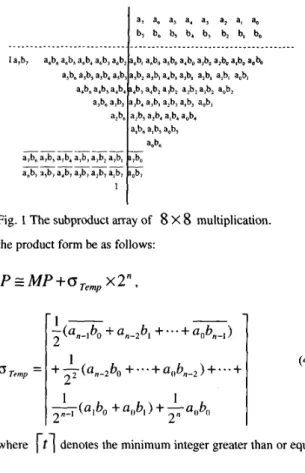
(3) i=OEq. (3) is a Baugh-Wooley array multiplier in which combining partial products with the same weighting factor and placing them in the same column. The algorithm yields the subproduct array as shown in Fig. 1 for
8
X8
multiplication.In 1997, Jou and Kuang (J-K) [l] provided another way to improve the error compensation. However, they solely improve error but not discuss the model of error compensation and the choice of index, so it is our motivation to improve them. Let
0-7803-5471 -0/99/$10.0001999 IEEE
' I
Fig. 1 The subproduct array of
8
X8
multiplication. the product form be as follows:(4)
1
pT@IbO
+ ~ l l ~ l ) + ~ ~ l l ~ l l 2I 1
where [ t i denotes the minimum integer greater than or equal to
t
, CJ Ten,p is the temporary error-compensation term. Because the variation of the error-compensation terms depends on input signals, we use index to classify the error-compensation terms for hardware realization.According to index definition as shown below:
(3in,,urA
<an-,bl,
>'"-I+
<
q 2 b I >9n-2+...+
< a,,b,,-,
>qo ( 5 ) whereqo,ql,
..., andqn-,
have only two binary values in which 1 and 0 represent the complement of product and the original product without complement, respectively. ThenCJ
Tempcan be rewritten as
Equation (6) is our first proposed error-compensation model depending on the choice of index. Of course, user can design many kinds of fixed-width multipliers after statistical calculations. We assume the input bits have uniform distribution and then obtain the expected value of
-Eremain
to replace-Eremoin
.
Writing it as following:
1
1
2
2
1 2 E ( - Errmain ) = 1 x Pb{a, bj = 1 I i+
j < n - 1)Based on full search, we can obtain a near optimized index as:
- -
'propose = an-1'0 +
a,',-,+
Cai'j ( 9 )( i + j) = n - 1 , i= j#n-1
Fig. 2 shows that applying the new index has lower variance of compensation than applying J-Ks' index.
Fig. 2. The comparison results of variation of
p
between J-Ks'index and proposed index.
Also, we estimate the first four terms in Eq. (7) based on a near optimized index as
where
1
2
E{
p)
= 1 x C P b { a b = 1 Iab
E P"_,1
+
E{--Emai" )Substituting Eqs. (8), (10) into Eq. (6) and considering the hardware realization, we obtain a new error-compensation term as
Multiplier n=4
Kidambi’s 6.96
J-K’s Structure 7.20
Proposed 5.17
According to Eq. ( l l ) , Fig. 3 is a lower error 8x8
multiplier in which error-compensation circuit is a series of AND-AND gates and three NAND gates.
a 7 a6 a5 a4 a3 a2 a1 a0 n=8 n=10 n=12 188.29 906.40 3842.06 170.46 736.62 3065.25 105.96 456.14 1907.36 bl
B ’ ~ ,
,‘
b 2 ‘*FA A A i .....I
... _1 *. Multiplier n=4 n=8 n=10 n=12 Kidambi’ s 1 2717 60970 1570086 J-K’sStructure 0 2 1435 78445-
Proposed Structure 0 0 8 2254 b3w,
,
ND-ND c e l l A.A C e l l il Multiplier- ~ Kidambi’s Structure J-K’sStructure Proposed Structure b4 b 5 b6 b 7 Y-..P15 P14 P13 PI2 PI1 PI0 P9 P 8
Fig. 3 The proposed lower error 8 x 8 multiplier.
Utilizing our structure, the maximum error listed in Table 1
can be reduced, and the average error shown in Table 2 obviously decreases compared to Kidambi’s and J-Ks’ structure. Here, the average error is the sum of the absolute value of error divided by the number of errors. In physical meaning, Table 3 indicates the variation of errors. Especially for 8 x 8 multiplication, our
structure restricts that the maximum error is less than 512, i.e., it guarantees that maximum error doesn’t extend to IO-th significant bit.
Table 1 : Comparison results of maximum error
~~~ ~~
n=4 n=8 n=10 n=12
33 1281 6145 32769
21 515 2403 10979
17 441 2105 9785
Table 2: Comparison results of average error
Table 3: Comparison results of the number of errors greater than
2 n + 1
3. APPLICATION OF FIR FILTER FOR SPEECH
PROCESSING APPLICATION
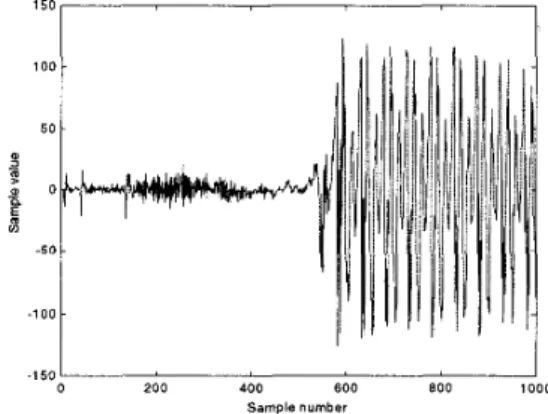
In this section, we apply a new multiplier to the fixed-width 35-tap digital FIR filter [3]. For the consideration of best performance, the maximum coefficient in the FIR filter is normalized to 127 and represented in two’s complement. The maximum input speech data is normalized to a maximum integer using 8 bits, that is, its value is 127. The coefficients of 35-point lowpass filter can be found in [3] and voice data, pronounced with “Chicken”, are given by 1000 samples as shown in Fig. 4. We use no loss accumulation as standard output as shown in Fig. 5. Using constant bias method [2], Fig. 6 shows much larger variance in consonant part. According to J-Ks’ method, it shows better performance in Fig 7 than that in Fig. 6. But as compared to standard output, we find that the output signals in Fig. 7 still have large variance. The smaller variance of the output signals as shown in Fig. 8 is obtained by using a near optimized index especially for consonant part.
I
0 200 400 600 800 1000
-150l
Sample number
Fig.
4.
Original input voice signal.200 400 600 800 1000
Sample number
FigS. Standard filtering output signals without loss.
I 0 200 400 6 0 0 800 1000
Sample number
Fig. 6. Output signals using Kidambi’s structure.
200 400 600 BOO 1000
Sample number
Fig. 7. Output signals using J-Ks’ structure.
0 200 400 600 800 1000
“I
Sample number
Fig. 8. Output signals using proposed structure
4. CONCLUSIONS
A 2’s-complement lower-error fixed-width multiplier that receives two n-bit numbers and produces an n -bit product, has been developed. Our paper proposes an efficient error compensation model in hardware for VLSI design. Based on this model, one can easily design any fixed-width multiplier after statistic calculation Also, we provide a better index choice to allow the error compensation to be near optimized. This novel structure to fixed-width digital FIR filter for speech signal processing has shown with excellent performance in maximum error, average error, and variance compared with the performance of Kidambi’s and J-Ks’ structures.
References:
[ I ] J. M. Jou, and S. R. Kuang, ‘Design of low-error fixed-width multiplier for DSP applications’, Electron. Lett., 1997, 33, (19), pp. 1597-1598
[2] S. S. Kidambi, F. EL-Guibaly, and A. Antoniou, ‘Area- efficient multipliers for digital signal processing applications’, IEEE Trans. Circuits Syst. II, 43, (2), pp. 90- 94, 1996
[3] M. E. Paul, and K. Bruce, C Language Algorithms for Digital Signal Processing. Englewood Cliffs, NJ: Prentice-Hall,
1991.