Ž .
Materials Letters 53 2002 155–159
www.elsevier.comrlocatermatlet
Microwave-assisted solution synthesis of SnO nanocrystallites
Dien-Shi Wu
a, Chih-Yu Han
a, Shi-Yu Wang
a, Nae-Lih Wu
a,), I.A. Rusakova
ba
Department of Chemical Engineering, National Taiwan UniÕersity, Taipei 106, Taiwan, ROC
b
Texas Center for SuperconductiÕity at the UniÕersity of Houston, Houston, TX 77204-5932, USA
Received 30 March 2001; accepted 9 April 2001
Abstract
High-purity powders of SnO nanocrystallites with crystallite sizes less than 30 nm and surface areas up to 40 m2rg have
been synthesized by a solution process, in which amorphous oxy–hydroxy precipitate of Snq2 is crystallized with
microwave heating. Microwave heating was found to have selectively accelerated SnO crystallization but not the concurrent Snq2-to-Snq4oxidation, which otherwise prevails in the conventional thermal heating process. Control studies give strong
indication of a non-temperature effect of the microwave irradiation in the present process. q 2002 Elsevier Science B.V. All rights reserved.
PACS: 81.05.Je; 81.07.-b; 81.20.Fw
Keywords: Tin oxide; Microwave heating; Nanocrystallites; Lithium secondary battery
1. Introduction
SnO has been recognized as a potential anode
w x
material for the lithium-ion secondary battery 1–6 . During the first charging step, Li ions react with SnO according to the following reaction:
6.4ey q6.4Liq qSnO ™ Li O q Li Sn . Ž s . 2 Žs . 4 .4 Ž s . 1
Ž .
The reversible anode half-cell reaction during subse-quent discharging–charging cycles is expressed as:
Li Sn l 4.4ey
q4.4Liq
qSn .
Ž .
24 .4 Ž s . Žs .
Ž .
The irreversible product Li O formed in reaction 12 helps to stabilize the anode structure by establishing
w x
a stable matrix 3 . The advantage, however, would
)
Corresponding author.
be counteracted by unnecessary excessive Li ion loss when SnO , rather than SnO, is used. As a result,2 one of the objects in synthesizing SnO powder for this application is to minimize oxidation of Snq2
, which otherwise leads to the formation of SnO .2
Furthermore, the practical charge capacity is known to depend heavily on the crystallite microstructural
w x
properties 3–6 . A smaller crystallite size, and hence a greater surface area, for example, has been shown facilitate the solid-state redox reactions, giving a
w x
higher practical reversible capacity 6 .
The low-temperature characteristic of the solution synthesis technique is particularly attractive for pro-ducing metal sub-oxides materials, which are mostly metastable at ambient oxygen pressure. We have previously developed a process in which SnO sub-micron crystallites with a size of ; 0.2 mm were synthesized via hydrothermal crystallization of amor-phous oxy–hydroxy precipitate obtained in an
aque-Ž . w x
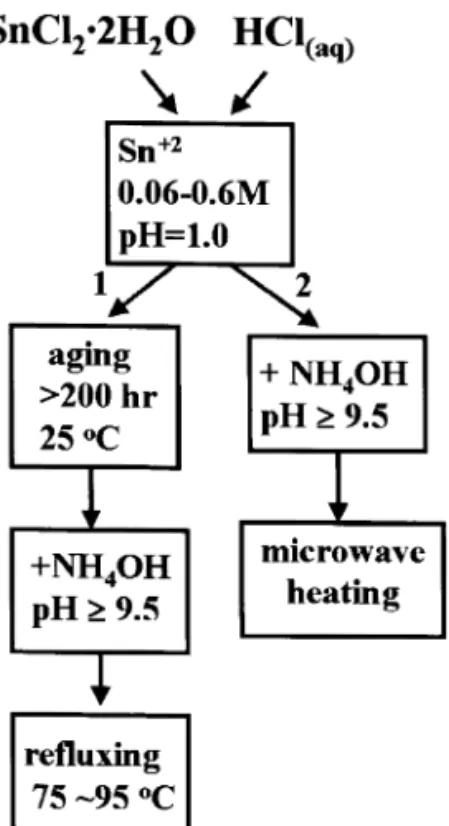
ous SnCl solution route 1 in Fig. 1 7 . It was then2
00167-577Xr02r$ - see front matter q 2002 Elsevier Science B.V. All rights reserved.
Ž .
Fig. 1. Experimental procedures for two adopted crystallization
Ž .
processes that employ the conventional thermal heating route 1
Ž .
and microwave heating route 2 methods, respectively.
found that during crystallization between 75 and 95
8C, oxidation of Snq2
to Snq4
took place simultane-ously, leading to the formation of SnO2 impurity. The oxidation rate was, nevertheless, effectively
sup-Ž .
pressed by adopting a prolonged ) 200 h solution aging prior to the final crystallization step. The stability of Snq2
against oxidation appeared to in-crease as the aquo–hydroxo complexes of Snq2
con-dense to form longer chains of oxy–hydroxy
col-w x
loidal polymers during aging 7 . The required long aging time, however, may not be practical.
Instead of reducing the oxidation rate, the other means to increase SnO selectivity is apparently to increase the SnO crystallization rate. Successful ex-amples of applying microwave heating in
accelerat-w x
ing solution crystallization of zeolites 8–12 have prompted us to employ the same heating technique in the present process. As demonstrated in this work, microwave heating has indeed resulted in a much greater SnO crystallization rate, but not the oxidation rate, than in the conventional heating process even at the same average temperature. As a result, SnO
crystallizes prior to oxidation, and the prolonged aging step is no longer necessary for reducing SnO2
impurity. Furthermore, the fast crystallization rate allows for formation of nanocrystallites with large surface areas. Control studies give strong indications of a non-temperature effect by the microwave irradi-ation.
2. Experimental
Ž .
The entire solution process route 2 in Fig. 1 consists of the following procedures. A reaction
w 2qx
solution containing 0.06 M Sn with pH ; 1.0 was prepared by dissolving SnCl P 2H O2 2 Žs. in an aqueous HCl solution. Ammonia was immediately introduced into the solution to produce a white cipitate until the solution pH reached 9.5. The pre-cipitate-containing solution in 200-ml capacity was heated in a household type microwave oven that has a wave frequency of 2.45 GHz and delivers a power level of 640 W. The product powder was collected either by completely drying the solution in mi-crowave oven or by filtration.
Powder composition was characterized by X-ray
Ž .
diffraction XRD; MAC M03XHF . Transmission
Ž .
electron microscopy TEM analysis was carried out on a Joel 2000 FX electron microscope, which oper-ates at 200 kV and is equipped with Energy
Disper-Ž .
sive Analysis of X-ray EDX analyzer. The samples were prepared by crushing and small particles were
Ž .
dispersed on a holey carbon film Cu grid . Surface area was determined by nitrogen adsorption
mea-Ž .
surement Micrometrics ASAP-2000 .
3. Results and discussion
The macroscopic change of the solution during microwave heating was followed by interruptions at a 1-min heating interval. The observation time was limited to a few seconds. It was found that the solution reached its boiling temperature within 1–2 min and a small portion of the precipitate turned orange after totally 7 min of heating. The precipitate became completely brown after 10 min of heating, and the supernatant solution was clear. At this mo-ment, the solution had only one-half of the initial
Fig. 2. XRD patterns for product powders via different solution
Ž . Ž .
crystallization processes. 1 and 2 are for powders subjected to
Ž . Ž .
microwave heating route 2 for 10 and 15 min, respectively. 3
Ž .
and 4 show typical powder compositions via thermal heating at
Ž .
75–90 8C for 1 h route 1 with and without aging of 240 h,
Ž .
respectively. 5 is for powder obtained in a control study where
Ž .
the solution is boiled ;95 8C by thermal heating for 10 min.
volume left due to evaporation. With continuous heating, the precipitate turned darker, and finally became black as the solution was dried out after 15
Ž
min. Precaution should be taken toward the com-plete dryness, because, as described later, the tem-perature of dry SnO powder rises rapidly under
.
microwave irradiation. When the brown precipitate obtained after 10 min of heating was filtered and dried at room temperature, it turned dark brown.
Ex-situ measurement showed that the solution has an initial boiling point of 90 8C. As the solvent evaporated, the boiling point gradually increased to 95 8C, and then became rather constant up to two-thirds of the evaporated solution.
Fig. 2 shows the XRD patterns of the 10- and 15-min microwaved powders. Both powders were
w x
found to contain predominantly tetragonal SnO 13 . For comparison, Fig. 2 also shows the XRD patterns of the powders that are typically obtained by thermal heating, i.e., via route 1 in Fig. 1. The effect of microwave heating is drastic. The SnO content can be quantitatively determined by using the Si internal standard in XRD measurements, as described in our
w x Ž
previous study 7 . A nearly 95% purity curve 2,
.
Fig. 2 was achieved in the present process for as short as 15 min of microwave irradiation without the need of solution aging. This is in great contrast with
an SnO content of 75% via route 1 under the condi-tions of 720 h of aging plus thermal heating at
w x
75–90 8C for 1 h 7 .
Nitrogen adsorption measurements showed spe-cific surface areas of 44 and 36 m2rg for the 10- and
15-min microwaved powders, respectively. They correspond to surface-weighted crystallite sizes of 25 and 30 nm, respectively, for non-agglomerated crys-tallites. The true crystallite sizes are expected to be smaller because these crystallites are in fact
agglom-Ž .
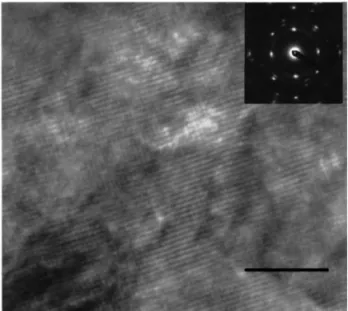
erated. High-resolution TEM Fig. 3 revealed severely defected structures, such as twins, devia-tions of planes, and voids, within the crystallites, which are presumably the consequences of fast crys-tallization rate.
In a control study, a reaction solution of 20 ml was subjected to thermal heating on a hot-stage set at 250 8C. The solution was heated to its boiling point in ; 1.5 min and showed loss of one-half of the solution in 10 min, similar to the case of the mi-crowave heating process for a 200-ml sample size. After 10 min of heating, the precipitate remained
Ž .
white and, as revealed by XRD curve 5, Fig. 2 , was mostly amorphous except for a minute amount of SnO .2
Fig. 3. TEM micrograph showing severely defected structures, such as twins and voids, within SnO nanocrystallites synthesized
Ž
by microwave-assisted solution synthesis the scale bar marks a
.
length of 5 nm . The inset shows the corresponding diffraction pattern.
Study using microwave heating on dry powders indicates that SnO absorbs microwave much stronger than SnO . By inserting a thermocouple into the2
powders immediately after 30 s of microwave irradi-ation, 10 g of SnO powder in Al O crucible showed2 3 a temperature of ; 170 8C, while SnO showed only2 50 8C. In another control study, it was found that introducing already formed SnO crystallites into the reactant solution did not significantly affect the crys-tallization process, other than shortening the time for reaching the boiling temperature from 2 to 1 min. The macroscopic evolution process described earlier for the solution during the course of microwave heating remained about the same, irrespective of being with or without pre-introduction of SnO crys-tallites.
w x
Slangen et al. 11 , in their study on synthesis of zeolite NaA, have suggested that the microwave-accelerated zeolite crystallization is most likely caused by inhomogeneous heating and superheating, which overall cause higher temperature than in ther-mal heating. However, these two causes fail to ac-count for what were observed in the present process. As described earlier, in the control study of thermal
Ž .
heating with a smaller 20 ml sample size, the
Ž .
heating temperature 250 8C was selected to give approximately the same power input into unit vol-ume of the solution as in microwave heating. Fur-thermore, the solutions were constantly heated at their boiling temperatures with self-sustained vigor-ous agitation. The temperature distributions in both cases are expected to be rather uniform, and there is no concern of possible difference in their tempera-tures. Yet, the microwave heating process produced SnO crystallite, while the thermally heated precipi-tate remained amorphous.
Local hot spots could occur at the surfaces of SnO crystallites because of its strong absorption of mi-crowave. However, the experiments with pre-intro-duction of SnO crystallites into the starting solution did not show significant effect on the crystallization, nor have we observed sign of autocatalytic effect,
w x
which was suggested by Chatakondu et al. 9 in
Ž .
their synthesis of VO PO P 2H O. In fact, both the4 2
oxidation and crystallization are thermally activated reactions, and therefore, a ApureB thermal effect would have accelerated both reactions. The present results, however, have shown rate enhancement only
in crystallization but not in oxidation. That is, the microwave-heated powders, which showed 95% SnO phase purity, have a less absolute amount of SnO2
than in any of the thermally heated powders. In view of the results described above, we tend to believe that the microwave-accelerated SnO crystal-lization in the present study is a non-temperature effect, and that the enhancement is more likely due to the coupling of microwave energy with certain reactive sites associated with the reactants andror intermediate structures. Being the nature of this kind, the coupling would be reaction-selective.
Identifica-Ž .
tion of thisrthese absorption site s is, however, difficult.
Crystallization of oxide from an amorphous oxy–hydroxy precursor consists of consecutive steps of dehydroxylation and oxolation reactions, nucle-ation, and nuclei growth. We noted that in a simpler system involving drying of silica gel, Rodrigues and
w x
Wilkes 14 observed accelerated gelation rate. The rate enhancement was attributed to the coupling be-tween the microwave and the hydroxyls, which are the principle reactive sites and are strongly dipolar. The possibility of similar enhancement mechanism in the present crystallization process cannot be ruled
w x
out 15 . Indeed, enhanced dehydroxylation and oxo-lation would produce a higher degree of supersatu-ration for nucleation, which in turn results in an increase in nuclei, and hence, a smaller average crystallite size. This is also consistent with our find-ings.
In summary, adopting microwave heating in the solution crystallization of SnO was found not only to selectively accelerate crystallization rate against oxi-dation of Snq2
but also to facilitate the formation of nano-scaled crystallites. Both effects have been at-tributed to the coupling of microwave energy with the reactions involved in the crystallization process.
Acknowledgements
This work was supported by National Science Council under Contract No. NSC88-2218-E-002-025. The TEM work was supported by the State of Texas through funding for the Texas Center for Supercon-ductivity at the University of Houston.
References
w x1 Y. Idota, A. Matsufuji, Y. Maekawa, T. Miyasaka, Science
Ž .
276 1997 1395.
w x2 J. Wang, I.D. Raistrick, R.A. Huggins, J. Electrochem. Soc.
Ž .
133 1986 457.
w x3 I.A. Courtney, J.R. Dahn, J. Electrochem. Soc. 144 1997Ž .
2045.
w x4 I.A. Courtney, J.R. Dahn, J. Electrochem. Soc. 144 1997Ž .
2943.
w x5 J.S. Sakamoto, C.K. Huang, S. Surampudi, M. Smart, J.
Ž .
Wolfenstine, Mater. Lett. 33 1998 327.
w x6 J. Wolfenstine, J.S. Sakamoto, C.K. Huang, J. Power Sources
Ž .
75 1998 181.
w x7 D.S. Wu, N.L. Wu, J. Mater. Res. 15 2000 1445.Ž .
w x8 P. Chu, F.G. Dwyer, J.C. Vartuli, US Patent a4,778,666 Ž1988 ..
w x9 K. Chatakondu, M.L.H. Green, D. Michael, P. Mingos, S.M.
Ž .
Reynolds, J. Chem. Soc., Chem. Commun. 1989 1515.
w10 C. Wu, T. Bein, J. Chem. Soc., Chem. Commun. 1996 925.x Ž . w11 P.M. Slangen, J.C. Jensen, H. van Bekkum, Microporousx
Ž .
Mater. 9 1997 259.
w12 S. Mintova, S. Mo, T. Bei, Chem. Mater. 10 1998 4030.x Ž . w13 International Center for Diffraction Data, PDF a6-395.x w14 D.E. Rodrigues, G.L. Wilkes, in: W.B. Snyder Jr., W.H.x
Ž .
Sutton, M.F. Iskander, D.L. Johnson Eds. , Microwave pro-cessing of materials. Mater. Res. Soc. Symp. Proc., vol. 189, 1991, p. 441, Pittsburgh, PA.
w15 N.L. Wu, L.F. Wu, I.A. Rusakova, A. Hamed, A.P.x
Ž .