A Tunable and Stabilized Single-Frequency Fiber Ring Laser Based on
Hybrid Amplifier and Shorter Length EDF with Unpumped Status
Chien-Hung Yeh*
a, Kuo-Pao Fan
a, Sien Chi
b, ca
Transmission System Dept., Computer & Communications Research Laboratories,
Industrial Technology Research Institute, Rm. 143, Bldg. 14, 195, Sec. 4, Chung Hsing Rd.,
Chutung, Hsinchu 310, Taiwan, R.O.C
b
Department of Photonics & Institute of Electro-Optical Engineering,
National Chiao Tung University, Hsinchu 310, Taiwan, R.O.C.
c
Department of Electrical Engineering, Yuan Ze University, Chung-Li 320, Taiwan, R.O.C.
ABSTRACT
A novel fiber ring laser technique, which covers both C- and L-bands, with the function of wavelength tunability and single-longitudinal-mode oscillation, is proposed and demonstrated experimentally. We propose a two-stage hybrid amplifier, which consists of a semiconductor optical amplifier (SOA) and an erbium-doped fiber amplifier (EDFA) with cascade configuration, for the gain profile to achieve C- to L-band (1540 to 1610 nm). A saturated-absorber-based autotracking filter, which composes of an unpumped erbium-doped fiber (EDF) and an optical reflected mirror (ORM), is employed to provide fine mode restriction and guarantee the single-frequency operation. The unpumped EDF must use shorter length to retrieve the stabilized single-frequency operation while the EDF length is between 0.5 to 1 m long. The effectively operation range is from 1542 to 1618 nm. The maximal output power of 5.7 dBm is retrieved at near 1577 nm, and the output power will drop to 3.7 and –0.32 dBm at 1604 and 1616 nm, respectively. The SMSR can be up to 53.2 dB/ 0.05 nm at around 1577 nm. The performance of output power of > 2.1 dBm, power stability of ≤ 0.02 dB, wavelength variation of ≤ 0.01 nm and side-mode suppression ratio (SMSR) of > 31 dB / 0.05 nm has been demonstrated for this single-frequency fiber laser over the wavelength range of 1550 to 1608 nm. The linewidth (RF) spectrum of the proposed structure has also been studied.
Keywords: single-frequency, EDFA, SOA, fiber ring laser, L-band 1. INTRODUCTION
Stable and wavelength-tunable fiber lasers are the major optical devices in wavelength division multiplexing (WDM) networks and sensor systems. Therefore, single-longitudinal-mode (SLM) operation in erbium-doped fiber (EDF) ring lasers is becoming all the more necessary. Conventionally, a fiber Fabry-Perot tunable filter (FFP-TF) can be provided wavelength tuning for the fiber ring laser. However, it is insufficient to stabilize the lasing wavelength and power in the traditional fiber ring laser. Recently, several techniques with the stable single-frequency operation have been studied, such as using a passive multiple-ring cavity or a compound ring resonator composed of a dual-coupler fiber ring (DCFR) to guarantee the SLM laser oscillation, 1-3 integrating two cascaded FFP-TF of wide different free spectral ranges (FSRs) into cavity to provide a full tunability and a SLM operation, 4, 5 adding an extra ITU-grid periodic filter in the optical loop, 6 using an unpumped EDF inside a ring cavity as a narrow bandwidth autotracking filter. 7, 8 Because of the bandwidth limitation of the conventional erbium-doped fiber (EDFs), the effective operation regions of the C- (1530–1560 nm) 3 or C- plus L-bands (1540–1610 nm) 10 for the EDF-based ring lasers have been reported. Moreover, a
novel S-band EDFA technique, which operated at the wavelength range of 1480 to 1520 nm, has also been studied. 11 To provide the stable and tunable single-frequency fiber ring laser covering both C- and L-bands, we experimentally demonstrate the fiber laser based on a two-stage hybrid amplifier module and a saturable-absorber-based autotracking filter. The proposed hybrid amplifier module consists of a semiconductor optical amplifier (SOA) and an erbium-doped fiber amplifier (EDFA). A saturable-absorber-based autotracking filter composes of a shorter length unpumped EDF and an optical reflected mirror (ORM) inside the ring cavity. The behavior of the output power and wavelength stabilities, tuning range, side-mode suppression ratio (SMSR), and linewidth spectrum has also been studied.
2. EXPERIMENTAL SETUP
Experimental setup of the proposed C- plus L-bands fiber ring laser with stabilized single-frequency operation is illustrated in Fig. 1. This apparatus comprises a two-stage hybrid amplifier module, a 1×2 and 90:10 optical coupler (C), a fiber Fabry-Perot tunable filter (FFP-TF), an optical circulator (OC), a polarization controller (PC), an unpumped EDF, and an ORM. In the hybrid amplifier, the first SOA stage is operated at 250 mW bias current. And the second EDFA stage composes of a high-concentration 18-m-long EDF (High Wave-742), a 1550/980 nm WDM coupler (W), an optical isolator and a 980 nm pump laser, as shown in Fig. 1. The 3 dB bandwidth and a threshold current of the SOA are 40 nm and 50 mA. The operation bias current region of SOA is between 50 to 250 mA. The saturated power of the SOA (250 mA bias current) can be gained to 15.1 dBm at 1562 nm when the input signal is 0 dBm. Actually, the optical output of the SOA is used to pump the second EDFA stage and also extend the operation bandwidth from C- to L-band. Therefore, we employ a SOA and an EDFA can achieve the broadband operation range covering both C- and L-bands.
980 nm Pump Laser W Isolator EDF Hybrid Amplifier SOA FFP Filter PC Output ORM Unpumped EDF C 90 10 1 2 3
Figure 1. Experimental setup for the proposed stable and wavelength-tunable single-frequency fiber ring laser.
The FFP-TF (Micron Optics) is a specialized tunable filter based on Fabry-Perot etalon technology. The filter passes wavelengths that are equal to integer fractions of the cavity (etalon) length; all other wavelengths are attenuated according to the Airy function. Low loss, high isolation and accurate power or wavelength measurements are just a few of the characteristics resulting from an ideal Airy function. The key to the elegant design of the FFP-TF is the lensless fiber construction. There are no collimating optics or lenses, thus the filter achieves high finesse and maintains low loss and transmission profile. This design makes the FFP-TF a critical component to a broad range of applications. The filter has the characteristic of widely tunable range, low insertion loss of < 0.5 dB, polarization-dependent loss (PDL) of ~ 0.1 dB, and 3 dB bandwidth of 0.4 nm. The FFP-TF with a free spectral range (FSR) of 80 nm and a finesse of 200 can be used to provide the wavelength selection, when the different external voltages (from 0 to 12 V) applied on the piezoelectric transducer (PZT) of the FFP-TF. Single-longitudinal-mode oscillation can be realized by employing a FFP-TF and a saturated-absorber-based autotracking filter inside the ring cavity. 7, 8 The saturated-absorber-based
autotracking filter consists of a shorter length of unpumped EDF and an ORM. The unpumped EDF can be acted as a saturated absorber. The fiber type ORM by the coating technique on the end is produced commercially and the ORM has 99 % reflectivity. The ORM will reflect propagating lightwave to interfere spatially the original propagating wavelength in the saturated absorber. As a result, the spatial hole burning (SHB) effect is created in the saturated absorber and narrow-band filtering is presented. 7 By using this saturated-absorber-based autotracking filter and the FFP-TF, this proposed broadband fiber laser would provide the stable and tunable single-frequency output.
Wavelength (nm)
1500 1520 1540 1560 1580 1600 1620 1640Po
w
er
(
d
B
m
)
-50 -40 -30 -20 -10 Hybrid Amplifier SOA EDFAFigure 2(a). Optical spectra of the ASE for the hybrid amplifier, first SOA stage and second EDFA stage, respectively.
-65 -50 -35 -20 -5 10 0 2 4 6 8 10 1560 1580 1600 1620
O
ut
pu
t P
ow
er
(
dB
m
)
Vol
tage
(V
)
Wa
vel
eng
th
(nm
)
Figure 2(b). Output spectra of this proposed fiber laser over the wavelengths from 1542 to 1618 nm when a 1.5-m-long unpumped EDF is used.
In addition, an optical spectrum analyzer (OSA) and a power meter (PM) are used to measure the output spectra and powers for this proposed laser at the output port, as shown in Fig. 1. Furthermore, single-frequency performance is verified by using the delayed self-homodyne method. The optical circuit for measurement is composed of a photodetector with 3 dB bandwidth of 12 GHz and a Mach-Zehnder interferometer with 25-km-long standard single-mode fiber (SMF). The linewidth spectrum of the fiber laser can be measured by a radio frequency (RF) spectrum analyzer.
Ⅲ. RESULTS AND DISCUSSIONS
Fig. 2(a) shows the amplified spontaneous emission (ASE) spectra of the first SOA stage, second EDFA stage, and hybrid amplifier when the EDFA and SOA are operated at 100 mW pump power and 250 mA bias current, respectively. When a hybrid amplifier is used, the medium gain can enhance and extend the operation range to longer wavelength. 10, 12 Therefore, the SOA is used to pump the second EDFA stage and extend the gain shifting to L-band. Based on this operation principle, we can reduce the total length of an EDF to 18-m-long. From Fig. 2(a), a maximum peak power of –19.3 dBm occurs at 1566 nm for the hybrid amplifier. And the maximum peak power of first and second amplifier stage is –33.8 and –20.7 dBm at 1560 and 1558 nm, respectively, as seen in Fig. 2(a). When the output power level is above –35 dBm, the wavelength regions of three mentioned amplifiers are at 1540 to 1580 nm, 1542 to 1576 nm and 1546 to 1600 nm, respectively, as illustrated in Fig. 2(a). In comparison with the three mentioned amplifiers, a hybrid amplifier has larger operation range than that of the others. Fig. 2(b) shows the output wavelength spectra of this proposed fiber laser in the wavelengths from 1542 to 1618 nm when 1.5-m-long unpumped EDF is applied.
Wavelength (nm)
1530 1550 1570 1590 1610 1630Out
put
Powe
r (
d
B)
-9 -4 1 6 11Si
de-M
ode Suppressi
on Rat
io (dB)
0 20 40 60 80 Output Power SMSRFigure 3. The output power and SMSR of the proposed fiber ring laser versus tuning wavelength in the operation range from 1542 to
1618 nm.
Fig. 3 shows the output power and SMSR of this proposed fiber laser with 1.5-m-long unpumped EDF over the wavelength range of 1542 to 1618 nm. As indicated in Fig. 3, the maximal output power of 5.7 dBm is retrieved at near 1577 nm, and the output power will drop to 3.7 and –0.32 dBm at 1604 and 1616 nm, respectively. The SMSR can be up to 53.2 dB/ 0.05 nm at around 1577 nm. The output power and SMSR can be kept larger than 2.1 dBm and 31 dB/ 0.05
nm in the wavelength region of 1550 to 1608 nm. When we use 2- and 2.5-m-long umpumped EDF, the wavelength tuning range will reduce to 1548 to 1602 nm and 1556 to 1594 nm. However, the output power is similar to use 1.5-m-long EDF. When the 0.5- and 1-m-long unpumped EDF are used in the proposed configuration, the optical output and wavelength tuning range are the same than that of the 1.5-m-long EDF. The results reveal that the wider wavelength tuning range can be achieved by using the shorter length of unpumped EDF in the proposed ring laser. From above observation, we know that the length of umpumped EDF governs the wavelength tuning range and single-frequency oscillation.
To verify the performance of single-frequency operation, the linewidth spectrum of this proposed fiber laser is observed by using the delayed self-homodyne technique. Fig. 4 shows the self-homodyne spectra of the fiber laser with conventional structure 10 and the proposed fiber laser when the wavelength operates at 1570.25 nm initially. A noisy and unstable waveform with 3.3 MHz mode spacing spikes (multi-mode type) is observed in the spectrum of the conventional EDF ring laser. Contrarily, no spike signals (single mode type) are observed in the RF spectrum of the proposed fiber laser.
Frequency (MHz) 0 20 40 60 80 100 -100 -80 -60 -40 -20 0 -100 -80 -60 -40 -20 0 Relati ve Intensi ty Noise (dB/Hz ) Conventional Proposed
Figure 4. The self-homodyne spectra of the proposed and conventional fiber ring lasers while the wavelength is 1570.25 nm.
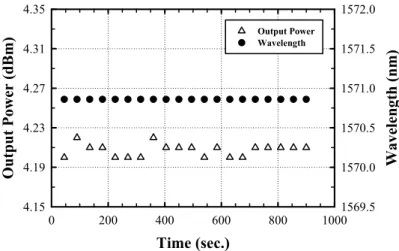
To investigate the behaviors of output power and wavelength stabilities, the short-term stability of the proposed configuration is measured, as shown in Fig. 5. The lasing wavelength is 1570.25 nm initially and the observing time is over 900 seconds. Experimental results show that the proposed fiber laser has excellent stabilities. The proposed ring laser can dramatically reduce the wavelength variation to zero (readout resolution is 0.01 nm). The output power fluctuation is less than 0.02 dB after passing through more observed time. Finally, during four-hours observation, the stable output of the proposed fiber ring laser is still maintained.
In summary, we demonstrate experimentally a new fiber ring laser with wavelength tunability and single-longitudinal-mode oscillation, covering both C- and L-bands. A saturated-absorber-based autotracking filter, which consists of an unpumped EDF and an ORM, is utilized to provide fine mode restriction and guarantee the single-frequency operation. The performance of output power of > 2.1 dBm, power stability of ≤ 0.02 dB, wavelength variation of ≤ 0.01 nm and SMSR of > 31 dB / 0.05 nm has been experimentally investigated for this proposed fiber laser in an operation wavelength of 1550 to 1608 nm. Therefore, the proposed stabilized and tunable single-frequency operation fiber laser is very suitable to WDM applications in future.
Time (sec.) 0 200 400 600 800 1000 Output Power (dBm) 4.15 4.19 4.23 4.27 4.31 4.35 Wavelength ( n m ) 1569.5 1570.0 1570.5 1571.0 1571.5 1572.0 Output Power Wavelength
Figure 5. The output power and wavelength variation of proposed stable single-frequency fiber laser while the wavelength is 1570.25 nm initially.
ACKNOWLEDGEMENTS
This work was supported in part by the National Science Council (NSC) of R.O.C. under grants NSC 93-2752-E009-009-PAE, NSC 93-2215-E-115-004, and NSC 93-2215-E-115-005.
REFERNCES
1. C. C. Lee, Y. K. Chen, and S. K. Liaw, “Single-longitudinal-mode fiber laser with a passive multiple-ring cavity and its application for video transmission,” Opt. Lett., 23, pp. 358-360, 1998.
2. J. Zhang, C. Y. Yue, G. W. Schinn, W. R. L. Clements, and J. W. Y. Lit, “Stable single-mode compound-ring erbium-doped fiber laser,” IEEE Journal of lightwave tech., Vol. 14, No. 1, pp. 104-109, 1996.
3. R. M. Sova, K. Chang-Seok, J. U. Kang, and J. B. Khurgin, “Tunable dual-/spl lambda/fiber ring laser based on 2/sup nd/order Sagnac-Lyot fiber filter,” in IEEE CLEO 2002 Tech. Dig., 1, 2002, pp. 444–445.
4. K. J. Vahala, P. Namkyoo, J. Dawson, and S. Sanders, “Tunable, single-frequency, erbium fiber ring lasers,” in IEEE
5. K. K. Chow, C. Shu, M. W. K. Mak, and H. K. Tsang, “Widely tunable wavelength converter using a double-ring fiber laser with a semiconductor optical amplifier,” IEEE Photon. Technol. Lett., 14, pp. 1445–1447, 2002.
6. A. Bellemare, J.-F. Lemieux, M. Tetu, and S. LaRochelle, “Erbiumdoped fiber ring lasers step-tunable to exact multiples of 100 GHz (ITUgrid using periodic filters,” in Proc. Eur. Conf. Optical Communications EOCC’98, 1, 1998, pp. 153–154.
7. Y. Cheng, J. T. Kringlebotn, and D. N. Payne, “Stable single-frequency traveling- wave fiber loop laser with integral saturable-absorber-based tracking narrow-band filter,” Opt. Lett. Vol. 20, pp. 875-877, 1995.
8. Y. W. Song, S. A. Havstad, D. Starodubov, Y. Xie, A. E. Willner, IEEE, and J. Feinberg, “40-nm-Wide Tunable Fiber Ring Laser With Single-Mode Operation Using a Highly Stretchable FBG,” IEEE Photonics Technol. Lett. 13, pp. 1167-1169, 2001.
9. S. Yamashita, and M. Nishihara, “Widely tunable erbium-doped fiber ring laser covering both C-band and L-band,”
IEEE J. Selet. Tops Quam. Electro., 7, pp. 41-43, 2001.
10. C. H. Yeh, C. C. Lee, C. Y. Chen, and S. Chi, “A Tunable C-plus-L Band Fiber Ring Laser Based on Hybrid Amplifier,” Jpn J. App. Phys., part 1, 43, pp. 650-651, 2004.
11. C. H. Yeh, C. C. Lee, and S. Chi, “A tunable S-band erbium-doped fiber ring laser,” IEEE Photonics Technol. Lett.
15, pp. 1053-1054, 2003.
12. C. H. Yeh, K. H. Lai, Y. J. Huang, C. C. Lee, and S. Chi, “Hybrid L-Band Optical Fiber Amplifier Module with Erbium-Doped Fiber Amplifiers and Semiconductor Optical Amplifier,” Jpn J. App. Phys., part 1, 43, pp. 5357-5358, 2004.