
宗教容忍與國家: 卡爾梅克共和國 - 政大學術集成
109
0
0
全文
(2) 2 Abstract 這篇研究宗教與政治的關係、。我把卡爾梅克為例,從 1640 到 1995 我分析卡爾梅克佛教 的變化與發展。再加上,我認為現在卡爾梅克共和國宗教寬容跟卡爾梅克佛教有關。我把 卡爾梅克族宗教歷史分成三個階段:1640-1917 俄羅斯帝國,1922-1939 蘇聯,1991-1995 俄羅斯聯邦。論文結論是從 1640 到 1995 卡爾梅克佛教通過民主化的過程變了十分寬容, 因此民族性與宗教之衝突非常少見。. 政 治 大. This thesis explores the evolvement of Kalmyk Buddhism through the period of 1640 to 1995.. 立. Looking at the changes in religious theology, polity, and interaction with the state of Kalmyk. ‧ 國. 學. Buddhism, I argue that these three dimensions went through the democratization process, and now in its current state contribute to the religious peace and tolerance in the modern Kalmykia.. ‧. n. er. io. sit. y. Nat. al. Ch. engchi. i n U. v.
(3) 3 Table of Content Chapter 1. Introduction .................................................................................................................4 Chapter 2.Theoretical Framework .............................................................................................13 2.1. Literature Review on Religion and State Interactions ........................................................13 2.2. Buddhist Political Theology ..............................................................................................20 2.3. Research Methodology .......................................................................................................29 Chapter 3. Kalmyk Buddhism and the State from 1640 to 1917 ............................................34 3.1. Religious Situation in the Russian Empire .........................................................................34 3.2. Political Theology of Kalmyk Buddhism ...........................................................................38 3.3. Religious Polity of Kalmyk Buddhism ...............................................................................42. 政 治 大 3.5. Summary………………………………………………………………………………….54 立. 3.4. Political Interactions between Kalmyk Buddhism and the Russian Empire.......................48. Chapter 4. Kalmyk Buddhism and the State from 1922 to 1939 .............................................56. ‧ 國. 學. 4.1. Religious Situation in the Soviet Union..............................................................................56 4.2. Political Theology of Kalmyk Buddhism ...........................................................................58. ‧. 4.3. Religious Polity of Kalmyk Buddhism ...............................................................................61 4.4. Political Interactions between Kalmyk Buddhism and the Russian state ...........................64. y. Nat. sit. 4.5. Summary………………………………………………………………………………….67. al. er. io. Chapter 5. Kalmyk Buddhism and the State from 1988 to 1995 .............................................69. n. 5.1. Religious Situation in the Russian Federation ....................................................................69. Ch. i n U. v. 5.2. Political Theology of Kalmyk Buddhism ...........................................................................73. engchi. 5.2. Religious Polity of Kalmyk Buddhism ...............................................................................78 5.4. Political Interactions between Kalmyk Buddhism and the Russian state ...........................85 5.5. Summary………………………………………………………………………………….88 Chapter 6. Conclusion .................................................................................................................90 Bibliography .................................................................................................................................95 Appendix 1. .................................................................................................................................108 Appendix 2. .................................................................................................................................109.
(4) 4 Chapter 1. Introduction Many popular conceptions tend to identify “authentic” Buddhism with nonviolence and peace has been understood to lie at the very heart of Buddhism. Buddhist precepts prohibiting killing and Buddhist texts speak in details about the moral consequences, in this and future lives, of harming another sentient being, human or otherwise.1 Moreover, in contrast to other religions, neither a belief in religious redemption through warfare like the Crusades, nor special doctrines to mobilize religious masses against unbelievers exist in Buddhism. Therefore, Buddhist. 政 治 大. communities generally do not unite across national boundaries for a common goal or to combat a religious “other”.. 2. 立. ‧ 國. 學. Notwithstanding all of the aforesaid, violence has been and remains to be present in Buddhist societies. The occupation of Tibet by China initiated the exodus of thousands of Tibetan monks. ‧. under the leadership of the Fourteenth Dalai Lama into exile to India. 3 In 1998 the members of. Nat. sit. y. radical the Tibet Youth Congress organized a major hunger-strike in New Delhi, which lead to. n. al. er. io. the death by self-immolation one member of a strike, in order to gain more attention of the world. v. community to the human rights violation in Tibet.4 However, their radical activities were aimed. Ch. engchi. i n U. at themselves and were never violent. In Sri Lanka, where the majority of the population, the Sinhalas, predominantly Buddhist, are at war with a separatist fraction within the largest minority, the Tamils, who are predominately Hindu, the Buddhist monks have been advocating the violent. 1. Juliane Schober,“Buddhism, violence and the state in Burma (Myanmar) and Sri Lanka,” in Conflictin South and Southeast Asia: disrupting violence, ed. Linell E. Cady and Sheldon W. Simon (London and New York: Routledge,2007), 52. 2 Ibid. 3 Patricia C. Marcello, The Dalai Lama: A Biography (Westport: Greenwood Publishing Group, 2003), 96. 4 Tibetan Women's Association. A Study of Tibetan Self-Immolations: February 27,2009-March 30,2012: The History, The Motive, and The Reaction, 2012. http://tibetanwomen.org/wp-content/uploads/2012/04/Self-Immolationreport.pdf (accessed December 13, 2013)..
(5) 5 riots in defense of a distinctly Buddhist nationalism.5 In 1997 thousands of Burmese Muslims have suffered from the violent rampage of the Buddhists population, led by the monks, and since then, the conflict between Muslim and Buddhist population remains present.6 Thailand state’s assimilation policy against Muslim minorities in the Malay Pattani region, and favoritism of Buddhism, resurged into violence between Malay Muslim minorities and Thai Buddhist majority.7. At the same time the Soviet Union has been torn apart by the mobilization of minority ethnic. 政 治 大. groups, that in most cases are not only ethnically, but also religiously different from the majority. 立. population. Although the dissolution of the Soviet Union was deemed to be the perfect solution. ‧ 國. 學. to prevent large scale violent ethnic conflict, it neither resolved the problem in the newly founded independent states, where the disputes continue to arise, (for instance: the Nagorno-. ‧. Karabakh conflict between Armenia, with the majority of population being Christian, and. Nat. sit. y. Azerbaijan, with the majority of population being Muslim; the Russia–Georgia War of 2008 with. n. al. er. io. Georgia on one side, and Russia and the rebellious republics of South Ossetia and Abkhazia on. v. the other; the ethnic clashes in South Kyrgyzstan between Kyrgyz people and Uzbek people,8. Ch. engchi. i n U. etc.), nor in the successor state of the Soviet Union – the Russian Federation, which is where our main case of the Republic of Kalmykia is located. Nevertheless, despite the fact, that the dissolution of the Soviet Union, made the Russian Federation more ethnically and religiously homogenous than the Soviet Union has ever been, the two Chechen wars, numerous terrorist attack in Moscow, Saint-Petersburg and other large cities, as well as an increased incidence of 5. Tessa J. Bartholomeusz, In Defense of Dharma (London and New York: RoutledgeCurzon, 2002), 9. Schober,“Buddhism, violence and the state in Burma (Myanmar) and Sri Lanka”, 59-60. 7 Joseph C. Liow, “Violence and the long road to reconciliation in Southern Thailand,” in Conflictin South and Southeast Asia: disrupting violence, ed. Linell E. Cady and Sheldon W. Simon (London and New York: Routledge,2007), 154-155. 8 For the conflicts in the post Soviet Union territories see: Conflict and Peace in Euroasia, edit. Debidatta Mahapatra (London and New York: Routledge,2013). 6.
(6) 6 violence evoked by ethnic and religious hatred, clearly demonstrates the existence of ethnic and religious problems.. However, unlike in South East Asia, in Russia, the violent clashes happen between Orthodox Russian majority and Muslim minorities, without any participation of Buddhist population. Indeed, even though ethnic Russian population is continuously leaving Muslim republics (if we compare results of the Russian Census from 20029 and 201010) due to the large discrimination, and non-Russian ethnic minorities are being discriminated in other Russian Orthodox regions11,. 政 治 大. the interreligious and interethnic situation in Buddhist republics of Russia remains harmonious.. 立. As neither ethnic Russian, nor numerous Caucasian 12 ethnic groups are leaving Buddhist. ‧ 國. 學. republics of Russia13, the remaining question is why.. ‧. In order to answer this question, this thesis will focus on examining the relations between Buddhism and the state, in the only Buddhist state14 in Europe – the Republic of Kalmykia15,. y. Nat. io. sit. which has the status of federal subject 16 of the Russian Federation and is situated between. n. al. er. Russian Orthodox regions (Volgogradskaya oblast’, Rostovskaya oblast’, Stavropol’skii krai,. 9. Ch. engchi. i n U. v. The Russian Census 2002, The Population by the Ethnicity and Russian Language Ability by the Federal Subjects of the Russian Federation, accessed 12 January 2014, http://www.perepis2002.ru/index.html?id=17. 10 Federal State Statistic Service, 2010 The Population by the Ethnicity and Russian Language Ability by the Federal Subjects of the Russian Federation, accessed 12 January 2014, http://www.gks.ru/free_doc/new_site/perepis2010/croc/Documents/Vol4/pub-04-04.pdf. 11 Human Rights Watch, Russian Federation: Ethnic Discrimination in Southern Russia, 1 August 1998, accessed January 2014, http://www.refworld.org/docid/3ae6a7d18.html. 12 Here the term Caucasian [кавказец] is used for a numerous Muslim ethnic groups, whose ancestral home is in the Caucasian mountain region. 13 See The Russian Census 2002, The Population by the Ethnicity and Russian Language Ability by the Federal Subjects of the Russian Federation and Federal State Statistic Service, 2010 The Population by the Ethnicity and Russian Language Ability by the Federal Subjects of the Russian Federation. 14 Here means a polity, and organized political community living under one government. 15 The Chapter 3.Article 65 of the Constitution of the Russian Federation, guarantees Kalmykia the status of the Republic, with the highest degree of independence. 16 Means constituent entities of Russia, the head of which signed the 1992 Federation treaty, which establishing and regulating the current inner composition of Russia, based on division of authorities and powers among Russian government bodies and government bodies of constituent entities..
(7) 7 Astrahan’skaya oblast’) and one Muslim republic (the Republic of Dagestan) of Russia.17 The case of the Republic of Kalmykia is not only valuable from the point of its special geographical location (being the only Buddhist state in Europe and borderland between Muslim and Russian Orthodox regions), but also, from the fact that despite the particularly diverse population structure18, with the majority of the population being religiously Buddhist, in Kalmykia unlike in the South East Asia, Buddhists do not fight religious “others”. 19. The aim of the study is to find an answer to the following questions: (1) why there is no serious. 政 治 大. religious conflict in the Republic of Kalmykia, despite the presence of different religious and. 立. ethnic groups, when the Buddhists in South East Asia are fighting Muslims? (2) Why are the. ‧ 國. 學. ethnic and religious “others” not discriminated? (3) And what facilitates the harmony found in the Republic of Kalmykia?. ‧. We suggest the hypothesis that the reason for religious tolerance and harmony in the Republic of. y. Nat. io. sit. Kalmykia can be found in the democratic features of Kalmyks Buddhism, its “democratic. n. al. er. theology,” “democratic ecclesiology,”20 and its interactions with the state.. Ch. engchi. i n U. v. In order to discover whether or not Kalmyk Buddhism possess the democratic features, I will examine political theology of Kalmyk Buddhism, its institutional structure and its interactions with the state. However, in order to completely concentrate on examining the Kalmyk Buddhism, we should first introduce the Kalmyk people and the Kalmyk state for better understanding the situation in which this Buddhism was nourished. 17. See Appendix 1. Map 1. See Appendix 2. Table 1. 19 Kermen Nadneeva, Tolerantnost’ I Netolerantnost’, Svetskoe i Religioznoe v Dukhovnom Prostranstve Yga Rossii I Kalmykii (Tolerance and Intolerance, Secular and Religious in the Spiritual Space of the Russian South and Kalmykia, accessed February 18, 2014, http://elibrary.ru/download/68953683.pdf. 20 See Chapter 2.1. 18.
(8) 8 The Kalmyks are the descendants of the Oirats, the western group of the Mongols, who originally belonged to the tribal confederation of the ‘Forest People’. The name ‘Oirats’ has its origin from the place of the Oirats inhabited: between Baikal and Altai regions. Unlike the eastern group of Mongols, the Oirats are not directly related to Genghis Khan, even though they were a part of his empire as an ally tribe.21. In the fifteenth century the Oirats emerged as a growing political power: they expanded their territory from Altai to Ili (a region in present day China, at the border between China and. 政 治 大. Kazahstan). However, not far along after that the Oirat started to be torn from inside with the. 立. race for power between different tribes. At the same time rivalry with the neighboring tribes of. ‧ 國. 學. Mongols and Kazakhs for pastures created an unfavorable situation for their livestock. Therefore, many Oirats decided to leave in search for more secure land and uncontested pastures.22. ‧. Our research is devoted to the Oirat tribes that left their ancestral home and migrated to lower. y. Nat. n. al. er. io. Kalmyks.. sit. Volga River and the north part of the Caspian Sea in 1630s, where they started to be called the. Ch. engchi. i n U. v. The etymology of the name Kalmyk for the Oirats tribes that migrated to the banks of the Volga River and the Caspian Sea derives from Turkish verb ‘kalmak’ – to stay, to remain23. The name Kalmyk was first used by their Turkish neighbors and can be traced back to the mid-fourteenthcentury work of the Arab geographer Ibn al-Wardi. 24 Historians have not yet reached a. 21. Utash B. Ochirov, “Oiraty zapadnoj Mongolii I severo-zapadnogo Kitaya: voprosy etnicheskoi istorii, demografii I geografii rasseleniya vo vtoroj polovine XVIII veka” (The Oirats of the Western Mongolia and Northwestern China: the questions of ethnical history, demography and geography of settlement in the second half of XVIII century), Vestnik KIGI RAN No. 2 (April 2010), 9. 22 Ibid. 23 “Kalmak”, last modified May 27, 2014, http://en.wiktionary.org/wiki/kalmak. 24 Michael Khodarkovsky, Where Two Worlds Met: The Russian State and the Kalmyk Nomads, 1600-1771 (Ithasa and London: Cornell University Press, 1992), 7..
(9) 9 consensus on what the Kalmyks remained from. A. Pozdneev, P. Pallace and J.-P. AbelRémusatargue thatthe name Kalmyks points out the territorial isolation of the Kalmyks from the other Oirats-Mongols.25 However, another group of scholars, such as C.-D. Nominhanov and V. Bartold disagree with them and state that the name Kalmyks points to the fact that the Kalmyks remain Buddhist, in comparison to the Oirats who turn to Islam, because only in the Muslim sources the Oirats are called Kalmyks.26. Nonetheless, starting from the seventeenth century the name Kalmyk started to be largely used. 政 治 大. by the Oirats that settled down at the bank of the Volga River and the Caspian Sea in their. 立. dealings with Russian and Muslim neighbors, even though, among each other they continued to. ‧ 國. 學. refer to themselves by their tribal, clan, or other internal affiliations for a long time from then. And according to Kalmyk scholar G. Avlyaev, complete consolidation of separate Oirat tribes. ‧. that migrated to the Southwestern border of seventeenth-century Russia into the Kalmyks. er. io. sit. y. Nat. happened during the rule of Ayuki Khan (1669-1724).27. After their arrival to the Southwestern border of Tsarist Russia, after the period of independence. n. al. Ch. i n U. v. the Kalmyk tribes started to slowly fall under the power of Russian Tsar. In fact, the Kalmyks. engchi. became a borderland power between the Orthodox Russian lands and the lands populated by Muslims. The Tsarist government sought to use the Kalmyk cavalry in support of its military campaigns against the Muslim powers at its Southern border: Persia, the Ottoman Empire, the Crimean Khanate, etc.28. 25. Genadij O. Avlyaev, Proishozhdenie kalmytskogo naroda (The origins of the Kalmyk people), (Elista: Kalmytskoe knizhnoe izdatel’stvo, 2002), 11. 26 Ibid.,12. 27 Ibid. 28 Michael Khodarkovsky, Where Two Worlds Met, 107-108..
(10) 10 After the end of the Tsarist rule, the Kalmyks were dragged into the Civil War, and in 1920 they became a part of the Soviet Union with the status of Kalmyk Autonomous oblast’, which in 1935 was upgraded to Kalmyk Autonomous Soviet Socialist Republic. In 1942 the whole Kalmyk people became the victim of deportation by the order of Stalin under the false accusation of treason, and cooperation with Nazi Germany, and were sent to Siberia, where they were forbidden to use their mother tongue and culture until the rehabilitation in 1957.29. After the rehabilitation of the Kalmyk people and restoration of their Kalmyk Autonomous. 政 治 大. Soviet Socialist Republic, they started to come back to their home, in the steppes near the. 立. Caspian Sea and the Volga River to rebuild their homeland. After the dissolution of the Soviet. ‧ 國. 學. Union, Kalmyk Autonomous Soviet Socialist Republic changed into the Republic of Kalmykia, a federal subject of the Russian Federation.. ‧. As we can see from this short discourse, the history of Kalmyk people had many tragic twists. y. Nat. er. io. sit. and drastic changes: the migration from Dzungaria to what now is the Republic of Kalmykia, the accession of Russian rule, the deportation, and rehabilitation. Notwithstanding all the drastic and. n. al. Ch. i n U. v. tragic twists in the history of Kalmyk people, they have managed to preserve their distinctive. engchi. cultural characteristics, among which Buddhism is, indeed, the most remarkable.. By the time the arrival to Volga steppes in the seventeenth century, the Kalmyks were already Buddhists. The first wave of acceptance of Buddhism by the Mongol and Oirat tribes occurred during Genghis Khan’s military campaigns in the end of the twelfth - beginning of the thirteenth centuries. However, at that time despite the acceptance of a new religion, most of the Oirat. 29. Vladimir B. Ubushaev and Kirill V. Ubushaev, Kalmyki: Vyselenie i Vozvrashenie (The Kalmyks: Exile and Return), (Elista: Izdatel’stvo Kalmytskogo gosydarstvenogo universiteta, 2007), 26..
(11) 11 people also continued to follow their traditional shamanist beliefs. And with the fall of Yuan dynasty in China the position of Buddhism significantly diminished.30. The second wave of acceptance of Buddhism by the Mongol and Oirat tribes was the result of the active missionary activities of Tibetan preachers and lamas, mostly from Tibetan Gelukpa School. One of the evident signs of success of Buddhism in winning the hearts and minds of the Oirats is the decision of each of the Oirat taishi (prince) in 1615 to dedicate one of their sons to follow a path of monkhood. 31 Moreover, in 1640 the Buddhism of Tibetan Gelukpa school. 政 治 大. obtained a position akin to that of a state religion for Mongol and Oirat tribes in the Mongol-. 立. Oirat Code (the code of law of Monol and Oirat tribes).32 Although after leaving Dzungaria, the. ‧ 國. 學. Kalmyk's became rather isolated from the center of their religion – Tibet, and from other Buddhist centers, they still managed to maintain strong ties with the Tibet, and other Buddhists,. ‧. despite the many attempts of Russian government to turn the Kalmyks into the Russian. er. io. sit. y. Nat. Orthodoxy.. As has already been mentioned, the aim of this work is to try to find an explanation to what. n. al. Ch. i n U. v. facilitates the present religious tolerance in Kalmykia. In order to fully answer this question, we. engchi. will trace back the history of Kalmyk Buddhism since the arrival of the Oirat tribes to the Caspian steppes until nowadays, and try to examine and analyze the changes, which occur in Kalmyk Buddhism during the given period of time. We will also concentrate on examining the transformation of original features of Tibetan Gelukpa school, which started was inevitable due 30. Araltan N. Bashaev and Dyakieva B. Raisa, Istoria Kalmykii I Kalmytskogo Naroda s Drevneishih Vremen do Nachala XIX veka (The History of Kalmykia and Kalmyk People from the Ancient Time till the XIX century), (Elista: Ministerstvo obrazovaniya, cultury i nayki Respubliki Kalmykia, 2010), 44-45. 31 Ibid, 46. 32 Elza Bakaeva, "Buddhism v Kalmykii: Osnovnye Etapy Razvitiya”(Buddhism in Kalmykia: the Principal Development Stages),Buddhism in Russia, No. 42 (2009): 10, accessed Novermber17, 2013,: http://www.buddhismofrussia.ru/_journals/buddhism-of-russia-42.pdf..
(12) 12 to the change of political and social environment in Kalmyk state and Kalmyk society under Russian rule. By doing so, we hope to find an explanation to the present religious harmony in the Republic of Kalmykia, where Buddhist do not fight religious “others”.. 立. 政 治 大. ‧. ‧ 國. 學. n. er. io. sit. y. Nat. al. Ch. engchi. i n U. v.
(13) 13 Chapter 2.Theoretical framework 2.1. Literature Review on Religion and State Interactions. The end of nineteenth-beginning of the twentieth centuries and the work of famous scholar Emile Durkheim, gave birth to secularization theory33, which prevailed in academia until the Iranian Islamist Revolution and the resurgence of religious movements all over the world with the dissolution of the Soviet bloc. Despite the secularization and promises of major decline, religion has not only survived, but also managed to preserve its long abiding relationships with politics.. 政 治 大. Our main points of concern are to fully understand the nature of interactions between religion. 立. and politics, and in order to do so, we are going to explore a number of the works devoted to the. ‧ 國. 學. theme of religion-state relationships, as well as political theology.. ‧. French philosopher Alexis de Tocqueville views Protestant political theology, which dominates in American society as a source for the tolerance and peace, as well as democratic nature of. y. Nat. er. io. sit. American state. He goes further and uses the example of the United States to describe how abstract democratic theology can be translated into concrete democratic practices: the idea of a. n. al. Ch. i n U. v. covenant with God, the freedom of conscience, and the priesthood of all believers, all found. engchi. institutional forms within freedom of speech, independence, and balance between clergy and laity.34 “They keep aloof from party and public affairs. In the US religion exercises but little influence upon the laws and upon the details of public opinion, but it directs the customs of the community, and, by regulating domestic life, it regulates states”.35 He also argues that it is for the reason of Protestant political theology the United States are not terrorizing the whole world,. 33. Émile Durkheim, The Division of Labour in Society, (New York: Macmillam Press, 1997), 49-50. Alexis de Toqueville, in Religion and Political Thought, ed. M. Hoelzl and G. Ward (London and New York: Continuum, 2006), 155-156. 35 Ibid. 34.
(14) 14 although, they have the ability to do so. Thus, following de Tocqueville's thoughts we can conclude that the particular political theology, democratic polity and religious-state interaction that can be found in the Protestant religion of the majority of American population assist to religious peace and tolerance. Thomas Hobbes in his masterpiece “Leviathan” provides a systematic account of the commonwealth, including the rational explanation of the formation of function of the state including religious dimension. The fact that Hobbes considers the religious dimension as. 政 治 大. important as secular politics makes it substantial for us to examine his work more thoroughly.. 立. According to Hobbes, the natural state of human society is “war of each man against the other”,. ‧ 國. 學. and in order to escape this pattern, he suggests to combine two conflicting principles of political power: social contract theory, which helps to foster a network and community feelings, and. ‧. theory based on the doctrine of the Divine Right of Kings rooted in the emphasis upon hierarchy. sit. y. Nat. in the Catholic tradition, which keeps all individual subjects in fear and awe. 36 Hobbes support. n. al. er. io. for the necessity to combine the secular and religious powers in order to overcome the “natural. v. state of war”, also can be found in his distinction of two forms of supreme power: “power of. Ch. engchi. i n U. spirits invisible” namely God, and “the power of those men they shall therein offend”.. According to Hobbes, Christian political ecclesiology can hardly be called democratic, since king or civil sovereign, no matter whether it is one man, or an assembly of men possess the uniform supreme power in both religious and civil dimension: the sovereign possess “the right of judging what doctrines are fit for peace, and to be taught to the subjects” and “the Christian. 36. Thomas Hobbes, in Religion and Political Thought, ed. M. Hoelzl and G. Ward (London and New York: Continuum, 2006), 102-105..
(15) 15 kings are the supreme pastors of their people, and have power to ordain what pastors they please, to teach the Church, that is, to teach the people committed to their charge.”37 In “Religious Regimes and State-Formation: Toward a Research Perspective” Max Bart draws a number of examples from the history of Roman Catholic Church and other religions to argue that religion and state have always been connected and religious regimes played an important role in processes of state-formation and state-development. For instance: in the Roman Empire, Christianity and the Roman Catholic Church were an important means of pacification and. 政 治 大. domestication in the hands of secular rulers; in the name of Allah, large number of Arabs were. 立. mobilized and sent into battles; the colonial expansion of the South and West European into. ‧ 國. 學. America and Africa would not have been as successful without large support from the Church. He also notes, that the reason for the interdependency of state and religion lies in the similarity of. ‧. their aims and functions fulfill important functions in the sphere of social organization and. Nat. sit. y. cultural orientation; develop policies towards nation-building and community-building; territorial. n. al. er. io. and influential expansion tendencies; and so forth.38. Ch. i n U. v. Although, Max Bart does admit the interdependent relationship between religion and state, and. engchi. their similar features, his examples are limited to Abrahamic religions. Moreover, his argument about the similar aims and functions of the religions, are also only suitable for Abrahamic religions (Christianity), because for religious like Hiduism and Buddhism the main goal is a personal salvation.39. 37. Ibid., 116-118. Mart Bax, “Religious Regimes and State-Formation: Toward a research perspective”, in Religious Regimes and State-formation: Perspectives from European Ethnology, ed. Eric L. Wolf et al. (Albany, N.Y. : State University of New York Press, 1991), 10-11. 39 Charles Eliot, Hinduism and Buddhism: And Historical Sketch, Vol. 1 (Surrey: Curzon Press, 1998), 9. 38.
(16) 16 Contemporary scholar Jurgen Manemann in his book “The Depolitization of God as a Challenge for Political Theology” claims that although we all live in the time of different crises (economic, moral, political, ecological), however the religious crisis is absent. He continues his arguments and calls the developments after 9/11 the neopolitization of religion, and blame the secular political powers in abusing religion as a weapon in the fight for creating collective identities. In Manemann’s opinion, the political developments of after 9/11 demonstrate that the intrinsic relationships between monotheistic religions and violence cannot be broken and that “with God everything is permitted”.40 Moreover, the Christian gnostic division of the world into good and evil hemispheres found its societies.41. 治 政 大 reflection into friend-foe politics 立. pursued in the democratic. ‧ 國. 學. Although, since our research looks at the tolerance in the non-Abrahamic religion, namely. ‧. Buddhism we cannot take into consideration his criticism of duality in Chrisianity, Manemann’s. Nat. io. sit. y. points about neopolitization of religion still stands.. n. al. er. Regina Schwartz’s views correspond the Mannemann’s, about rather non-peaceful than peaceful. Ch. i n U. v. nature of monotheist religions, because “the danger of universal monotheism is asserting that its. engchi. true is the Truth, its system of knowledge the System of knowledge, its ethnics, the Ethnics not because, as in particularism, any other option must be rejected, but because there is simply no other option.”42. 40. Jurgen Manemann, “The Depolitization of God as a Challenge for Political Theology” in Religion and Political Thought, ed. M. Hoelzl and G. Ward (London and New York: Continuum, 2006), 270. 41 Ibid., 273. 42 Regina M.Schwartz, The Crusade of Cain: The violent Legacy of Monotheism (Chicago: University of Chichago Press, 1997), 33..
(17) 17 Karen Armstrong seconds her argument and add that 'All three traditions are dedicated in some way to love and benevolence and yet all three have developed a pattern of holy war and violence that is remarkably similar and which seems to surface from some deep compulsion that is inherent in this tradition of monotheism, the worship of only one God. 43. All of the three authors (Jurgen Manemann, Regina Schwartz, Karen Armstrong) emphasize that intolerance to accept the existence of something else except of the Truth, the System, and the Ethnics, makes it difficult for the monotheistic religions to adapt to the reality of diversity of people’s believes in the modern world.. 立. 政 治 大. Martin E. Marty and R. Scott Appleby’s “Fundamentalism Project” examines the religious. ‧ 國. 學. fundamentalist movements all other the world, thus, demonstrating, the negative side of religious. ‧. resurgence. Relying on the essays collected in their volume, they conclude how religious fundamentalism is incompatible with of democratic values due to its denial of the ideas of. y. Nat. er. io. sit. pluralism, egalitarianism, religious tolerance, and disrespect for human rights. 44 However, in general, the countries there non-religious population dominate demonstrate very poorly in terms. al. n. 45. Ch. i n U. v. of democracy. Which also can be an indicator that overall, the religion in the healthy degree does promote the democratic values.. engchi. Unlike Martin E. Marty and R. Scott Appleby’s, Mark Juergensmeyer in “The New Cold War? Religious Nationalism Confronts the Secular State” rejects the notion of “religious fundamentalism”, and gives rather positive description to the rise of religious nationalism in the. 43. Karen Armstron, The Crusades and Their Impact on Today's World (New York: Anchor Books, 2001), 4. Martin E. Marty and R. Scott Appleby, Fundamentalism Observed (Chicago and London: The University of Chichago Press, 1991), 817-835. 45 Carsten Anckar. Religion and Democracy: A Worldwide Comparison.(London and New York: Routledge, 2011), 101. 44.
(18) 18 Middle East, South Asia, and post-Soviet. His great contribution to the study of religion and state relations is lying in his attempt to examine the religious nationalism through the lenses of politically engaged religious leaders. Juergensmeyer also argues that major conflicts in contemporary international politics are caused by the issue of dissent on whether the state should be secular or religious. Furthermore, he argues the rise of religious nationalism was caused by the fail of secular powers, both socialist and democratic to create a fair moral society, and give people stability which they were in need for.46 In his piece Juergensmeyer notes the controversial nature of relationships between democracy and the “modern religious state”: on one hand, the. 治 政 大of electoral and decision-making foundation of religious law protects the democratic character 立 process, but, on the other hand, the protection of minority and individual rights remains at. ‧. ‧ 國. 學. question.47. The modern sociologist of religion Jose Casanova supports the idea of Muslim theologian Abu. Nat. sit. y. Hamid Muhammad al-Ghazzali that religion, the world of politics and the world in general can. n. al. er. io. have three types of relationships: 1)”caesaropapism”, there the secular power controls and uses. i n U. v. religion for its own purposes, most frequently to legitimate political rule and to sanctify. Ch. engchi. economic oppression and the certain stratification system; 2) theocracy, there the religion tries to shape the world according to god's ways; 3) detachment and separation, which is preferable by both religion and worldly people, since it protects the world from religion and religion from the world. However, Casanova states that none of three options can permanently solve the tension between ‘religion' and 'the world'. 48 Jose Casanova also points out how important the role of. 46. Juergensmeyer Mark, The New Cold War? Religious Nationalism Confronts the Secular State, (Los Angeles: University of California Press, 1993), 2-4. 47 Ibid., 171-188. 48 Jose Casanova, Public Religions in the Modern World (Chicago and London: The University of Chicago Press, 1994), 48-51..
(19) 19 religion in the public sphere of modern world, as it can promote the modern freedom and rights, assist the democratic civil society to fight the authoritarian rules; give an alternative opinion about morality and ethics of secular powers; as well as protect the traditional life.49 Matthew Moen and Lowell S. Gustafson, the editors of the volume “The Religious Challenge to the State” highlighted the topic of religion as a source of regime opposition. Although, the ability of religion to be a basis of social cohesion and political legitimacy cannot be denied, Moen and Gustafson emphasize the role of religion in critique of the state, and of religious resources and. 政 治 大. infrastructure in helping resistance movements.50. 立. The author of the book “Religion and Democracy in Taiwan” Cheng-Tian Kuo, when answering. ‧ 國. 學. questions surrounding of relations between religion and democracy complement the examining. ‧. of the theological side of religion with the way institutions convert “abstract democratic theology” into “concrete democratic practices”.51 According to his definition: a theology which. y. Nat. er. io. sit. is based on the support of human rights, the theological transformation from spiritual equality to political equality, and a positive attitude towards religion-state relationships is called a. n. al. Ch. i n U. v. “democratic theology”; and a religious institution, which comprises the rules and norms that. engchi. impart institutional checks on religious leaders, moderately equal power between clergy and laity, and the autonomy of local religious organizations is a “democratic ecclesiology”52 In this thesis we will employ Cheng-Tian Kuo’s denominations of “democratic theology” and “democratic ecclesiology” to explore the case of religious tolerance in Kalmykia. 49. Ibid., 57-58. Matthew Moen and Gustafson Lowell, The Religious Challenge to the State (Philadelphia: Temple University Press, 1992), 10. 51 Cheng-Tian Kuo, Religion and Democacry in Taiwan (Albany: State University of New York Press, 2008), 5. 52 Ibid., 5-6. 50.
(20) 20 2.2. Buddhist Political Theology. In this chapter we will examine the political theology of Buddhism. Although, some might argue that after Siddhartha Gautama (future Buddha), renounced his throne, and created sangha (a community of monks and nuns), who left their houses to adopt ascetic way of live, it seemed that the Buddhism entanglement with the world of politics was abandoned. However, early Buddhist sources indicate that the Buddha preached on a variety of political related topics, and the consistent concern in the canons for insuring good sangha-state relation through the. 政 治 大. legitimization of the rulers by the monastic order53 prove this.. 立. From the Maha-parinibbana Sutta, we know that the Buddha praised the democratic theology of. ‧ 國. 學. Vajjian state, which was based on the social contract theory and equality of all people54; and. ‧. exemplifies its strength, justice and social solidarity as a model to inspire the Buddhist sangha. 55 However, political thought in the majority of Buddhist sources admits that to resist thriving of. y. Nat. io. sit. anarchy the kingship is needed. The narrative of the origins of Buddhist kingship can be found in. n. al. er. the Agganna Sutta: “then they instituted boundaries lines [on the land] and one steals another’s. Ch. i n U. v. share. After… the third time…they beat the offender with fists, earth clods, with sticks, etc. When. engchi. thus, stealing, reproof, lying, and violence had sprung up among them, they come together and said, ‘What if we elect some one of us, who shall get angry with him who merits anger, reproof, and banish him who merits banishment…’ He was called the ‘Great Elected One,’ ‘Lord of. 53. Ian Harris, “Buddhism and Politics in Asia: the Textual and Historical Roots,” in Buddhism and Politics in Twentieth Century Asia, ed. by Ian Harris (London and New York: Continuum, 1999), 2-3. 54 Ibid. 55 Francis Story,Maha-parinibbana Sutta:Last Days of the Buddha, accessed November 27, 2013, http://www.accesstoinsight.org/tipitaka/dn/dn.16.1-6.vaji.html..
(21) 21 Fileds,’…‘DharmaKing.’”56. The Buddhist specialist Frank Reynolds suggests that in the early times there were two ideals of Buddhist kingship: the cakkavatti ('wheel-turning') and dharmaking (the monarch who lives and rules by the dharma). In the cakkavatti ideal supports the king was parallel to the Buddha; just as the Buddha was the highest religious figure, the king was the highest lay figure. Such a king was, like the Buddha/ a universal monarch who ruled perfect world by the worth of his own merit. Here the king is a kind of supernatural being whose righteousness calls forth the 'wheel of. 政 治 大. Dharma' and this spreading the teaching legitimates his rule. The king does no violence because. 立. in this realm no one commits crime.” Up until now, it is unclear if the ideal of cakkavatti has. ‧ 國. 學. ever existed; however, we can be sure about the real historical existence of the second type of Buddhist kingship, namely dharmaking. The ideal of dharmaking, suggests the existence of a. ‧. er. io. sit. Nat. brings harmony out of chaos and can do violence to obtain justice.57. y. monarch, who rules an unideal world with righteousness and exemplifies dharma, and who. According to Buddhist tradition kings are just people, who have earned to be born kings, because. n. al. Ch. i n U. v. of their good karma, however, their great potential can be used for both good and evil doing. For. engchi. this reason, the Buddhist doctrine suggests the idea of the rule of Dharma (law, rule) for just kings, as the best solution of escaping from an evil path. The ideal kingship, in the Buddhist tradition runs by “the world ruler, the just and righteous king, relying on the law of righteousness (Dharma), honoring it, regarding it highly and respecting it, with the law of righteousness as his standard, banner and sovereign, provides lawful protection, shelter and safety for his own. 56. Henry C. Warren, Buddhism in Translations (Delhi: Motilal Banarsidass, 1995), 326. Frank Reynolds, “The Two Wheels of Dhamma: A Study in Early Buddhism” in The Two Wheels of Dhamma: Essay on the Theravada Tradition in India and Ceylon, ed. By Gananath Obeyesekere, et al. (Chambersburg, PA: American Academy of Religion, 1972), 18. 57.
(22) 22 dependants. He provides lawful protection, shelter, and safety for the warrior-nobles attending on him; for his army, for the brahmins and householders, for the inhabitants of town and countryside, for ascetics and brahmins, for the beasts and birds.”58. Since all the power was in the hands of a person, even though his decisions were made in accordance to the rules of Dharma, andwith the right intensions, we can say that the original ideal of Buddhist kingship is rather far from what we can call a democratic political theology, in our contemporary understanding.. 治 政 The first Buddhist monarch who set an example for future 大 king was Ashoka Maurya (304–232 立 B.C.E.), who’s rule facilitated the spread of Buddhism through Southeast Asia and beyond. ‧ 國. 學. through sending the envoys, monks, and building Buddhist temples. Indeed, the politics. ‧. conducted by emperor Ashoka are remarkable: he appointed Dharma-officials to encourage virtue, take care of aged people, orphans and those in needs, secure equal judicial standards, and. y. Nat. er. io. sit. provide aid for human beings, and so on.59 The other remarkable point of his rule is that despite the truly focal place of Buddhism in the empire, Ashoka urged tolerance and respect towards all. n. al. Ch. i n U. v. religions. Moreover, he established one of the most important objectives for the Buddhist. engchi. Dharma kings: the maintenance of discipline among monastic order, and purifying it from “lax monks”, if it is necessary.60. 58. Nyanaponika Thera and Bhikkhu Bodhi, Aṅguttara Nikāya: Discourses of the Buddha An Anthology Part I,accessed November 19, 2013. https://mywebspace.wisc.edu/jrblack/web/BU/PDF/bpsanguttara1.pdf. 59 Peter Harvey,AnIntroduction to Buddhism: Teaching History and Practices (New Delhi: Cambridge University Press, 1990), 76. 60 Ibid., 76-77..
(23) 23 Buddhist polities are usually founded on mutually beneficial relations between king, sangha and laity.61 Despite the fact that kingship was a lesser status than an arhat (saint), monks and kings existed in a symbiotic relationship. Monarchs preserved society from anarchy, built monasteries, temples, give gifts. Monks in the monastery instructed kings on their duties. 62 At the same time, the lay people make donations to earn merit, and sangha maintain virtuous lives, thus letting laity earn good karma; where a political ruler acts as a supervisor, who receives the payment for his job in the form of merit, food and respect.63. 政 治 大. The Buddhist sangha must adhere to the rules by law, which are written down in the Vinaya. 立. canon (Vinaya is a code of laws for the Buddhist monastic community) developed by the Buddha. ‧ 國. 學. to govern the sangha after his death. However, in the centuries following the death of Buddha, Buddhism has divided into a variety of traditions, due to the dissent over the interpretation of the. ‧. rules written in the Vinaya. The exact reasons for the schism are still unknown; however, some. Nat. sit. y. points of dissent concerned the monk ownership of specific property, the handling of money and. n. al. er. io. the relaxation of prohibitions on monks eating in the afternoon. 64 Over the centuries many. i n U. v. separate Buddhist traditions either disappear or merged together and the two main ones that. Ch. engchi. remain up to this day are: Theravada and Mahayana. Theravada tradition is also known as Hinayana, the Teaching of the Elders is widely spread in the countries of the Southeast Asia: Thailand, Burma, Laos, Cambodia, Sri Lanka.65 Mahayana tradition66, which also known as the. 61. Todd Lewis, “Buddhism: the Politics of Compassionate Rule” in God’s Rule: the Politics of World Religions, ed. by Jacob Neusmer, (Washington D.C.: Georgetown University Press, 2003), 237. 62 Balkrishna Govind Gokhale, Asoka Maurya (New York:Twayne Publishers, 1966), 28. 63 Todd Lewis, “Buddhism: the Politics of Compassionate Rule” in God’s Rule: the Politics of World Religions, ed. by Jacob Neusmer, (Washington D.C.: Georgetown University Press, 2003), 237. 64 Martin Mill, Identity, Ritual and State in Tibetan Buddhism: the Foundations of Authority in Gelukpa Monasticism (London and New York: Routledge, 2003), 10. 65 Donald K. Sweater, The Buddhist World of Southeast Asia (Albany: State University of New York Press, 2010), 1. 66 It is necessary to clarify, that in this work, the Tibetan Buddhism, which is also known as Vajrayana, or Diamond Way, will be regard as “particular form of Mahayana practice”..
(24) 24 Great Vehicle, can be commonly found in the East Asian countries, such as China, Japan, Korea, Vietnam, Mongolia, Nepal, Tibet, and the republics of Tuva, Buryatia and Kalmykia in the Russian Federation.67. Richard S. Cohen provides the following description to the two branches of Buddhism: “Hinayana champions the arhat (the Buddhist who reached Enlightenment) ideal, the Mahayana – the bodhisattva (a person who is able to reach nirvana but delays doing so through compassion for suffering beings) ideal; the Hinayana is centered on the Sangha, the Mahayana. 政 治 大. on the Buddha.”68 Indeed, The Theravada tradition does stress that to reach significant attainment. 立. and become Arhat 69 ones should join monastic order, thus the sangha struggle for individual. ‧ 國. 學. attainments; while the Mahayana tradition provides the equal opportunity to be come a Buddha to monks and to lay people;70 and the sangha have to not only “help themselves in their spiritual. ‧. paths but to provide the means for others to progress”.71. y. Nat. er. io. sit. Fowler claims that Mahayana branch of Buddhism in particular is marked by tolerance and adaptability, which can be proved by its successful spread in countries like China and Japan,. n. al. Ch. i n U. v. whereas Theravada Buddhism has less successful missionary record.72. engchi. The more democratic nature of Mahayana Buddhism in comparison with Theravada can be also seen from the quantitative study conducted by Carsten Anckar. He compared the compatibility of different religion with democracy and found that Mahayana dominated regions demonstrate a 67. Paul Williams, Mahayana Buddhism: The Doctrinal Foundations (London and New York: Routledge, 1989), 186. Richard Cohen, "Discontented Categories: Hinayana and Mahayana in Indian Buddhist History," American Academy of Religion, 63, No. 1 (Spring 1995): 1-25, accessed November 8, 2013, doi: http://www.jstor.org/discover/10.2307/1465151?uid=2&uid=4&sid=21103163832193. 69 Arhat means ‘the perfected one’ who has attained nirvana. 70 Cathy Cantwell, Buddhism: the Basics (London and New York: Routledge, 2009), 69-70. 71 Ibid., 108. 72 Merv Fowler,Buddhism: Beliefs and Practices(Brighton: Sussex Academic Press, 1999), 104. 68.
(25) 25 greater degree of democracy and democratic stability that Theravada ones.73. Unlike in historically state-supported Theravada Buddhism, where monkhood usually means the full-time commitment and there is almost no overlapping between monks’ and lay duties; in Mahayana Buddhism, the laity, who reached some level of attainment have often been central to the transmission and preservation of the tradition and presented some of the Buddhist services. For instance, in Pure Land School, lay priests lead memorials and funerals. 74. 治 政 大 order. Culture of hierarchy structure, which is based on the solid institutional hierarchical 立 Traditionally, in the Theravada branch of Buddhism the institution of sangha has its own power. pervades interactions with and among monks. Most basic is the seniority that monks acquire. ‧ 國. 學. through years spent living a monastic life.75 The institutional hierarchical order is less solid in. ‧. Mahayana branch of Buddhism (except in Tibetan Buddhism), and varies depend on the school.76 Overall, Theravada Buddhism is more interconnected with politics than Mahayana Buddhism,. y. Nat. er. io. sit. due to its long history of close entanglement between the state and sangha. However, Mahayana Buddhism (except for Tibetan Buddhism) has less involvement with the politics, and has more. n. al. humanistic face.. Ch. engchi. i n U. v. Overall, based on the typology suggested by Trevor Ling, we can distinguish three types of relationships between Buddhism and secular authority. First one, which Ling calls the “radical distinction” existed at the time of Buddha, when the tribal republics in north-east India were being destroyed by aggressive new monarchies. Under these circumstances of social upheaval, the sangha was not only the embodiment and the transmitter of Buddhist ideas and values, but 73. Anckar,Religion and Democracy, 99-100. Cantwell, Buddhism: the Basics, 117. 75 Schober, “Buddhism, violence and the state in Burma (Myanmar) and Sri Lanka”, 54. 76 Harvey, An Introduction to Buddhism, 236-237. 74.
(26) 26 also was representing of remaining collective ideals and collective consciousness, which were being destroyed with the tribal republics. The second type of relationships emerged in India, when emperor Ashoka became a Buddhist, and also can be found in the ninth century Tibetan under the rule of Ral-pa-can in Tibet, Burma under the rule of Anawratha, in Ceylon in the eleventh century under the rule of Parakrama Bahu I, and Cakri or Rama I in Thailand in the eigteenth century. During this time, the kings saw their mission “in protecting the Buddhist religion, purifying its institutions and encouraging its faithful practice.” The sangha remained its. 治 政 大 ideals. The European colonization, which brought up the overwrought of Buddhist monarchies 立. place as a Buddhist society ordered by the king, which existed in conformity with Buddhist. caused the broke down of the second type of the relationships and caused the reversion of first. ‧ 國. 學. type of relationship. The third type of relationships is one which existed in Tibet for 450 years,. ‧. where an entire society was under the governance of one who was regarded as the embodiment of a Bodhisattva, Dalai-Lama. This combination of secular and spiritual power came to an end in. y. Nat. er. io. sit. 1950 with Chinese invasion. 77 It should be noted, that Trevor Ling’s classification does not entirely comprise our case under consideration, namely Kalmyk Buddhism, due to its unique. n. al. geographical and political situation.. Ch. engchi. i n U. v. Kalmyk Buddhism takes its origin from Tibet. Therefore, in order to fully understand Kalmyk Buddhism, we will first look at the Tibetan Buddhism, or Lamaism, which is often considered a hybrid of Indian Buddhism and certain pre-Buddhist religions of Tibet. The name “Lamaism” for Tibetan Buddhism comes from its emphasis on the importance of the role of Buddhist spiritual preceptor (lama), which can refer to any religious practitioner, who. 77. Trevor Ling, Buddha, Marx, and God: Some Aspects of religion in the modern world (London: Macmillan Publishers Limited, 1979),151-154..
(27) 27 became the source of religious teaching.78 From surviving historical records and later tradition we can conclude that the expansion of Buddhism in Tibet can be traced back to political reasons: the king Khri srong Ide brtsan’s (754-797) attempt to consolidate his power.79 Thus, starting from the introduction of Buddhism in Tibet, it became an exceptional example of Buddhist kingship.. The early Buddhism did not have a church or ecclesiastical organization. The hierarchical system of Tibetan Buddhism date from thirteenth century A.D.,80 and by the end of the fifteenth century Lamaism has reached its definitive form.81 Henceforth, Lamaism has three ranks of monasticism:. 政 治 大. (1) the clerical apprentice or scholar (Genen), it can refer to both a lay believer, who has. 立. promised to avoid the five great sins; and to the monastic devotee or scholar, who keeps the ten. ‧ 國. 學. precepts and preparing for the holy orders; (2) the commencing but not quite fully ordained monk (Getsul); (3) the real monk, the priest over 25 years old, has been fully ordained and keeps. ‧. 200 and 53 rules (Gelung); (4) the highest Master or Abbot, who chairs the full Monastery (Kan-. Nat. sit. y. po). Additionally, there are reincarnate lamas, who stand higher in the hierarchy than all. n. al. er. io. aforesaid.82 The fact, that Lamaism allows lay practitioners to not only reach enlightenment, but. i n U. v. also become spiritual guides, demonstrates the democratic nature of Lamaists practices, despite their strong hierarchical system.. Ch. engchi. Originally, Tibetan Buddhism was divided into eighteen school, however, only four remained until nowadays, those are: Sakya, Nyingma, Kaguy, and Gelukpa. 83 The school of Tibetan Buddhism dominated in our research case – the Kalmyk state - is the Gelukpathat was founded in 78. Mill, Identity, Ritual and State, 28. Williams, Mahayana Buddhism, 188. 80 Austine Waddell, Buddhism and Lamaism of Tibet (New Delhi: Heritage Publishers, 1979), 227. 81 Giuseppe Tucci, The Religion of Tibet, trans. by Geoffrey Samuel (Oakland: University of California Press, 1988) 33. 82 Waddell, Buddhism and Lamaism of Tibet, 170-17. 83 Geoffrey Samuel,Introducing Tibetan Buddhism (London: Roudlegde, 2012), 18. 79.
(28) 28 the fourteenth century by Tsonghhapa (1357-1419).The fate of the Gelukpa order has been bonded with the Mongol people for a long time. Firstly, with the support of Mongol forces the Gelukpa order reached its total political ascendance in Tibet under the rule of the Fifth DalaiLama (1617-1681).84 Secondly, the title Dalai (Mongolian: vast as an ocean) Lama was given to the leader of Gelukpa order by Mongol Gusri Khan, when his army conquered Tibet, and made a pact about spiritual guidance of Gelukpa order to the Mongol Khans and Mongol people.85 And, third, but not least connection, the Fourth Dalai Lama (1589–1617) was found in a Mongol. 政 治 大. family of the great- grandson of Altan Khan (1507–1582), who played a great role in converting Mongol tribes to Buddhism.. 86. 立. ‧ 國. 學. One of the distinctive features of the Gelukpa school is its emphasis of monasticism as the essential determinant of religious authority; and acceptance of the idea of reincarnation. 87. ‧. Gelukpa order distinguishes three general categories of authoritative religious practitioners: the. Nat. sit. y. incarnate lama (tulku), the Buddhist scholar (geshe), and the oracle (lhapa or chosje). The. n. al. er. io. ecclesiastical structure of Gelukpa order has strong characteristics of interdependency: incarnate. i n U. v. lamas destined to teach, however in order to reach the necessary level of knowledge, they have to. Ch. engchi. first be tutored by geshe; at the same time, the authority of knowledge of incarnate lamas, including Dalai Lama depends on religious reputation of their tutors; conversely, incarnates involved in political affairs often look to affiliated oracles for aid in day-to-day decision making; and oracles, in their turn, are indentified by incarnates and translated by geshe.88. The interdependency described aforesaid, as well as the fact that anyone can attain the status of 84. Waddell, Buddhism and Lamaism of Tibet, 63. Ibid.,39. 86 Williams, Mahayana Buddhism, 192. 87 Waddell, Buddhism and Lamaism of Tibet, 63. 88 Mill, Identity, Ritual and State, 241-242. 85.
(29) 29 geshe as long as a candidate takes a special scholarly training and pass the necessary exams,89 gives the illustration of rather democratic feature of Gelukpa’s hierarchical system. The attitude of current the Dalai Lama Fourteenth complements the general ideas of compatibility of Tibetan Buddhism and democracy. For instance, during the series of lectures at George Washington University, His Holiness the Dalai Lama Fourteen gave his perspectives on the relationships between Buddhism and democracy. According to him, both Buddhism and democracy are compatible due to the fact, that they are rooted in the egalitarianism. Moreover, as. 政 治 大. aforesaid, the examples of the democratic procedure of decision making has a long lasting. 立. history in the Buddhist tradition: the Buddhist monastic order’s collective decision making;. ‧ 國. 學. every rite concerning the maintenance of monastic practice must be performed with a congregation of at least four monks; and, even the teaching of the Buddha can be altered under. ‧. certain circumstances by a congregation of a certain number of ordained monks.90 Moreover, the. Nat. sit. y. unprecedented political decisions of Dalai Lama Fourteenth to give up his political power to the. n. al. er. io. Assembly of Tibetan People’s Deputies, and adopt the Charter of Tibetans in Exile, which was. v. modelled on constitutions from established democracies91, also demonstrate rather flexible and. Ch. tolerant character of Tibetan Buddhism.. engchi. i n U. 2.3. Research Methodology. The research method used in this thesis will be the historical research method. The aim of historical research is to “uncover the unknown; to answer questions; to seek implications orrelationships of events from the past and their connections with the present;to assess past 89. Ibid, 237-240. His Holliness the Dalai Lama, “Buddhism, Asian Values, and Democracy,” in World Religions and Democracy, ed. Larry Diamond, et al. (Baltimore and London: John Hopkins University Press, 2005), 70-71. 91 Ibid. 90.
(30) 30 activities and accomplishments of individuals, agencies, orinstitutions; and to aid generally in our understanding of human culture”. 92 Thus, our aim is to explore how Kalmyk Buddhism evolved over time, and how it facilitates religious tolerance in Kalmykia.. As mentioned above, we have divided our collected data into primary and secondary sources, according to Norman Cantor and Richard Schneider’s classification. 93 More specifically, for primary data we rely on the ethnographic works of I.A. Zhitesky,N.Y. Bichurin, and V.M. Bakunin, A. Pozdneev.. 治 政 大Russian state, we will mainly use To explore the interactions between Kalmyk Buddhism and the 立. secondary sources.We examine the works of A.A. Kurapov “Buddhism i Vlast v Kalmytskom. ‧ 國. 學. Khanstve”94, Galini Dorzhievoj “Buddhism Kalmykii v Veroispovedatel’noj politike Rossijskogo. ‧. gosudarstva: seredina XVII – nachalo XX vv.”95, and A.N. Bashaev and K. N. Maksimov and “Buddhiskaya Tserkov Kalmykii: 1900-1943 gg.”.96. sit. y. Nat. n. al. er. io. We divided our research framework into three main periods: from 1640 to1917, from 1922 to. i n U. v. 1939, and from 1988 to 1995. The decision to divide the timeframe precisely into these three. Ch. engchi. periods has to do with the turning points in the history of Kalmyk Buddhism. Thus, we take 1640 as the beginning of the first period, as it is the year of adoption the Great Code of Laws (Kalmyk: Ики Цааджин Бичик), which recognized the Buddhism of the Tibetan Gelukpa school, as the. 92. Bruce L. Berge, “Historiography and Oral Tradition” in Qualitative Research Method for the Social Sciences (Long Beach: California State University, 2001), 212. 93 Norman F. Cantor and Richard I. Schneider, How to Study History (New York: Wiley-Blackwell,1967), 22-24. 94 Andrey Kurapov, Buddhism i Vlast v Kalmytskom Khanstve vXVII-XVIII vv.(Buddhism and Power in the Kalmyk Khanate in XVII-XVIII centuries) (Astrakhanʹ: Dzhangar, 2007.) 95 Galina Dorzhievoj, Buddhism Kalmykii v Veroispovedatel’noj politike Rossijskogo gosydarstva: seredina XVII – nachalo XXvv. (Buddhism of Kalmykia in the Russian state’s religious policy: the middle of VII – beginning of XX centuries), (Elista: Izd-vo Kalmytskogo gosudarstvennogo universiteta, 2012.). 96 Araltan Baskhaev, BuddhiskayaTserkovKalmykii: 1900-1943 gg. (Buddhist Church of Kalmykia: 1900-1943), (Ėlista: Dzhangar, 2007.).
(31) 31 official religion.97 Moreover, the Kalmyk’s arrival to the Caspiansteppes and their first contacts with the Russian state are marked by a high presence of Buddhist attributes and Buddhist actors.98 Although, the annexation of the Kalmyk lands in 1771 lead to more regulations of the Kalmyk Buddhism by the Russian authorities, we believe that mutual friendly relations remained present between two parties. Therefore, we entitle the first period as a flourishing of Kalmyk Buddhism.. The second period, from 1922 to 1939, marks a period of oppression for not only Buddhism as a. 政 治 大. religious belief but also, for some period of time, for Kalmyks as an ethnos. We purposely left. 立. out the years of Russian Civil War (1917-1922), as there was no a unified policies on religious. ‧ 國. 學. issues, which is crucial for examining Kalmyk Buddhism. Moreover, we end our second research period in 1939, as by that year Kalmyk Buddhism stopped its existence as a social institution.99. ‧. The third period,1988-1995, begins with the change of Russian state policy concerning religion:. y. Nat. er. io. sit. the legalization of religious practice, open prayer houses and foundation of religious communities. The third period represents the religious renaissanceof Kalmyk Buddhism: the. n. al. Ch. i n U. v. restoration of its relations with the state, the engagement of more people, and the establishment of new Buddhist communities.. engchi. In order to fully answer our main research questions: why there is no serious religious conflict in the Republic of Kalmykia, despite the presence of different religious and ethnic groups, when the Buddhists in South East Asia are fighting Muslims? Why are the ethnic and religious “others” not discriminated by the Kalmyk and Buddhist majority? And what facilitates the harmony found. 97. Nikolay Bichurin, Zapiski o Mongolii (Notes about Mongolia), Sankt-Peterburg: Tip. Karla Kraya, 1828). Kurapov, Buddhism i Vlast v Kalmytskom Khanstve, 89. 99 Baskhaev, BuddijskayaCerkov' Kalmykii, 181. 98.
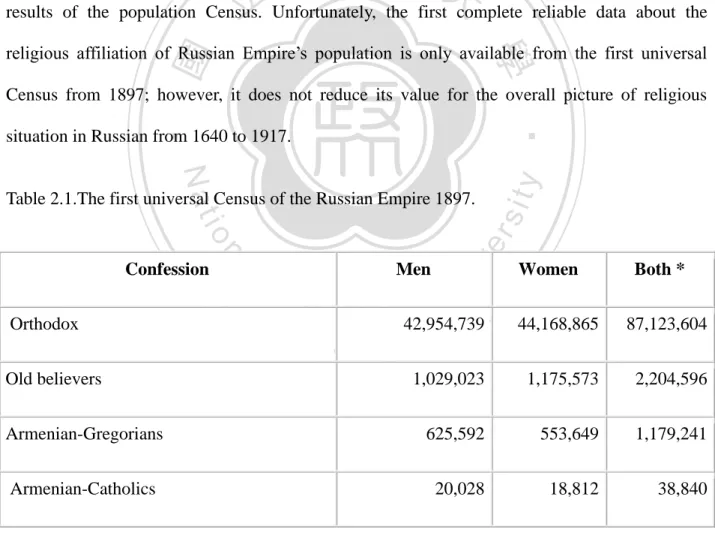
(32) 32 in the Republic of Kalmykia?. We suggest the hypothesis that the reason for religious tolerance and harmony in the Republic of Kalmykia can be found in the democratic features of Kalmyk Buddhism, its “democratic theology,” “democratic ecclesiology,” 100 and its interactions with the state.In order to explore Kalmyk Buddhism’s democratic features, we examine andanalyze the evolution of Kalmyk Buddhism over time, its interactions with the state and the laity, as well as its institutional structure.. 治 政 大 the socio-political matters as We take the attitude of the religious leaders and the sangha towards 立 an indicator for the political theology. At the same time, we assume that the code of laws and. ‧ 國. 學. rules of the sangha, and the laws of the central religious organizations are the valid indicators for. ‧. the religious polity of Kalmyk Buddhism. Additionally, we alsolook at Kalmyk Buddhist sangha involvement in the political contacts, as well as the use or not use of the Kalmyk Buddhist. y. Nat. er. io. sit. ceremonies for the political purposes, as an indicator for the political interactions between Kalmyk Buddhism and the Russian state.. n. al. Ch. engchi. i n U. v. Due to the lack of time and resources we were not able to conduct our own interviews, hence, we use as our primary data sources from National Archive of the Republic of Kalmykia, the official interviews of the religious leaders in the newspapers, news websites, and official webpage of the central Buddhist organization of KalmykiaGolden Adobe of Buddha Shakyamuni. Moreover, at our requests, the Shadzhin Lama (head lama) of Kalmyk people and the President of the Buddhist Union of Kalmykia Telo Tulku Rinpoche granted us with an access to the Charter of the Union, and the Charter of the Kalmyk Buddhist Monastery. 100. See Chapter 2.1..
(33) 33 Thus, we divide our data analysis in three dimensions:. (1) Political Theology of Kalmyk Buddhism. As political theology investigates the connections between religious and political ideas and practices, this dimension will deal with official statements of clergy on secular issues and the laws of monasteries and Buddhist organizations. We will also concentrate on the key points of the relationship between Buddhism, laity and the state. And in the end we will compare the. 政 治 大. results with the ideal of “democratic political theology”.. 立. (2)Religious Polity of Kalmyk Buddhism. ‧ 國. 學. In this dimension, we explore the way Kalmyk Buddhist organizations are governed, and. ‧. examine the role of monks in the Buddhist organizations, and the position of the laity therein. And in the end we will compare the results with the “democratic ecclesiology”.. sit. y. Nat. n. al. er. io. (3) Political Interactions between Kalmyk Buddhism and the Russian state,. Ch. i n U. v. Due to the peculiarity of Kalmyk state, namely, being part of the Russian state, and the. engchi. peripheral position of Buddhism in comparison to Russian Orthodox Christianity, this study will incorporate this dimension. It will study the political interactions between Kalmyk Buddhism and the Russian state, as well as the attitude of Kalmyk Buddhism, its organizations, and monks towards the central government of the Russian state..
(34) 34 Chapter3. Kalmyk Buddhism and the State from 1640 to 1917. 3.1. Religious Situation in the Russian Empire. During the time period under consideration religion played a significant role in Tsarist Russia. Although colonization and expansion politics made Russia into a religiously diverse country, the priority was still given to the religion of the majority population – Russian Orthodoxy. The state and the Church were interconnected, and it was difficult to draw a line between them. The. 治 政 大of loyal citizens. Orthodoxy was one of important instruments in the production 立. monarchs colonized new regions and expand Russian influence in the name of God, and 101. ‧ 國. 學. Starting from the Peter the Great until the October Revolution, the Russian Orthodox Church had an official status of a state department, which was administered by a secular bureaucracy, headed. ‧. by procurator, who as “an eye and ear of the tsar” controlled the Holy Synod and the whole. sit. y. Nat. church.102 Thereby, the Russian Orthodoxy became an official state religion, subordinated to the. n. al. er. io. state, and responsible for the legitimization of the Tsar’s authority.103 “The Tsar had come to be. i n U. v. considered a semi-sacrosanct personality with unlimited power, the earthy representative of God”.104. Ch. engchi. Despite the dominant position of Russian Orthodoxy, the laws of the Russian Empire allowed "people of other faiths, nonresident and foreign, the free exercise of their faith as worthy memory of the wise Russian princes, our ancestors and us have established and confirmed. All nations, staying in Russia, thank God almighty in different languages, according to the law and the 101. Kimmo Kaariainen, Religion in Russia after the Collapse of Communism: Religious Renaissance or Secular State(Lewiston, NY: E. Mellen Press, 1998), 11. 102 Bernard Pares, A History of Russia (London: Cape, 1947), 247. 103 Kaariainen, Religion in Russia after the Collapse of Communism,12 104 Kochan Lionel and Richard Abraham,TheMaking of Modern Russia(London: Penguin Books, 1962), 94..
(35) 35 profession of their forefathers, and our blessing reign mole Creator of the universe on the multiplication of prosperity and strengthening force the All-Russian Empire".105 This law was concerned the Russian citizens who were colonized by the Empire (like the subject of our research the Kalmyks), invited from abroad to inhabit the free lands, or were temporary serving the Russian crown. The fact that despite the obvious connection between the state and Russian Orthodoxy, the representatives of other religions had to pray for the Tsar, indicates that the need for acknowledgement of not only political, but also religious leadership of Russian monarch.. 政 治 大. In order to get an idea about the religious structure of Russian population, we should examine the. 立. results of the population Census. Unfortunately, the first complete reliable data about the. ‧ 國. 學. religious affiliation of Russian Empire’s population is only available from the first universal Census from 1897; however, it does not reduce its value for the overall picture of religious. ‧. situation in Russian from 1640 to 1917.. y. Nat. n. al. er. io Confession Orthodox. sit. Table 2.1.The first universal Census of the Russian Empire 1897.. Ch. Men. engchi. i n U. v. Women. Both *. 42,954,739. 44,168,865. 87,123,604. 1,029,023. 1,175,573. 2,204,596. Armenian-Gregorians. 625,592. 553,649. 1,179,241. Armenian-Catholics. 20,028. 18,812. 38,840. Old believers. 105. Alexander Gradovsky, Nachala Russkogo Gosudarstvennogo Prava (Principles of Russian State Law),vol. I-III”, (St. Petersburg: M. Stalusevich printing house, 1875 г. (volume I), 1876 г. (volume II), 1883 г. (volume III)), accessed February 19, 2014, http://constitution.garant.ru/science-work/prerevolutionar/3988988/chapter/29/#block_134600..
(36) 36 Roman Catholics. 5,686,361. 5,781,633. 11,467,994. Lutherans. 1,739,814. 1,832,839. 3,572,653. Calvinists. 42,877. 42,523. 85,400. Baptists. 18,372. 19,767. 38,139. Mennonites. 33,598. 32,966. 66,564. 2,042. 政 治 大 2,371. 2,141. 4,183. 1,581. 3,952. 6,372. 6,522. 12,894. 2,547,144. 2,668,661. 5,215,805. Anglicans. 立. Other-Christian believers. Total. 13,906,972. y. al. sit. 240,739. 193,124. 433,863. 144,983. 140,338. 285,321. 62,477,348. 63,162,673. 125,640,021. n Other non-Christians believers. 6,523,679. er. io. Buddhists and Lamaists. ‧. 7,383,293. Nat. Muslims. ‧ 國. Judaism. 學. Karaites. Ch. engchi. i n U. v. Pervaya Vseobshchaya Perepis' Naseleniya Rossiiskoy Imperii 1897 g. Raspredeleniye Naseleniya po Veroispovedaniyam i Regionam” (The First Universal Census of the Russian Empire in 1897 Population by Religions and Regions), Russkij Arkhipelag, accessed February 19,2014, http://www.archipelag.ru/ru_mir/religio/statistics/said/statistics-imp.. From the Census results we can see that despite the fact that majority of the population affiliated themselves with Orthodoxy, the religious composition of Russian Empire was far more complex.
(37) 37 than that.. As aforesaid, the Russian Orthodox Church was an official state department. However, in order to manage all confessions and make sure that the Orthodoxy remained the dominant religion, the Code of Laws of the Russian Empire allocated all confessions in the four hierarchical levels. Each of levels had its own scope of rights, privileges and restrictions. On the ground level the Russian Orthodox Church preserved its status of state religion with all the ensuing legal advantages. The second level of the legal hierarchy occupied so-called “recognized tolerant. 政 治 大. confessions”, which includes: the Catholicism, Protestantism, Armenian Gregorian and Armenian. 立. Catholic churches, Christian sects (Mennonites and Baptists). From the non-Christian faiths the. ‧ 國. 學. second stage also occupied Judaism, Islam, Buddhism, and Shamanism. The third category was represented by so called “unrecognized tolerated” religion – some religious sects and the Old. ‧. Believers. According to the official law the third category of religious believes did not exist, but. sit. y. Nat. was tolerated at the household level. The forth level belonged to “unrecognized intolerated”. n. al. er. io. confessions, which were categorized as state hostile, and persecuted by law.106. Ch. i n U. v. The state protection of the Orthodoxy was also expressed in the prohibition to the all other. engchi. religions to carry on missionary activities among the population. The violation of the rule by any religious entity or individuals was persecuted by Russian law. The legal barriers were also constructed to keep Orthodox believers in the Church, in the form of prohibition of conversion from the Russian Orthodoxy to any other non-Christian confession was illegal.107 Furthermore, the Christians were not allowed to marry non-Christians; and even in the mixed marriages with. 106. Fedor Kuliev, “Religioznyi Factor v Politike Rossiiskoi Imperii v Pervoi Polovine XIX v.” (Religious Factor in the Politics of the Russian Empire in the First Half of the XIX Century), in Nauchnye Problemy Gumanitarnyx Issledovanij, 11 (2009), 74-75. 107 Kaariainen, Religion in Russia after the Collapse of Communism, 15..
數據
Outline
Introduction
Literature Review on Religion and State Interactions
Research Methodology
Religious Situation in the Russian Empire
Political Theology of Kalmyk Buddhism
Religious Polity of Kalmyk Buddhism
Religious Situation in the Soviet Union
Political Interactions between Kalmyk Buddhism and the Russian state
Religious Situation in the Russian Federation
相關文件
好了既然 Z[x] 中的 ideal 不一定是 principle ideal 那麼我們就不能學 Proposition 7.2.11 的方法得到 Z[x] 中的 irreducible element 就是 prime element 了..
Wang, Solving pseudomonotone variational inequalities and pseudocon- vex optimization problems using the projection neural network, IEEE Transactions on Neural Networks 17
volume suppressed mass: (TeV) 2 /M P ∼ 10 −4 eV → mm range can be experimentally tested for any number of extra dimensions - Light U(1) gauge bosons: no derivative couplings. =>
We explicitly saw the dimensional reason for the occurrence of the magnetic catalysis on the basis of the scaling argument. However, the precise form of gap depends
Define instead the imaginary.. potential, magnetic field, lattice…) Dirac-BdG Hamiltonian:. with small, and matrix
incapable to extract any quantities from QCD, nor to tackle the most interesting physics, namely, the spontaneously chiral symmetry breaking and the color confinement..
• Formation of massive primordial stars as origin of objects in the early universe. • Supernova explosions might be visible to the most
Miroslav Fiedler, Praha, Algebraic connectivity of graphs, Czechoslovak Mathematical Journal 23 (98) 1973,
