Spin characteristics of excitonic absorption in multiply charged quantum dots
Shun-Jen ChengDepartment of Electrophysics, National Chiao Tung University, Hsinchu 300, Taiwan, Republic of China 共Received 10 July 2007; revised manuscript received 25 July 2007; published 16 August 2007兲
The excitonic absorption spectra of negatively charged self-assembled quantum dots as a function of resident electron number 共Ne= 0 – 5兲 are theoretically studied using the configuration interaction method. Spin Pauli
blockade, Coulomb共exchange and correlation兲 interactions, and symmetry of dot shape are identified as the three main underlying mechanisms, sensitively depending on Ne, in the spin characteristic spectra. In particu-lar, we predict that polarized absorption in triply charged dots exhibits anomalous spin-dependent features, resulting from the intrinsic correlations in charged exciton X−3.
DOI:10.1103/PhysRevB.76.075329 PACS number共s兲: 78.67.Hc, 71.35.Pq, 71.70.Gm, 72.25.Fe
I. INTRODUCTION
Spin in semiconductor quantum dots has drawn a great deal of attention for years in both applied and fundamental research. The preparation, storage, manipulation, and detec-tion of electron spin in charged quantum dots 共QDs兲 have been achieved only recently, relying on the spin-selective optical transitions involving both purely electronic states of interacting few electrons and excitonic states of charged excitons.1–4 For interacting few electrons 共neutral excitons兲 in QDs, Hund’s rules 共hidden symmetries兲 have been con-firmed as the underlying principle of the electronic 共exci-tonic兲 ground states.5,6Furthermore, recent advances in bias control of self-assembled quantum dots共SAQDs兲 have made it possible to unambiguously prepare and probe multiply charged excitons in individual SAQDs.7–16 Rich physics has been revealed in the measured emission spectra for nega-tively charged excitons X0– X−5 and the spin-selective ab-sorption for X0– X−2 in SAQDs.7,15,16 The experimental re-sults give significant implications for spin-based applications and stimulate great interest in the spin and optical properties of charge-tunable SAQDs.
In this work, we theoretically study the absorption spectra of multiply charged SAQDs as a function of charging elec-tron number Ne= 0 – 5 filling up to the p shell by using the
configuration interaction 共CI兲 method.17 The calculated re-sults account for the recently measured photoluminescence excitation spectra of singly charged SAQDs16and predict the spin and optical properties of multiply charged SAQDs. We find that the absorption spectra exhibit remarkable spin char-acteristics, sensitively depending on the number of charging electrons, and spin Pauli blockade, Coulomb共exchange and correlation兲 interaction, and symmetry of dot shape are iden-tified as the three main underlying mechanisms.
II. MODEL AND THEORY
For lens-shaped deformed SAQDs, the confining potential can be modeled by a two-dimensional anisotropic parabola,
Vas共x,y兲= m*
2关共x兲2x2+共y兲2y2兴, in terms of the two
oscilla-tor frequenciesxandy, where= e / h denotes the kind of particle 共electron or hole兲 and m* the effective mass of particle.18The asymmetric potential can be decomposed into two parts, Vas= Vs+␦V, i.e., the circularly symmetric
poten-tial Vs= 1 2m *¯  2共1+␥ 
2兲r2 characterized by the averaged os-cillator frequency¯⬅共x+y兲/2 and the deformation
po-tential given by ␦V共x,y兲=m*¯2␥
共x2− y2兲, where the parameter␥⬅共x−y兲/共x+y兲 is defined to measure the
extent of deformation. Throughout this paper, we consider
␥e=␥h=␥. Without deformation 共␥= 0兲, the single-particle
共SP兲 spectrum of a symmetric dot is the Fock-Darwin 共FD兲 spectrum, described by Enm =ប¯共n+m+1兲 for zero
mag-netic field, where n , m = 0 , 1 , 2 , . . . and=↑ /↓ denotes par-ticle spin. We approximate the valence hole states of the strained SAQDs to the pure heavy-hole ones with spin pro-jection jz= ± 3 / 2.19The angular momentum of an electron共a
valence hole兲 in the FD state 共n,m兲 is given by Lnme = m − n 共Lnm
h = n − m兲.
In the Fock-Darwin basis, we write the interacting e-h Hamiltonian for a charged SAQD subject to shape deforma-tion as H =
兺
i Ei e ci + ci+兺
i Ei h hi + hi−兺
ijkl Vijkl e-h ci + hj + hkcl 共1兲 +1 2兺
ijkl Vijkle-eci+cj+ckcl+ 1 2兺
ijkl Vijklh-hhi+hj+hkhl 共2兲 +兺
i⬘,i ⌬i⬘,i e ci+⬘ci+兺
i⬘,i ⌬i⬘,i h hi+⬘hi, 共3兲where i , j , k , l are composite indices of FD SP states, ci+共hi+兲 and ci 共hi兲 the operators of electron 共hole兲 creation and
an-nihilation operators, respectively, and Vijkl⬘ the Coulomb matrix elements.17 The last two terms arise from dot shape deformation, with the matrix elements ⌬i⬘,i ⬅兰drជi共rជ兲*␦V共rជ兲i共rជ兲. Because of the quadratic form of
␦V共rជ兲, ⌬i⬘,i⫽0 only if Li− Li⬘= 0 , ± 2. In this work, we focus
on the spin characteristics of the absorption spectrum of self-assembled QDs, typically resolvable at meV energy scale in experiments, as the fingerprint of the spin states of interact-ing charged excitons. We thus neglect the spin interaction mechanisms in SAQDs with a too weak relevant energy scale 共ⰆmeV兲, such as the spin-orbit and the hyperfine interactions.2,20–22 The extended states of wetting layers are not taken into account in calculations because the bound state transitions for InGsAs/ GaAs SAQDs considered in this
work are usually below the edge of the ones involving the extended states by some tens of meV.23,24The model based on the simplified electron-hole picture has been widely used and successfully accounted for many experiments for the studies of excitons in SAQDs.25 Throughout this work, we take the following parameters for InAs SAQDs: me
= 0.05m0, mh= 0.15m0, and e= 3h= 3Ry*, where Ry*
⬇3 meV is the effective Rydberg for InAs.
In numerical implementations of the CI method, we first generate all possible configurations of Ne electrons or X−Ne
charged exciton based on the three lowest shells, classified by total angular momentum L, projection of total electron spin Sz, and projection of hole spin jz, and then carry out
diagonalization for the Hamiltonian matrix.17 The spectrum of polarized absorption in a dot charged with Neelectrons is
evaluated by using Fermi’s golden rule,26 I ±共兲 =兺f兺i苸GS⬘s兩具X−Ne; f兩P±
+兩N
e; i典兩2␦共ប− Ef+ Ei兲, where the
in-terband polarization operator P++共P−+兲 for+ 共−兲 circularly polarized light is defined as P±+⬅兺nmhnmjz=±3/2
+
cnmsz=⫿1/2
+
, cre-ating a spin exciton with the projection of total spin angular momentum Mz⬅sz+ jz= + 1 共Mz= −1兲 and coupling the
charged dot from an Neelectron initial state 兩Ne; i典 to some
excited state of charged exciton兩X−Ne; f典. Charged dots are
assumed to be stable in the Ne-electron ground states 共GSs兲
prior to photoexcitation. In the following, we set the circular polarization of light to the+direction and analyze the po-larized absorption spectra for different possible spins of the GSs of charged dots.
III. RESULTS AND ANALYSIS
Figures1and2show the calculated+absorption spectra of symmetric charged dots with electrons Ne= 0 – 5. Figure
1共a兲shows the absorption spectrum of a neutral dot共Ne= 0兲,
characterized with three absorption lines, i.e., two main lines at E⬃0.51t and E⬃1.62t 关t⬅ប共e+h兲兴 corresponding to
the bright s-s and p-p transitions, respectively, and a weak line at E⬃1.2t corresponding to the transition involving the dark configuration hd0↑+ cs+↓兩0典, slightly coupled to the bright
one hp+±↑cp+±↓兩0典 via e-h Coulomb scatterings.26
The polarized absorption starts to exhibit some depen-dences on the spin states of a dot as it is singly charged 共Ne= 1兲 关see Fig.1共b兲兴. First, due to spin blockade 共SB兲, the
+ absorption line of the s-shell transition appears only for the dot charged with a spin-up
共
sz= +1
2
兲
electron at E ⬃0.46t.27While the spectrum of the p-shell absorption in the dot with sz= −1
2 electron is composed of a sole p-shell line at
E⬃1.49t, the spectrum for the dot with sz= +
1
2 electron is found to contain three main lines. In the former case, a+ absorption creates two electronic spin triplet共T兲 X−1 configu-rations,兩X−; t
a典=h+p−,↑c+p−,↓cs,+↓兩0典 and 兩X−; tb典=hp++,↑c+p+,↓cs,+↓兩0典. Via the e-h interaction Ve-hpp,x⬅Ve-hp±p⫿p⫿p±, the two coupled configurations generate a bright trion state of electronic spin triplet 兩X−; T−1典=共兩ta典+兩tb典兲/
冑
2 with eigenenergyE共X−1; T
−1兲=EGS1e+共Ep X
− Ve-hpp,x− Ve-esp,x兲, where EGS1e= E00
e
is the
Ne= 1 GS energy and Ep X
= Eep+ Eph− Ve-hpp,d共Ve-hpp,d⬅Vppppe-h 兲 is de-noted as the energy of a bare exciton on a p-shell state that is
further renormalized in the trion state by gaining the energies
Ve-esp,x= Vse-e±p⫿s⫿p±from the exchange interactions with the spin electron on s orbitals and Ve-hpp,xdue to configuration intermix-ing. The renormalization leads to the redshift ⌬E01= Ve-esp,x
+ Ve-hpp,x
共
=764冑3t⬇7.14 meV兲
of the main p-shell lines from E = 1.62t to 1.49t as the dot is loaded with electrons from Ne= 0→1, in agreement with the experiment in Ref.16.
For a singly charged dot with spin sz= +
1
2 electron, a+
p-shell absorption creates the two coupled configurations
with spins 共Sz= 0 , jz= + 3 / 2兲, 兩X−1; 1典=h+p−,↑cp+−,↓cs,+↑兩0典 and 兩X−1; 2典=h
p+,↑ +
cp++,↓cs,↑+ 兩0典. Furthermore, the two bright con-figurations are resonantly coupled to two other dark ones via
0 0.5 1 1.5 2 E/t σ+ light absorption σ+ light absorption a) ∆EST Sz e=1/2 Sz e=−1/2 σ +absorption(arb. units) b) ∆E01 c) 0e−>X0 1e−>X−1 2e−>X−2 T−1 S* T0 S + σ S* 0 S/T T0 T−1 σ+ σ+ EST ∆ σ+ (SB) σ+ s−shell p−shell exchange correl. S* (bright) (dark) (SB) (exchange) S −1 X (p−shell) −1 X (s−shell)
FIG. 1.共Color online兲 Polarized 共+兲 absorption spectra of sym-metric 共␥=0兲 charged SAQDs with resident electrons Ne= 0 – 2 关共a兲–共c兲兴 with all possible spin. The main configurations involved in the spin-selective transitions 1e→X−1and the energy levels of X−1 states with Sz= 0 vs Coulomb interactions are sketched beside the panel. The main underlying mechanisms共spin blockade, exchange, or correlation兲 in the spin characteristic spectra are denoted in the parentheses. Photon energies in the spectra are rescaled by t ⬅ប共e+h兲, the total kinetic energy of an e-h pair in the lowest
orbital state共t⬇37.7 meV for the SAQDs considered in this work兲. ⌬E01共⬇7.14 meV兲 denotes the redshift of the main p-shell lines as the dot is loaded with electrons from Ne= 0→1. The energy
sepa-ration between the S and T lines for X−1is⌬E
ST共X−1兲=2Vsp,x= 冑3
8t ⬇8.16 meV, in agreement with the measurement in Ref.16.
0.5 1 E/t 1.5 2 σ+ light absorption σ+ light absorption a) Sze =+1/2 Sz e =−1/2 Sze=+1 T0 S Sz e =+1/2 Sze =−1/2 T−1 σ + absorption(arb. units) b) Sze =0 c) 3e−>X−3 4e−>X−4 5e−>X−5 p−shell Sze =−1 X (p−shell)−3 T−1 σ+ S/T0 S/T σ+ (SB) X (p−shell)−5 ST ∆E ~0 (SB) (SB) (Correlation) S/T 0 σ+ correl. exchange
FIG. 2.共Color online兲 Same as Fig.1but for Ne= 3 – 5. Note that
共unlike X−1兲 the S and T states of X−3 are nearly degenerate 关⌬EST共X−3兲⬃0兴.
e-e exchange interaction Ve-esp,x, 兩X−1; 3典=h p−,↑ + cp+−,↑cs,↓+ 兩0典 and 兩X−1; 4典=h p+,↑ +
cp++,↑cs,+↓兩0典. In the basis of the even-parity con-figurations, 兩X−1; a +典=共兩X−1; 1典+兩X−1; 2典兲/
冑
2 and 兩X−1; b +典 =共兩X−1; 3典+兩X−1; 4典兲/冑
2, we have the 2⫻2 Hamiltonian ma-trix冋
Ep X + Es e − Ve-hpp,x − Ve-esp,x − Ve-esp,x Ep X + Es e − Ve-hpp,x册
, 共4兲 and the two trion eigenstates, both of which are optically active, i.e., a singlet 共S兲 state 兩X−1; S典=共兩X−1; a +典−兩X−1; b +典兲/冑
2 and a T one兩X−1; T0; +典=共兩X−1; a +典+兩X−1; b +典兲/
冑
2, possessing the eigenenergies E共X−1; S兲=EGS
1e+共E
p X
− Ve-hpp,x + Ve-esp,x兲 and E共X−1; T
0兲=EGS
1e+共E
p X
− Ve-hpp,x− Ve-esp,x兲, respectively. The two main lines shown in Fig. 1共b兲 at E⬃1.69t and E ⬃1.49t, respectively, correspond to the bright S and T states, separated in energy by 2Vsp,x
共
=冑38t⬇8.16 meV
兲
. In addition, the bright S state 兩X−1; S典 is nonresonantly coupled to the dark S configuration兩X−1; S*典=h d0,↑ + c s,↓ + c s,↑+ 兩0典 with the same total orbital and spin angular momenta via Coulombic e-h scattering. That induces the weak line at E⬃1.32t, denoted by S* in Fig. 1共b兲. As a result, the + p-shell absorption
pattern for Ne= 1 dots with Sz= +
1
2 is composed of three main lines, in agreement with the experimental observation in Ref.16.
For an Ne= 2 dot with closed s shell, the absorption
spec-trum is simply composed of a sole peak corresponding to the
p-shell transition, as shown in Fig.1共c兲. The s-shell
absorp-tion, absent in Fig. 1共c兲, is actually forbidden for all dots with Ne艌2 because of Pauli blockade.
So far, we have seen two underlying physics in the spin characteristic absorption for dots with Ne艋2, i.e., the spin
Pauli blockade共SB兲 and Coulomb exchange interaction. In our studies, we confirm that SB determines the spin charac-teristics of polarized absorption for the dots filled with elec-trons on a shell equal to or more than the shell orbital de-generacy, e.g., the s-shell absorption for Ne= 1关see Fig.1共b兲兴
and the p-shell absorption for Ne= 4 , 5 关see Figs. 2共b兲 and
2共c兲兴. In contrast, as a dot is filled with electrons less than the
shell orbital degeneracy, e.g., the p-shell absorption for dots with Ne= 1 and Ne= 3 关Figs.1共b兲 and2共a兲兴, there exists no
SB, and Coulomb interactions may play a key role.
Now, let us proceed to study the case of Ne= 3. Following
Hund’s rules, a GS of Ne= 3 dot consists of a pair of spin
antiparallel electrons on the s orbital and a p-shell electron with up or down spin. Like Ne= 1 dots, a triply charged dot
provides a net spin Sz= ±
1
2 to interact with spin exciton cre-ated by polarized absorption. Thus, one might expect some similar features of the absorption spectra for both Ne= 1 and
Ne= 3 cases.
For an Ne= 3 dot with Sz= −
1
2, a + p-shell excitation
pumps the dot in one of the doubly degenerate T X−3 states,
h+p−,↑c+p+,↓cp+−,↓兩2e;GS典 or hp++,↑c+p+,↓cp+−,↓兩2e;GS典, with the en-ergy E = EGS3e+ Ep
X
− Vsp,x− Vpp,x. As shown in Fig.2共a兲, its ab-sorption spectrum does show a similarity to that for Ne= 1
dot with the same spin Sz= −
1
2 关see Fig. 1共b兲兴, containing only one main p-shell line共T−1兲 corresponding to the T state.
Such a similarity however, is not seen in the absorption spectra for the Ne= 1 and Ne= 3 dots with up spin Sz= +
1 2. In both cases, +-excited dots could be in the states of X−1 or
X−3with electronic S or T spins. As discussed previously, the
S and T X−1 states are energetically separated by e-e
ex-change interaction 2Vsp,x. Surprisingly, the S and T states of
the X−3 complex in a+-excited dot are found to be nearly degenerate. Consequently, one sees only a single main line, a doublet for the S and T states, at E⬃1.43t in the spectrum of Fig. 2共a兲. For more illustration, we perform the following analysis.
Taking the three coupled low lying X−3 configurations into account, 兩X−3; 1典=h p−↑ + cp++↑cp+−↓兩2e;GS典, 兩X−3; 2典 = hp−↑ + cp+↓ + cp−↑ + 兩2e;GS典, and 兩X−3; 3典=h p+↑ + cp+↓ + cp+↑ + 兩2e;GS典, we have a T eigenstate given by 兩X−3; T典=共兩X−3; 1典 +兩X−3; 2典兲/
冑
2 and two S states, obtained by diagonalizing the Hamiltonian matrix in the basis of S configuration, 共兩X−3; 1典−兩X−3; 2典兲/冑
2 and兩X−3; 3典,冋
EGS3e + Ep
X
− Ve-esp,x+ Ve-epp,x −
冑
2Ve-hpp,x −冑
2Ve-hpp,x EGS3e + EpX
− Ve-esp,x
册
. 共5兲 The e-h interactions in the off-diagonal parts lead to the in-termixing of the S configurations and shifts the energy of the lower state down to ES1= EGS3e+ E p X − Vsp,x− V e-h pp,x. Thus, the
low S state becomes degenerate to the T GS if the dot pos-sesses a hidden symmetry共leading to Ve-epp,x= Ve-hpp,s兲, which has been previously evidenced in photoluminescence spectros-copy studies for some SAQDs.6Here, we see that the hidden symmetry results in the single S and T doublet line of polar-ized absorption and removes the spin dependence of absorp-tion spectra for triply charged dots.
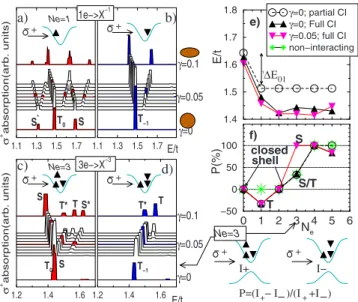
Nevertheless, slight deformations in SAQDs create addi-tional spin dependences of the absorption spectra.18Figure3 shows the + absorption spectra for asymmetric Ne= 1 dots
and Ne= 3 dots with spin Sz= ±
1
2 and␥= 0 , 0.01, . . . , 0.1. The deformation␦V共rជ兲 in the quadratic form opens the channels
of particle transferring between the orbitals differing in L by 0 , ± 2 共e.g., between the p+ and p− orbitals兲. For electronic
S states of X−3, the bright main configurations
h+p−↑c+p−↓cp+−↑兩2e;GS典 for the line labeled by S in Fig. 3共c兲 become coupled to other dark S ones with 兩⌬L兩=2 共e.g., hp++↑c+p−↓cp+−↑兩2e;GS典, hp+−↑cp++↓cp+−↑兩2e;GS典,...兲. The deformation-induced configuration intermixing lowers the bright S GSs and separates it from the T0state. Moreover, it gives rise to the line involving those dark S states, labeled by
S*in Fig.3共a兲. Likewise, the p-shell absorption lines for the
S and T X−1 trions in which the p shell is also singly
occu-pied by an electron or a hole is split into two with finite␥ 关see Figs.3共a兲and3共b兲兴.
In contrast, a weak deformation does not give rise to any new absorption line for T X−3 states. This is because the T
X−3 states must have the total electronic angular momentum
Le= 0 and deformation breaks the conservation of angular momentum. We see that there exists only one absorption line for the T X−3 states in Figs. 3共b兲 and3共c兲as ␥⬍0.05. As a result, the polarized absorption spectra for Ne= 3 dots subject
to a slight deformation exhibit remarkable spin dependence, in contrast to the spin insensitivity of the spectra of symmet-ric Ne= 3 dots.
Figure 3共e兲shows the energies of the p-shell absorption lines of charged dots at the highest intensities as a function of Ne and Fig. 3共f兲 shows the corresponding degree of
circular polarization, defined as P⬅共I+− I−兲/共I++ I−兲, to the main lines. For noninteracting dots, we derive P
= 0 , 33.3% , 100% for Ne=兵0,1,2其,兵3其,兵4,5其, respectively.
Turning on Coulomb interactions, the degree of polarization for Ne= 1 is changed from 0 to −33.3%. The negative finite
P = −33.3% for X−1 results from the Coulomb exchange that
splits the T and S states and decreases the intensity of the main line T0to half of the line T−1关see Fig.3共b兲兴. The P for
Ne= 3, however, remains unchanged because of the
degen-eracy of the S and T X−3 GSs, resulting from the intrinsic correlation in X−3. With deformation, the P for N
e= 3
abruptly increases from 33.3% to almost 100%, indicating the well resolved spin characteristic absorption pattern for
X−3.
IV. SUMMARY
In summary, we present theoretical studies of polarized absorption in charge-tunable SAQDs with resident electrons filling up to the p shell. Spin Pauli blockade, Coulomb ex-change and correlation, and symmetry of dot shape are iden-tified as the three main underlying mechanisms in the spin characteristic absorption. We point out that triply charged excitons in SAQDs possess intrinsic correlated nature and exhibit anomalous spin-related features of polarized absorp-tion.
ACKNOWLEDGMENTS
This work was supported by the National Science Council of Taiwan under Contract No. NSC-95-2112-M-009-033-MY3. S.J.C. thanks Wen-Hau Chang 共NCTU兲 for valuable discussions.
1S. Cortez, O. Krebs, S. Laurent, M. Senes, X. Marie, P. Voisin, R. Ferreira, G. Bastard, J. M. Gerard, and T. Amand, Phys. Rev. Lett. 89, 207401共2002兲.
2V. Cerletti, W. A. Coish, O. Gywat, and D. Loss, Nanotechnology 16, R27共2005兲.
3A. Imamoglu, D. D. Awschalom, G. Burkard, D. P. DiVincenzo, D. Loss, M. Sherwin, and A. Small, Phys. Rev. Lett. 83, 4204 共1999兲.
4X. Li, Y. Wu, D. Steel, D. Gammon, T. H. Stievater, D. S. Katzer, D. Park, C. Piermarocchi, and L. J. Sham, Science 301, 809 共2003兲; M. Atature, J. Dreiser, A. Badolato, A. Hogele, K. Kar-rai, and A. Imamoglu, ibid. 312, 551共2006兲; J. Berezovsky, M. H. Mikkelsen, O. Gywat, N. G. Stoltz, L. A. Coldren, and D. D. Awschalom, ibid. 314, 1916共2006兲; M. Kroutvar, Y. Ducom-mun, D. Heiss, M. Bichler, D. Schuh, G. Abstreiter, and J. J. Finley, Nature共London兲 432, 81 共2004兲.
5S. M. Reimann and M. Manninen, Rev. Mod. Phys. 74, 1283 共2002兲.
6M. Bayer, O. Stern, P. Hawrylak, S. Fafard, and A. Forchel, Na-ture共London兲 405, 923 共2000兲, and references therein.
7R. J. Warburton, C. Schaflein, D. Haft, F. Bickel, A. Lorke, K. Karrai, J. M. Garcia, W. Schoenfeld, and P. M. Petroff, Nature 共London兲 405, 926 共2000兲.
8K. Karrai, R. J. Warburton, C. Schulhauser, A. Hogele, B. Ur-baszek, E. J. McGhee, A. O. Govorov, J. M. Garcia, B. D. Ger-ardot, and P. M. Petroff, Nature共London兲 427, 135 共2004兲. 9E. A. Stinaff, M. Scheibner, A. S. Bracker, I. V. Ponomarev, V. L.
Korenev, M. E. Ware, M. F. Doty, T. L. Reinecke, and D. Gam-mon, Science 311, 636共2006兲.
10F. Findeis, M. Baier, A. Zrenner, M. Bichler, G. Abstreiter, U. Hohenester, and E. Molinari, Phys. Rev. B 63, 121309共R兲 共2001兲.
11L. Besombes, J. J. Baumberg, and J. Motohisa, Phys. Rev. Lett. 90, 257402共2003兲.
12F. Guffarth, R. Heitz, A. Schliwa, O. Stier, M. Geller, C. M. A. Kapteyn, R. Sellin, and D. Bimberg, Phys. Rev. B 67, 235304 共2003兲.
13B. Urbaszek, R. J. Warburton, K. Karrai, B. D. Gerardot, P. M. Petroff, and J. M. Garcia, Phys. Rev. Lett. 90, 247403共2003兲. 14A. S. Bracker, E. A. Stinaff, D. Gammon, M. E. Ware, J. G. 1.2 1.4 1.6 1.2 1.4 1.6 sez=−2*0.5;shz=+0.5 T0 S T−1 3e−>X−3 E/t γ=0.1 γ=0.05 γ=0 S* T* T* S T T σ + absorption(arb. units) 1.1 1.3 1.5 1.7 1.1 1.3 1.5 1.7 1e−>X−1 E/t γ=0 γ=0.1 γ=0.05 S* σ + absorption(arb. units) T0 S T−1 0 1 2 3 4 5 6N e −50 0 50 100 1.4 1.5 1.6 1.7 1.8 γ=0; partial CI γ=0; Full CI γ=0.05; full CI non−interacting e) f) S S/T Vsp,x+Vpp,x closed shell T E/t P(%) + I− + I+ + + + + P=(I − I )/(I +I )+ − + − a) c) d) b) Ne=3 Ne=1 Ne=3 E01 ∆
FIG. 3. 共Color online兲 Spin-dependent polarized+ absorption spectra of singly charged SAQDs with spins共a兲 Sz=
1
2 and 共b兲 Sz
= −12and triply charged dots with共c兲 Sz=
1
2and共d兲 Sz= −
1
2subject to different shape deformations 共␥=0,0.01, ... ,0.1兲. 共e兲 Energies of the p-shell absorption lines at the highest intensity of charged dots as a function of Ne. 共f兲 Degree of circular polarization P of the absorptions at the energies shown in共e兲 for Necharged dots. Open
circles: results calculated by using partial CI method, in which only the resonantly coupled configurations with the lowest total kinetic energies are taken into account. Up共down兲 filled triangles: results calculated by using full CI method based on the three lowest elec-tronic shells for interacting symmetric共asymmetric兲 charged dots.
Tischler, A. Shabaev, Al. L. Efros, D. Park, D. Gershoni, V. L. Korenev, and I. A. Merkulov, Phys. Rev. Lett. 94, 047402 共2005兲.
15S. Laurent, B. Eble, O. Krebs, A. Lemaitre, B. Urbaszek, X. Marie, T. Amand, and P. Voisin, Phys. Rev. Lett. 94, 147401 共2005兲.
16M. E. Ware, E. A. Stinaff, D. Gammon, M. F. Doty, A. S. Bracker, D. Gershoni, V. L. Korenev, S. C. Badescu, Y. Lyanda-Geller, and T. L. Reinecke, Phys. Rev. Lett. 95, 177403共2005兲; M. E. Ware, A. S. Bracker, E. Stinaff, D. Gammon, M. F. Doty, D. Gershoni, and V. L. Korenev, Physica E共Amsterdam兲 26, 55 共2005兲.
17S. J. Cheng and P. Hawrylak, Phys. Rev. B 73, 035326共2006兲. 18D. Chithrani, M. Korkusinski, S. J. Cheng, P. Hawrylak, R. L.
Williams, J. Lefebvre, P. J. Poole, and G. C. Aers, Physica E 共Amsterdam兲 26, 322 共2005兲.
19W. Sheng, S. J. Cheng, and P. Hawrylak, Phys. Rev. B 71, 035316共2005兲.
20The spin-orbit and Hyperfine interactions are negligible to the optical spectroscopy discussed here because the energy scale 共Ⰶ10−1meV兲 of the interactions 共Ref.2兲 is much smaller than
the resolution of the conventional spectroscopy共⬎10−1meV兲. Nevertheless, the spin interactions might significantly affect the coherence and dynamical properties of excitons in self-assembled quantum dots共Ref.22兲.
21M. Florescu and P. Hawrylak, Phys. Rev. B 73, 045304共2006兲. 22R. Oulton, A. Greilich, S. Yu. Verbin, R. V. Cherbunin, T. Auer,
D. R. Yakovlev, M. Bayer, I. A. Merkulov, V. Stavarache, D. Reuter, and A. D. Wieck, Phys. Rev. Lett. 98, 107401共2007兲. 23G. A. Narvaez and A. Zunger, Phys. Rev. B 74, 045316共2006兲. 24A. Vasanelli, R. Ferreira, and G. Bastard, Phys. Rev. Lett. 89,
216804共2002兲.
25P. Hawrylak and M. Korkusinski, in Single Quantum Dots: Fun-damentals, Applications, and New Concepts, edited by P. Michler, Topics in Applied Physics Vol. 90 共Springer-Verlag, Berlin, 2003兲, pp. 25–92.
26P. Hawrylak, G. A. Narvaez, M. Bayer, and A. Forchel, Phys. Rev. Lett. 85, 389共2000兲.
27A. Hogele, M. Kroner, S. Seidl, K. Karrai, M. Atatüre, J. Dreiser, A. Imamoglu, R. J. Warburton, A. Badolato, B. D. Gerardot, and P. M. Petroff, Appl. Phys. Lett. 86, 221905共2005兲.