行政院國家科學委員會專題研究計畫 成果報告
地震波傳遞和全球走時層析成像:香蕉-甜甜圈理論(II)
計畫類別: 個別型計畫 計畫編號: NSC91-2119-M-002-027- 執行期間: 91 年 08 月 01 日至 92 年 07 月 31 日 執行單位: 國立臺灣大學地質科學系暨研究所 計畫主持人: 洪淑蕙 計畫參與人員: 喬凌雲 報告類型: 精簡報告 報告附件: 出席國際會議研究心得報告及發表論文 處理方式: 本計畫可公開查詢中 華 民 國 93 年 2 月 11 日
行政院國家科學委員會補助專題研究計畫成果報告
※※※※※※※※※※※※※※※※※※※※※※※※※※
※ ※
※地震波傳遞和全球走時層析成像:香蕉-甜甜圈理論 (II) ※
※ ※
※※※※※※※※※※※※※※※※※※※※※※※※※※
計畫類別:ˇ個別型計畫 □整合型計畫
計畫編號:NSC 91-2119-M-002-027
執行期間: 91 年 8 月 1 日至 92 年 7 月 31 日
計畫主持人:洪淑蕙
共同主持人:
計畫參與人員:喬凌雲
本成果報告包括以下應繳交之附件:
□赴國外出差或研習心得報告一份
□赴大陸地區出差或研習心得報告一份
ˇ出席國際學術會議心得報告及發表之論文各一份
□國際合作研究計畫國外研究報告書一份
執行單位:台灣大學地質科學系
中 華 民 國 92 年 10 月 29 日
中文摘要
此研究結合長周期(25 秒為主)的波形所測量的 S-SKS 和 ScS-S 對於標準一維地球模型 PREM 的走時差殘餘值,共同推演地涵最底部 500 公里的三維速度構造。由於地震波僅具有限頻寬, 波相走時除了受構造的速度變化影響之外,還會因有限頻寬的繞射現象,造成波前後復原的 現象。因此根據層析成像原理,除了以假設地震波為無限高頻的一維線性波線理論來正演波 相走時和震波速度構造的關係之外,此研究並採用近年來新發展的香蕉甜甜圈理論作為建立 反演資料核(data kernel)的依據,因該論正確地考慮走時受波前復原影響的效應,將有助於改 善全球核涵邊界的解析度。同時,在模型參數化的技術上易加入多重尺度解析的觀念,由走 時資料本身採樣疏密的程度,客觀評析對毎一區域速度構造解析的能力。研究結果發現以有 限頻寬算核所得的層析成像模型,其剪力波的側向速度異常強度要比以傳統波線理論求得的 模型要大至兩倍左右。顯示過去對核涵邊界 D”層不均質的程度可能低估,連帶可能影響該層 溫度、化學組成以及動力學上的解釋。D”層速度構造以 Degree 2 的變化為主,在中太平洋 和非洲底下各出現慢的速度異常,地表熱點火山活動的位置大致落於這些區域,環太平洋區 域則是相對快速異常的區域,顯示和隱沒的古海洋板塊物質有關。關鍵詞:
有限頻寬走時層析成像、剪力波異常、核涵邊界、D”層、多重尺度模型參數化。Abstract.
We present the global distribution of shear velocity heterogeneity in the lowermost 500 km of the mantle derived from a joint inversion of differential S (or diffracted S)-SKS and ScS-S travel-time residuals measured by long-period waveforms dominant at 25 s. Fréchet or banana-doughnut kernel theory is utilized to forward modeling of finite-frequency travel-time measurements. A model parameterization based on a multiresolution wavelet representation is implemented to inversely solve for spatial variations in mantle shear wavespeed perturbations. The resolved velocity heterogeneity strength is about twice as much as that in the previous modelconstrained by similar dataset but ray-obtained tomography. Surface hotspots in the Central Pacific and the Indian-Africa are correlated with deep-rooted mantle plumes located within or on the edge of broad, low-velocity D" regions. Relatively fast velocity structures that underlie beneath the Circum-Pacific Rim are associated with ancient cold subducted materials.
Key words:
finite-frequency traveltime tomography, shear velocity heterogeneity, core-mantle boundary, D” layer, multiscale model parameterization1. Introduction
Lateral variation in shear velocity perturbations near the core-mantle boundary (CMB) or in D'' zone has been unraveled exclusively by the traveltimes of diffracted S waves. From an
infinite-frequency ray-theoretical point of view, the Sd wave emerging in the core shadow uniquely samples the grazing ray segment along the CMB. Synthetic experiment suggests that the
traveltime shift measured by an actual finite-frequency wave can differ substantially from the
prediction of ray theory because of intrinsic wavefront healing effects (Hung et al., 2001; Baig et al., 2001). Lately Fréechet kernel theory based on Born single scattering approximation has been developed to correct such deficiency (Dahlen et al., 2000; Zhao et al., 2000). A S traveltime residual yields unexpectedly zero sensitivity right on the geometrical raypath; rather, it is most sensitive to the surrounding off-path heterogeneity. The SHd traveltime kernel exhibits even paradoxical features on the CMB where the Sd ray glides; it has the opposite (or positive) sign suggesting that a Sd arrival could speed up by a slow anomaly at the CMB.
Constrained mostly by compelling seismic evidence, the remote D'' zone is thought to be one of the most heterogeneous and dynamic region in the earth's interior. Recent ray-based
tomographic inversion of long-period differential S(or Sd)-SKS traveltimes revealed a global
distribution of anomalous D'' shear velocity on the scale length > ~1000 km (Kuo et al., 2000). To assess the potential bias of the resolved D'' structure due to inadequate interpretation of
finite-frequency arrivals, we conduct a tomographic study of global mantle shear velocity heterogeneity using both 1-D ray theory and 3-D banana-doughnut kernels. A
computationally-efficient paraxial formulation based upon body-wave propagation together with full wave theory is implemented to construct the kernels for finite-frequency differential traveltime measurements. We discuss the difference among the resulting models as a result of wave diffraction and model parameterization.
2. Data and Method
Prior to differential traveltime measurements, all the teleseismic broadband waveforms are filtered to the LP response of the GDSN (Global Digital Seismic Network) data. Differential S (or Sd)-SKS and ScS-S traveltimes relative to the arrivals predicted by 1-D reference PREM model are determined by shifted time lags required to match the initial swing of the waveforms in a pair of phase arrivals. For a given differential traveltime residual δ that relates to shear velocity t
perturbation in the mantle, the conventional ray-theoretical formulation is simply
∫
⎜⎜⎝⎛ − ⎟⎟⎠⎞⎜⎜⎝⎛ ⎟⎟⎠⎞ = ray dl t β δβ β δ 1 , (1)that is, integral of the slowness (or the reciprocal of velocity) perturbation, δβ β, along the geometrical ray path in the radially-symmetric PREM model. On the other hand, finite-frequency kernel theory expresses the relation between δt and δβ β in a 3-D volumetric integral within the Earth's mantle, Ω (e.g., Dahlen et al., 2000),
(
)
∫
Ω = K r dV t β δβ φ θ δ , , (2)With (r,θ,
φ
) denoting the 3-D spherical coordinates, K represents the kernel function and δβ β is the shear velocity perturbation at (r,θ,φ
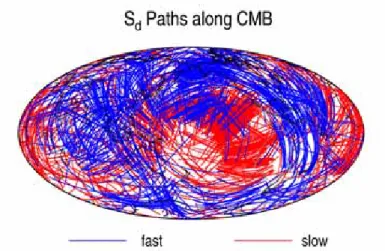
) within an infinitesimal volume, dV. In practice, numerical integration of eq (2) within a single voxel is achieved by the weighted sum of limited sampling points according to the Gaussian quadrature formulation (e.g., Zienkiewicz and Taylor, 1989). Contribution from all voxels are then summed up to form the data equation of the form,. j ij i i d G m t = = δ (3) Our data used for multiscale finite-frequency tomography consists of 1568 S-SKS residuals compiled by Kuo et al. (2000) who grouped the residuals from redundantly sampled regions to minimize uneven path coverage (Figure 1a). Additional 8256 ScS-S residuals from Masters et al. (2000) are also included in the traveltime inversion (Figure 1b).
Figure 1. (a) Segments of Sd ray paths within a 250-km-thick D'' layer. Red colors represent positive Sd-SKS residuals or slower differential arrivals relative to those in the PREM model, while blue colors are negative residuals or relatively faster arrivals.
Figure 1(b). The 2o cap-averaged ScS-S residuals showing long-wavelength velocity variations in the reflection points.
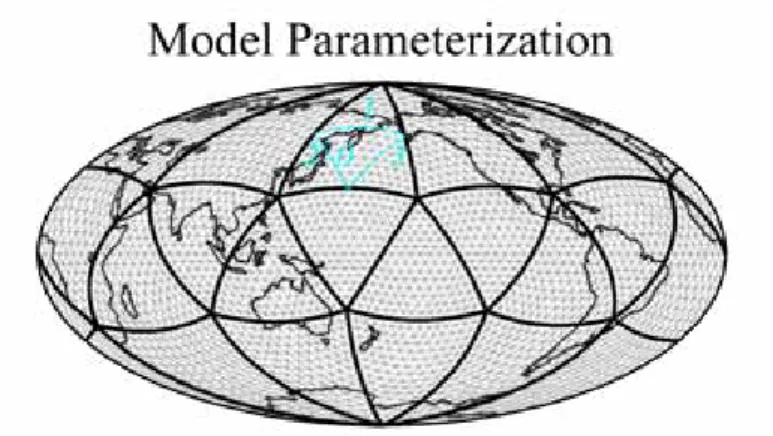
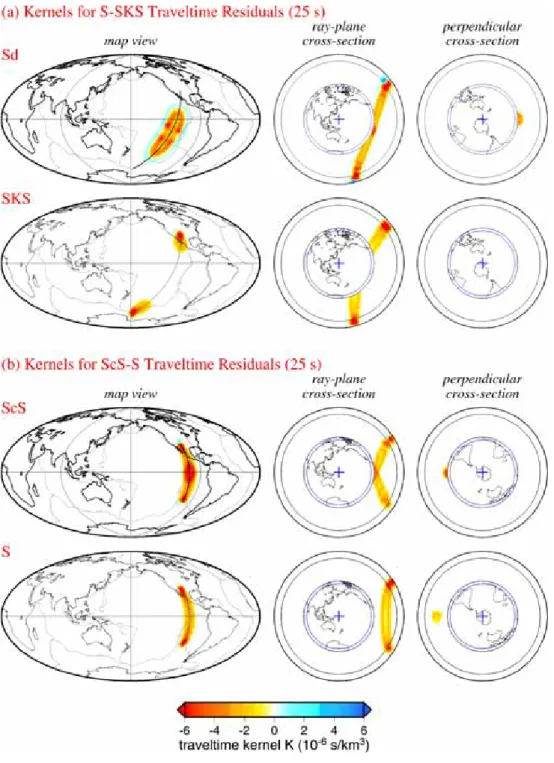
Figure 2 shows cross-sectional views of the 3-D sensitivity kernels for an example Sd-SKS and ScS-S residual measurement. The whole mantle is divided into 32 equally-spacing layers in radial direction and 5120 almost equal-area spherical triangles in lateral dimensions. Shear velocity perturbations are parameterized in terms of spherical blocks and multiscale representation that invokes the biorthogonal generalized Harr wavelets on a sphere (Chiao and Kuo, 2001; Chiao and Liang, 2002) (Figure 1c).
Figure 1(c). Model parameterization used in the traveltime tomography. Construction of spherical wavelets starts with a regular geodesic polyhedron (e.g., icosahedron) and successive refinement by subdividing each spherical triangle into four children up to the refinement level 5. It leads to totally 5120 spherical triangles.
Figure 2. (a) Finite-frequency traveltime kernels for Sd and SKS waves with a dominant period of 25 s at an epicentral distance ∆=114o. The kernel for a differential Sd-SKS traveltime residual is the difference of the individual Sd and SKS kernels. On map view shows the Sd kernel near CMB. (b) Finite-frequency traveltime kernels for ScS and S waves with a dominant period of 25 s at an epicentral distance ∆=71 o . The kernel for a ScS-S residual is the difference of the individual ScS and S kernels. The maximum amplitude of the kernel is projected on map view.
3. Result
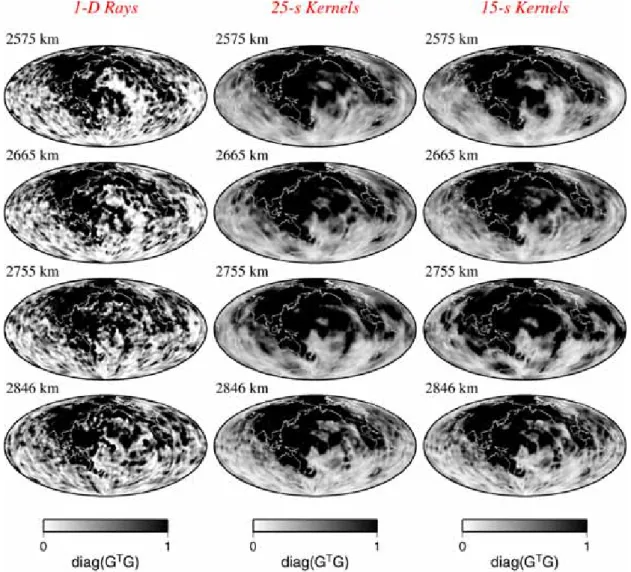
Because the sensitivity kernel K in eq~(2) is founded on the assumption that a differential traveltime residual is measured by cross-correlation of two observed waveform pulses, slightly different from the initial-swing time-shift measurements used for the S-SKS and ScS-S data. The latter approach is introduced by Masters et al., (1996) to improve the effective spatial resolution their traveltime measurements, by emphasizing the high-frequency components of an observed pulse. Hung et al., (2001) conducted a synthetic test of the traveltime shifts induced by a single spherical velocity anomaly and made comparison of the measurements obtained from these two methods. They found that the first-swing measurements did reduce the effects of wavefront healing; thereby reducing ~60% in the effective period, from 25 s to 15 s. Therefore, we present the finite-frequency tomographic models obtained with the traveltime sensitivity derived from the 25-s and 15-s kernels. Figure 3 compares relative sampling density among these three data kernels, that is, linearized ray, 25-s kernel and 15-s kernel.
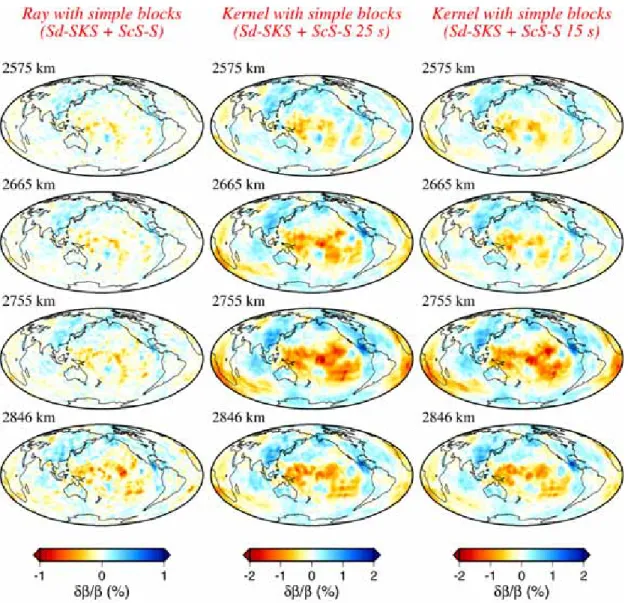
Figure 4 compares shear velocity perturbations in the lowermost mantle obtained with infinite-frequency ray and 25-s and 15-s finite-frequency tomography. All the three models are parameterized by spherical triangular blocks. Obviously, the velocity variation in the ray-based model tends to be restrained on the unevenly-sampling raypaths and yields many short-wavelength, rough features superimposed on a dominant degree 2 pattern. The power spectrum is substantially lost in the damped least-squares solution to maintain the spatial resolution. Because of the natural widespread off-path sensitivity for finite-frequency traveltimes, the kernel-derived model is comparatively smoother. Moreover, the 3-D kernels account for wavefront healing and other finite-frequency diffractive effects; thus the magnitude of resolved velocity perturbations increases by a factor of 2.
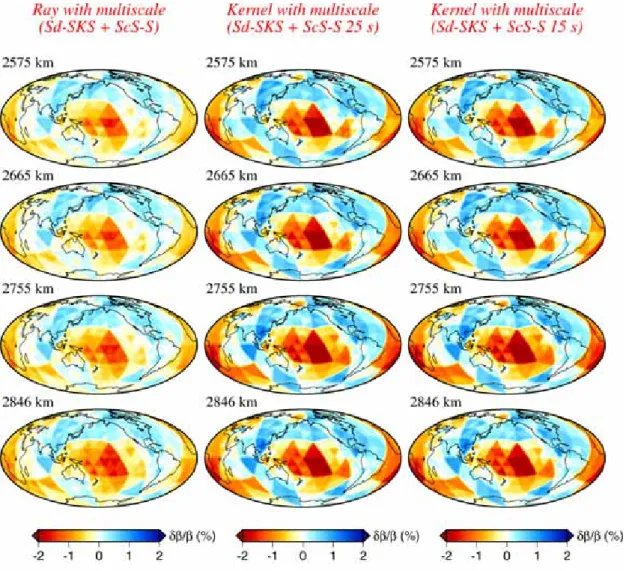
Figure 5 uses the same data kernels as those in Figure 4, while the model is alternatively parameterized in terms of multiresolution representation using spherical Harr wavelets. The wavelet-based multiscale parameterization builds a natural regularization scheme based on actual
raypath sampling to extract well-constrained structures without sacrificing the spectral resolution. Therefore, S-wave velocity structure near the CMB is dominated by lateral variations in degree 2 with the relatively slow anomaly beneath the Central Pacific and Africa surrounded by the fast anomaly.
Figure 4. Comparison of shear velocity perturbations near CMB resolved from traveltime tomography. The data kernel that governs the relation between model (velocity or slowness perturbation) and data (residuals) is built based upon ray theory and 3-D kernels of a
finite-frequency wave with a dominant period of 25 and 15 s. All the three models are parameterized by spherical blocks or pixels.}
Figure 5. Comparison of shear velocity perturbations near CMB resolved from ScS-S and S-SKS traveltime tomography. The data kernel is constructed in the same way as that done in
block-based inversion, while the model is alternatively parameterized in terms of multiresolution representation using spherical Harr wavelets.
4. Conclusion
Several conclusions can be drawn in this study:
1. Given similar variance reductions, the 3-D kernel inversion yields smoother models with much larger velocity perturbations. than those ray-based models.
2. The smoothing may arise from the off-path sensitivity of actual finite-frequency traveltimes as revealed from the 3-D kernel. The whole mantle heterogeneity inferred from all the contemporary 3D earth models is probably underestimated because wavefront healing is completely neglected in
the ray approach.
3. Multiscale inversions suggest that the current S (or Sd)-SKS and ScS-S residuals only resolve the robust features in long-wavelength, degree 2 variations.
References
Baig, A.M., F.A. Dahlen, and S.-H. Hung, Traveltimes of waves in three-dimensional random media, Geophys. J. Int., 153, 467--482, 2003.
Chiao, L.-Y., and B.-Y. Kuo, Multiscale seismic tomography, Geophys. J. Int., 145, 517--527, 2001.
Chiao, L.-Y., and W.-C. Liang, Multiresolution parameterization for geophysical inverse problems, Geophysics, 145, 517--527, 2003.
Cohen A., I. Daubechies, and J.-C. Feauveau, Biorthogonal bases of compactly supported wavelets, Comm. Pure Appl. Math., 45, 485--560, 1992.
Dahlen, F.A., S.-H. Hung, and G. Nolet, Fr\'{e}chet kernels for finite-frequency traveltimes -- I. Theory, Geophys. J. Int., 141, 157--174, 2000.
Hung, S.-H., and D.W. Forsyth, Modeling anisotropic wave propagation in oceanic inhomogeneous structures using the parallel multi-domain pseudospectral method, Geophys. J. Int., 133, 726--740, 1998.
Hung, S.-H., F.A. Dahlen, and G. Nolet, Fréchet kernels for finite-frequency traveltimes -- II. Examples, Geophys. J. Int., 141, 175--203, 2000.
Hung, S.-H., F.A. Dahlen, and G. Nolet, Wavefront healing: a banana-doughnut perspective,Geophys. J. Int., 146, 289--312, 2001.
Kuo, B.-Y., and K.-Y., Wu, Global shear velocity heterogeneities in the D'' layer: Inversion from Sd-SKS differential travel times, J. Geophys. Res., 102, 11,775--11,788, 1997.
Kuo B.-Y., E.J. Garnero, and T. Lay, Tomographic inversion of S-SKS times for shear velocity heterogeneity in D'': Degree 12 and hybrid models, J. Geophys. Res., 105, 28,139--28,158, 2000.
Mallat, S., Multiresolution approximations and wavelet orthonormal bases of L2(R), Trans. Am. Math. Soc., 315, 69--88, 1989a.
Mallat, S., A theory of multiresoultion signal decomposition: the wavelet representation, IEEE Transactions on Pattern Analysis and Machine Intelligence, 11, 674--693, 1989b.
Masters, G., S. Johnson, G. Laske, and H. Bolton, A shear-velocity model of the mantle, Phil. Trans. R. Soc. Lond., 354, 1385--1411, 1996.
Schroder, P., and W. Sweldens, Spherical wavelets: Efficiently representing functions on the sphere, SIGGRAPH: Computer Graphics Proceedings, Annual Conference Series, 161--172, 1995.
Sweldens, W., The lifting scheme: Accustom-design construction of biorthogonal wavelets, Appl. Comput. Harmon. Anal., 3, 186--200, 1996.
Zhao, L., T.H. Jordan, and C.H. Chapman, Three-dimensional Fr\'{e}chet differential kernels for seismic delay times, Geophys. J. Int., 141, 558--576, 2000.
Zienkiewicz, O.C., and R.L. Taylor, The Finite Element Method: Vol I, Basic formulation and Linear Problems, 4th ed., pp. 648, McGraw-Hill, Singapore, 1989.
Supplement Materials
1. Published paper related to this project
Montelli, R., G. Guust, F.A. Dahlen, G. Masters, E.R. Engdahl, and S.-H. Hung,
Finite-frequency tomography reveals a variety of plumes in the mantle, Science, 303, 338-343, 2004.
2. The results presented in the report was presented in 2001 Fall AGU meeting held in San Francisco, USA.
Hung, S.-H., L.-Y. Chiao, B.-Y. Kuo, and F.A. Dahlen, Diffraction tomography of shear velocity heterogeneity in the lowermost mantle, AGU Fall Meeting Suppl., 82, F1129, 2001.
T21A-0843 0830h POSTER
Diffraction Tomography of Shear Velocity Heterogeneity in the Lowermost
Mantle
S.-H. Hung1 (886-2-23630231: [email protected]) L.-Y. Chiao2 B.-Y. Kuo3 F.A. Dahlen4 1National Taiwan University, Department of Geosciences, Taipei 106, Taiwan
2
Nation Taiwan University, Institute of Oceanography, Taipei 106, Taiwan
3
Academia Sinica, Institute of Earth Sciences, Taipei 115, Taiwan
4
Princeton University, Deperatment of Geosciences, Princeton, NJ 08544, United States
Lateral variation in shear velocity perturbations near the core-mantle boundary (CMB) has been unraveled exclusively by traveltimes of diffracted S waves. From an infinite-frequency
ray-theoretical point of view, the Sd wave emerging in the core shadow uniquely samples the
grazing ray segment along the time shift measured by an actual finite-frequency wave can differ substantially from the prediction of ray theory because of intrinsic wavefront healing effects. The Fréchet kernel theory based on the Born single scattering approximation is developed lately to correct such deficiency. A S traveltime residual yields unexpectedly zero sensitivity right at the geometrical ray; rather, it is most sensitive to the surrounding off-path heterogeneity. The SHd
traveltime kernel exhibits even paradoxical features on the CMB where the Sd ray glides; it has the
opposite (or positive) sign suggesting that a Sd arrival could speed up by a slow anomaly at the
CMB.
Constrained mostly by compelling seismic evidence, the remote D” zone is thought to be one of the most heterogeneous and dynamic region in the earth’s interior. Recent ray-based tomographic inversion of long period differential S (or Sd)-SKS traveltimes revealed a global distribution of anomalous D” shear velocity on the scale length >~1000Km. To access the potential bias of the resolved D” structure due to inadequate interpretation of finite-frequency arrivals, we will insert the S-SKS dataset using the 3D kernels. The model is parameterized by both the common block and multiscale scheme that invokes spherical wavelets. A computationally-efficient paraxial formulation based upon body-wave propagation together with full wave theory is implemented to construct the Sd and SKS kernels. This study will discuss the plausible difference between the kernel and ray
based results. In consistency among the models arising from imperfect parameterization for nonuniform data coverage will be also addressed.
S32B-0636 1330h POSTER
Global Time Tomography of Finite Frequency Waves with Optimized
Tetrahedral Grids.
Raffaella Montelli1,2 (609-258-1505; [email protected]) Guust Nolet1 ([email protected])
Francis Anthony Dahlen1 ([email protected]) Guy Masters3 ([email protected])
Shu-Huei Hung4 ([email protected])
1
Department of Geosciences, Guyot Hall Princeton University, Princeton, NJ 08540, United States.
2
CNRS-UNSA Géosciences Azur, 215 rue A. Einstein Sophia Antipolis, Valbonne 06560, France
3
IGPP, U.C. San Diego, La Jolla, CA 92093, United states
4 Department of Geosciences, National Taiwan University, Taipei, Taiwan
Besides true velocity heterogeneities, tomographic images reflect the effect of data errors, model parameterization, linearization, uncertainties involved with the solution of the forward problem and the greatly inadequate sampling of the earth by seismic rays. These influences cannot be easily separated and often produces artefacts in the final image with amplitudes comparable to those of the velocity heterogeneities. In practices, the tomographer uses some form of damping of the
ill-resolved aspects of the model to get a unique solution and reduce the influence of the errors. However damping is not fully adequate, and may reveal a strong influence of the ray path coverage in tomographic images. If some cells are ill determined regularization techniques may lead to heterogeneity because these cells are damped towards zero. Thus we want a uniform resolution of the parameters in our model. This can be obtained by using an irregular grid with variable length scales.
We have introduced an irregular parameterization of the velocity structure by using as delaunay triangulation. Extensively work on error analysis of tomographic images together with mesh optimization has shown that both resolution and ray density can provide the critical information needed to re-design grids. However, criteria based on resolution are preferred in the presence of narrow ray beams coming from the same direction. This can be understood if we realize that
resolution is not only determined by the number of rays crossing a region, but also by their azimutal coverage. We shall discuss various strategies for grid optimization.
In general the computation of the travel times is restricted to ray theory, the infinite frequency approximation of the elastodynamic equation of motion. This simplifies the mathematic and is therefore widely applied in seismic tomography. But ray theory does not account for scattering, wavefront healing and other diffraction effects that render the travel time of a finite frequency
seismic waves sensitive to three-dimensional-structure off ray.
Dahlen et al (2000) used the Born approximation to find a double-ray sum representation of the 3D Fréchet kernel. Destructive interference among adjacent frequencies in the board-band pulse render a cross-correlation traveltime measurement sensitive only to the wave speed in an hallow
banana-shaped region combined the banana-doughnut kernel with the formalism for the adaptive parameterization based on resolution criterion for a long-period body wave data set.
Both absolute and differential times are computed using cross0correlation of each observed arrival with a synthetic pulse constructed by convolving the impulse and an attenuation operator for the preliminary reference earth model (PREM).
We shall present some first results illustrating the effects of using banana-doughnut Fréchet kernels instead of ray theory on the construction of optimized Delaunay meshs.
S32c-0640 1330h POSTER
Validation of Born Traveltime Kernels
Adam M Baig1 (609-258-1504; [email protected]) F. A. Dahlen1 (609-258-4130; [email protected]) Shu-Heui Hung1 ([email protected])
1
Department of Geosciences, Princeton University, Princeton, NJ 08554, United States
Most inversions for Earth structure using seismic traveltimes rely on linear ray theory to translate observed traveltime anomalies into seismic velocity anomalies distributed throughout the mantle. However, ray theory is not an appropriate tool to use when velocity anomalies have scale lengths less than the width of the Fresnel zone. In the presence of these structures, we need to turn to a scattering theory in order to adequately describe all of the features observed in the waveform. By coupling the Born approximation to ray theory, the first order dependence of heterogeneity on the cross-correlated traveltimes (described by the Fréchet derivative or, more colorfully, the banana doughnut kernel) may be determined.
To determine for what range of parameters these banana-doughnut kernels outperform linear ray theory, we generate several random media specified by their statistical properties, namely the RMS showness perturbation and the scale length of the heterogeneity. Acoustic waves are numerically generated from a point source using a 3-D pseudo-spectral wave propagation code. These waves are then recorded at a variety of propagation distances from the source introducing a third parameter to the problem: the number of wave lengths traversed by the wave. When all of the heterogeneity has scale lengths larger than the width of the Fresnel zone, ray theory does as good as the
banana-doughnut kernels do. Below this limit, Waveform healing becomes a significant effect and ray theory ceases to be effective even though the kernels remain relatively accurate a given regime.
The study of wave propagation in random media is of a more general interest and we will also show our measurements of the velocity shift and the variance of teaveltime compare to various theoretical predictions in a given regimes.