Isomerization of n-butane by gallium-promoted sulfated
zirconia supported on MCM-41
Wei Wang,aChang-Lin Chen,*aNan-Ping Xuaand Chung-Yuan Moub
aCollege of Chemical Engineering, Nanjing University of Technology, Nanjing 210009, China. E-mail: [email protected]
bDepartment of Chemistry, National Taiwan University, 1 Roosevelt Road, Section 4, Taipei, Taiwan
Received 6th February 2002
First published as an Advance Article on the web 13th May 2002
The n-butane isomerization reaction on sulfated zirconia (SZ) supported on MCM-41 mesoporous molecular sieve (SZ/MCM-41) was studied at various reaction temperatures in the presence of hydrogen. The catalytic activity was significantly improved with the addition of an appropriate amount of gallium as a promoter. The best conversion was achieved when the catalyst was promoted by 1.7 wt% gallium and calcined at 680 °C. Although the
deactivation of these catalysts in the initial stage was observed the deactivated Ga-promoted SZ/MCM-41 catalysts (SZG/MCM-41) could be completely regenerated in air at 450 °C. The Pt-impregnated SZG/MCM-41 catalyst exhibited higher steady conversion compared with the Pt-free form. These halogen-free catalysts have advantages over other strong acid catalysts, in overcoming corrosion and environmental problems.
Introduction
As an acid-catalyzed reaction, the isomerization reaction of straight-chain hydrocarbons to branched hydrocarbons is an important process for the production of clean-burning fuels in the petrochemical refining industry. For example, isobutene from butane is a key component for the manufacture of valuable gasoline additives such as methyl butyl ether (MTBE) to boost gasoline octane ratings. The current technology for n-butane isomerization is based on the Pt/chlorided Al2O3catalyst, which operates at elevated temperatures and requires constant addition of alkyl chlorides to recover acid functionalities. Owing to the increasingly strict environmental regulations, researchers have paid more attention to solid superacid catalysts to search for stable and environmentally friendly catalysts. Among the solid superacids, sulfated metal oxides, especially sulfated zirconia (SZ), have attracted considerable attentioninterest because they are more environmentally benign, and more active and selective for the transformation of hydrocarbons.1–4 According to Parvulescu, et al.,5factors affecting the catalytic activity of SZ are their surface area and the sulfur content on the surface. Well prepared SZ catalysts can achieve surface areas around 100–120 m2g21. Recently, Wolf and Risch6obtained SZ catalysts with high mesopore volume by prolonged reflux treatments. They found higher conversion in n-butane isomerization with this catalyst compared to results with a conventional catalyst with low mesopore volume. Hence, the preparation of SZ catalysts with high surface and high mesoporous volume is advantageous for n-butane isomerization. Thus it would be highly interesting to prepare SZ catalysts supported on mesoporous materials such as M41S with high surface area.7In this family, MCM-41 is an excellent support because of its uniform hexagonal array of mesopores and very high surface area (typically around 1000 m2 g21or higher).8–11A number of research groups have recently reported on the preparation of SZ on MCM-41,12SBA-1513and FSM-1614with various zirconium compounds as the precursors. However, the resulting catalysts were much inferior to the unsupported SZ owing to their lack of superacidity. They were, however, more suitable for medium strong and weak acid catalyzed reactions. Arata et al.15 reported that zirconium
sulfate calcined at 725 °C shows strong acidity. Using zirconium sulfate as the precursor, SZ/MCM-41 was prepared in our previous paper.16However, the catalytic activities of SZ/ MCM-41 for n-butane isomerization were very low. When Al was introduced into SZ/MCM-41, we found interesting strong acidity and good catalytic activities for n-butane isomerization. In this report, we continue our search for good promoters for SZ supported on MCM-41. With zirconium sulfate as the precursor, gallium-promoted SZ supported on pure siliceous MCM-41 was prepared by the direct impregnation method. The textural properties as well as acidities of the modified catalysts were characterized by X-ray powder diffraction (XRD), N2 adsorp-tion, and diffuse reflectance infrared fourier transform (DRIFT) spectroscopy. Their catalytic behaviors for n-butane isomeriza-tion in a flow system were studied. Very good improvements of catalytic activities were observed on the gallium-promoted SZ/ MCM-41 catalysts. The influence of platinum addition was also considered.
Results and discussion
For all the catalysts studied the ZrO2content was set at 50 wt%, which is close to the dispersion threshold of zirconia sulfate on MCM-41.16 The samples were labeled according to their ingredients and the respective weight percent loading of
Green Context
The search for highly active, stable and/or regenerable solid acids continues to be an important goal relevant to a range of processes. Sulfated zirconia has been proposed as a versatile highly acidic material with several possible appli-cations. This article discusses the preparation of a form of sulfated zirconia on a high surface area support, and indicates that gallium in small amounts has a very beneficial
effect in an important reaction type. DJM
This journal is © The Royal Society of Chemistry 2002
gallium. For example, a promoted sulfated zirconia catalyst with 1.7% Ga is denoted as SZG(1.7)/MCM-41.
The structural characteristics of the SZG/MCM-41 catalysts with pore structure was confirmed by XRD. The strongest peak was at 2q ca. 2.3° corresponding to the (100) reflection,
characteristic of ordered porous structure in MCM-41 materials. The catalysts gave a set of broad, weak reflections between 2q
= 10 and 70° that can be indexed as reflections from the tetragonal ZrO2phase. BET analyses in Table 1 show that in comparison with those of the parent MCM-41, the surface area and pore volume over the modified MCM-41 was substantially decreased. The pore diameter of the modified samples was also decreased. These results suggest the presence of sulfated zirconia inside the pore channels of MCM-41. The sulfur contents of the modified MCM-41 are also listed in Table 1. The sulfur contents of SZG/MCM-41 catalysts are much higher than that of SZ/MCM-41. DRIFT spectra of adsorbed pyridine on SZ/MCM-41 samples before and after promotion with gallium were recorded. Under our experimental conditions, the pyridine adsorption bands for both sets of samples appeared only at 1607, 1490 and 1445 cm21, with no band at 1540 cm21. These data
showed that Lewis acidity was dominant in both samples. The isomerization reaction of butane was carried out at 250 °C. The material obtained by decomposition of Zr(SO4)2·4H2O was also tested. Decomposition of Zr(SO4)2·4H2O was per-formed by calcination at 680 °C for 3 h and the resultant sample is denoted Z680. The conversion of n-butane isomerization for Z680, SZ/MCM-41 and SZG(1.7)/MCM-41 catalysts is given in Table 2. SZ/MCM-41 has a similar activity to Z680. However, great improvements were observed in catalytic activities over SZG(1.7)/MCM-41. The initial catalytic activity of SZG(1.7)/MCM-41 was improved up to 43%. The selectivity to isobutene was also improved up to around 88%. Fig. 1 showed the effect of various amounts of Ga incorporated in SZ/ MCM-41 catalysts on butane isomerization at 250 °C. The n-butane conversion increased with the Ga content up to 1.7 wt%, and then decreased as the Ga content was further increased.
Although, the activity of each SZG/MCM-41 sample decreased in the initial stage, the steady activity values of these SZG/ MCM-41 samples were still higher than that of the SZ/MCM-41 catalyst.
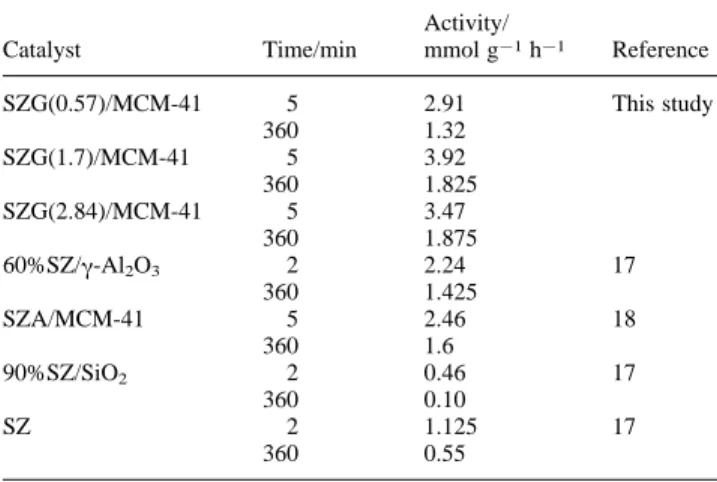
For comparison, the results of other previous studies17,18are also listed in Table 2. We found much a higher initial activity in butane isomerization at 250 °C with time on stream with our SZG/MCM-41 catalyst compared to results with bulk SZ, SZ/
g-Al2O3, SZ/SiO2and Al-promoted SZ/MCM-41(denoted SZA/ MCM-41) catalysts. The initial activity of SZG(1.7)/MCM-41 is three times that of bulk SZ. In comparison with bulk SZ, SZ/
g-Al2O3 and SZ/SiO2 catalysts, great improvements were observed in both initial activities and steady activities of SZG/ MCM-41. Previously, it was reported that aluminium is a good promoter for the SZ-catalyzed butane isomerization.17,18 We observe from Table 3 that gallium is an even better promoter than aluminium under comparable conditions.
The calcination temperature used for the preparation of SZG/ MCM-41 catalysts has a significant effect on the catalytic activities for n-butane isomerization. Fig. 2 shows the depend-Table 1 Textural and physical properties of the parent MCM-41 and
modified MCM-41 catalysts Sample SBET/m2g21 Pore volume/cm3g21 Pore diameter/nm SO3 content (wt%) MCM-41 1010 1.10 2.86 — SZ/MCM-41 442 0.31 2.15 2.3 SZG(0.57)/ MCM-41 438 0.32 2.23 3.2 SZG(1.70)/ MCM-41 480 0.36 2.26 3.6 SZG(2.84)/ MCM-41 357 0.27 2.24 4.1
Table 2 n-Butane conversion and product selectivity at 250 °C over Z680, SZ/MCM-41 and SZG/MCM-41 catalysts Selectivity (%) Catalyst Time/min Conversion (%) C3 i-C4 i-C5 n-C5 Z680 5 4.26 9.86 81.1 4.93 1.81 60 3.67 10.9 76.2 6.81 3.11 360 — — — — — SZ/MCM-41 5 5.17 9.16 80.8 4.02 1.49 60 4.72 10 79 4.91 1.53 360 — — — — — SZG(1.7)/ MCM-41 5 43.85 5.47 87.5 3.92 1.44 60 29.10 5.26 89.4 2.71 1.03 360 20.44 4.62 89.8 2.6 1.02
Fig. 1 Catalytic activity of catalysts (ZrO2content 50 wt%) calcined at 680 °C with the following Ga loadings: (a) 0.0 wt%, (b) 0.57 wt%, (c) 1.7 wt%, (d) 2.84 wt%.
Table 3 n-Butane isomerization activities of various catalysts at 250 °C
Catalyst Time/min Activity/ mmol g21h21 Reference SZG(0.57)/MCM-41 5 2.91 This study 360 1.32 SZG(1.7)/MCM-41 5 3.92 360 1.825 SZG(2.84)/MCM-41 5 3.47 360 1.875 60%SZ/g-Al2O3 2 2.24 17 360 1.425 SZA/MCM-41 5 2.46 18 360 1.6 90%SZ/SiO2 2 0.46 17 360 0.10 SZ 2 1.125 17 360 0.55
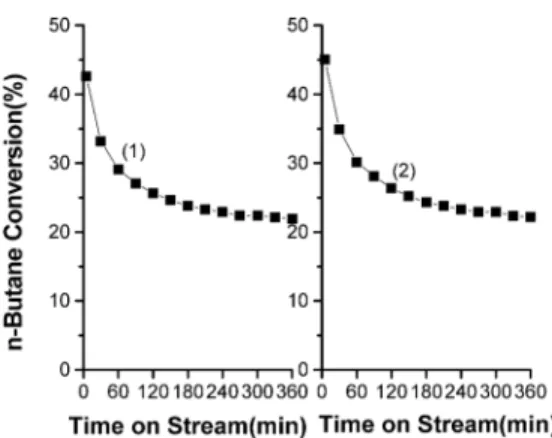
Fig. 2 Effect of calcination temperature on butane conversion at time-on-stream of 5 min over the catalyst SZG(1.7)/MCM-41 at 250 °C (ZrO2+50
wt%, Ga+1.7 wt%): (1) 630 °C, (2) 680 °C, (3) 720 °C.
ence of butane conversion on calcination temperature. The initial conversion was above 43% on the catalyst calcined at 680 °C while catalysts calcined at 630 and 720 °C have low activities. When the catalyst was calcined at 720 °C, the initial conversion decreased to 26.5%.
The variation of the conversion vs. time on stream for SZG(1.7)/MCM-41 at several reaction temperatures are given in Fig. 3 from which it is observed that higher reaction temperatures gave higher initial activity. When the reaction was run at 220 °C, though the initial activity was lower, the activity became more stable with time on stream. When the reaction was run at 250 °C, the initial conversion (t = 5 min) of around 44% fell to approximately 20% after 6 h on stream. After a fast initial deactivation, the isomerization activity declined at a lower rate. Though fast initial deactivation was observed, the catalyst could be completely recovered. The regeneration property of the catalyst is shown in Fig. 4. The catalyst after reaction on stream for 6 h can be regenerated by heating in dry air at 450 °C for 3 h. The regenerated catalyst has almost the same activity as the fresh catalyst. Possible deactivation of the SZ solid superacid catalyst is due to the loss of sulfur or to coking on the catalyst surface. From our experimental result it seems that coking may be the predominant factor.
The conversion vs. time curves obtained over the Pt-impregnated SZG/MCM-41 and SZG/MCM-41 catalysts are shown in Fig. 5. For the Pt-impregnated catalyst, a steady regime was attained. The conversion at 5 min was slightly lower than for the Pt-free form, whereas the steady conversion and selectivity to isobutane were enhanced. The steady conversion was improved up to around 28%.
In summary, the Ga-promoted SZ/MCM-41 catalyst is a new kind of solid acid catalyst with substantial mesoporous volume. An environmentally friendly catalyst, unlike liquid superacid catalysts, such as HF + SbF5 and HCl + AlCl3, it has a high catalytic activity for n-butane isomerization and can be completely regenerated.
Experimental
As-synthesized pure siliceous MCM-41 was synthesized using the delayed neutralization process reported by Lin et al.19The gel was crystallized in static conditions at 100 °C for 5 days. Then the solid product was filtered off, washed with deionized water, and dried in air. The as-synthesized mesoporous material was impregnated with a desired amount of Zr(SO4)2 in methanol and stirred at room temperature for about 10 h. The resulting sample was dried at 80 °C. Finally, it was calcined at 680 °C for 3 h in air. Ga-promoted samples were prepared in the same way with the desired amount of zirconium sulfate and gallium sulfate. The Pt-impregnated SZG/MCM-41 catalyst was prepared by impregnating H2PtCl6 solution with SZG/ MCM-41. The concentration of the solution was adjusted in order to obtain 0.5% Pt on the final catalyst. After impregnation, the sample was held for 4 h at room temperature. Then it was dried at 110 °C overnight and calcined in the reactor at 450 °C in an air stream for 3 h. Before reaction, the catalyst was reduced in a H2stream for 1 h at 250 °C.
XRD measurements were carried out on a Bruker D8 Advance instrument with Cu-Ka radiation at 40 kV and 30 mA.
BET surface areas of the samples were acquired on a Micromeritics ASAP 2010 automatic adsorption instrument using N2 as the adsorbent. DRIFT spectra of the adsorbed pyridine were recorded using a BOMEM MB155 FT-IR/Raman spectrometer. The sample was pre-heated at 300 °C for 3 h under 1026mbar vacuum before pyridine vapor was introduced
at room temperature, followed by evacuation at 400 °C for 1 h. Sulfur content in the catalysts was detected by a chemical method. The sulfate was converted into BaSO4and determined by gravimetric method.
The isomerization of n-butane to isobutene was performed in a fixed-bed continuous flow reactor operated at atmospheric pressure. The catalyst samples were pelletized and sized to 20–60 mesh. Approximately 0.6 g of the catalyst was loaded into the reactor and then pretreated in flowing dry air (20 ml min21) at 450 °C for 3 h. The reactor temperature was then
lowered to the reaction temperature of 250 °C or other desired temperature. After thermal equilibrium was established, the reaction was started by feeding an n-butane–H2mixture (1+10 Fig. 3 Influence of reaction temperature on conversion over the catalyst
SZG(1.7)/MCM-41 (ZrO2+50 wt%; Ga: 1.7 wt%): (1) 250 °C, (2) 220 °C,
(3) 180 °C.
Fig. 4 Regeneration of the catalyst SZG(1.7)/MCM-41 (ZrO2+50 wt%;
Ga+1.7 wt%): (1) fresh catalyst, (2) regenerated catalyst. Regeneration conditions: heating in dry air at 450 °C for 3 h.
Fig. 5 Catalytic activity of catalysts for the Pt-free and Pt-impregnated SZG/MCM-41 (ZrO2+50 wt%; Ga+1.7 wt%) at 250 °C: (5,2)
Pt-impregnated SZG/MCM-41 (Pt+0.5 wt%), (:,Ω) SZG/MCM-41.
v/v) at an n-butane weight hourly space velocity (WHSV) 0f 0.52 h21through the catalyst. An on-line gas chromatograph
equipped with FID was used to analyze the reaction products.
Acknowledgments
We acknowledge the support of the Educational Department of Jiangsu Province project (00KJB530001 to C.-L. C.) and Key Laboratory of Chemical Engineering and Technology of Jiangsu Province.
References
1 M. Hino, S. Kobayashi and K. Arata, J. Am. Chem. Soc., 1979, 101, 6439.
2 M. Hino and K. Arata, J. Chem. Soc., Chem. Commun., 1979, 1148.
3 A. Corma, Chem. Rev., 1995, 95, 559.
4 X. Song and A. Sayari, Catal. Rev.-Sci. Eng., 1996, 38, 329.
5 V. Parvulescu, S. Cman, V. I. Parvulescu, P. Grange and G. Poncelet, J. Catal., 1998, 180, 66.
6 E. E. Wolf and M. A. Risch, Appl. Catal. A., 1998, 172, L1. 7 C. T. Kresge, M. E. Leonowicz, W. J. Roth, J. C. Vartuli and J. S.
Beck, Nature, 1992, 359, 710.
8 A. Corma, A. Martinez, V. Martinez-Soria and J. B. Monton, J. Catal., 1995, 153, 25.
9 A. Corma, A. Martinez and V. Martinez-Soria, J. Catal., 1997, 169, 480.
10 T. Ookoshi and M. Onaka, Chem. Commun., 1998, 2399. 11 T. Blasco, A. Corma, A. Martinez and P. Martinea-Escolano, J.
Catal., 1998, 177, 306.
12 Q. H. Xia, K. Hidajat and S. Kawi, Chem. Commun., 2000, 2229. 13 T. Lei, W. M. Hua, Y. Tang, Y. H. Yue and Z. Gao, J. Mol. Catal. A.,
2001, 170, 195.
14 H. Matsuhashi, M. Tanaka, H. Nakamura and K. Arata, Appl. Catal. A., 2001, 208, 1.
15 K. Arata, M. Hino and N. Yamagata, Bull. Chem. Soc. Jpn., 1990, 63, 244.
16 C. L. Chen, T. Li, S. Cheng, H. P. Lin, C. J. Bhongale and C. Y. Mou, Microporous Mesoporous Mater., 2001, 50, 201.
17 T. Lei, J. S. Xu, Y. Tang, W. M. Hua and Z. Gao, Appl. Catal. A., 2000, 192, 181.
18 C. L. Chen, S. Cheng, H. P. Lin, S. T. Wong and C. Y. Mou, Appl. Catal. A., 2001, 215, 21.
19 H. P. Lin, S. Cheng and C. Y. Mou, Microporous Mater., 1997, 10, 111.