IEEE MICROWAVE AND WIRELESS COMPONENTS LETTERS, VOL. 20, NO. 4, APRIL 2010 199
Design of Dual-Passband Microstrip Bandpass
Filters With Multi-Spurious Suppression
Meshon Jiang, Li-Ming Chang, and Albert Chin, Senior Member, IEEE
Abstract—A systematic design method for microstrip bandpass
filters with both dual-passband response and multi-spurious sup-pression is proposed in this letter. The filter is composed of stepped impedance resonators (SIRs). A novel asymmetric SIR structure is proposed to effectively increase the degree of freedom in the dual-passband bandwidth design. As a consequence, the transmis-sion zero of the coupling stage could be used to suppress the un-wanted higher order spurious responses. A complete design proce-dure considering both the synthesis of passband responses and the suppression of spurious responses is also depicted in detail. A fifth order filter is designed and fabricated to demonstrate this idea. The measured results show that the upper stopband can have an atten-uation level near 30 dB up to more than 20 GHz (8.16 0).
Index Terms—Dual-passband filter, microstrip, spurious
re-sponse, stepped impedance resonator (SIR).
I. INTRODUCTION
D
UAL-BAND, even tri-band, operation for RF devices has become a widespread tendency in recent wireless communication systems for enhancing the system functionality. In recent years, multi-band filters used as key components in the front end of a wireless communication system have been proposed and investigated extensively in the related academic community [1]–[5]. All these multi-band filters discussed above suffer from the unwanted higher order spurious re-sponses, which deteriorates the rejection levels and bandwidth of the upper stopband and can greatly limit their applications. Many techniques have been proposed to tackle this problem for the single-passband filter [6]–[8], but very little has been done for the dual-band one. In the previous work [9], the idea in [10] is adopted to suppress the higher order spurious responses. However, the rejection level is obviously degraded due to the limited tuning ranges of the higher order resonant frequencies of the constitutive SIRs.A novel asymmetric SIR is proposed in this letter to increase the degree of freedom when designing the bandwidth of a dual-passband filter. Therefore, the over-coupled structure in [7] can be suitably used to suppress the unwanted higher order spurious Manuscript received October 08, 2009; revised January 07, 2010. First pub-lished March 01, 2010; current version pubpub-lished April 07, 2010. This work was supported in part by National Nano Project NSC 97-2120-M-009-005 and NSC 97-2221-E-233-002 of Taiwan.
M. Jiang is with the Department of Computer and Communications En-gineering, Ta Hwa Institute of Technology, Hsinchu 307, Taiwan (e-mail: [email protected]).
L.-M. Chang and A. Chin are with the Department of Electronics En-gineering, National Chiao Tung University, Hsinchu 300, Taiwan. (e-mail: [email protected]; [email protected]).
Color versions of one or more of the figures in this letter are available online at http://ieeexplore.ieee.org.
Digital Object Identifier 10.1109/LMWC.2010.2042550
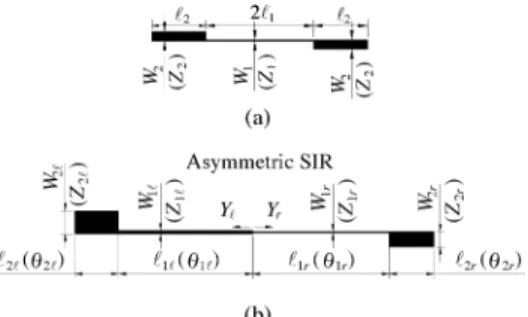
Fig. 1. Circuit layouts. (a) The traditional SIR. (b) The proposed asymmetric SIR.
responses. Section II will introduce the asymmetric structure of SIR and depict the overall design process. The measured re-sponses of the fabricated filter will be shown and compared with the simulation ones in Section III, and the conclusion will be drawn in Section IV.
II. ASYMMETRICSIRANDFILTERDESIGNPROCEDURE
A. Asymmetric SIR
The proposed asymmetric SIR is plotted in Fig. 1(b). The input impedance seen at the center of the SIR in Fig. 1(b) can be derived. The resonant conditions
for odd mode and even mode can be
collated as
(1)
(2)
where and . If let
and , (1) and (2) can be sim-plified to the form of the resonance conditions for traditional SIRs as in [8]. In other words, as long as the above conditions are held, the line widths of the asymmetric SIR can be arbi-trarily changed without affecting the SIR resonant characteris-tics. Hence, the degree of freedom in the bandwidth design of the filter can be effectively increased.
B. Filter Design Procedure
First, the SIR parameters, including impedance ratio and length ratio , must be determined. In Fig. 2, the de-sign curves show all the possible solutions for SIRs with GHz/2.45 GHz = 2.367. An impedance ratio 1531-1309/$26.00 © 2010 IEEE
200 IEEE MICROWAVE AND WIRELESS COMPONENTS LETTERS, VOL. 20, NO. 4, APRIL 2010
Fig. 2. Design curves for determiningR and u values of SIR with f =f = 2:367.
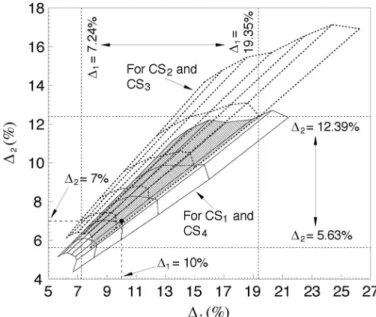
was chosen, and the corresponding values of and can be found to be 0.247, 4.0, 5.72 and 7.44 respectively in Fig. 2. A fifth-order dual-passband filter as shown in Fig. 3(c) is designed and fabricated to demonstrate the proposed ideas in this letter. The filter has five resonators (SIR –SIR ) and four coupled stages – , and is sym-metrical at the center. CS and CS are expected to suppress the spurious response at while CS and CS are used to cope with the unwanted harmonic at . The transmission zeros of CS and CS are located at , and those of CS and CS are at . Then, the fractional bandwidth design graph can be established as shown in Fig. 4. The passband ripples for the first and second passband are 0.01 dB and 0.1 dB respectively. If represents the th element value of the low-pass filter prototype of the th passband,
and for the Chebyschev filter. The bandwidth design graph can be divided into two portions. The dash line is for CS and CS while the solid one is for CS and CS . The shadow region represents the realizable fractional bandwidth for both bands in the given circuit size range of and . The range of is from 7.24% to 19.35%, and that of is between 5.63% and 12.39%. The scope of the shadow region can be adjusted by the element values of the low-pass filter prototype. Based on Fig. 4, and are chosen to be 10% and 7% respectively. The corresponding coupled stage circuit sizes for CS and CS are (0.5777, 0.7843), and those for CS and CS are (0.2487, 0.9655). The last step is to complete the design of tapped-line input/output as plotted in Fig. 3(b). By the method similar to that in [5], appropriate
values of for
can be 0.317 or 0.683, and the load impedances at the input/output points have an identical value of 164.35 . Based on [11], the dual-band frequency transformer with dimensions
and mm can
satisfy this demand. The parameters, and , in Fig. 3(b) refer to the line width and line length of the 50 line which is connected to the SMA connector for measurement. The
Fig. 3. Circuit layouts. (a) The coupled stage. (b) The tapped input/output resonator. (c) The fifth-order dual-passband bandpass filter (BPF). (SIR : W = 1:561; W = 0:715; W = 0:419; W = 0:294; W = 1:965; ` = 5:0; ` = 13:62; ` = 13:62; ` = 11:843; ` = 3:875; x = 9:505. SIR : W = 0:294; W = 2:13; W = 0:126; W = 1:426; ` = 11:715;` = 3:833; ` = 11:946;` = 3:908. SIR : W = 0:126; W = 1:372; ` = 12:035;` = 3:938. CS : ` = 15:181;S = 0:398. CS : ` = 11:92; S = 0:497. unit: mm.)
Fig. 4. Fractional bandwidth design graphs for a fifth-order dual-passband filter with suppression of spurious responses. Substrate:" = 2:2, thickness h = 0:508 mm.
systematic design process mentioned above can be applied to the design of even higher order filters.
III. SIMULATION ANDMEASUREMENT
The fifth-order filter is simulated by the full-wave commer-cial EM simulator IE3D and fabricated on a high frequency lam-inate RT/duroid® 5880 with and mm. The simulation and measured frequency responses are plotted
JIANG et al.: DESIGN OF DUAL-PASSBAND MICROSTRIP BANDPASS FILTERS 201
Fig. 5. Simulation and measured frequency responses of the experimental dual-passband filter with orderN = 5.
in Fig. 5, and the circuit layout with detailed circuit dimen-sions noted in the figure legend is shown in Fig. 3(c). The mea-sured results agree well with the simulation ones. The inser-tion losses at and are 2.12 dB and 2.33 dB respectively, and both return losses are greater than 12 dB. It can be shown that the spurious responses at ( GHz) and ( GHz) are effectively suppressed. The upper stopband can have an attenuation level near 30 dB up to more than 20 GHz .
IV. CONCLUSION
This letter brings up a complete design methodology for spu-rious-free microstrip line dual-passband filters. A novel idea of asymmetric SIR is proposed herein. One can arbitrarily change the line widths of the SIR without affecting its resonant char-acteristics. This particular feature can effectively increase the degree of freedom in the dual-passband bandwidth design and facilitate the structure of over-coupled stage in [7] to become
an appropriate choice for spurious responses suppression. A fifth-order filter is designed and fabricated to demonstrate the proposed ideas. The measured and simulation responses agree well with each other and show that good inband responses and upper stopband attenuation can be achieved simultaneously.
ACKNOWLEDGMENT
The authors wish to thank Dr. J.-T. Kuo and Dr. S.-J. Chung, Department of Electrical Engineering, National Chiao Tung University, Taiwan, for generously providing help on circuit fabrication and measurement.
REFERENCES
[1] J. Lee and K. Sarabandi, “A synthesis method for dual-passband mi-crowave filters,” IEEE Trans. Microw. Theory Tech., vol. 55, no. 6, pp. 1163–1170, Jun. 2007.
[2] H.-M. Lee and C.-M. Tsai, “Dual-band filter design with flexible passband frequency and bandwidth selections,” IEEE Trans. Microw.
Theory Tech., vol. 55, no. 5, pp. 1002–1009, May 2007.
[3] J. Lee, M. S. Uhm, and I.-B. Yom, “A dual-passband filter of canonical structure for satellite applications,” IEEE Microw. Wireless Compon.
Lett., vol. 14, no. 6, pp. 271–273, Jun. 2004.
[4] C.-Y. Chen and C.-Y. Hsu, “A simple and effective method for microstrip dual-band filters design,” IEEE Microw. Wireless Compon.
Lett., vol. 16, no. 5, pp. 246–248, May 2006.
[5] J.-T. Kuo, T.-H. Yeh, and C.-C. Yeh, “Design of microstrip bandpass filters with a dual-passband response,” IEEE Trans. Microw. Theory
Tech., vol. 53, no. 4, pp. 1331–1337, Apr. 2005.
[6] C.-F. Chen, T.-Y. Huang, and R.-B. Wu, “Design of microstrip band-pass filters with multiorder spurious-mode suppression,” IEEE Trans.
Microw. Theory Tech., vol. 53, no. 12, pp. 3788–3793, Dec. 2005.
[7] M. Jiang, M.-H. Wu, and J.-T. Kuo, “Parallel-coupled microstrip fil-ters with over-coupled stages for multispurious suppression,” in IEEE
MTT-S Int. Dig., Long Beach, CA, Jun. 12–17, 2005, pp. 687–690.
[8] J.-T. Kuo and E. Shih, “Microstrip stepped impedance resonator band-pass filter with an extended optimal rejection bandwidth,” IEEE Trans.
Microw. Theory Tech., vol. 51, no. 5, pp. 1554–1559, May 2003.
[9] M. Jiang, H.-P. Lin, and J.-T. Kuo, “Design of quasi-elliptic function filters with dual-passband responses and multi-spurious suppression,” in Proc. Asia-Pacific Microw. Conf., Bangkok, Thailand, Dec. 11–14, 2007, pp. 2365–2368.
[10] C.-F. Chen, T.-Y. Huang, and R.-B. Wu, “Design of microstrip band-pass filters with multiorder spurious-mode suppression,” IEEE Trans.
Microw. Theory Tech., vol. 53, no. 12, pp. 3788–3793, Dec. 2005.
[11] C. Monzon, “A small dual-frequency transformer in two sections,”
IEEE Trans. Microw. Theory Tech., vol. 51, no. 4, pp. 1157–1161,