DOI: 10.1002/adma.200701111
A New Route to Enhance the Light-Harvesting Capability
of Ruthenium Complexes for Dye-Sensitized Solar Cells**
By Chia-Yuan Chen, Shi-Jhang Wu, Jheng-Ying Li, Chun-Guey Wu,* Jian-Ging Chen, and
Kuo-Chuan Ho
Dye-sensitized solar cells (DSCs) have been explored for more than a decade for realistic photovoltaic applications ow-ing to their high conversion efficiency and low cost.[1] Molecu-lar engineering of the sensitizers to achieve high photovoltaic performance and long-term device stability is one of the criti-cal strategies. Since the first high-efficiency ruthenium-based sensitizer, cis-di(thiocyanato)-bis-(2,2
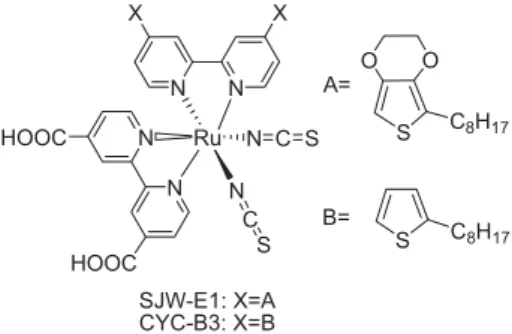
′-bipyridyl)-4,4′-dicar-boxylate ruthenium(II) (N3), reported by Grätzel and co-workers in 1993,[2]various structural modifications have been performed to improve the molar extinction coefficient of the sensitizers. It was found that elongating the conjugation length of the anchoring or ancillary ligand is the best route,[3–5] although it may come up against the problem of solubility, which is not only a critical point for dye preparation, purifica-tion, and identification but also one of the crucial factors for the photovoltaic performance of DSCs.[6] Nevertheless, it is essential to enhance the light-harvesting capacity and at the same time maintain the desirable solubility of dyes to be used in DSCs. Here we report the synthesis and performance of a new well-designed ruthenium complex, SJW-E1 (cis-di(thio- cyanato)-4,4′-di(octylethylenedioxythienyl)-2,2′-bipyridine-4,4′-dicarboxylate-2,2′-bipyridine ruthenium(II)), which showed high light-harvesting capacity and good solubility in organic solvents. Another new ruthenium complex, denoted CYC-B3 (cis-di(thiocyanato)-4,4′- di(octylthienyl)-2,2′-bipyri-dine-4,4′-dicarboxylate-2,2′-bipyridine ruthenium(II)), was also prepared not only to explore the effect of thiophene moi-eties but also for comparison with SJW-E1 to investigate the impact of the ethylenedioxy groups on the physicochemical properties and performance of the dye molecules.
The structures of SJW-E1 and CYC-B3, which incorporate a-octyl-ethylene-dioxythiophene (O-EDOT) and
octyl-thio-phene-substituted bipyridine, respectively, as an ancillary li-gand, are shown in Figure 1. The synthetic details and struc-ture characterizations are provided in the Supporting
Information. The frontier orbitals of SJW-E1 and CYC-B3 obtained with a semiempirical[7] calculation method (ZINDO/1) were illustrated in Figure 2. The results showed that both the highest-occupied molecular orbitals (HOMOs) and lowest-unoccupied molecular orbitals (LUMOs) of SJW-E1 and CYC-B3 have similar localizations: The HOMOs and LUMOs are contributed from the metal center with the NCS ligands and the anchoring ligand (4,4′-dicarboxylate-2,2′-bi-pyridine), respectively. In other words, the two dyes have a similar metal-to-ligand charge transfer (MLCT) excitation. In addition, the same anchoring group in the two dyes provides a comparable interfacial electron transfer process. Therefore the efficiency of the dyes will depend primarily on the absorp-tion coefficients of their MLCT bands.
The electronic absorption spectra of the dye molecules mea-sured in dimethylformamide (DMF) (Fig. 3a) display that the lower energy MLCT band for SJW-E1 is centered at 546 nm with a molar absorption coefficient of 18.7 × 10³M–1cm–1. This value is higher than those of the dyes CYC-B3 (15.7 × 10³M–1cm–1at 544 nm) and N3 (14.5 × 10³M–1cm–1 at 530 nm). The higher light-harvesting capacity of SJW-E1 dye compared with CYC-B3 and N3 dyes was attributed to the ethylenedioxy pendent group of EDOT, which could provide a supplementary electron-donating ability and p-con-jugation to the thiophene moiety. Although the light-harvest-ing ability of SJW-E1 is still lower than that of CYC-B1 (cis-di(thiocyanato)-4,4′-di(octylbithienyl)-2,2′-bipyridine-4,4′-dicarboxylate-2,2′-bipyridine ruthenium(II)), which we
re-COMMUNICA
TION
3888 © 2007 WILEY-VCH Verlag GmbH & Co. KGaA, Weinheim Adv. Mater. 2007, 19, 3888–3891
–
[*] Prof. C.-G. Wu, C.-Y. Chen, S.-J. Wu, J.-Y. Li
Department of Chemistry, National Central University Jhong-Li, Taiwan 32001 (Taiwan)
E-mail: [email protected] Prof. K.-C. Ho, J.-G. Chen
Department of Chemical Engineering, National Taiwan University Taipei 10617 (Taiwan)
[**] This work was financially supported by the National Science Coun-cil, Taiwan, under grant number NSC-95-2113-M-008-011-MY3. Sup-porting Information (detailed synthetic procedures and structure characterizations of the new ruthenium complexes, TiO2electrode preparation, DSC device fabrication and performance tests, as well as device-related measurements) is available online from Wiley In-terScience or from the authors.
N N HOOC HOOC Ru N C S N C S N N X X S C8H17 S C8H17 O O A= B= SJW-E1: X=A CYC-B3: X=B
ported previously,[8]it is close to that of HRS-1 (cis-di(thio- cyanato)-4,4′-di(hexylthienylvinyl)-2,2′-bipyridine-4,4′-dicar-boxylate-2,2′-bipyridine ruthenium(II)),[9]which uses thienyl-vinyl-conjugated bipyridine as an ancillary ligand. The electronic absorption spectra (in transmission mode) of SJW-E1, CYC-B3, and N3 assembled on the TiO2 thin films (Fig. 3b) combined with the absorption coefficients of the dyes in solution revealed that the TiO2thin films adsorbed a similar amount of SJW-E1, CYC-B3, and N3 molecules. Here we suppose that the absorption coefficients of the dye mole-cules in solution and adsorbed on the surface of TiO2are the same, and that the practical TiO2films (20 lm thickness) used in the device have the same behavior as the thin (2.4 lm) TiO2films used for the absorption measurement. This result then suggests that the size of the ruthenium complexes used in this study will not affect the number of dye molecules as-sembled on the TiO2electrodes. Therefore we could expect a SJW-E1-sensitized solar cell to have a better photon-to-cur-rent conversion efficiency than a N3-sensitized solar cell. Note here that the absorption intensity of CYC-B3 is lower than for the other two dyes, probably owing to the lower solubility of CYC-B3.
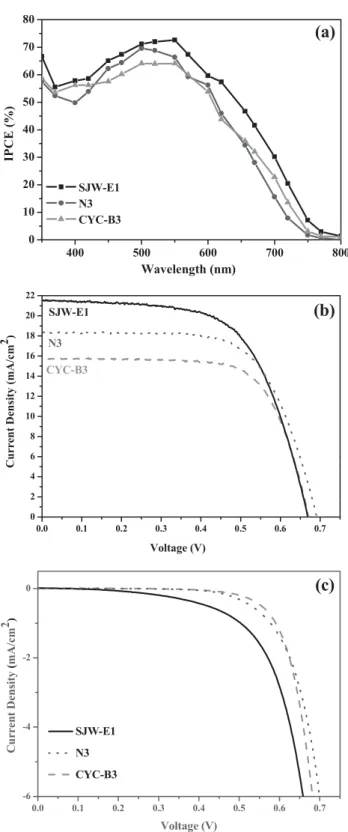
The incident photon-to-current conversion efficiency (IPCE) spectra of SJW-E1-, CYC-B3-, and N3-sensitized solar cells were illustrated in Figure 4a. The broad bands cover al-most the entire visible spectrum from 350 to 700 nm with the maxima of 72.6 % at 550 nm, 64.1 % at 520 nm, and 69.6 % at 500 nm for SJW-E1-, CYC-B3-, and N3-sensitized solar cells, respectively. The corresponding current–voltage (I–V) charac-teristic curves of the solar cells under AM 1.5 sunlight
illumi-nation (100 mW cm–2) are displayed in Figure 4b and the de-tailed device parameters are listed in Table 1. The IPCE values of the cells are slightly lower than the short-circuit photocurrent density (Jsc) appearing in the I–V characteristic curve because the light intensities used to measure these two data are not the same (the incident light employed in IPCE measurement is not continuous and the intensity is lower). The I–V curve revealed that the CYC-B3-sensitized solar cell has Jsc= 15.7 mA cm–2, 0.669 V open circuit potential (Voc) and 0.705 fill factor (ff), yielding power conversion efficien-cies (g) of 7.39 %, which is 87.8 % of the N3-sensitized solar cell, which has g = 8.42 % under the same cell fabrication and measuring procedures as used in our laboratory. The SJW-E1-sensitized solar cell gave a very high photocurrent density of 21.6 mA cm–2and g = 9.02 %, which is 22 % higher than that of the CYC-B3-sensitized cell. The significant increase in g value for SJW-E1- compared to CYC-B3-sensitized solar cells revealed the important role of the EDOT moiety in the ancil-lary ligand of the ruthenium complex. Nevertheless, we found that the SJW-E1-sensitized cell has a relatively lower fill fac-tor compared to N3- and CYC-B3-sensitized cells. This may due to the defects of the SJW-E1 monolayer on the TiO2
elec-COMMUNICA
TION
Adv. Mater. 2007, 19, 3888–3891 © 2007 WILEY-VCH Verlag GmbH & Co. KGaA, Weinheim www.advmat.de 3889
HOMO
LUMO
HOMO
LUMO
N N HOOC HOOC Ru N C S N C S N N S S C8H17 C8H17 N N HOOC HOOC Ru N C S N C S N N S S C8H17 C8H17 O O O OSJW-E1
CYC-B3
Figure 2. Graphical representation of the frontier orbitals of SJW-E1 and CYC-B3. Atoms in red, yellow, green, blue, and gray correspond to oxygen,
sul-fur, carbon, nitrogen, and ruthenium, respectively.
Table 1. Photovoltaic performance of DSCs with different sensitizers
un-der AM 1.5 simulated sunlight (100 mW cm–2) illumination.
Sensitizer Jsc[mA cm–2] Voc[mV] ff g[%]
SJW-E1 21.6 669 0.626 9.02
CYC-B3 15.7 669 0.705 7.39
trode (among other possibilities related to the device fabrica-tion) because we also found that the dark current of the SJW-E1-based cell (Fig. 4c) is higher than the cells based on the other two dyes. The use of appropriate co-adsorbents or sol-vent in the dye assembly process may be able to fix the defects and enhance the performance of SJW-E1. This work is in progress and the results will be reported elsewhere.
Photoelectrochemical impedance spectroscopy (PEIS) is generally used to investigate the lifetime s of the electron on the TiO2, which will be affected by the photo-oxidized sensi-tizers and electrolyte.[10,11]The measurements were performed under open-circuit conditions and AM 1.5 simulated sunlight illumination (100 mW cm–2). The results are displayed in the form of a Bode phase plot, as shown in Figure 5. The s values for SJW-E1-, CYC-B3-, and N3-sensitized cells calculated from the intermediate-frequency regime of the plot are 9.8, 6.8, and 12.4 ms, respectively. The N3-sensitized cell has quite a high s value, especially compared to CYC-B3. This is per-haps the reason why N3 dye has a high efficiency despite its
moderate light-absorption ability. Surprisingly, the SJW-E1-sensitized cell has a distinctly longer s value than the
CYC-COMMUNICA
TION
3890 www.advmat.de © 2007 WILEY-VCH Verlag GmbH & Co. KGaA, Weinheim Adv. Mater. 2007, 19, 3888–3891
300 400 500 600 700 800 0 1 2 3 4 5 M ola r A bs orpt io n Co ef fi ci ent (10 4 M -1 cm -1 ) Wavelength (nm) SJW-E1 CYC-B3 N3
(a)
400 500 600 700 800 0.0 0.1 0.2 0.3 0.4 0.5 0.6 Abso rba nce ( a. u. ) Wavelength (nm) SJW-E1 CYC-B3 N3(b)
Figure 3. a) Electronic absorption spectra of SJW-E1, CYC-B3, and
N3 measured in DMF. b) The visible absorption spectra of different dyes anchored onto a 2.4 lm thick transparent nanocrystalline TiO2film.
0.0 0.1 0.2 0.3 0.4 0.5 0.6 0.7 0 2 4 6 8 10 12 14 16 18 20 22 CYC-B3 Cur re nt De nsi ty (mA/ cm 2 ) Voltage (V) SJW-E1 N3
(b)
400 500 600 700 800 0 10 20 30 40 50 60 70 80(a)
Wavelength (nm) IP CE ( % ) SJW-E1 N3 CYC-B3 0.0 0.1 0.2 0.3 0.4 0.5 0.6 0.7 -6 -4 -2 0 C ur ren t Den sit y ( mA /c m 2 ) Voltage (V) SJW-E1 N3 CYC-B3(c)
Figure 4. a) The typical photocurrent action spectra of the photovoltaic
devices with different sensitizers. b) Characteristic current density–volt-age curves of photovoltaic devices measured under AM 1.5 simulated sunlight illumination (100 mW cm–2). c) Current density–voltage curves of photovoltaic devices measured in the dark. (Thickness of TiO2: 20 lm, cell active area (tested with mask): 0.16 cm2).
B3-sensitized cell. The dissimilarity in the s values between these two cells also points out the special function of the ethylenedioxy pendent on the ancillary ligand of SJW-E1; in other words, the novel properties of the EDOT moiety.
EDOT has the unique combination of strong electron dona-tion ability and self-structuring effects related to the intramo-lecular noncovalent interactions between oxygen and sulfur. This intramolecular interaction also affects the structure and electronic properties of conjugated molecules incorporating the EDOT unit. Consequently, EDOT is a good building block for the synthesis of functional p-conjugated systems such as fluorophores and push–pull chromophores.[12] Therefore, in the case of long substituents on the bipyridine of the ancillary ligand, a larger TiO2surface will be needed to avoid steric hindrance. Incorporating EDOT moieties on bipyridine can increase the conjugation length of the ancillary ligand without increasing the size of the ruthenium complex. The strongly electron-donating ether group on EDOT can avoid the intra-molecular electron–hole recombination of SJW-E1 and in-crease the lifetime of the electron on TiO2(reducing the pos-sibility of recombination of the electrons on TiO2 with the holes on the complex dye). The ether group also makes the a and a′ positions of the EDOT very reactive; further structure modification can be easily carried out, such as adding a alkyl group to prevent the water-induced desorption of the ad-sorbed dye molecules.[13] Moreover, the ether group in the EDOT may be also able to interact with the Li+to increase the dye regeneration rate, as found in K60 (cis-di(thiocyana- to)-4,4′-bis(2-(4-(1,4,7,10-tetraoxyundecyl)phenyl)ethenyl)-2,2′-bipyridine-4,4′-dicarboxylate-2,2′-bipyridine ruthenium (II)),[14]although we do not have any evidence.
In conclusion, we have prepared two new ruthenium com-plex dyes, SJW-E1 and CYC-B3, with very high photon-to-current conversion efficiency. The difference in the
perfor-mance of these dye-sensitized DSCs demonstrates that molec-ular engineering of the ancillary ligand of the ruthenium com-plexes to achieve higher performance could be expanded from one-dimensional extension of the conjugation length to two-dimensional conjugation enhancement and functional group substitution.
Experimental
Synthesis of SJW-E1 and CYC-B3: The detailed synthetic
proce-dures and structure characterizations of these two new ruthenium complexes can be found in the Supporting Information. The structure of the ligands was identified by1H NMR spectra. The structure of the complexes was also confirmed by13C NMR, mass spectrum, and ele-mental analysis, as well as1H NMR.
Physicochemical Studies: 1H NMR and 13C NMR spectra were
recorded with a Bruker 500 MHz NMR spectrometer in d6-DMSO (dimethyl sulfoxide). Fast atom bombardment mass sprectometry (FAB-MS) spectra were obtained using JMS-700 HRMS. UV-vis spectra were measured using a Cary 300 Bio spectrometer. Elemental analyses were carried out with a Heraeus CHN-O-S Rapid-F002 anal-ysis system. Molecular orbitals and geometry optimizations for free sensitizers were computed using the Hyperchem7 program. Geometry optimizations were calculated with ZINDO/1 parameter set. The overlap weighting factors were set as default. Detailed procedures for DSC device fabrication and performance testing can be found in the Supporting Information.
Received: May 8, 2007 Revised: August 20, 2007 Published online: October 31, 2007
–
[1] B. O’Regan, M. Grätzel, Nature 1991, 353, 737.
[2] M. K. Nazeeruddin, A. Kay, L. Rodicio, R. Humphry-Baker, E. Mül-ler, P. Liska, N. Vlachopoulos, M. Grätzel, J. Am. Chem. Soc. 1993,
115, 6382.
[3] P. Wang, S. M. Zakeeruddin, J.-E. Moser, R. Humphry-Baker, P. Comte, V. Aranyos, A. Hagfeldt, M. K. Nazeeruddin, M. Grätzel,
Adv. Mater. 2004, 16, 1806.
[4] S. R. Jang, C. Lee, H. Choi, J. J. Ko, J. Lee, R. Vittal, K. J. Kim,
Chem. Mater. 2006, 18, 5604.
[5] D. Kuang, S. Ito, B. Wenger, C. Klein, J. E. Moser, R. Humphry-Ba-ker, S. M. Zakeeruddin, M. Grätzel, J. Am. Chem. Soc. 2006, 128, 4146.
[6] a) C. Y. Chen, H. C. Lu, C. G. Wu, J. G. Chen, K. C. Ho, Adv. Funct.
Mater. 2007, 17, 29. b) M. K. Nazeeruddin, F. D. Angelis, S. Fantacci,
A. Selloni, G. Viscardi, P. Liska, S. Ito, B. Takeru, M. Grätzel, J. Am.
Chem. Soc. 2005, 127, 16835.
[7] E. Figgemeier, V. Aranyos, E. C. Constable, R. W. Handel, C. E. Housecroft, C. Risinger, A. Hagfeldt, E. Mukhtar, Inorg. Chem.
Commun. 2004, 7, 117.
[8] C. Y. Chen, S. J. Wu, C. G. Wu, J. G. Chen, K. C. Ho, Angew. Chem.
Int. Ed. 2006, 45, 5822.
[9] K. J. Jiang, N. Masaki, J. B. Xia, S. Noda, S. Yanagida, Chem.
Com-mun. 2006, 2460.
[10] S. Ito, M. K. Nazeeruddin, P. Liska, P. Comte, R. Charvet, P. Péchy, M. Jirousek, A. Kay, S. M. Zakeeruddin, M. Grätzel, Prog.
Photo-voltaics: Res. Appl. 2006, 14, 589.
[11] M. Adachi, M. Sakamoto, J. Jiu, Y. Ogata, S. Isoda, J. Phys. Chem. B
2006, 110, 25251.
[12] J. Roncali, P. Blanchard, P. Frère, J. Mater. Chem. 2005, 15, 1589. [13] P. Wang, S. M. Zakeeruddin, J. E. Moser, M. K. Nazeeruddin, T.
Se-kiguchi, M. Grätzel, Nat. Mater. 2003, 2, 402.
[14] D. Kuang, C. Klein, S. Ito, J. E. Moser, R. H. Baker, S. M. Zakeerud-din, M. Grätzel, Adv. Funct. Mater. 2007, 17, 154.
COMMUNICA
TION
Adv. Mater. 2007, 19, 3888–3891 © 2007 WILEY-VCH Verlag GmbH & Co. KGaA, Weinheim www.advmat.de 3891
10-1 100 101 102 103 104 0 -2 -4 -6 -8 -10 -12 -14 -16 -18 Theta ( D eg) Frequency (Hz) SJW-E1 N3 CYC-B3
Figure 5. Photoelectrochemical impedance spectra of SJW-E1-, CYC-B3-,
and N3-sensitized cells in the form of a Bode phase plot. (Measured un-der open-circuit conditions and AM 1.5 simulated sunlight illumination (100 mW cm–2)).