DOI: 10.1007/s00340-007-2648-0 Appl. Phys. B 88, 47–50 (2007)
Lasers and Optics
Applied Physics B
k.w. su
uy.t. chang
y.f. chen
Power scale-up of the diode-pumped actively
Q-switched Nd:YVO
4
Raman laser with
an undoped YVO
4
crystal as a Raman shifter
Department of Electrophysics, National Chiao Tung University, F353, Engineering Building VI, No 1001, Ta Hsueh Rd, Hsinchu 300, Taiwan
Received: 18 December 2006/ Revised version: 9 February 2007
Published online: 15 May 2007 • © Springer-Verlag 2007
ABSTRACT
With an undoped YVO
4crystal as a Raman shifter,
we substantially improved the reliability and the output
per-formance of an actively Q-switched 1176-nm Nd:YVO
4Raman
laser. With an incident pump power of 18
.7 W, the average
power is greater than 2
.6 W at 80 kHz. The pulse width of the
pulse envelope is shorter then 5 ns with mode-locked
modula-tion. With an incident pump power of 12
.7 W, the pulse energy
and peak power is higher than 43
µJ and 14 kW at 40 kHz.
PACS42.55.Ye; 42.55.Xi; 42.60.Gd
1
Introduction
Since the development of new Raman crystals
in the last decade [1–12], the stimulated Raman
scatter-ing (SRS) in crystal [13] has provided solid-state lasers
with an important way of operating in different
wave-lengths. The most commonly known materials for SRS are
Ba(NO
3)2[14], LiIO
3[15], KGd(WO
4)2[16], PbWO
4[17],
and BaWO
4[5, 6, 18–22]. Moreover, for self-Raman lasers,
the materials such as Yb:KGd(WO
4)2[23], Nd:KGd(WO
4)2[24–31],
Nd:PbWO
4[32],
Nd:GdxY
1−xVO
4[33, 34],
Nd:PbMoO
4and Nd:SrMoO
4[11, 12] have been reported.
A combination of their laser-emission and SRS properties
made these crystals appealing self-Raman media.
Neverthe-less, the Raman scattering was generated by host material.
Lasers could offer a number of advantages if the SRS could
be transferred from self-Raman media to additional undoped
crystals.
Nd-doped YVO
4and GdVO
4crystals, the acknowledged
useful gain media, were used in passively Q-switched (PQS)
and actively Q-switched (AQS) self-Raman lasers [34–39].
For instance, an AQS Nd:YVO
4self-Raman laser
demon-strated the average power, pulse width and peak power
of 1
.5 W, 18 ns and 4.2 kW for the Stokes wavelength of
1176 nm
[36]. However, the issue of the filed-induced
crys-tal damage usually restricted the output powers in self-Raman
Q-switched lasers [39].
u Fax: +886-35 725230, E-mail: [email protected]
In this work, to our knowledge, we report a new design
of a diode-pumped AQS 1176-nm Nd:YVO
4Raman laser
to increase the average power, repetition rate, peak power,
and damage threshold comprehensively. An undoped YVO
4crystal is employed to be an intracavity Raman shifter in
a Nd:YVO
4AQS laser. At an incident pump power of 18
.7 W,
the AQS Raman laser produces an average power greater than
2
.6 W with a pulse repetition rate of 80 kHz. The output pulses
noticeably display a mode-locking phenomenon that leads to
the maximum peak power to be higher than 14 kW.
2
Experimental setup
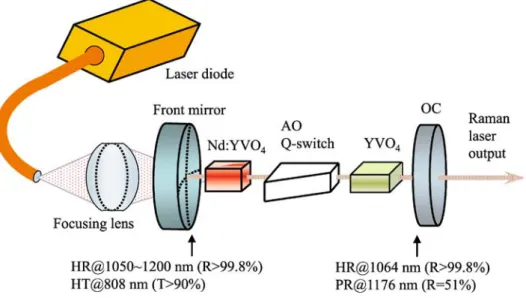
Figure 1 shows the experiment configuration for
AQS Nd:YVO
41176-nm
Raman laser which differs from
self-Raman laser. The pump source was an 808-nm
fiber-coupled laser diode with the core diameter of 800
µm, the
numerical aperture of 0.16, and the maximum output power
of 25 W. A focusing lens unit with a 85% coupling
effi-ciency was used to reimage the pump beam into the gain
medium with a pump spot radius of 400
µm. The gain
medium, a 9-mm-long a-cut Nd:YVO
4crystal with low
con-centrations, 0
.25 at. %, was used to reduce thermally induced
fracture [36]. Both sides of this laser crystal were coated
for antireflection (AR) at 1
.06 µm (R < 0.2%). The Raman
crystal was a 9.6-mm-long a-cut undoped YVO
4crystal.
These two crystals were both wrapped with indium foil and
mounted in water-cooled copper blocks individually. The
30-mm-long acousto-optic (AO) Q switch (NEOS
Technolo-gies) had AR coating at 1064 nm on both faces and was
driven at a 27
.12-MHz center frequency by 15 W of RF
power. The resonator was a plano-concave configuration.
Front mirror, a 500-mm radius-of-curvature concave mirror,
was coated with AR coating at 808 nm (R
< 0.2%) on the
en-trance face, and with high-reflection (HR) coating at 1064 nm
(R
> 99.8%) and high-transmission (HT) coating at 808 nm
(T
> 90%) on the other face. The coating of front mirror at
1176 nm
was high-reflection, too. The output coupler (OC)
was a flat mirror with HR coating at 1064 nm (R
> 99.8%) and
partial-reflection (PR) coating at 1176 nm (R
= 51%). The
cavity length was around 115 mm and depended on
pump-ing power. The spectrum of laser output was monitored by
an optical spectrum analyzer (Advantest Q8381A,
includ-48 Applied Physics B – Lasers and Optics
FIGURE 1 Schematic of a diode-pum-ped actively Q-switched Nd:YVO4
Ra-man laser at 1176 nm
ing a diffraction lattice monochromator) with a resolution
of 0
.1 nm. The temporal behaviors for fundamental and
Ra-man pulses were recorded by a LeCroy digital oscilloscope
(Wavepro 7100, 10 Gs
/s, 1-GHz bandwidth) with two fast
p-i-n photodiode ap-i-nd ap-i-n ip-i-nterferep-i-nce filter allowip-i-ng trap-i-nsmissiop-i-n
only at 1064 nm.
3
Experimental results and discussion
As a stimulated Raman material, taking the place
of Nd:YVO
4by undoped YVO
4has advantages on
robust-ness and output properties. Figure 2 displays the experimental
result for optical spectrum of the laser output and Raman
scat-tering spectrum of the YVO
4. The first Stokes wavelength
near 1176 nm was conversed from the fundamental
wave-length near 1064 nm by Raman peak at 890 cm
−1. The Raman
FIGURE 2 Optical spectrum of the actively Q-switched Raman output. The Raman scattering spectrum of an YVO4crystal showed in inset, which is
almost the same as it of Nd:YVO4crystal
shift of Nd:YVO
4and undoped YVO
4were almost the same,
came from the same periodic YVO
4lattice. But crystals
with-out dopant had more perfect lattice, which brought on higher
damage threshold and more stable frequency conversion. So,
we can put the pure YVO
4as a Raman crystal in the position
where the intensity is highest in the cavity, and still increase
the pumping power. Further, the reflectance of OC can be
lower (from 93% to 51%) to scale up average output power
due to lower lasing threshold at Raman wavelength. By using
lower reflection coating, we can narrow the pulse width. At the
same time, when we over drove current during the experiment,
the damage never happened in Nd:YVO
4, but in Raman
crys-tal. That means the SRS was generated mainly in pure YVO
4,
a more reliable and replaceable component in practical laser.
Figures 3 and 4 illustrate the output performance of AQS
1176-nm
Nd:YVO
4Raman laser. The average output power
at the Stokes wavelength of 1176 nm with respect to the
inci-FIGURE 3 The average output power at the Stokes wavelength of 1176 nm with respect to the incident pump power at different pulse repetition rate from 20 kHz to 80 kHz
SUet al. Power scale-up of the Q-switched Nd:YVO4Raman laser 49
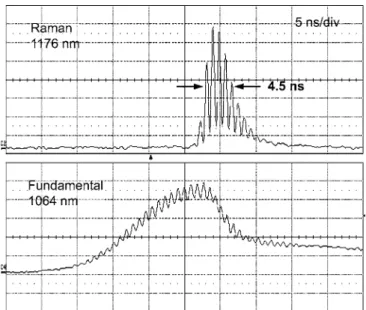
FIGURE 4 An oscilloscope trace with mode-locking effect for fundamental and Raman pulses
dent pump power for different pulse repetition rate of 20, 40,
60, and 80 kHz shown in Fig. 3. Because the thermal loading
of the end-pumped Q-switched Nd-doped laser increases with
decreasing repetition rate [24, 25], it can be seen that although
the pumping threshold is higher, increasing the pulse
repeti-tion rate can efficiently increase the maximum average output
power at 1176 nm and its maximum pump power (P
p,max).And for a certain repetition rate, to pump over P
p,maxwill
get the unstable Raman conversion and fall the output power.
The average output power is up to 2
.61 W with an incident
pump power of 18
.7 W at a repetition rate of 80 kHz,
corres-ponding to the conversion efficiency of 14% and slope
effi-ciency of 40%. Comparing to results of 1176-nm self-Raman
laser by use of Nd:YVO
4with lower dopant concentration of
0
.2 at. % [36], this Raman laser still has the increase of ratio in
average power of 74% and in conversion efficiency of 0
.7%.
It could be better if we were able to use 0
.2 at. % Nd:YVO
4and correctly AR-coated c-cut [41] YVO
4in this Raman laser.
On the other hand, the maximum pulse energy is generally
greater then 40
µJ at repetition rate from 20 to 60 kHz, and up
to 43
.5 µJ at 40 kHz with an incident pump power of 12.7 W.
The maximum pulse energy at repetition rate of 80 kHz is
32
.6 µJ.
The typical time traces for fundamental and Raman pulses
are shown in Fig. 4. The pulse width is always shorter then
5 ns, but the effective pulse width is much shorter due to
mode-locked shape. With the pulse energy of 43
.5 µJ, the pulse
width of the pulse envelop in Fig. 4 is 4
.5 ns, and the peak
power of the pulse seen as a Gaussian shape should be 9
.7 kW.
However, after curve fitting for the mode-locked shape, the
peak power is enhanced to 14 kW, 1.45 times the 9
.7 kW. In
other words, the effective pulse width is around 3
.1 ns which is
much shorter than 18 ns of self-Raman laser [36]. Comparing
to 1176-nm Nd:YVO
4AQS self-Raman laser of 4
.2 kW [36],
the output peak power was enhanced to be more than two
times. The present peak-power level was close to the results of
the PQS Nd:GdVO
4self-Raman lasers in which the average
power, pulse width and peak power were found to be 83 mW,
500 ps, and 9
.2 kW at 1174 nm in [37], or 140 mW, 750 ps,
and 8
.4 kW at 1176 nm in [38].
4
Conclusions
In conclusion, with an undoped YVO
4as a
stim-ulated Raman crystal, we substantially improve the
dam-age threshold, repetition rate, averdam-age output power, pulse
width, and the peak power of AQS Nd:YVO
4Raman lasers
at 1176 nm. With an incident pump power of 18
.7 W, the
average power is 2
.6 W at 80 kHz correspond to the
optical-to-optical conversion efficiency of 14%. Coming with the
mode-locked pulse shape, the effective cavity dump of intracavity
SRS leads to peak power at 1176 nm that is generally greater
than 10
.5 kW at repetition rate from 20 to 80 kHz. With an
incident pump power of 12
.7 W, the pulse energy and peak
power is higher than 43
.5 µJ and 14 kW at 40 kHz.
REFERENCES
1 T.T. Basiev, V.V. Osiko, A.M. Prokhorov, E.M. Dianov, Top. Appl. Phys. 89, 351 (2003)
2 T.T. Basiev, R.C. Powell, Solid State Raman Lasers in Handbook of Laser Technology and Applications, B1.7, 469 (Institute of Physics Pub-lishing, London, 2003)
3 H.M. Pask, Prog. Quantum Electron. 27, 3 (2003)
4 R.G. Zevrev, T.T. Basiev, A.M. Prokhorov, Opt. Mater. 11, 335 (1999) 5 T.T. Basiev, A.A. Sobol, P.G. Zverev, L.I. Iveleva, V.V. Osiko, R.C.
Pow-ell, Opt. Mater. 11, 307 (1999)
6 P. Cern´y, P.G. Zverev, H. Jel´ınkov´a, T.T. Basiev, Opt. Commun. 177, 397 (2000)
7 J.T. Murray, W.L. Austin, R.C. Powell, Advanced Solid-State Lasers, ed. by W.R. Bosenberg, M.J. Fejer, Vol. 19 of OSA, Trends in Optics and Photonics Series (Optical Society of America, Washington D.C., 1998), pp. 129–135
8 J.T. Murray, W.L. Austin, R.C. Powell, Advanced Solid-State Lasers, ed. by M.J. Fejer, H. Injeyan, U. Keller, Vol. 26 of OSA, Trends in Op-tics and Photonics Series (Optical Society of America, Washington D.C., 1999), pp. 575–578
9 C. He, T.H. Chyba, Opt. Commun. 135, 273 (1997)
10 J.T. Murray, W.L. Austin, R.C. Powell, Opt. Mater. 11, 353 (1999) 11 T.T. Basiev, S.V. Vassiliev, M.E. Doroshenko, V.V. Osiko, V.M. Puzikov,
M.B. Kosmyna, Opt. Lett. 31, 65 (2006)
12 T.T. Basiev, S.V. Vassiliev, M.E. Doroshenko, V.V. Osiko, Laser Os-cillation and Self-Raman Frequency Conversion in Nd:PbMoO4 and
Nd:SrMoO4Crystals under Laser Diode Pumping, Technical Digest,
Advanced Solid State Photonics, Jan. 29, 2006, Lake Tahoo, OSA, TuB21 (2006)
13 G. Eckhardt, D.P. Bortfeld, M. Geller, Appl. Phys. Lett. 3, 137 (1963) 14 A.S. Eremenko, S.N. Karpukhin, A.I. Stepanov, Sov. J. Quantum
Elec-tron. 10, 113 (1980)
15 E.O. Ammann, C.D. Decker, J. Appl. Phys. 48, 1973 (1977)
16 A.S. Grabtachikov, A.N. Kuzmin, V.A. Lisinetskii, V.A. Orlovich, G.I. Ryabtsev, A.A. Demidovich, Appl. Phys. Lett. 75, 3742 (1999) 17 J. Findeisen, H.J. Eichler, A.A. Kaminskii, IEEE J. Quantum Electron.
QE-35, 173 (1999)
18 T.T. Basiev, A.A. Sobol, P.G. Zverev, L.I. Iveleva, V.V. Osiko, R.C. Pow-ell, Laser material for stimulated Raman scattering, patent of Russian Fedration, 2178938 C1 1, pending 25.04.2000
19 T.T. Basiev, P.G. Zverev, A.A. Sobol, V.V. Skornyakov, L.I. Iveleva, N.M. Polozkov, V.V. Osiko, Sov. J. Quantum Electron. 30, 55 (2000) 20 P.G. Zverev, T.T. Basiev, M.E. Doroshenko, V.V. Osiko, Barium
Tungstate Raman laser – A new Coherent Source for Sodium Star Ex-periments, Trends in Optics and Photonics 34, Advanced Solid State Lasers, ed. by H. Injeyan, U. Keller, C. Marshall, (OSA, Washington D.C., 2000), pp. 348–354
21 P.G. Zverev, T.T. Basiev, L.I. Ivleva, V.V. Osiko, N.M. Polozkov, I.S. Voronina, Raman Laser on Strontium Tungstate Crystal, Trends in Optics and Photonics, Vol. 68 (OSA, Washington D.C., 2002), pp. 70–73 22 P. Cern´y, H. Jel´ınkov´a, T.T. Basiev, P.G. Zverev, IEEE J. Quantum
50 Applied Physics B – Lasers and Optics
23 A.A. Lagatsky, A. Abdolvand, N.V. Kuleshov, Opt. Lett. 25, 616 (2000) 24 K. Andryunas, Y. Vishakas, V. Kabelka, I.V. Mochalov, A.A. Pavlyuk,
G.T. Petrovskii, V. Syrus, JETP Lett. 42, 333 (1985)
25 K. Andryunas, Y. Vishakas, V. Kabelka, I.V. Mochalov, A.A. Pavlyuk, N.V. Ionina, V. Syrus, Patent of USSR #1227074
26 A.M. Ivanyuk, M.A. Ter-Pogosyan, P.A. Shakhverdov, V.D. Belyaev, V.L. Ermolaev, H.P. Tikhonova, Opt. Spectrosc. 59, 950 (1985) 27 Y.K. Vishakas, I.V. Mochalov, A.V. Mikhailov, R.F. Klevtsova,
A.V. Lyubimov, Lietuvos Fizikos Rinkinys 28, 224 (1988) 28 I.V. Mochalov, Opt. Eng. 36, 1660 (1997)
29 A.M. Ivanyuk, V.A. Sandulenko, M.A. Ter-Pogosyan, P.A. Shakhverdov, V.G. Chervinskii, A.V. Lukin, V.L. Ermolaev, Opt. Spectrosc. 62, 961 (1987)
30 V.A. Berenberg, S.N. Karpukhin, I.V. Mochalov, Sov. J. Quantum Elec-tron. 14, 1849 (1987)
31 J. Findeisen, H.J. Eichler, P. Peuser, Opt. Commun. 181, 129 (2000) 32 W. Chen, Y. Inagawa, T. Omatsu, M. Tateda, N. Takeuchi, Y. Usuki, Opt.
Commun. 194, 401 (2001)
33 A.A. Kaminskii, K. Ueda, H.J. Eichler, Y. Kuwano, H. Kouta, S.N. Bagaev, T.H. Chyba, J.C. Barnes, G.M.A. Gad, T. Murai, J. Lu, Opt. Commun. 194, 201 (2001)
34 Y.F. Chen, M.L. Ku, L.Y. Tsai, Y.C. Chen, Opt. Lett. 29, 2279 (2004) 35 Y.F. Chen, Opt. Lett. 29, 1251 (2004)
36 Y.F. Chen, Opt. Lett. 29, 1915 (2004)
37 T.T. Basiev, S.V. Vassiliev, V.A. Konjushkin, V.V. Osiko, A.I. Zagumen-nyi, Y.D. Zavartsev, S.A. Kutovoi, I.A. Shcherbakov, Laser Phys. Lett. 1, 237 (2004)
38 Y.F. Chen, Appl. Phys. B 78, 685 (2004) 39 Y.F. Chen, Opt. Lett. 29, 2632 (2004)
40 Y.P. Lan, Y.F. Chen, S.C. Wang, Appl. Phys. B 71, 27 (2000)
41 P.G. Zverev, A.Y. Karasik, A.A. Sobol, D.S. Chunaev, T.T. Basiev, A.I. Zagumennyi, Y.D. Zavartsev, S.A. Kutovoi, V.V. Osiko, I.A. Shcher-bakov, Stimulated Raman scattering of picosecond pulses in GdVO4and
YVO4crystals, Advanced Solid State Photonics Conference,
Techni-cal digest, Feb. 1–4 (2004), Santa Fe, USA, WB9, OSA TOPS ASSL, TuB10, pp. 25–27