
This content has been downloaded from IOPscience. Please scroll down to see the full text.
Download details:
IP Address: 140.113.38.11
This content was downloaded on 25/04/2014 at 12:44
Please note that terms and conditions apply.
View the table of contents for this issue, or go to the journal homepage for more 2009 J. Phys.: Conf. Ser. 150 042230
Ultrafast Polaron Dynamics in La
0.7
Ca
0.3MnO
3Thin
Films
K H Wu1, T I Hsu1, I J Chen1, H C Shih1, C W Luo1, T M Uen1, J-Y Lin2, J Y Juang1, and T Kobayashi1
1
Department of Electrophysics, National Chiao Tung University, Hsinchu 300, Taiwan
2
Institute of Physics, National Chiao Tung University, Hsinchu 300, Taiwan E-mail: [email protected]
Abstract.
In this work, we use ultrafast optical pump-optical probe (OPOP) spectroscopy to probe the polaron dynamics in La0
.7Ca0.3MnO3 (LCMO) thin films. The temporal evolution in transient
reflectivity change ∆R/R exhibits two relaxing components: a fast component with a time constant of subpicosecond and a slow component with time constant ranging from tens of ps to hundreds of ps. The amplitude of the fast component exhibits the similar temperature depence with that of the resistivity, and the neutron scattering intensity due to nanoscale correlated polarons. The results strongly suggest that the fast photoinduced reflectivity change may have been due to the photoexcitation and trapping process of correlated Jahn-Teller (T-J) polarons in the paramagnetic (PM) and ferromagnetic (FM) phases.
1. Introduction
Recently electronic inhomogeneities with a wide variety of length scales (from sub-nanometers to microns) have been recognized as the intrinsic features of manganites [1-3]. These inhomogeneities may result from the coexistence of correlated and uncorrelated local lattice distortions (JahnTeller polarons) in the paramagnetic (PM) phase or the combination of charge-orbital ordered regions and spin ordering (magnetic polarons) domains in the ferromagnetic (FM)/antiferromagnetic (AFM) phases of manganites. Neutron and x-ray scattering techniques are frequently used to explore the existence of electronic inhomogeneities and the distribution of uncorrelated and correlated polarons in manganites at various temperatures. The results strongly suggest that the nanoscale correlated polarons is the dominant contribution to the CMR effect and the competition between various interactions in the electronic inhomogeneities are crucial for the colossal responses in magnetoresistance. Recently, researchers have paid close attention to investigate the strongly correlated electron materials by the ultrafast techniques, since the relative contributions of electron, phonon, and spin dynamics in these materials can be directly resolved in the time domain [4-7]. Moreover, the temperature dependence of the relaxation behavior always demonstrates a dramatic change near the transition temperature, which may reveal the valuable information about the physical mechanisms governing the intriguing properties of these materials. In this work, we use ultrafast OPOP spectroscopy to probe polaron dynamics in La0.7Ca0.3MnO3 thin films. Although this manganite has been
investigated extensively by many groups, most of the reports are concerned with a relative slow component, which corresponds to the spin-lattice interaction and the temperature dependence
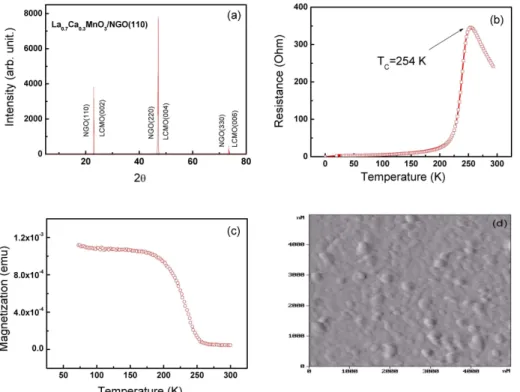
Figure 1. The (a) resistance versus temperature (R-T) curve, (b) magnetization versus temperature (M-T) curve, (c) X-ray diffraction (XRD) pattern, and (d) atomic force microscopy (AFM) image of the La0.7Ca0.3MnO3 sample.
2. Experiment
The pure phase (001) La0.7Ca0.3MnO3 thin film used in this study was prepared by pulsed laser
deposition. The deposited LCMO thin film has a Curie temperature TC = 255 K with a thickness
of 250 nm. The detailed characteristics of the films, include resistance versus temperature (R-T) curve, magnetization versus temperature (M-(R-T) curve, X-ray diffraction (XRD) pattern, and atomic force microscopy (AFM) image, are shown in Figure 1. The optical pulses were produced by a mode-locked Ti:sapphire laser ( Femtolaser, Austria) with a photon energy of 1.55 eV and a 75 MHz train of 20 fs pulses. The ratio between the average power of the pump and probe beams was set at 50:2. The typical energy density of the pump pulses was ∼ 5 µJ/cm2
, and the pulses were modulated at 87 KHz with an acousto-optic modulator. The small reflected signals were then detected by a lock-in amplifier [8].
3. Results and Discussion
Figure 2 shows the changes in transient reflectivity ∆R/R curves for a La0.7Ca0.3MnO3 thin
film measured at various temperatures. Each ∆R/R curve can be fitted by a superposition of two exponential terms (namely the fast, slow components in this paper) and a quasi-constant component, respectively. In the following, we will focus on the dynamics of fast component in
Figure 2. The transient reflectivity ∆R/R curves of a La0.7Ca0.3MnO3 thin film measured at
various temperatures.
LCMO. Figure 3 (a) and (b) show the temperature dependence of the amplitude Af ast(T) and
the relaxation time τf ast(T) of this component, respectively.
At T > TC, the relatively weaker and gradual decrease of Af ast(T) with increasing
temperature are primarily due to the decreasing population of the nanoscale correlated polarons and the lower hopping rate in the PM phase. Near TC and in the PM phase, the number
of nanoscale correlated polarons reaches maximum [2], causing Af ast to have a peak near the
transition temperature. Upon lowering the temperature into the FM phase, Figure 3 shows the Af ast has large fluctuations in TC > T > 220 K, and drop abruptly as temperature decreases
to 160 K in the FM phase. The reason for the complicated behavior just below TC may be due
to the rapid changes of the electronic and phase inhomogeneities in this region. For T < 140 K, the spins are almost fully alignd and the double exchange becomes dominant for the electrical conduction, thus the itinerant eg electrons hop freely between Mn ions. Then the population
of polaron and Af astalmost disappear in this temperature range. The temperature dependence
of the amplitude Af ast(T) of the fast component exhibits the similar temperature depencdence
of the resistivity, and the neutron scattering intensity due to nanoscale correlated polarons. Therefore, the results strongly suggest that the fast photoinduced reflectivity change may have been due to the photoexcitation and trapping process of correlated Jahn-Teller (T-J) polarons in PM and FM phases and also reveals the electronic inhomogenity and percolative nature of the PM- FM /metal-insulator transition in LCMO maganites.
The relaxation time, which corresponds to the re-trapping time of a photoexcited carrier to its polaronic state, is about 450-600 fs. It is closed to the time predicted by neutron and x-ray
Figure 3. The temperature dependence of (a) amplitude Af ast(T) and (b) relaxation time
τf ast(T) of the fast component.
4. Summary
In summary, we used ultrafast optical pump-optical probe (OPOP) spectroscopy to probe polaron dynamics in La0.7Ca0.3MnO3thin films. The temperature dependence of Af astand τf ast
of the fast component in ∆R/R reveals the electronic inhomogenity and percolative nature of the PM-FM/ metal- insulator transition in LCMO maganites. The present study demonstrates that ultrafast OPOP spectroscopy can serve as an alterative experimental technique to investigate the correlated J-T polaron dynamics in the PM and FM phases, which is crucial for understanding the role of polaron in the exotic physical properties of manganites.
Acknowledgements
This project is financially sponsored by National Science Council (grand no. NSC 95-2112-M-009-037-MY3) and Ministry of Eduation (2007 MOE ATU plan).
References
[1] Kiryukhin V, 2004 New Journal of Physics 6, 155
[2] Adams C P, Lynn J W, Mukovskii Y M, Arsenov A A, and Shulyatev D A, 2000 Phy. Rev. Letts. 85, 3954 [3] Shenoy V B, Sarma D D, and Rao C N R, 2006 ChemPhysChem 7, 2053-2059
[4] Averitt R D and Taylor A J, 2002 J. Phys.: Condens. Matter 14, R1357
[5] Hirobe Y, Kubo Y, Kouyama K, Kunugita H, Ema K, Kuwahara H, 2005 Solid State Communications 133, 449
[6] Ren Y H, Zhang X H, L¨upke G, Schneider M, Onellion M, Perakis I E, Hu Y F, and Li Q, 2001 Phy. Rev. B 64, 144401
[7] Ogasawara T, Matsubara M, Tomioka Y, Kuwata-Gonokami M, Okamoto H, and Tokura Y, 2003 Phys. Rev. B 68, 180407(R)
[8] Luo C W, Chen M H, Chen S P, Wu K H, Juang J Y, Lin J-Y, Uen T M, and Gou Y S, 2003 Phys. Rev. B 68, 220508(R)


![TraditionalMLCalgorithmsmainlytacklethebatchMLCproblem,wheretheinputdataarepresentedinabatch[24,28].Nevertheless,inmanyMLCapplicationssuchase-mailcategorization[22],multi-labelexamplesarriveasastream.Onlineanalysisistherefore dimensionreducermotivatedbyma](data:image/gif;base64,R0lGODlhAQABAIAAAP///wAAACH5BAEAAAAALAAAAAABAAEAAAICRAEAOw==)