
國外客戶給予新興市場供應商較合理價格之意願探討 - 政大學術集成
56
0
0
全文
(2) Abstract This study explores the strategies that emerging market firms can use to increase their bargaining positions and increase the willingness of foreign buyers to offer more favorable prices. It has been shown that customers are willing to accommodate their suppliers when they intend to maintain longer cooperative relationships with them. Accordingly, we propose that emerging market suppliers can receive more favorable prices through decreasing their customers’ perceived threat of product quality and increasing the customers’ perceived value of relationships.. 政 治 大. Based on a survey of 217 foreign customers of emerging market suppliers, our empirical testing. 立. identifies two major strategies that emerging market firms use to increase the willingness of their. ‧ 國. 學. customers to offer better prices. First, emerging market suppliers can improve their capabilities through making brand investment and upgrading manufacturing competencies in areas such as. ‧. product quality, service, and innovation know-how. Second, emerging market suppliers can. y. Nat. sit. strengthen the relationship with their foreign customers by making transaction-specific assets. n. al. er. io. investments (TSIs) and developing relational norms with the customers. In addition, the results. i n U. v. suggest that the supplier’s capabilities display a stronger impact on its customer’s perceived. Ch. value of relationships than other strategies.. engchi. Keywords: emerging market, favorable prices, international customer-supplier relationships, supplier capabilities, relationship value.
(3) Table of Contents 1. Introduction ......................................................................................................................1 2. Theoretical Background ...................................................................................................3 3. Theoretical Development .................................................................................................4 3.1 Customer’s expectation of relationship continuity ................................................4 3.2 Customer’s perceived threat of quality failure .......................................................6 3.3 Customer’s perceived relationship value ...............................................................7 3.4 Supplier’s brand investment ..................................................................................8 3.5 Supplier’s capabilities ............................................................................................9 3.6. 學. ‧ 國. 3.7. 治 政 Supplier’s transaction-specific assets investments 大 (TSIs) ...................................11 立 Supplier’s relational norms ..................................................................................13. 4. Research Method ...........................................................................................................14. ‧. 4.1 Research setting ...................................................................................................14. sit. y. Nat. 4.2 Sampling frame ....................................................................................................15. io. er. 4.3 Data collection .....................................................................................................16. al. 4.4 Measures ..............................................................................................................18. n. iv n C Data Analysis .......................................................................................................20 hengchi U. 4.5. 4.5.1 Reliability....................................................................................................21 4.5.2 Measurement validity..................................................................................21 4.5.3 Structural equation model ...........................................................................21 4.5.4 Competing models: Examining other direct or indirect paths ....................23 5. Discussion and Implications ..........................................................................................24 5.1 Limitations and future research directions ...........................................................27 References ..........................................................................................................................28. I.
(4) Table Table 1 Construct measures and validity assessment ........................................................39 Table 2 Demographic characteristics of the respondent firms ...........................................42 Table 3 Mean, s.d., inter-construct correlations, and average variance extracted .............43. Figure Figure 1 Conceptual Framework .......................................................................................44. 政 治 大. Figure 2 Hypothesized model with composite measures ...................................................45. 立. ‧. ‧ 國. 學 Appendix. y. Nat. n. al. er. io. sit. Appendix 1 Questionnaire .................................................................................................46. Ch. engchi. II. i n U. v.
(5) 1. Introduction Many emerging market firms participate in global value chains by being suppliers for multinational enterprises (Celly, Spekman, & Kamauff, 1999; Jean, Sinkovics, & Cavusgil, 2010; Kang, Mahoney, & Tan, 2009; Luo & Tung, 2007). Due to their lack of market intelligence, these emerging market firms are often highly dependent on the multinational firms (Jean et al., 2010; Kang et al., 2009; Subramani & Venkatraman, 2003). As a result, they often have relatively low bargaining power and consequently poor profit margins. This study attempts to explore the strategies that emerging market suppliers can use to. 治 政 increase the willingness of foreign buyers to offer more 大 favorable prices. The literature has 立. offered limited insights into how emerging market firms can do improve their bargaining. ‧ 國. 學. positions and to obtain more favorable prices from foreign buyers. Foreign customers are willing. ‧. to accommodate the emerging market suppliers when they offer price premiums to the suppliers.. sit. y. Nat. A price premium refers to a price that exceeds the marginal costs or, equivalently, the. io. al. er. competitive market price for a particular quality level (Klein & Leffler, 1981; Rao & Bergen,. v. n. 1992; Rao & Monroe, 1996; Shapiro, 1983). It has been suggested that a customer is willing to. Ch. engchi. i n U. pay the price premiums under information asymmetry and moral hazard because s/he uses the price premiums to reduce the opportunistic behaviors of the suppliers in skimping on quality (Klein & Leffler, 1981; Rao & Bergen, 1992; Rao & Monroe, 1996; Shapiro, 1983). However, in the business to business market, industrial customers have less information asymmetry about product quality as they often have prior manufacturing experience and often exert tight control over their emerging market suppliers through product materials and processes (Smith, Sinha, Lancioni, &Forman, 1999). Thus for emerging market suppliers, quality is no longer a sufficient condition to command price premium (Sheth, Sisodia, & Sharma, 2000). More recently, there 1.
(6) has been a growing recognition among scholars and practitioners that collaborative relationships with foreign customers can be source of competitive advantages for emerging market firms (Jean et al., 2010; Luo & Tung, 2007; Ulaga & Eggert, 2006). Built on this line of work, this paper proposes that emerging market firms can improve the willingness of multinational buyers to provide more favorable prices by not only reducing the threat of quality failure, but also enhancing the collaborative relationship with foreign customers. Based on a survey of 217 multinational buyers in the electronics industry, the empirical results indicate that emerging market suppliers indeed receive favorable prices through. 政 治 大. decreasing customers’ perceived threat of product quality and increasing customers’ perceived. 立. value of relationships, in the two ways. The first is to improve the suppliers’ capabilities through. ‧ 國. 學. making brand investment (Ghosh & John, 2009; Persson, 2010) and upgrading manufacturing. ‧. competencies in areas such as product quality, service, and innovation know-how (Cole, 1988;. sit. y. Nat. Shi & Gregory, 2003). The second is to consolidate the relationship with foreign customers by. io. al. er. making transaction-specific assets investments (TSIs) (Rokkan, Heide, & Wathne, 2003; Kang et. n. al., 2009) and developing relational norms (Heide & John 1992; Jap & Ganesan, 2000) with foreign customers.. Ch. engchi. i n U. v. This paper makes the following contributions. First, this study provides a theoretically grounded explanations and empirical evidences regarding why some emerging market suppliers are able to obtain more favorable prices from their foreign buyers. Second, this study advances the literature on the determinants of price premium (Kumar, Heide, & Wathne, 2011; Persson, 2010; Rao & Bergen, 1992; Smith et al., 1999), which has primarily examined this issue from the perspective of the customers. This study advances this line of research by taking the suppliers’ perspective (Jean et al., 2010; Kang et al. 2006; Lin, 2004) and exploring the strategies that the 2.
(7) suppliers can do to increase the willingness of their buyers to offer more favorable prices. This research is structured as follows: we demonstrate theoretical background of favorable prices and develop an integrated framework of how suppliers’ could do to influence favorable prices. Next, we present the results of an international survey among above senior purchasing/sourcing managers. Finally, we discuss the implications of our research for both academics and managers and conclude by outlining study limitations and an agenda for further research.. 2. Theoretical Background. 立. 政 治 大. Foreign customers are willing to accommodate the emerging market suppliers when they. ‧ 國. 學. offer price premiums to the suppliers. A price premium refers to a price that exceeds the. ‧. marginal costs or, equivalently, the competitive market price for a particular quality level (Klein. sit. y. Nat. & Leffler, 1981; Rao & Bergen, 1992; Rao & Monroe, 1996; Shapiro, 1983). The literature (Rao. io. al. er. & Bergen, 1992; Rao & Monroe, 1996; Kumar et al., 2011) has suggested that price premium is. v. n. a mechanism that a buyer can use to solicit good quality products from a supplier. Specifically, a. Ch. engchi. i n U. profit-seeking seller is incentivize to deliver a high-quality product when the offered price yields long-run profit over the life of the relationship that is greater than profits available from alternative (i.e., opportunistic) strategies, including (1) producing and selling low quality or (2) claiming high quality while producing and selling low quality (Kirmani & Rao, 2000). This economic theory of relationships is based on the assumption of a self-interested “homo economicus” whose decisions are “pulled from the front” by cost–benefit calculations of their likely consequences (Kumar et al., 2011). Therefore, a quality-sensitive buyer may knowingly pay price premiums (coupled with the promise of repeat purchase) to a particular supplier in 3.
(8) order to prevent the supplier from cheating on quality under conditions of uncertainty. This line of research suggests one critical factor that drives the presence of price premium: buyers’ desire for quality. However, this conclusion has limited practical implications for many emerging market suppliers since in some global industries, quality has become a necessary condition to compete in global markets and is no longer a sufficient condition to command price premium (Sheth et al., 2000). As many emerging market suppliers are located in industries where product/process technology has been standardized, the number of suppliers who are capable of providing products of good quality is growing and competition is increasingly intense. To obtain. 政 治 大. price premium, emerging market suppliers need to find other strategies.. 學. ‧ 國. 立. 3. Theoretical Development. ‧. In this section, we explore how emerging market suppliers can create values in the. sit. y. Nat. customer-supplier relationship (Sharma, Krishnan, & Grewal, 2001), raise their customers’. io. al. er. expectation of relationship continuity, and then increase the willingness of the customers to pay. n. more favorable prices. The literature has suggested that a customer’s expectation of relationship. Ch. engchi. i n U. v. continuity has an important influence on the magnitude of price premiums (e.g., Rao & Monroe, 1996). If there is only one-time transaction (or very infrequent purchase), the supplier has little incentive to maintain quality since the repeat “policing” mechanism does not apply; no price premium will be high enough to assure quality.. 3.1 Customer’s expectation of relationship continuity On the other hand, a customer is more willing to pay a higher price premium to a supplier if it wants to keep its relationship with the supplier going (Kumar, Bohling, & Ladda, 2003). In 4.
(9) other words, a loyal customer is less sensitive to price changes; thus its supplier can command premium prices (Porter, 1985). A customer’s tendency of continuing cooperative relationship with a supplier, or a customer’s expectation of relationship continuity, reflects the desire of the customer to remain a long-term relationship with a specific supplier (Noordewier, John, & Nevin, 1990). It highly depends on the customer’s perception of interdependence of outcomes, in that both the supplier's outcome and the joint outcomes are expected to benefit the customer in the long run (Ganesan, 1994; Lusch & Brown, 1996). A growing number of research shows that firms have increasingly moved away from an adversarial relationship management style with. 政 治 大. their suppliers and have begun building long-term relationships with selected key suppliers. 立. (Kalwani & Narayandas, 1995; Narayandas & Rangan, 2004; Spekman, 1988; Ulaga & Eggert,. ‧ 國. 學. 2006). For example, Chena, Paulraja, and Lado (2004) argued that strategic purchasing can. ‧. engender sustainable competitive advantage by enabling firms to: (a) foster close working. sit. y. Nat. relationships with a limited number of suppliers; (b) promote open communication among. io. er. supply-chain partners; and (c) develop long-term strategic relationship orientation to achieve. al. mutual gains. In particular, it is suggested that price premium is a tool for firms to foster a. n. v i n stronger cooperative relationship withCkey (Kumar et al., 2003). For the perspective of h esuppliers ngchi U emerging market suppliers, increasing their customers’ willingness to maintain a long term relationship with them will have a positive impact on the price premium they can receive from the customers, since these customers are less sensitive to the price of the product. Thus, we expect that, Hypothesis 1: A customer’s expectation of relationship continuity with a specific supplier is positively associated with a customer’s willingness of accommodate the supplier with more favorable prices. 5.
(10) 3.2 Customer’s perceived threat of quality failure We propose that a customer’s expectation of relationship continuity with a specific supplier is affected by its perception of threat of quality failure and its perceived value of the relationship with the supplier. We first discuss the threat of quality failure. As discussed above, the prior literature on price premium has suggested that a customer’s tendency to offer price premium is driven by their desire for quality (Rao & Bergen, 1992; Rao & Monroe, 1996). Threat of quality failure is greater when the customer is highly uncertain about the product/technology (Rao & Monroe, 1996). This literature has focused on functional or technical quality delivered by a. 政 治 大. supplier. A more recent line of research begins to take a broader view of product quality by. 立. including all dimensions of a product, including product features, innovation, reliability, proven,. ‧ 國. 學. consistency, performance as well as easiness to install and upgrade (Beverland, Napoli, &. ‧. Lindgreen, 2007; Mudambi, Doyle, & Wong, 1997: Kuhn, Alpert, & Pope, 2008; Van Riel, de. sit. y. Nat. Mortanges, & Streukens, 2005). In other words, the focus now shifts to the problems of. io. er. customers that a supplier/product is solving, rather than the physical product as such (Vargo &. al. Lusch, 2004; Beverland et al., 2007; Ballantyne & Aitken, 2007). This view implicates that. n. v i n C h or services, butUtotal solutions in the form of bundles customers are not buying separate products engchi of products and services that solve their problems rather than provide benefits or features. Both customization and value-in-use are also at the core of this thinking. A supplier’s investments in quality help foster a long term relationship with its customer (Anderson, Jain, &. Chintagunta, 1993; Cannon & Homburg, 2001). The supplier’s investments in research and development, quality control, and modern manufacturing practices improve its overall quality of products and services and help upgrading its ability that increases its competitiveness. Such investments therefore solicit greater customer loyalty and repeat purchase 6.
(11) (Stalk & Hout, 1990). These investments nonetheless raise the operating costs of the supplier. The customers are likely to accommodate the supplier by paying a price premium to the suppliers in order to consolidate a long relationship with the supplier. Thus, we expect that, Hypothesis 2: A customer’s perceived threat of quality failure is negatively associated with a customer’s expectation of relationship continuity. 3.3 Customer’s perceived relationship value A customer’s expectation of relationship continuity with a specific supplier can also be. 政 治 大. affected by its perceived value of the relationship with the supplier. The value of a business. 立. relationship is a multidimensional concept that reaches beyond the price versus quality trade-off. ‧ 國. 學. that is prevalent in the traditional consumer research (Gassenheimer, Houston, & Davis, 1998).. ‧. In particular, recent research (Eggert & Ulaga, 2002; Lapierre, 2000; Möller & Törrönen, 2003,. sit. y. Nat. Ravald & Grönroos, 1996; Ulaga & Eggert, 2005; Walter et al., 2003) have investigated the. io. er. multiple facets of relationship value, and generally conceptualized it in two major ways. The first focuses on the worth of a supplier’s bundle of physical products and services that offer to the. n. al. customer (Anderson et al., 1993;. v i n C h & Narus, 1999; Anderson e n g c h i U Newman,. 1988). For example,. Newman (1988) proposed that value received by a customer can be generally defined by the quality of the product offering divided by price. However, this approach is limited by the lack of empirical support for such a broad and mental accounting view. The second focuses more explicitly on the long-term costs and benefits associated with a customer firm’s relationship with the supplier. Grounded in resource-based theory (Barney, 1991; Conner, 1991; Hunt & Morgan, 1995), it views the relationship as a core asset of the firm whose value is best assessed holistically. Under this perspective, the value of a relationship can be 7.
(12) viewed as the aggregate worth of all exchanges that will occur between two firms. That is, a customer-perceived value in business relationships is greater when s/he obtains greater long-term benefits than costs. The research that takes this approach (Ulaga & Eggert, 2006; Wilson, 1995) has suggested that the value of a relationship is the outcome of a collaborative relationship, which could enhance the competitive abilities of the partners. While the customer receive more competitive abilities from the relationship with the supplier, s/he is more likely to consolidate a long-term relationship with this supplier (Ulaga & Eggert, 2006). Thus, we expect that, Hypothesis 3: A customer’s perceived relationship value is positively associated with a. 政 治 大. customer’s expectation of relationship continuity. 學. ‧ 國. 立. 3.4 Supplier’s brand investment. ‧. A supplier with a strong brand is likely to reduce a customer’s concern about quality failure.. sit. y. Nat. The brand reputation is the aggregate perception of outsiders on the salient characteristics of. io. er. companies, or brands (Fombrun & Rindova, 2000). A strong brand delivers a positive reputation. al. to be successful and hence profitable (Herbig & Milewicz, 1995). The literature (Rao & Monroe,. n. v i n 1996) has suggested that the supplierCwith name is less likely to cheat than a supplier h eanbrand gchi U without a brand name. Branded suppliers will offer their brand names as "hostages" in the. marketplace, where they effectively serve as reassurance to customers that they are not a "fly-by-night" operator. Moreover, suppliers with large investments in brand names are less likely to skimp on quality because of the perceived real costs of loss of future sales (and associated premiums), loss of sales in related markets, loss of goodwill, erosion of brand image, and the like. In other words, a branded supplier who cheats lose not only future sales and profits but also any prior investment in the brand name (e.g., advertising). Thus, a branded supplier firm 8.
(13) is less likely to provide defective products. Therefore, we expect that the greater a customer's perception of a supplier's brand name strength among customers, the less a customer's perception of threat of quality failure. From the customer's perspective, a supplier with large investments in brand names may have unique attributes and be hard to replace. A strong brand may generate positive externalities and add to the values of the cooperative relationship perceived by the customers (Ulaga, 2003; Ulaga & Eggert, 2006), which in turn increases the supplier's power in its relationships with the customer (Frazier, 1983). Thus, the greater a customer's perception of a supplier's brand name. 政 治 大. strength among customers, the greater a customer's perception of benefits from the relationship. 立. with the supplier. Hence, we expect that,. ‧ 國. 學 ‧. Hypothesis 4a: A supplier’s brand investments are negatively associated with a customer’s. y. Nat. perceived threat of quality failure. n. al. er. io. perceived relationship value. sit. Hypothesis 4b: A supplier’s brand investments are positively associated with a customer’s. Ch. engchi. i n U. v. 3.5 Supplier’s capabilities The literature (Choi & Hartley, 1996; Katsikeas, Paparoidamis, & Katsikea, 2004; Kannan & Tan, 2002) has shown that suppliers play an important role in affecting a buyer’s competitive advantage. According to the resource-based view (RBV), competitive advantage arises from capabilities that are valuable and rare, owned and controlled by the firm, and difficult for competitors to copy or acquire (Amit & Schoemaker, 1993; Barney, 1991; Teece, Pisano, & Shuen, 1997; Weigelt, 2013). Recent research (Dyer & Singh, 1998; Lavie, 2006; Denrell, Fang, 9.
(14) & Winter, 2003; Santos & Eisenhardt, 2005) has begun to extend the inward-looking perspective of the RBV to the interfirm level, proposing that partner capabilities could be important in shaping a firm’s competitive advantage. More precisely, a supplier’s capabilities and value-generating mechanisms through interfirm learning or resource sharing could enhance its customer’s competitive advantage (Dutta & Weiss, 1997; Lane & Lubatkin, 1998; Steensma & Corley, 2000). In this paper, a supplier’s capabilities are defined as the supplier's potential that can be leveraged to the buyer's advantages in the long term (Sarkar & Mohapatra, 2006). The empirical. 政 治 大. study (Ulaga & Eggert, 2005) has demonstrated that there are three fundamental sources of value. 立. creation in a business relationship: product quality (value creation through the core offering),. ‧ 國. 學. service support (value creation in the sourcing process), and know-how of a supplier (value. ‧. creation in customer operations). Therefore, if a supplier consistently offers a standard quality. sit. y. Nat. component which operates more efficiently than its competitors, it may have a better supplier. io. er. portfolio itself (Möller & Törrönen, 2003) and move into a main supplier position (Ulaga & Eggert, 2006). Thus, we propose that a supplier’s upgrading in its manufacturing competences. al. n. v i n may decrease the customer’s uncertainCabout supplier’s product/technology. h e the ngchi U. Indeed, holding a specific expertise helps a supplier solidify its position. In turn, a stronger position enables a supplier to accumulate more experience with a customer’s products and gain better insights into a customer’s operations than any other supplier. We also learned that key suppliers benefit from their preferred status because the interactions between key supplier status and know-how are mutually reinforcing (Ulaga & Eggert, 2006). Both the buyer and the supplier often have to make substantial adaptations and commitment of resources in the development of partnering relationships (Brennan & Turnbull, 1999; Ford & McDowell, 1999; 10.
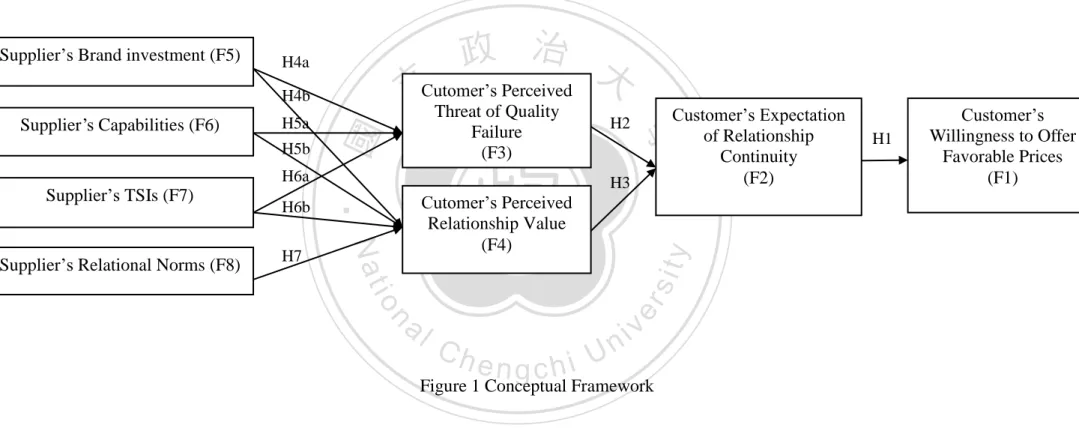
(15) Ritter, 1999; Spekman, Isabella, & MacAvoy, 2000). The efforts reflect the investment character of partnership establishment. A significant part of a supplier’s value is generally realized in the future and is thus dependent on the development of multiple partners (Möller & Törrönen, 2003). Therefore, a supplier’s upgrading manufacturing competencies in areas such as product quality, service, and innovation know-how provide many opportunities to add value in a customer–supplier relationship. Consequently:. Hypothesis 5a: A supplier’s capabilities are negatively associated with a customer’s perceived threat of quality failure. 立. 政 治 大. Hypothesis 5b: A supplier’s capabilities are positively associated with a customer’s perceived. sit. y. Nat. 3.6 Supplier’s transaction-specific assets investments (TSIs). ‧. ‧ 國. 學. relationship value. io. er. A supplier's transaction-specific assets investments (TSIs) are the supplier's investments. al. which are specialized to the exchange relationship that could be lost if s/he switches to another. n. v i n C h 1981). If theUrelationship ends, the other party will customer (Jap & Ganesan, 2000; Williamson, engchi suffer economic losses; hence, such idiosyncratic investments are not vain promises. All of these economic safeguarding mechanisms ensure substantial negative consequences if the exchange relationship is terminated; thereby reducing the exchange partner’s incentive to behave opportunistically (Kang, et al, 2009). On the other hand, a buyer firm safeguards his specific assets by establishing control over aspects of the supplier’s operations. Thus, the supplier is less likely to skimp on quality because of its unilateral investments in production equipment, tools, and procedures. Consequently: 11.
(16) Hypothesis 6a: A supplier’s transaction-specific assets investments (TSIs) are negatively associated with a customer’s perceived threat of quality failure. As mentioned above, when a supplier makes TSIs, the customer perceived such investments as a credible pledge of the supplier’s commitment to the relationship (Anderson & Weitz, 1992; Williamson, 1985). This action can act as a signal that the supplier is willing to shoulder its portion of the risks (Ouchi, 1980). When a customer observed a supplier making TSIs investments, s/he becomes more confident of the supplier’s commitment, because it knows that. 政 治 大. the supplier will sustain economic consequences if the relationship terminated. By making. 立. specific investments, a supplier has an incentive to maintain and continue the relationship until. ‧ 國. 學. the value of its investment is recouped (Williamson, 1985). There is a strong relationship. ‧. between a supplier’s TSIs and a customer’s perception of the manufacturer’s commitment to it. sit. y. Nat. (Anderson & Weitz, 1992). Previous studies (Anderson & Narus, 1990; Anderson & Weitz, 1989,. io. er. 1992) have concentrated mainly on the importance of transaction-specific investments in. al. determining long-term orientation. The more dedicated assets that a supplier invests, the more. n. v i n C h partner specificUknowledge (von Hippel, 1994) and likely that this supplier will accumulate engchi. thereby will develop interorganizational routines (Nelson & Winter, 1982). Such knowledge will then enable the supplier to outperform other potential suppliers in future transactions. Thus, these newly created capabilities can greatly improve exchange efficiency (Madhok, 2000) and enhance transaction value perceived by customers (Zajac & Olsen, 1993). Thus, we argue that a supplier’s transaction-specific assets investments (TSIs) will enhance the customer’s perception of relationship benefits. Consequently:. 12.
(17) Hypothesis 6b: A supplier’s transaction-specific assets investments (TSIs) are positively associated with a customer’s perceived relationship value. 3.7 Supplier’s relational norms Norms are expectations about behavior that are partially shared by a group of decision makers and directed toward collective or group goals (Gibbs, 1981; Macneil, 1980; Moch & Seashore, 1981; Thibaut & Kelly, 1959). Following the line of research (Dwyer & Oh, 1988; Heide & John, 1992; Jap & Ganesan, 2000), this study focuses on two mainly types of relational. 政 治 大. norms: solidarity and information exchange. The first relational norm is solidarity, which is a. 立. bilateral expectation that firms are directed toward relationship maintenance and a high value is. ‧ 國. 學. placed on the joint relationship (Jap & Ganesan 2000; Macneil, 1980). Solidarity is a feeling of. ‧. mutuality, a “we-ness” that assures the parties that arise in the course of the relationship will be. sit. y. Nat. treated as joint concerns. The second relational norm is information exchange, which is the. io. al. er. expectation that the parties sill freely and actively provide useful information to each other. n. (Heide & John, 1992; Jap & Ganesan, 2000). These norms address behavioral expectations in ongoing, present-day relationships.. Ch. engchi. i n U. v. Relational norms direct the focus of a supplier to bilaterally beneficial strategies and goals and a long-term orientation (Heide & John, 1992; Jap & Ganesan, 2000; Macneil, 1980). Developing solidarity shifts the focus of a supplier from self-created behaviors to behaviors that foster unity arising from common responsibilities and interests. Previous research (Jap & Ganesan, 2000) has proposed that the use of relational norms enhance a customer’s perception of the supplier’s commitment to the relationship. Consistent with past empirical results (Gundlach, Achrol, & Mentzer, 1995; Heide & John, 1992; Jap & Ganesan, 2000), we expect that a 13.
(18) suppliers’ development of such norms will enhance the customer’s perceptions of relationship benefits. Thus, we expect that Hypothesis 7: A suppliers’ development of relational norms is positively associated with a customer’s perceived relationship value. Figure 1 describes the determinants of a supplier’s willingness to provide a favorable price to its customer. H1 posits that customers’ expectation of relationship continuity (F2) with a particular supplier has a positive effect on their willingness to pay favorable price (F1). H2 and. 政 治 大. H3 contend that customers’ expectation of relationship continuity increase with decreased. 立. perceived threat of quality failure (F3), and with higher perceived values from relationship (F4).. ‧ 國. 學. The rest of the hypotheses suggest some factors that contributed to decreased threat of quality. ‧. failure and perceived relationship values. They include suppliers’ own capability (brand. sit. y. Nat. investment (F5) and capabilities (F6)), and their consolidating the relationship with foreign. io. n. al. er. customers (transaction-specific assets investments (F7), and relational norm (F8)).. 4. Research Method. Ch. engchi. i n U. v. 4.1 Research setting The unit of analysis in this study is the specific relationship between the emerging market supplier and its foreign customers in the electronics industry. We selected this subject for two major reasons. First, most of emerging market suppliers in the electronics industry often have relatively low bargaining power and extremely poor profit margins. The electronics industry is characterized by its highly uncertainty and stiff competition. Due to lack of quickly market 14.
(19) intelligence, the emerging market suppliers are often highly dependent on global firms which transfer technological and organizational skills to them (Jean et al., 2010; Kang et al., 2009; Subramani & Venkatraman, 2003). Second, another characteristic of electronics industry is vertically deintegrated in global production networks, where international customers concentrate on branding and product design, and suppliers are responsible for manufacturing parts, components, and assembly services. A majority of electronics manufacturers in emerging markets access international markets and advanced technology by serving foreign customers (Kang et al., 2006).. 政 治 大. The key informants in this study are senior purchasing/sourcing managers who are directly. 立. involved in international relationship with emerging market suppliers and have power of price. ‧ 國. ‧ sit. y. Nat. 4.2 Sampling frame. 學. setting.. io. er. The study uses a survey methodology for data collection. The sampling frame for the survey. al. comprises all foreign buyers from two international exhibitions held in Taiwan: 2012. n. v i n COMPUTEX TAIPEI and DISPLAYC TAIWAN. exhibition is an annual defining event for h e n gFirst chi U the Information and Communications Technology (ICT) industry which consolidated its standing as Asia’s largest, and the world’s 2nd largest ICT trade show. This event attracted 36,500 international buyers from 172 countries in 2012. Second one is the most international business-to-business (B2B) Flat Panel Display (FPD) exhibition in Taiwan, which includes international exhibitors from Korea, Japan, China, the U.S., Germany, Singapore, Belgium, the U.K., France and Austria composed over 35% of the overall exhibitors. This display also attracted more than 660 international buyers from over 70 countries in2012. Data used to test the 15.
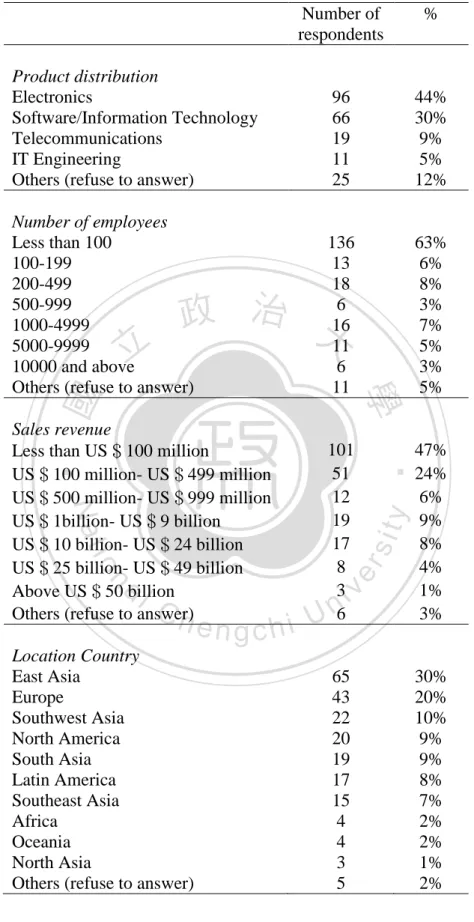
(20) model were collected through a questionnaire which visitors random contacted to international buyers in the above two exhibitions.. 4.3 Data collection Survey instrument. Questionnaire development was conducted of three stages: First, the initial survey format was developed based upon pre-existing measures developed researches. Next, the survey instrument was modified. In order to avoid errors, the content and face validity of the items were assessed by four Taiwanese judges and one American judge (university. 政 治 大. professors in international marketing); each judge was asked to assess how representative each. 立. item was of the final. Final, we submitted the mailing cover letter and scale items to a pretest. ‧ 國. 學. with two senior purchasing managers for completing the questionnaire. Few items were slightly. ‧. modified. The final list of scale items appears in the Table 1.. sit. y. Nat. Data collection was carried out in two stages: qualitative interview and a large-scale survey.. io. er. In the first stage, in-depth interviews were conducted with two senior electronics purchasing. al. n. managers. In order to balance the dyadic point of view in international out-sourcing, we also conducted two interviews with. v i n C haccount and marketing senior engchi U. managers. These interviews. provided insights into the strategies of emerging market suppliers can use to increase the willingness of foreign buyers to offer more favorable prices. In the second stage, a large-scale personal contact survey was conducted. We collected data in two international exhibitions: 2012 COMPUTEX TAIPEI and DISPLAY TAIWAN. Respondents among purchasing/sourcing managers of foreign electronics buyers were conveniently and randomly contacted by our well-trained visitors. Because all questionnaires were in English, visitors were asked to confirm that respondents had a good comprehension of 16.
(21) English before filling out questionnaires, thus mitigating any measurement equivalence concerns. Visitors must identify the representatives who (1) are willing to participate in the whole study (around. 30. minutes),. (2). are. knowledgeable. about. their. company’s. international. purchasing/sourcing decisions, and (3) are knowledgeable about their company’s price setting with the emerging market suppliers. The initial sampling frame was foreign buyers in 2012 COMPUTEX TAIPEI. During this period (2012, June 5th-8th), there were six well-trained and English fluently visitors (one PhD student and five undergraduate students) conducting this survey. There were total 186 foreign. 政 治 大. buyers are willing to complete our questionnaire. Among these respondents, a total of 143. 立. questionnaires were usable, resulting in an effective response rate of 77%. The second sampling. ‧ 國. 學. frame was foreign buyers in Display Taiwan. During the second period (2012, June 19th -21th),. ‧. there were one experienced PhD student and three well-trained undergraduate students. sit. y. Nat. conducting this survey. However, this time, a total 93 foreign buyers participated in our study.. io. er. Among these respondents, a total of 74 questionnaires were usable, resulting in an effective. al. response rate of 80%. Finally, there were final effective 217 samples in this survey.. n. v i n Sample characteristics. The 217C respondents from 49 countries, and their cooperative h e n g came chi U. supplier were in emerging markets (mainly in Taiwan (57%) and China (19%)) (As shown in Table 2). Customer firms ranged from small enterprises to multibillion dollar companies. On average, customers had been buying from their emerging market supplier for 6.5 years, with a standard deviation of 5.3 years. In our sample, on average, the suppliers captured 38.3% of customers’ order volumes in a given product category. Respondents held senior positions in their firms. They averaged 7 years of experience in their area.. 17.
(22) 4.4 Measures Existing scales identified through the literature review were modified to suit the research purpose and particular research context. These modified scales were supplemented with interviews from managers and academics in international sourcing and purchasing. All measurements ranged from one to seven (1=‘‘strongly disagree’’, 7= ‘‘strongly agree’’) and are reported below. The only one outcome variable in this study was foreign customers’ willingness to accommodate emerging market suppliers with favorable prices. Customer’s willingness to offer. 政 治 大. favorable prices measures the extent to which a customer is potentially exposing the supplier to a. 立. profitable situation in their pricing. Based on the definition of price premiums, which refers to. ‧ 國. 學. the prices in excess of marginal costs or the competitive market prices for a particular service. ‧. (Kumar et al., 2011; Rao & Bergen, 1992; Rao & Monroe, 1996), this study develop four items. y. sit. io. er. setting.. Nat. to fit this construct, and invest customers’ willingness to be more accommodating while price. Customer’s expectation of relationship continuity is defined that both parties have a high. al. n. v i n C h (Buchanan, 1992). stake in ensuring the relationship's success e n g c h i U In such cases, both parties have invested time, effort, and money in the relationship and committed to the relationship (Anderson. & Weitz, 1992; Lusch & Brown, 1996). In our study, this construct is measured along a four-item scale that was recently developed by Lusch and Brown (1996). Customer’s perceived threat of quality failure was based on the work of Steensma and Corley (2001), and modified to the supplier-customer context. It is operationalized as a construct comprising four measures. These address the uncertainty associated with both the engineering and design of a purchasing product and technology success. 18.
(23) Customer’s perceived relationship value consists of four items based on the work of Ulaga and Eggert (2006), and captures the concept that goes beyond the price vs. quality trade-off prevalent in consideration customer value from a relationship marketing perspective. Supplier’s brand investment including measures of supplier brand reputation and brand sustainable image, were adopted from Veloutsou and Moutinho (2009) to fit our context, and modified to the business to business market. The first is brand reputation consisted of 3 items and the second sustainable is image consisted of 2 items. The reputation is the aggregate perception of outsiders on the salient characteristics of companies (Fombrun & Rindova, 2000),. 政 治 大. or brands. Sustainable image captures the extent to which the values behind the brand will not. 立. change in the long-term.. ‧ 國. 學. Supplier’s capabilities scales, including measures of product quality, service support and. y. Nat. construct is assessed through seven items respectively. ‧. supplier know-how, were adopted from Ulaga and Eggert (2006) to fit our context. This. er. io. sit. Supplier’s transaction specific assets investments (TSIs) captures the extent to which the. al. supplier makes specific investments in the relationship that could be lost if it switched to another. n. v i n customer. This construct is measuredCusing adapted from the scales developed by h e nfourg citems hi U Rokkan, Heide, and Wathne (2003). Supplier’s relational norms were based on the work of Jap and Ganesan (2000) and Heide and John (1992). It is operationalized as a construct comprising seven measures. These address the standards for bow parties should treat each other, but they are not behavior per se. Information exchange items reflect the extent to which each party is willing to provide information that will help its partner. Solidarity items focus on the efforts directed toward preserving the relationship. 19.
(24) Control variables. First, we controlled for supply market dynamism by including the degree of variability of changes in the supplier’s market, such as rapidly changing technology or fluctuations in product availability (Cannon & Perreault Jr., 1999; Achrol & Stern, 1988). Significant supply market dynamism can create uncertainty and risk for a buying customer, and thus may increase the customer’s willingness to offer favorable prices (Roa & Monroe, 1996). This construct describes the extent of changes in the product market in recent years, and we use four indicators (product features and specs, vendor support services, technology used by suppliers, and product availability) to measure (Cannon & Perreault Jr., 1999). All indicators. 政 治 大. were measured on a seven-point scale from “major significant” to “minor significant.” The. 立. Cronbach alpha measure of reliability for this construct is 0.79.. ‧ 國. 學. Second, we controlled for the variability of product quality by testing the degree of. ‧. variability in product quality in the supply marketplace. If the product market is considerable. sit. y. Nat. variability in product quality, customers who are concerned about quality will be willing to offer. io. er. favorable prices to assure quality (Rao & Monroe, 1996). The variable of one scale was judged by comparing to other purchases the customer makes, the product is “highly variable in quality =. n. al. Ch. 7” to “not variable in quality = 1” (seven-point scale).. engchi. i n U. v. 4.5 Data Analysis The analysis for testing the proposed hypotheses was carried out in two stages. Initially, the reliability and construct validity of independent and dependent constructs were evaluated using Cronbach’s coefficients and confirmatory factor analysis (CFA). After reliability and construct validity were established, composite scores were used to reflect the dimensions of the underlying constructs, and to test the hypotheses using structural equation modeling (SEM). 20.
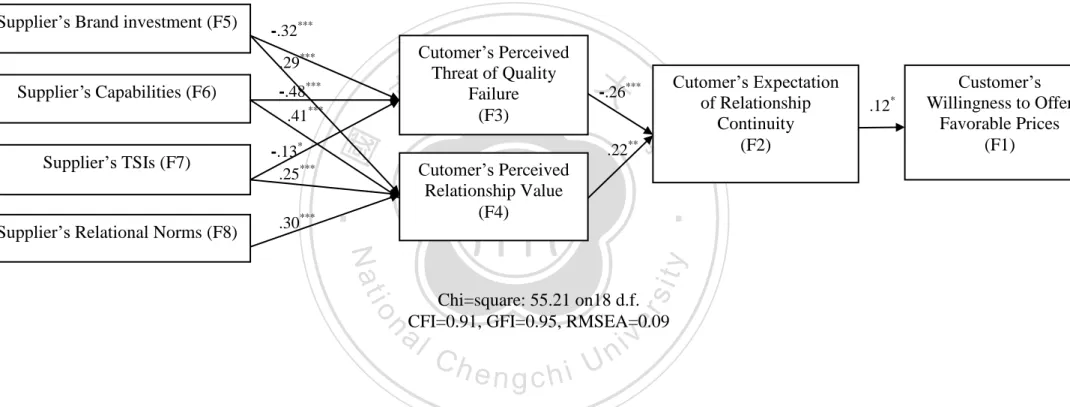
(25) 4.5.1 Reliability. For all seven multiple-item scales, the coefficient for each set of items was computed to assess the reliability of the measures. All of the scales demonstrate acceptable reliability above 0.70 (see Table 1), following criteria suggested by DeVellis (2003). 4.5.2 Measurement validity. Following Anderson and Gerbing (1988), CFA was carried out to assess the validity of all of construct measures included in this study. As shown in Table 1, the model provides an acceptable fit (2(674) =1930.69, CFI=0.94, NNFI=0.94, RMSEA=0.093). Moreover, all factor. 政 治 大. loadings were statistically significant at the 5% level, and most of the factor loadings exceed the. 立. arbitrary 0.5 standard (Fornell & Larcker, 1981). Thus these measures demonstrate adequate. ‧ 國. 學. convergent validity. In terms of discriminant validity, this study used the methods suggested by. ‧. Fornell and Larcker (1981). As shown in Table 3, the square root of the average variance. sit. y. Nat. extracted (AVE) (ranging from 0.687 through 0.866) is greater than most of the corresponding. io. er. correlations (ranging from 0.102 through 0.660), which indicates adequate discriminant validity.. al. v i n C model established, measurementh e n g c h i U we n. 4.5.3 Structural equation model. With the acceptable. proceeded to estimate the. structural model. We use data collected from 217 foreign customers to test the hypothesized relationships through path analysis using LISREL methodology and provide the results (Joreskog, 1977). As shown in Figure 2, the overall fit statistics indicate an adequate fit of the model to the data (2 (18) =55.21, CFI=0.91, GFI=0.95, RMSEA=0.09). As per our findings, the hypothesized relationship between a customer’s expectation of relationship continuity and its willingness to accommodate emerging market suppliers with favorable prices is positive and significant (=.12 p<0.05), which supports Hypothesis 1. 21.
(26) Hypothesis 2 postulates that a customer’s perceived threat of quality failure has negative effects on its tendency of continuing cooperative relationship with a supplier. Consist with our claim, a customer’s perceived threat of the quality failure does reduce a customer’s expectation of relationship continuity (= -.26, p<0.001). Hypothesis 3, which claims that a customer’s expectation of relationship continuity is also driven by its perceived value of a relationship with emerging market suppliers (=.22, p<0.01), is supported. In line with our claim, we found no difference in terms of the impact of a customer’s perceived threat of quality failure and relationship value on its expectation of relationship continuity (χ2 (19) =55.50, Δχ2 = 0.29, df =1, p >.05).. 立. 政 治 大. We found a different effect of a supplier’s brand investment on its customer’s perceived. ‧ 國. 學. threat of quality failure and relationship value, in line with Hypothesis 4. Our findings show that. ‧. a supplier’s brand investment reduces a customer’s perceived threat of quality failure (= -.32,. sit. y. Nat. p<0.001), as expressed in Hypothesis 4a. On the contrary, a supplier’s brand investments was. io. n. al. er. expected to affect a customer’s perceived relationship value, and that is also supported (=.29,. i n U. v. p<0.001), as expressed in Hypothesis 4b. Moreover, we found no significant difference in terms. Ch. engchi. of the impact of a supplier’s brand investment on its customer’s perceived threat of quality failure and relationship value (χ2 (19) =55.43, Δχ2 = 0.22, df =1, p >.05). Hypothesis 5a and 5b, which claim that a supplier’s capabilities have significant and negative effects on a customer’s perceived threat of quality failure (= -.48, p<0.001), but positive effects on a customer’s perceived relationship value (=.41, p<0.001). In addition, there is no significant difference in terms of the impact of a supplier’s competences on its customer’s perceived threat of quality failure and relationship value (χ2 (19) =55.85, Δχ2 = 0.64, df =1, p >.05) 22.
(27) Hypotheses 6 also relate a supplier’s TSIs to a customer’s perceived value from suppliers. We also found negative effect of a supplier’s TSIs on a customer’s perceived threat of quality failure (= -.13, p<0.05), but positive effect on a customer’s perceived relationship value (= .25, p<0.001), as predicted by Hypotheses 6a and 6b. Furthermore, there is no significant difference in terms of the impact of a supplier’s TSIs on its customer’s perceived threat of quality failure and relationship value (χ2 (19) =56.79, Δχ2 = 1.58, df =1, p >.05) Finally, Hypothesis7 postulates that a supplier’s relational norms have a positive impact on a customer’s perception of relationship value with the supplier. In line with our claim,. 政 治 大. relationship value was found to be driven strongly by the supplier’s relational norms (= .30,. 立. p<0.001): thus there is empirical support for Hypothesis 7.. ‧ 國. 學. 4.5.4 Competing models: Examining other direct or indirect paths.. ‧. Since our goal is to untangle direct versus indirect effects within a complex chain of. sit. y. Nat. constructs, it is important to verify that other paths are not significant. One possibility is that the. io. er. customer’s perceived threat of product quality and value of relationships may directly affect the. al. v i n C important mediator the customer’s long term orientation ashan e n g c h i U of the impacts of customer’s n. willingness of their customers to offer better prices. The issue is important because (1) we model. perceived value and its willingness of offering favorable prices. If either proves false, the chain of direct and indirect effects would be significantly different, having major theoretical and practical implications. To test the alternative model, the direct links between (customer’s perceived threat of product quality)-(customer’s willingness to offer favorable prices) and (customer’s perceived value of relationships)-(customer’s willingness to offer favorable prices) were added. The difference in χ2 was not significant, χ2 (16) =54.03, Δχ2 = −1.18, df =2, p >.05). Therefore, the customer’s perceived value affects its willingness of offering favorable prices is 23.
(28) indirect. Another possible challenge to the hypothesized model is that emerging market supplier’s strategies (i.e., supplier’s brand investment, supplier’s capabilities, supplier’s TSIs and supplier’s relational norms) may direct affect its customer’s willingness to offer favorable prices. To test this assertion, the links from the supplier’s strategies and its customer’s willingness to offer favorable prices were freed (six new paths). The results show that the difference in chi-square was not significant, χ2 (12) = 44.83, Δχ2 = −10.38, df = 6, p > .05). Thus, emerging market suppliers can receive more favorable prices indirectly through decreasing the customer’s. 政 治 大. perceived threat of product quality, increasing customer’s perceived value of relationships, and. 立. expectation of relationship continuity.. ‧ 國. 學 ‧. 5. Discussion and Implications. sit. y. Nat. The overall objective of this study is to explore the strategies that emerging market firms. io. al. er. can use to increase their bargaining positions and then increase the willingness of foreign. v. n. customers to offer more favorable prices. Findings demonstrate that the emerging market. Ch. engchi. i n U. supplier’s capabilities and collaborative relationship with the foreign customer do contribute to the customer’s tendency to continue the relationship, and accommodate the supplier with favorable prices. The empirical findings confirm that a customer’s expectation of relationship continuity serve as a powerful mediation between emerging market supplier’s strategies and its customer’s willingness to offer favorable prices. Indeed, a customer’s tendency of relationship continuity with the supplier has a strong influence on its willingness to offer favorable prices. This finding provides an empirical support for previous research (Dyer & Singh, 1998; Kumar et al., 2003; 24.
(29) Porter, 1985), which suggests that a customer is more willing to pay a higher price premium to a supplier if it wants to keep its relationship with the supplier going. For instance, Kim (2007) demonstrates that relational rent as a supernormal profit from an interfirm exchange can only be earned and preserved through relational behaviors between two exchange parties. Our findings also propose that a customer’s expectation of relationship continuity was driven by perceived the supplier’s value creation, which includes decreasing the relationship costs (threat of quality failure) and increasing the relationship benefits (relationship value) with the customer. The second findings highlight the mediation roles of emerging market supplier’s strategies. 政 治 大. can use to increase its customer’s expectation to continue the relationship with the supplier. This. 立. study finds that not only decreasing a customer’s perceived threat of quality failure may. ‧ 國. 學. contribute to its expectation to continue the relationship with the supplier, but also increasing a. ‧. customer’s perceived value of relationship may do. This is consistent with the emerging view of. sit. y. Nat. value-based perspective, and the crucial role of value creation in the management of. io. er. customer-supplier relationship (Heide, 2003; Ulaga & Eggert, 2006).. Interestingly, we find that a customer’s perceived threat of quality failure is driven by a. al. n. v i n C h and TSIs with the supplier’s brand investments, capabilities e n g c h i U customer. In addition, there is no difference in terms of the impact of these three supplier’s strategies on the customer’s perceived threat of quality failure (H4a & H5a, Δχ2 = 0.01 with df =1, p >.05; H4a & H6a, Δχ2 = 0.87 with df =1, p >.05; H5a & H6a, Δχ2 = 1.05 with df =1, p >.05). That is, both two major strategies that emerging market suppliers use will lead to decreasing foreign customer’s perceived threat of quality failure. Especially, previous research (Hague & Jackson, 1994; Persson, 2010; Wood, 2000) has proposed that the competitive advantage of firms that have brands with high equity can attain a price premium. For instance, Ackerman (1998) suggests that the corporate brand 25.
(30) offers managers a comprehensive discipline for clarifying, humanizing, organizing, and communicating how the company creates value. Therefore, a supplier’s brand investments could decrease a customer’s perceived threat of quality failure. Results also imply that a customer’s perceived value of relationship is driven by a supplier’s (1) making brand investment, (2) upgrading manufacturing competencies in areas such as product quality, service, and innovation know-how, (3) making transaction-specific assets investments (TSIs), and (4) developing relational norms with the customers. In line with our claim, there is no difference in terms of the impact of the first two supplier’s strategies on the. 政 治 大. customer’s perceived value of relationship (H4b & H5b, Δχ2 = 0.02 with df =1, p >.05).. 立. However, a customer’s perceived value of relationship was found to be driven more strongly by. ‧ 國. 學. the supplier’s capabilities than by supplier’s TISs and relational norms (H5b & H6b, Δχ2 = 10.66. ‧. with df =1, p <.05; H5b & H7b, Δχ2 = 14.32 with df =1, p <.05). In other words, emerging. y. sit. io. er. exchange relationships.. Nat. market supplier’s capabilities serve an essential role in enhancing the value of international. al. From a conceptual standpoint, this study advances the literature on the determinants of price. n. v i n C h2010; Rao & Bergen, premium (Kumar et al., 2011; Persson, e n g c h i U 1992; Smith et al., 1999) by offering the perspective of value of relationship between the supplier and its customer. We argue that the customer’s perceived value of relationship may also contribute to its willingness to offer favorable prices. From a practical standpoint, this study provides an empirical evidences regarding the strategies that the suppliers can do to increase the willingness of their buyers to offer more favorable prices. We find that supplier’s capabilities display a stronger impact on the customer’s perceived value of relationship with the supplier. This finding is consist with Ulaga and Eggert’s (2006) study, since they suggest that offering superior benefits (e.g. core benefits, 26.
(31) sourcing benefits, and operations benefits) to the customer is essential for winning a substantial share of a customer’s business. Therefore we extend Ulaga and Eggert’s (2006) study to international contexts, and argue that emerging market supplier’s capabilities plays a crucial role in building cooperative international exchange relationships.. 5.1 Limitations and future research directions The findings need to be evaluated taking into account several limitations. First, when exploring a supplier’s capabilities and associated a customer’s perception of the supplier’s value. 政 治 大. creation, this study considered the perspective of the customers. It may be valuable to compare. 立. whether the findings are equally applicable to the suppliers. Second, the specific context was a. ‧ 國. 學. sample of foreign customers’ attendance in international electronics exhibition in Taiwan,. ‧. suggesting that an extension of the study to other countries would be desirable. Third, our. sit. y. Nat. empirical testing identifies four major strategies that emerging market firms use to increase the. io. er. willingness of their customers to offer better prices: (1) making brand investment, (2) upgrading. al. manufacturing competencies in areas such as product quality, service, and innovation know-how,. n. v i n (3) making transaction-specific assetsCinvestments and (4) developing relational norms h e n g c(TSIs), hi U. with the customers. Future research could investigate other supplier’s competences within international customer-supplier relationship, such as dynamic competitive capability. In spite of all the limitations of our conclusions, we believe that the findings from our study are intriguing enough to invite further research on the related topic of the strategies that emerging market suppliers can use to increase the willingness of foreign buyers to offer more favorable prices.. 27.
(32) References Achrol, R. S. & Stern, L. W. (1988). Environmental determinants of decision-making uncertainty in marketing channels. Journal of Marketing Research, 25(February), 36-50. Ackerman, L. (1998). Secrets of the corporate brand. Across the Board, 35, 33–37. Amit, R. & Schoemaker, Pj. J. H. (1993). Strategic assests and organizational rent. Strategic Management Journal, 14, 33-46. Anderson, E. & Weitz, B. (1989). Determinants of continuity in conventional industrial channel dyads. Marketing Science, 8(Fall), 310-23.. 政 治 大. Anderson, E. & Weitz, B. (1992). The use of pledges to build and sustain commitment in distribution channels. Journal of Marketing Research, 29(1), 18-34.. 立. Anderson, J. C., & Gerbing, D. W. (1988). Structural equation modeling in practice: A review. ‧ 國. 學. and recommended two-step approach. Psychological Bulletin, 103(3), 411–423. Anderson, J. C., Jain, D., & Chintagunta, P. (1993). Customer value assessment in business. ‧. markets: A state-of-practice study. Journal of Business-to-Business Marketing, 1, 3–29.. sit. y. Nat. Anderson, J. C. & Narus, J. A. (1999). Business market management: Understanding, creating,. io. er. and delivering value. Prentice Hall, Upper Saddle River, New Jersey.. al. Anselmsson, J., Johansson, U., & Persson, N. (2007). Understanding price premium for grocery. n. v i n products: a conceptual modelCof customer-based brand equity. Journal of Product hengchi U Brand Management, 16(6), 401–414.. &. Ashwin, W. J. & Rodney, L. S. (1999). The contingent effect of specific asset investments on joint action in manufacturer-supplier relationships: An empirical test of the moderating role of reciprocal asset investments, uncertainty, and trust. Academy of Marketing Science. Journal, 27(3), 291 Ba, S. & Pavlou, P. A. (2002). Evidence of the effect of trust building technology in electronic markets: Price premiums and buyer behavior. MIS Quarterly, 26(3), 243-268. Ballantyne, D. & Aitken, R. (2007), Branding in B2B markets: Insights from the service-dominant logic of marketing. Journal of Business & Industrial Marketing, 22(6), 28.
(33) 363–371. Ballou, R. H. (2007). The evolution and future of logistics and supply chain management. European Business Review, 19(4), 332 – 348. Barney, J. (1991). Firm resources and sustained competitive advantage. Journal of Management, 17, 99–120. Beverland, M., Napoli, J., & Lindgreen, A. (2007). Industrial global brand leadership. Industrial Marketing Management, 36, 1082–1093 Brennan, R.& Turnbull, P. W. (1999). Adaptive behavior in buyer–supplier relationships. Industrial Marketing Management, 28, 481-95.. 政 治 大 attaining organizational goals. 立 Journal of Marketing Research, 29(1), 65-75.. Buchanan, L. (1992). Vertical trade relationships: The role of dependence and symmetry in. ‧ 國. 學. Cannon, J. P., & Perreault Jr, W. D. (1999). Buyer–seller relationships in business markets. Journal of Marketing Research, 36(4), 439–460.. ‧. Cannon, J. P. & Homburg, C. (2001). Buyer-Supplier Relationships and Customer Firm Costs.. sit. y. Nat. Journal of Marketing, 65, 29-43.. Celly, K. S., Spekman, R. E., & Kamauff, J. W. (1999). Technological uncertainty, buyer. io. n. al. er. preferences and supplier assurances: An examination of Pacific Rim purchasing. i n U. v. arrangements. Journal of International Business Studies, 30(2), 297–310.. Ch. engchi. Chena, I. J., Paulraja, A. & Lado, A. A. (2004). Strategic purchasing, supply management, and firm performance. Journal of Operations Management, 22, 505–523. Chiou, J. S. & Droge, D. (2006) Service quality, trust, specific asset investment, and expertise: direct and indirect effects in a satisfaction-loyalty framework. Journal of the Academy of Marketing Science, 34, 613-627. Choi, T. Y. & Hartley, J. L. (1996). An exploration of supplier selection practices across the supply chain. Journal of Operations Management, 14(4), 333-343. Cole, G. S. (1988). The changing relationships between original equipment manufacturers and their suppliers,” International Journal of Technology Management, 3(3), 299-324 29.
(34) Combs, J. G.& Ketchen, Jr. D. J. (1999). Explaining interfirm cooperation and performance: toward a reconciliation of predictions from the resource-based view and organizational economics. Strategic Management Journal, 20(9), 867-888. Conner, K. R. (1991). A historical comparison of resource-based theory and five schools of thought withinindustrial organization economics: Do we have a new theory of the firm? Journal of Management, 17, 121–154. Denrell, J., Fang, C., & Winter, S. G. (2003). The economics of strategic opportunity. Strategic Management Journal, 24, 977–990. DeVellis, R. F. (2003). Scale development: Theory and Applications, Applied Social Research. 政 治 大 Dorsch, M. J., Swanson, S. R., & Kelley, S. W. (1998). The role of relationship quality in the 立 stratification of vendors as perceived by customers, Journal of the Academy of Marketing Methods Series (2nd ed.). London: Sage.. ‧ 國. 學. Science, 26 (2), 128–142.. ‧. Dutta, S., & Weiss, A. M. (1997). The relationship between a firm’s level of technological innovativeness and its pattern of partnership agreements. Management Science, 43(3),. sit. y. Nat. 343–357.. al. er. io. Dwyer, R. F. & Oh, S. (1988). A tranaction-cost perspective on vertical contratual structure and. n. interchannel competitive strategies. Journal of Marketing, 52 (April), 21-34. Dyer J. H. & Singh, H. (1998).. v i n C hrelational view: U The e n g c h i cooperative. strategy and sources of. interorganizational competitive advantage. Academy of management review, 23, 660–680. Eggert, A. & Ulaga, W. (2002). Customer-perceived value: A substitute for satisfaction in business markets? Journal of Business and Industrial Marketing, 17 (2/3), 107–118 Eggert, A. & Ulaga, W. (2005). Relationship value in business markets: The construct and its dimensions, Journal of Business-to-Business Marketing, 12 (1), 73–99 Eggert, A., Ulaga, W. & Schultz, F. (2006). Value creation in the relationship life cycle: A quasi-longitudinal analysis, Industrial Marketing Management, 35(1), 20–27 Fombrun, C. J. & Rindova, V. (2000). The Road to Transparency: Reputation Management at Royal Dutch/Shell. in M. Schultz, M.J. Hatch and M.H. Larsen (eds.), The Expressive 30.
(35) Organization: Linking Identity, Reputation, and the Corporate Brand , Oxford University Press, Oxford . Ford, D.& McDowell. R. (1999). Managing business relationships by analyzing the effects and value of different actions. Industrial Marketing Management, 28, 429-42. Fornell, C. & Larcker, D. F. (1981). Evaluating Structural Equation Models with Unobservable Variables and Measurement Error. Journal of Marketing Research, 18(1), 39-50. Frazier, G. L. (1983). Interorganizational exchange behavior in marketing channels: A broadened perspective. Journal of Marketing, 47(4), 68-78. Ganesan, S. (1994). Determinant.s of long-term orientation in buyer-seller relationships, Journal. 政 治 大 Gassenheimer, J. B., Houston, F.立 S., & Davis, J. C. (1998). The role of economic value, social of Marketing, 58 (2), 1-19,. ‧ 國. 學. value, and perceptions of fairness in interorganizational relationship retention decisions, Journal of the Academy of Marketing Science, 26 (4), 322–337.. ‧. Ghosh, M. & George John, G. (2009). When should original equipment manufacturers use branded component contracts with suppliers? Journal of Marketing Research, 46(5),. sit. y. Nat. 597-611.. al. n. Elsevier.. er. io. Gibbs, J. P. (1981). Norms, Deviance, and Social Control: Caonceptural Matters. New York:. Ch. engchi. i n U. v. Grewal, D., Monroe, K. B., & Krishnan, R. (1998). The effects of price comparison advertising on buyers’ perceptions of acquisition value and transaction value. Journal of Marketing, 62, 46–59. Gundlach, G. T., Achrol, R. S. & Mentzer, J. T. (1995). The structure of commitment in exchange. Journal of Marketing, 59(January), 78-92. Hague, P. Jackson, P. (1994). The Power of Industrial Brands, an Effective Route to Competitive Advantage. McGraw-Hill, London,1–716 Heide, J. B. & John, G. (1992). Do norms matter in marketing relationships? Journal of Marketing, 56 (2), 32-44. Heide, J. B. (2003). Plural governance in industrial purchasing. Journal of Marketing, 67(4), 31.
(36) 18–29. Herbig, P. & Milewicz, J. (1995). To be or not to be … credible that is: A model of reputation and credibility credibility among competing firms. Marketing Intelligence and Planning, 13(6), 24 – 33. Hogan, J. E. (2001). Expected relationship value: A construct, a methodology for measurement, and a modeling technique. Industrial Marketing Management, 30, 339–351. Hunt, S. D., & Morgan, R. M. (1995). The comparative advantage theory of competition. Journal of Marketing, 59, 1–15. Jap, S. D. & Ganesan S. (2000). Control mechanisms and the relationship life cycle: Implications. 政 治 大. for safeguarding specific investments and developing commitment. Journal of Marketing. 立. Research, 227-245.. ‧ 國. 學. Jap, S. (1999). Pie-expansion efforts: collaborative process in buyer–seller relationships. Journal of Marketing Research, 36, 461–475.. ‧. Jean, R. J., Sinkovics, R. R., & Cavusgil, S. T. (2010), Enhancing international customer–supplier relationships through IT resources: A study of Taiwanese electronics. y. Nat. sit. suppliers. Journal of International Business Studies, 41, 1218–1239.. n. al. er. io. Jaworski, B. J. & Kohli A. K. (1993). Market orientation: Antecedents and consequences. Journal of Marketing, 57 (3), 53-70.. Ch. engchi. i n U. v. Joreskog, K. G. (1977). A General Method for Analysis of Covariance Structures. In D. J. Aigner and A. S. Goldberger (eds.), Latent Variables in Socio-Economic Models. North-Holland, Amsterdam, 187-204. Kim, S. K. (2007). Relational behaviors in marketing channel relationships: Transaction cost implications. Journal of Business Research, 60,1125–1134. Kim, S. M. & Mahoney, J. T. (2006). Mutual commitment to support exchange: relation-specific IT system as a substitute for managerial hierarchy. Strategic Management Journal, 27(5), 401-423. Kang, M. P., Mahoney, J. T. & Tan, D. (2009). Why firms ,ake unilateral investments specific to other firms: The case of OEM suppliers. Strategic Management Journal, 30, 117–135. 32.
(37) Kannan, V. R. & Tan, K. C. (2002). Supplier Selection and Assessment: Their Impact on Business Performance. Journal of Supply Chain Management, 38(4), 11-21. Kalwani, M. U. & Narayandas, N. (1995). Long-term manufacturer–supplier relationships: Do they pay off for supplier firms? Journal of Marketing, 59 (January), 1–16. Katsikeas, C. S., Paparoidamis, N. G. & Katsikea, E. (2004), Supply source selection criteria: The impact of supplier performance on distributor performance, Industrial Marketing Management, 33(8), 755-764. Kirmani, A. & Rao, A. R. (2000). No Pain, No Gain: A Critical Review of the Literature on Signaling Unobservable Product Quality. Journal of Marketing, 64(2), 66-79.. 政 治 大 Journal of Political Economy, 89 (4), 615-41. 立. Klein, B. & Leffler, K. B. (1981). The role of market forces in assuring contractual performance.. ‧ 國. 學. Kuhn, K. A. L., Alpert, F., & Pope, N. K. (2008). An Application of Keller's Brand Equity Model in a B2B Context. Qualitative Market Research: An International, 11(1),40–58.. ‧. Kumar, A., Heide J. B., & Wathne K. H. (2011). Performance implications of mismatched governance regimes across external and internal relationships. Journal of Marketing, 75. sit. y. Nat. (March), 1–17.. n. al. er. io. Kumar, V., Bohling, T. R., & Ladda, R. N. (2003). Antecedents and consequences of relationship. i n U. v. intention: Implications for transaction and relationship marketing. Industrial Marketing Management, 32, 667– 676. Ch. engchi. Lapierre, J. (2000). Customer-perceived value in industrial contexts, Journal of Business and Industrial Marketing, 15 (2/3), 122–140. Lane, P. J., & Lubatkin, M. H. (1998). Relative absorptive capacity and interorganizational learning. Strategic Management Journal, 19(5), 461–477. Lavie, D. (2006). The competitive advantage of interconnected firms: an extension of the resource-based view. Academy of Management Review, 31(3): 638–658. Lin, B. W. (2004). Original equipment manufacturers (OEM) manufacturing strategy for network innovation agility: the case of Taiwanese manufacturing networks. International Journal of Production Research, 42(5), 943-957 33.
(38) Luo, Y. & Tung, R. L. (2007). International expansion of emerging market enterprises: A springboard perspective. Journal of International Business Studies, 38, 481–498. Lusch, R. F. & Brown, J. R. (1996). Interdependency, contracting, and relational behavior in marketing channels, Journal of Marketing, 60, 19-38 Ravald, A & Grönroos, C. (1996). The value concept and relationship marketing, European Journal of Marketing, 30 (2), 19–30 Pavlou, P. A. & Dimoka, A. (2006). The nature and role of feedback text comments in online marketplaces: Implications for trust building, price premiums, and seller differentiation, Information Systems Research. 17(4), 392–414. 政 治 大 marketing, Australasian Marketing Journal, 7 (1), 41–51 立. Payne, A. & Holt, S. (1999). A review of the ‘Value’ literature and implications for relationship. ‧ 國. 學. Persson, N. (2010). An exploratory investigation of the elements of B2B brand image and its relationship to price premium. Industrial Marketing Management, 39, 1269–1277. ‧. Porter, M. E. (1985). Competitive Advantage: Creating and Sustaining Superior Performance. New York: The Free Press. y. Nat. sit. Pressey, A., Tzokas, N., & Winklhofer, H. (2007). Strategic purchasing and the evaluation of. al. n. Business & Industrial Marketing, 22(5), 282 – 294.. Ch. engchi. er. io. “problem” key supply relationships: what do key suppliers need to know? Journal of. i n U. v. Rao, A. R. & Monroe, K. B. (1996). Causes and consequences of price premiums. The Journal of Business, 69(4), 511-535. Rao, A. R. & Bergen, M. E. (1992). Price premium variations as a consequence of buyers' lack of information. Journal of Consumer Research, 19(3), 412-423. Rena, X., Ohb, S., & Noh, J. (2010). Managing supplier–retailer relationships: From institutional and task environment perspectives. Industrial Marketing Management, 39(4), 593–604 Ritter, T. (1999). The networking company: Antecedents for coping with relationships and networks effectively. Industrial Marketing Management, 28, 467-79. Rokkan A. I., Heide, J. B. & Wathne, K. H. (2003). Specific investments in marketing relationships: expropriation and bonding effects, Journal of Marketing Research, 40(2), 34.
數據

+2
相關文件
This proves that ρ is the radius of convergence of S, and that parts (i) and (iii) hold.. W EN -C HING L IEN Advanced
An n×n square is called an m–binary latin square if each row and column of it filled with exactly m “1”s and (n–m) “0”s. We are going to study the following question: Find
To proceed, we construct a t-motive M S for this purpose, so that it has the GP property and its “periods”Ψ S (θ) from rigid analytic trivialization generate also the field K S ,
name common laboratory apparatus (e.g., beaker, test tube, test-tube rack, glass rod, dropper, spatula, measuring cylinder, Bunsen burner, tripod, wire gauze and heat-proof
• If the same monthly prepayment speed s is maintained since the issuance of the pool, the remaining principal balance at month i will be RB i × (1 − s/100) i. • It goes without
• If the same monthly prepayment speed s is maintained since the issuance of the pool, the remaining principal balance at month i will be RB i × (1 − s/100) i.. • It goes
Biases in Pricing Continuously Monitored Options with Monte Carlo (continued). • If all of the sampled prices are below the barrier, this sample path pays max(S(t n ) −
• Delta hedge is based on the first-order approximation to changes in the derivative price, ∆f , due to changes in the stock price, ∆S.. • When ∆S is not small, the
