國 立 交 通 大 學
電信工程研究所
博 士 論 文
具服務品質保證之
下世代光纖網路訊務控制機制
Traffic Control Schemes for
Next-Generation Optical Networks with
QoS-Provisioning
研 究 生:唐文祥
指導教授:張仲儒老師
具服務品質保證之下世代光纖網路訊務控制機制
Traffic Control Schemes for Next-Generation
Optical Networks with QoS-Provisioning
研究生:唐文祥
Student:
Wen-Shiang
Tang
指導教授:張仲儒 博士 Advisor:
Dr.
Chung-Ju
Chang
國立交通大學
電信工程研究所
博士論文
A Dissertation
Submitted to Institute of Communication Engineering
College of Electrical and Computer Engineering
National Chiao Tung University
in Partial Fulfillment of the Requirements
for the Degree of Doctor of Philosophy
in
Communication Engineering
Hsinchu, Taiwan
具服務品質保證之下世代光纖網路訊務控制機制
研究生:唐文祥
指導教授:張仲儒 博士
國立交通大學電機工程學系博士班
摘 要
本論文的主要專注在下一世代光纖網路的訊務控制機制,其中討論的網路系統包含有光群 聚交換骨幹網路(optical burst switching backbone network)、高速都會區域網路(metropolitan area network, MAN)中的封包彈性環(resilient packet ring, RPR)、以及橋接式封包彈性環(bridged resilient packet ring, BRPR)。
我們首先探討光群聚交換骨幹網路中的訊務控制機制。該交換系統兼具光電路交換系統 (optical circuit switching, OCS)和光封包交換系統(optical packet switching, OPS)的優點,且所需 相關的光處理器也已開發,因以此交換機制比較受青眛。在光群聚交換骨幹網路中,頻寬的 分配只要是以預先保留(Reservation)的方式來處理巨集封包(Burst),再加入了光的緩衝器(Fiber Delay Line)可以使的比較晚到或具較低優先權的封包可以順利的傳送出去。在這樣架構下的考 量,我們設計一種具光緩衝器分配的權限群聚排程演算法(priority burst scheduling with FDL assignment, PBS-FA)。其主要設計理念是想讓具較高優先權的群聚必要情況下可以強制取代已 保留給低優先權群聚或群聚長度較短但高優先群聚的頻寬,之後再對被犧牲的群聚進行了補 償。
在本篇論文的第二部份,探討高速都會區域網路中的彈性分封環(Resilient Packet Ring)。 在彈性分封環中訊務控制所需考慮的議題主要希望可以達到公平性的頻寬分配並且可以快速 穩定各訊務流。我們提出一個高效能乏晰公平流速產生器(fuzzy local fairRate generator, FLAG),藉著乏晰運作機制產生一個準確的本地公平流速來抑制壅塞情況並且達成上述考 量。所提出的機制,是由三個部份所組成,適應性公平流速計算器(adaptive fairRate calculator, AFC)、乏晰壅塞偵測器(fuzzy congestion detector, FCD)、與乏晰公平流速計算器(fuzzy fairRate generator, FFG)。適應性公平流速計算器產生一個評估過的公平流速而乏晰壅塞偵測器根據次 級傳輸緩衝器(STQ)的容納量與接收到的流量大小來指出當前的壅塞程度。乏晰公平流速計算 器經由考量兩項由適應性公平流速計算器與乏晰壅塞偵測器輸出的結果來得到反映真實流量 狀況的本地公平流速。藉由適應性公平流速計算器與乏晰壅塞偵測器的使用,乏晰公平流速 產生器可產生較小的收斂時間,再者當與其它演算法相比,在不同大小的壅塞區域中皆獲得 極好的效果。 最後,我們探討由橋接器(bridge)鍵連多個彈性分封環而成的橋接式封包彈性環(bridged resilient packet ring, BRPR)中的路由問題。在此環境中,我們基於載量均衡原則(the load balancing principle)提出一個智慧型跨環路由控制法。該智慧型跨環路由控制法不只同時考慮 橋接器以及下游擷點雍塞的情況並且同時考量橋接器的服務速率以及訊務終點站與橋接器的
距離。此路由控制法主要包含三個部分:一個是乏晰橋接器雍塞指示器(fuzzy bridge-node congestion indicator, FBCI)、一個是平行串列遞迴類神經網路下游擷點公平性預測器(pipeline recurrent neural networks (PRNN) downstream-node fairness predictor, PDFP)、一個是乏晰由路控 制器(fuzzy route controller, FRC)。從模擬結果來看,該智慧型跨環路由控制法明顯改善佇列長 度閾控制器(queue length threshold route controller, QTRC)以及最短路徑控制器(the shortest path route controller, SPRC)很多。
Traffic Control Schemes for
Next-Generation Optical Networks with
QoS-provisioning
Student: Wen-Shiang Tang
Advisor: Dr. Chung-Ju Chang
Department of Electrical Engineering
National Chiao Tung University
Abstract
This dissertation is aimed at traffic control issue in the next-generation optical network for the optical burst switching (OBS) core network, the resilient packet ring (RPR), which is a metropolitan area network (MAN), and the bridged resilient packet ring (BRPR).
First, we propose a priority burst scheduling with fiber delay line (FDL) assign-ment (PBS-FA) for the OBS core network. It allows not only high-priority bursts to preempt low-priority ones but also longer high-priority bursts to preempt shorter high-priority ones. Meanwhile it schedules or reschedules these bursts by using FDL assignment. Simulation results reveal that the PBS-FA achieves the higher system throughput and the less average system dropping probability less than a preemptive latest available unused channel with void filling (PLAUC-VF) scheme.
Second, we propose a local fairRate generator using fuzzy logics and moving average technique for the RPR to achieve the congestion control. The fuzzy lo-cal fairRate generator (FLAG) is designed to achieve both low convergence time and high system throughput, besides fairness. It contains three functional blocks:
an adaptive fairRate calculator (AFC) to properly pre-produce a local fairRate by moving average technique; a fuzzy congestion detector (FCD) to intelligently esti-mate the congestion degree of station; finally, a fuzzy fairRate generator (FFG) to precisely generate the local fairRate. Simulation results show that only the FLAG can stabilize all flows in parking lot scenarios with different finite traffic demands, compared to conventional the aggressive mode (AM) and distributed bandwidth allocation (DBA) fairness algorithms.
Finally, we propose an intelligent inter-ring route control, employed in the bridges which connect two resilient packet rings (RPRs), for the BRPR. The intelligent inter-ring route controller (IIRC) is designed according to the load balancing principle, where the IIRC considers not only the congestion degree of both bridge and its downstream nodes but also the service rate and the number of hops to destination. It contains three functional blocks implemented by fuzzy logic systems or pipeline re-current neural networks (PRNN). A fuzzy bridge-node congestion indicator (FBCI) is to detect the congestion degree of the bridge, a PRNN downstream-node fairness predictor (PDFP) is to predict the mean received fairRate from downstream nodes, and a fuzzy route controller (FRC) is to determine a preference value of route accord-ing to the congestion indication, the predicted mean received fairRate, the service rate of the bridge, and the number of hops to destination. Simulation results show that the IIRC improves the performances in the packet dropping probability, the average packet delay, and the throughput over the queue length threshold route controller (QTRC) and the shortest path route controller (SPRC).
Acknowledgements
First of all, I would like to express my sincere gratitude to my advisor, Dr. Chung-Ju Chang, for the patient guidance and concern over the reach details and methodology. His attentive and professional attitude is always the quintessence of imitation.
Special thanks go my colleagues in the Broadband Communication Lab. and all of my friends, for their genuine encouragement, kind help, and sweet memories. Their assistance is always helpful and warm.
Finally, I am deeply indebted to my family for their love and understanding. This dissertation is dedicated to my parents. Without their wholehearted care and full support, it is impossible for me to exploit the life in an unburdened way.
Contents
Mandarin Abstract i
English Abstract iii
Acknowledgements v
Contents vi
List of Figures ix
List of Tables xii
1 Introduction 1
1.1 Motivation . . . 1 1.2 Paper Survey . . . 6 1.2.1 Burst Scheduling in Optical Burst Switching Networks . . . . 6 1.2.2 Traffic control in Resilient Packet Ring . . . 9 1.2.3 Traffic control in Bridged Resilient Packet Rings . . . 12 1.3 Dissertation Organization . . . 13
Switching Networks 15
2.1 Introduction . . . 15
2.2 Architecture of Intermediate OBS Node . . . 17
2.3 Priority Burst Scheduling with FDL Assignment (PBS-FA) . . . 19
2.4 Simulation Results . . . 23
2.5 Concluding Remarks . . . 25
3 FLAG: A Fuzzy Local FairRate Generator for Resilient Packet Ring 26 3.1 Introduction . . . 26
3.2 RPR System Model . . . 30
3.3 Fuzzy Logic System . . . 33
3.3.1 Fuzzy Inference System (FIS) . . . 33
3.3.2 Mamdani Fuzzy Model . . . 35
3.4 Fuzzy Local FairRate Generator . . . 37
3.4.1 Adaptive fairRate Calculator (AFC) . . . 38
3.4.2 Fuzzy Congestion Detector (FCD) . . . 40
3.4.3 Fuzzy fairRate Generator (FFG) . . . 43
3.5 Simulation Results and Discussions . . . 46
3.6 Concluding Remarks . . . 58
4 Intelligent Inter-Ring Route Control in Bridged Resilient Packet Rings 60 4.1 Introduction . . . 60
4.2.1 Architecture of Bridge Node . . . 63
4.2.2 Fairness Algorithm . . . 65
4.3 Neural Network Controller . . . 66
4.3.1 Neural Networks and its Learning Capability . . . 66
4.3.2 Multilayer Feedforward Neural Networks . . . 69
4.3.3 Radial Basis Function Neural Networks . . . 72
4.4 Intelligent Inter-Ring Route Controller . . . 75
4.4.1 Fuzzy Bridge-Node Congestion Indicator (FBCI) . . . 76
4.4.2 PRNN Downstream-Node Fairness Predictor (PDFP) . . . 81
4.4.3 Fuzzy Route Controller (FRC) . . . 82
4.5 Simulation Results . . . 85
4.6 Concluding Remarks . . . 93
5 Conclusions and Future Works 95
Bibliography 99
List of Figures
1.1 RPR structure . . . 4
1.2 BRPR structure . . . 7
2.1 Architecture of the OBS node . . . 18
2.2 The flowchart of the PBS-FA scheme . . . 20
2.3 The flowchart of the PBS-FA scheme . . . 22
2.4 The system throughput . . . 23
2.5 The average system dropping probability . . . 24
3.1 Resilient packet ring structure . . . 31
3.2 RPR station structure . . . 32
3.3 The basic structure of fuzzy inference system . . . 35
3.4 An example of Mamdani fuzzy model . . . 36
3.5 Definitions for functions f (·) and g(·) . . . 37
3.6 Functional blocks of FLAG . . . 39
3.7 The membership functions of the term set (a) T (Ls(n)) (b) T (As(n)) (c) T (Dc(n)) . . . 41
3.8 The membership functions of the term set (a) T (fp(n)) (b) T (Dc(n)) (c) T (fl(n)) . . . 45
3.9 (a) Small parking lot scenario with greedy traffic, and the throughput of (b) AM, (c) DBA, (d) DBA with moving average (DMA), and (e)
FLAG. . . 48
3.10 (a) Large parking lot scenario with greedy traffic, and the throughput of (b) AM, (c) DBA, (d) DMA, and (e) FLAG. . . 50
3.11 (a) Large parking lot scenario with greedy traffic, and the throughput of (b) AM, (c) DBA, (d) DMA, and (e) FLAG in a large parking lot scenario with various finite traffic flows. . . 51
3.12 The throughputs of (a) AM, (b) DBA, (c) DMA, and (d) FLAG in a large parking lot scenario containing 8 stations, where each flow is with truncated Pareto traffic model. . . 53
3.13 (a) Available bandwidth reclaiming scenario with finite traffic de-mand, and the throughput of (b) AM, (c) DBA, (d) DMA, and (e) FLAG. . . 55
3.14 (a) Available bandwidth reclaiming scenario with finite traffic demand and two reuse traffic flows, and the throughput of (b) AM, (c) DBA, (d) DMA, (e) FLAG and (f) M-FLAG. . . 57
4.1 Architecture of the bridge node . . . 64
4.2 Architecture of the interface . . . 65
4.3 The basic structure of neural network . . . 67
4.4 The structure of multilayer feedforward neural network . . . 70
4.5 The structure of RBFN controller . . . 73
4.7 The performance comparison for IIRC, SPRC, and QTRC in the bal-anced scenario . . . 88 4.8 The performance comparison for IIRC, SPRC, and QTRC in the
un-balanced scenario . . . 90 4.9 The bridge throughput versus the inter-ring traffic intensity under
different m size of observing window . . . 92 4.10 The comparison of bridge throughputs under different schemes versus
List of Tables
3.1 The rule base of FCD . . . 42
3.2 The rule base of FFG . . . 46
4.1 The Fuzzy Rule base of FBCI . . . 79
Chapter 1
Introduction
1.1
Motivation
In development of the Internet, the technology of the wavelength division multi-plexing (WDM) has impacted the designment and realization of the next gerneration network. From the point-to-point transport technology, the next generation network can be mainly divided into two types: long haul backbone (core) network and the metropolitan area networks (MAN). For the first network type, long haul backbone (core) network, the main challenge is how to keep data in the optical domain as much as possible. For the second network type, how to support the QoS, allocate bandwidth based on fairness, and avoid or solve congestion are the main problems. Several approaches have proposed to take advantage of optical communication to develop the long haul backbone (core) network. Three of these approaches are the Optical Circuit Switching (OCS), the Optical Packet Switching (OPS), and the Optical Burst Switching (OBS) [1]-[10]. The main attraction of optical switching is that it should enable routing of optical data signals without the need for conversion to electrical signals and, therefore, should be independent of data rate and data
protocol. Also, the three optical switchings could promise for the gradual migration of the switching functions from electronics to optics. While OCS provides bandwidth at a granularity of a wavelength, OPS can offer an almost arbitrary fine granularity, comparable to currently applied electrical packet switching, and OBS lies between them.
Unfortunately, the Optical Circuit Switching (OCS) inevitably suffers from various shortcomings. For example, at the network edge, sophisticated traffic aggre-gation (or grooming) mechanisms are needed to support applications requiring only sub-wavelength bandwidth cost-efficiently by fully utilizing the optical pipes. If the number of client nodes connected to an optical network increases, the number of wavelengths required to provide a full mesh (i.e., all-to-all connectivity), as well as the corresponding size of the wavelength switches (or cross-connects), may exceed technological limits.
In the Optical Packet Switching (OPS), the data (payload) is sent along with its control (header). Because the natural statistics of the OPS shares the resources, it can efficiently support bursty traffic. Unfortunately, the Optical Packet Switching (OPS) still faces many cost and technological hurdles. More specifically, one major challenge is the current lack of optical random access memory. When the header is being processed, the payload needs to be buffered which requires O/E and E/O conversions along with electronic buffer or the use of fiber delay lines (FDLs). No-tice that O/E conversion is used to convert optical signals to electrical form and, on the contrary, E/O conversion is used to convert electrical signals to optical form. Another major challenge is the stringent requirement for synchronization, both be-tween multiple packets arriving at different input ports of an optical switching, and
between a packet header and its payload. It is due to the fact that the processing time at the intermediate nodes varies. There is still one problem in OPS that the size of the payload is usually too small when considering the high channel bandwidth of optical networks thus normally resulting in a relatively high control overhead.
The optical burst switching (OBS) is viewed as an optical switching paradigm to combine the best of optical circuit and packet switching while avoiding their shortcomings [3, 10]-[13]. The OBS has received considerable attention in the past few years, and various solutions have been proposed and analyzed in an attempt to improve its performance. However, in OBS, a key problem is thus to design efficient algorithms for scheduling bursts (or more precisely their bandwidth reservation). An ideal scheduling algorithm could process a control burst fast enough before the burst arrives, and yet find a suitable void interval (or a suitable combination of a FDL and a void interval) for the burst as long as there exists one. Otherwise, a burst may be unnecessarily discarded either that a reservation cannot be completed before the burst arrives or the scheduling algorithm is not smart enough to make the reservation.
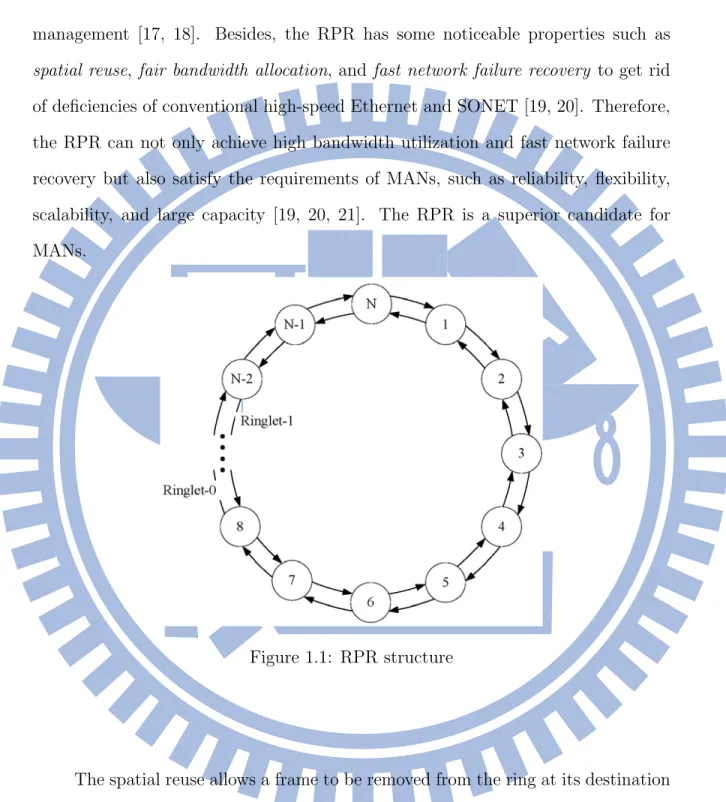
The ring network with the natural advantage, such as simple archtechure, eas-ily adding or removing nodes, the fault tolerance property, and the needless routing property, is the prevalent topology used in metropolitan area networks (MANs). The resilient packet ring (RPR) is a dual-ring-based optical packet network, shown in Fig.1.1, and has been recently approved as the IEEE 802.17 Standard [17]. The resilient packet ring (RPR) is constructed by several pairs of two unidirectional links between stations. The RPR can provide guaranteed quality of service param-eters and support service monitoring including performance management and fault
management [17, 18]. Besides, the RPR has some noticeable properties such as
spatial reuse, fair bandwidth allocation, and fast network failure recovery to get rid
of deficiencies of conventional high-speed Ethernet and SONET [19, 20]. Therefore, the RPR can not only achieve high bandwidth utilization and fast network failure recovery but also satisfy the requirements of MANs, such as reliability, flexibility, scalability, and large capacity [19, 20, 21]. The RPR is a superior candidate for MANs.
Figure 1.1: RPR structure
The spatial reuse allows a frame to be removed from the ring at its destination so that the bandwidth on next links can be re-used at the same time. Also, the fair bandwidth allocation avoids stations at upstream transmitting too many
low-congestion control to enhance the fair bandwidth division in the low-congestion domain which is defined in the IEEE 802.17 [19, 22]. The congestion control implemented in each station should periodically generate an advertised fairRate to advertise its upstream station for regulating the added fairness eligible (FE) traffic flow defined in IEEE 802.17 [19, 22]. The advertised fairRate should be determined referring to the local fairRate, the received fairRate, and the congestion degree of the station. The local fairRate is generated by a fairness algorithm, and the received fairRate is the advertised fairRate from the downstream station.
Two key factors affect performance of the fair bandwidth allocation: conges-tion detecconges-tion and fairness algorithm. If the congesconges-tion detecconges-tion is too rough, it would lower the networks throughput or raise frame loss. The fairness algorithm should consider the most important performance issues of FE traffic flows: stabil-ity, fairness, convergence time, and throughput loss caused by the FE traffic flow oscillation. The stability would avoid the oscillation of regulated FE traffic flows, which would cause the throughput loss. If a fairness algorithm referees a ring ingress aggregated with spatial reuse (RIAS) fairness, it has been proved that the algorithm will achieve high system utilization [25]. It is because the RIAS has two key prop-erties. The first property is that an ingress-aggregated (IA) flow fairly shares the bandwidth on each link, relating to other IA flows on the same link, where an IA flow is the aggregate of all flows originating from a given ingress station. The second property is that the maximal spatial reuse subjecting to the first property. Thus, the bandwidth can be reclaimed by IA flows when it is unused. In summary, the RIAS is a max-min fairness with traffic granularity of IA flow. The convergence time is the time interval between the instant of starting the congestion occurence
and the instant that the amount of arriving specified traffic flow approaches the ideal fairRate which meets the the RIAS fairness. Therefore, a fairness algorithm should achieve not only high stability based on the RIAS fairness but also low con-vergence time and flow oscillation. There are two conservative modes (CM) [19, 25] and the aggressive mode (AM) [19, 20] fairness algorithms, which have been pro-posed in IEEE 802.17. Actually, the AM fairness algorithm performs better than the CM fairness algorithm. Unfortunately, the AM suffers from severe oscillations and bandwidth utilization degradation [19, 22]-[24]. It is due to the fact that the AM issues an un-limited fairRate, called FullRate, as its advertised fairRate when the station is released from congestion.
Multiple RPR rings can be bridged together to form a larger network, named bridged-RPR network (BRPR), by a bridge which forwards packets from one RPR to another RPR, shown in Fig.1.2. A spatially aware sublayer (SAS), which is a part of the MAC layer, in the bridge is used to decide which ringlet interface the packet should be routed to [17, 26]. Current research on SAS, including the IEEE 802.17b Working Group, is mainly focusing on how to modify this sublayer in order to avoid flooding the entire bridged network when transmitting inter-ring packets [17, 26]-[28].
1.2
Paper Survey
1.2.1
Burst Scheduling in Optical Burst Switching Networks
In OBS networks, there is a strong separation between the control and data planes, which allows for great network manageability and flexibility. In addition, the ingress
Figure 1.2: BRPR structure
node assembles a number of IP packets, which go to the same egress node, into a data burst (DB). For each DB, there is a control burst (CB) associated with it. In the following, we shall use a burst to indicate that it consists of CB and DB. In OBS networks, DBs are sent on data wavelengths which do not go through optical-to-electronic-to-optical conversions at any intermediate node, whereas their associated CBs are sent on one or more control wavelengths and converted to electronic signals for processing at every intermediate node. This could facilitate efficient electronic control while retaining the advantages of all optical communications such as allevi-ation of the bottleneck, and support for transparent data rates, coding formats, and protocols [4].
Two kinds signaling protocols, called just-enough-time (JET) and just-in-time (JIT), were proposed in [11, 12, 14], for OBS network. The JIT can be considered a variant of tell-and-wait signaling protocol as it requires each burst transmission
request to be sent to a central scheduler. The scheduler then informs each requesting node the exact time to transmit the data burst. Here, the term just-in-time means that by the time a CB arrives at an intermediate node, the switching fabric has already been configured. In the JIT protocol, the ingress node of a burst sends a CB to the next intermediate to make wavelength reservation. Such packet performs resource reservation at each node belonging to the burst path. As soon as the control packet arrives at a node, wavelength reservation and switch configuration are performed, and then the packet is forwarded to the next node. Since burst transmission needs to happen only when resources have been configured along the entire path, an initial transmission delay is necessary at the ingress node.
The JET is a reserve-a-fixed duration (RFD) scheme that reserves resources exactly for the transmission time of the burst. Particularly, the JET protocol is considered most effective, a control packet for each burst payload is first transmitted out-of-band, allowing each switch to perform just-in-time configuration before the burst arrives. In JET protocol, the CB is first transmitted to the next node to reserve the bandwidth and then the DB is sent after an offset time. The duration of offset time is dependent on the number of intermediate OBS nodes in its routing path, and the routing path is determined by the ingress node, which would be the shortest path from source to destination. Two new prioritized signaling protocols, called prioritized JET (PJET) [15] and preemptive prioritized JET (PPJET) [16], were proposed to provide quality of service. The PJET introduces a significant amount of delay, called extra-offset-time, to let the high-priority traffic isolate from the low-priority traffic by that the higher priority burst has the longer extra-offset-time. The PPJET serves different traffic classes on the basis of a strict priority order.
It makes high-priority bursts preempt low-priority bursts, even if the low-priority burst was scheduled, and does not need the excessive delay.
There are several burst scheduling schemes proposed and applied with PJET, which are the Horizon [29], the latest available unused channel with void filling (LAUC-VF) [48], and the efficient burst scheduling algorithms using geometric tech-niques [31]. The Horizon chooses a wavelength whose latest available time is the most close to the arrival time of the new burst. The LAUC-VF first chooses, among all the proper voids between two scheduled bursts, the one whose latest available time is the most close to the arrival time of the new burst and whose length is larger than the new burst length. If there is no available void, then the LAUC-VF works the same as the Horizon. The scheduling algorithms in [31] are similar to the Horizon and LAUC-VF except they use an efficient data structure to reduce the computing complexity. Another new prioritized signaling protocol, called preemptive priori-tized JET (PPJET), was proposed in [16]. It serves different traffic classes on the basis of a strict priority order. A new scheduling scheme using PPJET, called pre-emptive latestavailable unused channel with void filling (PLAUC-VF), can provide better service for high-priority traffic by dropping reservations belonging to lower-priority traffic. It is similar to the LAUC-VF except it could let the high-lower-priority burst preempt the low-priority burst.
1.2.2
Traffic control in Resilient Packet Ring
Since the Resilient Packet Ring (RPR), unlike legacy technologies, supports des-tination packet removal so that a packet will not traverse all ring nodes and spatial reuse can be achieved. However, allowing spatial reuse introduces a challenge to
ensure fairness among different nodes competing for ring bandwidth [25]. The RPR defines two fairness algorithms, conservative mode (CM) [19, 25] and the aggressive mode (AM) [19, 20] fairness algorithms, that specify how upstream traffic should be throttled according to downstream measurements, named an advertised fairRate. The upstream nodes would appropriately configure their rate limiters to throttle the rate of injected traffic to its fair rate. Unfortunately, both the two RPR fairness algorithms have a number of important performance limitations. First, they are prone to severe and permanent oscillations in the range of the entire link bandwidth in simple unbalanced traffic network environment, in which all flows do not demand the same bandwidth. Second, they could not fully achieve spatial reuse and fairness. Third, they must take much time to stabilize all flows [25, 32]. The operations of the two algorithms are described as follows.
In AM, the congested station also calculates and advertises a fairRate estimate periodically without waiting to evaluate the received traffic which is regulated by the previously transmitted advertised fairRate. Also, the calculation of the fairRate is based solely on preset parameters and the station’s added rate which is the traffic added in ringlet. The frequent advertisement of new fairRate brings a more ”aggres-sive” algorithm, thus more quickly attempts to adapt to changing traffic conditions. However, the faster response as compared to the conservative mode induces the risk of instabilities that flows oscillate permanently, when rate adjustments are made faster than the system is able to respond. In CM, the congested station transmits an advertised fair rate to upstream, and then waits to see the change in traffic from upstream stations. If the observed effect is not the fair division of rates, then the congested station calculates a new fair rate estimate again, and distributes it to
upstream.
Several fairness algorithms were proposed to solve this problem and some of them were designed based on the RIAS fairness [25, 32]-[37]. The distributed virtual-time scheduling (DVSR) [25] is proposed by Gambiroza et al. and it mainly com-putes a simple lower bound of temporally and spatially aggregated virtual time using per-ingress counter of packet arrival. The aggregated information propagates along the ring to let each station know the traffic condition of downstream stations. Therefore, each node is capable of limiting its output rate to satisfy RIAS fairness. Unfortunately, it is at the expense of a high computational complexity O(N logN ), where N is the number of stations in the ring.
Alharbi and Ansari proposed a distributed bandwidth allocation (DBA) fair-ness algorithm with a low computational complexity O(1) [32, 33]. The DBA mea-sures the arrival rate so as to calculate the effective number of ingress-aggregated (IA) flows, where IA flow represents the aggregate of all flows originating from a given ingress station, transiting over the local station. By a recursive method, DBA uses the effective number of IA flows and the remaining bandwidth to obtain the advertised fairRate. After some rounds of recursion, an advertised fairRate which satisfies RIAS fairness can be obtained. However, whenever the effect of propaga-tion delay is severe, the DBA would not be a stable local fairRate algorithm. It is because the local fairRate generated by DBA is related only with the amount of the arriving transit FE traffic flows measured during a short frame time. This short-term amount is easily influenced by the effect of the propagation delay, which starts from a station sending its advertised fairRate and ends the corresponding transit traffic flows arriving the station. If the propagation delay is large, the short-term
arriving transit FE traffic flows would be largely varied and make the generation of local fairRate unstable (incorrect).
Moreover, Yilmaz and Ansari investigated weighted fairness in IEEE802.17 but found one unexpected phenomenon [35]. When a station with a larger weight becomes a head of congestion domain, it leads to an undesirable result of bandwidth allocation and oscillation. However, after modifying a little in original fairness al-gorithm of AM, it can work correctly under weighted fairness.
1.2.3
Traffic control in Bridged Resilient Packet Rings
Settawong and Tanterdtid proposed an enhancement by using a topology discovery and spanning tree algorithm [27]. The algorithm can manage traffic between rings more efficiently and can remove the need for flooding. The shortest path route controller (SPRC) was widely considered for metro rings [38]-[40] as it can maximize the spatial reuse and thus the achievable packet throughput for uniform traffic. However, as traffic load increases, incoming call requests could pile up at a node before being processed, and these would result in a potential bottleneck in network performance [40]. Also, Heiden et. al. analyzed the capacity of bidirectional optical packet ring networks, such as RPR, which employs the SPRC for multicast hotspot traffic [41]. They found that when the multicast traffic originating at the hotspot exceeds a critical threshold, the SPRC leads to a significant capacity reduction.
Intuitively, the route selection would be closely related with the congestion degree of the ringlet so as to follow the load balancing principle. Generally, RPR uses a queue length threshold to detect the congestion and a nodes adding rate limitation to avoid the network congestion [17]. Therefore, an intuitive queue-length
threshold route controller (QTRC) would be better than the SPRC. However, the correlation function between the congestion degree and these variables is nonlinear and complicated.
1.3
Dissertation Organization
In this dissertation, we first discuss the prioritized burst scheduling in OBS net-work, then the effective local fairRate generating in RPR netnet-work, and finally, the inter-ring route control.
In Chapter 2, we propose a new scheduling scheme, named priority burst schedul-ing with FDL assignment (PBS-FA) [42]. The PBS-FA scheme considers the pre-emptions because the high priority burst is more important than the low-priority one and the shorter burst is more easily to be rescheduled into the void. Therefore, it allows high-priority bursts to preempt low-priority ones and longer high-priority bursts to replace shorter ones. Meanwhile, FDL assignment is used when scheduling these bursts.
In Chapter 3, we propose an effective local fairRate generator based on fuzzy logic theory [43, 44] and moving average technique [45]. The effective local fairRate generator, named fuzzy local fairRate generator (FLAG), can meet the RIAS fair-ness and reflect timely the congestion status of station. The FLAG is sophisticatedly configured into three functional blocks: adaptive fairRate calculator (AFC), fuzzy congestion detector (FCD), and fuzzy fairRate generator (FFG). It first preproduces a local fairRate to meet the RIAS fairness and diminish the effect of propagation delay by AFC. Also, the FLAG evaluates the congestion degree of a station, denot-ing the forwarddenot-ing capacity of added FE traffic flows at the station and bufferdenot-ing
capacity of the STQ, by FCD. Finally, the FLAG generates a precise local fairRate by FFG. The FFG finely adjusts the pre-produced local fairRate from AFC accord-ing to the congestion degree of the station from FCD, usaccord-ing fuzzy logics based upon domain knowledge.
In Chapter 4, we propose intelligent inter-ring route control for bridged resilient packet rings in this paper [47]. Either CW or CCW ringlet at bridge will be properly chosen for an incoming new call request from one RPR to the other RPR. The selection is based on the load balancing principle which is in the sense that the selected ringlet would be with lower congestion degree and higher service rate [46]. An intelligent inter-ring route controller (IIRC) is designed to contain a fuzzy bridge-node congestion indicator (FBCI) to intelligently detect the congestion degree of bridge, and a pipeline recurrent neural networks (PRNN) downstream-node fairness predictor (PDFP) to effectively predict the mean received fairRate. Besides, the IIRC consists of a fuzzy router controller (FRC) to determine preference values of route of CW and CCW ringlets according to the congestion indication provided by FBCI, the predicted mean received fairRate provided by PDFP, the number of hops to destination, and the service rate of the bridge. A ringlet with a larger route preference value would be more proper to be selected.
Finally, some concluding remarks and future research topics are addressed in Chapter 5.
Chapter 2
Priority Burst Scheduling with
FDL Assignment for Optical Burst
Switching Networks
2.1
Introduction
Optical burst switching (OBS) is a new data transmission/switching method to realize IP over WDM. It strikes a balance between optical circuit switching and optical packet switching [13, 29]. In OBS networks, the ingress node assembles a number of IP packets, which go to the same egress node, into a data burst (DB). For each DB, there is a control burst (CB) associated with it. A signaling protocol, called just-enough-time (JET), was proposed [12], where the CB is first transmitted to the next node to reserve the bandwidth and then the DB is sent after an offset time. The duration of the offset time is dependent on the number of intermediate OBS nodes in the routing path, and the routing path is a shortest path which is determined by the ingress node. A prioritized signaling protocol, called prioritized JET (PJET) [15], was proposed to decrease the dropping probability of high-priority bursts. The PJET introduces a longer offset time for the high-priority burst to make the reservation earlier than the low-priority one.
There are several burst scheduling schemes proposed and applied with PJET, which are the Horizon [29], the latest available unused channel with void filling (LAUC-VF) [48], and the efficient burst scheduling algorithms using geometric tech-niques [31]. The Horizon chooses a wavelength whose latest available time is the most close to the arrival time of the new burst. The LAUC-VF first chooses, among all the proper voids between two scheduled bursts, the one whose latest available time is the most close to the arrival time of the new burst and whose length is larger than that of the new burst. If there is no available void, then the LAUC-VF works the same as the Horizon. The scheduling algorithms in [31] are similar to the Horizon and LAUC-VF except they use an efficient data structure to reduce the computing complexity. Another new prioritized signaling protocol, called preemptive prioritized JET (PPJET), was proposed in [16]. It serves different traffic classes on the basis of a strict priority order. A new scheduling scheme using PPJET, called preemptive latest-available unused channel with void filling (PLAUC-VF), can provide better service for high-priority traffic by dropping reservations belonging to lower-priority traffic [16]. It is similar to the LAUC-VF except it could let the high-priority burst preempt the low-priority burst.
This chapter proposes a new scheduling scheme, named priority burst schedul-ing with FDL assignment (PBS-FA). The PBS-FA scheme considers the preemptions because the high-priority burst is more important than the low-priority one and the shorter burst is more easily to be rescheduled into the void. Therefore, it allows high-priority bursts to preempt low-priority ones and longer high-priority bursts to replace shorter ones. Meanwhile, FDL assignment is used when scheduling these bursts.
The rest of this chapter is organized as follows. In Section 2.2, the architecture of intermediate OBS node is introduced. Section 2.2 presents the proposed schedul-ing PBS-FA and Section 2.4 presents simulation results. Finally, some concludschedul-ing remarks are given in Section 2.5.
2.2
Architecture of Intermediate OBS Node
Suppose that the intermediate OBS node is an N × N router connecting N in-coming and N outgoing fibers. Each fiber contains W + 1 wavelengths; one is the
control channel transmitting CBs, and others are data channels transmitting DBs.
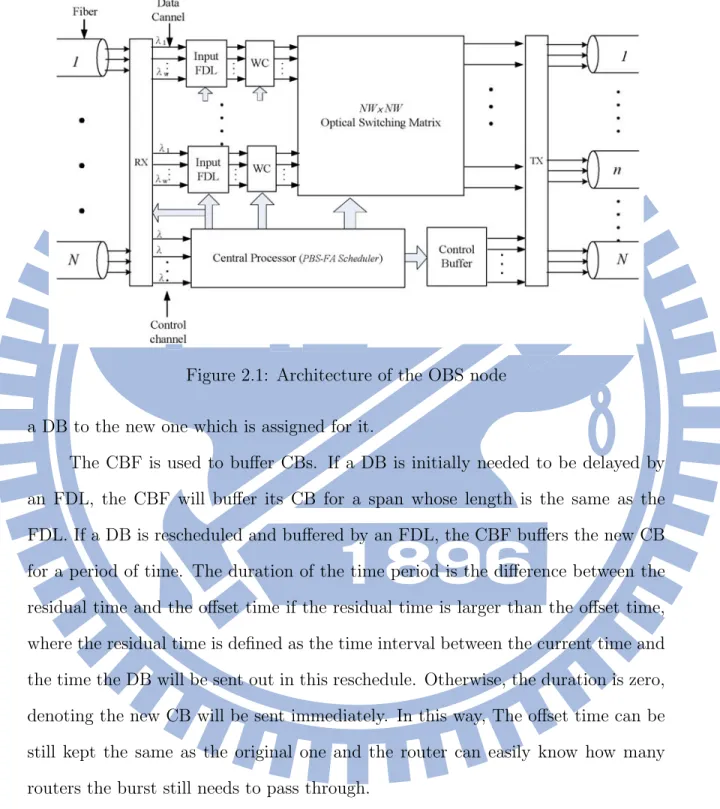
The architecture of an intermediate OBS routing node, shown in Fig. 2.1, con-sists of receiver equipment (RX), transmitter equipment (TX), N input FDLs, N wavelength converters (WC), an N W × NW non-blocking optical switching matrix (OSM), a control buffer (CBF), and a central processor embedded with the PBS-FA scheduler [48].
The RX receives a DB from a data channel and forwards it to the input FDLs if the DB could be scheduled into an available channel; otherwise, the RX drops it. Also, the RX receives CBs from the control channel and forwards them to the central processor. The TX transmits DBs (CBs) into the data (control) channel. When a CB arrives the cental processor, the PBS-FA scheduler properly determines a suitable scheduling result (for the associated DB) which will be sent to the RX, input FDLs, WC, and OSM. Also, the central processor generates a new CB containing the new scheduling result and sends it to CBF, which will inform the next router to cancel the last reservation and to make a new reservation. The input FDLs consists of a number of FDLs with different units of length. The WC converts the wavelength of
Figure 2.1: Architecture of the OBS node
a DB to the new one which is assigned for it.
The CBF is used to buffer CBs. If a DB is initially needed to be delayed by an FDL, the CBF will buffer its CB for a span whose length is the same as the FDL. If a DB is rescheduled and buffered by an FDL, the CBF buffers the new CB for a period of time. The duration of the time period is the difference between the residual time and the offset time if the residual time is larger than the offset time, where the residual time is defined as the time interval between the current time and the time the DB will be sent out in this reschedule. Otherwise, the duration is zero, denoting the new CB will be sent immediately. In this way, The offset time can be still kept the same as the original one and the router can easily know how many routers the burst still needs to pass through.
2.3
Priority Burst Scheduling with FDL
Assign-ment (PBS-FA)
The priority burst scheduling with FDL assignment (PBS-FA) scheme is shown in the Fig. 2.2. When a CB arrives, the PBS-FA denotes its corresponding DB
as b, empties the set of replaced burst, denoted by BR, initializes the number of
DB’s reassignment, denoted by t, and checks b’s priority. The BR is the set used to collect the preempted bursts. If b is with low-priority, the PBS-FA finds whether a channel CA with a minimal free FDL is available (the free FDLs are used from the shortest to the longest). If CA exists,b will be assigned into CA; otherwise, b will be droped. If b is with high-priority, the PBS-FA first finds whether a channel
CA with a minimal free FDL is available. If CA does exist, b is assigned into CA.
Otherwise, the PBS-FA further finds whether a channelCLwith a minimal free FDL is available for b, where CL is the channel given to a set of the low priority bursts, denoted by BL, which block b and have the shortest burst’s sum length. If CL exists, the PBS-FA allocates CL tob and removes the bursts in BL from CL into
BR. Noticeably, the FDL which has been assigned to a burst will be released when
the burst is replaced or dropped. If there is no CL, the PBS-FA looks into whether a channel CH with the minimal free FDL is available, where CH is the channel given to a set of the bursts, denoted by BH, which block b and have the minimum sum length but the sum length of the high-priority bursts is smaller than b. If CH exists, the PBS-FA removes the bursts in BH from CH into BR, and assigns b into CH; otherwise b will be dropped. Next if BR is not empty, the PBS-FA will perform the rescheduling and check whether the numbert+1 is smaller than T and free FDLs are available, where T is used to limit the reassignment times between
two successive new CBs and its value is determined according to the processing time of the PBS-FA scheme. If they do exist, the PBS-FA reschedules the bursts in BR on the order of the burst priority and length; the higher-priority burst with the longest length will be rescheduled first. Otherwise, the scheme ends.
We illustrate an example in Fig. 2.3, where the class 0 (class 1) denotes the high-priority (low-priority). In Fig. 2.3 (a), assume that six bursts have been scheduled and the low-priority burst 7 with length is |te− ts| will arrive at the ts. Since there is no available channel for the burst 7, the burst 7 will be dropped. If the burst 7 is with high-priority as in Fig. 2.3 (b), then the PBS-FA first searches a channel CL which has given to a set of the scheduled low-priority bursts BL which blocks the burst 7 and has the minimum sum burst length. It is found that CL is the channel C1 andBL consists of the burst 4 with low-priority. Then, the scheme schedules the burst 7 intoC1 and reschedules the burst 4 with FDL, which is shown in Fig. 2.3 (c). If the scheduled bursts which block the burst 7 are with high-priority, as in Fig. 2.3 (d), the PBS-FA makes the burst 7 to preempt the burst 5 because the burst 5 has the least amount of length. The result is shown in Fig. 2.3 (e).
Figure 2.4: The system throughput
2.4
Simulation Results
We compare the PBS-FA scheme with the PLAUC-VF scheme in the performance measures of system throughput and average system dropping probability. Assume two classes of bursts, namely class 0 and class 1, in the simulations, where class 0(1) burst corresponds to the high (low)-priority. An 8×8 OBS routing node is considered and each burst coming from any input fiber goes to a considered output fiber with the 5/16 probability. Suppose that a fiber contains 9 separate wavelengths, one (eight) for control (data) channel. The transmission speed per wavelength is 2.5 Gbit/s (OC-48). The burst arrival process is in Poisson distribution with a mean which is changed to show various traffic loads, and the burst length is in exponential distribution with a mean 16 KB. Class 0 and class 1 bursts share the total offered load in 9/16 and 7/16 perentages, respectively. The FDL length is measured in units of 10μs, and the longest one is 200μs.
Figure 2.5: The average system dropping probability
schemes. The result reveals that the PBS-FA achieves the throughput higher than the PLAUC-VF by an amount of 3% - 10% at traffic load 0.5 - 0.8. It is because the PBS-FA makes the longer high-priority bursts preempt not only the low-priority bursts but also the shorter priority bursts. This results in that the longer high-priority bursts can be successfully scheduled with higher probability and thus the total sum length of the served bursts would be larger, in PBS-FA. Also, the PBS-FA reschedules the preempted bursts into an available channel, while the PLAUC-VF takes no action.
Fig. 2.5 shows the average system dropping probability. It can be seen that the PBS-FA attains a smaller dropping probability than the PLAUC-VF by about 30% to 45% at the traffic load 0.4 to 0.8. The reasons are that the PBS-FA preempts bursts with the shortest total sum length first whenever necessary and reschedules the preempted short bursts with FDL assignment. Noticeably, the short bursts are more easily to be rescheduled, not blocked, whenever the high-priority burst needs
to preempt the low-priority burst. The PLAUC-VF does not choose the bursts with the smallest total length to replace.
2.5
Concluding Remarks
In this chpater we propose a new channel-scheduling scheme called priority burst scheduling with FDL assignment (PBS-FA) with PPJET for OBS networks. The PBS-FA allows priority bursts to preempt low-priority ones and longer high-priority ones to replace shorter ones due to that the high-high-priority is more important than the low-priority and the shorter one is more easily to be scheduled into the void. Also, it reschedules those preempted bursts by using FDL assignment. Simulation results reveals that the PBS-FA improves the system throughput by 3% to 10% and reduces the average system dropping probability by about 30% to 45% at the traffic load 0.4 to 0.8 over the PLAUC-VF.
Chapter 3
FLAG: A Fuzzy Local FairRate
Generator for Resilient Packet
Ring
3.1
Introduction
The resilient packet ring (RPR) is a ring based network for high-speed metropoli-tan area networks (MANs) [17]. It is a packet transport layer can provide guaranteed quality of service parameters and support service monitoring including performance management and fault management [17, 18]. Besides, the RPR has some noticeable properties such as spatial reuse, fair bandwidth allocation, and fast network failure
recovery to get rid of deficiencies of conventional high-speed Ethernet and SONET
[19, 20]. Therefore, the RPR can not only achieve high bandwidth utilization and fast network failure recovery but also satisfy the requirements of MANs, such as reli-ability, flexibility, scalreli-ability, and large capacity [19, 20, 21]. The RPR is a superior candidate for MANs.
The spatial reuse allows a frame to be removed from the ring at its destination so that the bandwidth on next links can be re-used at the same time. Also, the
priority frames to cause stations at downstream system congestion. RPR needs congestion control to enhance the fair bandwidth division in the congestion domain which is defined in the IEEE 802.17 [19, 22]. The congestion control implemented in each station should periodically generate an advertised fairRate to advertise its upstream station for regulating the added fairness eligible (FE) traffic flow defined in IEEE 802.17 [19, 22]. The advertised fairRate should be determined referring to the local fairRate, the received fairRate, and the congestion degree of the station. The local fairRate is generated by a fairness algorithm, and the received fairRate is the advertised fairRate from the downstream station.
Two key factors affect performance of the fair bandwidth allocation: conges-tion detecconges-tion and fairness algorithm. If the congesconges-tion detecconges-tion is too rough, it would lower the network’s throughput or raise frame loss. The fairness algorithm should consider the most important performance issues of FE traffic flows: stability, fairness, convergence time, and throughput loss caused by the FE traffic flow oscil-lation. The stability would avoid the oscillation of regulated FE traffic flows, which would cause the throughput loss. If a fairness algorithm referees a “ring ingress aggregated with spatial reuse (RIAS)” fairness, it has been proved that the algo-rithm will achieve high system utilization [25]. It is because the RIAS has two key properties. The first property is that an ingress-aggregated (IA) flow fairly shares the bandwidth on each link, relating to other IA flows on the same link, where an IA flow is the aggregate of all flows originating from a given ingress station. The second property is that the maximal spatial reuse subjecting to the first property. Thus, the bandwidth can be reclaimed by IA flows when it is unused. In summary, the RIAS is a max-min fairness with traffic granularity of IA flow. The convergence
time is the time interval between the instant of starting the congestion occurence and the instant that the amount of arriving specified traffic flow approaches the ideal fairRate which meets the the RIAS fairness. Therefore, a fairness algorithm should achieve not only high stability based on the RIAS fairness but also low convergence time and flow oscillation.
The aggressive mode (AM) fairness algorithm has been proposed in IEEE 802.17. It would suffer from severe oscillations and bandwidth utilization degra-dation [19, 22, 24, 25, 32]. It is because AM issues a un-limited fairRate, called FullRate, as its advertised fairRate when the station is released from congestion. Several fairness algorithms were proposed to solve this problem and some of them were designed based on the RIAS fairness [24, 25, 32, 33, 35, 34, 36, 37]. Gambiroza et al. proposed a distributed virtual-time scheduling in rings (DVSR) [25]. Unfortu-nately, it is at the expense of a high computational complexity O(N log N ), where
N is the number of stations in the ring. Alharbi and Ansari proposed a distributed
bandwidth allocation (DBA) fairness algorithm with a low computational complex-ity O(1) [24, 32, 33]. However, whenever the effect of propagation delay is severe, the DBA would not be a stable local fairRate algorithm. It is because the local fair-Rate generated by DBA is related only with the amount of the arriving transit FE traffic flows measured during a short frame time. This short-term amount is easily influenced by the effect of the propagation delay, which starts from a station sending its advertised fairRate and ends the corresponding transit traffic flows arriving the station. If the propagation delay is large, the short-term arriving transit FE traffic flows would be largely varied and makes the generation of local fairRate unstable (incorrect).
Recently, fuzzy logics system, which is a kind of intelligent techniques,has been widely applied to control nonlinear, time-varying, and well-defined systems for that fuzzy logic control can provide effective solutions with small computational complexity. Fuzzy set theory appears to be able to support a robust mathematical framework for dealing with real-world imprecision, and exhibits a soft behavior, which means a greater ability to adapt itself to dynamic, imprecise, and bursty environments [43].
In this chapter, we propose an effective local fairRate generator based on fuzzy logic theory [43] and moving average technique [45]. The effective local fairRate gen-erator, named fuzzy local fairRate generator (FLAG), can meet the RIAS fairness and reflect timely the congestion status of station. The FLAG is sophisticatedly configured into three functional blocks: adaptive fairRate calculator (AFC), fuzzy congestion detector (FCD), and fuzzy fairRate generator (FFG). It first pre-produces a local fairRate to meet the RIAS fairness and diminish the effect of propagation delay by AFC. Also, the FLAG evaluates the congestion degree of a station, denot-ing the forwarddenot-ing capacity of added FE traffic flows at the station and bufferdenot-ing capacity of the STQ, by FCD. Finally, the FLAG generates a precise local fairRate by FFG. The FFG finely adjusts the pre-produced local fairRate from AFC accord-ing to the congestion degree of the station from FCD, usaccord-ing fuzzy logics based upon domain knowledge. Simulation results show that the FLAG has better performance than AM and DBA in various scenarios in the aspects of lower convergence time, more fairness, and higher throughput. Take a small parking lot scenario with short propagation delay as an instance. The FLAG improves by more than 7 times over AM and by 2 times over DBA, in the convergence time of traffic flows.
The remaining of this chapter is organized as follows. Section 3.2 introduces the RPR system model. The concept of fuzzy logic system (FLS) and the most basic and popular architectures of a fuzzy logic controller are stated in section 3.3. Section 3.4 describes the proposed FLAG. Section 3.5 shows simulation results and discussions. Finally, concluding remarks are given in Section 3.6.
3.2
RPR System Model
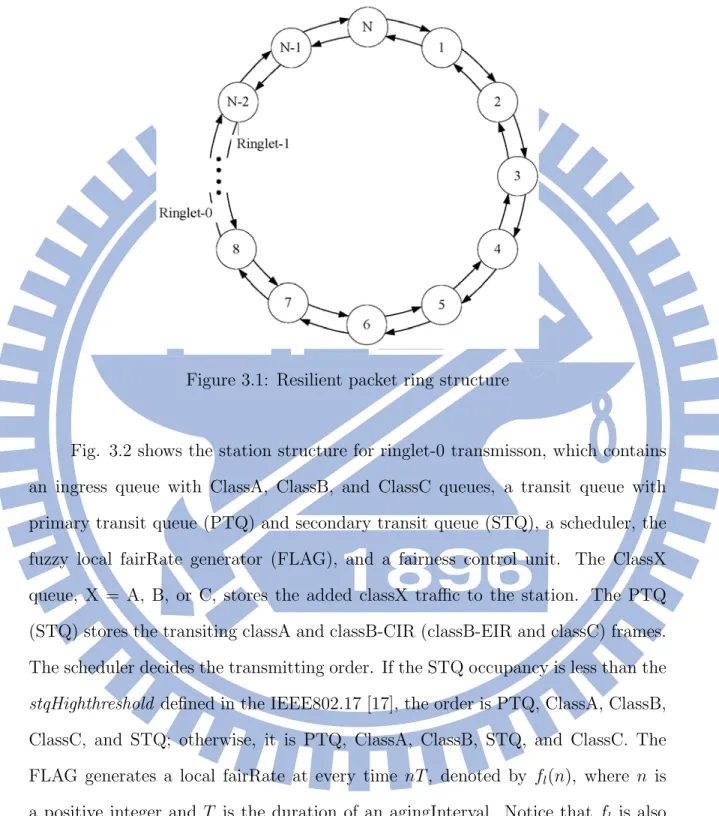
Assume that a resilient packet ring (RPR) with N stations, shown in Fig. 3.1, is constructed by two unidirectional, counter-rotating ringlets, named ringlet-0 and ringlet-1. Each station has two pairs of input and output ports to communicate with neighbor stations. Station X (Y) is said to be a upstream (downstream) node of sta-tion Y (X) on ringlet-0 or ringlet-1 if the stasta-tion Y (X) traffic becomes the received traffic of station X (Y) on the referenced ringlet. There are three classes of service for RPR. The classA is used for real-time services and it has subclassA0 for reserved bandwidth and subclassA1 for reclaimable bandwidth. The classB is targeted for near real-time services, and it also has two subclasses: classB-CIR (committed in-formation rate) which requires the bounded delay and guaranteed bandwidth, and classB-EIR (excess information rate) which does not guarantee bandwidth or delay bound. The classC is intended for best effort services and has the lowest priority. Each station only reserves bandwidth for subclassA0, and the remaining bandwidth is provided for other traffic classes according to the order of subclassA1, classB-CIR, classB-EIR, and classC. The latter two low priority traffics are called the fairness
Figure 3.1: Resilient packet ring structure
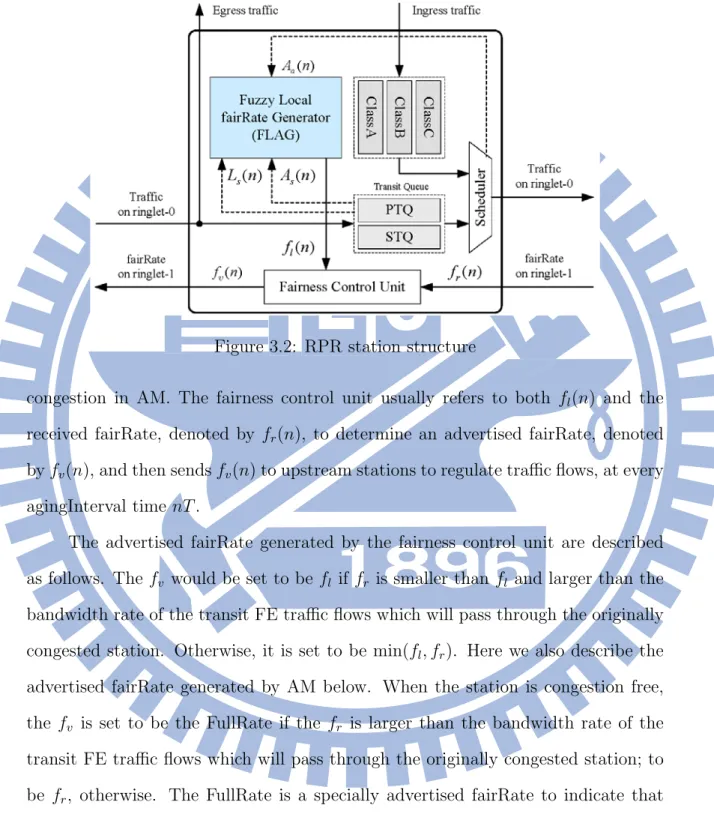
Fig. 3.2 shows the station structure for ringlet-0 transmisson, which contains an ingress queue with ClassA, ClassB, and ClassC queues, a transit queue with primary transit queue (PTQ) and secondary transit queue (STQ), a scheduler, the fuzzy local fairRate generator (FLAG), and a fairness control unit. The ClassX queue, X = A, B, or C, stores the added classX traffic to the station. The PTQ (STQ) stores the transiting classA and classB-CIR (classB-EIR and classC) frames. The scheduler decides the transmitting order. If the STQ occupancy is less than the
stqHighthreshold defined in the IEEE802.17 [17], the order is PTQ, ClassA, ClassB,
ClassC, and STQ; otherwise, it is PTQ, ClassA, ClassB, STQ, and ClassC. The FLAG generates a local fairRate at every time nT , denoted by fl(n), where n is a positive integer and T is the duration of an agingInterval. Notice that fl is also generated per agingInterval in DBA but is generated only when the station is in
Figure 3.2: RPR station structure
congestion in AM. The fairness control unit usually refers to both fl(n) and the received fairRate, denoted by fr(n), to determine an advertised fairRate, denoted by fv(n), and then sends fv(n) to upstream stations to regulate traffic flows, at every agingInterval time nT .
The advertised fairRate generated by the fairness control unit are described as follows. The fv would be set to be fl if fr is smaller than fl and larger than the bandwidth rate of the transit FE traffic flows which will pass through the originally congested station. Otherwise, it is set to be min(fl, fr). Here we also describe the advertised fairRate generated by AM below. When the station is congestion free, the fv is set to be the FullRate if the fr is larger than the bandwidth rate of the transit FE traffic flows which will pass through the originally congested station; to be fr, otherwise. The FullRate is a specially advertised fairRate to indicate that the station does not need to limit its added FE traffic flow. When the station is in
congestion, the fv is set to be fl if the fr is FullRate; to be min(fl, fr), otherwise. Note that the congestion is occurred at a station for AM if the STQ occupancy of the station is larger than the stqLowthreshold, defined in IEEE802.17 [17]. Also, the originally congested station is known to the observation station since the message of the advertised fairRate contains a field to record it [17]; the fl is the added FE traffic flow rate to the network.
3.3
Fuzzy Logic System
Fuzzy logic system is mimicked the behaviors of human brain: fuzzy logic operates on the way the brain deals with vague information [43]. Fuzzy logic system is numerical model-free estimators and dynamical system and, also, it has been shown to have the capability of modelling complex nonlinear processes to arbitrary degrees of accuracy. Fuzzy logic systems employ linguistic if-then fuzzy rules as a kind of expert knowledge to formalize insights about the structure of categories founding the real world. Fuzzy logic systems combine the mathematical theory of fuzzy sets with fuzzy rules to produce overall complex nonlinear behavior.
3.3.1
Fuzzy Inference System (FIS)
Fuzzy logic is based on the concepts of linguistic variables and fuzzy sets theory. A fuzzy set in a universe of discourse U is characterized by a membership function
μ(·) which takes values in the interval [0, 1]. A fuzzy set F is represented as a
set of ordered pairs, each made up of a generic element u ∈ U and its degree of membership μ(u). A linguistic variable x in a universe of discourse U is characterized by T (x) = {Tx1, ..., Ti
T (x) is the fuzzy term set, i.e., the set of linguistic values’ names Ti
x the linguistic
variable x can take, and Mi
x(u) is a membership function with respect to the term
Txi. If, for instance, x indicates the temperature, T (x) could be the set as {Low,
Medium, High}, and each element in T (x) is associated with a membership function.
The fuzzy inference system (FIS) is a popular computing framework based on the concept of fuzzy logic and fuzzy reasoning. As shown in Fig. 3.3, a fuzzy inference system consists of four fundamental blocks [51]: fuzzifier, fuzzy rule base,
inference engine, and defuzzifier. The fuzzifier performs a mapping function from
the observed value of each input linguistic variable xi to a fuzzy term set T (xi) with associated set of membership degree M (xi), i = 1, . . . , m. The fuzzy rule base is a knowledge base characterized by a set of linguistic statements in a form of “if-then” rules that describe a fuzzy logic relationship between the m-dim input linguistic variables {xi} and the n-dim output linguistic variables {yj}. The inference engine performs an implication function according to the pre-condition of the fuzzy rule with the input linguistic terms. It is a decision-making logic that acquires the input linguistic terms of T (xi) from the fuzzifier and uses an inference method to obtain the output linguistic terms of T (yj) [50]. The defuzzifier adopts a defuzzification function to convert T (yj) into a non-fuzzy (crisp) value that represents the decision
yj. Several implementation ways have been introduced to build a fuzzy inference system as a fuzzy logic controller, such as the Mamdani fuzzy model, Tsukamoto
fuzzy model, and Sugeno fuzzy model [49]. Briefly speaking, these fuzzy models (or
said implementation ways) differ on the high-level linguistic expression form of the fuzzy rule and the consequent reasoning way. Because the Mamdani fuzzy model is the most basic and popular one, some descriptions about the Mamdani fuzzy model
Figure 3.3: The basic structure of fuzzy inference system
are given in the following subsection.
3.3.2
Mamdani Fuzzy Model
The Mamdani fuzzy model is a way to implement a fuzzy inference system to serve as a controller. It was proposed as the first attempt to control a system by a set of linguistic control rules obtained from experienced human knowledge. Fig. 3.4 shows an example of Mamdani fuzzy model, where the overall output Z is derived from two linguistic variables X and Y . Here, the fuzzy rule is expressed by
if X is Ai and Y is Bi, then output Z is Ci with μ(Ci), i=1 and 2
where Ai, Bi and Ci are all fuzzy terms, and μ(Ci) is the membership value on
Ci. In the Mamdani model, each input linguistic variable is firstly fuzzified by the membership function μ(·). Then, the inferred value of the output of each fuzzy rule is determined by a pre-defined inference method. In this example, the min-max method is applied. That is, the inferred value of each fuzzy rule is obtained by
min operator and the inferred value of the same fuzzy term is obtained by max
operator. Finally, the overall crisp output is derived by a pre-defined defuzzification method. There are diverse defuzzification methods such as: centroid of area (COA), bisector of area (BOA), mean of maximum (MOM), smallest of maximum (SOM),
Figure 3.4: An example of Mamdani fuzzy model
and largest of maximum (LOM), among which COA is the most popular one. Additionally, the membership functions for terms in the term set should be defined with the proper shape and position. In general, a triangular function
f (x; x0, a0, a1) or a trapezoidal function g(x; x0, x1, a0, a1) is chosen as the member-ship function because of the advantage of simple computational complexity. This feature makes these functions are suitable for real-time application [50]. As shown
in Fig. 3.5, f (x; x0, a0, a1) and g(x; x0, x1, a0, a1) are given by f (x; x0, a0, a1) = ⎧ ⎨ ⎩ x−x0 a0 + 1 for x0− a0 < x≤ x0 x0−x a1 + 1 for x0 < x≤ x0+ a1 0 otherwise, (3.1) g(x; x0, x1, a0, a1) = ⎧ ⎪ ⎪ ⎨ ⎪ ⎪ ⎩ x−x0 a0 + 1 for x0− a0 < x≤ x0 1 for x0 < x≤ x1 x1−x0 a1 for x1 < x≤ x1+ a1 0 otherwise, (3.2)
where x0 in f (·) is the center of the triangular function; x0 (x1) in g(·) is the left (right) edge of the trapezoidal function; and a0 (a1) is the left (right) width of the triangular or the trapezoidal function.
Figure 3.5: Definitions for functions f (·) and g(·)
3.4
Fuzzy Local FairRate Generator
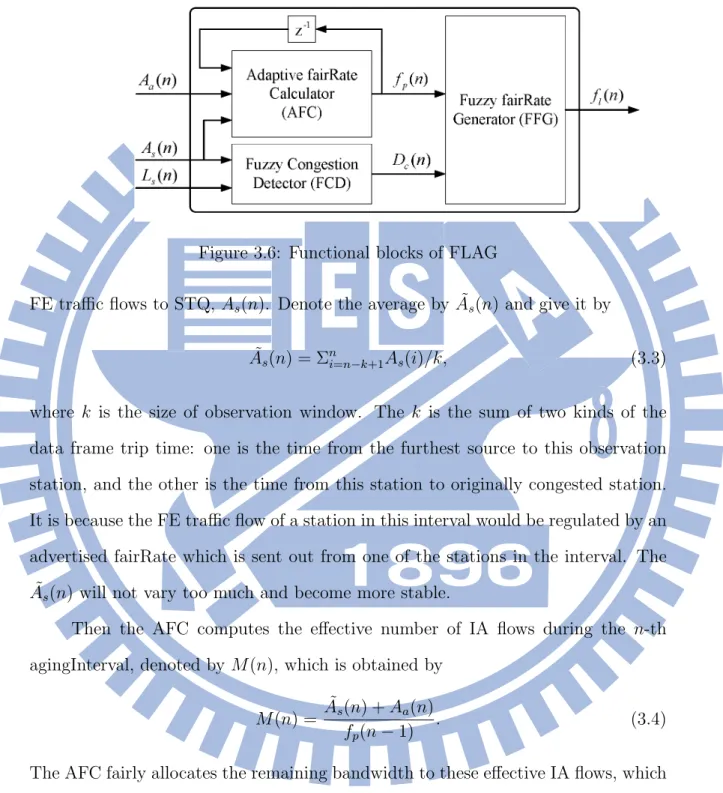
The proposed fuzzy local fairRate generator (FLAG), shown in Fig. 3.6, is com-posed of an adaptive fairRate calculator (AFC), a fuzzy congestion detection (FCD), and a fuzzy fairRate generator (FFG). During the nth agingInterval which is from time (n− 1)T to time nT , the FLAG determines fl(n) by referring to the arriving FE traffic flows to STQ, denoted as As(n), the added FE traffic flow to the network,
denoted as Aa(n), and STQ occupancy, denoted as Ls(n). The AFC pre-generates a local fairRate, called p-fairRate and denoted by fp(n), which satisfies the RIAS fairness. Its design imitates the DBA’s generation of local fairRate, but it would overcome the unstable (incorrect) local fairRate generation by DBA when the prop-agation delay is significant. Instead of using the short-term arriving transit FE traffic flows, it calculates a proper average of the arriving transit FE traffic flows by
moving average technique to mitigate the effect of the propagation delay. The FCD
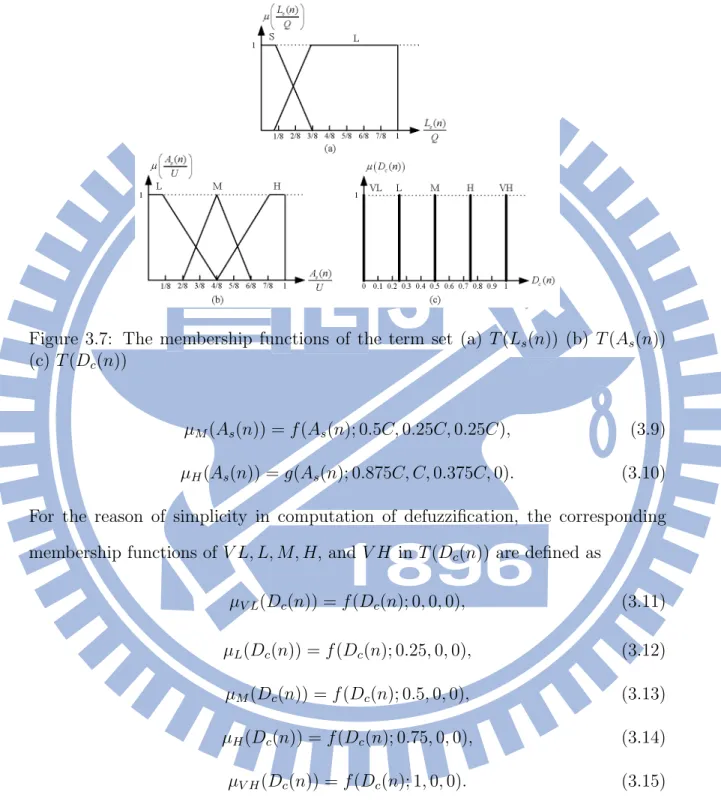
appraises the congestion status of station using fuzzy logics. Its design can softly de-tect the congestion degree of the station in each agingInterval n, denoted by Dc(n), considering not only the STQ occupancy but also the amount of the arriving transit FE traffic flows at the queue. The latter term denotes the change rate of the STQ occupancy which would play an important role in the congestion detection. Finally, the FFG generates a precise local fairRate by fine-tuning the p-fairRate from AFC, referring to the congestion degree from FCD, and further using domain knowledge designed by fuzzy logics. The FLAG would avoid serious regulating FE traffic flows to decrease the throughput or excessive relaxing the traffic flows to increase the frame losses.
3.4.1
Adaptive fairRate Calculator (AFC)
The adaptive fairRate calculator (AFC) adopts the moving average technique [45] on the short-term arriving FE traffic flows, trying to mitigate the effect of propagation delay on the generation of local fairRate by the DBA [24, 32]. During the n-th agingInterval, the AFC first takes the moving average of arriving transit
Figure 3.6: Functional blocks of FLAG
FE traffic flows to STQ, As(n). Denote the average by ˜As(n) and give it by ˜
As(n) = Σni=n−k+1As(i)/k, (3.3) where k is the size of observation window. The k is the sum of two kinds of the data frame trip time: one is the time from the furthest source to this observation station, and the other is the time from this station to originally congested station. It is because the FE traffic flow of a station in this interval would be regulated by an advertised fairRate which is sent out from one of the stations in the interval. The
˜
As(n) will not vary too much and become more stable.
Then the AFC computes the effective number of IA flows during the n-th agingInterval, denoted by M (n), which is obtained by
M (n) =
˜
As(n) + Aa(n)
fp(n− 1) . (3.4) The AFC fairly allocates the remaining bandwidth to these effective IA flows, which would be 1
M(n)(C − (As(n) + Aa(n))). Finally, the AFC calculates the fp(n) by