Fabrication and CO Sensing Properties of Mesostructured ZnO
Gas Sensors
Chueh-Yang Liu,a,zChia-Fu Chen,band Jih-Perng Leua a
Department of Materials Science and Engineering, National Chiao-Tung University, Hsinchu 300, Taiwan b
Institutes of Material and System Engineering, MingDao University, ChangHua 52345, Taiwan
This study presents the synthesis of mesostructured ZnO using a template replication method and the fabrication of a carbon monoxide sensor using the synthesized ZnO using the dielectrophoresis process. The mesoporous carbon, CMK-3, was employed for the template and zinc nitrite was used as the precursor for synthesizing the ordered porous ZnO. The mesostructured ZnO was analyzed using X-ray diffraction共XRD兲 patterns, scanning electron microscopy, transmission electron microscopy, selected area electron diffraction, and N2adsorption–desorption isotherms. The XRD patterns indicated that the ZnO exhibited a highly ordered structure after the template was removed. The morphology of the ZnO was randomly oriented and the structure was polycrystal-line. The surface area, pore volume, and pore size of the porous ZnO were 61.3 m2g−1, 0.31 cm3g−1, and 5.3 nm, respectively. When CO gas was injected, the optimum sensitivities at 250°C were 12.1, 14.6, 18.4, 26.0, and 60% when the CO concentrations were 10, 20, 30, 50, and 70 ppm, respectively.
© 2008 The Electrochemical Society. 关DOI: 10.1149/1.3021044兴 All rights reserved.
Manuscript submitted September 2, 2008; revised manuscript received October 10, 2008. Published November 14, 2008.
Carbon monoxide 共CO兲 is the main product from incomplete combustion processes and is toxic even at concentrations lower than 100 ppm. Its toxicity is dangerously magnified by the fact that it is colorless and odorless, and thus very difficult to detect. There has been extensive research into developing solid-state CO sensors us-ing semiconductor oxides, solid electrolytes, and organic semiconductors.1Conventional solid-state sensors have been fabri-cated by adding noble metal elements such as Pt, Au, and Pt into the oxide semiconductors such as SnO2, Fe2O3, and ZnO.2 However, few of them perform satisfactorily in terms of sensitivity and selec-tivity in the detection of CO.
Recently, the semiconductive metal oxide gas sensors have been developed. The sensors have low cost, high sensitivity, fast re-sponse, and are compatible with silicon materials. ZnO is an inter-esting n-type semiconductor with a large bandgap energy of 3.4 eV at room temperature, large excitonic energy, low electron affinity, and high mechanical strength.3ZnO is an intriguing possibility as a sensory material due to the high mobility of its conductive electrons and its good chemical and thermal stability. Several techniques have been used to prepare ZnO sensors, including chemical vapor depo-sition, the sol-gel process, and evaporation.4-6A new method for synthesizing semiconductor metal oxide sensors was recently devel-oped by Wagner et al. The semiconductor porous metal oxides not only have large surface areas and uniform pore dimensions, but also show a superior sensory performance to nonporous samples of the same metal oxides.7
A good example of a solid template for porous metal oxides is mesoporous silica. In the procedure, a matrix structure is impreg-nated with the precursor and transformed into the porous oxide. Using mesoporous silicas for the matrix, several metal oxides have been yielded, including Co3O4, CrO2, and Fe3O4.8-10 Tian et al. synthesized several porous metal oxides using microwave-digested mesoporous silica.11They reported that these mesoporous metal ox-ides exhibit original and highly ordered structures as well as large surface areas. They also synthesized mesoporous and mesorelief ox-ides with gyroidal structures.12 The metal oxide crystal showed double-scale ordering, and a single-crystalline structure could be observed. However, while several porous metal oxides can be syn-thesized using mesoporous silica as a template, mesoporous ZnO cannot because the removal of the silica templates HF or concen-trated sodium hydroxide共NaOH兲 solutions. Mesoporous ZnO is un-suited for this as it is soluble both when the pH is very low and very high. Therefore, mesoporous carbon is used instead of the mesopo-rous silica as the solid template for synthesizing mesopomesopo-rous ZnO.
The mesoporous carbon is first prepared through a structure replica-tion procedure, and then a mesoporous metal oxide is infused into the replica. This process has been shown to be successful in the preparation of mesoporous SiO2, CeO2, and TiO2.13-15Until now, porous ZnO materials for gas sensors were prepared using conven-tional sol-gel technology.16This paper presents the synthesis of or-dered mesoporous ZnO by use of mesoporous carbon as the struc-ture matrix and the fabrication of a mesostrucstruc-tured porous ZnO sensory device through dielectrophoresis共DEP兲 manipulation.
Experimental
Mesoporous SBA-15 silica was synthesized through modification of a known procedure in the literature of the field.17An 8.5 g P-123 block copolymer 共Sigma兲 was mixed with 325 mL HCl 共1.6 mol L−1兲 and stirred for 24 h at 308 K. After the addition of 18.7 g tetraethyl orthosilicate 共Merck兲 the mixture was stirred at 308 K for another 24 h. The resulting gel was transferred to a Teflon-lined autoclave and kept at 413 K for 24 h. The solid product was filtered off, washed with water, and calcined at 823 K for 6 h 共heating rate 2 K min−1兲. CMK-3 carbon was prepared according to another procedure in the literature18by impregnating SBA-15 with sucrose as the carbon source, which was converted to carbon by pyrolysis in a vacuum at 1173 K. The silica matrix was removed by stirring the silica/carbon sample in a 5% HF solution for 4 h at room temperature. Mesoporous ZnO was prepared by immersing 0.5 g CMK-3 carbon in 20 mL of a solution made up of Zn共NO3兲2 in tetrahydrofuran共1.5 mol L−1兲 and stirring at room temperature for 6 h. After filtration the impregnated carbon was dried at ambient temperature, heated in an air atmosphere to 573 K at a constant rate of 2.5 K min−1, and kept at that temperature for 2 h to convert zinc nitrate to zinc oxide. This procedure was repeated twice. The result-ant product was a powder without any specific particle morphology. X-ray diffraction共XRD兲 patterns were obtained using a Bede/D1 diffractometer with Cu K␣ radiation 共1.543 Å兲 at a voltage of 40 kV and current of 40 mA. Scanning electron microscopy共SEM兲 was performed using a JEOL 6700F electron microscope at an ac-celeration voltage of 3 kV. The mesoporous carbon was adhered to the carbon tape and sputtered with gold to the image. The nitrogen adsorption–desorption isotherms were measured at −196°C using a NOVA 1000e system in static measurement mode. The samples were degassed at 150°C for 3 h before measurement. The specific surface areas were determined by the Brunauer–Emmett–Teller method based on the adsorption branches. The pore diameter and pore size distribution were measured from the desorption branches obtained by the Barrett–Joyner–Halenda共BJH兲 method. Transmis-sion electron microscopy共TEM兲 and selected area electron diffrac-tion共SAED兲 were used to clarify the structure of mesoporous ZnO
z
E-mail: [email protected]
Journal of The Electrochemical Society, 156共1兲 J16-J19 共2009兲 0013-4651/2008/156共1兲/J16/4/$23.00 © The Electrochemical Society
J16
) unless CC License in place (see abstract). ecsdl.org/site/terms_use
address. Redistribution subject to ECS terms of use (see 140.113.38.11
using a JEOL-2100F electron microscope at 200 kV. Sine-wave sig-nals of 1 MHz and 10 V amplitude共peak-to-peak兲 were chosen to enable the mesoporous carbons to be deposited onto the electrode gap using DEP forces. The gas-sensing properties were character-ized using a computer-controlled gas-sensing characterization sys-tem. The test gas was 10–100 ppm CO in dry air, injected into the chamber at a total flow rate of 100 sccm. After some time, the cham-ber was purged with air and the experiment was repeated. The elec-trical resistance response during testing was monitored using a pre-cision analyzer 共Keithley 2400兲. The sensor response 共S兲 was defined as follows: S =共RCO− Rair/Rair兲*100%, where Rairand RCO represent the resistance of the sensor in air and in CO gas, respec-tively. The response time to CO gas was defined as the time required for 90% of total resistance to the gas.
Results and Discussion
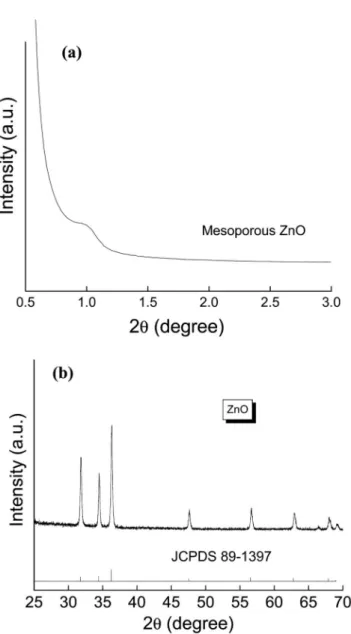
The low-angle XRD pattern of porous ZnO is shown in Fig. 1a, which gives the structural order of the mesoporous ZnO. The figure indicates that the sample has a clearly defined diffraction peak lo-cated at approximately at 1.0° which can be attributed to the共100兲 reflections of the hexagonal groups. It also indicates that the sample exhibits a well-ordered structure. Moreover, the cell parameter of
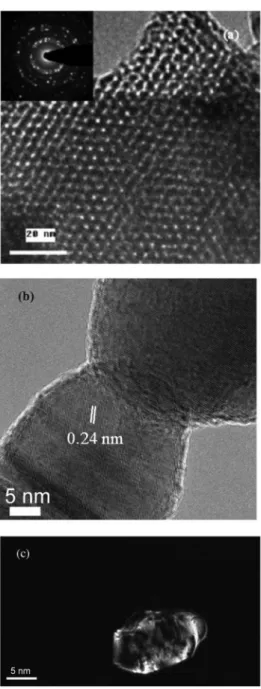
mesostructured ZnO is 10.35 nm. The peaks in the wide-angle re-gion共Fig. 1b兲 are located at 30.9, 33.4, 35.2, 46.0, 54.5, 60.5, 65.3, and 66.4° and correspond to a crystalline ZnO structure. These pat-terns also indicate the mesostructured ZnO has a c-axis preferred orientation. This is consistent with conventional bulk ZnO samples. The morphology of the mesostructured ZnO is confirmed by SEM in Fig. 2. The image indicates the mesostructured ZnO particles seem to be randomly oriented. The randomly oriented particles provide electrical paths between neighboring extrusions. When these ran-domly oriented mesostructured ZnO are in the spacer regions, the two electrodes are no longer electrically open. The ordered structure and the crystallization of porous ZnO were determined by TEM and SAED, as shown in Fig. 3. The TEM image shows the hexagonal arranged well-ordered structure; the SAED pattern also shows the diffraction rings, implying that the mesostructured ZnO is polycrys-talline. However, during the calcination process, the ZnO particles are aggregated and overlapped. Therefore, larger nanograins are ob-served. In order to investigate this phenomenon, a dark-field TEM image is examined. One particle with a nanograin having a size of approximately 20 nm is observed共Fig. 3c兲. Therefore, the sizes of the nanograins of mesostructured ZnO are approximately 20 nm. The high-resolution-TEM image also indicated that the d-spacing of porous ZnO was 0.24 nm, which is consistent with the XRD results. The surface area and pore volume of mesostructured ZnO are 61.3 m2g−1and 0.31 cm3g−1, respectively. The pore diameter dis-tribution determined by the BJH method showed a pronounced peak at 5.7 nm共not shown here兲, confirming a high degree of uniformity among the pores. The adsorption of oxygen forms ionic species such as O2−, O2−, and O−, which are adsorbed onto the mesostructured ZnO surface at elevated temperatures. The form of the oxygen ionic species is strongly dependent upon the temperature. In general, O2−is predominant at temperatures below 100°C, O− between 100 and 300°C, and O2−above 300°C.19The resistance of the mesostruc-tured ZnO sensor decreases upon the introduction of CO gas be-cause of the exchange of electrons between the ionosorbed oxygen and the mesostructured ZnO sensor.20For semiconductor gas sen-sors, it is known that oxygen sorption plays an important role in electron transport. The oxygen sorption affects the conductivity of ZnO.21 Therefore, the sensing mechanism of the nanostructured ZnO sensor for CO may be described through reaction kinematics in the following equations22
关1兴 关2兴 关3兴
Figure 1.共a兲 Low-angle XRD patterns and 共b兲 wide-angle XRD patterns of
the mesostructured ZnO.
Figure 2. SEM image of DEP immobilized mesostructured ZnO.
J17
Journal of The Electrochemical Society, 156共1兲 J16-J19 共2009兲 J17
) unless CC License in place (see abstract). ecsdl.org/site/terms_use
address. Redistribution subject to ECS terms of use (see 140.113.38.11
The reaction between CO gas and the ZnO surface, however, can be shown as follows23 2CO + O2−→ 2CO2+ e− 关4兴 CO + O−→ CO 2+ e− 关5兴 CO + O2−→ CO 2+ 2e− 关6兴
Figure 4 shows the effect of the working temperature on the sensitivity of the porous ZnO sensor toward CO. It shows that the working temperature plays an important role in the sensitivity of the porous ZnO sensor. At a low operation temperature, a low sensitivity can be expected because the CO molecules do not possess sufficient thermal energy to react with the surface adsorbed oxygen species, O2−, i.e., the reaction rate given by Eq. 4 is essentially low. However, as the temperature was increased to 250°C, the adsorbed oxygen
was converted from O2−to O−, and the CO sensing reaction was then given by Eq. 5. The increase in sensitivity for temperatures above 300°C can be attributed to the fact that the thermal energy obtained was sufficiently high to overcome the activation energy barrier to the reaction and the electron concentration increased significantly due to the sensing reaction, as indicated by Eq. 3, in which a maxi-mum sensitivity of 15.0% was found for the mesostructured ZnO sensor. The reduction in sensitivity above a temperature of 250°C was due to the difficulty in exothermic CO gas adsorption; therefore, an optimum operating temperature should be considered in order to obtain a high sensitivity. Similar temperature dependence has also been observed.24The sensor response increases to the maximum at 250°C, which is the threshold temperature for sensing CO gas. Wang et al. have indicated that ZnO-nanorod-based CO gas sensors can be used to perform measurements at 250°C. The sensor re-sponse was very low for ZnO nanorods to CO gas.25Hsueh et al. have shown that the optimum sensor response of the ZnO-nanowire-based CO sensor for 500 ppm CO gas was 57%.26 However, no response was detected at lower CO concentrations. Figure 5 shows the variation in sensitivity of the ZnO sensor in relation to its expo-sure to CO gas injection. It was found that the optimum sensitivities of the ZnO sensor are 12.1, 14.6, 18.4, 26.0, and 60% at CO con-centrations of 10, 20, 30, 50, and 70 ppm, respectively. This shows that the porous ZnO gas sensor has a high response at low CO concentrations. Recently, Malagù et al. demonstrated an enhance-ment in sensitivity when the grain size of the semiconductive oxide is below 10 nm.27They described a model where the surface accep-tor density decreases when the mean grain size is increased for
Figure 3.共a兲 TEM image of mesostructured ZnO materials as a replica of a
mesoporous carbon template.共b兲 High-resolution TEM micrograph of the crystalline framework of mesostructured ZnO.共c兲 Dark-field TEM image of mesostructured ZnO materials.
50 100 150 200 250 300 0 5 10 15 20 ppm CO
S
ensor
response
(%)
temperature (degree C)
Figure 4. Variation of sensing response of mesostructured ZnO sensor with temperature at 20 ppm CO. 0 2000 4000 6000 0 20 40 60 80 100 CO@250d 70 ppm 50 ppm 30 ppm 20 ppm 10 ppm sensor response (%) time (s)
Figure 5. 共Color online兲 Sensing response of mesostructured ZnO sensor
determined with several CO concentrations.
J18 Journal of The Electrochemical Society, 156共1兲 J16-J19 共2009兲
J18
) unless CC License in place (see abstract). ecsdl.org/site/terms_use
address. Redistribution subject to ECS terms of use (see 140.113.38.11
n-type semiconductive oxides. The CO response can be enhanced through a reduction in the surface charge accumulation, induced through a decrease in grain size. Williams and Coles agreed with this model.28The presence of the uniform mesopores in a porous ZnO sensor can also be another important reason for the high re-sponse for CO gas. The pores in the ZnO sensor can enhance the detection of gas molecules passing through and create more active sites to adsorb oxygen ions. As shown in Fig. 5, the response and recovery times of the nanostructured ZnO sensor were found to be 80 and 90 s, respectively. The response and recovery times are shorter than when other materials are used, especially the recovery time. These results indicate that the response speed and the stability of the porous ZnO sensor are both good.
Conclusion
This study presented the porous metal oxide ZnO, synthesized through a template replication method. Mesoporous carbon was suc-cessfully used as a hard template for synthesizing porous ZnO. The structural property of the porous ZnO was polycrystalline and ex-hibited a highly ordered structure. The surface area, pore volume, and pore size of the porous ZnO were 61.3 m2g−1, 0.31 cm3g−1, and 5.3 nm, respectively. The development of highly ordered porous ZnO and the fabrication of a nanostructured porous ZnO-based CO sensor were also reported. This device has high sensitivity to CO 共⬃60%兲 at 250°C and both the response and recovery times were fast共80 and 90 s兲. Furthermore, the response speed and stability of this device were demonstrated to be good as well.
Acknowledgments
The authors thank the National Science Council of the Republic of China, Taiwan, for financially supporting this research under con-tract no. NSC 96-2221-E-451-013. The authors are also grateful to the Center for Nanoscience and Technology of the National Chiao-Tung University for its assistance with the TEM and XRD charac-terizations.
National Chiao-Tung University assisted in meeting the publication costs of this article.
References
1. G. Neri, A. Bonavita, S. Galvagno, P. Siciliano, and S. Capone, Sens. Actuators B, 82, 40共2002兲.
2. M. C. Horrillo, A. Serventi, D. Rickerby, and J. Gutierrez, Sens. Actuators B, 24/25, 465共1995兲.
3. N. Kumar, A. Dorfman, and J. Hahm, J. Nanosci. Nanotechnol., 5, 1915共2005兲. 4. N. Koshizaki and T. Oyama, Sens. Actuators B, 66, 119共2000兲.
5. J. N. Zeng, J. K. Low, Z. M. Ren, T. Liew, and Y. F. Lu, Appl. Surf. Sci., 197, 362 共2002兲.
6. J. H. Lee, K. H. Ko, and B. O. Park, J. Cryst. Growth, 247, 119共2003兲. 7. T. Wagner, C. D. Kohl, M. Fröba, and M. Tiemann, Sensors, 6, 318共2006兲. 8. H. Yang, Q. Shi, B. Tian, Q. Lu, F. Gao, S. Xie, J. Fan, C. Yu, B. Tu, and D. Zhao,
J. Am. Chem. Soc., 125, 4727共2003兲.
9. J. H. Smått, B. Spliethoff, J. B. Rosenholm, and M. Lindén, Chem. Commun. (Cambridge), 2004, 2188.
10. C. Dickinson, W. Chou, R. P. Hodgkins, Y. Shi, D. Zhao, and H. He, Chem. Mater., 18, 3088共2006兲.
11. B. Tian, X. Liu, H. Yang, S. Xie, C. Yu, and D. Zhao, Adv. Mater. (Weinheim, Ger.), 15, 1370共2003兲.
12. B. Tian, X. Liu, L. A. Solovyov, Z. Liu, H. Yang, Z. Zhang, S. Xie, F. Zhang, B. Tu, C. Yu, et al., J. Am. Chem. Soc., 126, 865共2004兲.
13. M. Kang, S. H. Yi, H. I. Lee, J. E. Yie, and J. M. Kim, Chem. Commun. (Cam-bridge), 2002, 1944.
14. J. Roggenbuck, H. Schäfer, T. Tsoncheva, C. Minchev, J. Hanss, and M. Tiemann, Microporous Mesoporous Mater., 101, 335共2007兲.
15. A. Dong, N. Ren, Y. Tang, Y. Wang, Y. Zhang, W. Hua, and Z. Gao, J. Am. Chem. Soc., 125, 4976共2003兲.
16. W. J. Moon, J. H. Yu, and G. M. Choi, Sens. Actuators B, 87, 464共2002兲. 17. C. Y. Liu, C. F. Chen, J. P. Leu, and Y. C. Lin, J. Sol-Gel Sci. Technol., 43, 47
共2007兲.
18. K. Böhme, W. D. Einicke, and O. Klepel, Carbon, 43, 1918共2005兲. 19. M. Takata, D. Tsubone, and H. Yanagida, J. Am. Ceram. Soc., 59, 4共1976兲. 20. B. L. Zhu, D. W. Zeng, J. Wu, W. L. Song, and C. S. Xie, J. Mater. Sci., 14, 521
共2003兲.
21. P. Mitra, A. P. Chatterjee, and H. S. Maiti, Mater. Lett., 35, 33共1998兲. 22. P. P. Sahay, J. Mater. Sci., 14, 4383共2005兲.
23. S. R. Morrison, Sens. Actuators B, 84, 258共2002兲.
24. J. F. Chang, H. H. Kuo, I. C. Leu, and M. H. Hon, Sens. Actuators B, 84, 258 共2002兲.
25. J. X. Wang, X. W. Sun, Y. Yang, H. Huang, Y. C. Lee, O. K. Tan, and L. Vays-sieres, Nanotechnology, 17, 4995共2006兲.
26. T. J. Hsueh, Y. W. Chen, S. J. Chang, S. F. Wang, C. L. Hsu, Y. R. Lin, T. S. Lin, and I. C. Chen, Sens. Actuators B, 125, 498共2007兲.
27. C. Malagù, V. Guidi, M. Stefancich, M. C. Carotta, and G. Martinelli, J. Appl. Phys., 91, 808共2002兲.
28. G. Williams and G. S. V. Coles, MRS Bull., 24, 25共1999兲.
J19
Journal of The Electrochemical Society, 156共1兲 J16-J19 共2009兲 J19
) unless CC License in place (see abstract). ecsdl.org/site/terms_use
address. Redistribution subject to ECS terms of use (see 140.113.38.11