Doped red organic electroluminescent devices based on a cohost emitter system
Tswen-Hsin Liu, Chung-Yeh Iou, and Chin H. ChenCitation: Applied Physics Letters 83, 5241 (2003); doi: 10.1063/1.1635986
View online: http://dx.doi.org/10.1063/1.1635986
View Table of Contents: http://scitation.aip.org/content/aip/journal/apl/83/25?ver=pdfcov
Published by the AIP Publishing
Articles you may be interested in
Investigation of energy transfer and charge trapping in dye-doped organic light-emitting diodes by magneto-electroluminescence measurement
Appl. Phys. Lett. 102, 193304 (2013); 10.1063/1.4807009
Electric-field-induced fluorescence quenching in dye-doped tris(8-hydroxyquinoline) aluminum layers
Appl. Phys. Lett. 89, 103505 (2006); 10.1063/1.2337269
Improved electroluminescent efficiency of organic light emitting devices by co-doping N, N -Dimethyl-quinacridone and Coumarin6 in tris-(8-hydroxyquinoline) aluminum
Appl. Phys. Lett. 87, 213501 (2005); 10.1063/1.2132064
White organic light-emitting diode comprising of blue fluorescence and red phosphorescence
Appl. Phys. Lett. 86, 113507 (2005); 10.1063/1.1879108
Efficient red electroluminescence from organic devices using dye-doped rare earth complexes
Appl. Phys. Lett. 82, 2218 (2003); 10.1063/1.1564631
This article is copyrighted as indicated in the article. Reuse of AIP content is subject to the terms at: http://scitation.aip.org/termsconditions. Downloaded to IP: 140.113.38.11 On: Thu, 01 May 2014 05:16:46
Doped red organic electroluminescent devices based on a
cohost emitter system
Tswen-Hsin Liu
Institute of Electro-Optical Engineering, National Chiao Tung University, Hsinchu, Taiwan 30056, Republic of China
Chung-Yeh Iou and Chin H. Chena)
Microelectronics and Information Systems Research Center and Department of Applied Chemistry, National Chiao Tung University, Hsinchu, Taiwan 30056, Republic of China
共Received 5 August 2003; accepted 31 October 2003兲
We have developed an efficient red emitter in organic light-emitting diodes based on the fluorescent dye 4-共dicyanomethylene兲-2-t-butyl-6-共1,1,7,7-tetra-methyljulolidyl-9-enyl兲-4H-pyran doped in a cohost emitter system of 5,6,11,12-tetraphenylnathacene/tris共8-hydroxyquinolinato兲aluminum which achieved an electroluminescence共EL兲 efficiency of 4.4 cd/A and 2.1 lm/W at 20 mA/cm2and 6.8 V, with a near saturated Commission Internationale d’Eclairage coordinates (x⫽0.65, y⫽0.35兲. This cohost emitter system has the advantage of alleviating the current-induced fluorescence quenching often encountered in red organic EL devices and greatly improves the EL efficiency over a wide range of drive current conditions. From accelerated degradation tests, a device half-life of about 33 800 h can be projected in this system at an initial device luminance of 100 cd/m2. © 2003
American Institute of Physics. 关DOI: 10.1063/1.1635986兴
An archetypical red dopant used for many of today’s organic light-emitting diodes 共OLEDs兲 displays on the market is 4- 共dicyanomethylene兲-2-t-butyl-6-共1,1,7,7-tetra-methyljulolidyl-9-enyl兲-4H-pyran, better known as DCJTB.1 Despite the fact that it is an excellent red fluorescent dye with solution photoluminescencemax⬃630 nm and a quan-tum efficiency⬎90%, the optimally doped electrolumines-cence 共EL兲 in tris共8-hydroxyquinolinato兲aluminum (Alq3) produces an orange emission that is often contaminated by the residual green emission from the host Alq3. Although the color saturation of DCJTB can be improved by a high level of doping, its luminance is greatly compromised due to the onset of concentration quenching. As a result, red color ap-proaching Commission Internationale d’Eclairage 共CIE兲 co-ordinates (x⫽0.65, y⫽0.35兲 can only be obtained at dopant concentration of higher than ⬃4% when the luminance has dropped well below its peak. By adding 5% of 5,6,11,12-tetraphenylnathacene 共rubrene兲 as a red-emitting assist
dop-ant with 2% DCJTB in Alq3, Hamada and co-workers at
Sanyo2 were able to achieve a luminance efficiency of 2.1 cd/A with CIE x,y⫽关0.64,0.35兴. Subsequently, the Sanyo/ Kodak team discovered3 that by adding 6% of
N,N
⬘
-bis共1-naphthyl兲-N,N⬘
-diphenyl-1,1⬘
-biphenyl-4,4⬘
di-amine共NPB兲 as hole-trapping dopant to the above emitting system simultaneously, its efficiency could be improved to 2.8 cd/A at 20 mA/cm2 and a red chromaticity coordinate of CIE x, y⫽关0.65,0.34兴 was also obtained. The encapsulated device structure disclosed in that report showed a remarkable projected operational half-life of 8000 h with a startinglu-minance of 550 cd/m2. It is believed that this EL perfor-mance is by far one of the best for red fluorescent dye-based OLED emitters.
But, for passive as well as active matrix full color dis-play applications, the DCJTB-doped red emitter of an OLED is still in need of improvement in order to save power con-sumption and to meet the needs of system requirement.4 Fur-thermore, Kodak/Sanyo’s three-dopant process involving DCJTB, rubrene, and NPB is also in need of simplification, and the long standing problem of efficiency loss of DCJTB-doped emitters at high drive current conditions5remains un-solved and problematical for integrated circuit driver design and system integration. In this letter, we report a cohost emit-ter共CHE兲 system, in which the luminance yield of DCJTB-doped emitter can be boosted to 4.4 cd/A and more impor-tantly, we will show that in using this CHE system, the luminance efficiency of DCJTB-doped emitter is unaffected by the drive current in a wide range of doping concentrations and further improve the device reliability.
The CHE consists of a mixture of rubrene and Alq3
doped with 2% DCJTB. The CFx, NPB, and Alq3were used
as the hole injection material,6 hole transport, and electron transport material, respectively. After a routine cleaning pro-cedure, the indium-tin-oxide 共ITO兲-coated glass was loaded on the grounded electrode of a parallel-plate plasma reactor, pretreated by oxygen plasma, and then coated with a poly-merized fluorocarbon film. Polymerization was carried out with CHF3 using a low-frequency共13.56 MHz兲 power
gen-erator. The pressure was 270 mTorr. The rf power was 100 W for lasting 15 s. Devices were fabricated under the vacuum of about 10⫺6Torr in a thin-film evaporation coater follow-ing a published protocol.7 A multilayer structure of NPB/CHE/Alq3/LiF/Al was deposited on the substrate by
resistive heating with a thickness of 120, 30, 50, 1, and 200
a兲Author to whom correspondence should be addressed; electronic mail:
APPLIED PHYSICS LETTERS VOLUME 83, NUMBER 25 22 DECEMBER 2003
5241
0003-6951/2003/83(25)/5241/3/$20.00 © 2003 American Institute of Physics
This article is copyrighted as indicated in the article. Reuse of AIP content is subject to the terms at: http://scitation.aip.org/termsconditions. Downloaded to IP: 140.113.38.11 On: Thu, 01 May 2014 05:16:46
nm for NPB, CHE, Alq3, LiF, and Al, respectively.8All
de-vices were hermetically sealed prior to testing. The active area of the EL device, defined by the overlap of the ITO and the cathode electrodes, was 0.09 cm2. The current–voltage– luminance characteristics of the devices were measured with a diode array rapid scan system using a Photo Research PR650 spectrophotometer and a computer-controlled pro-grammable dc source. The lifetime measurements were per-formed in a glove box at a constant current density.
In this study, the key element of the red OLEDs is the ‘‘CHE’’ which consists of the mixture of bipolar transport host共rubrene兲 and organic metal chelate (Alq3) doped with 2% DCJTB. By tuning the relative ratio of the rubrene/Alq3 in the cohost matrix, we predict that the balanced carrier injection and transport can be achieved and further improve the device efficiency. Figure 1 shows the plots of luminance yield 共cd/A兲 and drive voltage with respect to rubrene con-centration共in wt %兲 of a series of 2%-doped DCJTB devices. The detailed EL performance of these devices is listed in Table I. It is found that the device drive voltage decreases steadily with respect to increasing rubrene concentration while the luminance efficiency tops out at ⬃60% and then begins to decrease sharply to 100% rubrene. The best EL performance is found in device D, where the device was driven with a dc current density of 20 mA/cm2 and 6.77 V which achieved a luminance efficiency of 4.44 cd/A and a power efficiency of 2.09 lm/W with a color coordinate of CIEx,y⫽关0.646,0.351兴. This efficiency is extremely high for an electrofluorescent red OLED.
Figure 2 shows the plot of luminance efficiency versus drive current density for all cohost-doped DCJTB 共2%兲 de-vices. It is clear from the profile that only as the cohosted
matrix of rubrene/Alq3 ratio reaches 60/40, can the cd/A
response be obtained independent of drive current density. This means that the usual quenching phenomenon of the DCJTB-doped Alq3 device
9
at high drive current is effec-tively suppressed by the presence of a large proportion of the bipolar transport rubrene in the cohost mixture. This also suggests that the presence of large amount of rubrene in the DCJTB-doped device can also remove the excess hole that is produced at high current density and thus reduce the propen-sity for the formation of 关Alq3兴⫹• which is a well known quenching species that can also lead to device instability.10A further increase of rubrene did not significantly change the profile of the ‘‘flat’’ response in Fig. 2 except that the overall luminance efficiency dropped precipitously. This could be due to the luminescence quenching of cohost rubrene at high concentration and a separate phenomenon, which is indepen-dent of carrier density. Additional evidence for this rational-ization came from the observation that at cohost rubrene/ Alq3 ratio ⬎60/40, the emissive color of 2% DCJTB-doped
device became increasingly more yellow 关as in 共100/0兲: CIEx,y⫽0.58, 0.41兴 with a lot of contamination of emission due to rubrene.
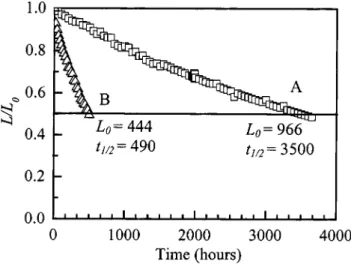
Since the CHE system can efficiently suppress the intrin-sic quenching effect of DCJTB-doped OLEDs, the device operational lifetime should be expected to improve. Indeed,
FIG. 3. Luminance (L)/initial luminance (L0) vs time of 2% DCJTB-doped OLEDs, both driven at 20 mA/cm2, and the compositions of CHE关rubrene: Alq3:DCJTB兴⫽共A兲关60:40:2兴 and 共B兲关100:0:2兴, respectively.
FIG. 1. Efficiency and drive voltage dependency on rubrene concentration in Alq3of 2% DCJTB-doped devices.
TABLE I. EL performance of 2% DCJTB-doped in rubrene/Alq3 CHE system. Device Rubrene concentration共%兲 Voltage 共V兲 CIE Lum yield 共cd/A兲 Efficiency 共lm/W兲 x y A 0 8.46 0.639 0.357 1.95 0.73 B 20 7.20 0.658 0.340 3.49 1.54 C 40 6.96 0.649 0.348 4.14 1.89 D 60 6.77 0.646 0.351 4.44 2.09 E 80 6.51 0.631 0.365 2.96 1.45 F 100 6.26 0.581 0.406 1.08 0.55
FIG. 2. Luminance efficiency vs current density.
5242 Appl. Phys. Lett., Vol. 83, No. 25, 22 December 2003 Liu, Iou, and Chen
This article is copyrighted as indicated in the article. Reuse of AIP content is subject to the terms at: http://scitation.aip.org/termsconditions. Downloaded to IP: 140.113.38.11 On: Thu, 01 May 2014 05:16:46
results from the device operational stability tests for two 2% DJCTB-doped OLEDs, driven at 20 mA/cm2, and the com-positions of CHE 关rubrene:Alq3:DCJTB兴⫽关60:40:2兴 and
关0:100:2兴, are shown in Fig. 3, curves A and B, respectively. L0, measured at the CHE composition, was 966 and 444
cd/m2, respectively. Assuming the scalable Coulombic degradation,11 for driving at L0 of 100 cd/m2, the half-life
(t1/2) of the CHE is projected to be 33 810 h.
In conclusion, we have developed an extremely high lu-minance efficiency for the archetypical DCJTB-doped red emitter at 4.44 cd/A at 20 mA/cm2 and 6.77 V with a
near-saturated CIEx,yred color coordinate of关0.65,0.35兴. By dop-ing DCJTB into the cohost matrix emittdop-ing system of rubrene/Alq3, we have also eliminated the problem of lumi-nescence quenching at high drive voltage and achieved a projected operational t1/2 lifetime of ⬎30 000 h with initial L0 of 100 cd/m2.
This work was supported by the Ministry of Education of Taiwan, Republic of China under a Grant from the PPAEU
共No. 91-E-FA04-2-4-B兲 and the National Science Council of
Taiwan, Republic of China under a grant from the Joint In-dustrial and Academic Research Project 共No.
NSC91-2622-L-009-001兲. The generous supply of OLED materials pro-vided by e-Ray Optoelectronics Technology Co., Ltd. is gratefully acknowledged.
1C. H. Chen, C. W. Tang, J. Shi, and K. P. Klubek, Thin Solid Films 363,
327共2000兲.
2
Y. Hamada, H. Kanno, T. Tsujioka, H. Takahashi, and T. Usuki, Appl. Phys. Lett. 75, 1682共1999兲.
3T. K. Hatwar, G. Rajeswaran, J. Shi, Y. Hamada, H. Kano, and H.
Taka-hashi, Proc. EL’00, Hamamatsu, Japan共2000兲, p. 31.
4
G. Rajeswaran, M. Itoh, M. Boroson, S. Barry, T. K. Hatwar, K. B. Kahen, K. Yoneda, R. Yokoyama, T. Yamada, N. Komiya, H. Kanno, and H. Takahashi, SID Digest 40, 1共2000兲.
5R. H. Young, C. W. Tang, and A. P. Marchetti, Appl. Phys. Lett. 80, 874 共2002兲.
6
L. S. Hung, L. R. Zheng, and M. G. Mason, Appl. Phys. Lett. 78, 673
共2001兲.
7S. A. Van Slyke, C. H. Chen, and C. W. Tang, Appl. Phys. Lett. 69, 2160 共1996兲.
8
C. H. Chen, Proceedings of the International Meeting on Information
Display (IMID 2002), Daegu, Korea, 21–23 August 2002.
9R. H. Young, C. W. Tang, and A. P. Marchetti, Appl. Phys. Lett. 80, 874 共2002兲.
10Z. Popovic and H. Aziz, IEEE J. Sel. Top. Quantum Electron. 8, 362 共2002兲.
11S. A. Van Slyke, C. H. Chen, and C. W. Tang, Appl. Phys. Lett. 69, 2160 共1996兲.
5243
Appl. Phys. Lett., Vol. 83, No. 25, 22 December 2003 Liu, Iou, and Chen
This article is copyrighted as indicated in the article. Reuse of AIP content is subject to the terms at: http://scitation.aip.org/termsconditions. Downloaded to IP: 140.113.38.11 On: Thu, 01 May 2014 05:16:46