which is crossed perpendicular to the photolysis laser beam in a ring-down cell, is used to probe the Br2 fragment in the B3⌸ou⫹⫺X
1⌺
g
⫹ transition using the range 515–524 nm. The ring-down time lasts 500 ns, so the rotational population of the Br2 fragment may not be nascent nature, but its vibrational population should be. The vibrational population ratio of Br2(v⫽1)/Br2(v⫽0)⫽0.8 ⫾0.2 implies that the fragmented Br2 is vibrationally hot. The quantum yield of the molecular elimination reaction is 0.23⫾0.05, consistent with the values of 0.26 and 0.16 reported in 234 and 267 nm photolysis of bromoform, respectively, using velocity ion imaging. A plausible photodissociation pathway is proposed, based upon this work and ab initio calculations. The A˜ 1A2,
B
˜ 1E, and C˜ 1A
1 singlet states of bromoform are probably excited at 248 nm. These excited states may couple to the high vibrational levels of the ground state X˜ 1A1 via internal conversion. This vibrationally excited bromoform readily surpasses a reaction barrier 389.6 kJ/mol prior to decomposition. The transition state structure tends to correlate with vibrationally hot Br2. Dissociation after internal conversion of the excited states to vibrationally excited ground state should result in a large fraction of the available energy to be partitioned in vibrational states of the fragments. The observed vibrationally hot Br2 fragment seems to favor the dissociation pathway from high vibrational levels of the ground state. Nevertheless, the other reaction channel leading to a direct impulsive dissociation from the excited states cannot be excluded. © 2004 American
Institute of Physics. 关DOI: 10.1063/1.1777211兴
I. INTRODUCTION
The atmospheric chemistry of bromine has recently re-ceived considerable attention. In spite of the low concentra-tion of bromine in the atmosphere, its catalytic rate on deple-tion stratosphere ozone is proposed up to be 100 times more rapid than chlorine atoms.1In addition, the coupling of BrO and ClO cycles to produce the atomic forms of Br and Cl can enhance the ozone depletion by chloroflorocarbons up to 20%. Halons and methyl bromides are well known sources of atmospheric bromine.2,3Bromoform, which can last long in the atmosphere and is primarily biogenic in origin, is an-other source that can contribute to active bromine.4,5 Photo-dissociation is considered as the major mechanism for bro-moform removal from the atmosphere, but the knowledge of its photochemistry is very limited.
In CHBr3photolysis, four dissociation channels are ther-modynamically probable in the ultraviolet wavelength re-gion:
CHBr3→CHBr2⫹Br ⌬H⫽258 kJ/mol 共1兲
→CHBr⫹Br2 ⌬H⫽349 kJ/mol 共2兲
→CBr2⫹HBr ⌬H⫽245 kJ/mol 共3兲
→CBr⫹HBr⫹Br ⌬H⫽530 kJ/mol. 共4兲
Early in 1961, Simons and Yarwood studied the photodisso-ciation of CHBr3 using flash photolysis near 200 nm.
6 They ascribed the observation of CBr to the primary loss of Br atom followed by decomposition of the energized CHBr2 radical. By using photofragment translational spectroscopy, McGivern et al. suggested that the loss of bromine atom is the only primary channel in the 193 nm photolysis, while the remaining CHBr2 may undergo secondary dissociation to give rise to comparable yield for the HBr elimination and CBr bond cleavage.7 On the other hand, Xu et al. using a velocity ion-imaging detection first observed a channel for the elimination of molecular bromine in the 234 and 267 nm photolysis of bromoform, and reported a quantum yield of 0.26 and 0.16, respectively.8Such an observation has an im-portant impact on the chemistry of atmospheric bromine, where the current atmospheric photochemical models con-sider only the loss of bromine atom.
*Author to whom correspondence should be addressed. Fax: 886-2-23621483; electronic mail: [email protected]
5253
The present work aims to confirm the photodissociation mechanism of bromoform to produce the Br2 fragment by using a cavity ring-down absorption spectroscopy 共CRDS兲. This technique has been widely applied in the studies of spectroscopy, kinetics, dynamics, and photochemistry in the condensed or gas phases.9–13The method is based upon the measurement of the decay rate of light trapped in an optical cavity with high reflectance. When a pulsed laser radiation is guided into an optical cavity, formed by a pair of highly reflective mirrors (R⬎99.9%), the small amount of light trapped inside the cavity reflects between two mirrors with a small fraction transmitting through each mirror for each pass. The decay rate of the light leaking out of the cavity is related to the absorption coefficient of the sample in the cavity. As an emerging absorption technique, CRDS has the following advantages: 共1兲 independence of fluctuation of radiation in-tensity; 共2兲 more sensitivity than conventional absorption methods due to a longer optical path; and共3兲 ease to set up apparatus.14
In this work, we adopt the CRDS technique to measure the nascent vibrational spectra of the molecular bromine fragmented in the photodissociation of bromoform. An exci-mer laser at 248 nm is employed to dissociate bromoform in a ring-down cell, while the other tunable laser is used to probe the Br2 fragment. Given the absorbed photon number density and the Br2 concentration produced in the beam-crossed region, the quantum yield for the molecular
elimina-tion channel is estimated to be 0.23⫾0.05, which is consis-tent with those reported by Xu et al. using velocity ion-imaging detection.8 The vibrational branching ratio of Br2(v⫽1) to Br2(v⫽0) is determined to be 0.8⫾0.2, sug-gesting that the Br2 fragment is vibrationally hot. With the aid of ab initio potential energy calculations, the dissociation mechanism leading to the products of Br2and CHBr may be gained insight.
II. EXPERIMENTAL SETUP
The CRDS apparatus used for photodissociation study of bromoform is depicted in Fig. 1. The radiation sources are composed of an excimer laser emitting at 248 nm for pho-tolysis of CHBr3 and a tunable dye laser working on Cou-marin 503 dye 共515–524 nm兲, pumped by the second har-monic of Nd:YAG laser, used to probe the released Br2 fragment in the B3⌸ou⫹←X1⌺g⫹ transition. The photolysis and probe lasers, with pulse durations about 20 and 5– 8 ns, respectively, both were operated at repetition rates of 10 Hz. The photolysis laser was focused with a 25 cm focal length cylindrical lens onto the ring-down cell at right angle to the cavity, while the probe beam was injected along the axis of the cavity. The two laser beams were overlapped in the cen-ter of the flow cell. The volume of the overlapping region was evaluated by multiplication of the beam width and height of the photolysis laser and the beam diameter of the
FIG. 1. Schematic of experimental ap-paratus for cavity ring-down absorp-tion spectroscopy.
probe laser, corresponding to共18⫻1⫻3兲⫾5 mm3. The delay time between photolysis and probe laser was adjusted to be 20 ns. In order to remain mostly the TEM00mode, the probe beam was guided through a spatial filter made of a pair of lenses of 10 and 5 cm focal length and a pinhole with 70m diameter. The pulse energies for photolysis and probe laser were controlled at 20⫾1 and 4⫾0.2 mJ, respectively, prior to entering the ring-down cell.
In this work, we used CHBr3, CCl3Br, and CH2ClBr as photolysis reagents. The later two were used to check whether the recombination process between primary Br-atom fragments played a significant role during the long ring-down time. They were all purified by repeated freeze-pump-thaw cycles at 77 K and each individual was introduced in the ring-down cell with the pressure regulated at 1–2 Torr monitored by an mks pressure gauge. The ring-down cell was sealed with two mirrors with high reflectance⬎99.9% at 500 nm, a diameter of 25.4 mm and a radius of curvature of 1 m. The probe beam was injected through the front mirror into the ring-down cell, but only a small fraction could be coupled into the cavity by transmission through one of cavity end mirrors. The mirrors were mounted about 53 cm apart in such a way that their positions may be slightly adjusted to trap a laser pulse inside the cavity by ensuring it retroreflects back and forth between two mirrors. A photomultiplier tube was positioned behind the rear mirror to record the intensity of the light pulse leaking out of the mirror on each round trip inside the cavity. The intensity envelope composed of each transmitted pulse exhibits an exponential decay, because of a constant loss of light at each mirror surface. The temporal profile of the ring-down signal was recorded on a transit digitizer and transferred to a personal computer. The ring-down time for each laser pulse may be determined by a best fit of the acquired exponential decay. The Br2 absorption
spectra were obtained by scanning the wavelength of the probe laser with a spectral resolution of 0.1 cm⫺1.
III. POTENTIAL ENERGY CALCULATIONS
The excitation of CHBr3 at 248 nm is lower in energy than that of the vertical transition to its first excited singlet state A˜ 1A2.15Stationary points on the ground state potential energy surface were located using the B3LYP density func-tional theory with the 6-311G** basis set.16,17 Unrestricted computations were performed throughout this work. For the transition states 共TSs兲, intrinsic reaction coordinate calcula-tions were performed.18 The computations were carried out with theGAUSSIAN 98suite of programs.19
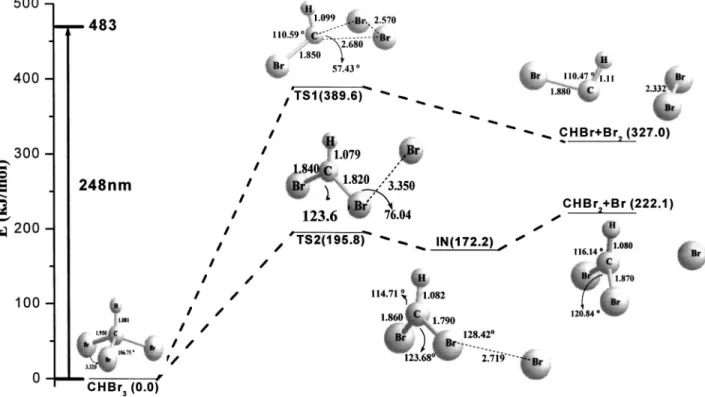
We have located a secondary saddle point共TS1兲 on the PES at 389.6 kJ/mol above the CHBr3 minimum, and a genuine TS共TS2兲 which lies at 195.8 kJ/mol. TS1 (Cs) has an
具
S2典
of 0.939 and two imaginary vibrational frequencies at 273 and 84 cm⫺1, which correspond to symmetric and asymmetric C-Br stretchings, respectively. The symmetric stretching mode leads to CHBr⫹Br2 共327.0 kJ/mol兲. TS2 (具
S2典
⫽0) has an imaginary frequency at 261 cm⫺1, which corresponds to C-Br bond breaking, leading to the CHBr2¯Br intermediate IN 共172.1 kJ/mol兲, which further dissociates into CHBr2⫹Br. The Br¯Br distance in the in-termediate is 2.719 Å.IV. RESULTS AND DISCUSSION
A. Nascent vibrational distribution of Br2 fragment As shown in Fig. 2, the CRDS spectra of Br2fragment in the B3⌸ou⫹←X1⌺g⫹transition are obtained following photo-dissociation of bromoform at 248 nm. The Br2 spectral as-signment is referred to the report by Barrow et al.20 Part of FIG. 2. CRDS spectra of Br2obtained from photolysis of bromoform at pressure of 2 Torr共a兲 without use of photolysis laser and 共b兲 with use of photolysis laser.共c兲 CARD spectra of pure Br2compound at pressure of 72 mTorr.
the results are shown in Fig. 2. When the photolysis laser is off, the Br2 signal disappears关Fig. 2共a兲兴. To confirm the ac-quired spectra resulting from the Br2 fragment, a pure Br2 compound at 72 mTorr was substituted in the cell and its CRDS signal was also measured for comparison关Fig. 2共c兲兴. Consistence of the spectra between Figs. 2共b兲 and 2共c兲 re-veals only the Br2 fragment occurring in the 515–524 nm region in the photolysis of bromoform.
When the photolysis-probe delay time is varied from 20 to 100 ns, the rotational feature of Br2 remains the same. Since the ring-down time is long, about 500 ns, the rotational population becomes thermally equilibrated and probably loses its nascent nature. Nevertheless, the occurrence of vi-brational energy transfer takes a longer time such that the vibrational population detected by CRDS method may still be in a nascent state. The vibrational population amounts to summation of each rotational line of the corresponding level. The rotational lines of P and R branches in the bands共37,0兲 and共41,1兲 both have been assigned up to J⫽34. To estimate the branching ratio of vibrational populations in the v⫽0 and 1 levels, one must take into account Franck-Condon fac-tors of the bands 共37,0兲 and 共41,1兲 and Ho¨nl-London factor for each rotational line.21 The ratio of Br2(v⫽1)/Br2(v ⫽0) yields a value of 0.8⫾0.2, which bears a large uncer-tainty caused by ignorance of the rotational lines ⬎J⫽34 and the partial overlap between them. In spite of that, the branching ratio shows significant evidence that the Br2 frag-ment is vibrationally hot following photodissociation of bro-moform.
During a long ring-down time, is it probable that the Br2 fragment comes from the secondary recombination of two Br atoms resulting from the dissociation channel 共1兲? We car-ried out two experiments to verify this possibility. First, a precursor CH2ClBr or CCl3Br was used to replace CHBr3in the cell. Under otherwise identical conditions, Fig. 3 shows no detectable signals of Br2 fragment in the photolysis of the
mono-Br-containing molecules. Even when the sample pres-sure was increased to 2.5 Torr and the photolysis-probe delay time was extended to 80 ns, we could not find any detectable bromine molecules either. Second, the measurement of laser energy dependence was performed for a selective rotational line P(37) of the band 共35,0兲 at 519.68 nm. The plot of rotational intensity as a function of the laser energy in a logarithmic scale yields a straight line with a slope equal to one, indicating that only single photon is involved in the formation of bromine molecule. Two photons are otherwise required for the recombination process.
This work demonstrates for the first time using CRD absorption spectroscopy that Br2 is formed in the primary photodissociation of bromoform at 248 nm. When laser wavelength is changed to 266 nm, the CRDS signals for Br2 are also detected but it is weaker under otherwise identical conditions. However, when a laser-induced fluorescence 共LIF兲 technique was employed, we failed to find any detect-able signals from B to X transition of Br2 fragment in the primary dissociation channel at a pressure of 8 Torr CHBr3 and with a photolysis-probe delay time of 150 ns. As the delay time is prolonged to 150 ns, only a Swan band of C2 appears in the 516 –517 nm region.22When a pure Br2 com-pound is substituted for bromoform, the LIF signals of the rotation lines in the 共37,0兲 band appear to be twice as wide when compared to those detected by CRDS method. The difficulty with LIF detection may rise from a low fluores-cence quantum yield caused by predissociation with the re-pulsive C1⌸1u state.23,24
B. Quantum yield for Br2 elimination
The quantum yield for the CHBr3photolysis via channel 共2兲 can be determined from the ratio of Br2 concentration produced in the beam-crossed region of photolysis/probe la-FIG. 3. Detection of CRDS spectra of Br2following photolysis of共a兲 CCl3Br and共b兲 CHBr3at 248 nm.
Eout⫽E0exp共⫺nᐉ2兲, 共7兲
where E0 is the photon energy of incident photolysis laser pulse prior to the cell, is the absorption cross section of CHBr3, n in the number density of CHBr3in the cell, andᐉ1 共or ᐉ2) indicates the distance between the inner side of the entrance cell window and the front 共or rear兲 edge of the beam-crossed region. The schematic is depicted in Fig. 1共b兲. is reported to be 1.94⫻10⫺18cm2 at 248 nm.25 ᐉ1 andᐉ2 are measured to be 6.35⫾0.02 and 6.65⫾0.02 cm, respec-tively. The number density of CHBr3 in the cell is 4 ⫻1016molecule/cm3. The beam-crossed region is estimated to be (5.4⫾0.5)⫻10⫺2cm3.
The Br2concentration may be determined by measuring its absorption coefficient after photolysis. The absorption co-efficient␣is evaluated by the following equation:
␣⫽cld
冉
1⫺01冊
, 共8兲where d⫽53 cm, the distance between two high reflectance mirrors; l⫽1.8 cm, the optical length of the absorber; c is the light speed, andand0are the ring-down times of Br2as a result of the probe laser wavelength in-resonance or off-resonance with 519.68 nm, respectively. If an empty cavity is used for the measurement, the additional bound-free absorp-tion may contribute to error in determining the term (1/ ⫺1/0). In this work the photolysis-probe delay time is set at 20 ns which are short enough to ignore the diffusion loss of Br2 fragment. Given the absorption cross section of the Br2 vapor at 519.68 nm, its concentration may be readily ob-tained.
To determine the absorption cross section of Br2, we replace the precursor with the pure Br2 compound regulated at different vapor pressures in the flow cell. The correspond-ing rcorrespond-ing-down timesand0were measured using the probe laser alone, as tuned in-resonance or off-resonance with 519.68 nm, respectively. By using Eq. 共8兲 in which l is re-placed by d, the absorption coefficient for a given vapor pressure may be obtained. As shown in Fig. 4, the linear plot of the absorption coefficient against the number density of Br2 has a slope that is equal to the absorption cross section, Br2⫽(1.3⫾0.3)⫻10⫺19cm2. The Br2 concentration pro-duced in the interaction region may be evaluated from the ratio of␣/Br2.
When the photolysis beam energies are varied from 10.7, 22.4, and 25.4 mJ/pulse, the methods described above may
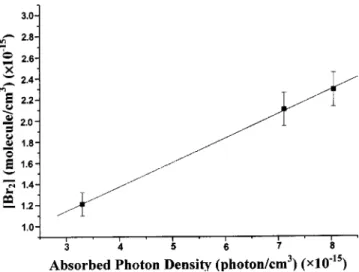
be used to obtain corresponding photon number density and Br2 concentrations. These two parameters are linearly pro-portional to each other. A plot of these quantities yields a straight line whose slope is equal to the quantum yield of 0.23⫾0.05 for the molecular elimination channel 共Fig. 5兲. Our result is consistent with those reported by Jackson group using velocity ion-imaging detection.8 They obtained the quantum yields of 0.26 and 0.16 at 234 and 267 nm, respec-tively, by assuming the ionization cross sections were iden-tical between the two fragment ions CHBr and CH2Br⫹. Thus far, the dissociation channels共1兲 and 共2兲 have ever been observed with short wavelength radiation. The quantum yield for the other primary channel leading to CHBr2 and Br should be 0.77. The branching ratio of dissociation channels 共1兲 to 共2兲 is about 3:1. Therefore, the molecular elimination of Br2must play a significant role in the atmospheric chem-FIG. 4. Plot of absorption coefficient versus number density of Br2at laser wavelength of 519.68 nm, yielding a slope indicative of the corresponding absorption cross section (1.3⫾0.3)⫻10⫺19cm2.
FIG. 5. Plot of number density of Br2produced in 248 nm photolysis of bromoform against the absorbed photon density, yielding a slope indicative of quantum yield 0.23⫾0.05 for the dissociation channel of molecular elimi-nation.
istry of bromine, which has been ignored in the past atmo-spheric models.
C. Photodissociation pathway
According to ab initio calculations, shown in Fig. 6, the energy barrier leading to the fragments CHBr and Br2 amounts to 389.6 kJ/mol, with respect to the electronic ground state of bromoform. The transition state lies along an adiabatic reaction coordinate for a photodissociation channel on the ground state surface bromoform that leads to the CHBr⫹Br2 products. This part of the surface is character-ized by A
⬘
symmetry, and its structure has two C-Br bonds elongated to 2.680 Å relative to 1.950 Å in the ground state. The Br-C-Br angle is bent symmetrically with respect to a mirror plane, and the Br¯Br is separated by 2.570 Å about 10% larger than 2.332 Å in the ground state Br2. Thus the photodisociation pathway via the transition state should lead to a vibrationally hot Br2 fragment.According to the ab initio potential energy calculations by Peterson and Francisco,15 the A˜ 1A2, B˜ 1E, and C˜ 1A1 states are probably excited by the laser at 248 nm. The tran-sition A˜ 1A2←X˜1A1 is dipole forbidden, but the transitions
B
˜ 1E←X˜1A
1and C˜ 1A1←X˜1A1are allowed and the ratio of the corresponding transition probability is 50:1. The excited states B˜ 1E and C˜ 1A1have the correct symmetry to correlate with the fragmented products via the molecular elimination pathway. If the photodissociation occurs directly from a re-pulsive limb of the excited state, the available energy is an-ticipated to substantially partition into the translational states of the fragments. On the other hand, the excited states may couple to the high vibrational levels of the ground state via
internal conversion. In this manner, the prolonged lifetime of photodissociation through the B˜ 1E⫺X˜1A1 or C˜ 1A1 ⫺X˜1A
1couplings should cause a large fraction of the avail-able energy to partition in vibrational levels of the fragments. The vibrationally hot Br2 fragment observed in the CHBr3 photolysis at 248 nm seems to favor the dissociation pathway from the highly vibrational levels of the ground state, al-though the information for the partition of translational en-ergy is not yet known.
Bromoform excited at 248 nm has an energy of 483 kJ/mol, which is enough to readily surpass the transition bar-rier. As shown in Fig. 7, the elongation of both C-Br bonds in the transition state may break concurrently along a symmetry plane. Thus a concerted mechanism is anticipated in any photolysis. We failed to find the possibility for a stepwise dissociation in the calculations. That is, a free Br atom
re-FIG. 6. Ab initio state energy calculations of bromoform dissociation along an adiabatic reaction coordinate. Two dissociation channels are calculated, the one leading to CHBr⫹Br2via a transition barrier 389.6 kJ/mol and the other leading to CHBr2⫹Br via a transition barrier 195.8 kJ/mol.
FIG. 7. Photodissociation mechanisms proposed for the Br2 elimination
photodissociation processes originate directly from a repul-sive potential surface, then an impulrepul-sive model may be ap-plied to predict how the available energy is partitioned in the photofragments.27,28According to this model, the fraction of the available energy Eavailpartitioned into the product trans-lation, ET, is given by
ET⫽
冉
u␣⫺ uA⫺B冊
Eavail, 共9兲
where u␣⫺ is the reduced mass of C and Br2, uA⫺B is the reduced mass of CHBr and Br2. The available energies are 511.4 and 448.2 kJ/mol in 234 and 267 nm photolysis, re-spectively. Thus with this model the average translational energies are predicted to be 30.9 and 18.9 kJ/mol, respec-tively. The theoretical translational energy for CHBr are es-timated to be 19.5 and 12.0 kJ/mol at 234 and 267 nm, re-spectively. In contrast, the observed translational energy of CHBr peaked at 10 and 20–25 kJ/mol, and the correspond-ing anisotropic parameter  was measured to be ⬃0 and ⬃0.5 in 234 and 267 nm photolysis, respectively.8The bro-moform photolysis at 234 and 267 nm should apparently lead to different dissociation pathways. Xu et al. suggested that the pathway differences at these two wavelengths is probably related to the nature of the excited states, but they did not have any further discussion.8 According to the theoretical calculations, the a˜3A
2state may be excited at 267 nm, while
A ˜ 1A
2, B˜ 1E, and C˜ 1A1 states are probably excited at 234 nm.15The transition probability to the a˜3A
2is weak and it is symmetry forbidden to dissociation via the molecular elimi-nation reaction. However, it can borrow intensity from the nearby b˜3E and c˜3A
1 triplet states which have relatively larger transition probabilities by 4 and 30 times, respectively, and these surfaces are allowed for reaction. If bromoform dissociates via b˜3E←X˜1A1 perpendicular transition, the re-coil fragment relative to the transition dipole would give rise to a negative  value,7 which does not agree with the ob-served average value of 0.5. Thus, the 267 nm photolysis may probably undergo fast direct photodissociation from the repulsive limb of excited state c˜3A
1. In contrast, when pho-tolysis occurs at 234 nm, the measured translational energy of CHBr is far less than that predicted by the impulsive model. A large fraction of the available energy should be partitioned into the vibrational levels of the fragments. As with the photolysis at 248 nm, the excited states B˜ 1E or
C˜ 1A1 of bromoform may have chance to couple with high
gests that more than one electronic transition contribute to the resonance Raman spectra. This seems to suggest that these four active modes in the Raman spectra are related to the two major primary dissociation channels via single Br atom cleavage and Br2 molecular elimination. Electronic transition that involves short-time dynamics along the 5 asymmetric stretch or 3 asymmetric bend may lead to the CHBr2 and Br fragments, while the transition involving the pathways along 6 symmetric bend or 2 symmetric stretch modes probably result in the Br2 elimination. In contrast to this viewpoint, Phillips and coworkers related the observed four active modes to the secondary HBr elimination or C-Br bond breaking, by considering scheme 共1兲 as the only chan-nel present in the photolysis with ultraviolet radiation.29For instance, they anticipated the electronic transition involving the 3 H-C-Br asymmetric bend mode to correlate with the secondary HBr elimination reaction. There is no available information to support their speculation regarding this mo-lecular elimination process.
V. CONCLUSION
By using CRDS technique, we have observed the Br2 molecular elimination as a second major reaction channel following the photodissociation of CHBr3 at 248 nm. The nascent vibrational spectra of the Br2fragment was reported, showing the fragmented Br2was vibrationally hot. The quan-tum yield for this reaction channel was determined to be 0.23⫾0.05, consistent with those reported by Jackson and coworkers using velocity ion-imaging detection in the 234 and 267 nm photolysis. With the aid of the calculations by Peterson and Francisco on the low-lying electronic states and the theoretical state structure calculations of the transition along the adiabatic reaction coordinate on the ground state surface in this work, a plausible photodissociation pathway is proposed. The A˜ 1A
2, B˜ 1E, and C˜ 1A1singlet states of bro-moform are probably excited at 248 nm. These states may couple to the high vibrational levels of the ground state
X1A1, from which the excited bromoform feasibly surpasses a reaction barrier prior to decomposition. The transition state structure tends to correlate with vibrationally hot levels of Br2 fragment. In addition, a concerted mechanism of photo-dissociation is anticipated, since two C-Br bonds elongate in the transition state and may break concurrently along a sym-metry plane. The observed vibrationally hot Br2 fragment seems to favor the dissociation pathway from these high
vi-brational levels of the ground state. Nevertheless, the other reaction channel leading to a direct impulsive dissociation from the excited state can not be excluded.
ACKNOWLEDGMENT
This work was supported by National Science Council of Republic of China under Contract no. NSC92-2113-M-002-046.
1
R. R. Garcia and S. Solomon, J. Geophys. Res., 关Atmos.兴 99, 12937
共1994兲.
2J. H. Butler, Geophys. Res. Lett. 21, 185共1994兲.
3J. M. Lobert, J. H. Butler, S. A. Montzke, L. S. Geller, R. C. Myers, and
J. W. Elkins, Science 267, 1002共1995兲.
4
V. L. Dvortsov, M. A. Geller, S. Solomon, S. M. Schauffler, E. L. Atlas, and D. R. Blake, Geophys. Res. Lett. 26, 1699共1999兲.
5W. B. DeMore, J. Phys. Chem. A 100, 5813共1996兲.
6J. P. Simons and A. J. Yarwood, Trans. Faraday Soc. 57, 2167共1961兲. 7
W. S. McGivern, O. Sorkhabi, A. G. Suits, A. Derecskei-Kovacs, and S. W. North, J. Phys. Chem. A 104, 10085共2000兲.
8D. Xu, J. S. Francisco, J. Huang, and W. M. Jackson, J. Chem. Phys. 117,
2578共2002兲.
9
A. O’Keefe and D. A. G. Deacon, Rev. Sci. Instrum. 59, 2544共1988兲.
10
A. O’Keefe, J. J. Scherer, A. L. Cooksy, R. Sheeks, J. Heath, and R. J. Saykally, Chem. Phys. Lett. 173, 214共1990兲.
11D. J. Benard and K. B. Winker, J. Appl. Phys. 69, 2805共1991兲.
12J. Pearson, A. J. Orr-Ewing, M. N. R. Ashfold, and R. N. Dixon, J. Chem.
Phys. 106, 5850共1997兲.
13U. Lommatzsch, E. H. Wahl, T. G. Owano, C. H. Kruger, and R. N. Zare,
Chem. Phys. Lett. 320, 339共2000兲.
14J. J. Scherer, J. B. Paul, A. O’Keefe, and R. J. Saykally, Chem. Rev. 共Washington, D.C.兲 97, 25 共1997兲.
15K. A. Peterson and J. S. Francisco, J. Chem. Phys. 117, 6103共2002兲. 16A. D. Becke, J. Chem. Phys. 98, 5648共1993兲.
17
C. Lee, W. Yang, and R. G. Parr, Phys. Rev. B 37, 785共1988兲.
18C. Gonzalez and H. B. Schlegel, J. Phys. Chem. 94, 5523共1990兲. 19M. J. Frisch, G. W. Trucks, H. B. Schlegel et al.,
GAUSSIAN 98, Gaussian 98 FULL REF, Gaussian, Inc., Pittsburgh, PA, 2001.
20
R. F. Barrow, T. C. Clark, J. A. Coxon, and K. K. Yee, J. Mol. Spectrosc.
51, 428共1974兲.
21J. A. Coxon, J. Quant. Spectrosc. Radiat. Transf. 12, 639共1971兲. 22I. D. Hein, Database for Excitation-Emission-Spectra共EES兲 in
Combus-tion Research, http://www.ltk.mw.tu-muenchen.de/wwwlaser/AES/ aesគhome.htm
23H. K. Haugen, E. Weitz, and S. R. Leone, J. Chem. Phys. 83, 3402共1985兲. 24J. Tellinghuisen, J. Chem. Phys. 115, 10417共2001兲.
25R. Atkinson, D. L. Baulch, R. A. Cox, R. F. Hampson, J. A. Kerr, M. J.
Rossi, and J. Troe, J. Phys. Chem. Ref. Data 26, 521共1997兲.
26
Q. Zhang, U. Marvet, and M. Dantus, J. Chem. Phys. 109, 4428共1998兲.
27T. Baer and W. L. Hase, Unimolecular Reaction Dynamics共Oxford
Uni-versity Press, New York, 1996兲, Chap. 9, pp. 361–363.
28R. Schinke, Photodissociation Dynamics: Spectroscopy and
Fragmenta-tion of Small Polyatomic Molecules 共Cambridge University Press, New
York, 1993兲, Chap. 10, pp. 251–255.
29Y. L. Li, C. W. Lee, K. H. Leung, G. Z. He, and D. L. Phillips, Mol. Phys.