I
國
立
交
通
大
學
資訊管理與財務金融學系
資訊管理碩士論文
群體購物之社群決策支援機制
A Social Decision
Support
Mechanism for Group Purchasing
研 究 生:
謝復勛
指導教授:
李永銘 博士
II
群體購物之社群決策支援機制
A Social Decision Support Mechanism for Group Purchasing
研 究 生:謝復勛 Student:Fu-Shun Hsieh
指導教授:李永銘 Advisor:Yung-Ming Li
國立交通大學
資訊管理與財務金融學系
資訊管理碩士論文
A ThesisSubmitted to Institute of Information Management College of Management
National Chiao Tung University in Partial Fulfillment of the Requirements
for the Degree of
Master of Science in Information Management June 2014
Hsinchu, Taiwan, the Republic of China
I
群體購物之社群決策支援機制
學生:謝復勛
指導教授:李永銘 博士
國立交通大學資訊管理研究所碩士班
摘要
隨這資訊科技的進步和群體商務快速的發展,人們的生活方式有很明顯的改 變,供應商可以提供商品給團體顧客,但是群體商務卻有著問題,從供應商的角 度,提供的商品是以供應商的角度去設計,所以群體商務商品的銷售量有變少的 趨勢;然而從消費者的角度,讓消費者組團討論並決策有一些問題,像是在討論 的過程中可能要花很多時間來達成共識,或者決策結果的並非該組的最佳選擇。 所以為了解決上述的問題,我們設計了一個群體討論決策機制,藉由討論的 內容來推薦最適合的新選項給團體討論者,並且考慮社交影響力及個人喜好去產 生商品決策清單。研究結果顯示,我們能夠顯著提高小組討論的有效性並且供應 商可以針對群體討論的清單,提供更適合的群體產品或服務給消費者。 關鍵字:社交網站、群體決策、文字探勘、群體商務II
A Social Decision Mechanism for Group Purchasing
Student :
Fu-Shun Hsieh
Advisor: Dr. Yung-Ming LiInstitute of Information Management National Chiao Tung University
ABSTRACT
With the advancement of information technology and development of group commerce, people have obviously changed in their lifestyle. However, group commerce faces some challenging problems. The products or services provided by vendors don’t satisfactorily reflect customers’ opinions, so the sale and revenue of group commerce gradually becomes lower. O the other hand, the process for a formed customer group to reach group-purchasing consensus is time-consuming and the final decision is not the best choice for each group members.
In this paper, we design a social decision support mechanism, by using group discussion message to recommend suitable options for group members and we consider social influence and personal preference to generate option ranking list. The proposed mechanism can enhance the group purchasing decision making efficiently and effectively and venders can provide group products or services according to the group option ranking list.
III
致謝
時光荏苒,最後的學生生涯就要結束了,回首這兩年,我想最難忘的回憶就 是撰寫論文的過程,首先,要感謝指導老師李永銘教授,老師告訴我們做研究必 須仔細謹慎,他曾說過:「細緻的研究是要經過很多的錘鍊,除了仔細的思考之 外,還要有正確的態度」,而在老師身邊,不僅僅學會寫論文的技巧,還學到做 人處事的道理,並且感謝老師以及口試委員翁頌舜教授、劉敦仁教授及陳柏安教 授給予我的論文指證及評閱,使論文內容更加地完善 在研究所的學習歷程中,要感謝的人很多,感學研究是博士班學長易霖及無 尾熊(政揚)學長,幫助我們思考自己論文的問題,而在論文進度停滯不前時,提 供了非常多的建議與方法。實驗室的好夥伴:渝婷,謝謝你在我論文遇到盲點時, 給我許多的中肯的意見,並在低潮時鼓勵我,讓我能繼續勇往直前完成論文;認 真的欣宸,謝謝你幫實驗室處理大小雜事,因為有你的幫助,我們才能方便的使 用實驗室的資源,很慶幸實驗室有你這麼一個好夥伴;美國人光宇,謝謝你時常 校閱我的論文中英文文法及用字,讓我在寫論文的過程中,能夠更快速的撰寫英 文的內容;銘彥,因為你的幽默,讓實驗室多了幾份歡笑,也因為妳願意傾聽我 的苦水,讓我紓解論文的壓力;還有感謝實驗室的學弟、學妹:彥丞、智聖、敬 媛及憶雯,謝謝你們幫忙處理實驗室及口試的大小雜事,讓我能過專心地撰寫論 文;另外還要感謝其他實驗室的學長及同學(裕昌、翊伶、美棻、宜群、曲峰、 悅瑜、林穎、泰熾),因為有你們的陪伴,讓黑白的研究生活增添許多色彩,只 要跟你們一起都會有充滿歡笑的氣氛,讓我有繼續研究論文的動力;還有交大室 友們,真的很喜歡跟你們聊天,從你們身上我看到了熱情、有想法、積極的人生 態度,感謝你們在程式設計及研究方法的教學,讓我的論文實驗能夠順利完成;IV
最後我要感謝我的家人,因為有你們的支持與鼓勵,讓我沒有經濟的憂慮,並且 順利完成碩士的學位,這篇論文獻給最愛的你們。
謝復勛 2014 年七月 謹誌於 新竹 國立交通大學光復校區
V
目錄
CHAPTER 1 INTRODUCTION ... 1
1.1 Research Background ... 1
1.2 Research Motivation and Problems ... 2
1.3 Research Objectives & Contributions ... 4
1.4 Thesis Outline ... 4
CHAPTER 2 LITERATURE REVIEW ... 6
2.1 Social and Group Commerce ... 6
2.2 Purchasing Decision Making... 7
2.3 Social Networks and Social Influence ... 8
2.4 Multi-criteria Decision Making and Adjective Analysis ... 8
2.5 Analytic Hierarchy Process ... 9
CHAPTER 3 THE SYSTEM FRAMEWORK ... 11
3.1 Group member Influence analysis ... 16
3.1.1 Group formation... 16
3.1.2 Social Influence Analysis ... 16
3.1.3 Participant Expertise Analysis ... 20
3.1.4 Influence Power Analysis ... 22
3.2 Group Discussion Proposal Analysis ... 23
3.2.1 Criteria Evaluation Analysis ... 23
3.2.2 Options Extraction Analysis ... 25
3.3 Group Consensus Decision Engine ... 29
3.3.1 Social Evaluation Analysis ... 29
3.3.2 Group Social Voting Analysis ... 30
CHAPTER 4 EXPERIMENTS ... 31
4.1 Experiment Process Flow ... 32
VI
4.3 Criteria Computing ... 40
4.4 Weight Generation ... 41
4.4.1 Factor Weighting Determination ... 42
CHAPTER 5 RESULTS AND EVALUATIONS ... 43
5.1 Hit Ratio ... 43
5.2 Factor Weighting Determination ... 43
5.3 Performance of Recommendation Factors ... 44
5.4 Participant’s satisfaction rate ... 48
CHAPTER 6 DISSSUSION AND CONCLUSION ... 51
6.1 Research Contribution ... 51
6.2 Research Limitations ... 52
6.3 Future Studies ... 53
VII
List of Figure
Figure 1. Traditional Group Decision Method... 12
Figure 2. Group Decision Support Mechanism Framework ... 13
Figure 3. The Social-Affiliation Network... 17
Figure 4. The example of interaction network ... 19
Figure 5 Semantic Orientation Identification ... 24
Figure 6. Experiment Process Flow ... 33
Figure 7. Facebook Group Invited Interface Part 1 ... 35
Figure 8. Facebook Group Invited Interface Part 2 ... 35
Figure 9. Group Discussion Message Interface ... 36
Figure 10. Voting Interface ... 38
Figure 11. Ranking List Generated Interface ... 38
Figure 12. Profile of Participants ... 40
Figure 13. APH Comparison Table ... 42
Figure 14. Performance of Different Weighting Approaches ... 44
Figure 15. The Average of Accuracy Including All Scenarios ... 45
Figure 16. Accuracy of Food Scenario ... 45
Figure 17. Accuracy of Travel Scenario ... 46
Figure 18. Accuracy of Shopping Scenario... 46
Figure 19. The Average of Satisfaction ... 48
Figure 20. The Satisfaction in Food Scenario ... 48
Figure 21. The Satisfaction in Travel Scenario ... 49
VIII
List of Table
Table 1. Option Bank Format ... 26
Table 2. Transform Options to Scores ... 27
Table 3. Category Score Format ... 28
Table 4. Term Library ... 34
Table 5. The Option Bank Format ... 37
Table 6. The Dataset Summary before Data Cleaning ... 39
Table 7. The Dataset Summary after Data Cleaning... 39
Table 8. Factor Weight Setting Questionnaire ... 41
Table 9. Each Factor Weight in Different Scenario ... 42
Table 10. Statistical Verification Results of Weighting Approaches ... 44
Table 11. Statistical Verification of the Accuracy in Food Scenario ... 47
Table 12. Statistical Verification of the Accuracy in Travel Scenario ... 47
Table 13. Statistical Verification of the Accuracy in Shopping Scenario ... 47
Table 14. Statistical Verification of the Satisfaction in Food Scenario ... 50
Table 15. Statistical Verification of the Satisfaction in Travel Scenario ... 50
1
CHAPTER 1 INTRODUCTION
1.1 Research Background
In recent, because of the rapid development of e-commerce market, on-line transaction platforms provide convenient trading services and change custom’s shopping habit. And with advancement of information technology and development of Web 2.0, there are a large variety of e-commerce applications, such as social commerce applications, mobile commerce applications and group commerce development etc.
The main factor of creating social commerce network is letting customers easily browse the marketplace [6], according to survey by Consumer Electronics Association [42], 24% of social network users browse social media before making a product decision, and 38% are referring to the comments from user who have goods or service experience. 84% persons use reviews from opinion leaders to make business decision and 51% are used to share their product or service experience on social media. Additionally, for creating suitable products or services, most enterprises collect knowledge from customers [34]. According to a survey [28], 71% of products or services recommendation information provided by consumers are valuable to the companies. That is say using product suggestions from customers can attract more customers to purchase.
Recently, group commerce has become an appealing electronic commerce. The group commerce venders provide products or services on the on-line websites, and they offer significantly discount price for customers who buy large quantity goods [8]. In other words, when customers are aggregated to reach a required group size, they can enjoy discounted group price. According to research report from Institute for Information Industry, the group commerce market value increases from 7.2 billion dollars in 2010 to 9 billion dollars in 2011 [52] and the group commerce market value will up to a trillion in 2015. With the popularity of social media, the customer grouping phenomena is emerging [5] and many emerging
2
applications considers the role of social interactions in group commerce [44] [50]. According to a report from TechCrunch [43], group commerce companies attempt to integrate with social platforms, such as Facebook, to allow consumers to post or discuss about the products or services they purchased.
1.2 Research Motivation and Problems
In order to increase the quantity of products or services, group commerce vendors recommend coupons, advertisements or restaurants to the customers’ based on their personal preference, such as staying time of browsing goods website or the types of goods previously purchased. However, many purchasing or consuming activities are likely group-driven, such as watch movie, travel, etc. Personalized decision method cannot meet requirements from group members because individual preference cannot represent group preference. In addition to the preference of each group member, the social influence and comments from opinion leaders are also key factors affecting the group recommendation performance.
According to a report from Institute for Information Industry [13], the development of group commerce gradually slows down because customers cannot find the goods which conform to their needs. In order to enhance group consumption, enterprises have to provide differentiation or customization of goods. Although group commerce provides differentiation and customization of goods for customers, these kinds of promotions is mainly manipulated by the vender.
Recently, many group commerce enterprises use feedbacks from groups or organizations to learn customers’ needs [3]. For example, Groupon collaborates with CafePress, which sells group customization products, to build a platform to let groups of customers set group product types or factors which customers want to [1] [16].
Group commerce enterprises provide a group decision platform and let customers organize groups to discuss their goods needs to produce more suitable product. However, this
3
current approach has some drawbacks: first, group members have to take a lot of time to reach the consensus during the discussion; second, the final decision result may not be satisfactory to all group members. In this study, we aim to propose a social decision support mechanism grounded on social media for group purchasing commerce. The proposed mechanism can extract the customers’ need and enhance the efficiency (time reduction) and effectiveness (consensus satisfaction). of group decision-making.
As a consequence, in this study, there are three main research questions to be solved: How to exploit social media to generate proposals for group purchasing?
Before group discussion, we build up options databank from the comments expressed on social media, such as Facebook fans page, blogger, or e-commerce websites etc. And considering different option criteria, a list of options are generated for support the discussion of group members. If the group members cannot reach consensus on the options, the system can discover and extend the options databank to recommend new options according to group discussion message.
How to find the opinion leader within a group during the discussion process?
The definition of opinion leader is someone who has a lot of accurate product or service information and whose opinions will influence people to make a decision. It is difficult for us to know who the opinion leader is. But we can utilize their interest or preference to identify the opinion leader. On social media, we can analyze personal interest by the set of fans pages a user clicked “like” button.
How to optimize group member’s satisfaction when they reach group consensus?
Before making decisions, group members will express their individual opinions on the options. Their discussion messages could be segmented and separated important nouns and
4
adjectives. Each group members’ social influence and personal expertise influence should be considered when evaluate the opinions of group members.
1.3 Research Objectives & Contributions
In this research project, we aim to enhance the decision-making performance (efficiency and effectiveness) in group purchasing by the utilizing the social media platform. We incorporate social context with group collaboration systems to help the group easily make decisions. The main components of the proposed mechanism include individual, social, and context factors. Individual factor represents the personal preference, which is considered in preference analysis. Social factor represents the influence between each group members, which is considered in social influence analysis. Context factor represents the group discussion context, which is used to detect and propose new options. After obtaining three factors scores, we will use AHP (Analytic Hierarchy Process) to set each factors weight in different scenarios. And then we use individual, social, and context factors to calculate each option scores. If a candidate option’s score is below some threshold, system will eliminate it and recommend a new option and let group members discuss again. Finally, the group members will obtain option ranking list when consensus is reached.
According to the experimental results, the proposed system can support group members to make a decision on selecting group purchasing opinion efficiently and satisfactorily. Group commerce venders can also benefit from providing more appropriate group products/services according to the option with consensus.
1.4 Thesis Outline
The outline of the paper is organized as follows. In Section 2, we discuss basic concepts and review related literature. In Section 3, we present the system framework, the social decision support mechanism, combined with social relationship analysis, group discussion
5
message analysis and personal preference analysis. Section 4 describes the experiment processes and data analysis procedures. In Section 5 we evaluate and discuss the experimental results. Section 6 summarizes research contributions and discusses future works.
6
CHAPTER 2 LITERATURE REVIEW
2.1 Social and Group Commerce
Social commerce is a form of commerce which integrates both online and offline environments by social media platform [22] [25] [47] and social commerce utilizes social network sites for social interactions and user information to promote the online buying and selling of various products and services [36] [38]. Significantly affected by fast development of social networks, social commerce has become a synonym for the next generation online commerce [32]. Moreover electronic commerce venders build social platforms to provide goods or advertisement recommendation services [27].
Group commerce is a specific type of social commerce. While the concept of group commerce is a group of customers bundling together for bargaining goods price [23] and reason of fast group commerce development is dependent on new information technologies and the global proliferation of the Internet [5]. Moreover group commerce websites, where buyers with similar purchase interests congregate online to obtain group discounts, have metamorphosed into several variants. The most popular variant is the deal-of-the-day group-buying website [54]. With the feature of fast-growing, group commerce market value increase from 7.2 billion dollars in 2010 to 9 billion dollars in 2011 [52] and the group commerce market value will up to a trillion in 2015.
With development of service industry, most service providers use customer-oriented rather than product-oriented marketing strategy. In order to make profit, companies conduct product research about consumer behavior, such as why consumers buy, what consumers buy, who consumers will buy with, when consumers buy, where consumers buy and how consumers buy.
7
decision making, which is implemented in social network platforms, such as Facebook, for support group purchasing with option proposing and opinion evaluation.
2.2 Purchasing Decision Making
According to research [31] [49], before making purchase decisions, individual or group consumers will ask the opinions of someone who have information about products they will want to buy. When they want to make a decision, they will be often influenced by the people who have similar decision experiences [19]. Several individual or group consumer behavior decision models were proposed. In consumer decision-making models, utility model theory suggests that consumers make a purchasing decision by usefulness of products; consumers are seen as rational actors who will estimate the product utility scores [46] [51]. However, in the real world consumers is not entirely rational. Conversely, Simon proposed a concept of decision-making process [39]. In this process, a decision maker can evaluate and compare all options with others. There are three phases: intelligence, design, and choice. Intelligence means thinking and finding all problems that will be encountered when someone proposes the alternatives. Design refers to a process that creates, develops, and analyzes all available alternatives. Choice means selecting an alternative from the possible options.
Kotler propose a concept of consumer purchasing decision-making process [20], when a consumer makes decisions there are five steps they will apply: problem recognition, information search, evaluation and selection of alternatives, decision implementation, and post-purchase evaluation. When consumers need to make decisions on something, they will begin to search some information and ask someone who have the past experience. Then in the stage of alternatives evaluation, consumers will evaluate all alternatives with some established criteria that are might be derived from past experience and friends who have given advises [7] [9] [12]. Finally in purchase decision stage, consumers will stop searching
8
and evaluating information and make their final purchase decisions.
In this research, we use group members’ interaction messages to analyze each group members’ preference on each option. Then according to their opinion view to identify what kind of option criteria is the most people prefer.
2.3 Social Networks and Social Influence
Individual decision making is to maximize decision effectiveness in the condition of being given limited resources [29]. However, there are three factors which will influence people when making a decision: influential people, utility improvement from the options, and people’s social network [4] [48].
Social influence is the process that individuals will change their feelings, thinking or behavior when interacting with someone with similar experience or expert [10] [35]. In the past, traditional social behavior is realized through physical interactions, such as face-to-face communication. But now there have a lot of powerful social network platforms which allow us to interact with each other on the Internet. As the quick development of social media, consumers can much easily get information (people’s preference and relationship) from on-line sources and make a decision with the support of their social network. It is an ideal approach to build up a decision support system by utilizing online social information which can extract much valuable data sources [15] [26].
In this research, we propose a social decision support mechanism according to human behaviors on and information extracted from the social networks.
2.4 Multi-criteria Decision Making and Adjective Analysis
It is a common decision-making process that people solicit some opinions from their friend social network before they makes a decision [24]. However the feedbacks are likely to
9
be vague as we usually use nature language to express our opinions. So when people make decisions they will encounter some problems, such as getting completely unknown or incompletely known information, time pressure, lack of knowledge and limited expertise [41].
Recently, intuitionistic fuzzy sets have been used for dealing with information vagueness in the semantic web [11]. Conceptually, intuitionistic fuzzy sets have feasible presentations for the degree of membership and non-membership, and degree of uncertainty [21]. It is difficult to level and classify users’ options. TOPSIS (“the technique for order preference by similarity to the ideal solution”) a powerful tool to classify the adjective level of the opinions. This technique is proved to be effective in solving multiple-adjective classification problems [53]. The concept of the technique for ordering preference by similarity to the ideal solution is using positive and negative aspects to level adjective degree [18]. For example, an adjective that is closer to the positive aspect also indicates that it is farther from negative aspect in the meanwhile.
In this research, we use vague information method to analyze vague words extracted from the interaction messages and apply the TOPSIS method to classify the positive and negative adjective semanteme of the opinion.
2.5 Analytic Hierarchy Process
Thomas L. Saaty proposed Analytic Network Process that is a concept of Analytic Hierarchy Process (AHP). Analytic hierarchy process is a structured and multi-criteria decision-making method, and it is widely used with quantifiable criteria in a lot of areas such as decision-making [17], [45] etc. Because this method can determine the importance of the alternatives by some important criteria in a hierarchy and the importance of the criteria by some alternatives decision problems cannot be structured hierarchically [33], so Analytic
10
Network process can take the interactions with elements into consideration by using network model. Moreover Fuzzy Analytic Hierarchy Process can translate the idea of consumers from certain values into fuzzy numbers. Therefore the messages of group members will more reasonably considered in evaluating criteria.
In this research, we use AHP to find important decision option factors and corresponding weighs with respect different group purchasing scenarios.
11
CHAPTER 3 THE SYSTEM FRAMEWORK
In this section, a group decision mechanism grounded on social media is proposed for expediting the decision on group purchasing. In our daily life, multi-criteria decision making problem is often existent such as deciding which kind of cloth to buy. Multi-criteria decision making includes diverse kinds of criteria, and people consider different criteria in making decision process.
For example, people may consider not only characteristic of dishes but also opinion from friends when determining where to go to restaurant. For a hotel, some people care about price, some people care about quality of service, and others more care about hotel evaluations from their friends. So the decision making criteria of group purchasing products is consisted of two criteria: whether group members will be influenced by opinions from their closeness friends, whether group members will be influenced by their group opinion leader.
Additionally, before the group members make a decision, they need to form a group to discuss. For example, if group members make a decision about the restaurant or travel, in traditional way, people will gather together for discussing. Our proposed mechanism will discover options to support the discussions among the group members after the group is formed.
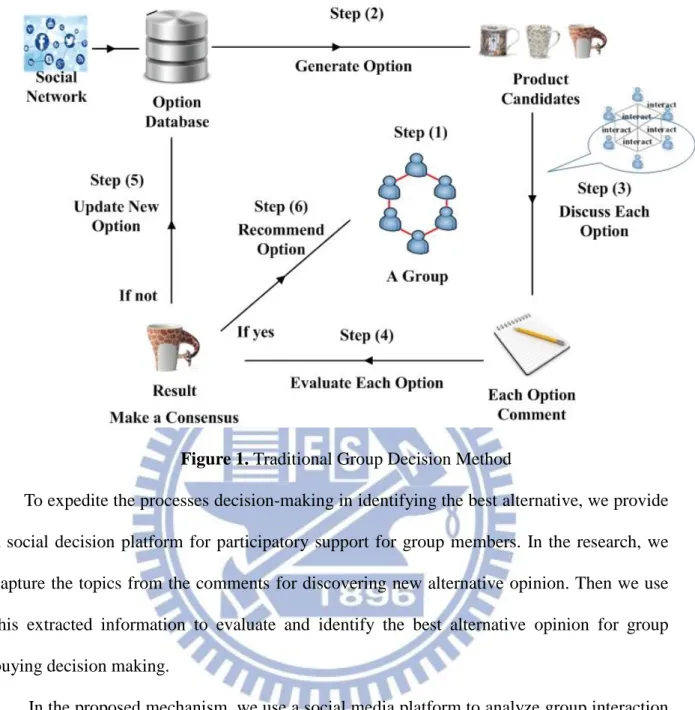
Figure 1 illustrates the discussion process for a group to determine the best alternative. (1) A group of collective purchasing is formed. (2) A list of discussion options, which are selected by the group leader from the option bank. (3) Group members exchange their information about each option through the group discussion platform. (4) The group members evaluate the options and make consensus. (5) If the consensus cannot be reached, new options are proposed and repeat the processes from (2). (6) If the consensus is reached, new options are recommended for group members.
12
Figure 1. Traditional Group Decision Method
To expedite the processes decision-making in identifying the best alternative, we provide a social decision platform for participatory support for group members. In the research, we capture the topics from the comments for discovering new alternative opinion. Then we use this extracted information to evaluate and identify the best alternative opinion for group buying decision making.
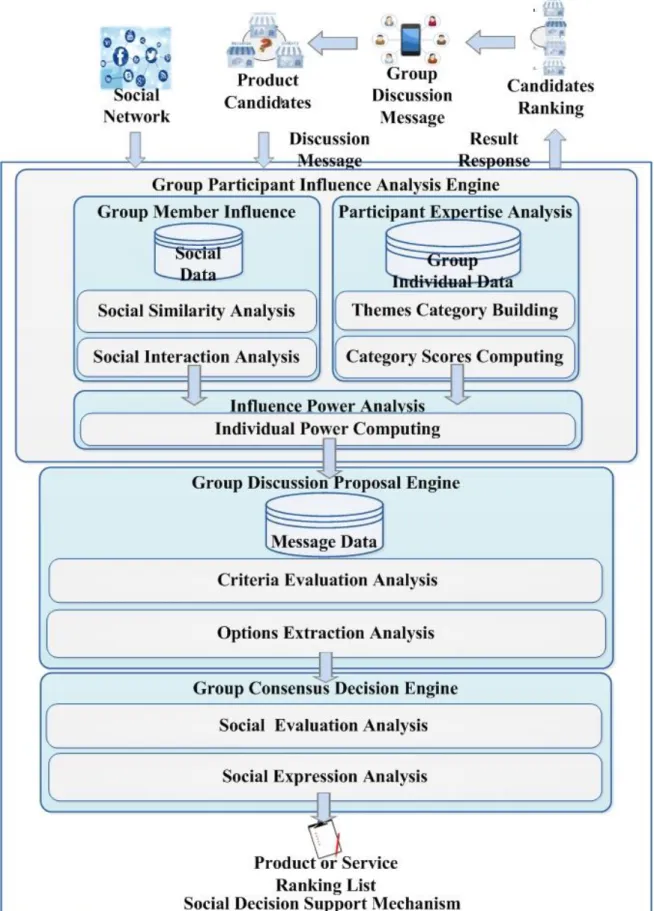
In the proposed mechanism, we use a social media platform to analyze group interaction messages which could help us know the preference of group members. Besides, we use social relationship to compute the closeness and interaction between the group members for finding the opinion leader, the most influential people. In the meanwhile, we use personal expertise score to understand the product professionalism of each group member. Finally, this mechanism would utilize these expertise, social relationship and closeness, and criteria evaluation information to get the alternatives ranking list. Figure 2 outlines the architecture of our proposed mechanism.
13
14
The main modules included in the proposed system framework are described as follows: 1. Group Participant Influence Analysis Module: This module has three main components:
Social Influence Analysis, Participant Expertise Analysis and Participant Influence Power Analysis
(1) Social Influence Analysis: The activities on social media are analyzed to identify the relationship between the group members. People tend to follow the suggestions provided by our familiar and friends. So we can find the group opinion leader who could help us to get a better ranking list of alternatives while getting maximum satisfaction of members in the group.
(2) Participant Expertise Analysis: People may be interested in some ideas/ products which are preferred by others. So we can observe the behavior of group members revealed in social media to infer the every member’s interests. This aggregate group preference information helps us to get more accurate list of alternatives.
(3) Influence Power Analysis: In this analysis, we evaluate the influence power of each group member in different product or service categories by combining their social influence score and participant expertise score.
2. Group Discussion Proposal Analysis Module: This engine has two main components: Criteria Evaluation Analysis and Opinions Extraction Analysis. The messages of group interactions are analyzed to extract the opinions and evaluations.
(1) Criteria Evaluation Analysis: The aim of criteria evaluation analysis is to find the criteria and evaluation from opinions which are expressed by group members. And each group members’ responses are transformed into a collective decision matrix.
15
Then collective decision matrix will utilize intuitionistic fuzzy values to represent uncertainty and incompleteness from opinion criteria evaluations.
(2) Opinions Extraction Analysis: In this analysis, for finding new option, the options can extract from the public and unprejudiced third parties, such as blogger or forum. According to their evaluation, we can extract option criteria adjective. Finally, we use these option criteria to build a collective options dataset.
3. Group Consensus Decision Module: This analysis has two main components: Social Criteria Influence Analysis and Social Influence Voting Analysis
(1) Social Evaluation Analysis: In social criteria analysis, we analyze the previous group discussion messages and utilize previous collective decision matrix and social influence between each group member to calculate each option criteria evaluations from different members.
(2) Social Expression Analysis: In social endorse analysis, we use an rating method for letting group members rate the alternative options. Each group member can rate for one or more two options which they be interested in. And we consider their personal preference scores to adjust the group members rating weight. Finally, we incorporate adjective semantic scores with voting scores to generate product ranking list. If voting scores don’t exceed the threshold, the proposed framework will repeat group discussion till scores exceed the threshold.
16
3.1 Group member Influence analysis
3.1.1 Group formation
When people, with same topic or target, make a group purchasing decision, such as go to restaurant, planning a travel tour, or purchasing group souvenir, they will organize a group to discuss.
3.1.2 Social Influence Analysis
The purpose of Social Influence Analysis module is to identify the all member similarity and the social tie strength in the group according to social information collected from social media. We use social-affiliation network to find what alternatives the member have interest. The social-affiliation network can be built up based on a group user’s social network relationship. As shown in Figure 3, if member A likes alternative X and share it (line AX) on his or her social platform to his/her friend B, the social influence will affect the friend B and arouse his/her friend’s interest about alternatives X (line BX).
17
Figure 3. The Social-Affiliation Network
However, the social influence power is not the same for all group users. For example user A, C and D are the user B’s friends. Compared with A, user C and D have closer relationship (represented by a border line) with user B. User A, C and D are interested in different alternatives (A interested line is AX, C is CY, D is DY), because user B is closer relationship with user C and D, compared with alternative X (dotted line BX), he/she will be interested in alternative Y (border dotted line BY).
Moreover people join the same a club because of the same interest. The more number of mutual clubs two people joined, the higher influence between them. In this research, we consider the number of mutual clubs on Facebook between each group members. Therefore we should consider the relationship closeness to evaluate the social influence degree. If there
18
are more common friends and clubs on Facebook between two people, their social tie will be stronger. Denote Club (𝑚𝑖) as the set of clubs group member 𝑚𝑖 attended in and Club (gm ) i
is set of clubs group member gm attended. i AllClubs m gm( i, i) represents the total number
of clubs group member 𝑚𝑖 and gm participate in. And i Club(mi) Club(gmi) denotes 𝑚𝑖 and gm mutual joined clubs (both of they attended). Friends (𝑚i 𝑖) as the set of group member 𝑚𝑖’s friends and Friends (gm ) is set of group member i gm ’s total friends. i
( i, i)
AllFriends m gm is total number of member 𝑚𝑖’s or gm ’s friends. The social similarity i
degree between group members 𝑚𝑖 and gm is measured as:i
( ) ( ) ( , ) * ( , ) ( ) ( ) i i i i i i i i Club m Club gm GSS m gm a
AllClubs m gm Club m Club gm
( ) ( ) (1 ) * ( , ) ( ) ( ) i i i i i i Friends m Friends gm a
AllFriends m gm Friends m Friends gm
. (1)
The social similarity scores between member 𝑚𝑖 and other group member gm attending i
group discussion is represented as
1 2 3
( i) { ( i, ), ( i, ), ( i, ) ( i, n)}
GSS m GSS m gm GSS m gm GSS m gm GSS m gm (2)
3.1.2.1 Social Interaction Analysis
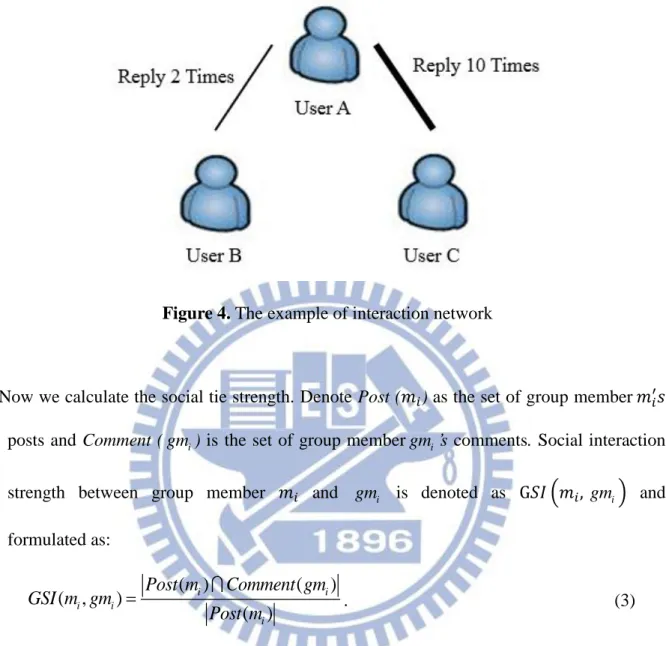
We can use interactions on the social media to calculate the social tie strength between two participants. Social interactions can be taken from the online posts on the social platform. For example, as shown in Figure 4, user A posted a message on the social media, and user B and C replied to user A. So user B and C have the social interaction with user A. However the social interactions between A and B and those between A and C are different as the frequencies of replies from B to A and from C to A are different. In the research, we use the number of replied messages to calculate the strength of social interactions. If the number of
19
C’s replies is higher (represented by a border line), the tie strength between A and C is higher.
Figure 4. The example of interaction network
Now we calculate the social tie strength. Denote Post (𝑚𝑖) as the set of group member 𝑚𝑖′𝑠
posts and Comment (gm ) is the set of group memberi gm ’s comments. Social interaction i
strength between group member 𝑚𝑖 and gm is denoted as i G𝑆𝐼 (𝑚𝑖, gmi) and
formulated as: ( ) ( ) ( , ) ( ) i i i i i Post m Comment gm GSI m gm Post m . (3)
The social interaction scores between group members 𝑚𝑖 and other group members is represented as
1 2 3
( i) { ( i, ), ( i, ), ( i, ), , ( i, n)}
GSI m GSI m gm GSI m gm GSI m gm GSI m gm . (4)
Then we normalize the social similarity and interaction scores by min-max normalization as follows: ( ) ( ) ( ) ( ) ( ) i i nor i i i Value m Min m Value m Max m Min m . (5)
20
( )
( )
( )
nor i nor i nor i
GSP
m
GSS
m
GSI
m
. (6)3.1.3 Participant Expertise Analysis
Customers choose various kinds of product with their preference. For finding the target products which customers are interested in, identifying preference from customers is an important marketing skill. If people have high interest in some products, they likely have high familiarity with and expertise on the product. The purpose of this analysis is to find the group members’ preference and infer a member’s expertise influence. The measurement of this analysis is donated as PE score which represents the expertise of group members in some products categories.
3.1.3.1 Themes Category Building.
Before calculating the group participant expertise score, a product category has to be built by referencing certain classification index. Each product is classified into only one category. In this research, the products categories include entertainment, food, travel, and sport.
We can utilize Internet behavior to observe the group member’s preference, for example if people are interested in shopping, they will pay a lot of attention to shopping website. So we can aggregate each group member preference to identify an expert. We use social media platform, Facebook, to analyze the social behavior of each group member. Therefore we utilize Facebook fans pages on which group member click “Like ” Buttonto identify group expert.
After Facebook fans pages was collected, we break down each Facebook fans pages post into separated terms by using the key terms identification technique TF-IDF(Term Frequency–Inverse Document Frequency). The concept of TF-IDF is to find important terms based on term frequency and the representative terms across documents. For example, for a
21
term t contained in a document, the importance of the term can be measured by TF-IDF score as: , , * i j i j i w tf idf , (7) , , ,
(
)
i p i p l l pfrequent
tf
Max frequent
, (8)where 𝑓𝑟𝑒𝑞𝑢𝑒𝑛𝑡𝑖,𝑝 represents the frequency of term i appearing in post p and
,
( )
l l p
Max frequent is the number of times the most frequent index term appears in message
m. The inverse document frequency for term i is formulated as:
log i i TNM idf n , (9)
where TNM is the total number of messages and 𝑛𝑖 is the number of post in which term i appears. We establish each category terms library, so we can classify each Facebook fans pages into the category in which Facebook fans pages have most related terms in post.
3.1.3.2 Category Scores Computing
Before we collect Facebook fans pages “Like” button from each group member, we search 50 Facebook fans pages by each product category. So each group member have 4 PE scores (entertainment, food, travel and sport). According to these PE scores we can set each group member weight in different purchasing decision scenarios.
Denote 𝑃𝐸(𝑚𝑖,c ) as 𝑚i 𝑖’s participant expertise score with respect to category c . 𝐶𝐹(𝑚i 𝑖, i
c ) is group member 𝑚𝑖’s the number of “Like” of the Facebook fans pages clicked in category i
c , and
i
c
NFG is the Facebook total fans pages number in category ci.
( , ) ( , ) i i i i i c CF m c PE m c NFG . (10)
22
Then we normalize the participant expertise scores by min-max normalization as follows:
( , )
( , )
( , ) ( , ) ( , ) i i j i nor i i j i j i PP m c Min PP m c PP m c Max PP m c Min PP m c . (11)After calculating all product categories scores, we present each 𝑚𝑖 category scores as vector ( i)
PP m .
1 2 3 4
(
i)
{
nor(
i, ),
nor(
i,
),
nor(
i,
),
nor(
i,
)}
PP m
PP
m c
PP
m c
PP
m c
PP
m c
. (12)3.1.4 Influence Power Analysis
In discussion and decision process, people will be influenced by close friends or experts. So in influence power analysis, we combine each social influence score and participant expertise score from each group member. Each group member has different participant expertise scores with respect to different discussion scenarios.
3.1.4.1 Individual Power Computing
The group membergm ’s influence power in i ci category is measured as:
(
i, )
i nor(
i)*
nor(
i, )
iGIP gm c
GSP
gm
PP
gm c
. (13)where GSPnor(gmi)is group membergm ’s social influence power score in the group. i
( , )
nor i i
PP gm c is the set which puts group member gm ’s participant expertise score in i
category ci. So we can utilize these individual influence power scores to set opinion weight
23
3.2 Group Discussion Proposal Analysis
Recently, many people use social media to share and discuss experiences on purchasing decision making. So we collect discussion messages from social media to analyze and to discover the topics and products the majority of people talked about. Therefore in group proposal discussion analysis module, we have two objectives: First, according to group discuss topic, we aim to automatically detect new options, which are related with the topic. Second, according to group discussion context, we extract adjective of each option criteria and use these criteria to recommend new options which is similarly conform to option criteria in the discussion context. Before we analyze the discussion messages, the sentences are separated by using CKIP Chinese words segmentation system.
An option is group candidate or choice which they can select. The criteria are request or condition which group members care about. For example, customers select a restaurant, they will consider service quality, price and kind of dishes, therefore service quality, food price and kind of dishes are criteria in food selecting scenario. And criteria evaluation is group member can directly evaluate the options with respect to different criteria by using some adjectives, such as delicious, good, tasty, etc.
3.2.1 Criteria Evaluation Analysis
Adjectives are useful emotional indicators in the sentiment [2]. Using semanteme of adjective, we can know personal subjective judgment from each group member. When people make a decision, they are more influenced by the opinions with positive or negative adjectives. We categorize the adjectives into two types: positive and negative and evaluate these adjective semanteme. Using the Turney and Littman proposed method [30], an adjective graph with orientation identification, which is nondirective synonymous, is built up. With this
24
graph, we can use the length of the shortest path between polar positive and polar negative aspect to measure adjective scores [18]. The adjective score ASadj(cri) is measured as:
( ) ( ) ( )
adj i adj i adj i
AS cr ND cr PD cr , (14)
where PDadj(cri) is certain option criteria ci of the path distance between adjective and
polar positive and NDadj(cri) is certain option criteria ci of the path distance between
adjective and polar negative.
Figure 5 Semantic Orientation Identification
Figure 5 illustrates semantic orientation identification process. Suppose a discussion message has an adjective “Good” and we want to compute adjective Good 𝐴𝑆𝑎𝑑𝑗 score. We need to calculate the distance from adjective “Good” to Polar Positive and Polar Negative. Adjective Good PDadj(cri) score is 1, NDadj(cri)score is 3 and OSadj(cri) score is 3-1=2.
i cr
OS is each group member’s adjective score in certain option criteria 𝑐𝑟𝑗, |G| is total number of group members. The matrix is represented as:
1 2 | |
{ , }
i
cr G
OS OS OS OS . (15)
Then we normalize the adjective scores by min-max normalization as follows:
( , ) { ( , )} ( , ) { ( , )} { ( , )} i j k k j nor i j k k j k k j OS gm cr Min OS gm cr OS gm cr Max OS gm cr Min OS gm cr . (16)
After group discussion, we collect group discuss messages and decompose each message sentences into separate terms by same system CKIP. According to sentence from group discuss message, we can obtain each criteria evaluation (adjective) of certain option. And then we use semantic orientation identification method (formula 14) to score each criteria
25
evaluation (adjective). Next we aggregate and calculate evaluation average scores from each options criteria. Finally, we use average evaluation scores of each criteria to compare with the opinions in the option bank, and recommend the option have high similarity in the database.
In discussion process, people will be influenced by close friends or experts. So option generation module also considers social influence and participant expertise of each group member. According to different purchasing scenarios, group members have different influence
power weights. So we can calculate each criteria evaluation score from each group member. The
average option oi’s evaluation score from each group member is obtained as:
, 1 , , [ ( )* ( )] ( ) i i i i i i N c i o cr i i c o cr i GIP gm OS gm GDMAdjscores gm N
, (17) where ( ) i c iGIP gm is group member gm ’s influence power between each group member in i
i
c category, , ( )
i i
o cr i
OS gm is option oi’s evaluation score from group member gm in i
criteria cr , and N is total number of group member. i
3.2.2 Options Extraction Analysis
The objective of this analysis is to generate new options for group members, so we utilize group discussion message and evaluation from the public and unprejudiced third parties, such as blogger or forum, to generate the options. The first step is to compute the similarity between the discussion group’s evaluation for option criteria and the evaluation in the option bank. The second step is to use TF to determine the term with highest frequency.
This expresses that this term is a candidate option for the group.
Option extraction from outside source. We have to build option bank by on-line
information and classify the option by using product category, therefore option bank have four type product categories, and the four type categories are food, travel, sport and
26
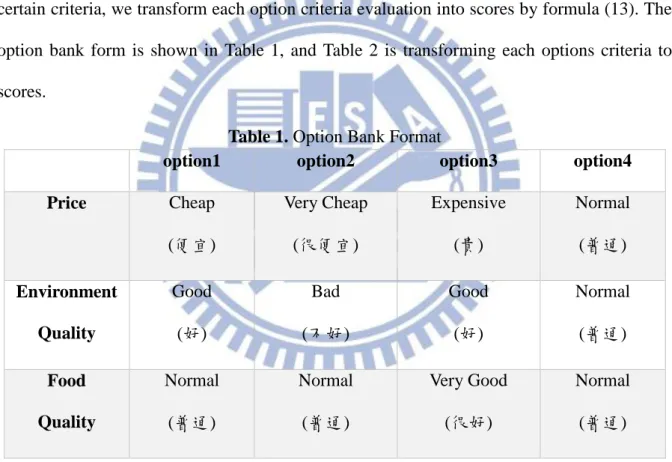
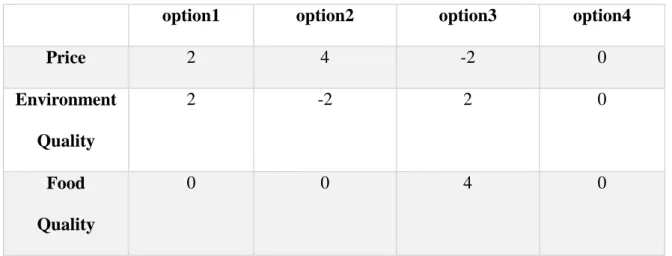
entertainment. There are a lot of evaluation on the Internet, so we use keyword to find several certain option comment from Facebook fans pages, blogger or forum post, and use CKIP system to separate each comment. Finally, according to option criteria, we extract evaluation of certain option criteria. For example, we want to find criteria evaluation of restaurant price, and then we get the evaluation such as cheap, reasonable or expensive. And we determine the evaluation of certain criteria with same adjective times which is certain option. For example, the times of food price criteria cheap 9 times, reasonable 4 times, expensive 1 time, we can judge that this food option price’s criterion is cheap. After having option evaluation of each certain criteria, we transform each option criteria evaluation into scores by formula (13). The option bank form is shown in Table 1, and Table 2 is transforming each options criteria to scores.
Table 1. Option Bank Format
option1 option2 option3 option4
Price Cheap (便宜) Very Cheap (很便宜) Expensive (貴) Normal (普通) Environment Quality Good (好) Bad (不好) Good (好) Normal (普通) Food Quality Normal (普通) Normal (普通) Very Good (很好) Normal (普通)
27
Table 2. Transform Options to Scores
option1 option2 option3 option4
Price 2 4 -2 0 Environment Quality 2 -2 2 0 Food Quality 0 0 4 0
Option expansion from discussion messages. We collect group discussion messages and
use CKIP to separate words in the messages. Then, we use term frequency (TF) to find the words that occur frequently in the messages. Each term is assigned a score based on their frequency, and we use the term with the highest frequency as a candidate option. When people frequently mention a term, it likely means that it is the subject of discussion, and has a high probability of being a candidate option. So we extract the option associated with this term and criteria evaluation from each group member, finally store it in our options bank for further extraction.
Discussion category initiation. In group discussion process, a hosted person will
determine group discussion topic. Therefore group member needs a hosted person to decide their discussion issue. The person who gathers group member can determine group discussion topic and our system recommends three options which are related to the setting topic for group discussion. For example, if a hosted person initiates that a topic is food category, our system will recommend three options from the food category option bank. Denote
( , )
i
c
CategorySim GC DB is category similarity between the hosted person of group and
database category, GC is the category score from the hosted person, and
i c
DB is category
28
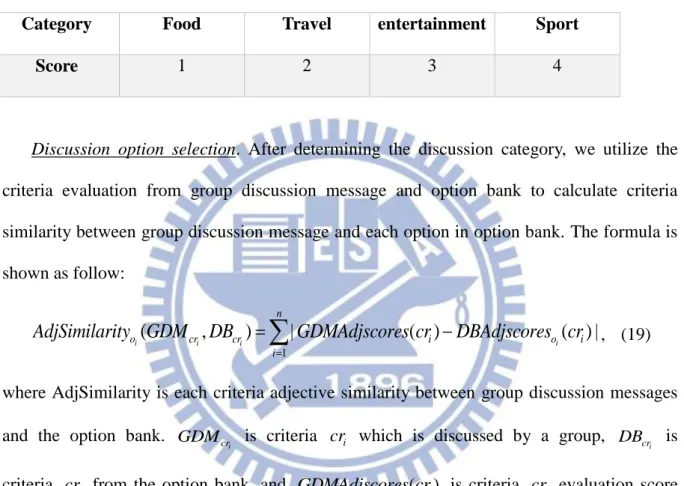
score ofci. We recommend the options by the minimum category score. Table 3 shows the
category score format.
( , ) | ( ) |
i i
c c
CategorySim GC DB Min GCDB .
Table 3. Category Score Format
Category Food Travel entertainment Sport
Score 1 2 3 4
Discussion option selection. After determining the discussion category, we utilize the
criteria evaluation from group discussion message and option bank to calculate criteria similarity between group discussion message and each option in option bank. The formula is shown as follow: 1
(
,
)
|
( )
( ) |
i i i i n o cr cr i o i iAdjSimilarity GDM
DB
GDMAdjscores cr
DBAdjscores cr
, (19)where AdjSimilarity is each criteria adjective similarity between group discussion messages and the option bank.
i cr
GDM is criteria cr which is discussed by a group, i i cr
DB is
criteria cr from the option bank, and i GDMAdjscores cr( i) is criteria cr evaluation score i
from group discussion messages, DBAdjscores cr( i) is criteria cr evaluation score from i
the option bank.
( ( , ))
i i i
o cr cr
Recommend Min AdjSimilarity GDM DB , (20) Finally we calculate recommend option score, if evaluation from group discussion message and option bank have high similarity, the recommend scores will be the minimum. So we recommend the option which have the minimum recommend scores.
29
3.3 Group Consensus Decision Engine
In the group consensus process, we observe each group member’s group influence power scores and discussion messages, then we consider two kinds of evaluation scores (social evaluation and social endorse) to generate option ranking list. The social evaluation score is generated using each group member’s evaluation on each option and the social endorse score is let group member endorse the options they want to purchase. Finally, we adjust each group member’s voting and evaluation weight by group influence power scores, and produce product ranking list. If consensus scores don’t exceed some threshold, the system will let group discussion continues again till scores exceed the threshold.
3.3.1 Social Evaluation Analysis
In social evaluation analysis, we observe each option criteria evaluation from each group member, and use their individual power score to generate social evaluation scores. We denote
, ( , )
i i
c o i k
SocialEvaScore m cr as an option oi’s score by aggregating each members evaluation
for each of the three criteria in categoryci. This scores also considers each member influence
power, denoted by ( ) i c i GIP m , ( ) i c i
GIP m is group member’s group influence power in
category ci scenario, ( , )
i
o i k
OS m cr is group member m ’s evaluation score for criteria k,i
k
cr , of option oi and J is set of option oi’s criteria.
, 1 1 ( , ) ( ) * ( , ) i i i i G J c o i k c i o i k i k SocialEvaScore m cr GIP m OS m cr
. (21)After calculating each option social evaluation scores, we use formula (5) to normalize each option social evaluation score.
30
3.3.2 Group Social Expression Analysis
In this part, we use a social expression method to calculate rating score from all group members. In the traditional condition, most of the rating methods treat each group member equally, so the weight of rating is same. But in the real world, our social influence power is always not equal. So we consider different weights to compute each group member’s rating score. Denoted VS(𝑜𝑖) as sum of all member rating scores with different social influence power, and GIP gm c( i, )i is group influence power between each group member, 𝑉(𝑜𝑖) is a rating score by all group members. If a member does not vote for any option, then their rating score will be assigned 0.5.
1 ( ) ( ) * ( , ) i n i i i i o VS o V o GIP gm c
, whereV o
( ) {0,0.5,1}
i
. (22)After calculating each option social rating scores we use formula (5) to normalize each option social rating score.
Finally, we combine social evaluation score and expression score to generate option ranking list. Denote OptionRankingScore o( )i as option oi’s final option score considering
the social evaluation and expression scores.
( )i ( ) (1i ) ( )i
OptionRankingScore o SocialEvaScore o VS o . (23) If OptionRankingScore o( )i is below a threshold, the mechanism will utilize ranking
list to get first option criteria and use the criteria to match option bank, then find a new option for group member to discussion.
31
CHAPTER 4 EXPERIMENTS
In this section, we execute an experimental study and verify the effectiveness of the proposed framework. The general idea of social decision mechanism is to generate a ranked options list according to the discussion of group members. We implemented the proposed mechanism on the most popular social network community, Facebook. According to a report form Statistic Brain [40], there are 1.3 billion active Facebook users. People commonly create a club to discuss or share information. A user is subscripted to averagely 80 groups. So Facebook provides one of the best platforms for implementing a social decision mechanism. Besides, Facebook provides a powerful application programming interface (API), so we can obtain social personal information, such as social relationship between two persons and personal preference from Facebook Pages.
In the experiment, we collect the discussions of the users joining the same Facebook Groups. According to [37], when people join the same groups in the online community, they have higher probability to get together and do some activities together in their real lives. Moreover, as reported by EZprice [14], in the case of group commerce, such as Groupon, 17life, and GOMAJI, the most frequent purchased categories are food, travel and shopping. So in this research, we consider three scenarios for members who are in the same group on Facebook to (1) discuss about what kind of restaurants to eat at, (2) discuss about where they want to travel and (3) discuss about what group product they want to purchase.
We utilize SAS that is an analytical tool to analysis the data with a personal computer that has core i7-4770 GHz CPU and 8 GB memory. When conducting the experimental process, we implement API on Facebook.
In the following sections, we will describe each procedures of data collection and the discussion of the experiment.
32
4.1 Experiment Process Flow
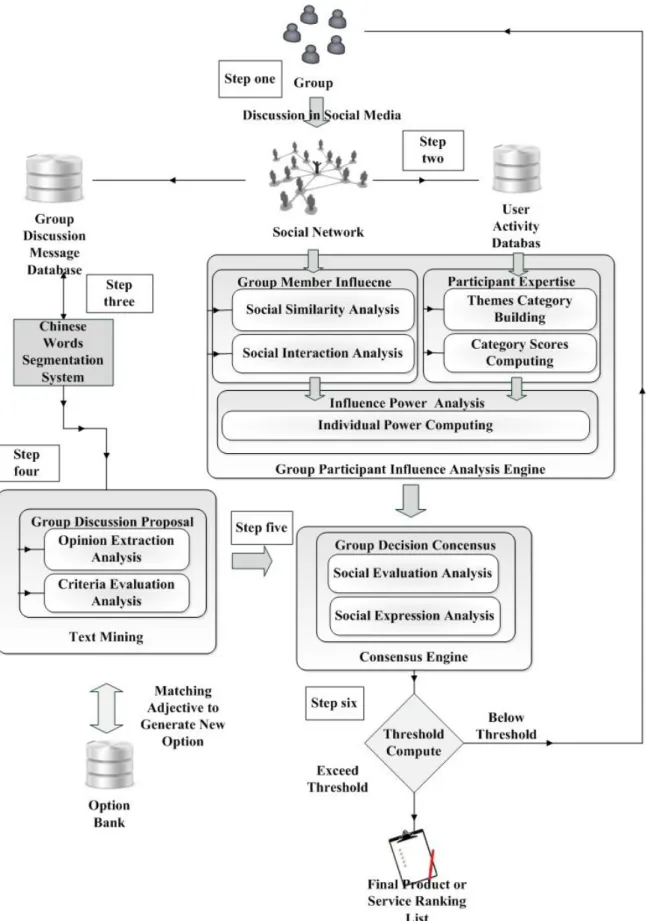
To implement our proposed mechanism, Facebook was selected to become our experimental platform and the main data source. The processes involved in the proposed mechanism are shown in Figure 6 and explained as follows.
33
34
Step one: we collect social network data of the group members, such as mutual
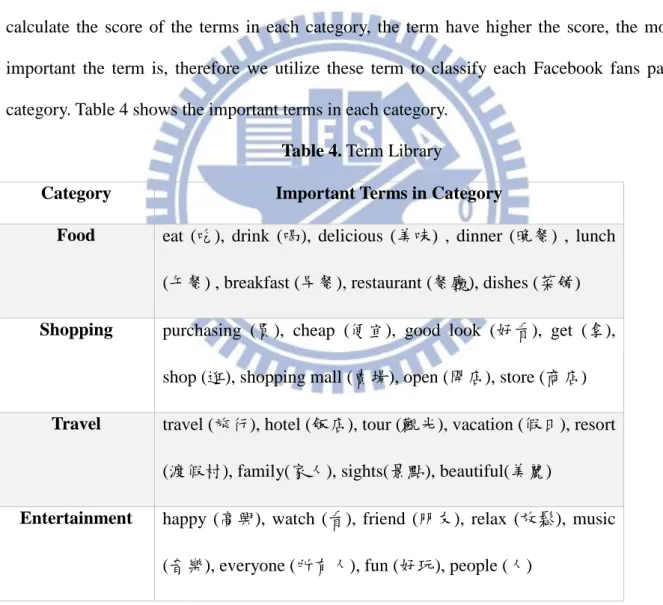
Facebook Club (Group) or their interactions and Facebook fans pages information by Facebook Graph API and FQL. Each Facebook fans page includes messages, which can be utilized to extract the important terms to classify Facebook fans pages category. Classifying Facebook fans pages “liked” allows us to analyze each group member’s expertise regarding each category. After collecting the training Facebook fans pages data, such as introduction and comment, we classify each fans page into the respective category. Then we used CKIP system to separate the data into words. Finally, we perform a method TF-IDF method to calculate the score of the terms in each category, the term have higher the score, the more important the term is, therefore we utilize these term to classify each Facebook fans page category. Table 4 shows the important terms in each category.
Table 4. Term Library
Category Important Terms in Category
Food eat (吃), drink (喝), delicious (美味) , dinner (晚餐) , lunch
(午餐) , breakfast (早餐), restaurant (餐廳), dishes (菜餚)
Shopping purchasing (買), cheap (便宜), good look (好看), get (拿),
shop (逛), shopping mall (賣場), open (開店), store (商店)
Travel travel (旅行), hotel (飯店), tour (觀光), vacation (假日), resort
(渡假村), family(家人), sights(景點), beautiful(美麗)
Entertainment happy (高興), watch (看), friend (朋友), relax (放鬆), music
(音樂), everyone (所有人), fun (好玩), people (人)
We let a person to organize a group by Facebook Club (Group) and decide their discussion topic. According to the topic category, our mechanism will recommend three
35
options from the option bank, which matches their discussion topic. There are three group decision scenarios: food (restaurant) category topic, travel (sight) category topic, and shopping (product) category topic. Figure 7 and 8 show this Facebook Groups invited interface.
Figure 7. Facebook Group Invited Interface Part 1
Figure 8. Facebook Group Invited Interface Part 2
Step two: because a group of people discuss with each other, they will be influenced by
36
group social influence between each group member and personal participant expertise in a certain category. Therefore, we compute group social influence and personal participant expertise scores, the expert member has the highest participant expertise scores in their group. Figure 9 is Group Discussion Message Interface. We will show all options, each criteria, group members, expert member on the interface.
Figure 9. Group Discussion Message Interface
Step three: for producing new options, we collect food restaurant comments from
online social community, such as blogger, forum and Facebook fans pages. We use CKIP Chinese words segmentation system to separate every Chinese words from online comment and utilize text mining method to get important words such as adjective and noun.
37
Step four: after collecting group discussion message, we also use CKIP system to
separate every Chinese words. Finally we transform those options adjective from online comment into scores and use the scores to matching option bankthat we created beforehand. The option bank format is shown in Table 5.
Table 5. The Option Bank Format
Price Food Quality Service Quality
McDonald's Cheap (便宜) Normal (普通) Normal (普通) KFC Cheap (便宜) Normal (普通) Good (好)
Pizza Hut Expensive
(貴)
Good (好)
Very Good (很好)
Step five: we let group member vote on the recommended options they discussed
previously. Then we will consider group social influence and participant expertise scores to adjust group participant’s voting weight. According to result of social ranking scores, we can generate a list of ranked options for group members and ask group members to rate their satisfaction on the list.
Step six: if social ranking score are below threshold, the proposed mechanism will let
group continue to discuss with a new recommended option for them. If the social ranking score exceeds threshold, the mechanism will stop discussion processing. Figure 10 shows the voting interface and Figure 11 shows ranking list generating interface.
38
Figure 10. Voting Interface
Figure 11. Ranking List Generated Interface
4.2 Data Collection and preprocessing
Data collection includes two parts: group discussion messages collection and social information collection.
In the part of group discussion message collection, our experiments have three scenarios mentioned earlier. Then system will suggest some option criteria to support discussion. In the food scenario, group members will get three restaurant options to discuss, such as McDonald's, KFC and Pizza Hut. In the travel scenario, group members need to discuss with