中國山水畫山石皴法合成技術之研究
研究生: 魏德樂
指導教授: 施仁忠 教授
國立交通大學 資訊學院 資訊工程學系
摘 要
電腦圖學自三十多年以來,追求逼真一直是不變的目標。所以各專家學者不斷研究 新的方法,以更接近真實與具物理特性的運作環境。而追求逼真的目標之餘,有些效果 卻是連真實世界都無法呈現的。藝術化視覺資訊在日常生活中也佔極重要的地位,它與 視覺資訊同為人類感官功能中所最常接觸的資料型態,而藝術化視覺資訊更能引發人類 的內心的感覺。當真實視覺資訊技術已逐漸成熟之時,近年來已有許多科學家研究印象 派畫家電腦自動產生技術,此即是電腦圖學的一分支領域所專注之處,有別於前者,此 領域名稱取為NPR(Non-Photorealistic Rendering)。NPR 的目標其中包括了模擬人類各種 繪畫風格,每年電腦圖學相關的國際研討會討論此領域技術之計劃也逐年以驚人的速度 激增,顯示此領域技術逐漸受人重視。 中國國畫具有悠久的歷史,我國傳統繪畫藝術之一,在世界美術領域中自成體系。 而山水畫於東晉時期萌芽,經一千六百多年眾名家不斷傳承創新下,累積了無數的技術 經驗。由於它的技法複雜、山川變化大、題材多,光是運筆用墨上,便需很多時間磨練。 在中國山水畫中,山石場景為首要的描寫對象之一,峯巒山石聯綴而成的優美律動,構 成生靈活潑、含蘊無窮之山水畫境。目前有許多NPR 的研究論文都著重在西畫的模擬, - i -譬如鉛筆、油畫或水彩等,這些研究已經為西部繪畫模擬出好結果。但這些方法不適合 中國水墨畫,通常西方繪畫需要更多的精確度,但中國墨水繪畫是比較抽象的。另外, 筆墨的模擬在中國水墨畫是主要的工作,包括水墨擴散,乾溼筆的順序和各種各樣的筆 觸大小和技術細節等,和西方繪畫的屬性完全不同。 在本論文中,我們提出「中國山水畫山石皴法合成技術之研究」。主要貢獻如下: 完成毛筆的模型,並控制墨的「水分」,讓其自然滲化、溶接,產生不同的墨色效果。 自動產生皴法的紋理,使用控制線及起始位置與結束位置,依山石的紋理以各種線條, 畫出石頭的質感或立體感。首先,我們將定義基本皴法的參數,包括用墨濃淡,墨的水 分多少,以及交錯的形式與方向等等。這些基本參數構成我們皴法筆觸的原型。我們可 以事先透過不同的參數組合,先完成一部份的皴法筆觸。我們得到向量化的資料之後, 就可以為皴法筆觸定義出起點以及終點。定義的方式當然可以自動,或是透過使用者完 成。有了筆觸的起點以及終點之後,自然筆劃的方向就大致確定。最後,起始點用淡墨, 終點用濃墨,再自動皴法筆觸,加以適合地動態調整,而形成我們所需要的一筆皴法。 同樣的原理將重複運用,直到整個水墨畫完成為止。這一套自動化的描繪過程首先擷取 三維山石模型的幾何形狀資訊,建立各類資訊的索引圖,從中分析以獲致描繪形狀與表 皮紋理(皴法)的參考依據,然後產生適當的勾勒筆觸,及變化豐富的皴擦渲染效果, 自動畫出俱山水畫風格的山川石岩,而成一幅幅引人入勝的山水畫作與具有中國水墨畫 風格的3D 動畫。 - ii -
The Synthesis of Rock Textures
in Chinese Landscape Painting
Student: Der-Lor Way
Advisor: Dr. Zen-Chung Shih
Department of Computer Science and Information Engineering
College of Computer Science
National Chiao-Tung University
ABSTRACT
Computer graphics-related research has focused on obtaining photorealistic images. However, photorealism is occasionally not the most effective means of visually expressing emotions. Accordingly, photographs can never entirely replace paintings. Non-photorealistic rendering (NPR) approaches have recently received renewed interest. Researchers have begun to study how a photograph or a photorealistic image may be made to look like a painting. In recently years, most research in NPR focused on Western painting. Lots of paintings algorithms have been proposed for convert a photorealistic image into an art form such as an oil painting or watercolor. Typically, such a painting style is created by applying masks or by placing user-defined patterns. These methods deliver good results for Western painting. But these approaches are not appropriate to Chinese ink painting. Generally, Western painting involves more precision but Chinese ink painting is more abstract. However, strokes in Chinese ink painting are in many aspects based on Chinese brushwork, including ink diffusion, pattern placing and describing details with various brush sizes and techniques.
Chinese ink painting stresses the notion of "implicit meaning" in which painters use a minimum amount of strokes to express their deepest feelings. Landscapes are one of the most important themes in Chinese painting. In the Tang dynasty, the range of subjects in painting expanded and landscape became established as a distinct category. Chinese landscape painting provided a more spontaneous style that captured images in abbreviated suggestive forms. Chinese landscape painting has been cultivated by masters through a long evolution into an exquisite art form.
To simulate the style of Chinese landscape painting is not trivial at all. It usually uses brushes and ink as mediums, values the expression of the artistic conception far beyond the precise appearance of the painted subjects. By means of the blending effects of brushes and ink, painters communicate their frame of mind to the viewers. This thesis proposes a set of methods to automatically create 3D animation of Chinese landscape painting. Rocks are the major painting objects in Chinese landscape painting. The given 3D models are drawn by outline rendering and texture generation, from information of the shape, shade and orientation of model’s surface. Many reference maps are constructed to analyze the information; create brush strokes for the outline and texture strokes. Finally, the target of the project will automatically create the still images and animations.
The main contribution of this investigation is the modeling and implementation of six major texture strokes for terrain surface using traditional brush techniques in Chinese landscape painting. The proposed rendering technique involves many fundamental parts. First, 3D terrain information is extracted to detect the edges of the silhouettes, and to generate streamlines and ridge meshes. The outline of a silhouette is then constructed and the streamlines of the texture strokes are generated. All control lines that involve the silhouette and streamlines then are projected onto a 2D viewing plane. Brush strokes then are applied to create an outline drawing and the texture of rock is captured using vertical or slanted strokes along the control lines with a rich ink tone specified by a luminance map. Finally, the ink diffusion on the rice paper is simulated.
Acknowledgements
First of all, I would like to show my gratitude to my advisor, Prof. Zen-Chung Shih for his patience and guidance. Also, I am grateful to all the members in Computer Graphics and Virtual Reality Laboratory for their useful suggestion and encouragement in these days.
It is hard to describe that my feeling is. I shuttle back and forth in the studies, the work and the family during these years. I would like to dedicate the achievement of this work to my wife Jean. Without her endless support, I couldn’t fully focus on my study. Special thanks to my mentor Ch'iu-Hsia Chang who always directs me the life-direction and helps my families. Finally, I also thanks to my father and my children. Without their unconditional love, I won’t finish it.
Contents
Abstract in Chinese
………... iAbstract in English
……….. iiiAcknowledgements
……….………...vContents
………viList of Tables
………...ixList of Figures
………... ...xChapter 1 Introduction ... 1
1.1 Non-Photorealistic Rendering ...3
1.2 Overview of Wrinkle Rendering Diagram...6
1.3 Organization of the Dissertation ...8
Chapter 2 Related Works ... 10
2.1 Ink Diffusion and 2D Brush Strokes ...10
2.2 3D Non-Photorealistic Rendering ...12
Chapter 3 Chinese Landscape Paintings ... 15
3.1 Properties of Chinese Ink Paintings ...16
3.2 Rock Texture Strokes (Ts’un) ...18
Chapter 4 Ink Diffusion Simulation ... 24
4.1 Discrete Paper Model ...25
4.2 Discrete Ink Model and Ink Flow...26
4.2.1 Water Particles ...26
4.2.2 Carbon Particles...27
4.3 The Moving Direction of Water Flow ...30
4.3.1 Gradient ...31
4.3.2 Absorbency ...31
4.3.3 Paper Texture...32
4.3.4 Inertia...33
4.4 Ink Diffusion Process ...34
4.4.1 Ink Diffusion Schema...34
4.4.2 Evaporation...36
4.4.3 Refilling Ink...37
4.4.4 Intensity of Paper Cells ...37
4.4.5 Experimental Examples...38
Chapter 5 Brush Stroke Generation... 39
5.1 Virtual Brush Model ...39
5.1.1 Motion Mechanism...41
5.1.2 Ink Effects...43
5.2 Vertical Stroke Technique...44
5.3 Slanted Stroke Technique ...46
Chapter 6 Texture Strokes Synthesis from 2-Dimension Picture ... 50
6.1 Texture Strokes Area...51
6.2 Distribution and Density...54
6.3 Stroke Length ...55
6.4 Crossing Angle ...55
6.5 Perturbation ...57
6.6 Experimental Results...58
Chapter 7 Texture Strokes Construction with 3-Dimension Terrain ... 61
7.1 Extracting 3D Information...61 7.2 Drawing of Outlines ...62 7.3 Generation of Streamlines ...63 7.3.1 Streamlines ...63 7.3.2 Ridge Mesh...65 7.3.3 Level of Detail...66
7.3.4 Brush Stroke of Streamlines ...67
7.3.5 Frame Coherence...67
7.4 Texture Stroke Rendering Procedure...69
7.4.1 Main Procedure ...70
7.4.2 Six Rendering Styles ...71
7.5 Experimental Results...78
Chapter 8 Conclusion and Future Works ... 82
Bibliograph ... 85
Appendix 中英文專有名辭對照表 ... 89
VITA ... 90
List of Tables
1.1 Comparing and Contrasting Photorealism and NPR ...4
5.1 The corresponding parameters of Figure 5.10...49
6.1 Stroke parameters of Figure 6.10 ...58
7.1 Performance measurements (sec) ...78
List of Figures
1.1 Surface wrinkle rendering diagram. ...9
3.1 The four treasures of Chinese ink painting...16
3.2 The capillary phenomenon ...18
3.3 The real ink diffusion effect ...23
3.4 Six Texture Stroke examples in actual Chinese landscape paintings by Liu...63
4.1 Three simulated ink diffusion image represent different kinds paper with different degree of absorbency value. ...26
4.2 An illustration to explain the phenomenon called “filter effect”. ...29
4.3 Determine directions of water flowing into neighboring papels ...30
4.4 Two illustrations are given to describe the water propagation influenced by capillary force and gradient of quantity of water...35
4.5 An example of Stroke segmentation. The stroke is divided into circular segments with their center positions on a given curve...36
4.6 Generated image of diffused ink drop in different step...38
4.7 (a)Actual ink diffusion image; (b)Simulated ink diffusion image...38
5.1 Virtual Brush Model ...40
5.2 Brush rotates to follow the moving direction. ...42
5.3 To generate contact region axes with linearly interpolation...42
5.4 Vertical Stroke ...44
5.5 Cardinal Curves with different t. (a) Hard rock’s contour (t = 0.2). (b) Soft rock’s contour (t = -0.5)...45
5.6 (a) Pressure on turning points = 0.6. (b) Pressure on turning points = 0.8...45
5.7 Slanted Strokes. ...46
5.8 Single Slanted Stroke...47
5.9 Pressure functions of axe-cut stroke...47
5.10 Ten slanted strokes and blending sample. ...48
6.1 Hemp-fiber texture strokes by Huang Kung-wang...51
6.2 Axe-cut texture strokes by Hsia Kuei ...51
6.3 The process of corner vertices adaption ...52
6.4 The texture strokes area and painting mesh...53
6.5 Two strokes generated by a knot. ...54
6.6 (a)Average length =8; (b)Average length =5...55
6.7 Orientation of strokes generated by a common knot depends on the α and β .56 6.8 Strokes with different α and β...57
6.9 Stroke areas and painting meshes of Figure 6.1 ...58
6.10 Resulting image of Figure 6.1 by our method...58
6.11 Resulting images of Fig. 6.2 by our method...59
6.12 Jungfraujoch-Top of Europe...59
6.13 Jungfraujoch-Top of Europe with axe-cut texture strokes...59 xi
6.14 “Titlis Mountain”, by Lin Yu-Shan...60
6.15 Imitate “Titlis Mountain”. ...60
6.16 Lan-Yan River in Taiwan; ...60
6.17 Lan-Yan River with hemp-fiber strokes. ...60
7.1 The reference direction Grref of an mesh F. ...64
7.2 An example of streamlines generation ...65
7.3 Examples of streamlines rendering with three different conditions ...67
7.4 The procedure of Hemp-fiber texture strokes...68
7.5 Examples of Hemp-fiber strokes in shaded area. ...71
7.6 Examples of Lotus-leaf strokes in shaded area...72
7.7 Examples of Axe-cut strokes in shaded area...73
7.8 Examples of Raindrop and Mi-Dot strokes in shaded area. ...75
7.9 An example of distance value between silhouette and boundary...76
7.10 An example of the boneless stroke by our method...77
7.11 (a)Streamlines. (b)Boneless Stroke...79
7.12 (a)Streamlines. (b) : Hemp-fiber, outline and boneless. (c) : Hemp-fiber, tree-dots and water’s wave line. ...80
7.13 Hemp-fiber stroke of Angel Island in different viewpoint. ...81
Chapter 1
Introduction
The realism is a major goal in computer graphics from 30 years ago. Computer graphics-related research has focused on obtaining photorealistic images. Over many years, the advocate of photorealism has conceived many methods and algorithms for synthetic image generation; the dominant form is based on the physical technology. These are discovered by physical world observation driving, in the light interaction by the surface and the object in the environment. The ray tracing and the radiosity are two powerful technologies in the photorealistic rendering. In both cases, the physical behavior of light is imitated to produce the best photorealism example in a hypothesized world.
Today, it is easy and powerful to construct a photo-realistic virtual world through many developed methods and graphic accelerator. However, photorealism is occasionally not the most effective means of visually expressing emotions. Accordingly, photographs can never entirely replace paintings. Non-photorealistic rendering (NPR) approaches have recently received renewed interest. Researchers have begun to study how a photograph or a photorealistic image may be made to look like a painting. In recently years, most research in NPR focused on Western painting. Many researches have addressed Western painting, including watercolors, impressionistic painting, pencil sketches and hatching strokes. Lots of
-painting-algorithms have been proposed for convert a photorealistic image into an art form such as an oil painting or watercolor. Recent research on non-photorealistic rendering has focused on modeling traditional artistic media and styles including pen-and-ink illustration and watercolor painting…etc. These methods deliver good results for Western painting. But these approaches are not appropriate to Chinese ink painting (水墨畫). Generally, Western painting involves more precision but Chinese ink painting is more abstract. To simulate the style of Chinese ink painting is not trivial at all. It usually uses brushes and ink as mediums, values the expression of the artistic conception far beyond the precise appearance of the painted subjects. By means of the blending effects of brushes and ink, a painter communicates their frame of mind to the viewers.
Chinese ink painting stresses the notion of "implicit meaning" in which painters use a minimum amount of strokes to express their deepest feelings. Landscapes are one of the most important themes in Chinese painting. In the Tang dynasty (唐朝), the range of subjects in painting expanded and landscape became established as a distinct category. Chinese landscape painting (山水畫) provided a more spontaneous style that captured images in abbreviated suggestive forms. Chinese landscape painting has been cultivated by masters through a long evolution into an exquisite art form.
-1.1 Non-Photorealistic Rendering
A few years ago, non-photorealistic rendering (NPR) began to keep a technical meeting to devote the artistic expression to supply the choice the form at the SIGGRAPH conference. This research frequently is the contrast to the photorealistic rendering. The term has become adopted by the computer graphics community to denote forms of rendering that are not inherently photorealistic. The terms expressive, artistic, painterly and interpretative rendering are often preferred by researchers of the field since they convey much more definitively what is being sought. The artistry, the fine arts and explanation rendering by the domain researcher frequently likes because they explicitly convey any to seek. The NPR early researcher concentrates their attention to imitate – the tradition artistic form reproduction to the natural medium, for example pen and ink, water color and oil on canvas. The natural medium imitation could be possibly considered a branch of NPR studies. But NPR provided a wider scope and the opportunity experiment for new artistic form, or because this artistic form could be the impractical creation uses the hand.
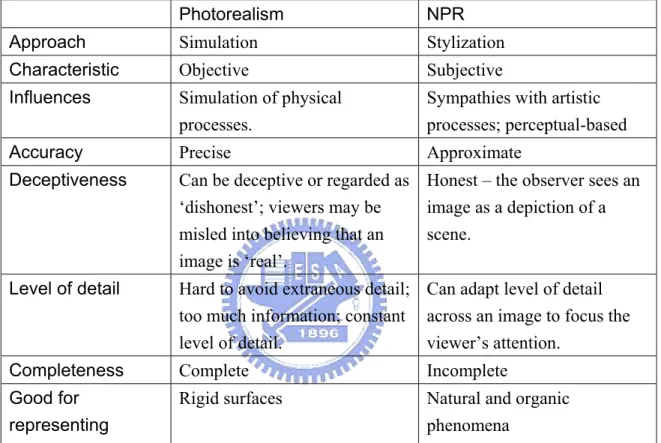
In contrast to photorealism, in which the driving force is the modeling of physical processes and behavior of light, the processes of human perception can drive NPR techniques. This can be just as demanding as physical simulation but for different reasons – a technologist may find comfort in developing algorithms to reproduce a certain physical phenomenon that is objective and relatively predictable. Developing techniques to replace, augment or even assist the subjective processes of an artist requires a shared understanding of the use to which these techniques will be put. The finest examples of NPR work will be produced when artists and technologists work together to identify a problem and develop solutions that are
-sympathetic to the creative processes. Table 1.1 provides a comparison of the trends of photorealism and NPR [53].
Table 1.1: Comparing and Contrasting Photorealism and NPR
Photorealism NPR
Approach Simulation Stylization
Characteristic Objective Subjective
Influences Simulation of physical processes.
Sympathies with artistic processes; perceptual-based
Accuracy Precise Approximate
Deceptiveness Can be deceptive or regarded as ‘dishonest’; viewers may be misled into believing that an image is ‘real’.
Honest – the observer sees an image as a depiction of a scene.
Level of detail Hard to avoid extraneous detail; too much information; constant level of detail.
Can adapt level of detail across an image to focus the viewer’s attention.
Completeness Complete Incomplete
Good for representing
Rigid surfaces Natural and organic phenomena
The NPR research was possibly considered early 2D interactive paint system. Researchers have developed these technologies including 2D brush-oriented painting involving more sophisticated models for brush, canvas, strokes, etc. Many researchers have developed renderings technology that can be applied to photographic images to synthesize painterly images. One of the key approaches that separate branches of research in the field is the degree to which user intervention is required. Some researchers have favored automatic techniques that require no or very limited user input, while others use the computer to place
-strokes at the guidance of the artist. 2½D paint systems have been developed in which augmented image data is used to automate paint actions initiated by the artist on pre-rendered scenes.
A more recent trend of NPR research has been the adoption of 3D techniques. The classic 3D computer graphics rendering pipeline exposes a number of opportunities within which NPR techniques can be applied to manipulate data in both 3D and 2D forms. A number of researchers have focused on providing real time algorithms for NPR which affords stylized visualizations of 3D data that can be manipulated interactively. The view-independence of some of these approaches provides obvious benefits for the generation of animation sequences.
During recent years, much research has addressed Western painting on Non-Photorealistic Rendering (NPR), including watercolors [3,11], impressionistic painting [16, 23], pencil sketches [37, 38] and hatching strokes [7,12,17,29,35,48]. These approaches deliver good results in western painting. However, these methods are inappropriate for Chinese ink painting. Chinese ink paintings typically comprise a few simple strokes intended to convey the artist’s deep feelings regarding the painted object. Simulating the style of Chinese landscape painting is challenging. The style includes free brush strokes, surface wrinkle and ink diffusion (水墨渲染) on the paper [1, 8, 24].
One skill used in Western painting is using hatching strokes simultaneously to convey the type of material, tone, and form [7, 12, 17, 29, 35, 48]. Hatching describes groups of strokes with a spatially coherent direction and quality. Stroke density controls the tone of the shading, while the character and arrangement of the strokes suggests a surface texture. In pen-and-ink illustrations, variable-density hatching and complex hatch patterns convey shape,
-texture and lighting. Texture strokes called “Ts’un” (皴法) in Chinese. However, the represented material differs from that represented by hatching. Texture strokes can be used to represent a rough, cracked surface. Ts’un in Chinese landscape painting is woven strokes that depict terrain textures. The main goal of this work is to develop a set of novel methods for rendering terrain wrinkles (texture strokes) in Chinese landscape painting. A specific 3D terrain model is drawn in outline (輪廓) and with texture strokes based on information on the shape, shade and orientation of the model surface.
1.2 Overview of Wrinkle Rendering Diagram
Landscapes have been the main theme of Chinese painting for over one thousand years. It is a form of non-photorealistic rendering. In Chinese landscape painting, rock textures convey the orientation of mountains and contribute to the atmosphere. Several landscape-painting skills are required to capture various types of rock. Over the centuries, masters of Chinese landscape painting have developed various texture strokes. The mature texture strokes may be divided into three groups: line, dot and plane. Chinese artists use many types of brushstrokes to depict nature. A painted of Chinese landscapes must understand both texture strokes and ink brush techniques. This thesis presents a set of novel methods for rendering rock textures in Chinese landscape painting. A 3D rock is drawn as an outline and texture strokes, using information on the shape, shade and orientation of the rock’s polygonal surface. This work also uses vertical (中鋒) or slanted (側鋒) brush strokes for drawing outlines and rock textures. The main contribution of this work is on the modeling and implementation of an integrated framework for rock texture rendering using traditional brush techniques in Chinese landscape painting.
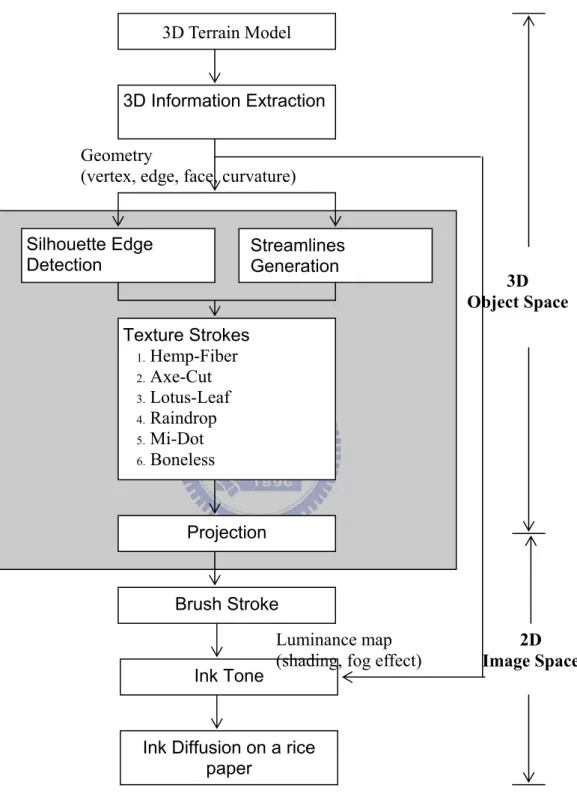
-This section describes the rendering of texture strokes and the use of the traditional brush technique to create primitive strokes. Figure 1.1 illustrates the process of producing texture strokes, which includes several basic elements:
(1) 3D information extraction: 3D terrain models rendered using OpenGL include vertices, edges, faces and so on. The luminance map is specified as ink tone (墨色濃淡) values. (2) Control line construction: a direction field on the surface is computed, silhouette lines are
detected and streamlines in 3D object space are generated.
(3) Projection: all control lines, silhouette lines and streamlines are projected onto a 2D viewing plane.
(4) Brush stroke: brush strokes are applied as outlines in the drawing, and the texture strokes are vertical or slanted strokes [45] following streamlines using a rich ink tone specified by a luminance map.
(5) Ink Diffusion: the motion of ink on rice paper (宣紙) is simulated [14].
Each part of the rendering diagram, shown in Figure 1.1, builds upon the others and is crucial for developing texture stroke rendering methods. This work focuses on simulating the six main texture strokes and builds upon our virtual brush with ink diffusion [14, 45, 46]. Users can easily choose a style of texture stroke and input parameters for controlling the desired effects. The proposed method then automatically completes the painting process.
The main contribution of this investigation is the modeling and implementation of six major texture strokes for terrain surface using traditional brush techniques in Chinese landscape painting. The proposed rendering technique involves many fundamental parts, illustrated in Figure 1.1. First, 3D terrain information is extracted to detect the edges of the silhouettes, and to generate streamlines and ridge meshes. The outline of a silhouette is then
-constructed and the streamlines of the texture strokes are generated. All control lines that involve the silhouette and streamlines then are projected onto a 2D viewing plane. Brush strokes then are applied to create an outline drawing and the texture of rock is captured using vertical or slanted strokes along the control lines with a rich ink tone specified by a luminance map. Finally, the ink diffusion on the rice paper is simulated [14].
1.3 Organization of the Dissertation
The rest of this thesis is organized as follows. Chapter 2 reviews works related to NPR. Chapter 3 then introduces the properties of Chinese ink painting and texture strokes used in Chinese landscape painting. Subsequently, Chapter 4 describes the process of ink diffusion in detail. Next, Chapter 5 shows the virtual brush model, the technique of vertical stroke and slanted stroke. Chapter 6 then demonstrates the texture stroke synthesis from 2-dimension picture using our proposed method. Chapter 7 shows six different rendering style of wrinkle onto the surface of 3-dimension terrain. Finally, Chapter 8 describes conclusions and suggests areas for future research.
-3D Terrain Model Silhouette Edge Detection Texture Strokes 1. Hemp-Fiber 2. Axe-Cut 3. Lotus-Leaf 4. Raindrop 5. Mi-Dot 6. Boneless 3D Information Extraction Streamlines Generation Ink Tone
Ink Diffusion on a rice paper
Geometry
(vertex, edge, face, curvature)
Luminance map (shading, fog effect) Projection Brush Stroke 2D Image Space 3D Object Space
Figure 1.1 : Surface wrinkle rendering diagram.
-Chapter 2
Related Works
2.1 Ink Diffusion and 2D Brush Strokes
Importantly, an artist can use thousands of styles to express his mental state while painting, using various brush storks and rich ink gradation. Ink diffusion is crucial in Chinese ink painting, and generates for example, the fluffy-edged effect, a variety of ink intensities, blurring the boundary of a stroke, the merging of two strokes, and other effects. Some particular techniques, such as, “dense brush following dilute brush” and the splashed ink painting (潑墨畫) technique are fairly important in Chinese ink painting.
Expressive brush strokes are the first requirement in Chinese landscape painting. Little research has addressed methods for simulating brush stroke and ink behavior. The brush has been simulated as a collection of bristles that evolve during a stroke. Strassmann [39] was the first to consider a hairy brush as a 1D array of bristles. Lee [19, 20] considered elastic bristles that obey Hooke’s law and described diffusion rendering of black ink paintings using new paper and ink models. Guo and Kunii [9, 10] first addressed ink diffusion in 1991. The diffusion of the ink into the absorbent paper is one of the most notable features of black ink
-painting (called ‘Sumie’ in Japanese). Zhang et al. [51] presented a 2D simple cellular automaton-based simulation of ink behavior. Furthermore, Saito and Nakajima [33] devised a 3D physics-based brush model that enables users to paint various strokes intuitively and directly on a computer with a pen-like input device. Xu et al. [49, 50] proposed a two-level hierarchical geometry model. They used three B-spline curves to control the three-dimensional brush geometry. Chu et al.[2] designed a 3D virtual brush model with ink depositing from brush to paper in real time.
Sousa and Buchanan [37, 38] focused on the technical aspects of physically simulating real media, including pencil, crayon, blenders and erasers. Watercolors have also been simulated. Small [36] proposed a parallel approach to predicting the action of the pigment and water on paper fibers. Curtis and Anderson [3] employed a more sophisticated paper model, a more complex shallow water simulation and more faithful rendering and optical composition of pigmented layers based on the Kubelka-Munk model, to simulate watercolors more realistically. Unfortunately, the properties of Chinese ink painting differ from those of watercolors. The physical behavior of watercolors differs from that of Chinese ink.
These papers proposed several methods for simulating brush strokes and the diffusion of ink. Although they realistically reproduced the diffusion of a single stroke, no mechanism has been presented to simulate the blending of two or more different kinds of brush strokes. Some results are unreasonable for Chinese ink painting. Accordingly, the simulated results in the above papers were not compared to real ink paintings.
This thesis presents a new method for simulating ink diffusion based on observation and analysis. The proposed method can simulate various expressions of tones on different types of paper. The elucidation of the effect of mixing simulated strokes made by different kinds of
-brushes is an important contribution of the method. Finally, the simulated results are compared with real ink painting.
2.2 3D Non-Photorealistic Rendering
This work is also related to research on 3D non-photorealistic rendering, [4, 13, 15, 16] including stylized line illustrations, artistic hand-drawn illustrations and hatching painting styles. Many studies have addressed the problem of generating silhouettes and high-quality hatching of static scenes. Markosian et al. [25] presented a randomized algorithm for locating silhouettes. Moreover, Winkenbach and Salesin [48] designed a method of rendering smooth surfaces with pen-and-ink. Salisbury et al. [35] introduced prioritized stroke textures with tone values that are mapped to the stroke arrangements, and presented impressive examples of computer-generated hatching. Furthermore, Sousa and Buchanan [37, 38] focused on the technical aspects of physically simulating real media, including pencil, crayon, blenders and erasers. Hertzmann and Zorin [12] generated high-quality silhouettes and established a scheme for placing image-space strokes for cross-hatching. Moreover, Lake et al. [17] described an interactive hatching system with stroke coherence in the image space. Finally, the method of Freudenberg [7] involved encoding a stroke texture as a halftone pattern.
Surface rendering using principle curvature directions has recently become an extremely popular technique for non-photorealistic rendering. Elberg [6] and Interrante used principal curvature directions for hatching. Curvatures normally provide good hatch directions. The most natural geometric candidate is the pair of principal curvature direction fields [6, 41]. Rössl et al. [30, 31, 32,] provided a new approach for automatically generating a direction field for the strokes. Discrete curvature analysis of such meshes permits the estimation of
-differential parameters. Curvature lines are then constructed and used as strokes. This work also designs a simple weighted technique that uses a reference direction generating smooth direction fields on a surface, which are suitable for generating streamlines for texture strokes of the surface of a terrain.
Freudenberg’s method involves encoding a stroke texture as a halftone pattern. The “height” of the corresponding location in the pattern is compared to each pixel’s target tone using a “soft” threshold function to shade a pixel. Emil Praun [29] described how prioritized stroke textures could be rendered efficiently using texture hardware by pre-computing a tonal art map (TAM).
In scientific and engineering applications, there is also a need to abstract other form-defining cues from a grid Digital Elevation Model (DEM). Visvalingam et al. [42, 43] showed the possibility of automatically abstracting a type of static 2.5D sketch called the profile-stroke (P-stroke) sketch. Lesage and Visvalingam [21] reviewed an image-based approach for deriving artistic sketches of terrain surfaces. Lesage and Visvalingam used a 3D visualization system for rendering luminance maps of different type of terrain, and compared four common image-based edge detectors for extracting the sketches. Although Lesage and Visvalingam reproduced pen, pencil and charcoal sketching styles that can be obtained by adjusting the grey scale and thickness of output primitives, unfortunately these styles of sketching differ from the properties of Chinese painting.
Sato et al. [34] extend their previous work to generate sumi-e like paintings of arbitrary objects from three-dimensional polygonal models. Their proposed method realizes three brush stroke (Kou, Ten, and Shun) techniques for generating landscapes paintings. A Kou stroke is generated for line drawing; a Ten stroke has the shape like a grain of rice, which is similar to
-dot stroke (Fig 1(d) (e)); a Shun stroke has the shape like a hemp-fiber stroke (Fig 1(a), 批麻 皴).
This thesis modeled the effects of brush strokes in traditional Chinese ink painting. That investigation simulated two fundamental brush strokes, namely vertical and slanted strokes. An interactive tool for painting two rock textures (hemp-fiber and axe-cut(斧劈皴)) on a 2D image was also presented. Furthermore, a method [14] of simulating the diffusion of ink on rice paper was provided. The proposed method was based on a physical mechanism and observational model of the interaction among real drawing materials used in Chinese ink painting and of the variation in ink diffusion in the real world. The method can simulate various tone expressions on different paper types. The effect of mixing strokes from different brush types was also simulated.
The main goal of this thesis is to develop a set of novel methods for rendering rock texture in Chinese landscape painting. A specific 3D rock model is drawn in outline and with texture strokes using information on the shape, shade and orientation of the model’s surface. The main contribution is the modeling and implementation of an integrated framework for rendering rock textures using the traditional brush technique in Chinese landscape painting. The proposed rendering technique involves four main stages. Figure 1 presents the procedure in detail. First, 3D information is extracted for rendering the rock texture. Secondly, the outline of the silhouette is determined. Third, the curvature direction field on the surface is computed and the streamlines for texture strokes are generated. Finally, brush strokes are applied as outlines in the drawing and the rock texture is captured by vertical or slanted strokes along streamlines with a rich ink tone referenced by shading value.
-Chapter 3
Chinese Landscape Painting
Chinese ink painting is a traditional art that is over three thousand years old. Chinese ink painting stresses the notion of "implicit meaning" in which painters use a minimum amount of strokes to express their deepest feelings. Chinese landscape painting plays a prominent role in Chinese ink painting. In Chinese landscape painting, rocks are major objects owing to their ability to create the mood of paintings. Artists use the Chinese character Ts’un, also meaning wrinkles, to represent texture strokes applied to rock formations. Over the centuries, masters of Chinese landscape painting developed various Ts’un techniques, which form the basis of an artist’s training. Chinese landscape painting with texture strokes is characterized by the following procedure:
1. An artist begins to visualize a land formation with external contours, which define the overall shape. Internal contour, as added to imply folds on the slopes, reveals the position and direction of the ridge and determines its volume.
2. After the internal contours are defined, texture strokes are applied in the area. 3. Texture stroke is used to symbolize the rock formation.
4. Finally, the brush moves along the path of the stroke and deposits ink on the rice paper.
-Of relevant interest is more thoroughly understand Chinese art by analyzing basic rules of Chinese painting. The application of the ink and brush is an essential element of landscape painting techniques. In the remainder of this chapter, the first introduction is the properties of Chinese ink and the four treasures. Besides, six major rock textures are also described in section 3.2.
3.1 Properties of Chinese Ink
Chinese ink painting uses four tools, commonly called the “four treasures“(文房四寶). Figure 3.1 depicts The Four Treasures - brush, ink stick (墨), ink stone (硯台) and paper. They are all used in calligraphy, writing and painting in China. The bristles of the brush touch the surface of the paper, and the ink in the bristles seeps into the highly absorbent paper, creating a stroke whose edge is fluffy and blurred. These characteristics of diffusion represent complex physical phenomena that cannot be accurately simulated by conventional graphical techniques such as texture mapping or degradation functions, since a purely mathematical method generally results in flatly blurred images that are unlike realistic diffusion images.
Figure 3.1: the four treasures of Chinese ink painting.
-The ink is a kind of colloidal liquid and diffusion phenomena can be considered as typical instances of the diffusion of a colloidal liquid in a highly absorbent paper. The capillary effect importantly causes ink to diffuse into the structure of the paper. Typical paper consists of fibers in random positions and directions; small holes and spaces among the fibers act as thin capillary tubes that carry water away from the area in which it is initially applied, causing diffusion.
Capillary phenomenon, a physical mechanism, is an important factor that causes the ink diffusion in the paper structure. In Figure 3.2, a thin tube is placed in a container filled with water with one end in the water and the other end in the air. The liquid will rise inside the tube and the liquid surface inside the tube is higher than the surface of the outside water. This phenomenon can also be observed in the ink diffusion in paper. The typical paper is composed of fibers which are positioned in random position and random direction in which small holes and spaces between fibers act as thin capillary tubes for carrying water away from the initial area, and create diffusion, as shown in Figure 3.3.
Figure 3.2 : The capillary phenomenon.
-Figure 3.3 : The real ink diffusion effect.
Besides the capillarity, the forces that move the ink include interactions among water molecules, water and carbons, and the force due to gravity, among others. The black ink is a dilute mixture of water and colloidal black carbon particles, which diffuse into paper in the absorbed water. Water and carbon are the two main constituents of Chinese ink and the motion of ink in the fibers as simulated as chaotic will be discussed in Chapter 4.
3.2 Rock Texture Strokes (Ts’un)
Rocks are primary objects in Chinese landscape painting because of their power to create the mood. Artists use the Chinese character TSUN, also meaning wrinkles, to represent texture strokes when applied to rock formations. Over the centuries, masters of Chinese landscape painting developed various TSUN techniques. In the Tang dynasty, the range of subjects in painting expanded and landscape became established as a distinct category. Chinese landscape painting provided a more spontaneous style that captured images in abbreviated
-suggestive forms. Chinese landscape painting has been cultivated by masters through a long evolution, into an exquisite art form.
The Chinese Ts’un depicts texture in Chinese painting. Ts’un represents a rough, cracked surface. Ts’un refers to woven strokes that depict the texture of rocks. According to “The Mustard Seed Garden” (芥子園畫譜), published in 1679, 19 texture strokes were recognized by the time of the Ching Dynasty (清朝). These texture strokes are the most important elements of Chinese landscape painting. Different kinds of texture strokes are used to represent different kinds of mountain. For example, granite mountains which always appear as squares or pyramids, are always painted using axe-cut strokes. Meanwhile, sedimentary mountains, which have a striated or layered texture, can be painted using hemp fiber strokes. Topographically, old flat lands are always painted using hemp-fiber strokes. When old lands rise up and are cut by rivers, they are treated as new and may be painted using axe-cut strokes. Moreover, young land that is eroded by rain and rivers and becomes softer can be painted using hemp-fiber strokes and lotus-leaf strokes (荷葉皴). All mature texture strokes may be divided into three groups, as follows.
1. Dot texture strokes, including raindrop strokes (雨點皴), Mi dots and half-bean strokes (豆瓣皴), among others.
2. Line texture strokes, including long hemp fiber strokes, short hemp fiber strokes, lotus leaf strokes and ox-hair strokes (牛毛皴), among others.
3. Plane texture strokes, including big axe-cut strokes and small axe-cut strokes.
Chinese artists use points, lines, planes and brushstrokes to depict nature. A painter of Chinese landscapes must understand both nature and ink brush technique. The proposed
-method simulates texture strokes, as will be discussed in greater detail in the chapter 6 and chapter 7.
In the development of texture strokes in Chinese landscape painting prior to the tenth century, the Chinese only used outlines to depict rocks and mountains, but they did not yet use texture strokes. Within the outlines, ink shading was applied. Later artists attempted to substitute ink shading for the texture strokes. Generally, texture strokes are applied using six techniques. Figure 3.4 shows these six kinds of texture strokes painted by Liu [24].
Hemp-Fiber Stroke (批麻皴)
Hemp-fiber stroke, shown in Figure 3.4(a), spreads and weaves like the fibers of the hemp from which it takes its name. The Hemp-fiber stroke is one of the most important strokes in Chinese landscape painting. Several texture strokes have been designed from the hemp-fiber strokes. The hemp-fiber stroke is a long line stroke painted with a dry vertical brush. Numerous long strokes are woven together in a pattern that frequently resembles a fishing net. This stroke imparts a rich, profound and soft feeling and is best used for depicting rough rock surfaces. Developed by the great Southern School master Tung Yuan
(907- 960 AD), the short hemp-fiber strokes were varied and generally favored by the literati painters, who dominated mainstream Chinese landscape painting, beginning with the emergence of the Four Masters of the Yuan dynasty (元四大家). The most important of the four Masters, Huang Kung-wang (1269-1354 AD, 黃公望), practiced the strokes in a loose, calligraphic fashion.
-Axe-Cut Stroke (斧劈皴)
The axe-cut stroke is a slanted stroke used in painting much like an axe is used to cut wood, shown in Figure 3.4(b). The axe-cut stroke is excellent for represent smooth cliffs and flat, planar rock surfaces. This stroke dominated Southern Sung (南宋) landscape paintings between the 12th and 13th centuries. Moreover, this stroke is ideal for depicting very hard rock. The axe-cut texture strokes developed earlier during the Sung dynasty (宋朝) by Li Tang (1049-1130 AD, 李唐). These simplified yet natural slanted brushstrokes depict earthen forms and hills. The stroke also effectively describes angularly shaped rocks of crystalline quality and sedimentary rocks displaying layered structures. The best-known exponents of the axe-cut strokes are Ma Yuan (馬遠) and Hsia Kuei (夏珪), associated with the Northern School of landscape painting, which particularly thrived in the Sung dynasty.
Lotus-Leaf Stroke (荷葉皴)
The lotus-leaf stroke was named owing to its similarity to the pattern of veins of lotus leaves, shown in Figure 3.4(c). These veins diverge and divide outwards from a central line many times. The lotus leaf stroke is used to represent mountain ridges or cracks in rocks and is always painted using a vertical brush.
Raindrop Stroke (雨點皴)
This stroke, Figure 3.4(d), is named after the rain because it resembles a raindrop that has just reached the ground. This stroke is also known as the sesame stroke, the thorn stroke or the bean stroke. This stroke is applied particularly in the foreground of paintings including
-several broken fragments of rock This stroke can be used to depict rocks that have been eroded, and thus have developed pockmarks and holes.
Mi-Dot Stroke (米點皴)
Mi-dot, Figure 3.4(e), is named after the artist who first used this kind of dot, Mi Fu (1051-1107 A.D. 米芾). This dot is particularly good for portraying cloudy mountains and rainy landscapes. This stroke is not only a texture stroke, but can also be used to depict a mountain forest containing several trees. These dots frequently appear horizontally, and therefore are also called horizontal dots.
Boneless Stroke (沒骨皴)
The boneless stroke, Figure 3.4(f), is always painted with a wet brush, using slanted strokes. The ink gradation is very soft and differs from other texture strokes which have a strong, hard feeling. This stroke is not good for depicting the texture of rocks, but can successfully provide a three-dimensional feeling and give form and substance to rock. This stroke is good present mountains are in the fog or in the mist.
(a)Hemp-fiber Stroke (b)Axe-cut Stroke
(c)Lotus-leaf Stroke (d) Raindrop Stroke
(e) Mi-dot Stroke (f) Boneless Stroke
Figure 3.4: Six Texture Stroke examples in actual Chinese landscape paintings by Liu [24].
-Chapter 4
Ink Diffusion Simulation
Simulating the behavior of Chinese ink is challenging work because ink moves in a complex manner. This thesis proposes a new method for simulating the diffusion of ink in paper. The method is based on a physical mechanism and an observational model of the interaction among real drawing materials used in Chinese ink painting and the variations in the diffusion of ink in the real world. The goal is to capture the core physical properties and behaviors to produce a high-quality ink diffusion model that a painter can use to generate a Chinese ink painting, including brush strokes, in various styles.
The proposed method has the following advantages. First, it simulates the physical behavior of ink diffusion, and can thus generate strokes that exhibit a feathery effect; second, it can blend two strokes with different thickness. Using this method to render a Chinese ink painting can generate highly realistic blending effect
-4.1 Discrete Paper Model
Several kinds of paper are used in Chinese ink painting. Basically, papers have one of two types of fiber mesh. The first kind is a regular fiber mesh, such as in silk paper, whose fibers are uniformly aligned as woven. The second kind is an irregularly distributed fiber mesh, such as in Hsuan paper that consists of a mesh of randomly positioned fibers.
Constructing a mesh like Hsuan paper requires an appropriate data format in which to represent a mesh structure. Traditionally, a network format is used to represent paper with a random fiber network [10]. The continuous interaction between water and fiber is discretely simulated by computers; a two-dimensional array, whose entries specify the attributes of the structure of the mesh, is used. The entire mesh in the paper is separated out into many layers, each of which are divided into [X×Y] cells called papels (paper element) [20]. A papel is a basic unit of paper structure and corresponds to a pixel.
Capillarity is evident in paper modeled as interlaced fibers. The ink seeps into the paper and is then pulled away from the area of application by capillary attraction; it then travels through the fibers. Some of the diffused ink is deposited in the holes or spaces between the fiber through which it passes; the remaining ink continuously flows along the fibers until it is completely absorbed.
Let Absorbency(p) of papel p be defined as follows. When the moving ink passes through p with N fibers, the amount of water deposited in p is Q. The relationship between Q and N can be expressed as Absorbency(p)∝N ∝Q. Based on this relationship, several models of paper can be defined with various absorbency, by fibers with various densities. An equation for the absorbency of each papel is,
-()
)
(
p
Base
Var
rand
Absorbency
=
+
×
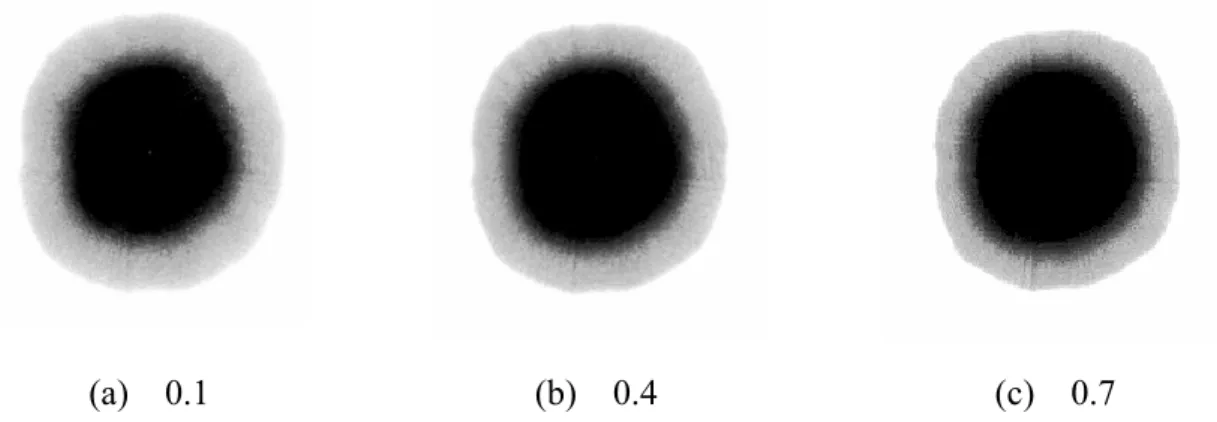
…. (4.1)Figure 4.1 depicts the resulting ink diffusion in three types of paper with different absorbencies. The coefficient of absorbency is a real number between zero and one.
(a) 0.1 (b) 0.4 (c) 0.7
Figure 4.1: Three simulated ink diffusion image represent different kinds paper with different degree of absorbency value.
4.2 Discrete Ink Model and Ink Flow
4.2.1 Water Particles
Water is a liquid which can move to anywhere in the paper under the forces associated with capillary action. All water particles are defined as objects with the same volume, mass, color and respond to forces. They only differ in position, recorded as coordinates in the papel. The quantity of water accordingly governs the span of the diffusion image or the number of diffusion steps. When the water in a certain papel flows out, its quantity and direction must be determined.
Based on above description, the approximate equation for K(p), the ratio of the quantity
-of out-flowing water to the quantity -of water in the papel p is represented as,
(
)
(
1 1 ( )2)
) (p F F Absorbencyp K = base + diff × − − , … (4.2)Where Fbase is a real number between zero and one that represents the basic flow rate p, and Fdiff is a real number between zero and one that represents the difference between the highest flow rate and the lowest.
The quantity of water that flows in all the directions to neighboring papels is determined by associated probabilities. Section 4.3 discusses the estimation of the probability associated with each direction of water flow.
4.2.2 Carbon Particles
A carbon particle is a black and solid grain. It cannot move by itself. When water particles move, carbon particles move with them. Carbon particles are suspended and move in this liquid since they collide with water particles. Suspended carbon particles undergo Brownian motion, buffeted water particles.
The carbon particles can be most simply simulated like water particles. They have mass, position, diameter and color. These attributes all vary among particles. The diameter and mass of a carbon particle are determined by the fineness to which the ink is initially ground. If the ink is initially ground coarsely, it contains small and large particles that produce observably different color intensities at the border of the initially brushed area. However, most homogeneous, small and uniform carbon particles move in water unhindered by the fibers, such the intensity changes smoothly over across the diffusion area.
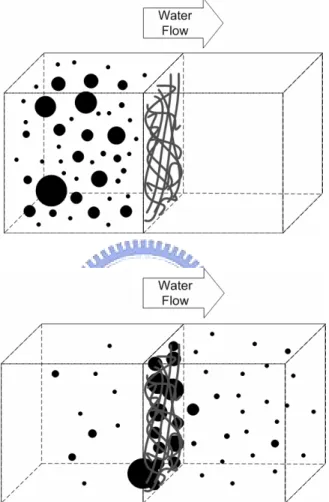
-Only carbon particles that are smaller than the space between the fibers can seep into the mesh in the water. Particles larger than the space remain in their initial positions, as shown in Figure 4.2. This phenomenon is referred to as the “filtering effect” of the fiber mesh, and can be represented as follows, where p is the papel in which the carbon particle is located.
if ( Carbon_Diameter > Hole_Diameter(p)) then Carbon_Position Å p
else
Carbon_PositionÅ Water_OutFlow_Direction(p)
In Figure 4.2, two adjacent cubes represent two neighboring papels. Black grains in papels are carbon particles with different sizes. It is chaotic between two papels represent fibers. The arrow represents the direction in which the water flows; the carbon particles move in this direction. Larger carbon particles cannot pass through holes in the paper.
As well as the diameter-filtering mechanism, a mass-filtering mechanism is proposed. Suppose is the velocity of a carbon particle c, suspended in water in papel p, and is the quantity of out-flowing water from p. The relationship between , and the diameter of holes in p, Hole_Diameter(p), is given by V
c V Wp c V Wp p c ∝W , 2 )) ( _ (Hole Diameter p Vc ∝ 1 0 ← V . If carbon particle c is too heavy to exit papel p and is deposited in p, then . Accordingly, an upper-bounded threshold for papel p determines whether the carbon particle can. If the
mass of carbon particle c exceeds then
c
p
T
p
T Vc ←0. The value of is determined by depending . The relationship between and is represented as,
p T c
V
Tp Vc ) )) ( _ ( ( ) ( 2 p Diameter Hole W T V T Tp = c = p × 1 , …… (4.3) 28-where T a transformation from
V
c to Tp.Figure 4.2: An illustration to explain the phenomenon called “filter effect”.
-4.3 The Moving Direction of Water Flow
Water may flow from one papel to some of its neighboring eight papels. The directions of this motion are determined by considering the following factors that dominate the flow of water.
1. Gradient of water between neighboring papels, based on Brownian motion. 2. Absorbency of neighboring papels for water.
3. Paper texture of neighboring papels. 4. Inertia of water.
Figure 5 shows that a papel C0 has eight neighboring cells defining eight directions, (k = 1, 2,, 8). The probabilities of motion in each direction are calculated according to the above four factors. The amount of water particles that flow into a neighboring papel is proportional to the calculated probability.
k
p
kd
Figure 4.3: Determine directions of water flowing into neighboring papels, (k = 1, 2, , 8), according to the probabilities in eight directions calculated based on four factors.
k
p
-4.3.1 Gradient
The motion of water particles in paper is assumed to obey Brownian motion. A mixture of two sets of different numbers of water particles will produce irreversible diffusion in which water particles are transferred from the set with more to that with fewer particles. This movement continues until the difference between the numbers of particles in the two sets reaches a value that expresses the balance of forces on these two sets. Gradient represents the difference between the numbers of water particles in the two sets.
The number of water particles in and are assumed to be and , respectively. The probability, based on Brownian motion, is determined by the equation,
0
c
p
kW
cW
k(
)
sum k G G =uWc −Wk ,∑
8(
)
……… (4.4) = − = 1 i i c sum uW W Gwhere is a probability determined by gradient. is the unit function; that is, if , then k G
u
(x
)
0
≥
x
u
(
x
)
=
x
, otherwiseu
(
x
)
=
0
.4.3.2 Absorbency
Attraction to each neighboring papel causes different amounts of water to flow into each. Newton’s Second Law of Motions is: fd =M×a (4.5)
The dynamic friction is ideally a constant force between the flowing water and the fibers. The term is the acceleration of the flowing water particles. Based on the theorem of Theo, is usually much smaller than
d
f
a
a g, the acceleration due to gravity. Therefore, it can 31
-be regarded as constant. M is the mass of the flowing water particles. The pre-defined uniformity of the mass of water particles is such that the amount of flowing water is proportional to M. Assume Nw is the number of water particles in the flowing water.
From Eqs. (4) and (5),
f
d∝
N
w×
a
.This important deduction indicates that increases with . Based on the relationship in Eq. (3),w
N
d
f
f
d∝
a
p Î , whereis the absorbency of papel
p
w
a
N
∝
p
a
p
. Assume that the eight neighbors of the central papelare , and the absorbency of and are and ,
respectively. Probabilities, based on absorbency, are attributed to the eight directions according to, 0
c
kp
c
0p
k Absorbency(c0) Absorbency(pk) sum k A A = Absorbency(pk) 8 1 ) ( i i p Absorbency A ,∑
…….(4.6) = = sumwhere
A
k (k = 1, 2,, 8) is a probability based on absorbency.4.3.3 Paper Texture
The texture of the paper also determines the directions in which the water flows. When water undergoes capillary action and flows in the holes among the fibers, fibers in the trajectory of the flowing water become saturated. Variously aligned of fibers promote different trajectories of the flowing water. Two kinds of paper exist – one with regular and the other with an irregular fiber mesh, such as silk paper and Hsuan paper, respectively.
Papers with differently distributed fibers have different textures. When the water
-particles in a papel
c
0 flow out,c
0 is the center of a 3× texture mask, 3 , with a central element at . The eight elements at the periphery of , (k = 1, 2, …, 8), are assigned weights to represent the alignment of the fibers.direct
M
0m
c
0M
directm
k4.3.4 Inertia
Besides the three aforementioned factors, inertia is involved in another important physical mechanism. According Newton’s First Law of Motion, inertia increases with the mass of an object. During painting, water is treated as a moving object. Assume that water in papel
in the (t)-th time interval originates from papels in the (t-1)-th time interval, and the quantity of water particles flowing in the direction , from to is . Based on the relationship between inertia and the mass of an object, water in will flow out in the same direction as . The probabilities associated with the eight directions of flow from
, , are proportional to the in direction .
t 1 − t 1 − t t−1 t 1 − t 1 − t
p
0 k p id
pk p0 t−1 k w p0 k w t p0 t k Iw
k t−1 i dThe probabilities are used to determine the directions of water flow. A higher probability of a neighboring cell corresponds to more water’s flowing into it. The probabilities
are, sum k k k k k R I m A G R =α1 +α2 +α3 +α4 t 8 , (7) where (k =
1, 2, …, 8) is the probability governed by four main factors for each neighboring papel and ) ( 1 2 3 4 1 t i i i i i sum G A m I R =
∑
α +α +α +α =R
k 1α
,α
2,α
3, andα
4 are weights that control the behavior and movement of water, resulting in different kinds of effects.-The directions of the water particles, the points in the mesh to which water will flow are determined using these probabilities. The quantity of water that flows to neighboring papel
(k = 1, 2, …, 8) is proportional to the probability .
k
p
R
k4.4 Ink Diffusion Process
The diffusion of ink in paper is complex. It can be regarded as a continuous and time-dependent. The evaporation of water and the absorption of any ink left on the surface of the paper are also considered.
4.4.1 Ink Diffusion Schema
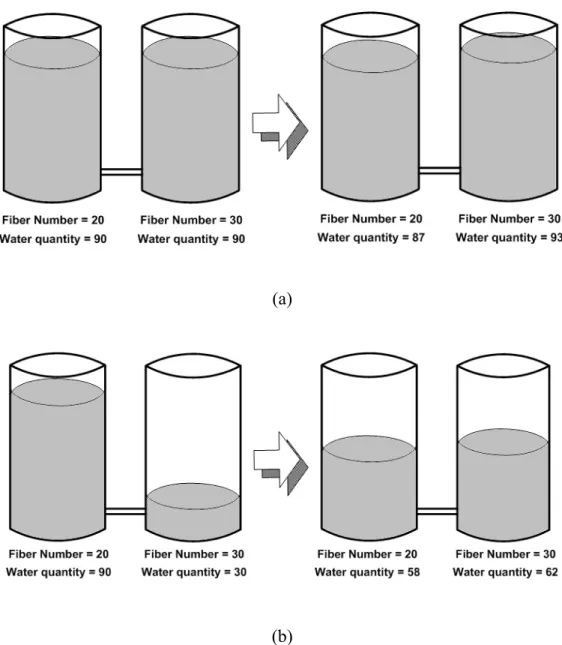
Ink diffusion is caused by the capillary action of water between fibers and the gradient of the quantity of water in paper cells. Given two neighboring papels saturated with water, as shown in Figure 4.4(a), as a rough estimate, only the strength of the capillary forces in these two papels influences the direction of flow of the water. In contrast, in Figure 4.4(b), only one papel is saturated with water and the other is absolutely dry. The water gradient between these two papels is maximal, resulting in an obvious propagation of water from the papel with much to the other with little.
-(a)
(b)
Figure 4.4: Two illustrations are given to describe the water propagation influenced by capillary force and gradient of quantity of water, relatively. Two containers with a pipe connecting to each other in this picture represent two adjacent papels.
Besides, three issues were addressed in simulating ink diffusion - brush strokes, initial area and propagation. The area on the surface of the paper touched by the brush is approximately circular, because the profile in the horizontal direction of the brush used in Chinese Ink Painting is round. The stroke is a sequence of circular segments shown in Figure 4.5. Ink in old segments starts to diffuse earlier than in new segments, and ink within old segments may even dry up. Stroke segmentation makes the simulation of the painting
-processes more realistic. The skeleton of a brush stroke area of the application of ink is just one line, and can be simply used to describe a brush stroke as a trajectory of the center of a circle.
Figure 4.5: An example of Stroke segmentation. The stroke is divided into circular segments with their center positions on a given curve.
4.4.2 Evaporation
In the real world, water evaporates continuously from paper. The evaporation of water is a complex process governed by many parameters. One important parameter is the area of contact with the atmosphere. When other parameters are fixed, a larger contact area increases the rate of water evaporation. Assume that the contact area of each papel with atmosphere is the same. The rate of evaporation from each papel is then approximately equal.
Important parameter humidity resists the evaporation of water. For simplicity, assume that the number of water particles evaporated from papel P ion the t-th step, , depends on the humidity H (0≦H≦1) according to the equation , where Water t p E p p h H Water Et = (1− )× ) (x h
1
0
p is the number of water particles in papel P, and function yields a coefficient for
the evaporation of water, where
≤ x
≤
.-4.4.3 Refilling Ink
When the brush’s bristles first touch the initial area, the paper does not completely absorb the ink pulled out by capillary action from the bristles in a single time step. The rates of absorbency and capillary action are not sufficiently high to prevent ink from remaining on the surface of paper. Some of this remaining ink saturates a papel in the next time step. This phenomenon of saturation by remaining ink, called ink refilling, occurs continuously in the subsequent time steps. Ink refilling is promoted by adding ink to the papels in the initial area stepwise at a certain rate until the remaining ink on the surface of paper has been exhausted.
4.4.4 Intensity of Paper Cells
A papel contains water particles and carbon particles. Water particles are achromatic. Carbon particles are defined as absolutely black. On the gray scale, each carbon particle is zero. Accordingly, the color intensity of the paper is determined by the color of the fibers of the paper and the density of carbon particles. Assume C is the number of carbon particles in papel P, and the maximum capacity of the carbon particles of P is Cmax. The color intensity CIp in P
can be calculated from P
c CIp ⎟⎟− ⎠ ⎜⎜ ⎝ − × = max 1
255 ⎛ c ⎞ , P = 255−PIp where PIp is the original
color intensity of paper.
-4.5 Experimental Results
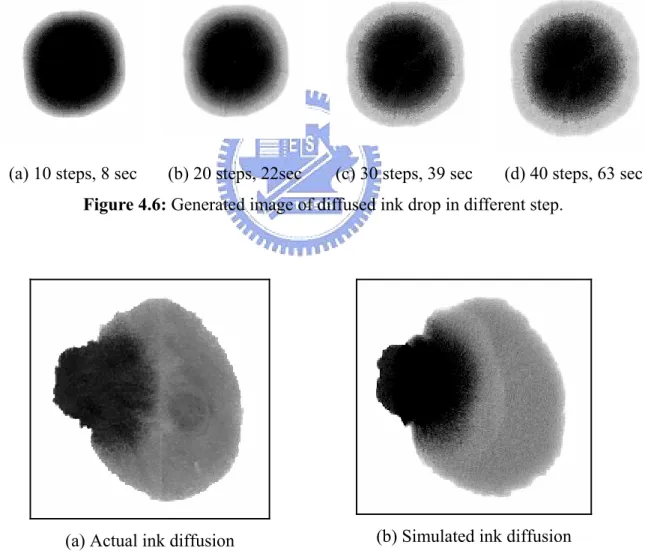
The proposed method yields several results. Figure 4.6 shows the simulated dropping of ink onto Hsuan paper. The time required for the simulation is also given. Figure 4.7 depicts an example of the basic blending of two brush strokes. The process of “dense brush following dilute brush” is described as follows. After a dilute brush stroke is applied to the paper, a dense brush stroke is immediately applied to the same area, before the first stroke has dried.
(a) 10 steps, 8 sec (b) 20 steps, 22sec (c) 30 steps, 39 sec (d) 40 steps, 63 sec Figure 4.6: Generated image of diffused ink drop in different step.
(a) Actual ink diffusion (b) Simulated ink diffusion
Figure 4.7: (a) Actual ink diffusion image on Hsuan paper, (b) Simulated ink diffusion image.
-Chapter 5
Brush Strokes Generation
A beginner in Chinese painting must learn some technical terms and make a preliminary study of brush techniques. A stroke may be light or heavy. When drawing a line, a painter may half-lift the brush such that only the tip touches the paper, to make a swift and thin line. He may, as the subject requires, press the tip of the brush onto the paper to make a thick, heavy line. Sometimes, he stops and changes the direction of the line, inserting a break into the brush-stroke. A line may therefore look smooth or rugged or may even include some blank spaces, deliberately made by not putting enough ink onto the brush-tip. Various brush-strokes suggest different textures. Two fundamental brush strokes, the vertical stroke and the slanted stroke, are simulated.
5.1 Virtual Brush Model
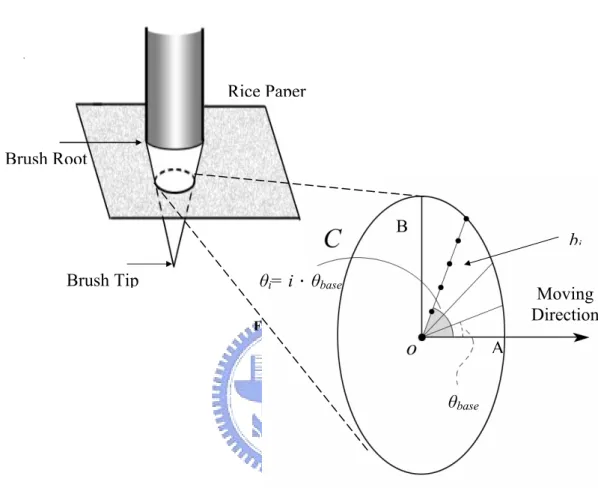
The application of the brush is an essential element of landscape painting techniques. Brushwork is very important in Chinese ink painting. A brush consists of a bundle of bristles. Where the brush contacts the rice paper, the footprints of the bristles form a contact region.
![Figure 3.4: Six Texture Stroke examples in actual Chinese landscape paintings by Liu [24].](https://thumb-ap.123doks.com/thumbv2/9libinfo/8048900.162292/35.892.147.787.160.1026/figure-texture-stroke-examples-actual-chinese-landscape-paintings.webp)