國立高雄大學亞太工商管理學系碩士班
碩士論文
知覺利益與競爭強度對公司聲譽和反傾銷答辯決策之
影響
The Impact of Perceived Benefits and Competitive
Rivalry on Reputations for Toughness and Anti-dumping
Rebuttals Decision
研究生:吳欣怡 撰
指導教授:陳一民 博士
誌 謝
首先誠摯的感謝指導教授陳一民博士,用心、細心的教導使我得以順利完成 這本論文,不時的討論並指點我正確的架構與方向,使我在這兩年中獲益匪淺。 老師的博學多聞以及對學問的嚴謹更是我輩學習的典範。本論文的完成另外亦得 感謝劉信賢副教授的大力協助,有您精闢指導問卷的設計及分析,並提供專業的 建議,使得本論文能夠更完整且嚴謹。感謝口試委員鄧穎懋副教授,您對於此研 究上的專業見解與建議更是使本論文更臻完備。 其次,對於我的同門夥伴韋樺、慧婷,感謝妳們這一路走來的扶持與鼓勵,很 榮幸與妳們共同度過這些一起努力、成長的時光,相信未來回想起來都別具意義。 亞太系碩二的諸位同窗,在這兩年的日子裡,不管是課業、學術上的討論,或是 課外的休閒娛樂,相當感謝你/妳們的陪伴與幫忙,過程雖然艱辛,但有你/妳們 的陪伴讓兩年的研究生活變得絢麗多彩。另外,在此也感謝亞太系 EMBA 碩士 在職專班 L103 的朝琴大哥、正祥大哥、小捲姊姊以及其他大哥、大姊們,幫忙 發放問卷以及互相討論與鼓勵,是本論文完成的重要關鍵。 最後要將這份榮耀與喜悅給予我的家人,我的爸爸、媽媽、弟弟與姑姑,在 這些日子裡不斷的給我鼓勵往前邁進,支持我帶給我最大的動力。 完成了這本論文後,我更肯定了自己的能力,同時也覺得自己非常幸福與幸 運,能夠得到這麼多人的幫助。對於所有給予幫助的人,本人一切銘記在心,十 分感激。 吳 欣 怡 謹 誌 於 國 立 高 雄 大 學 民 國 一 百 零 五 年 六 月 I知覺利益與競爭強度對公司聲譽和反傾銷答辯決策之
影響
指導教授: 陳一民 博士 國立高雄大學亞太工商所 學生: 吳欣怡 國立高雄大學亞太工商所 摘要 為了保護國內產業不受國外競爭者的威脅,企業會尋求法律上的貿易障礙 (如:反傾銷法)來阻止國外競爭者進入市場。現存的文獻也提供許多理論基礎關於 反傾銷保護措施帶來的利益,且多以國內企業的角度探討。然而,反傾銷控訴可 被視為價格競爭的強烈信號裝置,對於本國企業與國外競爭者皆有重大的影響。 基於訊息不對稱理論,這項研究探討國外競爭者將如何回應反傾銷控訴,以 及在什麼條件下,國外競爭者會積極做出反傾銷答辯。本研究採用實驗設計法, 藉由高階管理者的回應找出決策過程的標準。結果表示: 價值創造透過知覺利益 影響公司對聲譽的堅韌傾向,而產品生命週期階段也透過競爭強度影響公司對聲 譽的堅韌傾向,最後公司對聲譽的堅韌傾向影響了反傾銷答辯的決定。這項研究 不僅提供了更完整的反傾銷答辯架構,同時也使我們透過反傾銷答辯的情況下描 繪出管理者的行為準則。 關鍵字:反傾銷答辯、價值創造、知覺利益、公司聲譽、競爭強度、產品生命週 期階段 IIThe Impact of Perceived Benefits and Competitive
Rivalry on Reputations for Toughness and
Anti-dumping Rebuttals Decision
Institute of Asia-Pacific Industrial and Business Management Advisor: Dr. Yi-Min Chen
National University of Kaohsiung
Institute of Asia-Pacific Industrial and Business Management Student: Hsin-Yi Wu
National University of Kaohsiung
ABSTRACT
In order to protect domestic industries from foreign competition against, incumbents seek support for legal or regulatory barriers such as anti-dumping laws that prevent the entry of foreign competitors. The existing literature offer a theoretical rationale of creating trade barriers to competition that supports the benefits of seeking anti-dumping protection from the perspectives of domestic petitioning firms. However, anti-dumping measures would affect domestic firms and foreign competitors, and it can be considered a strong signaling device of price competition.
Based on the information asymmetry theory, this study explores how foreign competitors respond to anti-dumping petitions in the process, and under what conditions foreign competitors should actively respond to anti-dumping investigations. This study uses an experimental design method to find out the decision criteria from managers’ reaction. The results show that both
anti-dumping rebuttals’ value creation and the stages of the product life cycle separately that influence the propensity of reputations for toughness through perceived benefits and competitive rivalry, and thereby affecting the rebuttals’ decision. This study not only provides a more comprehensive framework on anti-dumping rebuttals decisions, but also enables enterprises to formulate managers’ codes of conduct from the perspective of anti-dumping rebuttals circumstance.
Keywords: anti-dumping rebuttals; value creation; perceived benefits; reputations for
toughness; competitive rivalry; stages of the product life cycle
Table of Contents
摘要 ... II
ABSTRACT ... III Table of Contents ... V List of Figures ... VIII List of Tables ... IX
Chapter One Introduction ... 1
1.1 Research Background ... 1
1.2 Research Motivation and Purposes ... 3
1.3 Research Process ... 6
Chapter Two Literature Review ... 8
2.1 Anti-dumping (EU against Asia) ... 9
2.2 The Propensity of Reputations for Toughness and Anti-dumping Rebuttals .... 12
2.3 Value Creation Based on Transaction Costs and Perceived Benefits ... 13
2.4 Perceived Benefits and The Propensity of Reputations for Toughness ... 14
2.5 Stages of The Product Life Cycle and Competitive Rivalry ... 15
2.6 Competitive Rivalry and The Propensity of Reputations for Toughness ... 16
Chapter Three Research Methodology ... 17
3.1 Research Framework ... 17
3.2 Methodology ... 18
3.3 Situation Design and Survey Procedures ... 19
3.3.1 Experimental Design ... 19
3.3.2 Survey Procedure ... 23
3.4 Measures and Measure Validation ... 23
3.5 Reliability of Questionnaire ... 26 V
3.6 Sample Data ... 28
Chapter Four Empirical Results ... 30
4.1 The Causation between Value Creation and Perceived Benefits ... 30
4.1.1 The Result of The Causation between Value Creation and Perceived Benefits ... 31
4.2 The Causation between Product Life Cycle and Competitive Rivalry ... 32
4.2.1 The Result of The Causation between Product Life Cycle and Competitive Rivalry ... 33
4.3 The Causation between Value Creation, Product Life Cycle and The Propensity of Reputations for Toughness ... 34
4.3.1 The Result of The Causation between Value Creation, Product Life Cycle and The Propensity of Reputations for Toughness ... 35
4.4 The Causation between Perceived Benefits, Competitive Rivalry and The Propensity of Reputations for Toughness ... 36
4.4.1 The Result of The Causation between Perceived Benefits, Competitive Rivalry and The Propensity of Reputations for Toughness ... 38
4.5 The Causation between The Propensity of Reputations for Toughness and Anti-dumping Rebuttals Decision ... 38
4.5.1 The Result of The Causation between The Propensity of Reputations for Toughness and Anti-dumping Rebuttals Decision ... 39
4.6 Discussion ... 40
Chapter Five Conclusions and Implications ... 43
5.1 Conclusions ... 43
5.2 Managerial Implications ... 44
5.3 Theoretical Implications ... 45
5.4 Limitations ... 46
5.5 The Suggestions for Future Research ... 46
Reference ... 48
Appendix ... 53
Questionnaire A-New product stage / High value creation ... 53 VI
Questionnaire B-New product stage / Low value creation ... 57 Questionnaire C-Standardized product stage / Low value creation ... 61 Questionnaire D-Standardized product stage / High value creation ... 65
List of Figures
Figure 1-1 EC anti-dumping cases during 2008-2012 ... 1
Figure 1-2 The flow chart ... 7
Figure 2-1 EC anti-dumping cases against ASEAN during 2008-2015 ... 10
Figure 2-2 EC anti-dumping article 5 investigation ... 11
Figure 3-1 The conceptual hypothesized model ... 18
Figure 4-1 The model of hypothesis H2 ... 31
Figure 4-2 The result of hypothesis H2 ... 31
Figure 4-3 The model of hypothesis H4 ... 32
Figure 4-4 The result of hypothesis H4 ... 33
Figure 4-5 The model of rebuttal’s value creation, product life cycle and the propensity of reputations for toughness ... 34
Figure 4-6 The result of the causal relationship between rebuttal’s value creation, product life cycle and the propensity of reputations for toughness ... 35
Figure 4-7 The model of hypothesis H3 and H5 ... 37
Figure 4-8 The result of hypothesis H3 and H5 ... 37
Figure 4-9 The model of hypothesis H1 ... 39
Figure 4-10 The result of hypothesis H1 ... 39
Figure 4-11 Path diagram of manager’s decision-making process ... 42
List of Tables
Table 3-1 The measurement of competitive rivalry ... 24
Table 3-2 The measurement of propensity of reputations for toughness ... 25
Table 3-3 The measurement of perceived benefits ... 26
Table 3-4 Cronbach’s Alpha of each construct of questionnaire ... 27
Table 3-5 Demographics of the sample ... 29
Table 4-1 Path diagram of perceived benefits ... 31
Table 4-2 Path diagram of competitive rivalry ... 33
Table 4-3 Path diagram of reputations for toughness ... 35
Table 4-4 Path diagram of the propensity of reputations for toughness ... 37
Table 4-5 Path diagram of anti-dumping rebuttals decision ... 39
Table 4-6 The result of hypothesized model ... 41
Chapter One Introduction
1.1 Research Background
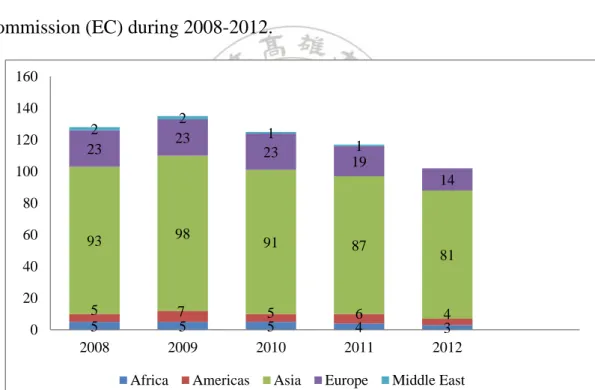
Under the trend of globalization, many countries focus on the enlargement of international trade. However, in order to protect domestic industries from foreign competition, incumbents seek support for legal or regulatory barriers such as anti-dumping laws that prevent the entry of foreign competitors (Baron, 1997). Figure 1-1 shows the number of anti-dumping cases in European Commission (EC) during 2008-2012.
We can see that the number of EC anti-dumping cases are more than 100 every year. This result represents that an increasing number of countries are aware that anti-dumping measures not only have defensive characteristics, but
5 5 5 4 3 5 7 5 6 4 93 98 91 87 81 23 23 23 19 14 2 2 1 1 0 20 40 60 80 100 120 140 160 2008 2009 2010 2011 2012
Africa Americas Asia Europe Middle East
Figure 1-1 EC anti-dumping cases during 2008-2012
Source: 21st Century Business Herald, Data From:WTO
also are an effective weapon to protect the domestic market while promoting fair competition. In this way, firms may utilize anti-dumping petitions to create international trade barriers and increase competitive advantages in market competition (Marsh, 1998; Schuler, 1996). Some benefits can be gained from the anti-dumping petition review process, for example, domestic firms can reduce the threat from foreign competitors by creating barriers to foreign competition through the imposition of an anti-dumping duty (Marsh, 1998). Previous scholars also point out a theoretical rationale of the strategic thinking of creating barriers to competition that supports the benefits of seeking anti-dumping protection from the perspectives of domestic petitioning firms (D’Aveni, 1994; Porter, 1985). However, anti-dumping petitions would affect domestic firm and foreign competitors, and it can be considered a strong signaling device of price competition. The existing literatures on anti-dumping petitions focus on the effects of improving firms’ performance from the perspectives of domestic firms, rather than those of foreign competitors.
On the other hand, in order to gain benefits from pursuing anti-dumping protection, domestic firms may be induced to invest in corporate political activities. Some management literatures also mention that the influence of institutional environment may affect the performance of the enterprise (Shaffer et al., 2000). In this way, domestic firms may involve in lobbying and campaign contributions, thereby promoting corporate interests and agendas over broader public interests (Hadani & Schuler, 2013; Lee & Baik, 2010; Lenway, Jacobson, & Goldstein, 1990). Over these researches, we can understand the importance of corporate political activity, and know how domestic firms influence government policy through corporate political
activities. Based on this, we research previous studies and build up our research frame for proving the benefits of anti-dumping protection.
1.2 Research Motivation and Purposes
How do foreign competitors manage the process of responding anti-dumping petitions? How do foreign competitors respond to anti-dumping petitions? In previous studies, anti-dumping investigation and corporate political activity are from the perspectives of domestic firms, but less from those of foreign competitors. However, Porter (1980) points that firms can influence the behaviors of other firms through the release of information. Based on the information asymmetry theory, some scholars point that firms practice corporate political activity is the context characterized by information asymmetry and institutional constraints between multiple actors (Baumgartner, Berry, Hojnacki, Kimball, & Leech, 2009; Hadani & Schuler, 2013; Hansen, 1991; Hart, 2004). For this reason, we can claim that the information asymmetry and considerable causal ambiguity such as government policy will affect the actions and outcomes of practicing an anti-dumping activity between domestic petitioners and foreign competitors. Therefore, this study expects to explore how foreign competitors respond to anti-dumping petitions in the process, and under what conditions foreign competitors should actively respond to anti-dumping investigations.
A firm builds its own reputation via past operations. There are many literatures found the beneficial effects of building a positive reputation for performance in economics, sociology, and strategy fields (Shapiro, 1983; Rao,
1994; Roberts & Dowling, 2002; Shamsie, 2003). Moreover, a growing body of research argues that good corporate reputations have strategic value for the firms that possess them (Dierickx & Cool, 1989; Rumelt, 1987; Weigelt & Camerer, 1988). Therefore, firms have to attach importance to its reputation, with the strategic advantages of being ‘tough’ in the context of entry deterrence (Kreps & Wilson, 1982; Milgrom & Roberts, 1982), a firm’s reputation for toughness in patent enforcement will significantly reduce spillovers otherwise anticipated from employee departures to rivals (Agarwal, Ganco & Ziedonis, 2009). In addition, corporate reputations for toughness are particularly powerful in curbing knowledge outflows to entrepreneurial firms (Agarwal et al., 2009). According to the view of the above literature on corporate reputations for toughness, this study infers that when a foreign competitor faced with ambiguity and information asymmetry in the anti-dumping petitions, foreign competitor’s reputation for toughness will be particularly powerful in anti-dumping rebuttals, and foreign competitor will actively respond to anti-dumping investigations.
Although there are theoretical rationale of reputations for toughness and the product life cycle to support foreign competitors in seeking anti-dumping rebuttals, entrepreneurs still looking forward to the impact of negative rulings would be most significant for their firms after actively engaging the anti-dumping rebuttals. For example, the negative anti-dumping decision of the final determination by the European Commission (EC) or U.S. International Trade Commission (U.S. ITC) can enable foreign competitors benefit from an elimination of the anti-dumping duty, and will also increase market share. However, it may average take 1-2 years to complete the review process of an
anti-dumping petition on. The long-term and sustained period could lead to costly legal bills (Marsh, 1998). Unless the benefits resulting from a negative ruling outweigh the costs, people would not expect foreign competitors to actively respond to the anti-dumping investigations and incur the additional costs of the rebuttals. Therefore, Foss (2005) develops the concepts of the tradeoffs between value creation and transaction costs. In this sense, we will apply this view to explore that under which conditions, foreign competitor will choose to actively engage in anti-dumping rebuttals in favor of their benefit and value creation.
This study contributes to the following literature streams, and we expect to achieve the purpose of below:
(1) Chen, Liu, Liu, and Huang (2015) call for examination of the mechanism of the intellectual property rights’ value creation based on transaction costs in patent litigation. This study is related to anti-dumping rebuttals through value creation based on transaction costs. Therefore, this study extends their research field and provides evidence of the positive impact of premium products’ value creation based on transaction costs of anti-dumping rebuttals through perceived benefits.
(2) This study builds on reputation effects in corporate strategy. While previous studies indicate firms can enhance performance by developing reputations for being toughness (Agarwal et al., 2009; Roberts & Dowling, 2002). In this way, we extend previous research and know that foreign competitors can also garner strategic advantages by developing reputations for being tough on anti-dumping investigations.
(3) Based on the literature on anti-dumping (Marsh, 1998) and information asymmetry theory (Baumgartner, Berry, Hojnacki, Kimball, & Leech, 2009; Hadani & Schuler, 2013; Hansen, 1991; Hart, 2004), this study raises the possibility that responding action confers reputations for toughness and product life cycle that shape anti-dumping rebuttals, thus revealing a source of asymmetry among anti-dumping review process. (4) This study also broadens Chen, Ni, Liu, and Teng’s (2015) formulation
of managers’ codes of conduct in regard to legal astuteness. We can
observe managers’ codes of conduct from the perspective of anti-dumping rebuttals contexts.
1.3 Research Process
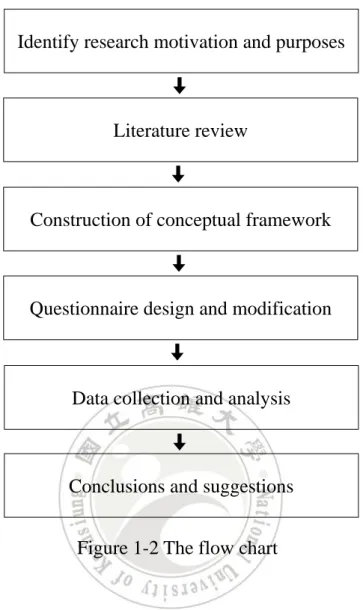
The remainder of this study is organized as follows. The next section we provide the conceptual model associated with the propensity of reputations for toughness, value creation based on transaction costs, perceived benefits, stages of the product life cycle, and competitive rivalry. We explore the relationships between each construct, and discusses the impact of the effects on anti-dumping rebuttals. Next, we will develop related hypotheses through related literatures, and present our research methods to examine the conceptual model. We gathered data from enterprise managers of Taiwan, using situation questionnaire. The results of path analysis are then presented, followed by the conclusions and implications. The flow chart is depicted in Figure 1-2.
Figure 1-2 The flow chart
Identify research motivation and purposes
Literature review
Construction of conceptual framework
Questionnaire design and modification
Data collection and analysis
Conclusions and suggestions
Chapter Two Literature Review
Dumping is, in general, a situation of international price discrimination, where the price of a product when sold in the importing country is less than the price of that product in the market of the exporting country. Article VI of GATT 1994, explicitly authorizes the imposition of a specific anti-dumping duty on imports from a particular source, in excess of bound rates, in cases where dumping causes or threatens injury to a domestic industry, or materially retards the establishment of a domestic industry. The past few decades, many countries have increasingly turned to the use of anti-dumping policy to provide protection for import-competing industries (Blonigen&Prusa, 2001). Moreover, previous scholars witness an explosion of anti-dumping petitions and investigations in the United States (Marsh, 1998). Why did the quantity of anti-dumping cases surge? This study argues that the surge in case filings and negative anti-dumping decisions by the EC or U.S. ITC at the final determinations stimulates active anti-dumping rebuttals that strengthen the bargaining power of foreign competitors, and intensify efforts by firms to capture value from innovation-related investments. In this sense, it could indicate that there are potential reputation effects of these anti-dumping rebuttals acts. However, existing literatures do not mention this issue, leaving a gap that this study proposes to fill in. This study follows up the strategy and economics literature on corporate reputations for toughness (Agarwal et al., 2009; Kreps & Wilson, 1982; Milgrom & Roberts, 1982; Shamsie, 2003) to systematically investigate the effects of reputations for toughness that induce foreign competitors to respond anti-dumping rebuttals. Viewing the current
active anti-dumping rebuttals (i.e., proving that the products are innovative products, not dumping products) as a general reputation-building strategy for foreign competitors. Therefore, the following will describes the anti-dumping (EU against Asia) and the hypotheses.
2.1 Anti-dumping (EU against Asia)
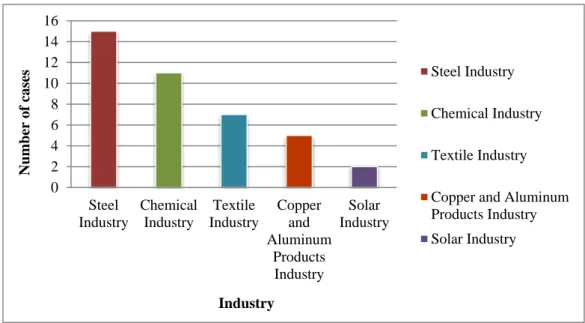
Based on the Figure 1-1, the number of EC anti-dumping cases during 2008-2012, we can see that the EU anti-dumping target are mainly from Asian countries over the past few years. The WTO assessment report indicates that the main anti-dumping measures against imports from Asia, especially China. Furthermore, the number of anti-dumping measures against Asian countries accounted for 74% share during 2008-2012. The WTO assessment report also indicates that steel industry and chemical industry have been the most affected industries by trade remedies. According to the EC Anti-dumping case, we compile the EC anti-dumping cases against ASEAN during 2008-2015 as follows (see Figure 2-1). From this, we can see that EU anti-dumping mainly targeted at the steel industry and chemical industry in ASEAN, consistent with WTO report results, and followed by the textile industry, copper and aluminum products industry, and ceramics industry.
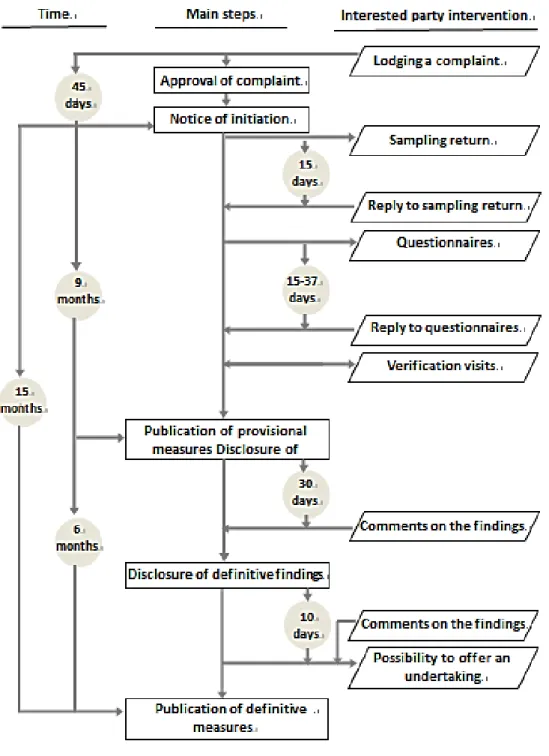
The European Commission alleges that the average length of the EU anti-dumping measures is seven years, and approximately 17% of the anti-dumping measures will be executed more than 10 years. However, according to the EC anti-dumping article 5 investigation (see figure 2-2), it may averagely take 15-20 months to complete the review process of an anti-dumping investigation. Overall, once the anti-dumping investigation start, it will take a long time, and produce significant cost on the company.
0 2 4 6 8 10 12 14 16 Steel Industry Chemical Industry Textile Industry Copper and Aluminum Products Industry Solar Industry N u mb er o f ca ses Industry Steel Industry Chemical Industry Textile Industry Copper and Aluminum Products Industry Solar Industry
Figure 2-1 EC anti-dumping cases against ASEAN during 2008-2015
Source: European Commission
Figure 2-2 EC anti-dumping article 5 investigation
Source: European Commission
2.2 The Propensity of Reputations for Toughness and
Anti-dumping Rebuttals
Corporate reputation is a general organizational attribute that reflects the extent to which external stakeholders see the firm as ‘good’ and not ‘bad.’ (Weiss, Anderson & MacInnis, 1999). However, foreign competitors can build a corporate reputation for being tough in the anti-dumping rebuttals by protecting its innovative products in the context of anti-dumping investigations. The protection of proprietary technology well adequately as a trade secret or by a patent can bring the increasing returns to the firm (Teece, Pisano, & Shuen, 1997).
Therefore, we build up this research on reputation effects in corporate strategy. Just like firms can garner strategic advantages by developing reputations for being tough in patent enforcement (Agarwal et al., 2009), this study follows up this view and claims that foreign competitors can enhance performance by developing reputations for being ‘good’ in anti-dumping investigations, such as providing favorable evidence. On the other hand, many managers engage in explicit reputation-building activities in order to improve their firms’ reputations (Fombrun, 1996). Just as much recent work emphasizes the benefits of being ‘good’ –either as a socially responsible corporate citizen or as a high-quality producer (Roberts & Dowling, 2002), this study infers that reputation-building investments for foreign competitors can lead to actively responding anti-dumping rebuttals and can reap benefits under two conditions. One is the investing foreign competitor need to have an advantage( e.g., favorable evidence) over its domestic rivals, and the other is foreign competitor must demonstrate a credible commitment to following through with the
reputational strategy, regardless of a domestic rival’s actions (Carlton & Perloff, 2005). For the reason that this study makes the following hypothesis:
H1: The propensity of reputations for toughness will have a positive impact on foreign competitors’ anti-dumping rebuttals.
2.3 Value Creation Based on Transaction Costs and
Perceived Benefits
For domestic firms with high exit costs and/or high downsizing costs, anti-dumping petitions may gain a larger net benefit when compared with other strategies that create barriers for foreign competitors (Marsh, 1998). Marsh (1998) suggests that U.S. ITC decisions influence security prices. In this way, domestic firms may suffer considerable loss in security prices, market value and potential costs from negative rulings at the final stage of the process. In contrast, foreign competitors may benefit more from negative rulings and actively engaging anti-dumping rebuttals. Thus, this study expects that foreign competitors would increase their market value, based on the transaction costs of the anti-dumping rebuttals.
We want to explore whether variation in value creation based on transaction costs in the situation of anti-dumping investigations affects foreign competitors’ perceived benefits to actively engage anti-dumping rebuttals. Accordingly, this study makes the following hypothesis:
H2: The foreign competitors’ value creation based on transaction costs from anti-dumping rebuttals will have a positive impact on their perceived benefits.
2.4 Perceived Benefits and The Propensity of Reputations
for Toughness
Once the preliminary and final determinations is affirmative, the imposition of the anti-dumping duty will affect all the firms in an industry, but the effects on individual firms may differ due to each firm’s strategy and competitive position (Porter, 1985). On the contrary, negative rulings of anti-dumping investigations leading to an elimination of the anti-dumping duty may also affect both domestic firms and foreign competitors in different ways. For example, negative rulings bring about direct benefits such as an elimination of the anti-dumping duty and indirect benefits such as winning reputation back to foreign competitors (Marsh, 1998).
In this sense, this study infers that the increased perceived benefits from the anti-dumping investigations would positively influence the propensity of reputations for toughness in the anti-dumping rebuttals for foreign competitors. Accordingly, this study makes the following hypothesis:
H3: In the context of anti-dumping investigations, the foreign competitors’ perceived benefits will have a positive impact on their propensity of reputations for toughness.
2.5 Stages of The Product Life Cycle and Competitive
Rivalry
Anderson and Zeithaml (1984) indicate that the product life cycle is likely a contingency variable during strategy formulation. In addition, Hofer (1975) develops descriptive propositions for each stage of the product life cycle, and environmental and organizational characteristics provide a major strategic influence on each stage. In order to reflect different product development/pricing positions relative to competition, this study uses Vernon’s (1966) three stages of product life cycles (i.e., new product, maturing product, and standardized product) to compare the nature of competition between the new product and standardized product stages. For example, strategies for new product stage focus on the target customer and product development, building on the newness of product and the rate of technological change in product design (Hofer, 1975). On the other hand, standardized product stage emphasize competitors’ focus and pricing policy, building on lower product cost and intensive competition (Anderson & Zeithaml, 1984; Vernon, 1966).
In the traditional economics literature, scholars mention that intensive competitive rivalry is a matured or standardized market characterized by high excess capacity, high sunk costs, and sustained price competition beyond perfectly competitive levels (Scherer & Ross, 1990). In this sense, this study suggests that the nature of competition at different product development stage positively influences different competitive rivalry. Therefrom, this study makes the following hypothesis:
H4: While product development is important during the new product stage, competitive rivalry is more urgent during the standardized product stage.
2.6 Competitive Rivalry and The Propensity of Reputations
for Toughness
Many studies spanning economics, strategy, and organization theory emphasize on why firms imitate (Lieberman & Asaba, 2006), what firms choose to imitate, and under what conditions does imitation erode the advantage of the innovator (Ethiraj & Zhu, 2008). In this way, this study considers that shift in the nature of imitation lead to different competitive rivalry. For example, hiring employees from rivals enables established firms to learn about external technologies more efficiently and, conversely, hastens the speed of imitation and increases the degree of competitive rivalry (Levin, Klevorick, Nelson & Winter, 1987).
Danneels (2011) suggests that in highly intense competition market some firms indeed want to aggressively protect their proprietary products, and often respond to anti-dumping investigations directly. Thus, viewing active anti-dumping rebuttals as a general reputation-building strategy, the purpose of this study is to examine the environmental characteristics such as intensive competitive rivalry that result in reputations for toughness for foreign competitors.
H5: For foreign competitors, highly intensive competitive rivalry will have a positive impact on their propensity of reputations for toughness.
Chapter Three Research Methodology
Based on the literature review, this study builds the hypothesized model to measure these five variables, including the propensity of reputations for toughness, value creation on transaction costs, perceived benefits, product life cycle and competitive rivalry, and explore how these variables affect anti-dumping rebuttals decision. This chapter is divided into five sections. First and second sections are research framework and research methodology. In the third section, this study explains the experimental situation and survey procedure. Sequentially, we adopt prior studies to separately develop the questionnaire items for measuring the competitive rivalry and the propensity of reputations for toughness. Finally, this study shows the reliability of questionnaire and sample data.
3.1 Research Framework
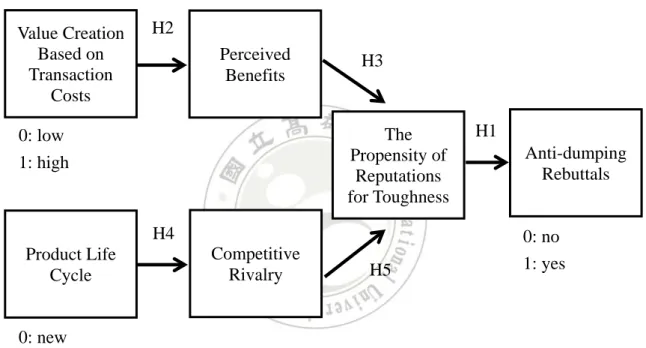
This study examines the impact of anti-dumping rebuttals decision with quantitative way, and validate the hypothesis from past literature. The research framework (Figure 3-1) is mainly developed from five variables. We infer that the propensity of reputations for toughness will have a positive impact on foreign competitors’ anti-dumping rebuttals (hypothesis; H1). In terms of perceived benefits, the foreign competitors’ value creation based on transaction costs from anti-dumping rebuttals will have a positive impact on their perceived benefits (hypothesis; H2). In addition, the foreign competitors’ perceived benefits will have a positive impact on their propensity of reputations
for toughness (hypothesis; H3). Regarding the competition intensity, we consider that while product development is important during the new product stage, competitive rivalry will be stronger during the standardized product stage (hypothesis; H4). We also infer that, for foreign competitors, highly intensive competitive rivalry will have a positive impact on their propensity of reputations for toughness (hypothesis; H5).
3.2 Methodology
In order to make the reaction practices of domestic firms and foreign competitors as an inference for strategy choice when manager face the anti-dumping petition, we will use an experimental design to find out the decision criteria from participants’ reaction. The experimental design method
Value Creation Based on Transaction Costs The Propensity of Reputations for Toughness Anti-dumping Rebuttals Perceived Benefits Competitive Rivalry Product Life Cycle H1 H3 H2 H4 H5
Figure 3-1 The conceptual hypothesized model
0: low 1: high 0: new 1: standardized 0: no 1: yes 18
is a good way to explain the correlation of each construct. So, in order to clarify whether the stages of the product life cycle and the value creation based on transaction costs influences the propensity of reputations for toughness through competitive rivalry and perceived benefits, and thereby influences the anti-dumping rebuttals decisions, this study uses an experimental design to examine the above hypotheses. In addition, we use characterization and properties of each construct to develop the questionnaire question to increase the authenticity of the situation.
By the way of respondents to fill up the questionnaire about anti-dumping investigation situation, we can understand the possibility that managers use rebuttal in the anti-dumping investigation, and provide the solution direction about anti-dumping investigation in the future.
3.3 Situation Design and Survey Procedures
3.3.1 Experimental Design
This study design is a 2x2 between-subject design and divided into four scenarios questionnaire. The between-subject experimental design consisted rebuttal’s value creation (high versus low) and stages of the product life cycle (new versus standardized). The questionnaire uses a five-point Likert scale that is from strongly disagrees to strongly agree. The questionnaire has three parts in this study and all details are described below (full content of the questionnaire please refer to appendix).
(1) Pure scenario
In this part, the purpose is to understand how the managers react the anti-dumping investigation with intuition when they were not reminded any external factors. In the pure scenarios, all participants read the same situation as follows.
Imagine you are an executive in a publicly-traded company named Company X which produces special screws. Company X recently launches a special screw, which can be used in many high level consumer market, such as high level dental implant. The Company X’s procurement and manufacture costs for this special screws are relatively low, therefore the selling price are cheaper compared to other competitors’. However, your competitor, Company Y, believes your product is dumping, so it files a dumping petition to the U.S.ITC (United States International Trade Commission). The U.S.ITC soon launches a dumping investigation on your product, and decides to impose the anti-dumping duty for your product. Now the sales volumes of Company X has decreased by 20%.
You do not believe Company X’s special screws are dumping products, so you are considering whether to proceed the anti-dumping rebuttal. At this moment, as a top executive of Company X you are considering the relevant market potentials (e.g., dental implants) for the special screws industry, but also worrying about the impact of the dumping investigation. In addition, a general anti-dumping rebuttal petition takes about 2-3 years. Therefore, you have to evaluate whether you should proceed this anti-dumping rebuttal.
If you choose the “To rebuttal” strategy, the cost and benefit are as followings: First, anti-dumping rebuttal will increase business costs (e.g.,
identification of re-investigation costs, evidence collection, attorneys' fees, and lawsuit costs… etc..). Second, if the rebuttal is successful, company X can enhance its reputation on its excellence, innovation and leading position, and gain the competing advantage. Third, during the rebuttal period, the human and financial resources can be dispersed, which may lead to delay in R&D and the launch of the new products. Finally, if the rebuttal is successful, the company gets full refund and the paid anti-dumping duty will be withdrawn. The profit and the market share will also increase.
On the other hand, if you choose the “Not to rebuttal” strategy, the cost and benefit are as followings: First, there are no additional attorneys' fees and rebuttal expenses. Second, not rebuttalling will decrease company X’s reputation on its excellence, innovative and leading position. Third, the R&D will not delay. Finally, Company X will have to pay the anti-dumping duty and it will affect the company's revenue and market share in the future. It may also indirectly affect the stock price.
(2) Scenario with conditions
In this part, participants will be given the different information across these four scenarios. In order to manipulate the independent variables, four scenarios are exactly similar, except that the stages of product life cycle and rebuttal's value creation vary. For example, the new product stage/high value creation scenario is described as follows.
As the executives of Company X, you decide to look at the current situation of the whole industry completely before making your rebuttal decision. The current market size of the special screw industry is about $2-3 billions, and Company X’s product is at the new product stage in the industry.
Because the technical threshold is higher, and the products are unique and highly variable, only fewer competitors in the market. Moreover, the market growth rate is increasing steadily.
You have also discussed with other managers in the relevant departments, and understand that if you choose to rebuttal, you will have to put in more costs, such as attorney fees (about $ 1,200 per hour). On the other hand, if the rebuttal is successful, company X might get more benefits, such as royalties and damage compensation. If you choose not to rebuttal, you will not need to put in any costs, but it may result in the potential loss of the company's benefit. The following is a detailed description:
To rebuttal: Based on past cases, the rebuttal will cost at least $3 million. After the assessment by the law department, the successful probability for the rebuttal is more than 51%, and the expected revenue will increase by 20-30%.
Not to rebuttal:Although you need not put any relevant rebuttal fees, the company's revenue will decrease by more than 20% due to the anti-dumping duty.
In contrast, to participants in the standardized product condition instead read “Company X’s product is at the standardize product stage” and “ the technical threshold is low, and the products are similar each other in the industry, therefore there are many competitors in the market. Moreover, the market growth rate is decreasing steadily.” Similarly, participants in low value creation condition read “ the successful probability for the rebuttal is between 20%-25%, and the expected revenue will increase by 7-10%” if they choose to rebuttal. The other details are the same across four conditions.
(3) Basic personal information
In this part, participants need to fill up basic information, including gender, age, occupation, and seniority, etc. We will use this part to identify participants basic personal information through the cluster group method.
3.3.2 Survey Procedure
We collect 114 senior managers from different industries as our survey sample, and randomly assigned each subject to one of four conditions. After deducting some invalid questionnaires, there are 107 valid questionnaires. First, participants encounter the pure scenarios and then respond to their anti-dumping rebuttals decisions in the scenarios with conditions. In the pure scenarios, all participants read that they are considering a rebuttal due to an anti-dumping accuse. After reading the pure scenario, participants then read the scenario with conditions, and answer the questionnaire of items. Then, they respond whether they will rebuttal (yes versus no). Finally, participants answer their demographics and are debriefed.
3.4 Measures and Measure Validation
In order to verify our model, this study also adopts prior views of scholars to separately develop the questionnaire items for measuring the competitive rivalry and the propensity of reputations for toughness.
In previous studies, competitive actions and responses represent different decision situations, and develop propositions heterogeneity may enhance some
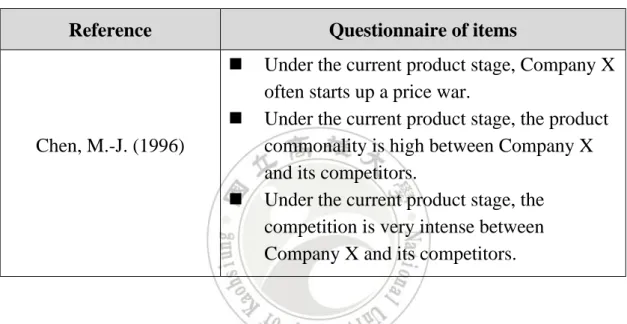
competitive behaviors (Chen, M.-J. 1996). Based on this view, we would like to explore what strategies managers will take if they think the competition is very intense under the current product stage. So, we employ this views to develop the question items on five-point scale which ranges from strongly disagree to strongly agree as shown in Table 3-1.
Table 3-1 The measurement of competitive rivalry
Reference Questionnaire of items
Chen, M.-J. (1996)
Under the current product stage, Company X often starts up a price war.
Under the current product stage, the product commonality is high between Company X and its competitors.
Under the current product stage, the competition is very intense between Company X and its competitors.
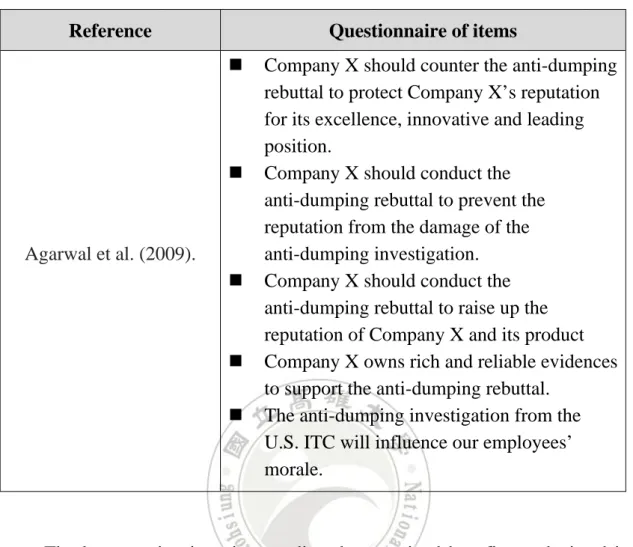
In terms of reputation for toughness, as discussed in the previous chapter, Agarwal et al. (2009) indicate that firms can garner strategic advantages by developing reputations for being tough in patent enforcement. Scholars also point out corporate reputations for toughness are particularly powerful in curbing knowledge outflows to entrepreneurial firms. In this sense, we think company may conduct the anti-dumping rebuttal to protect company's reputation for its innovative and leading position. So, in this part, we follow up the views above to develop more question items (see Table 3-2).
Table 3-2 The measurement of propensity of reputations for toughness
Reference Questionnaire of items
Agarwal et al. (2009).
Company X should counter the anti-dumping rebuttal to protect Company X’s reputation for its excellence, innovative and leading position.
Company X should conduct the anti-dumping rebuttal to prevent the reputation from the damage of the anti-dumping investigation.
Company X should conduct the anti-dumping rebuttal to raise up the reputation of Company X and its product Company X owns rich and reliable evidences
to support the anti-dumping rebuttal. The anti-dumping investigation from the
U.S. ITC will influence our employees’ morale.
The last question item is regarding the perceived benefits as depicted in Table 3-3. Marsh (1998) suggests that anti-dumping petitions may gain a larger net benefit when compared with other strategies that create barriers for foreign competitors. Based on this point, we consider that if the rebuttal is successful, the expected reward will be high. So, participants also need to answer one question item about the perceived benefit that we can widely validate our model.
Table 3-3 The measurement of perceived benefits
3.5 Reliability of Questionnaire
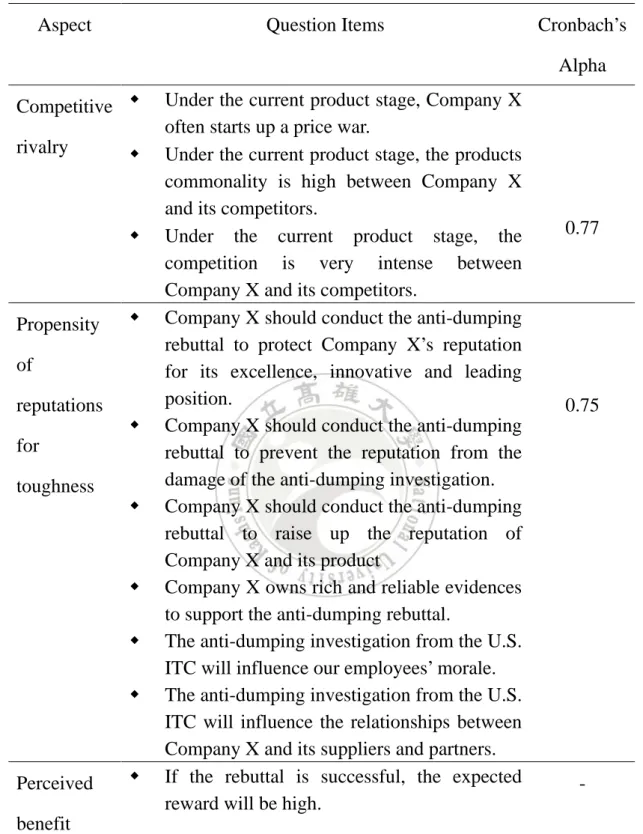
Question items for anti-dumping rebuttals decisions are shown in Table 3-4. The constructs of questionnaire for the competitive rivalry (Cronbach’s alpha=0.77) and the propensity of reputations for toughness (Cronbach’s alpha=0.75) are highly reliable (see Table 3-4 on next page).
Reference Questionnaire of items
Marsh (1998)
If the rebuttal is successful, what will be the expected reward (very low to very high)
Table 3-4 Cronbach’s Alpha of each construct of questionnaire
Aspect Question Items Cronbach’s
Alpha Competitive
rivalry
Under the current product stage, Company X often starts up a price war.
0.77 Under the current product stage, the products
commonality is high between Company X and its competitors.
Under the current product stage, the competition is very intense between Company X and its competitors.
Propensity of
reputations for
toughness
Company X should conduct the anti-dumping rebuttal to protect Company X’s reputation for its excellence, innovative and leading
position. 0.75
Company X should conduct the anti-dumping rebuttal to prevent the reputation from the damage of the anti-dumping investigation. Company X should conduct the anti-dumping
rebuttal to raise up the reputation of Company X and its product
Company X owns rich and reliable evidences to support the anti-dumping rebuttal.
The anti-dumping investigation from the U.S. ITC will influence our employees’ morale. The anti-dumping investigation from the U.S.
ITC will influence the relationships between Company X and its suppliers and partners. Perceived
benefit
If the rebuttal is successful, the expected reward will be high.
-
3.6 Sample Data
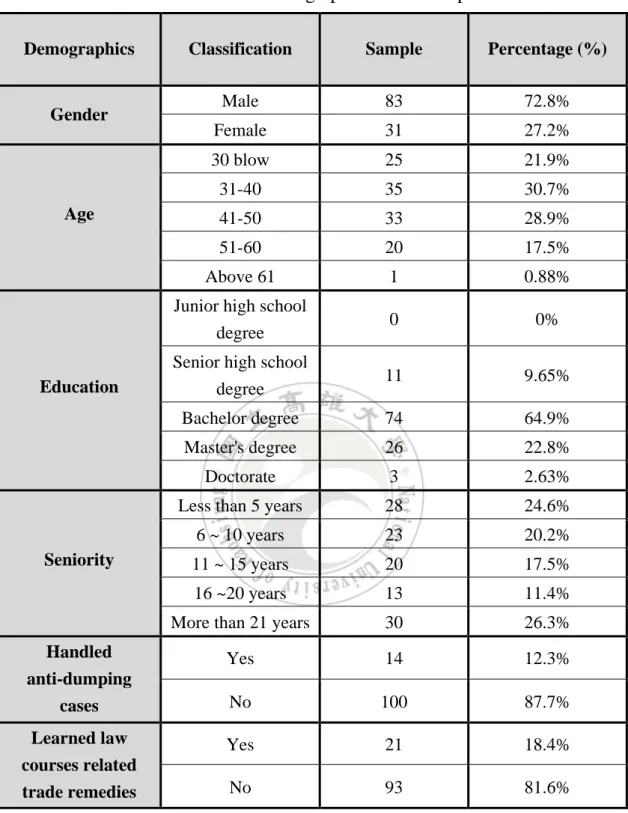
Because most of the respondents are senior managers, they can provide valuable information related to the topic of decision-making behaviors. The demographics of the sample are shown in Table 3-5. The proportion of male participants are 72.8%, and female participants are 27.2%. Most of the respondents are 31-40 years old (30.7%), and followed by 41-50 years old (28.9%). 64.9% of the respondents have a bachelor's degree, and 22.8% have a master's degree. Most of the respondents are over 20 years of seniority (26.3%). In addition, 12.3% of the respondents have dealt with the anti-dumping cases, and 18.4% have studied the law courses related to trade remedies.
Table 3-5 Demographics of the sample
Demographics Classification Sample Percentage (%)
Gender Male 83 72.8% Female 31 27.2% Age 30 blow 25 21.9% 31-40 35 30.7% 41-50 33 28.9% 51-60 20 17.5% Above 61 1 0.88% Education
Junior high school
degree 0 0%
Senior high school
degree 11 9.65%
Bachelor degree 74 64.9%
Master's degree 26 22.8%
Doctorate 3 2.63%
Seniority
Less than 5 years 28 24.6%
6 ~ 10 years 23 20.2%
11 ~ 15 years 20 17.5%
16 ~20 years 13 11.4%
More than 21 years 30 26.3%
Handled anti-dumping cases Yes 14 12.3% No 100 87.7% Learned law courses related trade remedies Yes 21 18.4% No 93 81.6% 29
Chapter Four Empirical Results
This study uses path analysis to exam these hypotheses on statistical analysis software SAS9.0 tool. In order to understand the process of how managers make a decision, this study uses one of multivariate analysis-path analysis to examine the causation of each factor in the full model. We explore whether the stages of the product life cycle and the rebuttal’s value creation separately influence competitive rivalry and perceived benefits, which then influences the propensity of reputations for toughness, and thereby affecting the anti-dumping rebuttals decisions. The procedure of the path analysis is described by Nie, Hull, Jenkin, Steinbrenner, and Bent (1975). Land (1969) also points out that a path is considered meaningful if its coefficient is greater than or equal to 0.05. This study adopts this criterion to test these factors individually, and explores the causation of the full model .
4.1 The Causation between Value Creation and Perceived
Benefits
First, this study uses different degree of value creation (0: low / 1: high) as an independent variable to investigate whether managers’ value creation based on transaction costs from anti-dumping rebuttals has an impact on their perceived benefits (H2). The results are shown below (see Table 4-1).
Figure 4-1 The model of hypothesis H2
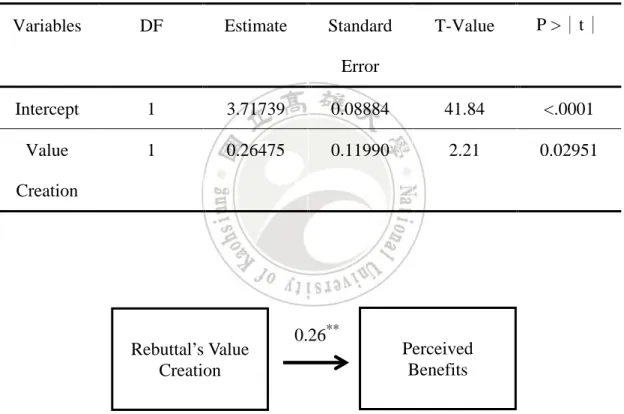
Table 4-1 Path diagram of perceived benefits
Dependent Variable: Perceived Benefits (individually test-T Test)
Variables DF Estimate Standard
Error T-Value P >∣t∣ Intercept 1 3.71739 0.08884 41.84 <.0001 Value Creation 1 0.26475 0.11990 2.21 0.02951
Figure 4-2 The result of hypothesis H2
4.1.1 The Result of The Causation between Value Creation and Perceived Benefits
In order to examine H2, this study divides the condition of value creation into two versions (low / high), and uses one question that is related to perceived
Rebuttal’s Value Creation Perceived Benefits H2 Rebuttal’s Value Creation Perceived Benefits 0.26** 31
benefits to test managers. As shown in Table 4-1, rebuttal’s value creation significantly influences perceived benefits (β= 0.26, t=2.21, p-value=0.03). The result supports H2.
According to the result of H2, we find that rebuttal’s value creation has strong positive associated with perceived benefits. In other words, rebuttal’s value creation in anti-dumping investigations do certainly affects perceived benefits. Thus, the result shows that managers believe the company will benefit if anti-dumping rebuttal is successful.
4.2 The Causation between Product Life Cycle and
Competitive Rivalry
In this phase, this study uses the stages of the product life cycle (0: new / 1: standardized) as an independent variable to examine whether the stages of the product life cycle influences competitive rivalry. The purpose of this model is to investigate competitive rivalry in which stages of the product life cycle is more urgent (H4). The results are shown below (see Table 4-2).
Figure 4-3 The model of hypothesis H4
Competitive Rivalry Product Life Cycle H4 32
Table 4-2 Path diagram of competitive rivalry
Dependent Variable: Competitive Rivalry (individually test-T Test)
Variables DF Estimate Standard
Error T-Value P >∣t∣ Intercept 1 3.73469 0.11356 32.89 <.0001 Product Life Cycle 1 0.66551 0.15753 4.22 <.0001
Figure 4-4 The result of hypothesis H4
4.2.1 The Result of The Causation between Product Life Cycle and Competitive Rivalry
To test the impacts of the independent variable on competitive rivalry (H4), this study also divides the stages of the product life cycle into two versions (new / standardized), and uses three competitive rivalry-related questions to test managers. As shown in Table 4-2, the stages of the product life cycle positively influences competitive rivalry (β = 0.67, t=4.22, p-value<0.01), in support H4.
Table 4-2 indicates that the product life cycle is significant and positive to
Competitive Rivalry Product Life Cycle 0.67** 33
competitive rivalry. The result explains that while product development is important during the new product stage, intensive competitive rivalry is more pressing during the standardized product stage. It also means that managers believe that competitive rivalry in the standardized product stage is more urgent than the new product stage.
4.3 The Causation between Value Creation, Product Life
Cycle and The Propensity of Reputations for Toughness
Before testing the causation between perceived benefits, competitive rivalry and the propensity of reputations for toughness (H3 and H5), this study measures the direct effect of rebuttal’s value creation and product life cycle on the propensity of reputations for toughness. Similarly, we use value creation (0: low / 1: high) and the stages of the product life cycle (0: new / 1: standardized) as independent variables to explore whether these factors individually influence the propensity of reputations for toughness from the perspective of managers. The results are shown below (see Table 4-3).
Figure 4-5 The model of rebuttal’s value creation, product life cycle and the propensity of reputations for toughness
Rebuttal’s Value
Creation The Propensity
of Reputations for Toughness Product Life
Cycle
Table 4-3 Path diagram of reputations for toughness
Dependent Variable: Reputations for Toughness (individually test-T Test)
Variables DF Estimate Standard
Error T-Value P >∣t∣ Intercept 1 3.84483 0.09936 38.69 <.0001 Value Creation 1 0.03938 0.10865 0.36 0.7178 Product Life Cycle 1 0.18753 0.10865 1.73 0.0874
Figure 4-6 The result of the causation between rebuttal’s value creation, product life cycle and the propensity of reputations for toughness
4.3.1 The Result of The Causation between Value Creation, Product Life Cycle and The Propensity of Reputations for Toughness
As described in the above articles, we design different situations of rebuttal’s value creation and the stages of the product life cycle in the questionnaire. In order to test the propensity of reputations for toughness from
Rebuttal’s Value Creation The Propensity of Reputations for Toughness Product Life Cycle 0.04 0.19 35
managers, this study has six questions that are related to the propensity of reputations for toughness in anti-dumping investigations. The result appears that both rebuttal’s value creation (β = 0.04, t=0.36, p-value=0.72) and the stages of the product life cycle (β = 0.19, t=1.73, p-value=0.09) do not significantly influence the propensity of reputations for toughness.
Based on the result, this study infers that rebuttal’s value creation and the stages of the product life cycle will not directly influence the propensity of reputations for toughness in anti-dumping investigations. In other words, managers tend to think the propensity of reputations for toughness in anti-dumping investigations won’t be directly affected by rebuttal's value creation. Besides, managers believe that no matter in which stages of the product life cycle, the propensity of reputations for toughness in anti-dumping investigations won’t be affected.
4.4 The Causation between Perceived Benefits, Competitive
Rivalry and The Propensity of Reputations for Toughness
In order to understand the process of how managers make a decision, this study explores whether the considerable factors (perceived benefits / competitive rivalry) individually influence the propensity of reputations for toughness, and accordingly influence managers’ decision. Thus, we use perceived benefits and competitive rivalry as independent variables to examine the impacts on the propensity of reputations for toughness in anti-dumping investigations (H3 and H5). The results of this model are shown below (see Table 4-3). In the next chapter, we will discuss whether the propensity of reputations for toughness influences the anti-dumping rebuttals decision.
Figure 4-7 The model of hypothesis H3 and H5
Table 4-4 Path diagram of the propensity of reputations for toughness
Dependent Variable: Reputations for Toughness (individually test-T Test)
Variables DF Estimate Standard
Error T-Value P >∣t∣ Intercept 1 1.83506 0.33960 5.40 <.0001 Perceived Benefits 1 0.31107 0.08095 3.84 0.0002 Competitive Rivalry 1 0.20086 0.05789 3.47 0.0008
Figure 4-8 The result of hypothesis H3 and H5
The Propensity of Reputations for Toughness Perceived Benefits Competitive Rivalry H3 H5 The Propensity of Reputations for Toughness Perceived Benefits Competitive Rivalry 0.31** 0.20** 37
4.4.1 The Result of The Causation between Perceived Benefits, Competitive Rivalry and The Propensity of Reputations for Toughness
This study totally uses ten questions to investigate the causation between the perceived benefits, competitive rivalry and the propensity of reputations for toughness. From Table 4-3, we can see that perceived benefits significantly affects the propensity of reputations for toughness (β= 0.31, t=3.84, p-value<0.01), and competitive rivalry also positively affects the propensity of reputations for toughness (β = 0.20, t=3.47, p-value<0.01). The results support H3 and H5.
The result indicates that perceived benefits has a positive influence on the propensity of reputations for toughness in anti-dumping investigations. The meaning is that managers will be tough on the company's reputation if the company can benefit from anti-dumping rebuttals. On the other hand, if the company is in a highly intensive competitive market, their reputations for toughness will be high. Therefore, perceived benefits and competitive rivalry are two important factors in the company in anti-dumping investigations.
4.5 The Causation between The Propensity of Reputations
for Toughness and Anti-dumping Rebuttals Decision
Finally, this study aims to find out the causation between the propensity of reputations for toughness and anti-dumping rebuttals decision. This study uses the propensity of reputations for toughness as our independent variables to test whether the propensity of reputations for toughness positively influences managers’ anti-dumping rebuttals decision. The results are shown below (see
Table 4-5).
Figure 4-9 The model of hypothesis H1
Table 4-5 Path diagram of anti-dumping rebuttals decision
Dependent Variable: Anti-dumping Rebuttals Decision
Variables DF Estimate Standard
Error T-Value P >∣t∣ Intercept 1 1.26148 0.18363 6.87 <.0001 Reputations for Toughness 1 0.30770 0.04885 6.30 <.0001
Figure 4-10 The result of hypothesis H1
4.5.1 The Result of The Causation between The Propensity of Reputations for Toughness and Anti-dumping Rebuttals Decision
This study uses six questions that are related to the propensity of
The Propensity of Reputations for Toughness Anti-dumping Rebuttals H1 The Propensity of Reputations for Toughness Anti-dumping Rebuttals 0.31** 39
reputations for toughness in anti-dumping investigations. Then, managers answer one question about their anti-dumping rebuttals decisions (yes / no). The result shows that the propensity of reputations for toughness positively affects anti-dumping rebuttals decisions (β= 0.31, t=6.30, p-value<0.01), which support H1.
The result appears that the propensity of reputations for toughness in anti-dumping investigations has strong positive influences on managers’ anti-dumping rebuttals decision. Therefore, the propensity of reputations for toughness in anti-dumping investigations can lead to actively responding anti-dumping rebuttals. Managers will take anti-dumping rebuttals to protect the company's reputation.
4.6 Discussion
According to the results of path analysis shown in table 4-6, we can understand the manager’s decision-making process (see Figure 4-11). The results show that the rebuttal’s value creation positively affects perceived benefits (H2), and perceived benefits significantly influences the propensity of reputations for toughness (H3). Moreover, the stages of the product life cycle also has positive effects on competitive rivalry (H4), which then positively influences the propensity of reputations for toughness (H5). Finally, the propensity of reputations for toughness positively affects managers’ anti-dumping rebuttals decisions (H1).
On the other hand, this study presents a comprehensive framework of anti-dumping rebuttals through two key mechanisms, and finds the mediating effects of them (perceived benefits / competitive rivalry). This finding indicates
anti-dumping rebuttals’ value creation affects the propensity of reputations for toughness through perceived benefits. Similarly, the stages of the product life cycle influences the propensity of reputations for toughness in anti-dumping investigations through competitive rivalry.
Table 4-6 The result of hypothesized model
Hypothesis Independent Variable Dependent Variable Result
H1 The Propensity of Reputations for Toughness Anti-dumping Rebuttals Decision Support H1 (β= 0.31, t=6.30, p-value<0.01) H2
Value Creation Based
on Transaction Costs Perceived Benefits Support H2 (β= 0.26, t=2.21, p-value=0.03) H3 Perceived Benefits The Propensity of Reputations for Toughness Support H3 (β= 0.31, t=3.84, p-value<0.01)
H4 Product Life Cycle Competitive Rivalry
Support H4 (β = 0.67, t=4.22, p-value<0.01) H5 Competitive Rivalry The Propensity of Reputations for Toughness Support H5 (β = 0.20, t=3.47, p-value<0.01) 41
Figure 4-11 Path diagram of manager’s decision-making process Value Creation Based on Transaction Costs The Propensity of Reputations for Toughness Anti-dumping Rebuttals Perceived Benefits Competitive Rivalry Product Life Cycle 0.26** 0.67** 0.20** 0.31** 0.31** 42
Chapter Five Conclusions and Implications
5.1 Conclusions
This study explores the impact of perceived benefits and competitive rivalry on reputations for toughness and anti-dumping rebuttals decision. In the strategic management fields, many scholars seek to understand the manager’s reaction to anti-dumping investigation process. However, most of the previous studies investigating anti-dumping petitions are from the perspectives of domestic firms, rather than those of foreign competitors. Thus, this study explores how foreign competitors respond to anti-dumping petitions, and under what conditions, foreign competitors should actively respond to anti-dumping investigations. This study develops highly reliable question items for the propensity of reputations for toughness and competitive rivalry in different product life cycle stages to exam our hypotheses by using an experimental design method.
This study reveals important links between value creation and the stages of the product life cycle to measure the propensity of reputations for toughness through competitive rivalry and perceived benefits, which then affect anti-dumping rebuttals decisions. Therefore, this study reaches a new finding, and supports the existing research in the perspectives of legal, economic, and strategic management.
5.2 Managerial Implications
First, although the previous studies explore the strategic advantages of being ‘tough’ in the context of entry deterrence and employee departures (Agarwal et al., 2009; Kreps & Wilson, 1982; Milgrom & Roberts, 1982), this study uses quantative method to discover that the propensity of reputations for toughness might also enhance the rebuttal decisions. This is a new finding in the literature. Managers will take anti-dumping rebuttals because they are tough on the reputations of the company in anti-dumping investigations.
Second, compared with a standardized product cycle stage, many managers would rather prefer a new product cycle stage, and might exert more anti-dumping rebuttals because it has the potential for growth. However, based on previous studies (Anderson & Zeithaml, 1984; Danneels, 2011; Vernon, 1966) and our findings, this study proves that the company in standardized product stage may exert higher propensity of reputations for toughness than the new product stage through competitive rivalry, and more likely to actively engage in anti-dumping rebuttals.
Third, while many domestic firms believe that anti-dumping petitions is an useful ways to avoid competition (Baron, 1997; Marsh, 1998), foreign competitors might fight back by taking a retaliatory anti-dumping rebuttal. Therefore, this study proposes that domestic firms should consider the stages of the product life cycle and anti-dumping investigations’ value creation before initiating anti-dumping proceeding.
Finally, for anti-dumping investigations, this study concludes that foreign competitors can increase realizable value by using reputations for toughness as indispensable advantages to respond to the anti-dumping petitions, in attractive
by using the features of innovative products as countermeasure to engage in anti-dumping rebuttals, and finally going beyond compliance with the anti-dumping law and trying to convert regulatory constraints into opportunities for value creation.
5.3 Theoretical Implications
First, this study extends the research of Chen, Liu, Liu, and Huang (2015) on the value creation based on transaction costs in patent litigation. We further confirm the impact of rebuttal’s value creation of the anti-dumping rebuttal’s decision through perceived benefits.
Second, for the literature on anti-dumping (Marsh, 1998) and information asymmetry theory (Baumgartner, Berry, Hojnacki, Kimball, & Leech, 2009; Hadani & Schuler, 2013; Hansen, 1991; Hart, 2004), this study indicates the perspectives of reputation effects that lead to responding action and product life cycle that shaps anti-dumping rebuttals. Therefore, this study reveals a source of asymmetry among anti-dumping review process.
Third, while previous studies indicate that firms can enhance performance by developing reputations for being toughness (Agarwal et al., 2009; Roberts & Dowling, 2002), this study finds that foreign competitors can also garner strategic advantages by developing reputations for being tough on anti-dumping investigations.
Finally, based on the formulation of managers’ codes of conduct in regard to legal astuteness (Chen, Ni, Liu & Teng, 2015), this study also observes managers’ codes of conduct from the perspective of anti-dumping rebuttals
decision. In sum, this study not only broadens previous studies into the relevant fields, but also provides a more sound judgment on manager’s decision-making process in depth.
5.4 Limitations
This study naturally has some limitations. First, anti-dumping investigations may deter against specific industries. Since, some respondents haven’t handled the similar case experience before. Second, this study assumes that anti-dumping rebuttal will lead to the greatest impacts (positive or negative impacts) on the company, because the degree of influence in anti-dumping investigations may be different in each industry for each company. Finally, the questionnaire we designed is only a situation that managers need to decide whether to take anti-dumping rebuttal immediately after receiving the anti-dumping investigation, but in reality, the proceedings can be reconciled any time. This study can illustrate more appropriate questionnaires to solve this disadvantage.
5.5 The Suggestions for Future Research
Many countries focus on the enlargement of international trade, however, in order to protect domestic industries from foreign competition, understanding how foreign firms can shape the competitive environments to employ nonmarket and market strategy is essential in anti-dumping proceeding in international business. Therefore, below are some suggestions for future
researchers.
First, we recommend that respondents in the same industry can be divided into a group so that researchers can understand the different views on anti-dumping rebuttals from each industry. Second, we suggest that future studies can follow each stage of the proceedings to discuss the changes of decision when managers encounter initial anti-dumping investigations. Finally, this studysuggests future theoretical and empirical research by adding a variable of the resource-based view, and explore whether and under what conditions reputations for toughness may be an element of sustained competitive advantage under the resource-based view of the firm and the competitive dynamics.