ELSEVIER Materials Chemistry and Physics 56 (1998) 56-62
Phase development and activation energy of the Y203-A1203 system
by a modified sol-gel process
Jun-Ren Lo, Tseung-Yuen Tseng *
Department of Electronic Engineering and Instirute of Electronics, National Chiao-Tzmg Ur~iversity, Hsinchu, Taiwan Received 19 November 1997; received in revised form 19 January 1998; accepted 30 March 1998
Abstract
The phase development of Y3AlSO12 (YAG), YA103 {YAP), and Y,Al,O, (YAM) synthesized by a modified sol-gel method has been studied. A &elate agent (ethyl acetoacetate) is added to control the hydrolysis and to modify the sol-gel process. The sol-gel-derived powder is then heat-treated to induce crystallization. The X-ray diffraction method is employed to determine the crystalline phases of the resulting powders. The formation of YAG, YAP, and YAM is described. For both YAP and YAM compositions, there is a phase transformation from YAP polymorphism to perovskite YAP. The activation energies of YAG are estimated at about 69 kcal/mol by the isothermal process as fitted with the Johnson-Mehl-Avrami equation and about 222 12 kcal/mol by the continuous heating method as fitted with Kissinger and Sotgiu plots. The difference of activation energies calculated from the two methods is mainly due to the complicated crystallization of YAG. 0 1998 Elsevier Science S.A. All rights reserved.
Keyzwrds: Phase developmmr; Sol-gel process; Yttria-alumina system
1. Introduction
In the Y20X-A1203 system there are three transition com- pounds including Y,Al,O,, (YAG), YAlO, (YAP), and Y&l&& (YAM), which beiong to cubic garnet, orthorhom- bit perovskite and monoclinic structure, respectively. YAG possesses a host lattice of good efficiency and is employed as a phosphor. The applications of phosphors are in display devices such as television, projection television, field emis- sion display (FED), and electroluminescent devices. The oxide-based phosphors are thermally more stable than traditional ZnS-based phosphors under electron-beam bom- bardment. It was found that S, SO, and SO2 evaporated from the ZnS-based phosphors would damage the tips or cathodes when they were employed in FED and other vacuum fiuores- cent devices [ 11. Oxide phosphors would be a better choice for vacuum fluorescent display because of their thermal sta- bility. YAG powder containing Tb as dopant has already been applied in projection television and its saturation character is better than that of ZnS-based phosphors. YAG powder con- taining Cr as dopant is a long-life phosphor used in liquid- crystal-light-valve projection display. Ce-doped YAP single crystals have been applied as fast-acting scintillators for the detection of ionized radiation [ 2-41. The scintillation effect
* Corresponding author. Tel.: + 886-3-573-1879; Fax: + 886-3-572-4361.
is determined by the 5d-4f interconfigurational luminescence of Ce3 + ions. YAP has three polymorphisms and the structure often seen is the distorted perovskite structure. The other two metastable phases are hexagonal and cubic structures. It was pointed out that the YAP structure lies between the perovskite and ilmenite structures [ 5 ] . The tolerance factor of the per- ovskite structure usually lies between 0.8 and 1. The perov- kite structure of YAP was formed with a tolerance factor of 0.86 and it presents an ilmenite structure for a tolerance factor below 0.75 [4]. YAM is a monoclinic structure with space group P2,/c. It shows a con-went melting point in the tem- perature range 2020 & 20°C 171 and a polymorphic transition at 1377°C [ 8,9]. Hence, it is a problem in application to use YAM as laser host crystal.
Solid-state reaction using A1203 and Yz03 powders as starting materials has been extensively studied to prepare polycrystalline YAG. Y,O,-deficient YAG formed at a tern- perature above 1600°C. A larger amount of Yz03 wouldneed a higher temperature and longer time to achieve the nearly reacted YAG crystalline phase [ 101. Sintering at low tem- perature has been investigated by various techniques such as the flux method, sol-gel method, etc. In the flux method, the incorporation of low-melting-temperature components such as BaFz or YF, has resulted in a lowering of the sintering temperature to ti 1500°C [ 11,121. YAG was also prepared
0254-0584/98/$ - see front matter 0 1998 Elsevier Science S.A. All rights reserved. PIISO254-0584(98)00139-4
J.-R. Lo, T.-Y. Tseng / Materials Chemistv and Physics 56 (1998) 56-62 57
by the sol-gel method and other chemical routes such as co- tri-set butylate ( > 97%, Merck) was dissolved to form the precipitation. Preparation of YAG, YAM, and YAP doped solution II. The purpose of EAA addition is to slow down the with rare earth using the sol-gel process was reported by Rao hydrolysis of aluminum tri-set butylate before solutions I and [ 131. In that experiment Y (OH), and Al( OH) 3 xerogels II were mixed. The concentration of aluminum was adjusted were used as the starting materials and the samples were to 0.5 M. Solutions I and II were well mixed by stirring at found to be fully crystallized at 1000°C. Liu et al. have studied 25°C for 12 h. The solution was added dropwise into 0.1 M a similar metalorganic method to prepare YAG [ 141. They NHjOH solution to form the gels. The gels were dried at 80°C used yttrium and aluminum isobutyrates as precursors and for three days in an oven. The process flow is shown in Fig. obtained nearly pure YAG phase at 900°C. Hay has reported 1. The three compositions for YAG, YAP, and YAM were sol-gel-derived YAG films [ 151. The yttria sols and alumina prepared by mixing appropriate volume ratios of solutions I sols were made separately from yttrium and aluminum iso- and II. Hereinafter, we denote the powder composition of propoxide. The films were formed on nickel or platinum grids Y:Al=3:5 as A, Y:Al= 1:l as B, and Y:Al=4:2 as C. The for TEM studies. He also observed the phase transformation dried gel powders were characterized with a differential scan- of the bulk gel with a Y:Al mole ratio of 35 during heat ning calorimeter (DSC) (DuPont Instruments DSC 2910). treatment and found that the YAM phase appeared at 850°C The rate of heating and cooling was S”C/min from room and then the pure YAG appeared at 1050°C. The grain temperature to 500°C. This showed that the organic compo- growth/coarsening was noticed from TEM analysis. From nents were decomposed at about 200°C. The dried gels were the formation rate constant, the activation energy of YAG fired at 250°C for 1 h and then at 500°C for 2 h in a muffle was estimated about 280 kJ/mol. Zhukovskaka and Strakhov furnace to form the starting powders. The chemical species
[ lo] estimated the activation energy of YAG using the Zhu- presented in starting powders A, B, and C were determined ravlev equation and studied the quantitative effect of Y,O, by an inductively coupled plasma atomic emission spectro- for the same issue. They found that the composition with a meter (ICP-AES) (Perkin Elmer, SCIEX ELAN 5000) and mole ratio of Y:A1=3:5 possessed the lowest activation the results are shown in Table 1. The error for the ICP-AES energy of 23 kcal/mol. Kumar et al. [ 161 studied the ther- composition analysis is less than 10%. It indicates that the modynamics and nucleation behavior in the YAG system compositions of the resulting powders are close to the starting using the regular solution model. They reported that the free compositions. Powder X-ray diffraction (XRD) (Shimadzu energy barrier of a YAG critical nucleus was high under XD-5 Cu Ka) patterns were used to characterize the phase homogeneous conditions. development. The powders annealed at 500°C were found to
Besides the use of experimental formulae such as the above-mentioned Zhuralev equation [ lo], the activation energy of crystal growth can also be approached by using isothermal and continuous heating processes. Because the crystalline phase is formed at high temperature and the dif- fusion takes a long time, calculation of the activation energy is difficult for isothermal solid-state reaction. In addition, it is difficult to identify peaks in the differential thermal analysis (DTA) spectra due to the complex phase transitions in solid- state reactions. The sol-gel method could offer a low- temperature synthesis and the resulting mixture can be investigated on nanometer scale so that the diffusion problem seems to be limited.
uY(No,), * 6W (1I)Ethyl acetoacetate
dissolved in mixed with
Z-Methoxyethanol(0.3M) 2-Methoxyethanol
Aluminum tri-set butylate added in solution(0.5M) Mixing hvo solutions
with suitable ratios
Stirring for 12 h
Dropping into NH,OH bath
The purposes of this study are: ( 1) preparation of powders using a modified sol-gel process; (2) investigation of phase development for three compositions Y:Al= 3:5,1: 1, and 4:2; and (3) calculation of activation energy for a Y:Al mole ratio of 3:5 by the isothermal process and continuous heating analysis.
1 Drying in oven at 80°C 1
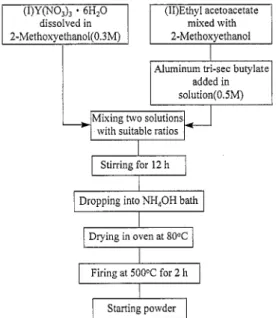
Fig. 1. Flow chart for preparation of starting powders.
Table 1
2. Experimental The ICP-AES results of three compositions of starting powders
2-Methoxyethanol, H3COCH20H (99.9%, Merck), was used as a solvent. Yttrium nitrate (99.9%, Aldrich) was dis- solved in 2-methoxyethanol to form the solution I of 0.3 M. The ethyl acetoacetate (EAA) chelate agent was first mixed with 2-methoxyethanol to form a mixture and then aluminum
Powder Starting composition ICP-AES analysis of the powder
A Y/M=35 Y/Al = 35.157
B Y/AI= 1:l Y/Al= 1:1.041
58 J.-R. Lo, T.-Y. Tseng/Maren‘als Chemistry and Physics 56 (1998) 56-62
be amorphous. Differential thermal analysis (DTA) (DuPont Instruments DTA 1600) of the starting powders was done at temperatures ranging from 600 to 1500°C with a heating rate of 1O”CVmi.n and a-alumina was used as the reference. The starting powders were fired at 650, 750, 1000, 1300, and 1500°C for 10 h with a heating rate of lO”C/min for studying phase development. The powders were also heated at 1500°C for 6 min to 10 h or even longer time to achieve a single phase.
The estimation of activation energy was conducted for the composition of Y:Al = 35 and the DTA measurements were done from 600 to 1000°C with various heating rates from 2 to 20”C/min. For the isothermal process, the volume fraction of crystalline phase was determined by the change of relative intensity of the (420) diffraction peak for YAG using Si( 111) as the standard. The powders used for the estimation of activation energy by the isothermal process were heat- treated at 900 and 950°C for various time durations.
3. Results and discussion
3.1. Phase developmel t
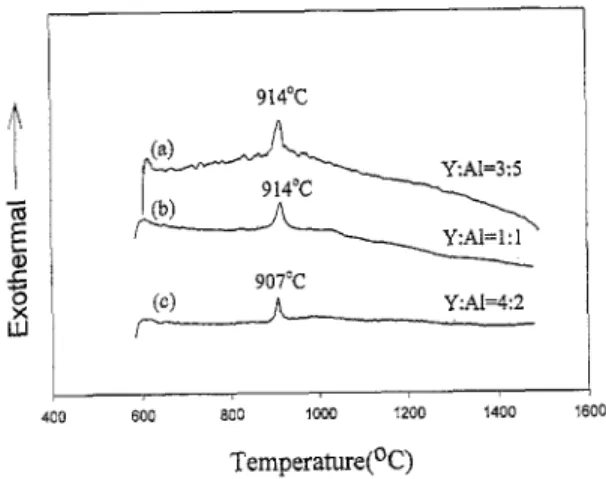
Fig. 2 shows the DTA trace for the starting powders A, 3, and C. Curve (a) for powder A indicates a sharp exothetic peak at 914°C. The absence of a peak below 800°C in all DTA traces indicated that the organic components of the precursor were completely decomposed by the 500°C firing processing. YAG prepared by other chemical processes also showed a similar peak around 900-950°C in the DTA trace [ 13-181. The DTA trace of composition B exhibits a similar peak around 914°C and is shown in Fig. 2(b). Composition C exhibited one narrow peak at 907°C as indicated in Fig. 2(c). XRD patterns of powder A heat-treated at 650 and 750°C for 10 h (Fig. 3) display little crystalline phase. The crystallinity of YAG became obvious as the temperature was raised up to 1300°C and the powder shows little change with higher temperature. XRD results also indicated that YAP (perovskite YA103) was the only second phase in powder A for the present study. It has been reported that YAG is the most stable phase in the Y,O,-Al,O, system [ 191. Therefore, the presence of the second phase YAP at 1300°C cannot be a result of the decomposition of YAG. The appearance of YAP may possibly be attributed to the chemical inhomoge- neity of yttrium in our gel-derived powders. It was reported that a mixture with garnet and hexagonal YA103(H-YAlO?) could be formed when the glassy phase from the melt con- taining 42.5-45 mol% Y203 (it has 37.5 mol% Y,O, within YAG) was heated up to 1000°C [ 201. It is suggested that the YAP phase is the result of a phase transformation from H- YA103 to YAP for powder A. However, no H-YAlO, phase exists in lOOO”C/ 10 h fired powder A as revealed from XRD analysis (Fig. 3). The possible reason is that H-YA103 is usually present in powder for a short period [ 18,201 that is much less than our heat-treatment time ( 10 h) .
914°C c 5 907T 3 (cl Y:Al=4:2 i 400 600 600 1ccQ ,200 1400 moo Temperature(‘C)
Fig. 2. DTA traces of starting powders (a) A, (b) B, (c) C.
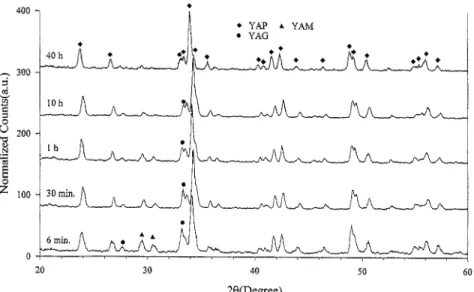
The phase development of composition B as shown in Fig. 4 is more complicated than that for composition A. The crys- tallization of Y203 and YAG began at 650°C. At lOOO”C, YAM presented as the third phase and coexisted with Y203 and YAG. Ys03 presented as one of the major phases even after heat treatment at 1300°C. YAP started to grow at 1300°C. The amount of Y,03 phase diminished with temper- ature and was almost consumed at 1500°C (Fig. 5). YMi YAM, and YAG coexisted at 1500°C for 10 h heat-treatment. After extending the firing time up to 40 h, we can obtain a high-purity perovskite phase (YAP) as shown in Fig. 5. We can deduce the reaction for YAP formation as YAG+ YAM + YAP. In fact, the peak intensities of YAM andYAG decreased with firing time as shown in the XRD analysis.
The phase development of composition C for different firing temperatures as revealed by the XRD patterns is shown in Fig. 6. The formation of YIO, began at 650°C and YAG appeared at 750°C. The XRD pattern of the powder heat- treated at 1300°C shows the co-existence of YAP, YAM and Y203. The reaction of Y203 and YAP formed YAM phase. The formation of pure YAM phase was achieved at 1500°C for 10 h (Fig. 7). From the XRD patterns (Fig. 7) for the powder treated isothermally at 1500°C for 1 h, it is indicated that there is YAP phase with a small amount of Y20, phase. The Y203 phase disappeared after that the firing time was extended to 10 h.
The phase distributions for various compositions and firing conditions are shown in Table 2. We find that YAP phase appeared above 1300°C in all compositions.
3.2. Activation energy of YAG
The isothermal process used for the determination of acti- vation energies of chemical reactions usually takes a long time. Numerous investigations [ 21-281 have been devoted to studying the kinetic parameters of crystal growth and glass devitrification by DTA, a dynamic method. In these reports, the continuous heating method was proven to be as good as isothermal analysis. The basic approximation of the contin- uous heating method assumes that AT (the temperature dif-
J.-R. Lo, T.-Y. Tseng /Materials Chemistr)land Physics 56 (1998) 56-62 59
”
20 30 40 SO 60
20@egree)
Fig. 3. XRD patterns of powder A heat-treated for 10 h at different temperatures. YAG peaks indexed by JCPDS card 33-40 and YAP peaks by JCPDS card 33-41. 400 l YAG . YAM l YAP ’ YA . _I 0 , I , 20 30 40 50 60 28Qlegree)
Fig. 4. XlW patterns of powder B heat-treated for 10 h at different temperatures. YAM peaks indexed by JCPDS card 34-368 and Y203 peaks by JCPDS card 41-110s.
ference between the sample and standard) is proportional to the reaction rate [ 261.
The isothermal process is described by the Johnson-Me& Avrami equation as [ 22,26-281
x(t)=l-exp(-kt)’ (1)
where x(t) is the volume fraction of the transformed phase,
t the firing time, Y a reaction order [ 221 or morphology index [ 281 which depends on the crystallization mechanism, and k
a rate constant. k could be expressed by the Arrhenius equa- tion, i.e.,
k(T)=k,exp(-EIRT) (2)
where k0 is a constant, R is the gas constant, and E is the activation energy associated with the process. On the basis of Eq. ( 1) , we can obtain the growth rate of the crystalline phase for the starting powder A when heat-treated at 900 and
950°C for various periods of iking time. Linear regression analysis of the plots In [ ln( l/ ( 1 -x) ] ] versus ln( t) provides linear correlation coefficients of 0.991 and 0.943 and mor- phology indexes of 0.881 and 0.759 for 900 and 950°C respectively. The fitting results are shown in Figs. 8 and 9. From the two intercepts with the vertical axis of the plots in Figs. 8 and 9, we can get two rate constants. Using Eq. (2), the activation energy can be calculated as 69 kcal/mol. This value is similar to Hay’s result [ 1.51.
For the continuous heating process, the kinetic parameter of a phase transformation can be described as [ 231
In 5 =-$+const. ( m 1 m
where cy is the heating rate, T, is the maximum rate at which conversion occurred, E is the activation energy, n and m are
60 J.-R. Lo, T.-Y. Tseng/Mnterials Clzemistv and Physics 56 (1998) 56-62 400 - . " zoo- . 0 i 20 30 40 50 60 2EQegree)
Fig. 5. XRD patterns of powder I3 heat-treated at 1500°C for 6 min to 40 h.
20 30 40 50 60
29
Fig. 6. XRD patterns of powder C heat-treated for 10 h at different temperatures.
Fig. 7. XRD patterns of powder C heat-treated at 1500°C for 6 min to 30 h.
40 50
28
J.-R. La T.-Y. Tseng / Mnrerials Ckemisr~ and Physics 56 (1998) 56-62 61
Table 2
Summary of phase development of the starting powders
Y203 (mol%) Temp. P.3 Time (h) Phases 66.6 (powder C) 50 (powder B) 37.5 (powder A) 650 10 750 10 1000 10 1300 10 1500 10 1500 30 650 10 750 10 1000 10 1300 10 1500 10 1500 30 650 10 750 10 1000 10 1300 10 1500 10 Y203 + YAG Yz03 + YAG YzOz + YAG + YAM YzO, t YAM t YAP YAM
YAM Y,O? + YAG Y201 + YAG Y203 t YAM t YAG Y203 t YAM t YAP t YAG YAM t YAP t YAG YAP t YAG YAG YAG YAG t YAM YAGtYAP YAG t YAP 1 2 3 4 5 6 7 8 9 w
Fig. 8. Plot of Mn( 1 -x) - ’ vs. In(t) for isothermal crystallization of YAG at 900°C.
-4 4
1 2 3 4 5 6 7 8 9 W
Fig. 9. Plot of lnln( 1 -x) - ’ vs. ln( t) for isothermal crystallization of YAG at 950°C.
nism, and ~2 = n2 + 1 for a bulk reaction. When the crystalli-
zation mechanism is surface-nucleation related then n = M = 1
for different heating rates, and the equation can be described as the Kissinger equation [ 231, i.e.,
a ( 1
E
In ~,1, =-~~,+const. (4)
From the slope of the ln( crlTm2) versus l/T, plot we can obtain the activation energy. The slope of Eq. (3) is m/n times that for Eq. (4). If the plot of Eq. (4) was a fitted line, then the plot of Eq. (3) also should form a fitted line. If m/n is known, we could determine the activation energy from the slope of the Kissinger plot.
There is another modified Kissinger’s equation, derived by Baiocchi et al. [ 261, which can be represented as follows:
In
( F m 1 = $- m +const.
(5)
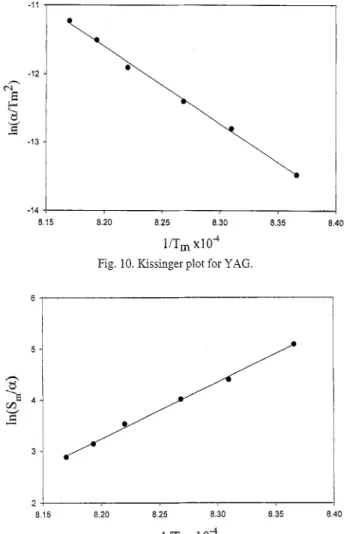
in which S, = T, - To, where To is the starting temperature for DTA. The activation energy E can be calculated from the slope of the In(S,lcu) versus 1 /T, plot. Since the plot does not include the factors m and n, the slope can give directly the activation energy. The two plots (Eqs. (4) and (5) ) are shown in Figs. 10 and 11, respectively. Linear regression analysis gives correlation coefficients of -0.997 from the1
8.15 0.20 8.25 8.30 5.35 8.40
l/T, x104 Fig. 10. Kissinger plot for YAG.
6
51
3
-2
2
4-”
3-1
0 15
8.20 8.25 8.30 8.35 8.40 1-r,x10‘462 J.-R. Lo, T.-Y. Tseng /Marerids Chemistq and Physics 56 (1998) 56-62
Kissinger plot and 0.997 from the Sotgiu plot. From these slopes, the calculated activation energies are 224 and 220 kcal/mol, respectively, i.e., the activation energy calculated from Eq. (4) is very close to the results obtained from Eq. (5). This clearly indicates that the m/n ratio is equal to one, that is, n = m or n = m = 1, It is frequently observed that, if rz =?nf 1, this indicates that the crystallization of YAG includes only the mechanism of crystal growth [28] ; if IE = m = 1, the crystallization mechanism of YAG includes surface nucleation and crystal growth [ 231. The above anal- ysis gives n = m = 1. Therefore, the crystallization of sol-gel- derived powders for the present study belongs to the latter case. In fact, our starting powders are amorphous so that the
nucleation process should be involved in the crystallization mechanism.
The activation energies obtained from the continuous heat- ing process are about 3.7 times that of the isothermal process. The difference between the two methods may be attributed to the various phase-transformation mechanisms. The acti- vation energy obtained from DTA analysis includes a kinetic barrier 1241. It was reported that the DTA analysis might agree with the analysis of the isothermal process when the mechanism is related to the first coordinate reaction [ 271 or decomposition [21]. YAG, containing 160 atoms in a unit cell, is more complex and hence crystallization will berelated to higher coordinate changes. The kinetic barrier is higher than decomposition or the first coordinate change. In fact, the role of the kinetic barrier is also shown in the YAG melt. It has been reported that the melt must be supercooled down to 920°C for starting the solidification of the YAG [ 201. Geravis et al. [ 201 concluded that the complex structure could lead to difficulties for the creation of a nucleus greater than the critical size required for growth.
4. Conclusions
The incorporation of a chelate agent effectively controls the hydrolysis and helps to improve mixing the nitrates with aluminum tri-set butylate. We could successfully obtain clear solutions and synthesize high-purity YAG and YAM phases by the modified sol-gel method. In the case of powder A, it forms a YAG phase at a low temperature of 1000°C. Powder B fired at 1500°C for 40 h can give high-purity YAP phase. Powder C fued at above 1300°C can induce the phase trans- formation from YAIO, polymorphism to YAP. High-purity YAM phase can be obtained for powder C fired at 1500°C for 10 h.
The activation energies of YAG calculated by the isother- mal process and DTA analysis are 69 and 222 f 2 kcal/mol, respectively. The difference between the results is attributed to the different crystallization mechanisms for the methods. From the numerical parameters n and no of the DTA analysis,
the crystallization of the sol-gel-derived powder may include surface nucleation and crystal growth.
Acknowledgements
The authors gratefully appreciate the financial support from the National Science Council of the Republic of China under Project No. NSC 86-2112-M009-28.
References [II [21
S. Itoh, T. Kimizuka, T. Tonegawa, J. Electrochem. Sot. 136 (1989) 1819.
[31
[41
V.G. Baryshevsky, M.V. Korzhik, V.I. Moroz, V.B. Pavlenko, A.A. Fyodorov, S.A. Smimova, O.A. Egorycheva, V.A. Kachanov, Nuclear In&urn. Methods Phys. Res. B58 (1991) 291.
V.A. Kachanov, V.V. RykaIin, V.L. Solovyanov, V.Yu. Hodyrev, M.V. Korz.h& V.I. Moroz, A.S. Lobko, A.A. Fyodorov, A.F. Novgorodov, B.A. Khachaturov, S.A. Smimova, Nuclear Instrum. Methods Phys. Res. A314 (1992) 215.
V.G.Baryshevsky, M.V. Korzhik,B.I. Minkov, S.A. Smimova,A.A. Fyodorov, P. Dorenbos, C.W.E. van Eijk, J. Phys.: Condens. Matter 5 (1993) 7893. [51 [Cl [71 [81 t91 1101
I. Warshaw, R. Roy, J. Am. Ceram. Sot. 42 (1959) 434. F.D. Bloss, Crystallography and Crystal Chemistry: an Introduction, Holt, Rinehart and Winston, New York, 1971, p. 253.
T.I. Mah, M.D. Petry, J. Am. Ceram. Sot. 75 (1992) 2006. H. Yamane, M. Omori, A. Okubo, T. Hirai, J. Am Ceram. Sot. 76
(1993) ‘2382.
H. Yamane, K. Ogawara, M. Omori, T. Hirai, J. Am. Ceram. Sot. 78 (1995) 1230.
A.E. Zhukovskaya, V.I. Strakhov, Zh. Prikladnoi Khimii 48 (1975) 1125.
!lll [I21
[I31 [ 141
K. Ohno, T. Abe, J. Electrochem. Sot. 133 (1986) 638. K. Ohno, T. Abe, J. Electrochem. Sot. 141 t, 1994) 1252. R.P. Rao, J. Electrochem. Sot. 143 (1996) 189.
Y. Liu, Z.F. Zhang, B. King, J. Halloran, R.M. Laine, J. Am. Ceram. Soc.79(1996) 385. [I51 [I61 1171 [I81 [I91 [201 1211 [=I L’31 [%I [=I [261 [271
R.S. Hay, J. Mater. Res. 8 (1993) 578.
J. Kumar, M. Thirumavalavan, R. Dhanasekaran, F.D. Gnanam, P. Ramasamy, J. Phys. D.: Appl. Phys. 19 (1986) 1223.
R.V. Kamat, K.T. Pill& V.N. Vaidya, D.D. Sood,Mater. Chem.Phys. 46 (1996) 67.
K.M. Kinsman, J. McKittrick, E. Sluzky, K. Hesse, J. Am. Ceram. Sot. 77 (1994) 2866.
J.S. Abell, I.R. Harris, B. Cockayne, B. Lent, J. Mater. Sci. 9 (1974) 527.
M. Geravis, S. Le Floch, N. Gautier, D. Massiot, 3.P. Coutures, Mater. Sci. Eng. B45 ( 1997) 108.
G.O. Piloyan, I.D. Ryabchikov, O.S. Novikova, Nature 212 (19661 1229.
A. Marotta, A. Buri, G.L. Valenti, J. Mater. Sci. 13 (1978) 2483. K. Matusita, S. S&&a, J. Non-Crystalline Solids 38-39 (1980) 7411 A. Marotta, A. Buri, F. Branda, J. Mater. Sci. 16 (1981) 341. A. Marotta, S. Saiello, F. Branda, A. Buri, J. Mater. Sci. 17 (1982) 105.
E. Baiocchi, M. Bettinelli, A. Montenero, L. di Sipio, A. Sotgiu, J, Mater. Sci. 18 (1983) 411.
J. Morales, L. Heman, M. Macias, A. Ortega, J. Mater. Sci. 18 (1983) 2117.