Data Data voice Packet classifier MAC CS MAC CPS BW-CID#5 UL BW request generator UL BW request generator Packet re-construct CID#1 CID#2 CID#3 CID#4 MS CID#6 CID#7 CID#8 DL traffic processor
The authors evaluate
the downlink
performance of the
Mobile WiMAX
cellular system
with different
radio resource
management,
especially the
scheduler for QoS
control and the
implementation of
multi-connection
for streaming
applications.
I
NTRODUCTION
The standards of the IEEE 802.16 family [1, 2] provide fixed and mobile broadband wireless access (BWA) and promise to deliver multiple high-data-rate services over large areas. The Worldwide Interoperability for Microwave Access (WiMAX) Forum streamlines the imple-mentation of IEEE 802.16 standards. Based on complexity and flexibility management of the medium access control (MAC) and physical (PHY) layers, the IEEE 802.16 family is expect-ed to support better quality of service (QoS).
The first IEEE 802.16 standard, approved in 2001, is in the 10–66 GHz range for line-of-sight wireless broadband services. In order to over-come the disadvantage of line-of-sight links, IEEE 802.16a, completed in 2003, is in the 2–11 GHz band for non-line-of-sight wireless broad-band services. IEEE 802.16d, approved in 2004, named IEEE 802.16-2004, is designed for fixed wireless communications. The new IEEE 802.16e standard extends the 802.16d standard and provides mobility support in cellular deploy-ments [3].
Even flexible bandwidth allocation and QoS
mechanisms are provided in the IEEE 802.16 standard; the details of scheduling, admission control, and reservation management are left undefined. This article will focus on evaluating IEEE 802.16e system-level performance with dif-ferent radio resource management for mixed VoIP and non-real-time services. Besides, the performance of video streaming services will also be investigated.
The rest of this article is organized as follows. We discuss the PHY and MAC layers of mobile WiMAX. The service classes and service data flow are discussed. We introduce the radio resource management implemented in mobile WiMAX. The performance of mobile WiMAX is investigated. Finally, conclusions are drawn.
O
VERVIEW OF THE
PHY
AND
MAC
LAYER OF
W
I
MAX
IEEE 802.16e defines only the PHY and MAC layers. Based on the specifications, a simulation platform is developed to investigate the perfor-mance of mobile WiMAX. In the next few sub-sections we discuss the PHY and MAC layers in more detail.
PHY L
AYERBasically, the PHY layer of WiMAX comprises different configurations. Among them, the time-division duplex (TDD) mode of the wireless MAN (WMAN) orthogonal frequency-division mutliple access (OFDMA) PHY layer is selected by most vendors. Here, our discussion focuses only on the TDD mode.
Figure 1 shows the concept of a WMAN-OFDMA frame structure in TDD mode. The frame structure contains the downlink subframe and the uplink subframe. Transmit/receive tran-sition gap (TTG) and receive/transmit transi-tion gap (RTG) are the transmission gaps between the downlink and uplink subframes. These two gaps allow the antenna to switch from transmit mode to receive mode and from
C
HINGY
AOH
UANG, H
UNG-H
UIJ
UAN, M
ENG-S
HIANGL
IN,
ANDC
HUNG-J
UC
HANG,
N
ATIONALC
HIAOT
UNGU
NIVERSITYA
BSTRACT
IEEE 802.16e, known as Mobile WiMAX, has gained much attention recently for its capability to support high transmission rates in cellular environments and QoS for different applications. Beyond what the standard can define, in order to effectively support video streaming, VoIP, and data services, proprietary radio resource management, including multi-connection assignment, scheduling controls, and call admission controls, are essential. In this study we evaluate the downlink perfor-mance of a Mobile WiMAX cellular system with different radio resource management, especially the scheduler for QoS control and the implementation of multiconnection for streaming applications.
R
ADIO
R
ESOURCE
M
ANAGEMENT OF
H
ETEROGENEOUS
S
ERVICES IN
M
OBILE
W
I
MAX S
YSTEMS
R
ADIO
R
ESOURCE
M
ANAGEMENT AND
P
ROTOCOL
E
NGINEERING FOR
IEEE 802.16
HUANG LAYOUT 2/1/07 12:31 PM Page 20
receive mode to transmit mode. In TDD mode, the uplink subframe follows the downlink sub-frame on the same frequency band. Moreover, each subframe is further divided into physical slots for the purpose of bandwidth allocation for multiple users. The downlink (DL) sub-frame contains the following parts. The pream-ble occupies the first symbol that can be used for synchronization and channel estimation. The frame control header (FCH) with a fixed slot size specifies the resource allocation of the DL_MAP. The DL_MAP and UL_MAP mes-sages are used for the resource allocation of DL and UL data bursts, including burst-mobile station (MS) pairing information, modulation, and coding schemes of each data burst. The remaining parts of the downlink subframe are DL data bursts. The uplink (UL) subframe con-tains the following: The ranging subchannel specified in the UL_MAP message is used for initial ranging, periodic ranging, and con-tention-based bandwidth request. The initial ranging transmission shall be used by the MS to synchronize with the system during the first setup. Periodic ranging will be executed period-ically to update the system time, frequency, and transmission power. The bandwidth request is used by the MS to request the uplink alloca-tions. The remaining parts of the uplink sub-frame are UL data bursts.
Advanced Modulation and Coding — IEEE 802.16
defines several burst profiles that are the com-bination of the modulation and coding scheme in each PHY configuration. With link adapta-tion, the system can decide the proper modula-tion and coding level based on the current carrier-to-interference-and-noise ratio (CINR) value. In IEEE 802.16e the CINR of each mobile station may change with time. At the beginning of the frame, the base station (BS) will decide the burst profile of each DL and UL data burst. For the DL data burst, the BS can also decide the burst profile of the DL data burst according to the feedback DL channel condition in the UL channel quality indication channel (CQICH). For the UL data burst, the BS can measure the signal strength of the trans-mitted UL data burst and decide the burst pro-file for the mobile station. Besides, there is an optional mechanism called UL sounding that can support smart antenna or multiple-input multiple-output (MIMO). The UL sounding signal is similar to the uplink pilot where the BS can measure the signal strength of the UL sounding signal transmitted from the MS. Then the BS can translate the measured UL channel condition to a proper burst profile for the uplink transmission of the MS.
MAC L
AYERThe MAC layer of WiMAX mainly supports a point-to-multipoint (PMP) architecture and a mesh architecture (optional). The MAC layer is designed for handling applications with differ-ent quality of service (QoS) requiremdiffer-ents. In mobile WiMAX, all services are connection-ori-ented; as shown in Fig. 2, each service is mapped to one connection or multiple connec-tions, and is handled by the convergence
sub-layer (CS) and then the common part subsub-layer1
(CPS). Because the MAC layer of WiMAX must support various backhaul networks such as asynchronous transfer mode (ATM) and IP-based networks, the CS needs to be able to handle a mapping from different types of trans-port-layer traffic to a MAC formatted connec-tion (or multiple connecconnec-tions). As menconnec-tioned before, the MAC is connection-oriented; each service, including the connectionless service, is mapped to at least one connection. Each con-nection is identified by a 16-bit concon-nection identifier (CID). This sublayer classifies the service data units (SDUs) to a proper connec-tion with specific QoS parameters. After the CS, the CPS controls most MAC functionalities (fragmentation, packing, scheduling, retrans-mission, etc.). Besides, the IEEE 802.16 MAC implements a request-and-grant mechanism for allocating resources. This provides more cen-tralized QoS control of all applications.
S
ERVICE
C
LASS AND
S
ERVICE
D
ATA
F
LOW
S
ERVICEC
LASSESThe service classes for mobile WiMAX consist of five different types: unsolicited grant service (UGS), real-time polling service (rtPS), extend-ed rtPS (ertPS), non-real-time polling service (nrtPS), and best effort service (BE).
Unsolicited Grant Service — The UGS is designed to
support real-time service flows that will generate fixed-size data packets periodically. The UGS will be granted periodically without a polling-request procedure; hence, it can reduce the latency. With UGS, the grant management subheader will include the poll-me bit, and no random access opportunity is allowed for bandwidth requests.
■Figure 1. Example of an OFDMA frame in TDD mode.
TTG
UL subframe
OFDMA symbol number t
FCH (DL burs t #1) UL -MA P DL MA P P reamble S ub ch annel lo gic al number DL burst #4 Ranging subchannel UL burst #1 UL burst #2 UL burst #4 UL burst #5 UL burst #3 DL burst #2 DL burst #6 DL burst #3 DL burst #5 RTG DL subframe
1The security sublayer is the third sublayer in the MAC
layer. However, since it is has no impact on transmission performance, discussion of its functionalities is excluded.
HUANG LAYOUT 2/1/07 12:31 PM Page 21
Real-Time Polling Service — The rtPS is designed to
support real-time service flows, which will gener-ate variable-size data packets on a periodic basis. This service requires more request overhead and latency than UGS, but can support variable grant sizes. The rtPS is well suited for connec-tions carrying services such as voice over IP (VoIP) or video streaming services.
Extended Real-Time Polling Service — The ertPS is
designed to support real-time service flows that generate variable-size data packets on a periodic basis, such as VoIP services. Extended rtPS is to utilize the efficiency of both UGS and rtPS. In ertPS, the BS provides unicast grants in an unso-licited manner as in UGS to save the latency caused by bandwidth request.
Non-Real-Time Polling Service (nrtPS) — The nrtPS is
designed to support delay-tolerant data streams that consist of variable-sized data packets. In general, these services can tolerate longer delays and are relatively insensitive to delay jitter. The nrtPS is suitable for Internet access with a mini-mum guaranteed rate, such as FTP and HTTP.
Best Effort Service — The BE service is designed to
support data streams that have no minimum ser-vice requirement and therefore may be handled on a resource-available basis, such as email. In BE neither throughput nor delay guarantees are provided.
The service classes are distinguished by the service-specific convergence sublayer (CS). When the packets are classified in the CS, the connection is chosen based on the type of QoS requirements.
S
ERVICED
ATAF
LOWIn Fig. 3 we show how different services are han-dled within an IEEE 802.16e system. The MAC layer defines QoS signaling mechanisms and functions that can control BS and MS data trans-missions. The CS sublayer classifies the different QoS services into connections and assigns the connection a unique connection indicator (CID) on both downlink and uplink. The data of the connections are forwarded to appropriate queues. On the downlink, transmission is rela-tively simple because the BS is the only one that transmits during the downlink subframe in which the BS schedules all downlink connections. The assignments are broadcast to all MSs in the DL_MAP. The associated MS will then know exactly when to receive its own packets. The BS also determines the number of slots that each MS will be allowed to transmit in an uplink sub-frame. This information is broadcast by the BS through the UL_MAP at the beginning of the first DL burst. The UL_MAP contains an infor-mation element (IE) that includes the transmis-sion opportunities (i.e., the slots in which the MS can transmit during the uplink subframe). After receiving the UL_MAP, each MS will transmit data in the predefined slots as indicated in the IE.
R
ADIO
R
ESOURCE
M
ANAGEMENT
The purpose of radio resource management is to improve the efficiency and reliability of wireless transmission. In this study the following radio resource management is considered:
Rate Control: The adaptive modulation and coding scheme (AMC) is a major method to
■Figure 2. IEEE 802.16e protocol layer.
MAC-CS MAC-CPS PHY and RF Interface Fragmentation Scheduler Available transfer data size Cell loading CINR-AMC mapping PHY module DL burst CINR information UL CQICH ARQ status
Con#1 Con#2 Con#n
Traffic generator
Receive SDUs Report bandwidth
ACK info. UL ACK channel
The nrtPS is
designed to support
delay-tolerant data
streams which
consist of
variable-sized data packets.
In general, these
services can tolerate
longer delays and
are relatively
insensitive to the
delay jitter. The
nrtPS is suitable for
Internet access with
a minimum
guaranteed rate.
HUANG LAYOUT 2/1/07 12:31 PM Page 22
maintain the quality of wireless transmission. IEEE 802.16e supports a variety of modula-tion and coding schemes. In our study, with 1/2 convolution code rate, we have considered quaternary phase shift keying (QPSK), 16-quadrature amplitude modulation (QAM), and 64-QAM schemes. As a result, based on differ-ent radio frequency (RF) conditions, each transmission slot could carry 48, 96, or 144 bits, respectively.
Power Control: Even IEEE 802.16e allows dynamic power control; on the downlink, with rate control, power control is not very critical to maintain transmission quality. Here, fixed power is assumed for all users in different RF condi-tions. In that case, rate control is applied to ben-efit from changing RF conditions.
Channel Assignment: The OFDMA frame structure has two dimensions where each trans-mission slot is consisted of subchannel numbers and OFDMA symbols. Basically, packets are segmented and fitted into one OFDMA slot. To construct the transmission slot, subchannel num-bers (the frequency) will be decided prior to the number of OFDMA symbols.
Subcarrier Permutation: In mobile WiMAX, there are two types of permutation:
• Distributed subcarrier permutation: This method is designed for averaging intercell interference by assigning subcarriers pseudo-randomly across the entire transmission spec-trum. In this case users all have cross-spectrum subcarrier assignment. In-band interference and frequency selective fading affect all users evenly (approximation). This permutation
method is adopted by Partial Usage of Sub-channels (PUSC) and Full Usage of Subchan-nels (FUSC).
• Adjacent subcarrier permutation: The adja-c e n t s u b adja-c a r r i e r p e r m u t a t i o n m e t h o d i s d e s i g n e d t o m a k e u s e o f t h e f r e q u e n c y selection gain where the quality of different subcarriers is not the same. To define adja-cent subcarrier permutation, a bin, which consists of a set of nine contiguous subcar-riers within an OFDMA symbol, is a basic transmission unit in both the downlink and uplink. A typical implementation example is the AMC band designed for an adaptive antenna system (AAS) with the beamform-ing technique.
In this article, with sectorized antennas the PUSC distributed subcarrier permutation method is chosen.
Scheduling method: Scheduling control is an important radio resource management. For com-parison, round-robin (RR), proportional fair (PF), max CINR (MC), fair throughput (FT), and early deadline first (EDF) [4–7] are consid-ered in this study. The detail of each scheduler algorithm is discussed as follows:
• Round robin: With respect to RR scheduling, users are cyclically scheduled irrespective of the channel condition.
• Proportional fair: A PF scheduler allocates user m* with the maximum ratio of achievable instantaneous data rate over the average received data rate. The user in the OFDMA system is scheduled at frame n using the fol-lowing function:
■Figure 3. Example of 802.16 service flow.
Data traffic UL-MAP Data traffic DL-map TDM voice Packet classifier MAC CS Packet re-construct CID#5 TDM voice TDM voice CID#6 VoIP CID#7 TFTP CID#8 CID#1 HTTP E-mail MAC CS MAC CPS BW-request CID#5 UL BW request generator UL BW request generator MAC CPS Scheduler UL BW grant generator VoIP TFTP HTTP E-mail CID#2 CID#3 CID#4 TDM voice Packet re-construct Packet classifier CID#1 VoIP CID#2 TFTP CID#3 CID#4 MS BS HTTP E-mail VoIP CID#6 TFTP CID#7 E-mail Uplink Downlink CID#8 HTTP DL traffic processor DL traffic processor DL-map generator HUANG LAYOUT 2/1/07 12:31 PM Page 23
(1)
where IRms(n) denotes the achievable
instanta-neous data rate for user m at time n on subcarri-er s. S is the total subscribsubcarri-ers assigned to the user. Rm(n) denotes the moving average of
data-rate at user m who has received up to time n according to the following equation:
(2) where NTdenotes the length of moving average,
which has been set to 750.
• Max CINR: The MC scheduler allocates the user m* with the maximum received CINR. The user in the OFDMA system is scheduled at frame n using the following function:
(3) where CINRms(n) denotes the CINR for user m
at time n on subcarrier s.
Fair throughput: The FT scheduler allocates the user m* with the minimum average received data rate. The user is scheduled at frame n using the following function:
m* = argmmin{Rm(n)}, (4)
where Rm(n) denotes the moving average of the
data rate at user m that has received up to time
n and is equal to Eq. 2.
• Early deadline first: The EDF scheduler allo-cates the user m* with the minimum remain-ing time that needs to be transmitted. EDF
provides priority treatment for real-time ser-vices. The user is scheduled at frame n using the following function:
m* = argmmin(DB – Age – Tt}, (5)
where DB is the delay bound, Age is the time that the user’s packet has stayed in the MAC layer, and Ttis the required time to finish
trans-mission of the packet.
M
OBILE
W
I
MAX P
ERFORMANCE
In this section we examine mobile WiMAX per-formance by considering non-real-time services, mixed VoIP, and video streaming services. With different applications, we examine the effects of implementing different radio resource manage-ment. All performances are simulated based on a three-sector 19-cell mobile system considering slow fading channels and PUSC distributed sub-carrier permutation. The total transmission bandwidth is 6 MHz with a frequency reuse fac-tor of one. The detail simulation parameters are listed in [8].
N
ON-R
EAL-T
IMES
ERVICES: HTTP
Considering only non-real-time services, Fig. 4 shows the throughput and minimum transmis-sion rate each scheduler algorithm can achieve.
As shown in Fig. 4, MC, which can achieve the highest system aggregate throughput, has the lowest number of users that can meet the minimum transmission rate. This is because even MC always chooses the best CINR for transmission but has the worse fairness control among users. Thus, any poor CINR users will suffer from low transmission rates. On the other hand, in the mobility environment, the propor-tional fair (PF) algorithm, considering both the RF opportunity and fairness in average trans-mission rate simultaneously, can effectively improve the system aggregate throughput and at the same time also maintain the highest number of users with the minimum transmission rate. Even though the RR and FT scheduling control algorithms try to provide fairness in the trans-mission time and transtrans-mission rate, respectively, neither algorithm takes the opportunity to trans-mit in good RF conditions, which degrades overall performance including the number of users with the minimum transmission rate. The above results can be used as a reference design for call admission control if the minimum rate is the QoS for non-real-time services. For exam-ple, if the target minimum rate is set at 50 kb/s, the call admission control might need to be applied when the number of active users exceeds 26, 32, 40, and 60 for MC, RR, FT, and PF respectively.
M
IXEDV
OIP
ANDN
ON-R
EAL-T
IMES
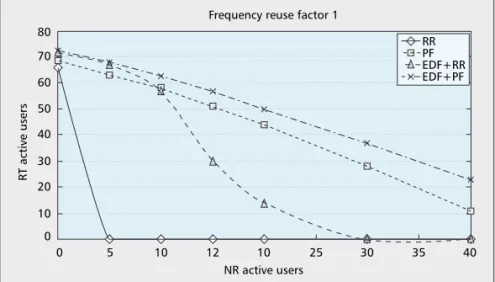
ERVICESInstead of considering only non-real-time ser-vices, mixed VoIP and non-real-time services are investigated. With 1 percent packet loss rate for VoIP and a minimum transmission rate of 50 kb/s for non-real-time services, Fig. 5 shows the trade-off in capacity between the VoIP and non-real-time services. As shown, for RR, without priority treatment (no EDF) for VoIP users, VoIP capacity will be degraded significantly
m m CINRms n s S *=arg max ( ) , =
∑
1 R n N R n N IR n m T m T massigned ( )= − ( ) ( − + − 1 1 1 1 1)), m IR n R n m m s s S m * arg max ( ) ( ) , = =∑
1■Figure 4. Minimum rate and system throughput.
NR active users
Frequency reuse factor 1
10 0 0 50 Minimum rate (kb/s) PHY throughput (Mb/s) 100 150 200 250 300 0 1 2 3 4 5 6 20 30 40 50 60 70 80 90 100 RR (min rate) PF (min rate) Max (min rate) Fair (min rate) RR (throughput) PF (throughput) Max (throughput) Fair (throughput) HUANG LAYOUT 2/1/07 12:31 PM Page 24
when non-real-time traffic is introduced. But with EDF control, VoIP capacity will be held initially until the non-real-time users reach a cer-tain number. On the other hand, with PF alone the VoIP capacity can hold and will be degraded only linearly with the increase of non-real-time users. With EDF, all VoIP capacity in different scheduler controls is improved. In other words, the priority treatment on VoIP can smooth the degradation caused by the increase of non-real-time traffic.
V
IDEOS
TREAMINGS
ERVICESFinally, we examine the transmission quality of video streaming services by exploring the option of the multiconnection feature. In mobile WiMAX, there is an option of estab-lishing multiple connections for a single appli-cation. In other words, it is possible to transmit/receive different priority packets on different connection IDs. To examine the trans-mission performance of the video streaming service, we consider H.264/AVC-based scalable video coding (SVC) developed to provide high-quality streaming under various transmission bandwidths.
The scalable extension of H.264/AVC is the latest SVC standard. It is developed by the Joint Video Team (JVT) formed by the International Standards Organization/International Elec-trotechnical Commission (ISO/IEC) MPEG and ITU-T, and is aimed to simultaneously provide three-dimensional scalabilities with good com-pression efficiency. To support spatial scalability, the video is decomposed into several layers. Each layer can be encoded separately or get pre-diction from the lower spatial layers to remove redundancy. In each spatial layer, the data can be separated into several signal-to-noise ratio (SNR) layers by two means. Coarse-grained scal-ability (CGS) means the bitstream can only be truncated at several predefined points, while fine-grained scalability (FGS) means the bit-stream can be truncated at any position. Note that in the standard, the first SNR layer in a spa-tial layer is restricted to CGS. To support tem-poral scalability, a hierarchical prediction structure is used. The pictures in a group of pic-tures (GOP) are dyadic decomposed into several layers, including base layers and enhanced lay-ers. Basically, compared to enhanced-layer pack-ets, base-layer packets are critical and need to be delivered successfully. For more details of SVC, please refer to [9–12].
To support multiple connections between the BS and MS, the data sent to the BS from the streaming server is allocated into several connec-tions according to importance levels, as shown in Fig. 2. The more important data is allocated to the connection that has more protection (i.e., higher transmission priority and MAC retrans-mission). To address the bandwidth fluctuation effect, in the proposed two-connection imple-mentation the server allocates important data to the first connection and the remaining data to the second connection. Thus, the BS needs to retransmit only the more important data when the real bandwidth is smaller than the expected bandwidth.
Figure 6 shows the SDU failure rate of
impor-tant video packets in the two-connection and one-connection scenarios. By considering the failure rate of important video packets only, from Fig. 6 it is obvious that the two-connection scenario has better control of the failure rate of important video packets even when cell loading increases. The type0 failure rate of one connec-tion is the loss of important packets from the one-connection-only delivery.
C
ONCLUSIONS AND
R
ECOMMENDATIONS
In this article, to support mixed VoIP and non-real-time services in mobile WiMAX, we have shown that a proper choice of good scheduling control is critical. Of all options, PF can be con-sidered a good scheduling control algorithm for non-real-time services. Priority treatment for VoIP services is important and can minimize the degradation caused by the introduction of non-real-time services. For H.264/AVC-based scal-able video streaming, it is critical to assign multiple connections to a single streaming appli-cation by separating the layered video packets into two different connections with different treatments in protection and retransmission. With the implementation of multiconnection, transmission quality can be maintained even with increasedd cell loading.
■Figure 5. The trade-off in capacity between VoIP and non-real-time services.
NR active users Frequency reuse factor 1
10 0 0 10 RT active users 20 30 40 50 60 70 80 5 12 10 25 30 35 40 RR PF EDF+RR EDF+PF
■Figure 6. The SDU failure rate of important video packets in two-connection
and one-connection scenarios.
Cell loading 0.7
0.65 0 0.02
SDU failure rate 0.04
0.06 0.08 0.1 0.12
0.75 0.8 0.85 0.9 0.95 CON#1 failure rate of 2-connection scenario
Type0 failure rate of 1-connection scenario HUANG LAYOUT 2/1/07 12:31 PM Page 25
A
CKNOWLEDGEMENTThe authors would like to thank Taiwan ITRI’s support in providing a generic mobile WiMAX simulation platform and the discussions through-out this study. This work was founded by Medi-aTech — NCTU Research Fund and Taiwan MOE ATU Program 95W803C.
R
EFERENCES[1] IEEE 802.16-2004, “IEEE Standard for Local and Metropolitan Area Networks Part 16: Air Interface for Fixed Broadband Wireless Access Systems,” Rev. of IEEE 802.16-2001, 2005, pp. 0_1–857.
[2] IEEE 802.16e-2005 and IEEE 802.16-2004/Cor 1-2005 (Amendment and Corrigendum to IEEE Std 802.16-2004), “IEEE Standard for Local and Metropolitan Area Networks Part 16: Air Interface for Fixed and Mobile Broadband Wireless Access Systems Amendment 2: Physical and Medium Access Control Layers for Com-bined Fixed and Mobile Operation in Licensed Bands and Corrigendum 1,” 2006, pp. 0_1–822.
[3] A. Ghosh et al., “Broadband Wireless Access with WiMax/802.16: Current Performance Benchmarks and Future Potential,” IEEE Commun. Mag., vol. 43, no. 2, Feb. 2005, pp. 129–36.
[4] C. Wengerter, J. Ohlhorst, and A. G. E. von Elbwart, “Fairness and Throughput Analysis for Generalized Pro-portional Fair Frequency Scheduling in OFDMA,” 2005
IEEE 61st VTC, vol. 3, 30 May–1 June 2005, pp.
1903–07.
[5] S. Yoon et al., “System Level Performance of OFDMA Forward Link with Proportional Fair Scheduling,” 2004
15th IEEE Int’l. Symp. Pers., Indoor and Mobile Radio Commun., vol. 2, 5–8, Sept. 2004, pp. 1384–88.
[6] S. Ryu et al., “Urgency and Efficiency Based Packet Scheduling Algorithm for OFDMA Wireless System,”
2005 IEEE ICC, vol. 4, 16–20, May, 2005, pp. 2779–85.
[7] F. M. Chiussi and V. Sivaraman, “Achieving High Utiliza-tion in Guaranteed Services Networks using Early-Dead-line-First Scheduling,” 6th Int’l. Wksp. QoS, 18–20 May 1998, pp. 209–17.
[8] C. Y. Huang, M. S. Lin, and H. H. Juan, “Radio Resource Management in Mobile WiMAX Systems,” 2006 Wireless
and Optical Comm. Conf., HangZhou, China, Oct 2006.
[9] ITU-T and ISO/IEC JTC1 JVT-R201, “Joint Draft 5: Scal-able Video Coding,” Jan. 2006.
[10] ITU-T and ISO/IEC JTC1 JVT-R202, “Joint Scalable Video Model JSVM-5,” Jan. 2006.
[11] H. Schwarz, D. Marpe, and T. Wiegand, “Comparison of MTCF and Closed-Loop Hierarchical B Pictures,” ITU-T and ISO/IEC JTC1, JVT-P059, July 2005.
[12] J. R. Ohm, “Advances in Scalable Video Coding,” Proc.
IEEE, vol. 93, no. 1, Jan. 2005, pp. 42–56.
B
IOGRAPHIESCHINGYAOHUANG([email protected]) received his B.S. degree in physics from National Taiwan University in 1987, and his Master’s and Ph.D. degrees in electrical and computer engineering from New Jersey Institute of Tech-nology (NJIT) and Rutgers University (WINLAB) in 1991 and
1996, respectively. He joined AT&T, Whippany, New Jersey, and then Lucent Technologies in 1996, and was a system engineer for THE AMPS/PCS Base Station System Engineer-ing department until 2002. In 2001 and 2002 he was an adjunct professor at Rutgers University and NJIT. In 2002 he joined the Department of Electronics Engineering, National Chiao Tung University, Taiwan, as an assistant professor and as a director of the NCTU Technology Licens-ing Office since 2003. He is the recipient of the Bell Labs Team Award from Lucent in 2002 and the Best Paper Award from IEEE VTC Fall 2004. His research areas include wireless medium access controls, radio resource manage-ment, scheduler control algorithms for wireless high-speed data systems, end-to-end performance, and provisioning strategies. He has published more than 50 technical mem-oranda, journal papers, and conference papers, and is the author of a chapter in Handbook of CDMA System Design,
Engineering and Optimization. Currently, he also has 12
patents and 20 pending patents.
HUNG-HUIJUAN([email protected]) received his Bachelor’s degree in electronics engineering from NCTU in 2004. Currently he is a Ph.D. student in Electronics Engi-neering at NCTU. His research interests currently include cross-layer radio resource management, mobility manage-ment, and QoS provisioning in mobile wireless systems. MENG-SHIANGLIN([email protected]) received his Bachelor’s and Master’s degrees in electronics engineering from NCTU in 2004 and 2006, respectively. In August 2006 he jointed MediaTek Corporation, which is a professional fabless IC company. He is currently involved in the design and implementation of mobile WiMAX products.
CHUNG-JUCHANG([email protected]) received B.E. and M.E. degrees in electronics engineering from NCTU, Hsinchu, Taiwan, in 1972 and 1976, respectively, and a Ph.D. degree in electrical engineering from National Taiwan University in 1985. From 1976 to 1988 he was with Telecommunication Laboratories, Directorate General of Telecommunications, Ministry of Communications, Taiwan, as a design engineer, supervisor, project manager, and division director. He also acted as a science and technical advisor for the Minister of the Ministry of Communications from 1987 to 1989. In 1988 he joined the faculty of the Department of Communication Engineering, College of Electrical Engineering and Computer Science, NCTU, as an associate professor. He has been a professor since 1993. He was director of the Institute of Communication Engi-neering from August 1993 to July 1995, chairman of the Department of Communication Engineering from August 1999 to July 2001, and dean of the Research and Develop-ment Office from August 2002 to July 2004. Also, he was an advisor to the Ministry of Education to promote the education of communications science and technologies in colleges and universities in Taiwan, 1995–1999. He is act-ing as a committee member of the Telecommunication Deliberattion Body, Taiwan. Moreover, he serves as an Edi-tor for IEEE Communications Magazine and an Associate Editor for IEEE Transactions on Vehicular Technology. His research interests include performance evaluation, radio resources management for wireless communication net-works, and traffic control for broadband networks. He is a member of the Chinese Institute of Engineers.
To support mixed
VoIP and non-real
time services in
Mobile WiMAX, we
have shown that a
proper choice of
good scheduling
control is critical.
Among all, PF can
be considered as a
good scheduling
control algorithm
for non-real time
services.
HUANG LAYOUT 2/1/07 12:31 PM Page 26