
影響中文雙賓動詞句型結構之因素
115
0
0
全文
(2) 摘要 雙賓動詞的句子結構長久以來都是語言學界關心的焦點。本文研究焦點特別 著重於影響雙賓動詞句子結構的重量問題。根據 Quirk et al. (1972)的研究指 出,通常越重的結構越會放在句子的後面。然而對於如何定義結構重量至今在學 界尚未有一個明確的定義。因此,本研究試著釐清所謂的重量是如何定義出來的。 此外,根據張蘭心(2001)的研究指出,回聲效應對於雙賓動詞的句型選擇上 也有影響。在受試者回答問題時,受試者傾向於重複之前所聽到問句的句型結 構。因此,本研究也探討當回聲效應以及結構重量問題都出現時,受試者將會如 何的做出選擇。 本文採用問卷研究以及語料庫蒐集的方式進行研究。問卷包含句子喜好程度 測試以及情境問題選項。研究結果指出影響句子結構重量的問題有包含句子結構 的複雜度以及句子本身字數的多寡,同時回聲效應也是影響雙賓動詞的因素之 ㄧ。除此之外,影響雙賓動詞的因素還包含了另外許多的其他因素,不可光從句 子的重量問題來探討。 關鍵字: 雙賓動詞,回聲效應,結構重量. ii.
(3) ABSTRACT The issue of dative alternation construction has long been a debated topic in the linguistics field. This thesis especially focuses on the grammatical weight interpretation. Quirk et al. (1972) stated the end-weight rule, which predicted that people tended to put the NP which is heavier at the final position of a sentence. However, how to define the heaviness of NP is still in debate. Ross (1967) claimed that an NP is heavy if it dominates “a sentence”. Emonds (1976: 112) argued that an NP is called as heavy in the complex NP shift is that the NP dominates an S or PP. On the other hand, Hawkins (1990, 1994) proposed the idea that the heaviness is determined by the number of words dominated by a NP. Therefore, this thesis tries to shed some light on the precise definition of grammatical weight for Chinese native speakers. Secondly, Chang (2001) argued that the echo effect was prominent for Chinese native speakers to determing the dative word order variation. The subjects tended to echo the question pattern when they responded to that question. Hence, this thesis also tries to investigate the phenomenon when the echo effect issue meets with the grammatical weight interpretation. Judgment task, contextual questions task and corpus analysis are adopted in this study. Contextual questions task tries to investigate the subjects’ response to a contextual question which contains dative verbs. The purpose of this contextual questions task is to know when the complexity effect meets with the echo effect, what is more determining. The judgment task tests the participants’ judgment on the grammaticality of sentences which contains dative alternation. The purpose of this questionnaire is to see if the complexity of a NP contributes to the determining of a dative alternation construction. The corpus used is Chinese Word Sketch corpus developed by Academia Sinica. There are 253 sentences in total. I try to consider the length of the constituents and the complexity of constituents in dative alternation. iii.
(4) In the first section of the questionnaire, the result shows that the Chinese native speakers are both sensitive to the echo effect and the complexity effect. Besides, the preference for the dative sentence type is also found based on the result. In the second section of the questionnaire, the result indicates that the Chinese native speakers are indeed sensitive to the complexity of a NP. The subjects tend to rate the sentences which contains a more complex NP at the final position of a sentence more acceptable than that at the middle of a sentence. In addition, the preference of the dative sentence type is also found in the result. In the corpus study, the results show that subjects are both sensitive to the complexity of constituents and length of constituents. In conclusion, the Chinese native speakers in this study shows sensitivity to both the complexity effect, length effect and echo effect. Furthermore, in both questionnaires, the preference for the dative sentence type is identified. This preference can be explained through the unmarked property of the dative sentence type in Chinese. Key words: dative alternation, grammatical weight, echo effect. iv.
(5) ACKNOWLEDGEMENTS When I look back on the process of my academic research, I feel so grateful to a number of people for their being generous with their constant help and guidance. This master thesis would not have been possible to complete without the assistance and support of those individuals. First, I would like to show my sincere gratitude to my advisor, Dr. Shu-ing Shyu. Dr. Shu-ing Shyu is a hard-working and active researcher. Dr. Shu-ing Shyu trained me strictly and inspired me to become a serious acedemic thinker. During the time of the writing of this thesis, she always offerd me a variety of ways to think and taught me to be critical about the related refereces I have read. I would also like to express my deepest gratitude to my thesis committee, Dr. Lan Hsin Chang, Dr. Huei Lin Lin, and Dr. Hui Chin Lin who gave me their critical advice on my study that made my research more organized and robust. I would like to express my deepest gratitude to the teacher Jane and her students in Guo-guang senior high school who assisted in filling out the questionnaires. Jane allowed me to conduct research in their classes, and kindly offered me any help that I needed during and after the research. I am sincerely honored to have the students be my subjects. I give my sincere thanks to my dear friends, Belinda, Candice, Cathy, and Yali. Their friendship gave me confidence and kept me in great spirits. Without their valuable friendship, I would not have been able to overcome the long journey of completing this thesis. Last but not least, I want to thank my parents and my dear soul mate Jackie for their total support and sacrifice. I finished this thesis with love and gratitude to them.. v.
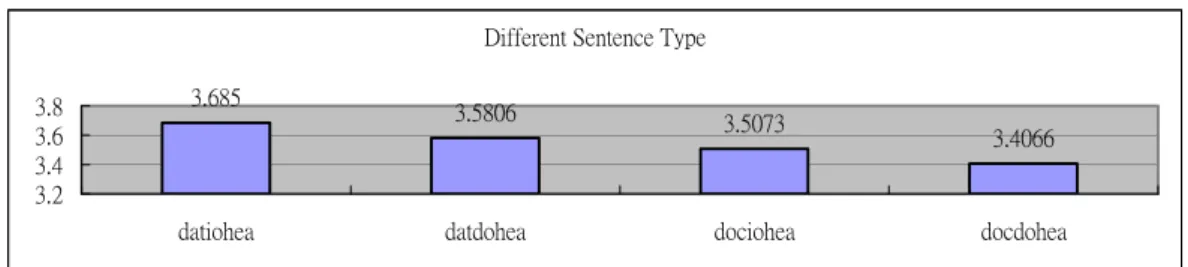
(6) Table of Contents ABSTRACT..................................................................................................................ii ACKNOWLEDGEMENTS ........................................................................................v LIST OF TABLES.................................................................................................... viii LIST OF FUGURES ...................................................................................................ix Chapter One Introduction...........................................................................................1 1.1 Introduction and Motivation ............................................................................1 1.2 Rationale for This Study ..................................................................................2 1.3 Overview of Chapters ......................................................................................3 1.4 Definition of Key Terms..................................................................................3 Chapter Two Literature Review .................................................................................6 2.1 Dative Constructions in Chinese......................................................................6 2.1.1 Different Accounts of Dative Constructions in Chinese.......................6 2.1.2 The Interpretation of Gei ....................................................................10 2.1.3 The Properties of Double Object Construction...................................15 2.2 Dative Alternations in English.......................................................................17 2.3 Possessor Effect .............................................................................................18 2.4 Function of Grammatical Weight Interpretation............................................21 2.5 The role of grammatical weight.....................................................................24 2.6 Syntactic priming effects ...............................................................................32 Chapter Three Methodology.....................................................................................36 3.1 Part A of the Questionnaire: Preference judgment task.................................36 3.1.1 Material ...............................................................................................38 3.1.2 Subject.................................................................................................41 3.1.3 Data collection ....................................................................................41 3.2 Part B of the Questionnaire: Contextual questions ........................................42 3.2.1 Material ...............................................................................................50 3.2.2 Procedure ............................................................................................50 3.2.3 Subjects ...............................................................................................51 3.2.4 Data collection ....................................................................................51 3.3 Corpus Analysis .............................................................................................51 3.3.1 Material ...............................................................................................52 Chapter Four Results and Discussion ......................................................................53 4.1 Part A of the Questionnaire: Preference judgment test..................................53 4.1.1 Discussion ...........................................................................................54 4.1.1.1 Preference for dative sentence type .........................................56 4.1.1.2 Ambiguity avoidance ...............................................................57 4.2 Part B of the Questionnaire: Contextual questions ........................................58 vi.
(7) 4.2.1 Discussions .........................................................................................60 4.2.1.1 Preference for dative sentence type .........................................61 4.2.1.2 Influence from the context .......................................................62 4.3 Corpus analysis ..............................................................................................64 4.3.1 Information status ...............................................................................69 4.3.2 Discussions .........................................................................................72 Chapter Five Conclusion, Limitations, and Suggestions........................................74 5.1 General conclusion.........................................................................................74 5.2 Limitations of the study .................................................................................76 5.3 Suggestions for further study .........................................................................76 REFERENCES...........................................................................................................77 APPENDIX A QUESTIONNAIRE PART A ...................................................81 APPENDIX B QUESTIONNAIRE PART B ...................................................82 APPENDIX C CORPUS DATA...........................................................................91. vii.
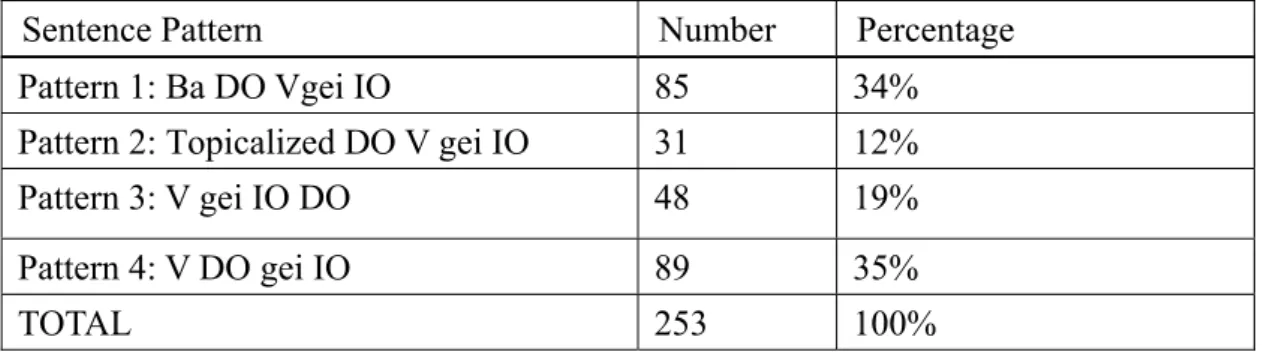
(8) LIST OF TABLES Table 1 Summary of dative verbs in Mandarin Chinese................................8 Table 2 Expected frequency for the effect of complexity............................37 Table 3 Question patterns in contextual questions.......................................43 Table 4 Question patterns in questionnaire B ..............................................59 Table 5 Corpus result of different sentence patterns....................................66. viii.
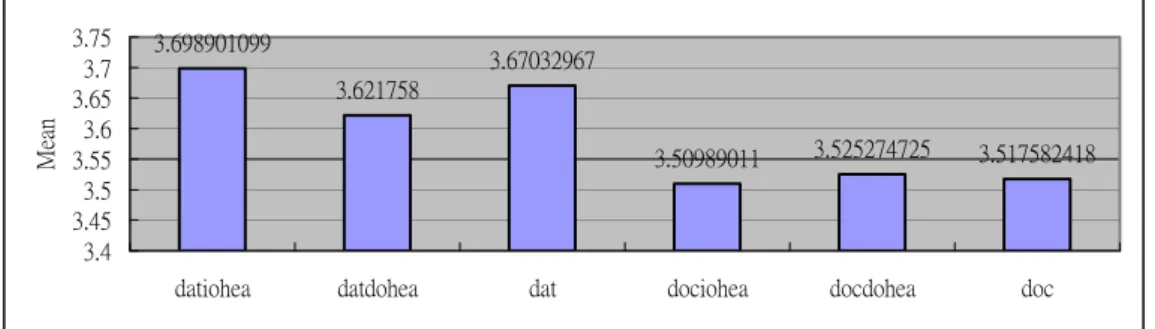
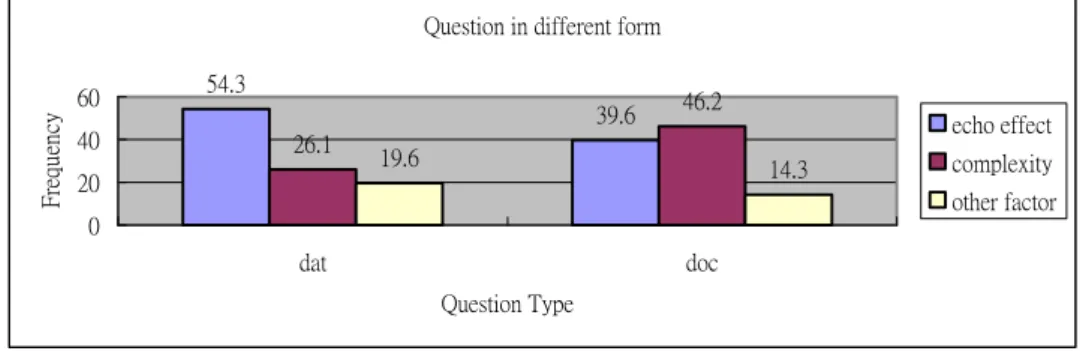
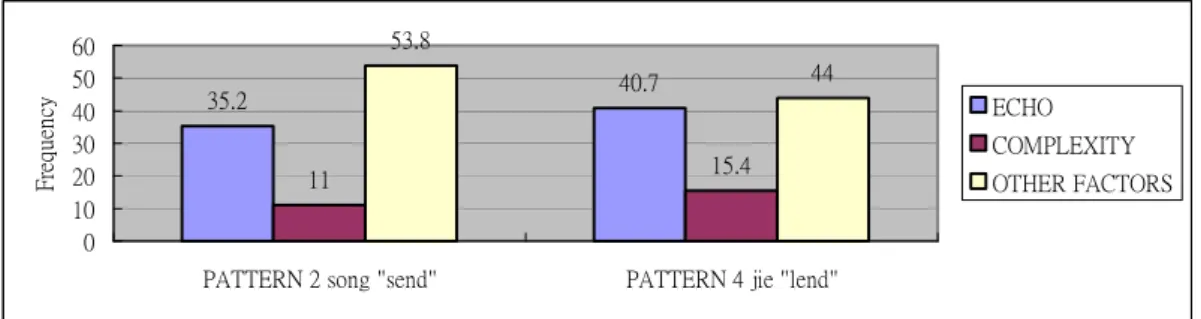
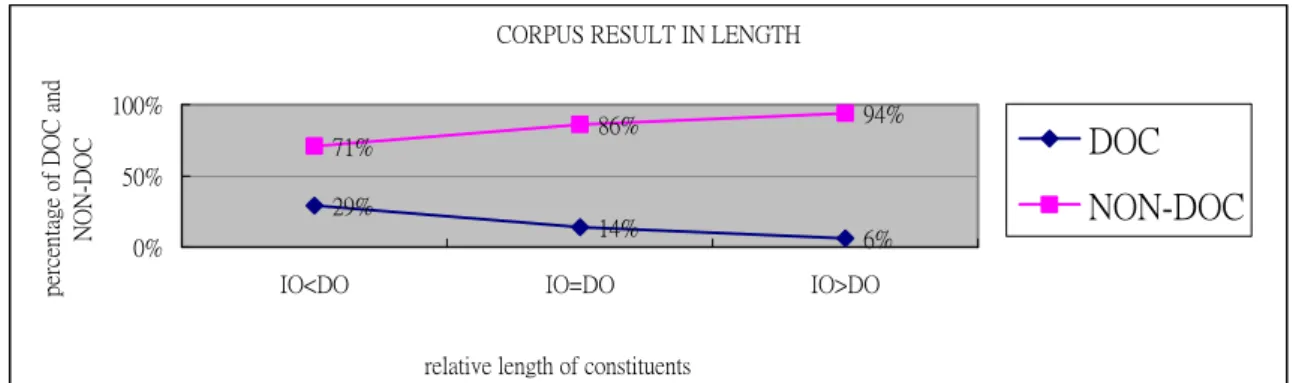
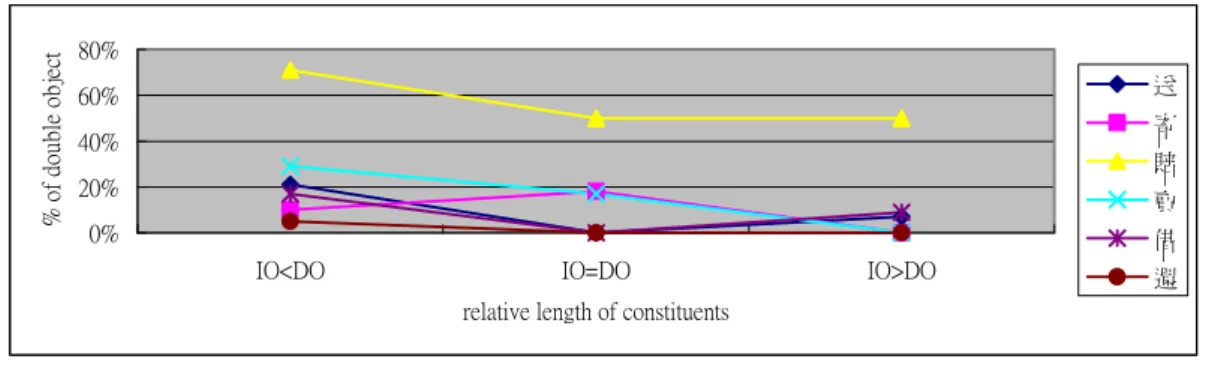
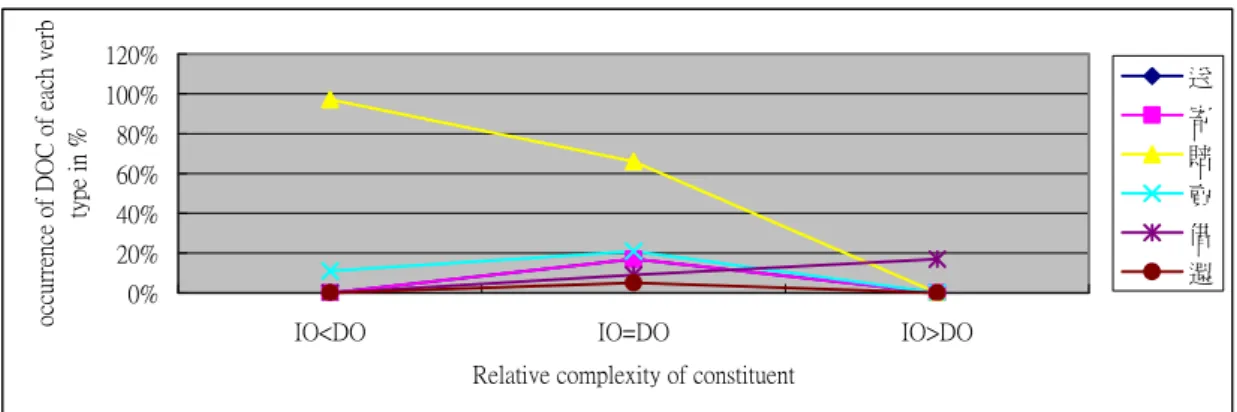
(9) LIST OF FUGURES Figure 1 Result of means of different sentence types ..................................53 Figure 2 Sentences containing pei “compensate”........................................55 Figure 3 Result without pei “compensate” ..................................................55 Figure 4 Results of question in different sentence type ...............................59 Figure 5 Results of song “give” in pattern 2 and jie “lend” in pattern 4 .....62 Figure 6 Results of corpus in length ............................................................67 Figure 7 Corpus result of different verbs in length......................................68 Figure 8 Corpus result of complexity ..........................................................68 Figure 9 Corpus result of different verbs in complexity..............................69 Figure 10 Corpus result in information structure.........................................70 Figure 11 Same grammatical weight with information structure ................71. ix.
(10) Chapter One Introduction. 1.1 Introduction and Motivation The issue of dative alternation has long been a debated topic in the linguistic field. Many different proposals have been raised to account for the English dative alternation, such as, the weight effect, information structure, and animacy effect. Moreover the general accepted conclusion is that given elements tend to be followed by new ones (Quirk et al., 1985), lighter elements precede heavy ones (Hawkins 1994, Wasow 2002), and animated elements precede inanimate ones (Mcdonald et al., 1993). The purpose of the thesis is to, first, investigate whether complexity of constituents and length of constituents are both factors influencing the word order variation, namely the dative alternation. Second, when grammatical weight interpretation meets with echo effect, which one is more determining for the Chinese native speakers on the choice of dative alternation? Corpus analysis and two parts of questionnaire are adopted in this study. The first part of the questionnaire in this study is to test the Chinese native speakers’ perception on the dative alternation. That is, the subjects are given sentences containing direct object and indirect object, and the participants are asked to judge the acceptability of the sentences based on their intuition. The number of words in the direct object and the indirect object is controlled to be the same but differs in complexity. In other words, either the direct object or the indirect object contains a clause. The aim to control the number of words is to exclude the possible influence from the length of words since the length of words is also a possible factor contributing to the grammatical weight. The purpose of the preference judgment task is to investigate 1.
(11) whether the subjects consider the sentences which contain a heavy NP at the final position a more acceptable alternation or not. If the subjects judge these sentences including a heavier NP at the final position more acceptable, we may claim that complexity of NP might play a role in determining the dative alternation. In the second part of the questionnaire, the researcher has tried to focus on the interplay between complexity of NP and the echoicity effect. In this contextual question task, the subjects hear a context followed by a question. The participants are asked to circle the most appropriate answer to the question based on what they have heard and their intuition. There are three answers after each question for the participants to choose from. Besides, all the three answers are read by the researcher in front of the participants. One of the choices echoes the question pattern. Another choice concerns about the complexity effect. The other choice is considered to be influenced by unpredicted factors. The third part is the corpus analysis. Wasow (2002) claimed that the actual usage of data is important when considering the word order variation. The corpus is selected from Chinese Word Sketch corpus by Academia Sinica. In the corpus analysis, the length of the constituents and the complexity of constituents in the 253 sentences are both considered.. 1.2 Rationale for This Study In the literature, the precise definition of grammatical weight in the dative word order variation is still in debate. Ross (1967), Emonds (1976, p. 112) and Chomsky (1975, p. 477) claimed that the heaviness of an NP is determined by the complexity of the NP. On the other hand, Hawkins (1990, 1994) argued that heaviness of an NP is categorized by the length of NP. Besides, few studies have investigated the grammatical weight interpretation in Chinese. Therefore, a study investigating the 2.
(12) grammatical weight interpretation in Chinese is needed. Secondly, according to Chang (2001), Chinese subjects were sensitive to the echo effect in determination of the dative word order variation. However, few studies have investigated the interplay of the echo effect and grammatical weight interpretation in the dative word order variation. As a consequence, my study exploring the interaction of the echo effect and the grammatical weight in dative word order variation may be needed.. 1.3 Overview of Chapters Chapter two introduces the debate over the dative alternation word order in the literature, and some possible explanations to the dative word orer variation, including the End-Weight rule, grammatical weight, and echo effect. Chapter three describes the methodology such as the participants, instrument, procedure, data analysis. Chapter four presents the results and discussion of the study. Chapter five presents the summary and conclusion of this study, limitations of this study and further suggestion.. 1.4 Definition of Key Terms Grammatical Weight According to Quirk et al. (1972), end-weight rule was stated as to put the heavier NP at the end of a sentence. However, Quirk et al. (1972) didn’t define what exactly a heavy NP is. Ross (1967), Emonds (1976) and Chomsky (1975) claimed a heavy NP was to be syntactically complex, for example, containing a clause. Hawkins (1990, 1994) defined a heavy NP by the length of the NP, namely the total words. Niv (1992) argued that the heaviness of NP is formalized by givness in the discourse. In this thesis, I try to approach heaviness by complexity of NP and length of NP. Echo Effect and Syntactic Priming Effect 3.
(13) Echo effect was proposed by Chang (2001), which stated that the subjects tended to repeat the sentence structure of the questions when answering the questions. Repetition can mean repetition of words, repetition of phrases, or repetition of sentence structures. Chang (2001) defined the echo effect as the repetition of sentence structures because she focused on the sentence structure but not the repetition of words or phrases. The syntactic priming effect is similar to the echo effect proposed by Chang. Ferreira & Bock (2006) proposed that syntactic priming effect meant that the speakers repeated or echoed the sentence pattern which the speakers had previously heard or produced. Ferreira & Bock also proposed that the syntactic priming effect was to repeat the sentence pattern the speakers had previously heard or produced. Thus, the two terms, echo effect and syntactic priming effect were used in turn in the thesis. Dative Alternation It is a form of systactic pattern in some languages. In this pattern, the verbs have two objects, the indirect object and the direct object. The indirect object usually refers to the place, the goal, or the beneficier. As for the direct object, it usually refers to the object that is being transferred or that is under discussion. In the following discussions, the indirect object is shorted as IO for the convenience of discussion, and the direct object is shortened as DO. The dative alternation contains two possible patterns. One is the IO DO order, eg. I give Mary a book. The IO DO order is termed as double object construction. Moreover, the double object construction will be abbreviated as DOC in the following sections. The other one is the DO IO order, eg. I give a book to Mary. As for the DO IO order, it is termed as dative construction, which will be abbreviated as DAT in the following chapters. No matter which pattern is used, the meaning of the alternation is the same. In addition, both the DO IO order and the IO DO order are grammatical. 4.
(14) Animate Element/Inanimated element Goldsmith (1980) proposed the concept of animate and possessor to account for the dative alternation. The animate concept means that the object under discussion is a living creature. On the contrary, if the object being discussed is not a living creature, it is inanimated. Take the desk for example. A desk is not a living creature, so it is inanimated. However, a teacher is a living creature, thus it is animate. Goldsmith argued that the primary object in the double object construction was usually animate and the possessor of the second object, eg. I owe one hundred dollars to John. The sentence is grammatical because John is animate. 5.
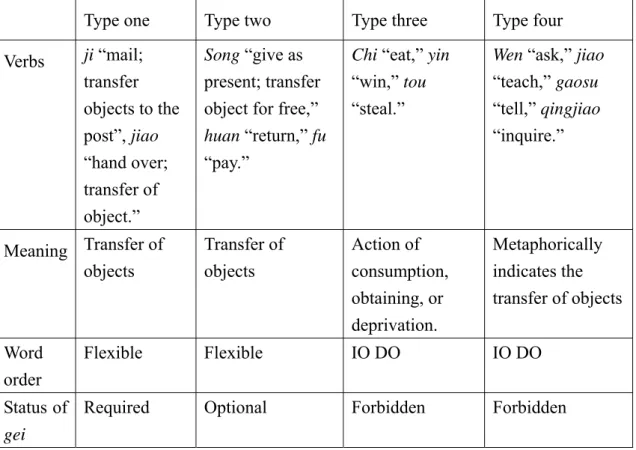
(15) Chapter Two Literature Review. The dative alternation includes two variants: the dative construction (DAT), e.g., John gave a pen to Tom and the double object construction (DOC), e.g., John gave Tom a pen. As can be seen from the above two sentences, the dative alternation is a choice between the two variants DAT and DOC. DAT contains a transitive verb followed by a direct object (DO) and a prepositional phrase containing an indirect object (IO); DOC includes a verb followed by two NPs as objects. In DAT, the first NP is usually called direct object (DO) and the second object is often termed as indirect object (IO). In DOC, the first NP is usually called indirect object (IO) and the second object is often termed as direct object (DO). The direct object is usually referred to be the theme, and the indirect object is often called the goal or the recipient.. 2.1 Dative Constructions in Chinese The following presents the dative verbs in Mandarin Chinese and the different interpretations of gei.. 2.1.1 Different Accounts of Dative Constructions in Chinese Tang (1979) suggested four different types of dative verbs based on their meanings, the order of DO and IO, the syntactic transformations, and the requirement of gei. The syntactic transformations that serve as the classification criteria for the four types of verbs are: (1) BA constructions, (2) lian constructions, (3) topicalization, (4) passivization, (5) relativization, and (6) clefting. Type One verb includes ji “mail,”. 6.
(16) jiao “hand over.” Type One denotes the transfer of objects. The subject transfers the DO (direct object) to the IO (indirect object.) Gei is required and the IO must co-occur with gei. The order of DO and IO is flexible: IO can either precede or follow the DO. In addition, the omission of IO is acceptable; while the omission of DO is not. As for the six syntactic transformations, only DO can have passivization, relativization, topicalization, cleft sentences and can be preposed in BA constructions and lian construction. Type Two verbs behave quite like Type One verbs. Type Two verbs include song “give as present,” huan “return,” fu “pay.” Type Two verbs also denote the transfer of objects. The word order of IO and DO is also flexible and the IO also has to co-occur with gei. The omission of IO is acceptable; while the omission of DO is not. As for the status of gei, gei is optional and can be omitted when the IO precedes DO. DO is the only one that can be preposed in BA constructions and passivization. Both DO and IO can occur in lian constructions, topicalization, relativization, and clefting. Type Three verbs include chi “eat,” yin “win,” tou “steal.” These verbs behave quite different from the previous two types. Type Three verbs denote the action of consumption, obtaining, or deprivation. The word order is fixed: IO must precede DO. Gei is forbidden in this type. IO can be omitted but the omission of DO is not acceptable. Both DO and IO cannot occur in the BA constructions. Only the IO can be preposed in the lian construction and passivization. The movement of IO in the topicalization, relativization, and clefting seems more acceptable than DO. The fourth type verbs include wen “ask,” jiao “teach,” gaosu “tell,” and qingjiao “inquire.” The fourth type of verbs metaphorically indicates the transfer of objects. The verbs behave like Type Three verbs. The word order is fixed: IO must precede DO. Gei is forbidden. Both DO and IO can be omitted. Both DO and IO can occur in lian construction, topicalization, relativization, and clefting. But for BA constructions 7.
(17) and passivization, some difference appeared. In the BA constructions, the DO of jiao “teach” can be preposed; however, neither the DO nor the IO of the verb wen “ask” can be preposed. In addition, for verbs like wen “ask,” the IO can be passivized; whereas for the verbs like jiao “teach,” neither the DO nor the IO can be passivized. In addition to the above four types of verbs, there are still some verbs which Tang (1979, p. 367) called “bi-directional” verbs. This kind of verbs has two different directions considering its meaning, the outward meaning and the inward meaning. The outward meaning means the action is from the subject to the IO and gei is required. The inward meaning means the action is from the IO to the subject and gei is forbidden. The bi-directional verbs include mai “buy,” zu “rent,” jie “lend/borrow.” Tang proposed detailed classification criteria of the dative verbs in Mandarin Chinese. The following table is the summary of the four types of verbs.. Type one. Type two. Type three. Type four. ji “mail; transfer objects to the post”, jiao “hand over; transfer of object.”. Song “give as present; transfer object for free,” huan “return,” fu “pay.”. Chi “eat,” yin “win,” tou “steal.”. Wen “ask,” jiao “teach,” gaosu “tell,” qingjiao “inquire.”. Meaning Transfer of objects. Transfer of objects. Action of consumption, obtaining, or deprivation.. Metaphorically indicates the transfer of objects. Word order. Flexible. IO DO. IO DO. Optional. Forbidden. Forbidden. Verbs. Flexible. Status of Required gei. Table 1 Summary of dative verbs in Mandarin Chinese. 8.
(18) In Chinese, gei must occur with a verb denoting the process of transaction. Thus, the semantic function of the coverb gei is to identify the goal of the transaction expressed by the verb (Li & Thompson 1981, p. 383). Li & Thompson (1981) proposed that Chinese dative verbs can be classified into three types based on the status of gei. The three types of verbs are the gei-required verbs, the gei-optional verbs, and the gei-forbidden verbs. The gei-required verbs include fen “share,” na “take,” zu “rent,” mai “sell,” xie “write,” shu “lose,” di “pass.” The gei-optional verbs contain verbs like jie “lend,” song “give as present,” jiao “teach,” fu “pay.” The gei-forbidden verbs include verbs like gei “give,” gaosu “tell,” daying “promise,” huida “answer,” wen “ask,” tou “steal,” qianjiao “ask for enlightment,” ying “win,” qiang “rob,” duo “snatch.” Based on Li & Thompson, the gei-forbidden verbs can be further classified into three sub-groups according to their meanings. The first group consists simply of the verb gei itself. Since the coverb gei is historically derived from the verb gei, there is no historical basis for the two to occur. The second group of verbs like gaosu “tell,” daying “promise,” and wen “ask” denote the meaning of linguistic communication or words are being spoken. Since gei literally functions to mark goals in transactions, and the above mentioned verbs involved no transactions taking place, there is no need for these verbs to co-occur with gei. The third type includes ying “win,” qiang “rob,” duo “snatch,” and tou “steal.” In these verbs, the transfer is from the IO to the subject, so gei is forbidden to these verbs since there is no transfer for an object to the IO. In conclusion, Li & Thompson grouped the Chinese dative verbs into three types: the gei-required verbs, the gei-optional verbs, and the gei-forbidden verbs. In addition, Li & Thompson further divided the gei-forbidden verbs into three sub-types, and offered explanations based on their meanings.. 9.
(19) 2.1.2 The Interpretation of Gei Gei can both function as a verb or a preposition. When it functions as a preposition, its usage is like the to in English; while it functions as a verb, its meaning is “giving.” Considering the sentence:. (1) Wo gei ta yi zhi bi I give him one-CL pen “I gave him a pen.” “我給他一支筆”. A. Li (1990) argues that the verb and the pronoun form a complex verb. In addition, the complex-verb analysis can be extended to the V-gei compounds, which Li views as V-V compound. As for the [V NP1 gei NP2] sequence, Li claims that it should be treated as a serial verb construction but not a counterpart of English dative construction. Similarly, Huang and Ahrens (1999) also argue that the gei in the [V NP1 gei NP2] sequence is part of a serial verb construction (SVC.) Consider the following sentences:. (2) Ta fang-le yi-ge wan zai zhuo-shang, hen youni s/he put-ASP one-CL bowl at table-top very greasy a. ‘S/he put a greasy bowl on the table.’ b. ‘*S/he put a bowl on a greasy table.’ “他放了一個碗在桌上很油膩” (3) Lisi song-le yi-ben shu gei Zhangsan Lisi give-ASP one-CL book give Zhangsan ‘Lisi gave a book to Zhangsan to read.’ “李四送了一本書給張三看”. kan. read. In (2) Huang and Ahrens argue that only the direct object wan “bowl” can be the controller of the predicate hen youni “very greasy” but not the object of the. 10.
(20) preposition zai zhuo-shang “on the table.” In (3), since Zhangsan can be the controller of the predicate kan “read,” the gei in (3) must be a verb instead of a preposition. A. Li (1990) claims the sequence [V NP1 gei NP2] is not comparable to the English dative counterpart but instead a serial verb construction. Huang & Ahrens (1999) also suggest the gei in [V NP1 gei NP2] is a verb rather than a preposition. However, Ting & Chang (2004) proposed the different view on the interpretation of the [V NP1 gei NP2]. Ting claimed that the gei should be a preposition instead of a verb. Consider the following sentences:. (4) Zhangsan song-le yi-ge wawa gei Youyou, hen piaoliang Zhangsan send-ASP one-CL doll give Youyou, very beautiful a. ‘Zhangsan gave a beautiful doll to Youyou.’ b. *’Zhangsan gave a doll to the beautiful Youyou.’ “張三送了一個娃娃給友友,很漂亮”. Ting & Chang proposed that the parallel sentence, as in sentence (3), that Huang et al. suggested was not actually a parallel construction to sentence (2). The secondary VP and AP in (3) and (2) are different constructions, because it requires a pause in the AP. However, no pause is needed in the secondary VP. Secondly, Ting further proposed that SVC allows the adverbial phrase to modify, but the post DO gei allows this on a marginal case. Generally speaking, the adverbial phrase precedes the main predicate. The difference is shown in the following sentences based on the interpretations of Ting & Chang (2004): (5)a. Zhangsan shang-ke toutoude dakeshui Zhangsan up-class unnoticeably doze-off ‘Zhangsan discretely dozed off while he was in class.‘ “張三上課偷偷地打瞌睡” b. Zhangsan. gudong. qunzhong. wuqinde 11. gongji. jingcha.
(21) Zhangsan agitate crowd mercilessly attack police ‘Zhangsan agitated the crowd to attack the police with no mercy’ “張三鼓動眾人無情地攻擊警察” (6) a. ??Zhangsan fang-le san-ben shu zhengzhengqiqide Zhangsan put-ASP three-CL book in-order ‘Zhangsan put three books on the table in an ordered way.’ “張三放了三本書整整齊齊地在桌上”. zai zhuo-shang at table-top. b. Zhangsan zhengzhengqiaide fang-le san-ben shu zai zhuo-shang Zhangsan in-order put-ASP three-CL book at table-top ‘Zhangsan put three books on the table in an ordered way.’ “張三整整齊齊地放了三本書在桌上” Considering the sentence (5) and (6), we find that the adverbial phrase may only occur before the verb instead of the preposition. As shown in (7), the adverbial modification may occur before the verb song “give” instead of gei. Hence, Ting & Chang claimed that this further proves that gei is a preposition rather than a verb.. (7) a. ??Zhangsan song-le yi-ben shu gaosingde gei Lisi Zhangsan send-ASP one-CL book happily give Lisi ‘Zhangsan gave a book to Lisi happily.’ “張三送了一本書高興地給李四” b. Zhangsan gaosingde song-le yi-ben shu gei Lisi Zhangsan happily send-ASP one-CL book give Lisi ‘Zhangsan gave a book to Lisi happily.’ “張三高興地送了一本書給李四”. In addition, Zhang (1990) also argues against a serial verb construction for the gei in the [V NP1 gei NP2] construction. Zhang proposed that the second verb in the SVC should be stranded, but the gei cannot. Consider the following sentences:. (8)a. Lisii, Zhangsan yao na gunzi da ti Lisi, Zhangsan want take stick hit ‘Lisi, Zhangsan wanted to take a stick to beat.’ 12.
(22) “李四,張三要拿棍子打” gei ti b. *Lisii, Zhangsan song yi-ben shu Lisi, Zhangsan send one-CL book give ‘Lisi, Zhangsan gave a book to.’ “李四,張三送一本書給”. In addition, Zhang argued that SVC should allow either verb to take the aspect marker –le, while the post-verbal gei cannot take –le. The following sentences show the difference.. (9)a. Zhangsan song-le yi-ben shu gei Lisi Zhangsan give-ASP one-CL book gei Lisi “Zhangsan gave a book to Lisi.” “張三送了一本書給李四”. b. *Zhangsan song yi-ben shu gei-le Lisi Zhangsan give one-CL book gei-ASP Lisi “Zhangsan gave a book to Lisi.” “張三送一本書給了李四”. In sum, different researchers propose different accounts on the gei in the [V NP1 gei NP2] sequence. A. Li (1990) claims the sequence [V NP1 gei NP2] is not comparable to the English dative counterpart but instead a serial verb construction. Huang & Ahrens (1999) also suggest the gei in [V NP1 gei NP2] is a verb rather than a preposition. On the other hand, Zhang (1990) and Ting (2004) argue that gei is a preposition. In addition to the serial verb construction and the preposition interpretation on gei, Her (2006) claimed that gei in the [V NP1 gei NP2] is a verb and also a preposition, as can be seen in (10):. 13.
(23) (10)Yuehan zhuan qian gei nupengyou sanhuo fei John earn money gei girlfriend living expensives “John earns money to afford his girlfriend’s living expenses.” “約翰賺錢給女朋友生活費”. Her considered (10) to be a serial verb construction. The object position of the VP, liwu “present”, can be a gap, as seen in (11):. (11) Yuehan zhuan qiani gei nupengyou ei John earn money gei girlfriend “John earns money to give it to his girlfriend.” “約翰賺錢給女朋友” Based on (10) and (11), Her claimed that gei can sometimes be treated as a verb. However, Her also argued that gei is also a preposition in the same position. Sentence (12) illustrates the verbal and the prepositional interpretations of gei:. (12) Yuehan jie yi qian kuai gei Mali John loan one thousand dollars gei Mary i. “John loaned one thousand dollars to Mary.” ii. “John borrowed one thousand dollarsi to give ei to Mary.” “約翰借一千塊給馬莉” According to the above examples, Her claimed that gei can either function as a verb or a preposition. When gei is used as a Goal marker, it is a preposition. When gei means “give,” it is a verb. In this thesis, Gei will be treated as a preposition here. The account of treating gei as a preposition is a straight forward way of interpreting gei. In addition, the focus of this thesis is on the choice of the dative alternation. Therefore, a straight forward analysis without the technical discussion of trace better helps the investigation of the dative alternation and can avoid the focus from being distracted from the topic I intend to explore. 14.
(24) 2.1.3 The Properties of Double Object Construction Chinese double object constructions appear in different patterns. As illustrated in (13a), gei follows after the verb. In (13b), gei is optional in the sentence. Mali “Mary” occurs immediately after the verb without gei in (13c).. Subject + Verb +Direct object + Indirect object (13)a. wo ji gei Mali yi feng xin I mail gei Mary one-CL letter “I mailed Mary a letter.” “我寄給馬莉一封信” b. wo song (gei) Mali yi ben shu I send gei Mary one-CL book “I sent Mary a book.” “我送(給)馬莉一本書” c. wo gaosu Mali yi ge gushi I tell Mary one-CL story “I told Mary a story.” “我告訴馬莉一個故事”. It may seem confusing to have so many double object constructions, thus, an overall analysis of the double object verbs may be needed. Yang (1991) suggested that verbs like ji “mail”usually take the Agent and the Patient as two arguments, eg. the Agent Mali “Mary,” and the Patient xin “letter.” These verbs indicate the physical transaction of objects but they did not denote the meaning of giving. This is why when there is a Recipient or a Goal, gei must appear. Moreover, Yang classified these verbs as gei-required verbs. Verbs like song “give” as in (13b) are like verbs ji “mail” as in (13a) in that they can co-occur with gei. However, the difference lies in that gei can be omitted in (13b) but not in (13a). Yang claimed that the difference was because verbs like song “give” not only have the meaning of transferring the object but also denote. 15.
(25) the meaning of giving. Therefore they can occur without gei. Yang thus classified these verbs as gei-optional verbs. As for verbs like gaosu “tell” in (13c), Yang suggested that they do not imply the physical transaction of objects. On the contrary, they only indicate the abstract transaction. They are defined as gei-forbidden verbs. In addition to the three types of verbs, there exists the fourth type as in (14):. (14) Lisi ying le Mali yi bai kuai Lisi win ASP Mary one hundred dollars “Lisi won one hundred dollars from Mary.” “李四贏了馬莉一百塊” Li (1990) and Yang (1991) called these verbs as source verbs since the IO, such as yi bai kuai “one hundred dollars”, in the sentence is a source rather than a goal. The indirect objects in these verbs are the source rather than the goal; therefore, the preposition gei is forbidden. Moreover, Yang also argued that for some verbs like jie “lend to or borrow from” that have directional meanings, gei plays an important role on the interpretation of the sentence for these verbs may indicate the inward or outward meaning. Consider the examples:. (15)a. wo jie le Zhangsan yi bai kuai I borrow/lend ASP Zhangsan one hundred dollars “I borrowed one hundred dollars from Zhangsan.” or “I lent one hundred dollars to Zhangsan” “我借了張三一百塊” b. wo. jie. gei. le. Zhangsan yi. bai. kuai. I lend to ASP Zhangsan one hundred dollars “I lent one hundred dollars to Zhangsan.” “我借給了張三一百塊”. In (15a), the sentence meaning may be ambigious for two interpretations may be got 16.
(26) from the sentence: the inward interpretation (borrow from) or the outward interpretation (lend to). However, if gei is placed after the verb in (15b), the outward interpretation can be clearer. In sum, Yang classified the requireness of gei based on that if verbs themselves carry the meaning of giving or denote the meaning of the transferring of the object to the recipient, gei is optional; otherwise, gei is required. The appearance of gei is related to the subcategorization of the verbs. As for gei-optional verbs, they subcategorize the theme and the recipient; therefore, gei can be optional. On the contrary, the gei-required verbs subcategorize only the theme, therefore, when a recipient appears, gei must be presented.. 2.2 Dative Alternations in English Different researchers have proposed different explanations to the dative alternation. The followings are the different approaches accounting for dative alternation. Some issues have been raised concerning the dative alternation in the literature. First, some verbs allow both double object construction and dative sentence construction; whereas others do not. For example: (16) a. Nancy gave a book to Mary. b. Nancy gave Mary a book. (17) a. Eric donated some money to the hospital. b.* Eric donated the hospital some money. To analyze, sentence (16a) and (16b) are both acceptable and grammatical. But considering sentences (17a) and (17b), we find that sentence (17a) is grammatical; whereas sentence (17b) is ungrammatical. Green (1974), Oehrle (1976) and Stowell (1981) have claimed that whether a verb can show dative alternation or not is related to its origin. Considering the 17.
(27) examples of give and donate above. The verb give is native in origin and monosyllabic, so it allows both DAT and DOC structure. Whereas donate is Latinate origin and stresses on the second syllable, so it allows only DAT construction. Native verbs or non-Latinate verbs are monosyllabic or disyllabic with stress on the first syllable. They allow both DOC and DAT. On the other hand, Latinate and polysyllabic with non-initial stress verbs only allow DAT construction. However, Mazukewich (1984) found some polysyllabic verbs of Latinate origin (e.g., promise, offer, and allow) that permit the alternations, both double object pattern and dative sentence construction. The morphological interpretation may not be sufficient to account for the asymmetry of the grammaticality. Thus, we may need to seek other solutions.. 2.3 Possessor Effect Owing to the insufficiency of the morphological interpretation, Goldsmith offered a semantic account. Goldsmith (1980) explained the dative alternation by the concept of animate and possessor. He argued that the primary object in the double object structure is usually animate and the possessor of the second object. Consider the examples from Mazurkewich (1984, p. 94) (18) a. I owe five bucks to Joe Smith. (DAT) b. I owe Joe Smith five bucks. (DOC) c. I owe this example to Joe Smith. (DAT) d. *I owe Joe Smith this example. (DOC) In sentence (18a) and (18b), Joe Smith is the owner of the five bucks, so both the DAT and DOC structure are acceptable. But, in sentence (18d), Joe Smith cannot be the owner of this example, so (18d) is ungrammatical. However, there are some sentences which do not follow this rule. For example: 18.
(28) (19) a. John asked a question of Tom. b. John asked Tom a question.. According to Goldsmith’s account, the direct object in (19b) should be the possessor of the direct object. However, “Tom” is impossible to be the possessor of “a question.” Due to the insufficient explanation, Pinker (1989) showed that the arbitrary constraints on dative alternation are semantically motivated. In Pinker’s proposal, he argued that the verb, in order to occur in a double object construction, must follow the broad range rule (BRR). The BRR defines the underlying semantic principle of double object construction. In BRR, the meaning of a double object construction is X verb Y Z, which means X causes Y to have Z. As a consequence, Y must be the processor of Z. If the construction fails to entail the semantic meaning, then the sentence is ungrammatical.. (20) a. John drove a car to Chicago. b. *John drove Chicago a car.. Because (20b) is impossible to be the prospective processor of car, therefore, sentence (20b) is regarded as ungrammatical based on Pinker’s BRR. However, there are still some exceptions. Some verbs follow the possessor constraint. Some of them can occur in the double object construction, while some cannot. Consider the examples:. (21) a. John shoved his clothes into the drawer. b. *John shoved the drawer his clothes. (22) a. John tossed a coin to Mary. b. John tossed Mary a coin. 19.
(29) In order to account for the exceptions, Pinker (1989) further proposed narrow range rule, namely NRR, to explain the exceptions. NRR defined subclasses of verbs, fourteen narrowly subdivided verbs in total, which explained the restrictive performance of the dative alternation constructions. The verb classes include verbs of continuous causation of motion (like push, shove, etc), verbs denoting the physical manners of speaking (like whisper and shout). Although Pinker had tried to offer an explanation on the restricted occurrence of the dative alternation, he failed to account for the underlying principle indicating why a particular dative form is selected rather than the other one. In other words, when both DOD and DAT are acceptable, what are the possible factors contributing to alternation between the two constructions? The above approaches somehow offered some solutions to the first issue concerning dative word order variation. That is, under what consideration some verbs allow both DAT and DOC constructions, while other verbs do not allow. Furthermore, another question might appear, which is also the main focus of this research, remains unsolved. What factors determine the use of the dative alternation when both double object construction and dative sentence constructions are permitted? The question is that when a verb such as “send” occurs, why do some people use dative construction while others use double object construction?. (23) a. John sent a book to Mary. b. John sent Mary a book.. When sentence (23a) and (23b) represent the same meaning and both are syntactically correct, why does one choose (23a) instead of (23b)? The main focus of this paper is on this issue, the determining factors for people to use one sentence. 20.
(30) structure instead of the other structure.. 2.4 Function of Grammatical Weight Interpretation The function of grammatical weight has been defined in various ways, such as end-weight rule. Quirk et al. (1972) labeled end-weight as the following:. End-weight rule: Put the heavier NP at the end of a sentence.. The function of end-weight rule is divided into two different accounts. Hawkins (1994) elaborated the function of end-weight from the hearer’s view. The intuitive idea was that end-weight made parsing easier. In other words, the main idea of end-weight was to make sure that the heavier element was placed at the sentence-final position so that the parser understands the sentence more quickly. For example, (Hawkins, 1994, p. 57):. (24) a. I vp[gave np[the valuable book that was extremely difficult to find]pp[to Mary]] [1 2 3 4 5 6 7 8 9 10 11 ] b. I vp[gave pp[to Mary]np[the valuable book that was extremely difficult to find]] [1 2 3 4]. Hawkins explained the two sentences through the notion of immediate constituents (IC). In sentence (24b), ICs (immediate constituents) of the VP are three (V, NP, and PP). In (24b), if the listener wants to get access to the three ICs, V, PP, and, NP, he needs to go over four words, give, to Mary, and the. On the contrary, if the speaker wants to get access to the three ICs in (24a), he must extend from give to the to in the PP, which is totally eleven words. Thus, Hawkins claimed that this cannot make the parser easier to understand the sentence compared with (24b). Thus, it 21.
(31) makes the parser more difficult to understand the meaning of the sentence. Therefore, the function of end-weight rule is explained through the parser’s consideration by Hawkins. On the contrary, Clark & Wasow (1998) claimed that the function of dative alternation should be based on the speaker’s consideration. End weight is to facilitate planning and production. Based on Clark & Wasow, speakers do not have the exact words in their minds before the words came out. Therefore, Clark & Wasow claimed that it is reasonable for them to delay more complex and longer phrases, so that the speakers have more time to arrange their wording. For example, Wasow (1997b) offered an example uttered by baseball announcer to support this speaker oriented proposal from collocation and heavy NP shift.. (25). That brings to the plate Barry Bonds.. Example (25) is not easier to parse compared with its counter part “That brings Barry Bonds to the plate.” However, Wasow (1997b) claimed by ordering the sentence in this way, the announcer could have more time to check who will be the next player to bat. Furthermore, Wasow (1997b) also conducted corpus analysis on heavy NP shift and dative alternation constructions. He found that based on the point of commitment the speaker’s need and the listener’s need are actually in conflict. To the listener, if he is able to predict the subsequent structure earlier, he can understand the meaning of the sentence more clearly. When there are fewer possible subsequent structures that may occur in a sentence at any given point, it will cause less load on memory and less work for the listener to interpret the sentence. Commitment is defined that it is a given point that the speaker or the listener can decide what the subsequent structure a sentence may have. As a consequence, the listeners prefer early commitment. On the 22.
(32) contrary, for the speaker, late commitment can keep the options of the subsequent structure open. By keeping the option open, the speaker can postpone the decision-making and they can have more time to decide what to say next. Hence, it is the speaker’s advantage not to limit the ways of the possible subsequent structure early. Therefore, the speaker will prefer late commitment; whereas, the listener will prefer the early commitment. In the following examples, the arrow represents the point of commitment in the sentence. The point of commitment is determined when the speaker or the listener is sure about all the constituents the verb requires. Consider the examples from Wasow (1997b).. Vt (transitive verbs): require NP objects in all their subcategorizations (26)* Pat brought to the party (27) Pat brought a box with a ribbon around it to the party. ↑ (28) Pat brought to the party a box with a ribbon around it. ↑ Vp (prepositional verbs): can occur with NP objects but also have uses with immediately following PP and have no NP object. (29) Pat wrote on the blackboard. (30) Pat wrote something about Chris on the blackboard. ↑ (31) Pat wrote on the blackboard something about Chris. ↑ Based on Wasow (1997b), from the listener’s perspective, we expect that Vt to have higher rates of heavy NP shift than Vp. A verb in Vt subcategorizes a NP. Therefore in sentences (27) and (28), the listener knows that the verb must contain both a NP and a PP when to is uttered. Hence, in (28), the information can be available earlier than that in (27). Hence, the heavt NP shift makes the commitment earlier. On the other hand, the situation is different for verbs in Vp. In (30), the 23.
(33) listener needs to hear something so that he can be sure the VP containes both an NP and a PP because the object NP is optional in the subcategorization. In other words, heavy NP shift constitutes late commitment for verbs in Vp. In sum, heavy NP shift should be favored with verbs in Vt, and disfavored with verbs in Vp from the listener’s perspective. On the contrary, the prediction should be the opposite from the speaker’s perspective. When uttering verbs in Vt, the speaker must spontaneously produce a NP followed the verb since the verb subcategorizes a NP. Hence heavy NP shift should be disfavored for verbs in Vt. Contrarily, by producing a PP after the verb in Vp, the speaker has more time to decide whether to use the verbs with an NP object or with a shifted one. In short, in Waosw’s account, for verbs in Vt, they help the listeners understand the sentences when it is early commitment; early commitment is not favored by the speakers. On the other hand, for verbs in Vp, the heavy NP shift is favored by the speakers since it provides the speakers with more time to determine what to say next; heavy NP shift is not favored by the speakers. To sum up, in Hawkin’s account, the function of grammatical weight is for the conveninence of the listeners; whereas in Wasow’s consideration, the function of grammatical weight is based on the convenience of the speakers. And in this paper, we will verify Hawkins’ claim that the function of grammatical weight interpretation is to serve the purpose of the parser since the experiment conducted in this study is to ask the subjects to choose the best answer after hearing the statements of the question and the choice answers.. 2.5 The role of grammatical weight According to Haegman (1991, p. 384), “A precise definition of the conception of heaviness has not been formulated but the intuitive idea is clear.” The following are some explanations about what heaviness is from the perception of Chomsky (1975, p. 477). 24.
(34) It is interesting to note that it is apparently not the length in words of the object determines the naturalness of the transformation, but, rather, in some senses, its complexity. Thus “they brought all the leaders of the riot in” seems more natural than “they brought the man I saw in.” The later, though shorter, is more complex.. Hence, though in the literature the general idea of heaviness is recognized, the precise definition has not been decided yet. Some people claimed heaviness is determined by the complexity of NP. Ross (1967) claimed that an NP is heavy if it dominates “a sentence.”, such as “The book which I borrowed from the library.” Emonds (1976, p. 112) argued that the constraint on the complex NP shift Is that the NP dominates an S or PP, for example, John took into account only the people he knew. On the other hand, Hawkins (1990) proposed the idea that the heaviness is determined by the number of words dominated by a NP; Hawkins (1994) elaborated on his proposal and claimed that heaviness is decided by the number of nodes dominated by the NP. Due to the two different accounts to explain how heaviness is named, different researchers had done investigations on its definition. In Wasow’s (1997a) investigation of the corpus in consideration of the complexity of constituent influenced the heavy NP shift, dative alternation, and verb particle constructions, the complexity effect and length effect were used to analyze the data. For the complexity effect, three criteria are identified: an NP dominating a sentence, dominating a sentence or an NP, and a coordinated or postmodified NP. As for the length effect, he identified three criteria: words, nodes, and phrasal nodes. Wasow found that in complexity effect, the result is not able to account for the heavy NP shift since the percentage of NP which get shifted is more than the complexity account indicated. That is, some NPs which are not identified by the complexity effect. 25.
(35) still get shifted. In addition, Wasow further indicated that only the account “dominates a sentence” shows that most NP identified as heavy are shifted , but there are still NPs which are identified as heavy do not get shifted. In other words, the number of NPs identified as heavy by the account “dominates a sentence” is far more than those get shifted. That is, there are still many NPs which are identified as heavy do not get shifted. By contrast, the length effect perfectly predicted the heavy NP shift and the dative alternation; in dative sentence pattern, the mean weight of direct object and indirect object is two words to sic words, and in double object construction, the mean weight of indirect object and direct object is one word to six words. However, we should note here that Wasow did not use the complexity effect to test the dative alternation since he considered that the complexity effect had failed to predict the heavy NP shift, thus it is unnecessary to continue to test the dative alternation. Therefore, we may doubt here that if the result meets the end-weight rule, putting a heavy constituent at the final position of a sentence, when we examine the heaviness of constituents in dative alternation by the complexity effect. Furthermore, Wasow (2002) conducted an experiment on heavy NP shift, dative alternation and verb particle concerning the complexity of NP by distributing questionnaires to native speakers in America. Wasow conducted pairs of NPs, which are identical in length and similar in meaning but differ in that one contains a sentence, but the other contains a simple NP, and made them into constructions in postverbal position and in position later in the clause. Hence each sentence has four variants: sentential vs. non sentential NP, crossed with immediately postverbal vs. later position. Subjects were asked to judge the acceptability of the sentences. The finding was that the participants judge the sentences containing a sentential NP at the final position of a sentence more acceptable. This result indicated that complexity of constituents might play a role in the definition of grammatical weight. This result was indeed 26.
(36) puzzling when comparing to Wasow (1997a). In Wasow’s study (1997a), he claimed that the complexity of constituents was not able to predict the grammatical weight. We may wonder if it is the difference between the corpus analysis and the grammatical judgment to cause the different results. Hence, this thesis includes corpus analysis and grammatical judgment. Rickford et al. (1995) did an investigation on the absence of verb in as far as construction to examine the influence of NP complexity. They did the research by giving questionnaires and collecting the actual uses in daily conversations. In the questionnaire study, they designed questionnaire containing thirteen as far as construction sentences--- four with concerned, one with go, and eight verbless, with four filler sentences and scrambled order. Respondents were asked to rate all the sentences on a four-point scale, ranging from totally acceptable (scored as 4) to totally unacceptable (scored as 1). The elicited responses were seventy-nine responses. Besides, the collected tokens of the as far as construction on actual uses in daily life conversation are twelve hundred over an eight-year period. Through their experiment, among the seven factors which contribute to the verb absence in as far as construction including syntactic complexity of the NP, number of words in the NP, prosodic structure of the NP, position in sentence, age of speaker, sex of speaker, and mode, syntactic complexity is the most significant factor. That is, when the NP is a simple NP in as far as construction, the verb was usually kept, for example, as far as Tom is concerned; whereas when the NP is a complex one, the verb is usually omitted, for example, as far as playing baseball. The following examples are more discussions to the NPs discussed.. Simple NPs: as far as sociolinguistics is concerned. 27.
(37) Conjoined NPs: as far as better house and better cars NPs containing PPs: the whole situation upset me as far as the outcome of the verdict Sentential NPs: people think that I’m constantly in motion, as far as making films. On the other hand, number of words in the NP follows as far as proved to be nonsignificant in the VARBRUL statistics. Based on the study of Rickford et al., the complexity effect is considered to be the most important in deciding the word order variation; whereas the length effect is regarded as to be even nonsignificant at all. Besides, Rickford et al. (1995) argued that ninety-nine percent of the second object (either direct object or indirect object) in a dative alternation is heavier than the previous one, at least as the same weight as the first object. The heaviness was determined by the complexity of the constituents. Consider the example from Rickford et al. (1995):. (32) They immediately give [a natural chemical] to [patients who have suffered heart attacks].. Feng (2005) proposed that the dative alteration in Chinese can be solved by the Nuclear Stress Pattern. The heavier one should be put at the end, and the lighter one should show earlier. Consider the example from Feng:. (33) a. * Please pick THE BOOK I BOUGHT YESTERDAY up. 請 拿 這本 書 我 買的 昨天 請把我昨天買的那本書拿起來! b. Please pick up THE BOOK I BOUGHT YESTERDAY. 請 拿 起來 這本 書 我 買的 昨天 請把我昨天買的那本書拿起來 28. 起來.
(38) Based on Feng, (33a) is ungrammatical because the noun phrase is heavier than “up”. It is unacceptable that the noun phrase be put in front of “up.” Therefore, that’s why when a pronoun occurs in the verb-particle pattern construction, the pronoun can not be placed after “up” for a pronoun is considered to be the lightest. In other words, when the object in the dative construction is very heavy, it is placed at the final position due to the Normal Stress Pattern. However, in Feng’s work, he fails to identify what “heaviness” exactly means. Does heaviness refer to the word number of a phrase or the complexity in phrase’s structure or in pronunciation? From the above mentioned studies, the different results proposed by different researchers lead us to ask the question why such difference appears when accounting for the word order variations? Concerning the discourse effect, Niv (1992, p. 3) claimed the concept of heaviness is formalized by giveness in the discourse, which means the given information is usually followed by new information. Thus, the dative word order variation is determined by the giveness of the constituents. In addition, Gundel (1988, p. 229) also proposed given before new principle, which stated that what is given before what is new in relation to it. However, the precise definition of what can termed as given is still in debate in the literature. A more straightforward definition is proposed by Prince (1992). In Prince’s term, the information status of a constituent can be divided as discourse-given, inferable, and discourse-new. In Prince’s term, when the referent of an NP is completely new to the discourse, it is called discourse-new. Prince labelled an NP as discourse-given when it is mentioned earlier in the discourse. As for inferable, Prince defined it as a NP which is not mentioned earlier in the discourse but the hearer can recognize it by logical reasoning. For example, a landlord must have a land, so a land can be inferred from landlord. 29.
(39) In the study of the interaction of heaviness and newness based on the production experiment and the corpus of elicited sixty-nine examples of give for dative alternation, Arnold et al. (2000) claimed that both heaviness and newness are significantly correlated with constituent ordering, and that neither correlation can be reduced to the other. Among the two types of word order variations: heavy NP shift and dative alternation, length effect is considered by the number of words of the constituent. Therefore, it can be classified into three categories. The first one is the theme is shorter than the goal, theme NP length - goal NP length = -2 or less.. The. second one is the theme is equal to the goal, theme NP length - goal NP length = between - 1 and 1. The third one is the theme is longer than the goal, theme NP length - goal NP length = 2 or more. Newness is coded as the following two categories: given and new. These are determined according to whether the referent had previously appeared within each context. In their production task, the participants worked in pairs and were presented with three sets of three animals each and over a hundred objects. The participants worked together, one give instructions and the other carry out the instructions. There are twenty-four pairs of participants, each of which performed the experiment twice, switching roles the second time. That is, there are fourty-eight sessions in total. Giveness is determined when the referent had been referred to. Length is determined by the number of words of the constituents, theme length shorter than goal length, theme length equal to goal length, and theme length longer than goal length. The result showed that newness and heaviness correlated with the subjects’ choice of word order. That is, the participants tend to use more double object construction when the indirect object is given and is shorter than the direct object. Although many researches have been done concerning the grammatical weight on the dative alternation, few have considered two possible factors, namely the 30.
(40) newness and the heaviness, at the same time in one study. The study conducted by Arnold et al. is one which considered the interplay of two factors. As for the information order in Chinese sentences, the position of the NP earlier or later in a sentence distinguishes definite and indefinite status (Chao, 1968; Li, 1971; Teng, 1975; Li & Thompson 1975). In other words, new information is indefinite thus occupies the final position of a sentence; on the other hand, given information is usually definite and occupies the sentence initial position. According to Chang (2001), the devices which are commonly used in Chinese to differentiate the given and new information are topicalization, BA-construction, and pre-verbal or post-verbal position. According to Chang (2001), the function of BA-construction is to distinguish the given information from the new information. The given information is placed after BA, so that the infotmation can be arranged in the given-new order. Consider the examples from Chang (2001):. (34)a ?Ta zhong shu zai yuanzi li he plant tree at garden in “He is planting the tree/s in the yard.” “他種樹在院子裡” (34)b Ta ba shu zhong zai yuanzi he tree plant at garden “He is planting tree/s in the yard.” “他把樹種在院子裡。”. li in. Chang claimed that (34a) is less acceptable due to the position where the information is placed. If shu “the tree” is the given information, it is usually followed by BA to separate it from the new information. As for the topicalization, Chang (2001) proposed that a topic means what a sentence is about, or what is known to both the interlocutors. Besides, the topic is 31.
(41) usually placed at the sentence initial position. And the rest of the sentence functions as a comment to interpret the topic. Consider the example from Chang (2001):. (35) Zhangsan wo yijing jian-guo Zhangsan I already meet-past “Zhangsan, I have already met (him).” “張三,我已經見過了。”. le Asp. Since Zhangsan is the person that the speaker talks about, it is placed in the sentence initial position for the hearer to identify. Zhangsan may be mentioned in the previous discourse and is treated as a topic rather than the object of “meet”.. 2.6 Syntactic priming effects Ferreira & Bock (2006) proposed that syntactic priming effect means that the speakers repeated or echoed the sentence pattern which the speakers had previously heard or produced. The repetition can be words, phrases, or sentence structures. Levelt & Kelter (1982) found repetition across speakers in question-answer sequences. For example, they called several hundred merchants in the Netherlands and asked them the Dutch equivalents of the questions (a) At what time does your shop close? or (b) What time does your shop close. The responses to these questions vary in a very regular way: When the question contains a prepositional phrase, as in (a), the answer tends to be in the form of prepositional phrase, such as At five o’clock; when the question contains a simple noun phrase, as in (b), simple noun phrase responses such as Five o’clock increases in frequency. Bock (1986) argued that when speakers previously produce a dative sentence pattern, they are very likely to describe a following picture with a dative sentence pattern too. That is, when the speakers produce sentences like The governess made a 32.
(42) pot of tea for the princess, they will also describe a following picture with a dative pattern like The woman is showing the dress to the man. On the contrary, when the speakers previously produce a double-object sentence structure, they will tend to describe a subsequent picture with double-object sentence type too. For example, speakers who produced sentence like The governess made the princess a pot of tea will also describe a subsequent picture with double-object sentence type like The woman is showing the man the dress. Another research (Weiner and Labov, 1983; cited in Chang, 2001) investigated the usage of active and agentless passive constructions in natural speech from different social status. The result showed that the sentence pattern which appeared earlier influenced the subjects’ choice of passive or active sentences. That is, when the object of a sentence becomes the subject in the previous sentence, the subjects tend to use the passive sentence form because the subjects move the object into the subject position under the influence of the previous utterance. The agentless passive in Weiner and Labov was associated with the sentence structure in previous sentence. Thus, the syntactic priming effect affects the word order variation. In this paper, I argue that the syntactic priming effect will be a crucial role for determining the dative alternation for Chinese native speakers, which is termed as echo effect by Chang. When the speakers encounter a question which is in dative sentence form, they will tend to answer the question with a dative sentence too; on the other hand, when the speakers encounter a question which is in double object pattern, they are prone to answer the question in double object sentence type. The above mentioned all focuse on the English native speakers’ judgment of dative alternation. As for the Chinese native speakers and the L1 English Chinese second language learners, Chang (2001) had investigated L1 English Chinese second language learners and Chinese native speakers’ use on the dative alternation. Chang 33.
(43) conducted the Chinese test, in which included three types of questions, the simple wh-questions, multiple wh-questions, and contextual questions. In her simple wh-question, she intended to examine whether the participants echoed the question pattern or followed the given-new order. For multiple wh-questions, Chang tried to lead the participants to follow the question format, the new-given order, which violated the given-new order but echoed the question pattern. As for the last part of the question, contextual question, the subjects were expected to answer questions with given-new order. Since no question formats were provided for them to echo, the participants had no choice but to produce answers to show if they could follow the given-new order. The results from simple wh-question showed that the subjects did not follow the given-new order at all. In other words, all the participants answered the questions according to the question format. They echoed the question pattern. In multiple wh-questions, Chang successfully got the new-given order answers from the participants. This result was also predicted in Chang’s hypotheses, since the question format and the time pressure for answering these multiple wh-questions were all carefully designed in order to get the echoed responses. In contextual questions, the Chinese native speakers showed less sensitivity to the given-new order than the L1 English CSL learners. That is, Chinese native speakers were considered to be less sensitive than the L1 English CSL learners to given-new order. Besides, Chang also found that the Chinese native speakers tended to use more dative sentence type than double object sentence type. In conclusion, in Chang’s study, the echoicity factor was prominent in determining the dative alternation for the Chinese native speakers. And the given-new effect was less dominant to Chinese speakers. As for the preference for the dative sentence type, Chang viewed it as the secondary factor in priority. Chang had considered the interaction of discourse effect and the echo effect. 34.
(44) However, the grammatical weight is not discussed in this study. Based on the above literature, there are many possible factors influencing the dative alternation, such as complexity of words, length of words, discourse status, and syntactic priming effect. Many researches have been carried out considering only one factor. However, in the literature, few have been done focusing on two factors at the same time. Moreover, in Chinese, few researches have been conducted concerning the possible factors influencing dative alternation. Arnold et al. was the study which focused on the factors at one time, the newness and the heaviness. Chang was the other one which focused on two factors as well, the newness and the syntactic priming effect. However, as Chang had claimed, Chinese native speakers seem to be less sensitive to the giveness of the constituents, but are more sensitive to the echo effect. Therefore, to conduct a study concerning two possible factors influencing the dative alternation, the echo effect and the grammatical effect is thus chosen in this thesis. First, the precise definition of grammatical weight is still under a great debate, and different results can be proposed by different researchers. Second, the echo effect is found to be crucial for Chinese native speakers to decide on the dative alternation. As a consequence, the thesis focuses on the echo effect and heaviness.. 35.
(45) Chapter Three Methodology In the following sections, the methodology of this thesis will be introduced. There are one questionnaire, which consist of two parts, and corpus data adopted in this thesis. In the questionnaire, subjects take Part B contextual questions first, then they continue to take Part A preference judgement task. In the preference judgment task, the thesis tries to test whether the subjects will consider the sentences with a complex object at the sentence-final position more acceptable or not. We foucs on the complexity of the objects here instead of the length of objects is for the consideration tha longer noun phrases are tend to be more complex. However, a more complex noun phrase is not necessary to be longer. As for the contextual questions, the thesis tries to find out which is the determining factor to the dative alternation, the echo effect or the complexity effect. The reason why they take contextual questions first is for they may detect what the questionnaire intends to investigate if they take the preference jidgement task first.. 3.1 Part A of the Questionnaire: Preference judgment task According to Quirk et al. (1972), end-weight rule predicts that the heavier constituent is placed at the final position of a sentence. In order to test whether the complexity of NPs influences the choice of dative alternation or not, we conduct this preference judgment task. The research question and the hypotheses for preference judgment task are as follows. Research Question: Does the complexity of a NP contribute to the grammatical weight? That is, will the Chinese native speakers tend to judge complex NPs in the final position of a sentence as more acceptable than a non-complex NP in the same position? 36.
數據
+7

相關文件
The hashCode method for a given class can be used to test for object equality and object inequality for that class. The hashCode method is used by the java.util.SortedSet
substance) is matter that has distinct properties and a composition that does not vary from sample
Wang, Solving pseudomonotone variational inequalities and pseudocon- vex optimization problems using the projection neural network, IEEE Transactions on Neural Networks 17
Hope theory: A member of the positive psychology family. Lopez (Eds.), Handbook of positive
(a) The magnitude of the gravitational force exerted by the planet on an object of mass m at its surface is given by F = GmM / R 2 , where M is the mass of the planet and R is
Courtesy: Ned Wright’s Cosmology Page Burles, Nolette & Turner, 1999?. Total Mass Density
Define instead the imaginary.. potential, magnetic field, lattice…) Dirac-BdG Hamiltonian:. with small, and matrix
* School Survey 2017.. 1) Separate examination papers for the compulsory part of the two strands, with common questions set in Papers 1A & 1B for the common topics in
