A NOVEL ATM TRAFFIC
SCHEDULER FOR
REAL-TIME MULTIMEDIA DATA
TRANSPORT WITH IMPROVED PACKET LEVEL QOS
*
Fu-Ming
Tsout
Hong-Bin Chiout
Zsehong
Tsais
ABSTRACT
In this paper, we propose an efficient scheduling scheme called
Multi-layer Gated Frame Queueing (MGFQ) for real-time traffics
over ATM networks. ATM switches equipped with function of MGFQ which employs only one set of FIFO queues can provide real-time multimedia communication with a wide range of QoS
requirements. In addition, a hybrid design which combines MGFQ scheme with Age Priority Packet Discarding (APPD) scheme is proposed to enhance packet level QoS. The simulation results show that the cell level performance as well as the packet level QoS can be improved simultaneously when applying this hybrid design.
1. INTRODUCTION
One of the major goals of ATM is to provide integrated service to all traffic types including voice, video, data, etc., within one transport architecture. In the past, performance studies on ATM networks or designs of ATM switches and schedulers have been done with the focuses mostly on the QoS at the cell level. How- ever, what end users directly concem may not just be the lower layer performance, but the IP layer QoS or even the network ap- plication performance. Hence, how to design an efficient ATM scheduler combined with buffer management mechanism for real- time packet streams not only to keep QoS on the cell level but also to improve QoS on the packet level or higher layer applications require further studies.
Many scheduling disciplines [ 1][2] have been proposed for data transport. But these scheduling algorithms inherently cause the tradeoff between jitter bound and statistical multiplexing gain. Although schemes such as jitter-Earliest-Due-Date (JEDD) and delayed frame queueing (DFQ), proposed in [3] and [4], support both flexible delay and jitter guarantees, the implementation com- plexity in [3] is high and large amounts of RM cell overhead lead to poor network utilization in [4]. Hence, we propose a novel traffic scheduling scheme based on the extension of Gated-Scheduling- Server (GSS) approach[S], called Multi-layer Gated Frame Queue- ing (MGFQ)[6], for real-time traffics. The rationale of our algo- rithm is to accommodate all arriving cells into the proper FIFO
queues according to their due-dates in the current node, which is calculated upon the due-dates passed from their upstream node. We also propose a hybrid design, called MGFQ with APPD [7], combining scheduling scheme with packet discarding scheme. With
‘THIS WORK WAS SUPPORTED BY NATIONAL SCIENCE COUNCIL OF THE REPUBLIC OF CHINA UNDER GRANT NSC89-
t F-M. Tsou is with Garduate Institute of Communication Engi- neering, National Taiwan University,Taipei, Taiwan. His e-mail is fmtsou @ eag1e.ee.ntu.edu.m.
t H-B. Chiou is with Telecommun. Laboratories, ChunghwaTelecom- mun. Co., Ltd., Taipei, Taiwan. His e-mail is [email protected],com.rw.
5 Z. Tsai is with Garduate Institute of Communication Engi- neering, National Taiwan University,Taipei, Taiwan. His e-mail is
ztsui @ cc.ee.ntu.edu. rw. 22 13-E-002-078.
0-7803-6536-4/00/$10.00 (c) 2000 IEEE
this hybrid design, the improvement on packet level QoS can be achieved significantly.
The rest of this paper is organized as follows. In Section 2 , the design of the proposed scheme is presented. Then, the due-date calculation procedure is described in Section 3. Simulation results are shown in Section 4. And finally in Section 5 , we draw our conclusions.
2. THE DESIGN OF MGFQ SCHEME
In this section, we describe the proposed new cell format applied in our scheme. Then, the rationale of MGFQ algorithm and its oper- ations in the ATM switches for processing real-time traffic streams are described in details.
2.1. Cell Format for Real-Time Data Transport
In order to meet the delay and jitter constraints of real-time traf- fics (such as voice, video, etc.), the information regarding to the queueing delay in the current node must be carried to the down- stream node. As we known, AALS is the most efficient candidate to carry the video streams. Hence, we recommend on applying AALS to carry timing information directly in our design. We also adopt
RTP
and the principle of Application Level Framing[8] to minimize the impact on receiver’s frame-level QoS degradation due to the cell losses. The overall protocol stack for transmitting video streams is shown in Fig. 1. In order to be consistent with the cell format of voice traffic proposed in [6], we assign a 1-byte dummy data (null data field in the figure) and a 2-byte due-date field’ before the regular video data in the Service Specific Con- vergence Sublayer (SSCS) of AALS. It is noted that if the switch is able to perform different processing on voice and video cells according to their VPIs and VCIs respectively, then the null data field in the video cell can be eliminated. Nevertheless, we believe that the design of consistent cell format will be essential to imple- ment the ATM switches which process all type of cells under the same operation. The detailed cell format for voice traffic is avail- able in [6]. If the cell does not require real-time transmission, no new cell format is required and the cell can be transmitted as low priority traffic streams under MGFQ.2.2. Operations of MGFQ Algorithms
The queueing model of our MGFQ scheme is shown in Fig. 2.
Each virtual path (VP) is assigned a dedicated FIFO queue. We assume each virtual path is dedicated to a class of services with a set of pre-determined cell-level QoS parameters, including delay, jitter, and cell loss ratio, etc. In addition, VPs of the physical link are organized as several groups according to VPs’ jitter constraints. The jitter bounds of all VPs in the Group z are within ( ( 2 - 1)T,
iT]
In this field, if we denote 12 bits as z and other 4 bits as y, then this
field represents z . 29 time unit.
AAL5 CPCS ATM
(1
AAL Trruler N i D D ; DLegend: ND
-
Null data DD-
Due date . . . . . . . , k.
.q ATM headerClOA
-
Classical IP over ATMFigure 1 : The protocol stack and cell format for video traffic.
slot times. Thus, T decides the granularity of the jitter bounds. T also denotes the "period" that parameters in the scheduling op- erations are updated. This period is called refreshing-period and is explained in further detail latter. In addition, each group al- locates a dedicated
FIFO
queue, called the temporary-queue. Thetemporary-queue i buffers the cells whose due-dates are within the interval
(iT,
(a+
1 ) q in the last refreshing period. The function of flow processor (FP) is to inform due-date departure-controllers (DDCs) to open the "gate" with the period T . When DDCs of Group z open their gates, all eligible cells belonging to Group z are moved to the temporary queuei
- 1. In order to reduce the imple- mentation complexity, in this design, the jitter bound of each VP has to be ceiled as the integer multiple ofT
to reduce implemen- tation complexity. Here, a cell is called eligible if it can be trans- mitted immediately without violating its cell delay bound and cell delay jitter constraint. In order to avoid unnecessary bandwidth waste of transmitting the overdue cells, we employ packetdiscard- ing schemes, such as partial packet discarding scheme (PPD)[9] and Aged Priority Packet Discarding scheme (APPD)[7] in the output buffer.The operations of the MGFQ algorithm are described as fol- lows. Suppose the nodal jitter bounds of all VP's in this node is within the interval [0, N T ] , then N temporary queues are dedi- cated to buffer eligible cells. Each time when a cell arrives, the initial nodal due-date (IND) and the eligible time (ET) of the cell are calculated. When the flow processor informs all DDCs to open the "gate," the cells originally belonging to Group z are moved to the temporayqueue z
-
1. Then, the cells whose due-dates are within [(z-
l)T
+
1,iT]
are marked eligible. Next, the eligi- ble cells in Group 1 are moved to the output buffer. The detailed operation of the MGFQ algorithm is available in [ 6 ] .3. DUE-DATE CALCULATION PROCEDURES The definitions of notations to calculate due-date information for video traffic streams are as follows. The notations with upper sub- script h represent the variables at node h.
0 NDF: the nodal cell delay bound assigned to virtual path i
(VP,) at node h , h = 1 , 2 ,
....
H ; 0-7803-6536-4/00/$10.00 (c) 2000 IEEE ... , Legent:I
vp*'1
non-eligible c e k U8
e b w e ce~k DDC duedate departure FP: Row processor Group N controllerFigure 2: Queueing model of the MGFQ algorithm for real-time traffics.
J:: the nodal cell jitter bound assigned to V P , at node h, h = 1, 2,
....
H ;
X;,;
: the peak cell rate of virtual channel 1 (VC,) of V P , of the video traffic;P:f,k,l:
the 1-th cell of k-th video frame ofvc,,
vp,;
AT,";;:,, : the arrival time of p : ; , k , l ;
ET,'';;:,l : the eligible time of P:J,k,l;
DT,y3::,1: the departure time of p : J , k , [ ;
IND:,:?,,: the initial nodal due-date of P : J , k , l ;
DDr,:$l: the due-date of P,"J,k,l when it departs node h.
Without loss of generality, we assume node 1 and node H are the ingress node and the egress node of the network, respectively. Although the assigned jitter bound is J:, but in order to reduce the implementation complexity, the jitter bound provided by the scheduler is ceiled into
can be neglected in all calculations. And the calculations are based on the operations and modified cell format mentioned in Section 2.
Then, it is easy to derive formulas to calculate the initial nodal due- date as
T.
We assume the propagation delaySuppose the video cell P:;,k,l arrives at nodeh at time
AT^";::,^.
IND;>;?;,~ = N D ~ , (1)
( 2 ) INDP'Ph , j , k , l - - DDY"h-1 , , , k , l
+
N D Y ' s h l>
'71
>
1 , h>
1. (3) The eligible timeET,"&
for video cell P:;::,l is calculated via~ q ~ ~ * ;
J , 8 =AT;;;:,^
+
IND;,;?,~ - J:,i
2
1, h2
1.(4)
For each video frame, the due-date information is carried only in the BOM (Beginning of Message) cell. The formula to update the due-date of the BOM cell is as
Mean frame length (cells) Variance of frame length (cell”)
Maximum frame length (cells) Overall mean rate According to the operations of the MGFQ algorithm, we know
that the jitter bound of a VP is constrained by the egress node of the network. Suppose the local jitter bound assigned to V P , at the egress node H is J p . Then, the end-to-end transmission delay (CTD) of V P , is
I-Frame P-Frame B-Frame
217.401 108.376 27.868 4609.706 2757.451 119.330 637 543 145 587.881 Kbps
(F
N D : )-
T5
CTD5
h= 1 V P JTherefore, the jitter bound (or called Cell Delay Variation (CDV)) is
T
+
T .
Because of the lack of space, the detailed proce- dures to derive these formulas are shown in [6].When the BOM cells can not be identified, the results of due- date calculations will be incorrect until the occurrence of next identified BOM cell. However, because PPD and APPD mech- anisms are applied, those cells, whose due-date are in error, are discarded by the ATM switch. Therefore, scheduling performance should not be affected by the cell loss for video traffics. Hence, MGFQ is very robust for cell loss events.
I-Frame 28.95 13.15 38.95
I
6.929 P-FrameI
2.976 4.445I
18.21I
8.091 B-Wame I 0.406 I 2.019 I 9.320 I 4.381 4. SIMULATION RESULTSIn this simulation scenario, video traces are applied to investigate the performance of MGFQ algorithm applied to real-time MPEG video transport over ATM. The collected simulation results include delay distributions and discarding ratios of the cells and frames respectively. Notice that any cell is discarded while it violates the delay constraint. A video frame is discarded if any cell of the frame is discarded.
The simulation configuration is shown in Figure 3. All link bandwidth are assumed 45 Mbps. The target virtual path, VPo, consists of 10 VCs. These VCs are assigned nodal delays of 6.0 ms, 6.0 ms, and 0.5 ms at nodes z (where i = 1 N 3) respectively.
VP1 to VP3 serve as competing cross traffics and each of them contains 45 VCs. The nodal delays assigned to cross traffics are all 6 ms. Each VC carries a video stream and each video stream is a replay of “James Bond: Gold finger” MPEG-I video trace [ 101, with equally separated starting points within the 39996 frame positions. Since the frame rate is 24 framedsec, each stream is equivalent to a video of the length 1666.5 seconds. Initially, the starting epoch of each video stream is uniformly distributed over 1 sec interval to avoid simultaneous arrivals of cell bursts at the multiplexer. All simulations last for 10’ cell slot periods. We list the statistic of the video trace in Table 1. When a VC has a video frame to send, it uses the peak rate to transmit the burst of cells segmented from the video frame. We assume the peak rate of each VC is 15 Mbps. Therefore, the average link utilization is 0.72 in this simulation scenario.
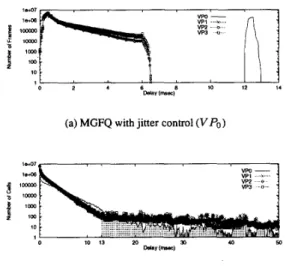
Fig. 4 (a) and Fig. 5 (a) show the cell delay distribution and frame delay distribution’ of the MGFQ algorithm for video traf- fics, respectively. The cell delay distribution and frame delay dis- tribution of FCFS service scheduling mechanism without any other 2Here, the frame delay is defined as the duration between the time when the first cell of the frame is transmitted and the time when the last cell is received. 0-7803-6536-4/00/$10.00 (c) 2000 IEEE VP, 10 vcs NL$=6,6.0.5 ms Host A Host B VP, VP? V A 45 vcs 45 vcs 45 vcs NDi=6 ms N$=6 ms ND+6 ms
Figure 3: Simulation model of a MGFQ network for video traffic.
control mechanism and regulators are also shown in Fig. 4 (b) and Fig. 5 (b) for the baseline comparison. All switch nodes in this baseline system perform nothing except forwarding the cells. The cells with delay constraint violations are discarded only by the re- ceiver. The shadow part in Fig. 4 (b) represents the cells of VPo
with delay beyond 13 ms. The FCFS scheme indeed lead to poor performance in term of cell delay distribution and frame delay dis- tribution (see Fig. 4 (b) and Fig. 5 (b)). As we known, it is hard to control the delay jitter at the frame level. Nevertheless, the simu- lation results show that if the cell delay jitter is under control, then the frame delay jitter become small. Therefore, it is feasible to al- locate smaller buffer in the receiver to compensate the frame delay jitter if traffic scheduler is implemented in the network. Without employing traffic scheduler, many cells are discarded due to their delay bound violations. This will lead to poor network utilization because network resources are wasted to transmit overdue cells.
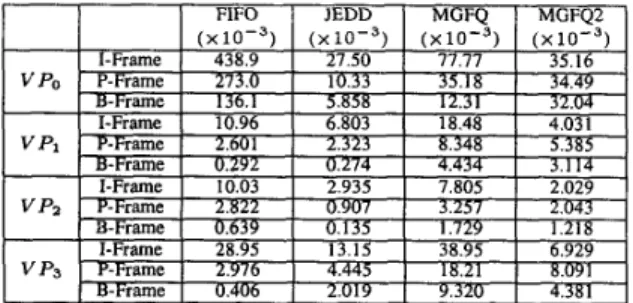
I I 1 FIFO I JEDD I MGFQ I MGFQ2 1
Table 2: Frame discarding ratios of various scheduling algorithms, where MGFQ2 represents the MGFQ algorithm combined with APPD and PPD schemes.
MGFQ2 in the Table 2 denotes the MGFQ scheme combined with APPD and PPD. Observing from the results in Table 2, the frame discarding ratio of I-frame is higher than B-frame or P-frame under JEDD or pure MGFQ algorithm. This can be explained
1 I ,
1 6 8 10 12 I 4 Dslay1-1
0 2
(a) MGFQ with jitter control (VI‘,)
(b) FCFS without any control mechanism
Figure 4: Cell delay distributions of MGFQ and FCFS without any control mechanism for video traffic simulation. The jitter bound
of V P o is 1 ms. The shadow part represents the discarded cells of
VPo due to the violations of delay and jitter constraints.
by the large cell burst of I-frame. Meanwhile, there are signifi- cant improvements in terms of faimess among different types of frames for MGFQ2. Although the frame discarding ratios of P- frame and B-frame for MGFQ2 are higher than other schemes, the frame playback performance is not expected to degrade seri- ously because of layering codec technique. Therefore, we believe the MGFQ algorithm should be an excellent candidate to combine with advanced buffer management schemes easily. In contrast, this feature has not been well investigated in other scheduling algo- rithms.
5. CONCLUSIONS
MGFQ provides a novel approach to implement the efficient traf- fic scheduler over ATM networks. Versatile customer require- ments, such as flexible end-to-end jitter constraints, transmission via AAL112, and adaptive playout, etc., can be achieved by em- ploying the MGFQ scheme in switches. In addition, the MGFQ scheme not only reduces the hardware implementation complexity significantly but also achieves high statistical multiplexing gain. From the simulation results, we show that MGFQ combined with APPD or PPD in the cell level can improve packet level QoS in
term of frame discarding ratio for video traffic significantly. Fi- nally, we believe the MGFQ scheme should be a promising tech- nique to be included in ATM switches for real-time multimedia data transport in future B-ISDN or Internet backbone.
6. REFERENCES
[l] A. Demers, S. Keshav, and S. Shenker, “Analysis and Sim- ulation of a Fair Queueing Algorithm,” Proc. ACM SIG-
COMM’89, pp. 1-12, 1989.
0-7803-6536-4/00/$10.00 (c) 2000 IEEE
(a) MGFQ with jitter control (VPo)
(b) FCFS without any control mechanism
Figure 5: Frame delay distributions of MGFQ and FCFS with- out any control mechanism for video traffic simulation. The jitter bound of VPo is 1 ms. Only eligible frames are accounted for the frame delay statistics.
1050
S.J.Golestani, “A Self-clocked Fair Queueing Scheme for Broadband Applications,” Proc. IEEE lNFOCOM’94,
Toronto, Canada, pp. 636-646, Jun. 1994.
D. Verma, H. Zhang, and D. Ferrari, “Guaranteeing Delay jitter Bounds in Packet Switching Networks,” in Proc. Tri- comm ’91, Chapel Hill, NC, pp. 35-46, Apr. 1991. H. L. Pocher, V. C. M. Leung, and D. W. Gillies, “An Ef- ficient ATM Voice Service with Flexible Jitter and Delay Guarantees,” IEEE J. Selected Areas Commun., Vol. 17, No.
1, pp. 51-62, Jan. 1999.
F-M. Tsou and Z . Tsai, “Gated-Scheduling Algorithms in Packet Switching Networks,” Proc. ICCCN ’99, pp.270-275, Oct. 1999.
F-M. Tsou, H. B. Chiou and Z. Tsai, “Design and Simulation of An Efficient Real-Time Traffic Scheduler with Flexible Delay and Jitter Guarantees,” http://eagle. ee.ntu.edu.tw/paper/chiu/MGFQ.ps.gz.
H-B. Chiou and Z . Tsai, “Performance of ATM Switches with Age Priority Packet Discarding under the ON-OFF Source Model,” IEEE INFOCOM ’98, San Francisco, USA, March 31-April 2, 1998.
A. Tanenbaum, Computer Networks, 3rd edition, Prentice Hall, 1996.
A.E.Kama1, “A Performance Study of Selective Cell Dis- carding Using the End-of-Packet Indicator in AAL q p e 5,”
0. Rose, MPEG-1 Video Trace, James Bond: Goldfinger, In-
stitute of Computer Science 111, University Wuerzburg, ftp:// ftp-info3 .informatik.uni-wuerzburg.de/publMPEGltraces, 1995.