CHINESE JOLTRNAL OF PHYSICS VOL:l2, NO. 2 OCTOBER 1974
Evolution of Vacancy Supersaturation in Relation to Electromigration in Thin Film Metallization*
HUEI-LI HUAXG ($$H$sy) ant! YI-SHUKG CHALG (+x--@)+ Departnzext of Ph;Gcs, National Taituapz University, Taisei, Taiwan
(Received 30 September 1974)
T h e o r y o f e v o l u t i o n o f v a c a n c y s u p e r s a t u r a t i o n i n g r a i n b o u n d a r y i n relation to electromigration based on the concept of the critical length for void growth is presented. The theory offers satisfactory explanation to some peculiar phenomena hitherto unexplained.
1. INTRODUCTION
I
N electronic indu.stry, people frequently quote the following relation”)tf =
Aj-l’exp j r\JI/kTj (1)to characterize the quality of thin film metallization in terms of the m.ean-time-to-failure due to electromigration where A is a constant: i the current density,
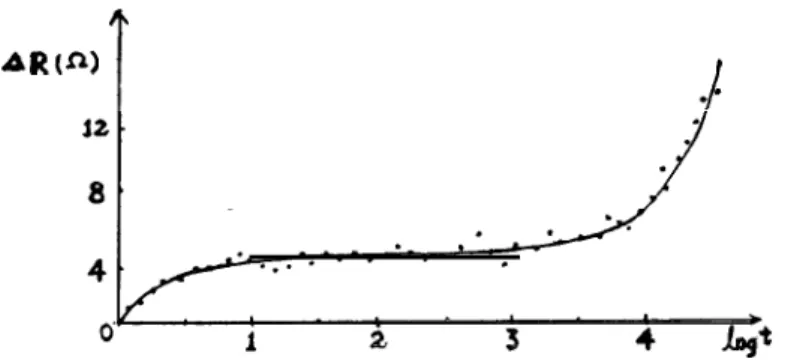
AH the (grain bou.ndary) diffu.sion activation energy and n lies between 2 and 3. Among other things. this relation unequivocally su.ggests that the cnset of electromigration begins u.pon the application of cu.rrent. As a resu.lt: the me-tallization deteriorates gradually and continuously and apparen.tly has no abrupt break away point. In contrast, what does one observe in a typical electromigra-tion test is this: The thin film stripe resistant e rises sharply in the first few minutes of test due to uniform joule heating, then it settles down at a new plateau for a considerable length of time accompanied only by a small scale of fluctuation until, all of a sud.den, a catastrophic stage sets in, the stripe resistance breaks away and the circu.it swung open. . A typical data depicts these features
is shown in Fig l.(” Figu.re (1) and Eq (1) stand in sharp contrast against each other on several counts: Firstly, Fig (1) amply suggests that the effective mass transport due to electromigration does not take place d.u.ring the early stage of test, in fact, not until the kink in the resistance curve appeared. Secondly, the resistance remains practically constant for a considerable length
* Work supported in part by National Science Council.
t Present address: Tatung College of Engineering, Taipei, Taiwan.
( 1 ) See, for example, a special issue on electromigration: Proc. IEEE. Vol. 57, No. 9, (1S69).
(2) H. L. Huang: (Jnpublished results, 1971. For experimental procedures please consult: H. L. Huang and C.-Y. Chang: Chinese J. Phys. 11, 18-32 (1973).
62 RELATION TO ELECTROMIGJIATION
AR(n)
T
Fig. 1. Change in stripe resistance vs time on test as monitored by the auto-matic digital printer HP-5050A. Please note the fluctuation and the breakaway in resistance during and at the end of incubation period.
of time, instead of gradually deteriorating. The nearly-constant resistance pericd is normally termed as the incubation period.‘3’ Nonetheless: du.ring this period, the stripe resistance does fluctuate a bit. The latter is hardly understandable in terms of Eq. (1).
The main purpose of this paper therefore is to offer a simple yet plausible
explanation for the above dilemma in terms of the evolution of vacancy super-saturation at the grain boundary. We shall approach the problem from the phenomenological and statistical point of view.
2. VACANCY SUPERSATURATION AND NUCLEATION CENTERS
Mass flux along a certain direction is synonymous with vacancy flux in the opposite direction. As vacancies accumulate at and diffuse away from the grain boundary, the equation of continuity in the vacancy flux becomes:
d*.=
-v. J n-noat 5
(2)
where J=-D~rt+pnnF~ in which D, n(no), ,u, T and F are, respectively, the
diffusion constant, concentration (at equilibrium), mobility, relaxation time and effective force on the vacancy. At steady state, the left hand side of Eq. (2) vanishes, the vacancy supersaturation S has the following approximate form: (*I
S- n--nQ
---_&!!t_
( 3 )no dz
where for no loss of generality the effective force is assumed to be applied along z-direction and that Basically, ,u depends on temperature, position and the direction of the effective force. At low temperature, ,u is approximately
(3) R. Rosenberg and M. Ohring: J. Appl. Phys., 4 2 , 5 6 7 1 ( 1 9 7 1 ) . ( 4 ) H. Shul and P. A. Turner: J. .4ppl. Phys., 44, 4 8 9 1 (1973).
H. L. HUANG AND Y. S:CHAUG 63
zero everywhere except in a grain boundary. A grain generally looks like a polygon, hence a grain boundary like a straight line. Occassionally, it may look like a parabola, say rc=+qP, stemming from a triple point, as shown in Fig 2. For the latter case, we have o=constant and S=O for ~ct0, and ,u=,LI~ COST hence s=FrQ/-r/ 2~ (1+2a~) 3 since cos0 (XC) = 1/s2b for x)0. Obviousiy, s
is non-zero in the region of positive x and has a maximum at x=0+. That is to say, the grain boundary triple point has an opportune chance of becoming the sink of vacancies, resulting in discontinuity in flux divergence and formation of the nucleation center of void embryos. Meanwhile, the grain boundaries extend-ing from the same triple point in the same positive region may get further and further delineated and depleted. These features are clearly discernible in
Fiz. 2. An ideal parabolic grain boundary triple point.
- e
Fig. 3a, b. Evolution of vacancy supersaturation at the grain boundary triple point and the delineated and depleted grain boundaries a s a result of electromigration. (photo reproduced from ref. 5)
64 RELATION TO ELECTROMIGRATION
Fig 3a, b.(5) Actually, S for the straight line portion of the grain boundary i s
not necessarily zero since the gradient of vacancy concentration there is by no means small. In a typical experimental condition for’ testing electromigration in thin film metallization at j--10” amp/cm’ and Tz400”K, the vacancy super-saturation S is found to be around O.l.(‘)
3.
As the processes of vacancy accu.mulation at the grain boundary continue, EVOLUTION OF VOID EMBRYOS
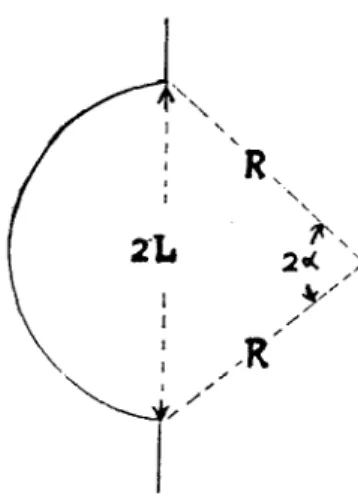
the void embryos so formed may, in due course of time, grow into voids of marcroscopic dimensions provided only a certain criterion is satisfied. In nature, a heterogeneous nucleation process is a far more favored process than a homogeneous nucleation process.“’ Thus, assuming that there is a void embryo formed on the wall cf a grain bou.ndary in the form of a spherical cap, as suggested in Fig 4, then, based upon the elementary nucleation theory for crystal growth, free energy required in forming a void of volume V surface area A at the degree of supersaturaticn S is
Fig. 4. A hypothetical spherical cap type void embryo at a grain boundary.
@=--No~kTIn(l+S) +A(:,-$ia) (4)
where No is the atomic density of the thin film, rs(rb) the surface (grain bound-ary) free energy density. The change in free energy per unit volu.me per adding one additional vacancy to the void is
A G = l~
N0 --N&T ln(l+S) + (rs --zrb)-$$} (5)
(5 j L. Berenbaum: J. Appl. Phys. 41, 883 (1971).
H. L. HUANG AND Y. $. CHAUG 65
Typically, ig=+r*, S-0.1, hence In(l +S) =S. Equation (5) is reduced t o
-N,,k TS+ ;-rs”
AV
(6)
As part of the activated diffusion processes, the vacancies and the lattice atoms bordering on the void embryo are bound to diffuse into each other at different jumping rates due to the difference in the activation energy involved. Let Ye be the jumping frequency for a vacancy (lattice atom) to jump back into a lattice site (vacancy) bordering on the void embryo, we have YI=Y~ expl -M/
kTj, vz=vo exp f - (AH+ AG)/kTI where ~0 is the equilibrium vibration frequency of the vacancy, AG as given in Es. (5) and AH as defined following
Es. (1).
The rate of increase in the number of vacancies inside the void embryo isy=y2-yl=~o exp(-s)( eXp(-$$-)-~}=-~O($$) exp(-+) (7)
where AG<kT for the case of present interest.
Suppose that the lattice parameter of the thin film metallization is b and that the volume occupied by a lattice atom is approximately equal to that of a vacancy, the number of vacancies (or atoms) surrounding the surface of the void embryo is approximately A/b’. At thermal equilibrium, the number of vacancy is N,=No expi-Q/kTj where No is the density of atoms and Q the formation energy for a vacancy. Thus, the number of vacancies surrounding the
A
surface of the void embryo is simply NU=F exp(-Q&/kT). To the void embryo, the rate of the volume increase per unit time is therfore
dv A
-= -- exp(---$-) b3v=-AbvO (;g-)exp!-(Q+AH)/kTj
dt b2 ( 8 )
For brevity, put
f =&
expj-(Q+AH)/kT~~ we rewrite Eq. (8) as0
(9)
Let us discuss closely the significance of Eq. (9) in relation to the evolution of the void embryo: Referring to Fig. (4): the linear dimension of the spherical cap is L=Rsina. If length L remains fixed during the course of time”), the condition for the void growth is to have the subtending angle a increasing, i. e., $->O. Since the surface area of the cap is A=2irR2 (~--COW), that of the
66 RELATION TO ELECTROMIGRATION
base plane of the cap is Ab= 7r (Rsina) ’ and its volume Vc=$R” (2--3~0~ + COS'~), equation (9) is transformed easily into the form:
da -=
dt
NokTS--+-sina
(l+cosa)Thus, the condition for the void embryo to continue growing is
NokTS - 14’S~ sina>O. Or, approximately, L> ,“,‘;, =Lo If
8L 0
satisfied the void embryo will be able to grow and evolves
to require that this condition is into a void of marcfoscopic dimension ! On the other hand, if LtLo, the void embryo so formed is unstable, and is liable to dissipate and collapse as a result of further diffusion. Thus, Lo is the ever important critical length for void growth and the corresponding supersaturation the critical supersaturation So. For So-0.1,
7,=103erg/cm2, T=400”K, No-6 x 10” we have Lo~102A.
(10)
4. RESULTS AND DISCUSSIONS
The descriptions given above seems to attest the plausibility and accountability to the present theory that the phenomenon of the formation, evolution and the ill-fated collapse of the void embryos with dimension falling below the critical length Lo are certain to give rise to fluctutation in resistance (before its break-away) as suggested in Fig. (1). The fluctuation is therefore non-accidental. This picture becomes clearer as we proceed further as follows.
Integrating Es (10) one obtains
t=-b(N,,iTS)’
f($
+In(z’-2P+l)+
A-.
tan-’z-8
d l--P2 i
,,-+
taniF=+)}
(11)
in which b’=Lo/L and z=tan
Vi, we have
Substituting z for a in the expression for
VY = ($‘3( x3;3rc )l’3Lo
(12)
expressing the linear dimension of the spherical cap (i. e. the void embryo) in term of the critical length Lo. Combination of Eqs (11) and (12) yields the most important correlations between the linear dimension of a growing void in relation to time on test. Fig 5 depicts these relations in terms of (X3;& )1’S versus t
H. L, Hl_!:\NG AND Y. S.-ClI_WG
10
23 + 3x I!3 Fig. 5. Growth of void embryo in terms of ~
O3 vs
~f(AVTi* t for Ys
several valus of gs. Note that at low t, the degree of supersaturation is small and LI large. As a result, the growth rate of the void embryo is relatively slow. As time goes on, B turns small, the void’ s growth rate becomes much higher and the embryo quickly evolves into a void of marcroscopic dimensions as suggested by the steep slope for @=1X01.
closely. At relative low t, that is, when the sample is first put on test, the degree of supersaturation S is small, hence the critical length Lo is correspond-ingly large. Thus, it is highly inprobable, if not impossible, for a nucleation center to grow into a void of marcroscopic dimension. The frequent occurrence during this period of time is to witness the nucleation of the void embryos and their uneventful collapse. This is exactly the reason why the fluctuation in resistance occurrs as suggested in Fig (1) during the early stage of test, though remaining practically constant on the average. As time goes on, the degree of supersaturation at the grain boundary grows bigger and bigger and Lo becomes correspondingly smaller and smaller. The chance is much improved now for a void embryo to grow beyond the critical length Lo in grain boundary. Once this is achieved, gets smaller, the void’s growth rate becomes higher. There-fore the void embryo grows into a void of macrroscopic dimensions beThere-fore long and breaks away the stripe’s resistance and we have a kink in the resistance-vs-time curve. Apparently, the critical length Lo or the corresponding critical supersaturation So plays a key role in characterizing the mean-time-to-failure due to electromigration in thin film metallization. We denote the period of time before reaching this critical stage as the incubation period for the void growth. The incubation period thus is of the same order of magnitude as the mean-time-failure as far as electromigration is concerned in thin film metllization. Taking S - 0 . 1 , b-3A”, ~~=lo’~ cps, T-400°K, &-0.35ev, AH=00.65ev, r,=103erg/cm2 w e
68 RELATION TO ELECTROMIGRATION
have L~lOZAo and the incubation period approximately-lO’sec, rou.ghIy in agree. ment ‘with our experimental observation for Z,. In actual laboratory test, B is ever changing with time since the degree of supersaturation in the grain bound-ary is changing. For that matter, the growth rate for a void embryo is not at a constant rate at any time. Consequently, it is not an easy task to estimate the incubation period to a good accuracy.
As a concluding remark, it is fair to say that the simpleminded approach to the problem, that is the evolution of nucleation centers due to vacancy supers-aturation in grain boundaries is fully capable of explaining the change in the stripe resistance at all stages du.e to electromigration in this .fiIm m.etaIlizztion, at least, to qualitative satisfaction.