sets
and systems
ELSEVIER
Fuzzy Sets and Systems 84 (1996) 75-83Finding inheritance hierarchies in interval-valued fuzzy
concept-networks
Shyi-Ming
Chen *, Yih-Jen Horng
Department of Computer and Infiwmation Science. National Chiao Tung Uniawsity. Hsinchu. Taiwan. ROC
Received September 1994: revised August 1995
Abstract
This paper extends the work of Itzkovich and Hawkes (1994) to present the concepts of interval-valued fuzzy concept-networks and to present an algorithm for finding the collection of inheritance hierarchies in interval-valued fuzzy concept-networks, where the similarity relations and the generalization relations between concepts are represented by interval values in [0, 11. The proposed method is more flexible than the one presented in Itzkovich and Hawkes (1994) due to the fact that it allows the grades of similarity relations and the generalization relations between concepts to be represented by interval-values rather than crisp real values between zero and one.
Keywords: Inheritance hierarchy; Interval-valued fuzzy concept-network; Similarity relation; Generalization relation
1. Introduction
In [4], Itzkovich and Hawkes presented a fuzzy extension of inheritance hierarchies. They pointed out that inheritance hierarchies provide significant descriptive capability using only the generalization. They also pointed out that inheritance hierarchies have been used in knowledge representation and object-oriented software development. Firstly, they presented the theory of concept-networks, and then extended it to fuzzy concept-networks. Furthermore, they also discussed how fuzzy concept-networks can be used in the application of reusable software retrieval in object oriented software development, where a concept-network is defined by two kind of relations between concepts: synonymy relations and generalization relations, and a fuzzy concept-network is defined by similarity relations and graded generalization relations. In [S], Lucaralla and Morara also presented a kind of concept-networks for fuzzy information retrieval, where the relevant values between concepts are represented by real values between zero and one. In [3,8], we presented knowledge-based fuzzy information retrieval techniques based on [S]. However, the concept-networks presented in [4, 51 all assume that the relevant values (degrees of graded generalization or degrees of similarity) in a concept-network are represented by crisp real values between zero and one. If we can allow
* Corresponding author. Address: No. I 1. Lane 118. Minchuan W. Road, Taipei. Taiwan, ROC 0165-0114,/96/$15.00 Copyright c 1996 Elsevier Science B.V. All rights reserved
16 S.-M. Chew, Y-J. Horng / Fuzzy Sets and Systems X4 lIYY6) 75-83
the relevant values (degrees of graded generalization or degrees of similarity) between concepts to be represented by an interval in [0, l] rather than crisp real values between zero and one, then there is room for more flexibility. In [7], Turksen proposed interval valued fuzzy sets for the representation of combined concepts based on normal forms. In [6], Mukaidono introduced interval logic and its extension, where two partial ordered relations on the set of truth values of interval logic were introduced.
In this paper, we extend the work of [4] to present the concepts of interval-valued fuzzy concept-networks based on [6, 71 and to present an algorithm for finding the collection of inheritance hierarchies in interval-valued fuzzy concept-networks, where the similarity relations and the generalization relations between concepts in an interval-valued fuzzy concept-network are represented by a real interval in [0, 11. The proposed method is more flexible than the one presented in [4] due to the fact that it allows the similarity relations and the graded generalization relations between concepts to be represented by interval-values rather than crisp real values between zero and one.
2. Interval-valued fuzzy concept-networks
In 1994, Itzkovich and Hawkes presented a fuzzy extension of inheritance hierarchies [4]. They pointed out that the purpose of presenting a fuzzy extension of inheritance hierarchies is to provide a more refined construction that facilitates the representation of relations among concepts under uncertain conditions. The extension is done in the following two steps:
Step 1: Incorporate the synonymy relation in the inheritance hierarchy, resulting in a new construction denoted as a concept-network.
Step 2: the relations of the concept-network are fuzzified to yield a new construction denoted as a fuzzy concept-network.
In this section, we present the concepts of interval-valued fuzzy concept-networks based on [4]. In [4], it was pointed out that a fuzzy concept-network is an extension of the concept-network. The definition of fuzzy concept-networks is reviewed from [4] as follows
Definition 1. The similarity relation Rsim over a finite set of concepts C, C = (cl, c2, . . , c, ), is a binary fuzzy relation which satisfies all of the following properties:
(1) Reflexive: Ilsim(ci,Ci) = 1.
(2) Symmetric: ~~im(Ci,Cj) = /Lsim(cj,(.i).
(3) Transitive: psim(ci, ck) 3 ‘Jc,(psim(ci, cj) A p,im(cj, ck)).
Definition 2. The graded generalization relation R, over a finite set of concepts C, C = {c~,L.~, . . . ,c,,}, is a binary fuzzy relation which satisfies all of the following properties:
(1) Reflexive: ~F(g(Ci, ci) = 1.
(2) Anti-symmetric: If ~Ls(Ci, cj) > 0 and ~p(cj, Ci) > 0, then ci = cj. (3) Transitive: pp(Ci, ck) 2 'J<,(pLg(Ci,Cj) A ,ULg(cj,~k))
Definition 3. A fuzzy concept-network is denoted by FCN(C, R), where C is a finite set of concepts and
R consists of two relations Rsim and R, over C as defined in Definitions 1 and 2. For example, Fig. 1 shows a fuzzy concept-network.
In the following, we present the concepts of interval-valued fuzzy concept-networks. In an interval-valued fuzzy concept-network, the degrees of similarity and the degrees of generalization between concepts are represented by a real interval in [0, 11. Two intervals [a, b] and [c, b] are called equal if and only if a = c and
S.-M. Chen. Y.-J. Horng / Fuzzy Sets and Systems 84 (1996) 75-83 71
Fig. 1. A fuzzy concept-network.
piq= [0.8,
0.91
CL;,~=
[0.85,
0.951
Fig. 2. An interval-valued fuzzy concept-network.
Definition 4. The interval-valued similarity relation Rivsim over a finite set of concepts C, C = .(c,, c2, . . , c, ), is a binary fuzzy relation which satisfies all of the following properties:
(1) Reflexive: ,Uivsim(ci, ci) = [l, 11. (2) Symmetric: l(ivsim((.i, Cj) = pivsim(Cj, Ci).
(3) Transitive: Let the degree of interval-valued similarity between any concepts c, and cY be represented by pivsirn(c,, cY), where Pivsim (c,, cY) = [S’(c,, cY), SL(cX, cY)] and 0 d S’(c*_, cY) 6 Sh(c,, cY) d 1. Then,
S’(Ci, ck) 3 V (S’(ci, Cj) A S'(Cj, Ck)),
Sh(Ci, Ck) 3
V
(Sh(Ci, Cj) A Sh(Cj, Ck)).Definition 5. The interval-valued generalization relation Rivg over a finite set of concepts C, C = (c1,c2, ,c,}, is a binary fuzzy relation which satisfies all of the following properties:
(1) Reflexive: pivg(ci, ci) = [l, 11.
(2) Anti-symmetric: If pivg(Ci,Cj) > [O,O] and pivp(cj,ci) > [O,O], then ci = cj.
(3) Transitive: Let the degree of interval-valued generalization between any concepts c, and cy be repre- sented by ,u~~&c,, c,), where pivg(c,: c,) = [g’(cX, c,), gh(c,, c,)] and 0 G g’(cX, c,.) d gh(c,, cv) < 1. Then,
!Jh(Ci3Ck) 3 V(Yh(ci.cj)
A
C7h(Cj,Ck)).Definition 6. An interval-valued fuzzy concept-network is denoted by IVFCN(C, R), where C is a finite set of
concepts and R consists of two relations Rivsim and Rivg over C as defined in Definitions 4 and 5.
78 S.-M. Chen, Y-J. Horng 1 Fuzzy Sets and Systems 84 (1996) 75 --83
3. An algorithm for finding the inheritance hierarchies in interval-valued fuzzy concept-networks
In this section, we present an algorithm for finding the inheritance hierarchies in interval-valued fuzzy concept-networks. Firstly, we present a method to model the interval-valued fuzzy concept-network by using a concept matrix A4. If there are n concepts in an interval-valued fuzzy concept-network, then a n x n concept matrix A4 will be used to model the interval-valued fuzzy concept-network. The method for modeling interval-valued fuzzy concept-networks by means of a concept matrix M is presented as follows:
If ~ivsim(Ci, cj) = ~ij, where 0 6 ,~~ij < 1, then let M(i,j) = M(j, i) = [/lij, I’ij];
if pivg(ci, cj) = ~ij, where 0 < ~ij < 1, then let M(i,j) = [~ij, Ilij] and M(,j, i) = [0, 01; if Clivsim(Ci, Cj) = [,~fj, ~21, where 0 < /~:j < p;j < 1, then let M(i,j) = M(j, i) = [lnfj, ~~j];
if pivg(ci,Cj) = [~11j,~~j], where 0 < ~fj < cl~j < 1, then let M(i,j) = [~~j,~~j] and M(j,i) = [O,O]; if there are no relationships between the concepts ci and “j, then let M(i,j) = M(j, i) = [O,O].
Furthermore, we let M(i, i) = [l, 11, where 1 < i d n. due to the fact that each concept (‘i is reflexive to itself.
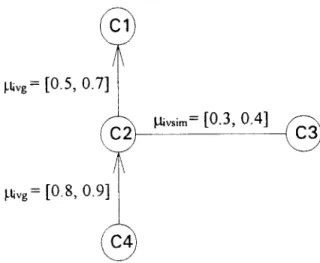
Example 1. Given an interval-valued fuzzy concept-network IVFCN(C, R), where C = {cl, c2, L’~, c4 ), c1 is an interval-valued generalization of c2 with ~ivg(cZ,cl) = [0.5, 0.71, (‘3 is similar to ~2 with Ilivsim(C*,Cj) = [0.3,0.4], and c2 is an interval-valued generalization of cq with ~livg((.4, c2) = [0.8, 0.91. The interval-valued fuzzy concept-network is shown in Fig. 3.
In this case. we can use a 4 x 4 concept matrix M to model the interval-valued fuzzy concept-network shown as follows:
co,
01
co>
01
[IO,
01
CL
11
[0.3,0.4] [O, O] [0.3,0.4] [ 1, l] CO,01
[O.S,
0.91 [O, O] CL 11 1we present a method for performing x-cuts operations in an interval-valued fuzzy
M = co.5,0.71
w, 01
l[
0, cl
1
In the following, concept-network. llivg= [0.8, 0.910
c4S.-M. Chen, Y.% Homg II_ Fuzz Sets and $wems 84 (19%) 75-83 19
Let P be a probability matrix derived from the a,-cut concept matrix M, where s1i is a threshold value between zero and one. In a probability matrix P, P(i,j) = 1 indicates that the degree of relationship (graded generalization relationship or similarity relationship) between the concepts ci and cj is larger than or equal to ‘xi, where xi E [0, 11; If M(i,j) = [/lfj,~~~j] and pij = llfj, then
CUX 1: If it > al, then we let P(i,j) = 1. CU.W 2: If ~~j < ~(i, then we let P(i,j) = 0. Otherwise, if ;lfj # ,lFj, then we let
P(i,j) = h I Pij - llij
P(i,j) = 0 indicates that the degree of probability in which the degree of relationship between the concepts ci and c,i is less than ri, where xi E [0, 11; P(i,j) = /J, fl E [0, 11, indicates that the degree of probability /J in which the degree of relationship between the concepts ci and c,i is represented by an interval [a. h] is larger than or equal to x,, where 0 < [I d r, 6 h < 1, and
p = h - max(a,x,), h--N
The larger the value of p. the more the degree of the probability that the relationship between the concept ci and ci is larger than a,.
Let Q be a confidence matrix derived from P, and let z2 be a threshold value between zero and one. If
P(i.,j) 3 az. where x2 E [0, I], then we let Q(i,j) = 1. Otherwise, we let Q(i,j) = 0. Q(i,j) = 1 indicates that the
degree of probability /I, in which the degree of relationship between the concepts ci and c,i is larger than or equal to c(i, is larger than or equal to x2, where x2 E [0, 11.
In the following, we assume that an interval-valued fuzzy concept-network consists of n concepts which has been modeled by an n x IZ concept matrix M, where M(i,j) = [~~lfj,~~j], 0 < ~~j < ~1:~ < 1, 1 < i < n, and 1 <,j < n. The algorithm for performing x-cuts operations in an interval-valued fuzzy concept-network to obtain the probability matrix P and the confidence matrix Q is now presented as follows:
a-Cuts Operations Algorithm for i + 1 to y1 do
forjt 1 tondo begin
if (/1Ij = /it) then
if (p!j 3 pi) then P(i,j) + 1 else P(i,j) t 0
else if (I(~ 3 xl) then P(i,,j) =
“’ - :fax”-‘,‘i’rl
’
Pij - Pi,,
else P(i,j) t 0;
if (P(i,j) 3 x2) then Q(i,j) c 1 else Q(i.j) + 0
end.
Example 2. Given an interval-valued fuzzy concept-network IVFCN(C,R) shown in Fig. 4. Assume that r, = 0.6 and xZ = 0.6, then we can use a concept matrix M to model the interval-valued fuzzy
80 S.-M. Chen, Y.-J Horng 1 Fuq Sets and systems 84 ll996) 75-83 concept-network of Fig. 4 as follows
M=
Cl,
11
cuo.21 co,01 co>
01
cot
01
co,
01
[IO,
01
co,
01
co,01 CL 11
[0.8,0.8] [O, O] [0.4,0.7] [O, O] [0.7,0.9] [IO, O] CO,01 co, 01
[L 11
co, 01
[@ 01
[0.8,0.9] [O,O] CO>01
co, 01 co> 01
I% 01
CL 11
co, 01
co, 01
co, 01
co, 01
co, 01 co, 01
I3 01
[OS,O.S]
[l. l] CO,01
PI 01
[0.8,0.9: [O,01 co, 01
[0.8,0.9] [0, 0] [IO,01
Cl> 11
co, 01
co, 01
ILO,
01
c0.7,0.91LO,
01
co, 01
r_o,
01
r_o,
01
CL 11
KA 01
t-o,01 N 01
[Q 01
I% 01
[O.S, 0.91 [O, O]
KA 01
Cl? 11
By performing the cc-cuts operations, the probability matrix P and confidence matrix Q can be obtained as follows: P= 100 0 0 000 0 1 1 0 l/3 0 1 0 001 0 0 100 000 1 0 000 0 0 0 213 1001 0010 0 100 010 0 0 010 000 0 1001
Q=
10000000 ,01100010 00100100 00010000 00011001 00100100 01000010 00001001 LIn the following, we present the definition of concept classes in an interval-valued fuzzy concept-network based on [4].
0
c4
pvg= [OS, 0.81
f
S.-M. Chen. Y.-J Horng ! Fuzzy Sets and Systems 84 (1996) 75-83 81
A concept class Pi in an interval-valued fuzzy concept-network is a set of concepts, such that the set of concepts C in an interval-valued fuzzy concept-network is the union of each concept class, i.e., C = Ui Pi. Furthermore, after performing the z-cuts operations of an interval-valued fuzzy concept-network, we can define the set of synonymous concepts in each concept class.
Definition 7. In a concept class Pi, Vci, C; E Pi, if /livsim(Ci, cj) > 0, then we say that ci and cj are in the same set of synonymous concepts.
The algorithm for finding the inheritance hierarchies in an interval-valued fuzzy concept-network is now presented as follows:
Inheritance Hierarchy Generation Algorithm for i +- 1 to n do
forjt 1 tondo begin
if (i =j) then
if (ci is not in any concept class) then
generate a new concept class, and put (‘i in the new generated concept class; if [(i #j) and (Q(i,j) = l)] then
if (Q(j, i) = 1) then begin
if ((.i is not in any concept class) then
generate a new concept class, and put (‘i and cj in the new generated concept class else
put cj in the same concept class with ci;
if (q is not in any set of synonymous concepts) then
generate a new set of synonymous concepts, and put Ci and Cj in the new generated set of synonymous concepts
else
put Cj in the same set of synonymous concepts with Ci end
else begin
if ((ci is not in any concept class) and (Cj is not in any concept class)) then
generate a new concept class, and put <ti and cj in the new generated concept class; if ((ci is in a concept class) and (cj is not in any concept class)) then
put cj in the same concept class with ci;
if ((Ci is not in any concept class) and (Cj is in a concept class)) then put Ci in the same concept class with cj;
if ((Ci is in a concept class) and (Cj is in a concept class)) then begin
put all concepts in the concepts class containing cj in the same concept class with ci; put all interval-valued generalizations in the concept class containing cj in concept class containing Ci
end;
let (ci, (‘j) be an interval-valued generalization relation in concept class containing ci end
82 S.-M. Chen, Y.-J. Horng i Fuzzy S&s md Systems X4 (1996) 75-83
(a) (b) (d)
Fig. 5. Inheritance hierarchies.
find the concept class containing concept cb;
list all interval-valued generalization relations in this concept class which form an inheritance hierarchy; for all ci in this inheritance hierarchy do
begin
find the set of synonymous concepts containing ci: for each cI in this set of synonymous concepts do begin
substitute ci in the interval-valued generalization relation by “j;
list all interval-valued generalization relations in this concept class which form a new inheritance hierarchy
end end.
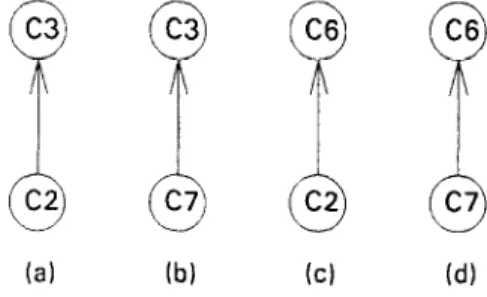
Example 3. We make same assumptions as in Example 2, where the interval-valued fuzzy concept-network is modeled by the concept matrix M, and the probability matrix P and the confidence matrix Q have been obtained. By applying the inheritance hierarchy generation algorithm, we can obtain three concept classes: {cl >, (c2, c3, cfj, (‘7 ), {c‘t, c5, CS )> and three sets of synonymous concepts: (cZ, c7 ), ic5, c8 ), (c3, c6). Assume that
we are interested in the concept class containing c2, then after performing the algorithm, we can find the inheritance hierarchy (<c,,~.~)) containing c2, graphically as shown in Fig. 5(a). By using replacements among synonymous concepts, we can obtain the other three inheritance hierarchies: ((c,, c3) )-, [(c2, c6) ),
((c7,ch)) as shown in Figs. 5(b))(d), respectively.
4. Conclusions
In this paper, we have extended the work of [4] to present the concepts of interval-valued fuzzy concept-network and to present an algorithm for finding the collection of inheritance hierarchies in interval- valued fuzzy concept-networks. The proposed method is more flexible than the one presented in [4] due to the fact that it allows the similarity relations and the generalization relations between concepts to be represented by interval values in [0, l] rather than crisp real values between zero and one.
Acknowledgements
The authors would like to thank the reviewers for providing very helpful comments and suggestions. Their insight and comments led to a better presentation of the ideas expressed in this paper. This work was supported in part by the National Science Council, Republic of China, under Grant NSC 84-2213-E-009-100.
S.-M. Chen, Y.-J. Horng i Fuzzy Sets and $vstems 84 (1996) 75-83 83
References
[l] SM. Chen, A new approach to handling fuzzy decisionmaking problems, IEEE Trans. Sysrem.7 Man Cyhernet. 18 (I 988) 1012- 1016. [2] SM. Chen, An improved algorithm for inexact reasoning based on extended fuzzy production rules, Cyberrzrt. Sy.stenl.s 23 (1992)
463-48 1.
[3] SM. Chen and J.Y. Wang, Document retrieval using knowledge-based fuzzy information retrieval techniques. IEEE 7runs. Sj~trrn,\
Man Cybernrt. 25 (1995) 793-803.
[4] I. Itzkovich and L.W. Hawkes, Fuzzy extension of inheritance hierarchies, Fuzzy Sets md Systrrns 62 (1994) 143- 153.
[S] D. Lucarella and R. Morara, FIRST: Fuzzy information retrieval system, J. Inform. Sci. 17 (1991) 81-91.
[6] M. Mukaidono, Interval logic and its extension. Proc. 1992 IEEE InTrrnal. Co$ FK;~ Systems, San Diego. California (1992) 579-586.
[7] I.B. Turksen, Interval valued fuzzy sets based on normal forms, Fu,_ -‘y Set.7 and Sysrems 20 (1986) 191P210.
[S] J.Y. Wang and S.M. Chen, A knowledge-based method for fuzzy information retrieval. Proc. 1st Asitrn Fux~, S~~,str~t~s Snnp.. Singapore ( 1993).