Aging behavior and recovery of polarization in Sr 0.8 Bi 2.4 Ta 2 O 9 thin films
San-Yuan Chen and Ving-Ching Lee
Citation: Journal of Applied Physics 87, 3050 (2000); doi: 10.1063/1.372298
View online: http://dx.doi.org/10.1063/1.372298
View Table of Contents: http://scitation.aip.org/content/aip/journal/jap/87/6?ver=pdfcov Published by the AIP Publishing
Articles you may be interested in
Room temperature aging behavior of thermally imprinted Pt/SrBi 2 Ta 2 O 9 /Pt ferroelectric thin film capacitors J. Appl. Phys. 90, 4130 (2001); 10.1063/1.1402663
Fabrication of ferroelectric SrBi 2 Ta 2 O 9 capacitor films using plasma-assisted metalorganic chemical vapor deposition and their electrical properties
J. Appl. Phys. 89, 6370 (2001); 10.1063/1.1353564
Degradation of ferroelectric SrBi 2 Ta 2 O 9 materials under reducing conditions and their reaction with Pt electrodes
Appl. Phys. Lett. 75, 2839 (1999); 10.1063/1.125167
Erratum: “Structure control and characterization of SrBi 2 Ta 2 O 9 thin films by a modified annealing method” [Appl. Phys. Lett. 74, 1221 (1999)]
Appl. Phys. Lett. 75, 2151 (1999); 10.1063/1.124947
Structure control and characterization of SrBi 2 Ta 2 O 9 thin films by a modified annealing method Appl. Phys. Lett. 74, 1221 (1999); 10.1063/1.123505
Aging behavior and recovery of polarization in Sr
0.8Bi
2.4Ta
2O
9thin films
San-Yuan Chena)and Ving-Ching LeeDepartment of Materials and Science Engineering, National Chiao-Tung University, 300 Hsinchu, Taiwan, Republic of China
共Received 24 August 1999; accepted for publication 13 December 1999兲
Ferroelectric thin films of bismuth-containing layered perovskite Sr0.8Bi2.4Ta2O9共SBT兲 have been
prepared by both metalorganic decomposition 共designated as MOD–SBT film兲 and magnetron sputtering共designated as sputtering-SBT film兲 processes. SBT thin films are well known to exhibit free-fatigue behavior with electrical field cycling. However, it was found that after the SBT films were applied with electrical field display, the polarization reduction with time was observed. The aging rate was related to microstructure, which in turn was dependent on the film processing. The sputtering-SBT films show a slower degradation rate than MOD–SBT films. The suppressed polarization can be near-completely recovered by applying either thermal treatment above 150 °C or electric-field cycling. There exists a minimum required thermal energy to restore the polarization. The easy recovery exhibited by SBT films in suppressed polarization reveals that a relatively weak domain pinning may exist between domain wall and electronic defects in SBT. The SBT shows little fatigue behavior during electric field cycling but exhibits an aging phenomenon after applied electric field. © 2000 American Institute of Physics.关S0021-8979共00兲04906-9兴
INTRODUCTION
Ferroelectric memories offer several advantages over silicon-based memories such as faster write speeds and lower operating voltages.1,2 In the past few years, Pb共Zr, Ti兲O3 共PZT兲 compositions have been widely studied and recog-nized to be highly promising for nonvolatile memory appli-cations because of their excellent good ferroelectric proper-ties and relatively low processing temperature. However, it was later found that PZT films for ferroelectric random ac-cess memory 共FRAM兲 device applications still have several problems since it exhibits severe polarization fatigue during electric field cycling, particularly with a Pt electrode.3,4
Recently, alternative materials, belonging to the bismuth layered perovskite-like structure, show essentially no polar-ization fatigue with electric field cycling with a Pt electrode.5
These materials have the general formula of
共Bi2O2兲⫹2(Am⫺BmO3m⫹1)2⫺, consisting of m-perovskite
units sandwiched between bismuth oxide layers.共Here A and B are the two types of cations that enter the perovskite unit. A is Bi3⫹, Ba2⫹, Sr2⫹, Pb2⫹, or K1⫹; B is Ti4⫹, Nb5⫹, Ta5⫹, Mo6⫹, or W6⫹.)6–8Among these materials, ferroelectric thin films of SrBi2Nb2O9, SrBi2Ta2O9, and their solid solutions have been widely investigated for potential applications in high density nonvolatile FRAMS because of their excellent ferroelectric properties, characterized by free polarization fa-tigue and low coercive field.5,9,10According to Chen et al.’s report, the reason for good fatigue resistance of SBT or SBN films is due to higher ionic conductivity leading to easy re-covery of defects.11 However, in Dimos et al.’s
investigation,12 SBT thin films were revealed to exhibit sig-nificant polarization fatigue by electric-field cycling under broadband, optical illumination. Also the photoinduced
fa-tigue was observed for Pb共Zr, Ti兲O3thin-film capacitors with
a 共La, Sr兲CoO3 electrode.13 Moreover, the fatigued sample
under illumination can be fully rejuvenated by a dc saturat-ing bias with light or electric-field cyclsaturat-ing without light, which indicates an intrinsic, field-assisted recovery mecha-nism. Al-Shareef et al.14further suggests that the recovery of photoinduced fatigue of SBT films was due to a relatively weak domain pinning. These findings demonstrate that the relatively weak domain pinning plays a pretty important role in the fatigue behavior and recovery of SBT films.
Even though the fatigue phenomenon has received wide attention, aging behavior, i.e., polarization degradation with time is also a particular important reliability issue for FRAM devices. Furthermore, a similar effect was often observed in ferroelectric ceramics, especially for PZT15,16 In this work, the polarization reduction of the ‘‘free-fatigue’’ SBT thin film with aging time at room temperature was observed. Moreover, we found that the polarization recovery of the aged sample was strongly related to both electric-field cy-cling and thermal treatment at a higher temperature. A de-tailed study and qualitative model was proposed to account for the unique aging behavior and subsequent polarization recovery in the free-fatigue SBT films.
II. EXPERIMENT
The Sr0.8Bi2.4Ta2O9 films were deposited on a Pt共150 nm兲/Ti共20 nm兲/SiO2(1m)/Si共100兲 substrates by
both metalorganic decomposition共designated as MOD–SBT film兲 and radio frequency magnetron sputtering 共designated as sputtering-SBT film兲 techniques. The starting materials for the MOD process were bismuth 2-ethylhexanate
兵Bi关CH3共CH2兲3CH共C2H5兲COO兴3其, strontium 2-ethylhexanate
兵Sr关CH3共CH2兲3CH共C2H5兲COO兴2其, lead 2-ethylhexanate
兵Pb关CH3共CH2兲3CH共C2H5兲COO兴2其, and tantalum ethoxide a兲Electronic mail: [email protected]
3050
0021-8979/2000/87(6)/3050/6/$17.00 © 2000 American Institute of Physics
关Ta共OC2H5兲5兴 with 2-ethylhexanoic acid as the solvent. The
metalorganic precursors were mixed to form a solution with the compositions of Sr0.8Bi2.4Ta2O9. After the solutions were
spin coated onto the substrate at a speed of 3000 rpm, the as-deposited film was dried on a hot plate at a temperature of about 150 °C to remove the solvent before the next coating was applied. A single coating generally gave a 0.14 m crack-free film after firing. After the process was repeated three times, the films were pyrolyzed and crystallized at 800 °C temperatures for 30 min by directly placing the coated substrate into the tube furnace.
In the sputtering-SBT film, the SBT film was deposited
on Pt by magnetron sputtering from the sintered
Sr0.8Bi2.4Ta2O9 target. The films were prepared at a fixed power of 100 W. A constant chamber pressure of 20 mTorr was maintained by a mixture of argon and oxygen at a flow-rate ratio of 200/50. The details of the sputtering and anneal-ing conditions of the SBT films were described in Ref. 17. The crystal structures of the films were analyzed using a Siemens D5000 x-ray diffraction 共XRD兲 with Cu K␣ radia-tion and a Ni filter. The surface and cross-secradia-tional mor-phologies of the films were investigated by a field-emission scanning electron microscope共FESEM, Hitachi S4000兲. The film thickness was measured by a Dektak surface profilome-ter. Patterned top Au electrodes through a shadow mask on an area of 8.0⫻10⫺4cm2 area were sputter deposited onto the SBT layers to define capacitors in order to perform elec-trical measurements. A ferroelectric testing system共RT-66A, Radiant Technologies Inc.兲 operating in the virtual-ground mode was used to obtain the remanent polarization ( Pr)-coercive field (Ec) hysteresis characteristics and
fa-tigue properties. After the films were applied at a voltage of 5 V for Pr– Ec measurement, the films were then aged at
room temperature. The aging was interrupted by a certain time period to measure Pr– Econ the same sample again. As
the aged sample showed no apparent loss of remanent polar-ization with aging time, the thermal recovery was performed in a vacuum chamber at temperatures ranging from 75– 450 °C for 2 min after the aged sample was loaded and the chamber was pumped down to⬃20 mTorr. After the thermal treatment, the chamber was pumped down again while cool-ing down to room temperature. Fatigue tests for the aged films were also conducted with an applied voltage of 5 V at 1 MHz.
III. RESULTS
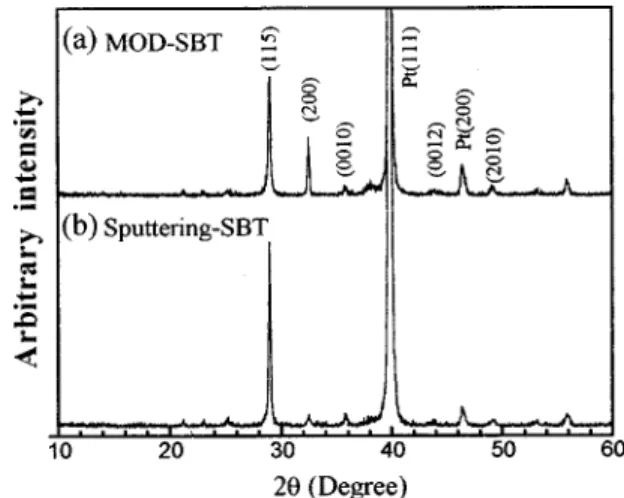
As the MOD–SBT films were annealed at 800 °C, the layered perovskite phase appears with a random orientation, as evidenced by the共115兲 and 共200兲 reflections of the XRD pattern shown in Fig. 1共a兲. On the other hand, the XRD studies of sputtering-SBT films indicate that the films depos-ited at temperatures below 500 °C were amorphous and com-pletely crystallized at 600 °C as shown in Fig. 1共b兲, in which a strong共115兲 reflection was observed. The polarization ver-sus electrical field curves for both sputtering-SBT and MOD–SBT films were measured and shown in Fig. 2. The sputtering-SBT film has a higher remanent polarization than MOD–SBT film. The 2 Pr values were 30.9 and 15.7
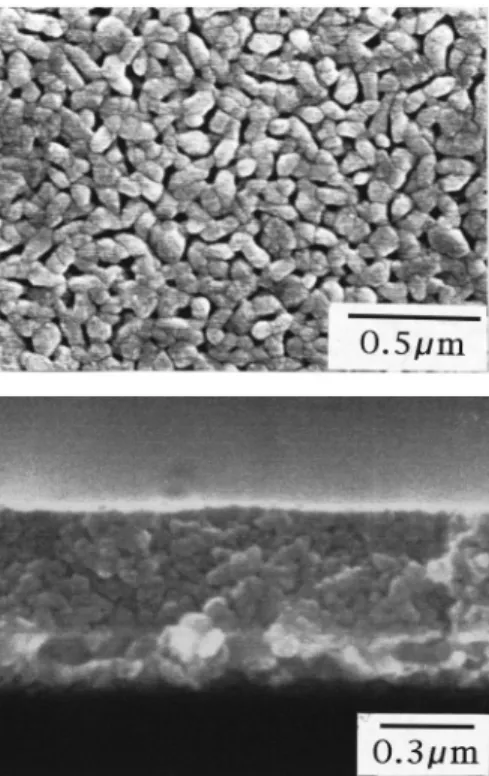
C/cm2for the former and the latter under an applied volt-age of 5 V, respectively. These excellent properties of sputtering-SBT films may be attributed to dense and larger-grain microstructure and unique crystal orientation as com-pared with those of MOD–SBT films. The SEM morpholo-gies of sputtering-SBT films 共Fig. 3兲 exhibit a dense structure and columnar microstructure. On the other hand, SEM observation in Fig. 4 shows the surface microstructure of MOD–SBT films composed of somewhat porous structure with rod-like grains. Furthermore, it was found that SEM cross-section morphology was composed of polycrystallites instead of columnar grains as in sputtering-SBT films.
The fatigue test was performed using a bipolar square wave of 5 V at 1 MHz. As shown in Fig. 5, no obvious fatigue was observed for sputtering-SBT films after the sample was switched up to 1⫻1010 cycles. However, for MOD–SBT films, a partial loss of 2 Pr was observed after
fatigue. The percentage of the remanent polarization after 1010 cycles lies around 86%. According to our previous re-port, it was found that the fatigue endurance of MOD–SBT films was somewhat influenced by the composition.18 The Sr-stoichiometric SrBi2.3Ta2O9or SrBi2Ta2O9films show no
any appreciable loss under the same applied voltage of 5 V after 109cycles. However, a detectable degradation after fa-tigue was observed in the Sr-deficient Sr0.8Bi2.3Ta2O9
com-FIG. 1. XRD patterns of共a兲 sputtering-SBT and 共b兲 MOD–SBT films.
FIG. 2. SEM plan view and cross-section of sputtering-SBT films annealed at 600 °C.
3051
J. Appl. Phys., Vol. 87, No. 6, 15 March 2000 S.-Y. Chen and V.-C. Lee
position. Similar phenomenon was also reported by Noguchi
et al.19 This observable fatigue behavior may be correlated with microstructure, crystal orientation and further, the sub-stituting Bi for Sr vacancy.18,20The detailed discussion can be referred to Ref. 18.
As the SBT films were aged at 25 °C, Fig. 6 shows rapid polarization reduction with aging time after the films were
applied with a voltage of 5 V. The polarization reduction rate in MOD–SBT films was apparently faster than sputtering-SBT films. In the case of MOD films, the 2 Pr value of MOD–SBT films rapidly degrades and decreases from 15.7 to 6.4 C/cm2after 5 h aging. The average remanent polar-ization dropped by nearly 59%. A longer aging time period leads to substantially slight and additional continuous sup-pression of the switchable polarization, i.e.,⬃10% more loss of 2 Prfor 25 h共67% loss of initial 2Pr). In the other case of
sputtering-SBT films, similar effects were also observed as the films were subjected to the same testing sequence. How-ever, the degradation rate in sputtering-SBT films was much slower than MOD–SBT films. A slighter loss of 2 Pr
(⬃4%) was found in the sputtering-SBT film if the same aging time period of 2 h was evaluated. The 2 Pr value
gradually decreased from 30.9 to 6.9 C/cm2 after the sample was aged⬃1440 h at room temperature. In this ex-periment, it was found that as the films were applied at a lower voltage such as 3 V, the reduction rate in remanent polarization during aging was somewhat slower than that at 5 V共not shown here兲.
However, interestingly, a rapid heating of the aged sputtering-SBT films in a vacuum at 450 °C for 2 min results in substantial recovery of the switchable polarization as shown in Fig. 7. In this case, a roughly of 90% of the initial FIG. 3. SEM plan view and cross-section of MOD–SBT films annealed at
800 °C.
FIG. 4. P – E hysteresis loops of both sputtering-SBT and MOD–SBT films under applied voltage of 5 V.
FIG. 5. Fatigue behavior of both sputtering-SBT and MOD–SBT films with an applied voltage of 5 V.
FIG. 6. Degradation of polarization with aging time for sputtering-SBT and MOD–SBT films after applied electric filed and then aged at 25 °C.
switchable polarization is recovered. However, a second ag-ing behavior of the recovered film was observed once again but the degradation rate of aged samples in the second run is faster than the first. It only took ⬃2 weeks to loss most of switchable polarization in the 2nd aging. If the aging cycling was repeated 共3rd aging兲, the smaller the restored remanent polarization and the shorter the near-complete loss. Similar phenomena were also observed but the cycling process of aging to recovering only could be performed twice in MOD– SBT films 共not shown here兲.
Moreover, as the aged sample was further applied with electric-field cycling, the 2 Princreases instead of decreases with cycling numbers. As shown in Fig. 8, the magnitude of 2 Pr reaches 22.9 C/cm2 after 1010 cycles at an applied
voltage of 5 V when the aged sputtering-SBT films were subjected to electric-field cycling. Similarly, for MOD–SBT films aged for 240 h, the 2 Prvalue increased from 4.7 to 9.1
C/cm2 after 1010 cycles 共not shown here兲. The recovered percentage of the 2 Prvalue was around 63%–75%
depend-ing on the sample condition.
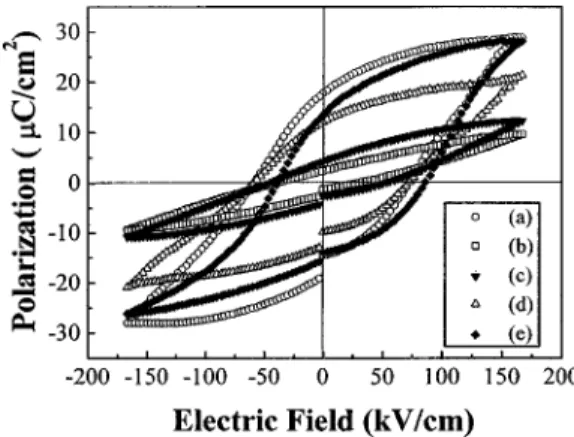
Alternatively, as observed in Fig. 9, a thermal rapid heat treatment at 150 °C was applied on the aged SBT films, roughly 74% of the initial switchable polarization of the aged SBT films was recovered after a thermal rapid heat treatment at 150 °C was applied. Furthermore, we found that the recov-ery was strongly correlated with temperatures used. A higher
temperature such as 450 °C, which is higher the Tc
(⬃320 °C) of SBT,6,21was employed to heat the aged films, a higher recovering percentage of the initial switchable po-larization was detected as compared to that at 150 °C. Mean-while, a comparable 2 Pr recovery with the film at 450 °C was also obtained for the case of the film heated at 275 °C. However, at a slightly lower temperature, i.e., 75 °C, only a limited recovery was observed. The 2 Pr value increases
from 6.4 to 9.7 C/cm2.
IV. DISCUSSION
The aging behavior was a common phenomenon and widely observed in ferroelectric ceramics.15 Mason22 sug-gested that the aging effect is a reduction of effective polar-ization produced by the domain-wall motion. The rearrange-ment of ferroelectric domains with time is considered to be the causes of aging phenomena.23 As shown in Fig. 5, the polarization reduction with aging time occurs in SBT films after the films were applied with electric field. The occur-rence of aging phenomenon was also dependent on the mag-nitude of applied field. While a larger electric field than the switching threshold was applied most of the domains will be switched and aligned in the same direction. An internal re-sidual stress will be induced due to the electric field. How-ever, as the applied electric field was removed, the
polariza-tion reduction with time was observed. Different
mechanisms have been proposed for aging effects. Bradt and Ansell24 assumed that the aging phenomenon results from the relief of the residual stress due to domain switching aris-ing from electric and elastic fields. Accordaris-ing to the report by Al-Shareef et al. SBT film exhibits a relatively weak do-main wall pinning.14 Consequently, as the applied electric field was removed, some of the domains tend to reorient in a variety of directions and attempt to move into lower energy configurations, which lead to the decrease of switchable or remanent polarization with time as one can see in Fig. 6. Therefore, it stands to reason that a larger external field or energy was required to switch these domains. The magnitude of induced strain due to electric field was dependent on the internal residual stress, which in turn was closely related to microstructure. As observed in Fig. 3, the sputtering-SBT FIG. 7. Repeated aging and thermal treatment of sputtering-SBT films.
FIG. 8. The effect of electric-field cycling on the change of 2 Prfor origin
and aged sputtering-SBT films.
FIG. 9. Hysteresis loops of Au sputtering-SBT Pt films共a兲 before aging, 共b兲 after aged for 2 months and共c兲 75, 共d兲 150, and 共e兲 450 °C thermal treatment of aged samples.
3053
J. Appl. Phys., Vol. 87, No. 6, 15 March 2000 S.-Y. Chen and V.-C. Lee
film, having columnar and dense structure, facilitates the do-main switching. Therefore, the slower polarization degrada-tion was observed as compared to that in MOD–SBT film, which is composed of loose and porous structure.
The aging recovery of SBT films can repeat many cycles by thermal treatment, as shown in Fig. 7, until the polariza-tion switching completely diminishes at very short time which was probably correlated with the characterization of a relatively weak domain wall pinning in SBT film. It has been reported that the H⫹ions and electrons produced by the dis-sociative adsorption of the hydrogen molecules on the Pt surface play critical roles in degrading the ferroelectric prop-erties of SBT and PZT thin films.21,25–26 The Pr-induced
internal electric field makes the H⫹ions and electrons form local space charges which pin the domains. There are two major factors, which in turn affect the aging behavior and recovery phenomenon of polarization in our case. One is the internal residual stress caused by either domain reorientation during applied electric field or space charge due to water molecules or H⫹ ions from environment atmosphere. The other is the unique characteristic of relatively weak domain wall pinning. For the samples without applying thermal treat-ment or electric-field cycling, the release of internal residual stress plays the main role in aging behavior and the decrease of Pr.
When the heating temperatures are lower than Tc
共⬃320 °C兲, the water molecules or hydrogen ions adsorpted on the electrode interfaces or domain boundaries are easily taken off in a vacuum chamber. Furthermore, the thermal treatment contributes domains more energy and therefore, the probability of overcoming the potential barrier to release the internal stress is increased. Consequently, the recovery is enhanced with increasing temperature and thus, almost 70%–90% recovery of initial polarization is obtained. When the heating temperature increases to over Tc, the uniform
redistribution of electrons and effective removal of water molecules, as similar to those below Tc, continually occur, causing the relief of the internal electric field. Consequently, a little higher recovering percentage of the initial switchable polarization was obtained at 450 °C as compared to that at 275 °C. These results again demonstrate that the domain boundaries are weakly pinned in SBT and easily unpinned by thermal energy.
On the other hand, besides thermal treatment, the easy recovery of domain switching can be also further demon-strated from the electric cycling fatigue of the aged sample. As shown in Fig. 8, the magnitude of 2 Princreases when the
aged SBT was subjected to electric field cycling at 5 V. A roughly 76% of the initial switchable polarization can be recovered after 1010 cycles. This behavior can be
qualita-tively explained based on model of self-recovery mechanism of SBT proposed by Al-Shareef et al. reporting that signifi-cant polarization suppression may be induced in SBT films using optical illumination but the optically fatigued SBT films can be rejuvenated using electric field cycling.14
Furthermore, in our case, either thermal treatment or electric-field cycling of the aged SBT films recovered a 76%–95% of the suppressed polarization. Also, in Fig. 9, we found the recovery percentage of the initial switchable
polar-ization was related to the temperature used in the thermal treatment. The higher thermal treating temperature often re-sults in higher recovery rate and recovery switchable polar-ization. However, when the temperature used was lower than 150 °C, the increment of recovery polarization is very small. This result may suggest that there exist a minimum threshold thermal energy for the unpinning of domain wall.
The weak domain wall pining in SBT films is postulated to result from smaller magnitude of ferroelectric polarization or relatively low oxygen vacancy concentration in the perov-skite sublattice. However, we found a larger leakage current along with a larger loss tangent in the SBT films. That is pretty consistent with the investigation that the bulk ionic conductivities of SBT or SBN are much higher than those of the perovskite ferroelectric ceramics, e.g., PZT.11 Warren
et al.27 reported that electrical fatigue is primarily due to electronic charge trapping by showing that application of a saturating bias with band gap light restored nearly 90% of the switchable polarization of electrically fatigued Pt/PZT/Pt capacitor. Therefore, the recovering behavior at either ther-mal treatment or electric-field cycling allow us to believe that the good fatigue resistance of SBT or SBN-based films is due to relative weak domain wall pinning which exists in between domain wall and electronic defects.
V. CONCLUSIONS
In this investigation, we observed that even the free-fatigue SBT films show aging phenomenon as similar to bulk ferroelectric materials, i.e., PZT. The aging raised from the relief of residual internal stress and domain wall reconfigu-ration caused by electric field when no thermal treatment is applied. The polarization degradation rate during aging was dependent on the microstructure and orientation of the films. A sputtering film with oriented and columnar structure shows a slower degradation rate. On the contrary, a MOD film with loose and small-grain structure presents a higher degradation rate. However, the electrically aged SBT films can be rejuvenated by either thermal treatment above 150 °C or electric-field cycling after 1010 cycles. A nearly 75%– 90% of the initial switchable polarization can be restored during these processes. These might suggest that the domain wall energy to pin the electronic defects be easily balanced by the electric-field cycling or thermal treatment due to a weak domain wall pinning.
ACKNOWLEDGMENT
The authors gratefully acknowledge the financial support by the National Science Council of the Republic of China under Contract No. NSC87-2218-E-009-016.
1J. F. Scott and C. A. Paz de Araujo, Science 246, 1400共1989兲. 2B. A. Tuttle, Mater. Res. Bull. 12, 40共1987兲.
3
I. K. Yoo and S. B. Desu, Integr. Ferroelectr. 3, 365共1993兲.
4
W. L. Warren, D. Dimos, B. A. Tuttle, R. D. Nasby, and G. E. Pike, Appl. Phys. Lett. 65, 1018共1994兲.
5C. A. Paz de Araujo, J. D. Cuchiaro, M. C. Scott, L. D. McMillan, and J.
F. Scott, Nature共London兲 374, 627 共1995兲.
6
G. A. Smolenskii, V. A. Isupov, and A. I. Agranovskaya, Sov. Phys. Solid State 3, 651共1961兲.
7B. Aurivillius, Ark. Kemi 1, 463共1949兲.
8E. C. Subbarao, Phys. Chem. Solids 23, 665共1962兲. 9
R. Dat, J. K. Lee, O. Auciello, and A. I. Kingon, Appl. Phys. Lett. 67, 572 共1995兲.
10P. Y. Chu, R. E. Jones, P. Zurcher, D. J. Taylor, B. Jiang, S. J. Gillespie,
and Y. T. Li, J. Mater. Res. 11, 1065共1996兲.
11
T.-C. Chen, C.-L. Thio, and S. B. Desu, J. Mater. Res. 12, 2628共1997兲.
12
D. Dimos, W. L. Warren, M. B. Sinclair, B. A. Tuttle, and R. W. Schwartz, J. Appl. Phys. 76, 4305共1994兲.
13D. Dimos, H. N. Al Shareef, W. L. Warren, and B. A. Tuttle, J. Appl.
Phys. 83, 1682共1996兲.
14
H. N. Al Shareef, D. Dimis, T. J. Boyle, W. L. Warren, and B. A. Tuttle, Appl. Phys. Lett. 68, 690共1996兲.
15N. Uchida and T. Ikeda, Jpn. J. Appl. Phys., Part 1 7, 1219共1968兲. 16J. C. Carrano, C. Sadhama, V. Chikarmane, J. Lee, W. Shepherd, and N.
Abt, IEEE Trans. Ultrason. Ferroelectr. Freq. Control 38, 690共1991兲.
17
H-M Tsai, P. Lin, and T.-Y. Tseng, J. Appl. Phys. 85, 1095共1999兲.
18S. Y. Chen and V.-C. Lee, J. Appl. Phys.共submitted兲. 19
T. Noguchi, T. Hase, and Y. Miyasaka, Jpn. J. Appl. Phys., Part 1 35, 4900共1996兲.
20T. Atsuki, N. Soyama, T. Yonezawa, and K. Ogi, Jpn. J. Appl. Phys., Part
1 34, 5096共1995兲.
21
K. Takamura, T. Noguchi, T. Hase, and Y. Miyasaka, Appl. Phys. Lett. 73, 1649共1998兲.
22W. P. Mason, J. Acoust. Soc. Am. 27, 73共1955兲. 23
R. Herbiet, H. Tenbrock, and G. Arlt, Ferroelectrics 76, 319共1987兲.
24
R. C. Bradt and G. S. Ansell, J. Am. Ceram. Soc. 52, 192共1969兲.
25K. K. Abdelghafar, H. Miki, K. Torii, and Y. Fujisaki, Appl. Phys. Lett.
69, 3188共1996兲.
26S. Aggarwal et al., Appl. Phys. Lett. 73, 1973共1998兲. 27
W. L. Warren, D. Dimos, B. A. Tuttle, R. D. Nasby, and G. E. Pike, Appl. Phys. Lett. 65, 1018共1994兲.
3055
J. Appl. Phys., Vol. 87, No. 6, 15 March 2000 S.-Y. Chen and V.-C. Lee