X-ray absorption and optical spectroscopy studies of
„Mg
1ÀxAl
x…B2H. D. Yang,1H. L. Liu,2J.-Y. Lin,3M. X. Kuo,2P. L. Ho,1J. M. Chen,4C. U. Jung,5Min-Seok Park,5 and Sung-Ik Lee5 1Department of Physics, National Sun Yat-Sen University, Kaohsiung 804, Taiwan, Republic of China
2Department of Physics, National Taiwan Normal University, 88, Sec. 4, Ting-Chou Road, Taipei 116, Taiwan, Republic of China 3Institute of Physics, National Chiao Tung University, Hsinchu 300, Taiwan, Republic of China
4Synchrotron Radiation Research Center (SRRC), Hsinchu 300, Taiwan, Republic of China
5National Creative Research Initiative Center for Superconductivity and Department of Physics, Pohang University of Science and Technology, Pohang 790-784, Republic of Korea
共Received 1 October 2002; revised manuscript received 6 May 2003; published 8 September 2003兲
X-ray absorption spectroscopy and optical reflectance measurements have been carried out to elucidate the evolution of the electronic structure in (Mg1⫺xAlx) B2for x⫽0.0, 0.1, 0.2, 0.3, and 0.4. The important role of
B 2 p hole states to superconductivity has been identified, and the decrease in the hole carrier number is
quantitatively determined. The rate of the decrease in the hole concentration agrees well with the theoretical
calculations. On the other hand, while the evolution of the electronic structure is gradual through the doping range, Tc suppression is most significant at x⫽0.4. These results suggest that the superstructure in
(Mg1⫺xAlx)B2, in addition to the holes, can affect the lattice dynamics and contributes to the Tcsuppression
effect. Other possible explanations like the topological change of the band Fermi surface are also discussed. DOI: 10.1103/PhysRevB.68.092505 PACS number共s兲: 74.25.Gz, 74.70.Ad, 74.25.Jb, 78.70.Dm
Within two years of the discovery of superconductivity in MgB2,1intensive studies have led to tremendous
understand-ing of this new and unique intermetallic superconductor. The main frame has been set both by theory and experiments. MgB2is a phonon-mediated strong coupling superconductor.
The two-dimensional B 2 p holes play a crucial role in superconductivity of MgB2.2–5 In contrast to classical
s-wave superconductors, MgB2 has multiple
superconduct-ing energy gaps though it is fully gapped.2,5–10 However, there are issues on MgB2remaining somewhat open yet. One
example is the Al doping effects on Tcof MgB2. It is
estab-lished that the Al doping leads to Tc suppression in MgB2.
Al doping also shortens the c axis in the layered hexagonal structure. Furthermore, the Al-layer ordering in (Mg1⫺xAlx)B2 was reported.11,12Since superconductivity in MgB2is of phonon origin, the interplay of the lattice
dynam-ics and the evolution of the electronic structure in (Mg1⫺xAlx)B2is of great interest. However, compared to the
detailed studies of phonon spectrum in (Mg1⫺xAlx)B2,13the
Al doping effects on the electronic structure have not been thoroughly explored yet. In this paper, we report detailed x-ray absorption and optical reflectance measurements in (Mg1⫺xAlx)B2 for x⫽0.0, 0.1, 0.2, 0.3, and 0.4.
Compari-sons between the present results and other theoretical and experimental works provide deeper insight into the electronic structure and Tcsuppression mechanism in (Mg1⫺xAlx)B2.
To prepare (Mg1⫺xAlx)B2, the stoichiometric mixture of Mg11B, and Al powder共Alfa Aesar兲 was ground softly for an hour. Resultant powder was palletized and wrapped by a Ta foil. Then it was put into a high pressure cell. This whole process was performed in an inert Ar gas. A 12 mm cubic multianvil system was used for a high pressure synthesis. The cell was heated up to 950°C and maintained 950°C for 2 h. Then it was quenched to room temperature. Details of high-pressure synthesis will be found elsewhere.14,15The lat-tice parameters a and c, shown in the inset of Fig. 1, were obtained from x-ray diffraction measurements. Al doping led
to an obvious decrease in c due to the smaller ionic radius of Al3⫹than that of Mg2⫹, while the effect on a was relatively insensitive. The diffraction pattern of the x⫽0.2 sample showed the presence of two phases. All the above x-ray dif-fraction results were consistent with those in the literature.11,12 The resistivity was measured by the four-probe method, as shown in Fig. 1. Tcwas determined by the midpoint of the transition, and was consistent with the mag-netization M measurements. The sharp transition both in and M manifested the good quality of the samples. Moreover,
FIG. 1. Resistivity(T) of (Mg1⫺xAlx)B2. Inset: lattice
param-eters of (Mg1⫺xAlx)B2.
PHYSICAL REVIEW B 68, 092505 共2003兲
Tc suppression effects due to Al doping are consistent with the reported results.11,12
X-ray absorption near edge structure共XANES兲 in fluores-cence mode is a powerful tool to investigate the unoccupied 共hole兲 electronic states in complex materials and is bulk sen-sitive. The B K-edge x-ray absorption spectra were carried out using linear polarized synchrotron radiation from 6-m high-energy spherical grating monochromator beamline lo-cated at The Synchrotron Radiation Research Center共SRRC兲 in Taiwan. Details of the measurements were described elsewhere.16,17 Energy resolution of the monochromator is set to be 0.15 eV for the B K-edge energy range. The energy was calibrated as in Ref. 18. The absorption spectra were normalized to the maximum of the peak around 200 eV.
Near-normal optical reflectance spectra were taken at room temperature on mechanically polished surfaces of high-density polycrystalline samples. Middle infrared (600–3000 cm⫺1) measurements were made with a Perkin-Elmer 2000 spectrometer coupled with a FT-2R microscope, while the spectra in the near-infrared to near-ultraviolet re-gions (4000–55000 cm⫺1) were collected on a Perkin-Elmer Lambda-900 spectrometer. The modulated light beam from the spectrometer was focused onto either the sample or an Au共Al兲 reference mirror, and the reflected beam was di-rected onto a detector appropriate for the frequency range studied. The different sources and detectors used in these studies provided substantial spectral overlap, and the reflec-tance mismatch between adjacent spectral ranges was less than 1%.
The B K-edge XANES on (Mg1⫺xAlx)B2was studied and shown in Fig. 2. The peaks centered between 186.5 and 187 eV can be identified to be closely associated with B 2 p holes. Two additional peaks around 192–194 eV 共not shown兲, probably due to either boron oxides or resonances, were also observed in this work. These features do not ap-pear to affect the peak of B 2 p states, and are not included in the following discussions.18 –20
The most noticeable change is the decrease in the inten-sity of the preedge peak with increasing Al doping. This can be reasoned as the electron doping effect with the substitu-tion of Al3⫹ for Mg2⫹. XANES thus directly verifies the crucial role of B 2 p holes together with Tc suppression effects due to Al doping. It is also noticed that the change of the intensity is gradual, like the x dependence of Tc(x), until
x⫽0.4. No dramatic change between x⫽0.0 and 0.1 was
observed in the present work, while a 65% drop in the spec-tral weight was reported in Ref. 20. In general, the onset and the peak energies both increase with Al doping as expected naively by the concept of hole filling, while indicating that the rigid band model cannot be vigorously applied. Further-more, the onset and the peak energies actually decrease slightly from x⫽0.0 to 0.1, which probably suggests a cor-responding change of the core level energy. This curious ten-dency appears to be genuine, since it was also observed in another independent work.21
To further quantify the decrease in the number of hole carriers, the optical spectroscopy has been proved to be an effective tool for the investigation of the doping-induced spectral weight.22 The optical properties 关i.e., the complex conductivity ()⫽1()⫹i2() or dielectric function ⑀()⫽1⫹4i()/] were calculated from Kramers-Kronig analysis of the reflectance data.23 To perform these transformations one needs to extrapolate the reflectance at both low and high frequencies. At low frequencies the exten-sion was done by modeling the reflectance using the Drude model and using the fitted results to extend the reflectance below the lowest frequency measured in the experiment. The high-frequency extrapolations were done by using a weak power law dependence, R⬃⫺swith s ⬃1 –2.
Similar optical experiment has been performed on MgB2.24 In this work, the detailed optical measurements on
(Mg1⫺xAlx)B2 are reported. Figure 3 shows the
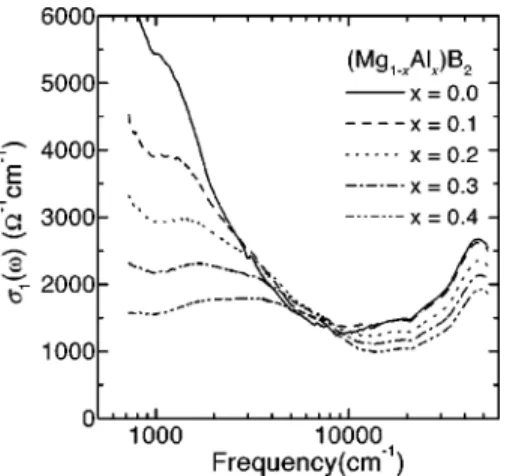
room-temperature real part of the optical conductivity1() as a
function of Al doping, obtained from a Kramers-Kronig transformation of the measured reflectance data. For the x ⫽0.0 sample, the optical conductivity can be described in general terms as 共i兲 coherent response of itinerant charge carries at zero frequency, 共ii兲 an overdamped midinfrared component around 3500 cm⫺1, and共iii兲 two interband
tran-FIG. 2. B K-edge XANES of (Mg1⫺xAlx)B2 for x⫽0 to 0.4.
The preedge peak is associated with the B 2 p hole states.
FIG. 3. Room-temperature optical conductivity spectra of (Mg1⫺xAlx)B2.
BRIEF REPORTS PHYSICAL REVIEW B 68, 092505 共2003兲
sitions near 17 000 and 50 000 cm⫺1. We have tried to fit the conductivity spectrum in the whole frequency range with a Drude part and three Lorentz oscillators. The Drude plasma frequency of the carriers pD and their scattering rate 1/D are 27 000 and 1000 cm⫺1, respectively. The estimated Drude resistivity 关Drude⫽(pD
2
D/60)⫺1, in unit ⍀ cm兴 is 8⫻10⫺5⍀ cm, in reasonable agreement with the transport results. As Al doping proceeds, the far-infrared conductivity is decreasing, while the oscillator strength of the midinfrared absorption is nearly independent of doping.
An attempt in separating the zero-frequency absorption channel from the midinfrared absorption sometimes pro-duced ambiguous results. This is the case that there has been much discussion over the one-component and the two-component pictures to describe the optical conducitivity of high-Tc cuprates.25 The doping dependence of the low-frequency optical conductivity of these samples can also be summarized by plotting the integrated spectral weight in the conductivity,23 Neff共兲⫽ 2m0Vcell e2
冕
0 1共⬘
兲d⬘
, 共1兲where m0 is taken as the free-electron mass, and Vcellis the
unit cell volume. Neff() is proportional to the number of
carriers participating in the optical absorption up to a certain cutoff frequency and has the dimension of frequency squared. Integration of the conductivity up to ⫽8000 cm⫺1 — the frequency at which we observe a clear
onset of interband transitions—provides only 30% of the spectral weight we measure when is extended up to our experiment limit of 52 000 cm⫺1. Figure 4 shows the quan-tity Neff(⫽8000 cm⫺1) plotted as a function of Tc, illus-trating the correlation between the number of carriers and Tc in the (Mg1⫺xAlx)B2 systems. It is interesting to note that
the spectral weight corresponds to an effective number of carriers of ⬃0.48 and 0.16 for the x⫽0.0 and 0.4 samples, suggesting that each Al removes approximately one carrier. From Fig. 4, it is intriguing to note that Tcchanges accord-ingly with Neff until a more significant drop in Tcoccurs at
x⫽0.4. This implies that an additional effect other than Neff
begins to play a role in the determination of Tc at the com-position of x⫽0.4. Another intriguing plot is Neff vs x as in
Fig. 5. It unambiguously demonstrates no abrupt change of
Neff at either x⫽0.1 or 0.4, in agreement with XANES in
Fig. 3. It has been argued that the evolution of the electronic structure is responsible for the change of the lattice dynamics in (Mg1⫺xAlx)B2.
13
The results in Figs. 4 and 5 further sug-gest that the phonon spectrum could be affected by the su-perstructure, in addition to the factor of Neff. Why this su-perstructure effect takes place at x⫽0.4 rather than at smaller
x is unknown. Perhaps the composition of x⫽0.4 approaches x⫽0.5 close enough where the Al layer ordering is much
preferred. The formation of the superstructure has been ex-plained recently by a simple model, though with a too low instability temperature for the phase separation.26The inter-play of the electronic structure, the lattice dynamics, and the superstructure still remains unclear with respect to the de-tails.
B 2 p holes in (Mg1⫺xAlx)B2 were actually
theoreti-cally investigated.4 Figure 5 provides an excellent stage to compare between theoretical calculations and experimental results. Though the absolute value of the carrier number is difficult to compare, the comparison of the relative change of the carrier number due to Al doping can be made. Theoreti-cal Theoreti-calculations predict Neff(x)/Neff(0)⫽1⫺1.75x4, which
amazingly agrees with the experimental results in Fig. 5. It is noted that the solid line in Fig. 5 represents the theoretical prediction with no fitting parameter. This astonishing agree-ment deserves further consideration. In the calculations of Ref. 4, doped Al atoms were assumed to be distributed in Mg planes, and no superstructure effects were included. It seems that the occurrence of the superstructure has no effect on Neff
while it affects the lattice dynamics which contributes to fur-ther Tcsuppression for x⭓0.4. This scenario is qualitatively in accord with the experimental results.13It is also likely that the coupling between and bands has to be included to account for the correct Tcsuppression effects.
26
Furthermore,
FIG. 4. The effective number of carriers Neff integrated up to
8000 cm⫺1 vs Tc. FIG. 5. N
effvs x. The experimental results are shown as the solid
circles. The theoretical prediction is taken from Ref. 4 and denoted as the solid line. No fitting parameter is adjusted.
BRIEF REPORTS PHYSICAL REVIEW B 68, 092505 共2003兲
another first principle calculation work共without considering the superstructure effects兲 suggests that an abrupt topological change in the Fermi surface between x⫽0.3 and 0.4.27 How this electronic structure change reconciles with the ob-served smooth change of XANES and Neff(x), and how it is
related to the evolution of the lattice dynamics and the Tc suppression remain largely unknown. Certainly further theo-retical studies as in Ref. 4 but including the interplay of all the electronic structure, the lattice dynamics, and the super-structure effects are indispensable.
To conclude, spectroscopy studies of (Mg1⫺xAlx)B2 by XANES and optical reflectance measurements not only iden-tify the importance of B 2 p hole states to superconductiv-ity, but also quantify the changes of the carrier number due to Al doping. The quantitative decreasing rate of the hole
number agrees well with the theoretical calculations. No abrupt change of the carrier number was observed for x ⫽0.0 to 0.4. This smooth change is difficult to reconcile with the large Tc suppression at x⫽0.4. While either the super-structure or the topological change of the electronic super-structure in (Mg1⫺xAlx)B2 could be responsible for this anomaly, the
experimental results of the electronic structure evolution in-dicate that a full understanding of the large Tcsuppression at
x⫽0.4 is still desirable.
We are grateful to B. Renker and R. Heid for inspiring discussions at the MOS2002 conference. This work was sup-ported by the National Science Council of the Republic of China under Grant Nos. NSC 91-2112-M-003-021, NSC91-2112-M-110-005, and NSC91-2112-M-009-046.
1J. Nagamatsu, N. Nakagawa, T. Muranaka, Y. Zenitani, and J.
Akimitsu, Nature共London兲 410, 63 共2001兲.
2A. Y. Liu, I. I. Mazin, and J. Kortus, Phys. Rev. Lett. 87, 087005
共2001兲.
3P. P. Singh, Phys. Rev. Lett. 87, 087004共2001兲.
4S. Suzuki, S. Higai, and K. Nakao, J. Phys. Soc. Jpn. 70, 1206
共2001兲.
5H. J. Choi, D. Roundy, H. Sun, M. L. Cohen, and S. G. Louie,
Nature共London兲 418, 758 共2002兲.
6H. D. Yang, J.-Y. Lin, H. H. Li, F. H. Hsu, C.-J. Liu, S.-C. Li,
R.-C. Yu and C.-Q. Jin, Phys. Rev. Lett. 87, 167003共2001兲.
7F. Bouquet, R. A. Fisher, N. E. Phillips, D. G. Hinks, and J. D.
Jorgensen, Phys. Rev. Lett. 87, 047001共2001兲.
8T. Takahashi, T. Sato, S. Souma, T. Muranaka, and J. Akimitsu,
Phys. Rev. Lett. 86, 4915共2001兲.
9S. Tsuda, T. Yokoya, T. Kiss, Y. Takano, K. Togano, H. Kito, H.
Ihara, and S. Shin, Phys. Rev. Lett. 87, 177006共2001兲.
10X. K. Chen, M. J. Konstantinovic´, J. C. Irwin, D. D. Lawrie, and
J. P. Franck, Phys. Rev. Lett. 87, 157002共2001兲.
11J. S. Slusky, N. Rogado, K. A. Regan, M. A. Hayward, P.
Khali-fah, T. He, K. Inumaru, S. Loureiro, M. K. Hass, H. W. Zand-bergen, and R. J. Cava, Nature共London兲 410, 343 共2001兲.
12J. Q. Li, L. Li, F. M. Liu, C. Dong, J. Y. Xiang, and Z. X. Zhao,
Phys. Rev. B 65, 132505共2002兲.
13B. Renker, K. B. Bohnen, R. Heid, D. Ernst, H. Schober, M.
Koza, P. Adelmann, P. Schweiss, and Th. Wolf, Phys. Rev. Lett.
88, 067001共2002兲, and references therein.
14C. U. Jung, Min-Seok Park, W. N. Kang, Mun-Seog Kim, Kijoon
H. P. Kim, S. Y. Lee, and Sung-Ik Lee, Appl. Phys. Lett. 78, 4157共2001兲.
15
C. U. Jung, Heon-Jung Kim, Min-Seok Park, Mun-Seog Kim, J. Y. Kim, Zhonglian Du, Sung-Ik Lee, K. H. Kim, J. B. Betts, M.
Jaime, A. H. Lacerda, and G. S. Boebinger, Physica C 377, 21
共2002兲.
16J. M. Chen, R. S. Liu, J. G. Lin, C. Y. Huang, and J. C. Ho, Phys.
Rev. B 55, 14 586共1997兲.
17I. P. Hong, J.-Y. Lin, J. M. Chem, S. Chatterjee. S. J. Liu, Y. S.
Gou, and H. D. Yang, Europhys. Lett. 58, 126共2002兲.
18J. Nakamura, N. Yamada, K. Kuroki, T. A. Callcott, D. L. Ederer,
J. D. Denlinger, and R. C. C. Perera, Phys. Rev. B 64, 174504
共2001兲.
19T. A. Callcott, L. Lin, G. T. Woods, G. P. Zhang, J. R. Thompson,
M. Paranthaman, and D. L. Ederer, Phys. Rev. B 64, 132504
共2001兲.
20S. Schuppler, E. Pellegrin, N. Nu¨ker, T. Mizokawa, M. Merz, D.
A. Arena, J. Dvorak, Y. U. Idzerda, D.-J. Huang, C.-F. Cheng, K.-P. Bohnen, R. Heid, P. Schweiss, and Th. Wolf, cond-mat/0205230共unpublished兲.
21K.-D. Tsuei, H.-J. Lin, L.-C. Lin, T.-Y. Hou, H.-H. Hsieh, C. T.
Chen, N. L. Saini, A. Bianconi, and A. Saccone, Int. J. Mod. Phys. B 16, 1619共2002兲.
22D. B. Tanner, H. L. Liu, M. A. Quijada, A. M. Zibold, H. Berger,
R. J. Kelley, M. Onellion, F. C. Chou, D. C. Johnston, J. P. Rice, D. M. Ginsberg, and J. T. Markert, Physica B 244, 1共1998兲.
23F. Wooten, Optical Properties of Solids共Academic, New York,
1972兲.
24For example, B. Gorshunov, C. A. Kuntscher, P. Haas, M.
Dressel, F. P. Mena, A. B. Kuz’menko, D. van der Marel, T. Muranaka, and J. Akimitsu, Eur. Phys. J. B 21, 159共2001兲.
25D. B. Tanner and T. Timusk, in Physical Properties of High Tem-perature Superconductors III, edited by D. M. Ginsberg共World
Scientific, Singapore, 1992兲, p. 363.
26S. V. Barabash and D. Stroud, Phys. Rev. B 66, 012509共2002兲. 27
O. de la Pen˜a, A. Aguayo, and R. de Coss, Phys. Rev. B 66, 012511共2002兲.
BRIEF REPORTS PHYSICAL REVIEW B 68, 092505 共2003兲