Pergamon
Appl. Math. Lett. Vol. 11, No. 2, pp. 109-114, 1998 Copyright(~)1998 Elsevier Science Ltd Printed in Great Britain. All rights reserved 0893-9659/98 $19.00 + 0.00 PII: S0893-9659(98)00020-2
D-Stability Analysis for Discrete
Uncertain Time-Delay Systems
F E N G - H S I A G H S I A O
Department of Electrical Engineering, Chang Gung University 259, Wen-Hwa 1 st Road, Kwei-San, Taoyuan Shian, Taiwan, 333, R.O.C.
J I I N G - D O N G H W A N G
Department of Information Management, Jin-Wen College of Business and Technology 99, An Chung Road, Hsin Tien, Taipei, Taiwan, 231, R.O.C.
S H I N G - P A I P A N
Department of Control Engineering, National Chiao Tung University 1001, Ta Hsueh Road, Hsinch, Taiwan 300, R.O.C.
(Received December 1996; accepted January 1997) Communicated by K. Glover
A b s t r a c t - - T w o cases of the robust D-stability criterion are derived for discrete uncertain systems with multiple time delays. One is a direct test and the other is a boundary test. These cases provide the sufficient conditions under which all solutions of the characteristic equation remain inside the specific disk D(a, r) in the presence of parametric uncertainties.
K e y w o r d s - - D - s t a b i l i t y , Multiple time delays, D-pole placement. 1. I N T R O D U C T I O N
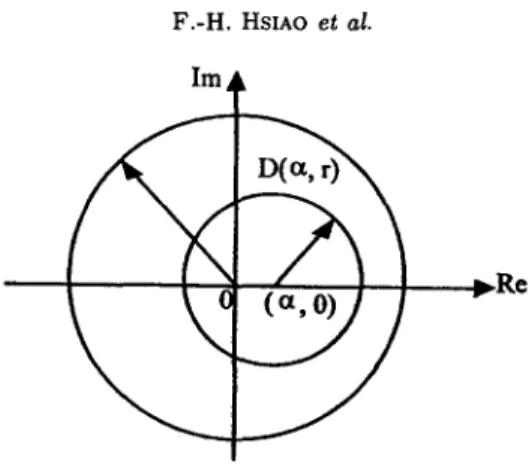
T h e p r o b l e m of pole assignment in linear system theory has been discussed by m a n y authors and solved in various ways. However, locations of poles vary and cannot be fixed because of p a r a m e t r i c uncertainties t h a t originate from different sources, e.g., identification errors, aging of devices, variation of operating points, etc. Therefore, placing all poles in a specific region rather t h a n assigning t h e m to precise locations m a y be satisfactory in practical applications. One such specific region for discrete systems is a disk D ( ~ , r) centered at D ( ~ , 0) with radius r, where I~ I + r < 1. T h e assignment of all poles of a system in the specific disk D ( a , r) shown in Figure 1 is known as a D-pole placement problem [1]. This subject has received much attention in the literature [1-3].
T h e problem of stabilization of time-delay systems has been explored over the years, primarily because the delay is often encountered in various engineering systems, e.g., chemical p r o c e s s - - steel smelting and r e f i n e r y - - o r in long transmission lines, in pneumatic, hydraulic, or electrical networks. Its occurrence m a y frequently result in undesirable system responses. Consequently, the problem of stability analysis of time-delay systems is one of the main concerns of the re- searchers who would like to inspect the properties of such systems. Numerous r e p o r t s in regard to this subject have been published [4-6].
The authors wish to express sincere gratitude to the anonymous referee for his constructive comments and helpful suggestions which led to substantial improvements of this paper. Moreover, this research work was supported by the National Science Council of the Republic of China under Contract NSC 85-2213-F_~182-006.
Typeset by JtA/eS-TEX 109
I m
~ R e
Figure 1. A disk D(a, r) centered at (a, 0) with radius r.
The introduction of time-delay factor complicates the D-pole placement problem, since the number of poles of a system will increase due to time delays. The D-stability problem for discrete time-delay systems has been discussed by Lee et al. [2] and their result is extended to include multiple time-delay systems by Su and Shyr [3]. However, the criteria proposed by Lee et al. [2] and Su and Shyr [3] are too conservative. In order to improve their results, two cases of the robust D-stability criterion in terms of complex stability radius are proposed for discrete uncertain systems with multiple time delays. One is a direct test (i.e., check dl < ds) and the other is a boundary test. The robust D-stability is first checked by the direct test. If it fails, resort to the boundary test.
2. R O B U S T D - S T A B I L I T Y A N A L Y S I S
Consider a discrete uncertain system, with multiple time delays, described by the following difference equation:
n
X ( k + 1) = A X ( k ) + A A X ( k ) + Z AdiX (k - hi) + Z AAd~X (k - h~) , (1)
i = 1 i = 1
in which X ( k ) E R m and hi, i = 1, 2 , . . . , n, are positive integer numbers; A and Adi are constant matrices with proper dimensions. Also, AA and AAd~ denote the parametric uncertainties with the following upper norm-bounds:
IIAAII _< ,~,
(2)
HAAdiI[ ~- ~/i, i = 1 , 2 , . . . ,n, (3) where/3 and ~?i are given constants.
Before proceeding to the main result, some useful concepts are given in the following.
DEFINITION 1. A system is said to be D(a, r)-stable if all poles of the system axe within the specific disk D(a, r) centered at (a, O) with radius r. Namely, all the solutions of its characteristic equation satisfy [(z - a)/r[ < 1, in which r > 0 and [a[ + r < 1.
DEFINITION 2. Let all eigenvalues of the matrix A be inside the unit circle of the complex plane, then the positive value
p(A)-= o
{
(4)
is said to be a complex stability radius of the matrix A.
REMARK 1. The value p(A) depends on the choice of norm. For instance, if the Euclidean norm is used, then it is easy to show that
p(A) = min {a_ [ e J e I - A]} (5)
O_<O_<2~r
D-Stability Analysis 111 LEMMA 1 [7]. Let el/eigenvalues of the matr/x M be inside the unit disk of the complex plane. All the eigenvalues of all matrices M + A M are inside the unit disk if and only if HAM[[ < p( M ) . LEMMA 2 [8]. Let a matr/x E(z) E v-oo~'nx'* with --oo~mx~ denoting the set of m x n matrices whose elements are proper stable rational functions, then
sup IlE(z)ll = sup IlE(z)ll =
sup liE ( j0) ll,
(6)
zEf2 [z[>_l 0E[0,2~r]
where f~ - {z = re #°, 0 E [0, 2~r], r > 1}. Since E ( z ) is analytic for z E f~, this norm is well defined.
After reviewing the above definition and lemma, we are in the position to derive the robust D-stability criterion in terms of complex stability radius for a discrete uncertain multiple time- delay system.
THEOREM l.
(I) Suppose that all the eigenvalues of A are within the specific disk D ( a , r). System (1) is robustly D ( a , r)-stable (with In[ < r), ff
(7)
(II) I f dx >_ ds and the function
h(g) - - ~ + ~ Ad,(rg + +
n, (r -I 1)
-h'r i=l
(8)
lies outside the interval [ds, dl], where In[ < r and g take the values in the bounded region Ul = {6 [ 1 _< [6[ _< dlr} with dlr = [[(A - aI)/r[[ + dl, then system (1) is robustly D ( a, r )-stable.
PROOF. See the Appendix.
REMARK 2. Case (I) of Theorem 1 gives a nice algebraic condition to test the robust D-stability of system (1) at the cost of conservativeness. It is therefore reasonable to check the D-stability with Case (I), and then if it fails, resort to Case (II). Thus, Cases (I) and (II) complement each other.
REMARK 3. It is easy to see that the D-stability criterion in Theorem I will get a less conservative result than the criteria proposed by Su and Shyr [3].
However, for a practical application, it is difficult to examine Case (II) of Theorem 1. The following 'boundary test' may be helpful in examining Case (II) of Theorem 1.
COROLLARY 1. I f dl ~_ ds azld the following inequality holds:
I$
]
h(g) - - /3 + Acl~(rg + a) -h' + 7h(r - lal) -h' < ds,
r i = 1
(9)
where
lal
< r and g = e j° for 8 E [0, 27r], then system (1) is robustly D ( a , r)-stable.PROOF. The matrix ) - ~ 1 Ad~(rg + a) -h' of which all poles of the elements have the modulus Igl = l a l / r < 1 belongs to R ~ . Consequently, based on Lemma 2, the function h(g) in (21) takes on its supremum in the range given by g = e#0 for O E [0, 21r]. Therefore, if inequality (9) holds, h(g) lies outside the interval [ds, dl] for all g E Us and then system (1) is robustly D ( a , r)- stable (according to Case (II) of Theorem 1). This completes the proof.
3. E X A M P L E
Consider a discrete uncertain multiple time-delay system:
[002 ]
]
[_0.0010]
X ( k + l) = 0 X ( k ) + I 0"0168 0 X ( k - 1 ) 4- X ( k - 2)
0.2
i
0.01 -0.05 0.01 0.001 (10)+ A A X ( k ) + A A d l X ( k - 1) + A A d 2 X ( k - 2), in which
IIAAII < 0.4749, I]AAdlH < 0.0186, and IIAAd2H ~ 0.016. (11) (see footnote1).
The purpose is to inspect whether system (10) satisfies the following time-domain specifications: (i) overshoot < 15%, or equivalently, damping ratio ~ _> 0.5;
(ii) rise time < 4.17s, or equivalently, natural frequency w, ~ 0.6;
(iii) settling time < 43.65s, or equivalently, all poles less than 0.9 (the sampling interval T =
ls).
These constraints (i)-(iii) may be interpreted as pole locations inside the specified disk D(0.2, 0.7) (see [9]).
SOLUTION. According to (2), (3), and (11), the norm-bounds of parametric uncertainties are given as f~ = 0.4749, 7z = 0.0186, and 72 = 0.016. From (7), we have
d l ---- _1 f~ 4-
(IIAdiH
4- 7i) (r -I~l) -h,
= 1.2264 > ds = P A _ a I = 1. (12) 1" i=1Therefore, the inequality (7) is not satisfied. We now proceed to Corollary 1.
The simulation of the function h(g) in (9), where g = e je for 8 E [0, 21r], is depicted in Figure 2. This figure reveals t h a t h(g) < ds = 1. Therefore, according to Corollary 1, we can conclude t h a t system (10) is D(0.2, 0.7)-stable.
h(g)
0.98 0.97 0.96 0.95 0.94 0.93 0.92 0.91 0.9 0 o Figure 2. 7 0 0In order to verify this result, a set of parametric uncertainties which satisfies the norm-bound conditions (11) is chosen as follows:
[0::1
o]
AA = . 0.44 J ' A A d l = 0 . ' L0.009 0.01 "
D-Stability Analysis 113 By the computer simulation shown in Figure 3, we find that all poles (0.5299=kj0.1218, - 0 . 0 5 8 5 + j0.164, 0.019 -4- j0.1091) of the system lie inside the specific disk D(0.2, 0.7). Therefore, the multiple time-delay system (10) meets the time-domain specifications (i)-(iii) in the presence of parametric uncertainties as depicted in (13). This justifies our result.
1!
0.5 ] -1 -1 -0.5 -0.5 0 0.5 Figure 3.4. C O N C L U S I O N
Two cases of the robust D-stability criterion are proposed for discrete uncertain systems with multiple time delays. One is a direct test (i.e., check dl < ds) and the other is a boundary test. The robust D-stability of system (1) is first checked by the direct test. If it fails, resort to the boundary test, as illustrated in the example.
A P P E N D I X
PROOF OF THEOREM 1.
CASE I. From (7), the following inequality (14) can be achieved:
_1 [[AAI[ + ([[Ad~[[ + [[AA~il[)Irg
+ a[ -h' < p
r i = 1
=~
AA +
(Aa~ + AAd~) (rg + a) -h'
< P
r
'
i = l for Igl-> 1, for [g[ > 1.(14)
(15)
Hence, from Lemma 1,
A { A - a I r
- - + - 1 A A +E (A4~ +
AA4i)(rg +
a ) - h ,r i--1
< 1 , for Igl >-- 1.
(16)
This implies that
Igl # A - a_._____I/+ 1 AA + E (Adi + AAd~)
(rg + a) -h'
r r ~=1 for Ig[ ~ 1.
(17)
In view of (17), we can see that the solutions of the characteristic equation (of system (1))
{[
]}
or equivalently (with z = r g ÷ ~),
(19)
satisfy Igl < 1 (i.e., I(z - ~ ) / r I < 1). Therefore, s y s t e m (1) is r o b u s t l y D(c~,r)-stable. T h i s c o m p l e t e s t h e p r o o f of Case I.
CASE I I . I f s y s t e m (1) is not D ( ~ , r ) - s t a b l e , t h e n t h e r e exists a solution g of t h e characteristic e q u a t i o n (19) satisfying
_> 1. (20)
B a s e d on L e m m a 1 a n d (20), we can get t h e following inequality:
<_ - A A l l + A d i ( r g + ~ ) - h , + IIAAdill Irg ÷ al - h ' = h ( g ) (21)
r i---1
<_ - ~ + (]lAdiII + ~li) (r - Ial) - h ' -~ d l , for Igl -> 1.
r i ~ l
ds
= p_<
Moreover, according to (20), we have
(22)
1 <_ Ig] = A - ~_____~I + _1 A A + (Adi -~ A A d i ) ( r g + c~) - h '
r r i--1
<- + r j3 + (llAdiH + Tli) (r - [al) - h ' = dlr. i---1
T h i s implies t h a t if s y s t e m (1) is n o t D(c~, r ) - s t a b l e , t h e n all t h e u n s t a b l e poles of this s y s t e m m u s t b e w i t h i n t h e b o u n d e d region U1 = (if I 1 < I~1 < d l r ) . Hence, if inequality (21) is not t r u e (i.e., h ( g ) lies outside the interval [ds, dl]) for all g E U1, t h e n s y s t e m (1) is r o b u s t l y D ( ~ , r ) - s t a b l e . T h i s c o m p l e t e s t h e p r o o f of Case II.
R E F E R E N C E S
1. K. Furuta and S.B. Kim, Pole-assignment in a specified disk, IEEE Trans. Automat. Control 32, 423-427 (1987).
2. C.H. Lee, T.H.S. Li and F.C. Kung, D-stability analysis for discrete systems with a time delay, Systems Control Letters 19, 213-219 (1992).
3. T.J. Su and W.J. Shyr, Robust D-stability for linear uncertain discrete time-delay systems, IEEE Trans. Automat. Control 39, 425-428 (1994).
4. A. Feliachi and A. Thowsen, Memoryless stabilization of linear delay-differential systems, IEEE Trans. Automat. Control 26, 586-587 (1981).
5. T. Mori, N. Fukuma and M. Kuwahara, Delay independent stability criteria for discrete-delay systems,
IEEE Trans. Automat. Control 27, 964-966 (1982).
6. T. Mori, Criteria for asymptotic stability of linear time delay systems, IEEE Trans. Automat. Control 30, 158-161 (1985).
7. V.L. Kharitonov, Stability radii and global stability of difference systems, In Proc. 3 0 ~h IEEE CDC,
pp. 877-880, Brighton, England, (1991).
8. M. Vidyasagar, Control System Synthesis: A Faetorization Approach, MIT Press; Cambridge, MA, (1985). 9. S.H. Lee and T.T. Lee, Optimal pole assignment for a discrete linear regulator with constant disturbances,