行政院國家科學委員會專題研究計畫 期中進度報告
極高能宇宙微中子之探測(1/3)
期中進度報告(精簡版)
計 畫 類 別 : 個別型 計 畫 編 號 : NSC 96-2811-M-002-001- 執 行 期 間 : 96 年 08 月 01 日至 97 年 07 月 31 日 執 行 單 位 : 國立臺灣大學天文物理學研究所 計 畫 主 持 人 : 陳丕燊 報 告 附 件 : 國外研究心得報告 出席國際會議研究心得報告及發表論文 國際合作計畫研究心得報告 處 理 方 式 : 本計畫可公開查詢中 華 民 國 97 年 06 月 06 日
NSC Mid-Term Report
Detection of Ultra High Energy Neutrinos
May 31, 2008
一、中英文摘要
ABSTRACT
There have been exciting progresses during the first year of the NSC funding of the project, “Detection of Ultra High Energy Cosmic Neutrinos”. Our main thrusts have been two-fold. On the one hand, our team has been taking the lead in analyzing the ANITA-1 data, taken during the 2006-2007 flight, within the ANITA Collaboration. On the other hand, we have made decisive progress in the R&D of a new data storage based on the new solid-state flash drive technology as part of the overall upgrade of the detector for the upcoming ANITA-2 flight in December 2008. We are hopeful that the second flight later this year would result in the discovery of the ultra high energy GZK cosmic neutrino for the first time in history.
摘要
本團隊所執行之國科會“宇宙極高能微中子之探測”計劃,在第一年已經取得相當可喜的 進展。我們的工作主要集中在兩個重點上。一方面,本團隊在分析2006-2007年ANITA-1 所取得的數據上,以成為整個ANITA國際合作團隊中的主角。另一方面,本團隊在改進 ANITA探測器上,亦已作出重大貢獻。為了增強2008年年底第二度飛行時ANITA-2之靈 敏度,我們已成功研發了一個使用最新科技“固態快速儲存”(SSD)之數據儲存系統。在 夏威夷測試元件後,證明它可抗極低溫及極低壓。我們有信心ANITA-2飛行將會發現第一 顆宇宙極高能GZK微中子。二、報告內容
前言
Cosmic neutrinos can provide a new window to look into the deep Universe that other particles such as photons and protons cannot do. In particular, the portion of the cosmic neutrino spectrum at around 1018 eV is guaranteed by the so-called GZK effect [1]. The observation of this GZK neutrino spectrum would have far-reaching impact on cosmology[2].
研究目的
The major purposes for the search of GZK neutrinos
are to address key issues in
astrophysics and particle physics at the extreme energy frontier, as follows.
1. Cosmic Accelerator
One of the 11 Science Questions for the New Century put forward by the NRC Turner Committee on “Connecting Quarks with the Cosmos”[3] is: “How do cosmic accelerators work and what are they accelerating?” Existing models for UHECR can be largely categorized into top-down or bottom-up approaches. The top-down scenario assumes that the UHECRs are the decay products of some exotic, non-standard model super-heavy particles. The bottom-up scenario, on the other hand, assumes that the UHECRs are ordinary particles, i.e., protons, accelerated at their source to ultra-high energies. If it is indeed bottom-up, what accelerates the cosmic particles and where are the sources? To find answers to these, the GZK neutrino spectrum and directions are indispensable [4]. To this end, we note that being charge-neutral and weakly-interacting, every neutrino points back to its source!
2. Topological Defect
Detection of ultra-high energy neutrinos can also provide signals to possible “relic” particles (dubbed X) due to symmetry breaking in the early Universe. Such particles are posited to have masses at the GUT scale (MX~1025eV). They could be in the forms of monopoles, superconducting strings, domain walls, etc.
3. Particle Physics at the Energy Frontier
If either ARIANNA or SalSA experiment is proven successful, it should provide the scientific and technical justifications for the future generation of neutrino detectors based on the same approach but with larger coverage of ice or salt volume to improve the detection sensitivity. With sufficient statistics (O(100) events), high energy cosmic neutrinos can also address particle physics issues in the energy-frontier. When interacting with a stationary proton in the target, it can provide 15-150 TeV center of momentum particle physics. This is about 1 order of magnitude beyond the maximum energy of LHC [5]. Study of GZK neutrinos can therefore provide a unique opportunity in the search for large extra dimensions (See Fig.1), micro-black-hole production and TeV strings.
Fig.1 Neutrino-proton cross-section as a function of neutrino energy. GZK neutrinos stand a unique opportunity in the search for large extra dimensions.
Our Monte Carlo simulations indicate that 30% Cross Section measurement with ARIANNA or SalSA is easily achievable using Earth as a filter. Fig.5 shows electroweak interaction cross section as a function of azimuth angle based on 100 neutrino events. Departure from the Standard Model in particle physics can be identified. The physics so deduced is not dependent on GZK shape or absolute intensity. For example, anomalous cross sections from large extra dimensions etc. at Ecm=150 TeV would be clearly visible (See Fig. 4).
Std. model
Large
extra
dimension
s
GZK
ν
LHCθ
z Earthθ
z= 0
Fig. 2 Electroweak interaction cross section as a function of azimuth angle based on 100 neutrino events. Departure from the Standard Model in particle physics can be identified.
GZK neutrinos are the “longest baseline” neutrino experiment: Longest L/E (proper time) ratio for the study of possible extra neutrino admixtures and anomalous neutrino decays.
In comparison, while the solar neutrinos can provide a distance-to-energy ratio L/E ~ 30 m/eV, the GZK neutrinos offer L/E ~ 109 m/eV. Taking advantage of the long baseline, the measurement of flavor ratios of νe: νm: ντ can identify non-standard physics at source.
文獻探討
REFERENCES
[1] K. Greisen, Phys. Rev. Lett. 16, 748 (1966); G. T. Zatsepin and V. A. Kuzmin, JETP Lett. 4, 78 (1966).
[2] V. S. Berezinsky and G. T. Zatsepin, Phys. Lett. 28B, 423 (1969).
[3] National Research Council, “Connecting Quarks with the Cosmos: Eleven Science Questions
for the New Century”, ed. M S. Turner, Chair, US National Academies Press, 2003.
[4] For example, P. Chen, T. Tajima and Y. Takahashi, Phys. Rev. Lett. 89, 161101 (2002). [5] Anchordoqui et al. Astro-ph/0307228.
[6] I. Kravchenko et al., (RICE Collab.), Astropart. Phys. 20, 195 (2003). [7] P. Gorham et al., (GLUE Collab.), Phys. Rev. Lett. 93, 041101 (2004).
[8] N. Lehtinen, P. Gorham, A. Jacobson, and R. Roussel-Dupre (FORTE Collab.), Phys. Rev. D.
69, 013008 (2004).
[9] P. Miocinovic et al., (ANITA Collab.) Proc. 22nd Texas Symposium on Relativistic
Astrophysics at Stanford University, astro-ph/0503304.
[10] M. Ackermann et al., (AMANDA Collab.), Astropart. Phys. 22, 127 (2004).
[11] For example, A. Achterbert et al., (ICECUBE Collab.), Proc. 22nd Texas Symposium on
Relativistic Astrophysics at Stanford University, astro-ph/0509330 (2005).
[12] L. Anchordoqui, T. Han, D. Hooper, S. Sarkar, Astropart. Phys. 25, 14-32 (2006). [13] S. Barwick, presentation at Aspen Center for Physics, 2005; A. Connolly, private communication,
2005.
[14] For the original concept of SalSA, see P. Gorham et al., Phys. Rev. D 72, 023002 (2005); See also notes from SALSA collaboration at http://www.physics.ucla.edu/astroparticle/salsa.
研究方法
METHODOLOGY: THE ASKARYAN EFFECT
Our project relies on the Askaryan effect as the fundamental underlying detection mechanism. The Askaryan effect was first described in 1962[15]. It was noted by Askaryan that selective scattering and absorption processes in a high energy particle cascade, namely,
Positron annihilation: e+ + e-(at rest) → γ + γ ,
are not the same between e+ and e-. Such a disparity between e+ and e- in the shower leads to a net negative charge excess (20% more electrons than positrons when the shower is fully developed), which would in turn induce a coherent radio Cerenkov emission.
While solid material such as salt and ice can be the converter that would trigger the Askaryan mechanism for our purpose, our present project chooses ice as the target.
Ice
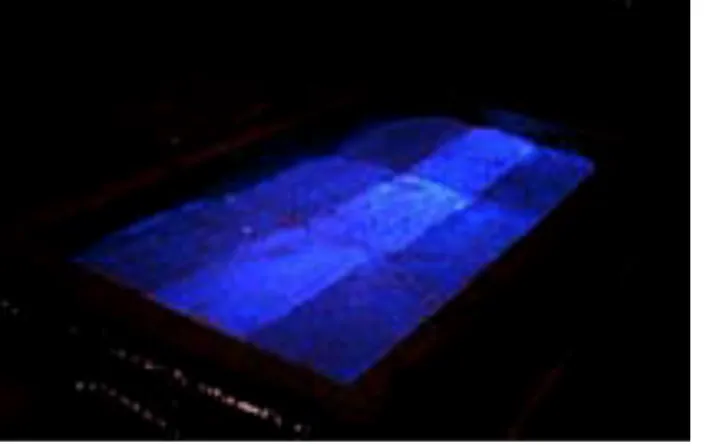
In June 2006, the ANITA collaboration calibrated the actual detector at SLAC End Station A (ESA) using an ice target (See Fig. 3). Again the Arkaryan effect was well validated [16]. Figure 4 is a photo of the SLAC ESA ice target illuminated by the Cherenkov radiation in the visible range (blue), which is part of the entire spectrum that includes the radiowaves.
Fig. 3 The ANITA detector in SLAC’s End Station A (ESA) ready for calibration of the Askaryan Cherenkov radiation from ice (June 2006).
Fig. 4 The blue (visible) range of the Cherenkov radiation emitted from the ice target triggered by the shower induced by the SLAC high energy beam (2006).
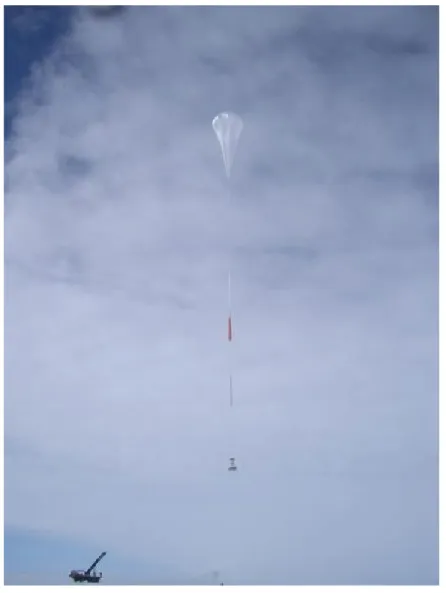
Our ANITA project, which employs the same technology, has made its first flight, ANITA-1, in December 2006 in Antarctica. Before the flight, the ANITA Collaboration has carried out a successful experiment at SLAC’s End Station A using a large ice target to calibrate the actual ANITA detector with perfect confirmation of the Askaryan effect in ice [16].
Fig. 5 Launching of ANITA-1 in Antarctica in December 2006 by NASA.
REFERENCES
[15] G. A. Askaryan, JETP 14, 441 (1962).
結果與討論(含結論與建議)
1. Although NTU joined the ANITA Collaboration after the ANITA-1 flight, our group has been taking the lead in the analysis of the ANITA-1 flight data, primarily because of Dr. Jiwoo Nam’s joining NTU.
2. R&D on antenna and readout electronics has been in wonderful progress this year. Our team is responsible for the R&D of the new solid-state storage device (SSD) based data acquisition system. The prototype has passed the thermal vacuum test at University of Hawaii in April, and we are now in the process of integrating the entire system of 8 SSD drives.
3. Supported jointly by the NTU President, the Dean of the College of Science and the Chairman of the Physics Department as a matching and start-up fund for the PI of this project with a total of NT$8M, we have been developing a Radiowave (RF) Test Lab. Once the installation is completed in summer of 2008, the Anechoic Chamber of this state-of-the-art RF Test Lab should be capable to facilitate the R&D of new antenna designs for our future projects.
4. After some careful consideration, we have made the decision to join the IceRay project instead of ARIANNA as our follow-up project beyond ANITA for collecting more GZK neutrino events. IceRay is the collaboration between ANITA and the huge IceCube experiment that is currently under construction at the tip of the South Pole. This collaboration has the clear advantage in that it would benefit from the tremendous resource and the existing infrastructure of IceCube over ARIANNA and SalSA. In addition, we have also decided to join another project AMBER, which utilizes the same radiowave detection technique but looks for the very complementary ultra high-energy cosmic rays (baryons) instead of neutrinos. We like to emphasize that, although we branch out to join AMBER in addition to IceRay, the former is a much minor project and would not divert our primary attention to IceRay.
三、發表之論文
(1) Observation of the Askaryan Effect in Ice
By ANITA Collaboration (P.W. Gorham et al.). SLAC-PUB-12286, Nov 2006. 4pp. Published in Phys. Rev. Lett. 99, 171101 (2007).
e-Print: hep-ex/0611008
四、計畫成果自評:
The following was our original proposed research schedule for Year-1 (07-08).
1. Preparation for the December 2008- January 2009 ANITA-2 flight instrumentation
2. Decision made by end of 2007 on selecting either ARIANNA or SalSA project 3. R&D on antenna, readout electronics design, and solar panel (assuming ARIANNA)
研究內容與原計畫相符程度
Our research during the Year-1 has been following the above schedules in different degrees. Specifically,
1. Progress in ANITA-1 data analysis has been made. The R&D of the detector upgrade for the ANITA-2 flight has been in wonderful progress and will definitely be in time for the December 2008 flight. The system integration test has been scheduled for June in Palestine, Texas.
2. After some careful consideration, we have made the decision to join the IceRay project instead of ARIANNA as our follow-up project beyond ANITA. IceRay is the collaboration between ANITA and IceCube experiment at the tip of the South Pole. IceCube is the world’s largest cosmic neutrino experimental project. Collaboration with IceCube has the clear advantage over ARIANNA and SalSA in that it would take full advantage of the tremendous infrastructure and manpower already established by IceCube.
3. We have successfully developed the new solid-state storage system for ANITA-2 data acquisition. In addition, we have designed and contracted the construction of the RF Test Lab with a modern anechoic chamber, due to complete in summer of 2008. When completed, we should be able to launch significant R&D on new antenna and electronic designs. Although we have decided to join IceRay instead of ARIANNA, and in addition we will also join AMBER, which is a RF detector augmented to the Pierre Auger Observatory for UHECR, the R&D on antenna is common to all these projects.
達成預期目標情況
The project has accomplished essentially all its original goals for Year-1.
研究成果之學術或應用價值
The key to this cosmic neutrino detection project is the Askaryan mechanism. This effect was verified by the ANITA Collaboration in 2001 by using SLAC’s accelerator beam as the simulator. In addition to apply this effect to the cosmic neutrino detection such as ANITA and IceRay, this effect can also be a powerful tool in the detection of the ultra high-energy cosmic ray (UHECR) protons. One such potential new application is the project AMBER, which is to be installed at the Pierre Auger Observatory, the world’s largest UHECR detector, in Argentina as an additional instrument to augment its ground array and fluorescence measurements. Our NTU team has recently joined the AMBER project to further expand into the area of cosmic ray detection, which is closely complementary to the UHE neutrino detection with ANITA and IceRay.
Yes, the results of this research are suitable for publication in major scientific journals. In fact, our confirmation of the Askaryan effect in ice using the SLAC high-energy beams was published in Phys. Rev. Lett. Another paper, led by our team member, Dr. Jiwoo Nam, on the preliminary results from the ANITA-1 flight data, was presented at the CosPA07 Symposium and published in Mod. Phys. Lett. A. We expect more papers to be published in the coming years.
主要發現或其他有關價值
At this moment we have not yet made Earth-shaking discovery on the first cosmic neutrino. However, the confirmation of the Askaryan effect in ice is scientifically important. Together with the earlier confirmation of Askaryan effect in salt and sand, also made by the ANITA Collaboration at SLAC, it provides higher level of confidence in the potential application of this effect in various other sciences. One good example is the application of the same Askaryan effect to the detection of ultra high-energy cosmic rays (UHECR), instead of UHE neutrinos, in the AMBER project.
赴國外研究心得報告
計畫編號 96-2811-M-002-001-計畫名稱 極高能宇宙微中子之探測 (1/3) 出國人員姓名 服務機關及職稱 陳丕燊/台大天文物理所/教授 出國時間及地點 97.3.22-97.4.13 美國舊金山國外研究機構
Kavli Institute for Particle Astrophysics and Cosmology (KIPAC), at
Stanford Linear Accelerator Center (SLAC), Stanford University
工作記要:
The PI of this project, Prof. Pisin Chen, has made several visits to one of the
collaborating institutions of the ANITA project, the Kavli Institute for Particle
Astrophysics and Cosmology (KIPAC), at Stanford Linear Accelerator Center
(SLAC), Stanford University during the first year of the funding (Aug.
2007-July 2008). These visits have generated important progresses towards the R&D
of the NASA approved ANITA-2 flight, scheduled for December 2008.
In 2006, SLAC’s world-famous 3 km-long linear accelerator was used for the
successful testing the Askaryan effect in ice, which is the detection mechanism
that ANITA is based upon. The PI of this project took the leadership of that
experiment, which resulted in the publication in Phys. Rev. Lett. SLAC’s
outstanding infrastructure and its technical expertise were the key to the success
of that experiment and we continue to rely on that to further advancement of our
ANITA project.
During the PI’s several visits to Stanford this year, progresses have been made
in the several critical areas of ANITA. First, there was the collaboration on the
Monte Carlo simulations of the Askaryan effect in ice and the detector
sensitivity on the radio wave signals so generated. Dr. Kevin Reil of KIPAC is
majorly responsible for this progress on the SLAC side. The second critical area
of collaboration is the R&D of the radio wave antenna. With SLAC’s help and
input, the NTU group is now setting up a new Radio Frequency Test
Laboratory at NTU. This RF Test Lab would be a powerful facility to carry out
the testing of new antennas and its integration with the electronics designed and
developed at SLAC. We look forward to a long and productive collaboration
between NTU and KIPAC, SLAC on ANITA for years to come.
出席國際學術會議心得報告
Report on Participating an International Conference
計畫編號
96-2811-M-002-001-計畫名稱 極高能宇宙微中子之探測(1/3)
出國人員姓名
服務機關及職稱 Dr. Jiwoo Nam
會議時間地點 97.5.22-97.6.2 Christchurch, New Zealand 會議名稱
Conference Neutrino 2008 發表論文題目
Talk Title Results from the ANITA experiment. 一、參加會議經過Description of the meeting
The Neutrino 2008 conference is one of the most important meetings in the neutrino physics society. I presented recent results of ANITA data analysis which is one of the main activity in the NTU Anita group.
二、與會心得The thought on the conference
It was the first opportunity to show ANITA data analysis results to public. The result I showed in the meeting is the best limit in the ultra high energy neutrino flux. Many physicist including IceCube people were very interested in our results. Several people including Gary Hill (University of Wisconsin at Madison) is willing to give a review talk including my presentation. The meeting was a milestone for our NTU Anita activity since we were recognized as an ANITA’s
representative in the ANITA collaboration as well as in world physics society, and also our results are well accepted by them.
國際合作計畫赴國外研究心得報告
計畫編號 96-2811-M-002-001-計畫名稱 極高能宇宙微中子之探測(1/3) 出國人員姓名 服務機關及職稱 陳志清 出國時間及地點 97.3.24-97.4.7 夏威夷大學合作研究機構 Dept. Phys. & Astronomy, U. Hawaii 合作計畫名稱 ANITA-2 & IceRay
合作計畫主持人 Peter Gorham 出國事由 測試高速高容量固態硬碟陣列系統 一、內容及成果: 與夏威夷大學及數美國頂尖研究單位的合作計畫:ANITA-2之熱氣球將於97年底至南極升空 故本次前往合作已完成數項成果: 1. 完成台灣設計之高速高容量固態硬碟陣列(Tera-byte SSD Array )(圖一)之測試。利用於 夏威夷大學架設之熱真空測試系統(圖四)模擬太空環境,經氣壓0.1torr至750torr及攝氏 零下20度至200度等極端條件測試,此系統已完全符合實驗需求。 2. 合作設計組裝200MHz-1.2GHz天線之前級低噪音放大器(front-end LNA)系統。 3. 修復改良于ANITA-1實驗之後級放大器系統(圖二)。 4. 利用冷熱負載方法測試高速類比數位轉換模組(SHORT)之系統溫度。 5. 修復於ANITA-1實驗時毀損之射頻真空導通元件(圖三)。 6. 協助熱真空測試系統架設(圖四)。
二、建議事項 希望延長在夏威夷大學合作研究的時間,可利用當地資源為台灣團隊爭取更重要之合作 地位。 三、攜回資料 高速高容量固態硬碟陣列測試之數據及各項系統模組組裝時之測試資料。