Lamb waves in binary locally resonant phononic plates
with two-dimensional lattices
Jin-Chen Hsu and Tsung-Tsong Wua兲
Institute of Applied Mechanics, National Taiwan University, Taipei 106, Taiwan
共Received 27 February 2007; accepted 19 April 2007; published online 15 May 2007兲
The authors study the propagation of Lamb waves in two-dimensional locally resonant phononic-crystal plates, composed of periodic soft rubber fillers in epoxy host with a finite thickness. Our calculations are based on the efficient plane wave expansion formulation which utilized Mindlin’s plate theory. Calculated results show that the low-frequency gaps of Lamb waves are opened up by the localized resonance mechanism. The resonant frequencies of flexure-dominated plate modes are significantly dependent not only on the radius of circular rubber fillers but also on the plate thickness. The properties of localized resonance are qualitatively analogous to the vibration of a circular thin plate. © 2007 American Institute of Physics.
关DOI:10.1063/1.2739369兴
Over the past decade, propagation of acoustic waves in periodic structures comprised of multicomponents has re-ceived much attention because of their renewed physical properties and potential applications.1–11 These composite materials, called phononic crystals共PCs兲, give rise to forbid-den gaps of acoustic waves which are analogous to the band gaps for electromagnetic waves in photonic crystals.5Major mechanisms leading to the forbidden gaps are Bragg scatter-ing and localized resonances共LR兲.6The former opens up the Bragg gap at Brillouin-zone boundaries, and the band-gap frequency corresponds to the wavelength in the order of the structural period, i.e., the lattice constant, and relates to the lattice symmetry. On the other hand, the later creates the resonant gap dictated by the frequency of resonance associ-ated with scattering units and depends less on the lattice symmetry, orderness, and periodicity of the structure. Based on LR mechanism, Liu et al.7demonstrated the existence of band gap at extremely low frequencies. For acoustic waves propagating in three-component PC that consists of high-density solid core coated with a layer of soft rubber in epoxy matrix, the induced frequency gap is two orders of magni-tude smaller than that of Bragg gap.7–10 Compared to the three-component PC, the LR PC with binary structure was studied by Wang et al.11 Their structure consisting of soft rubber cylinders in epoxy predicted that low-frequency gaps can also appear. Some promising applications, such as to insulate the low-frequency noise or vibration by a small-sized structure with low-frequency gaps achieved by LR PCs, were suggested.
Recently, several studies investigating the phononic lat-tice embedded in plate structures rather than a bulk or semi-infinite structure have been presented.12–15 These studies re-veal that the propagation of Lamb waves guided in the PC plate also exhibits frequency gaps, and the ratio of plate thickness to lattice constant is also an important parameter in changing band structures. A plate structure with a forbidden gap required in the low-frequency range could also be a use-ful structural element in engineering. However, up to now, this part has not been studied yet.
In this letter, we analyze the binary LR PC plates which consist of an array of soft rubber inclusions in epoxy matrix with a finite thickness. Our calculations are based on the plane wave expansion共PWE兲 formulation utilizing Mindlin’s theory.15 Compared to the three-dimensional PWE method3 which is difficult to cope with the guided-wave problem by taking enough PWs into account, Mindlin’s theory based PWE method is very efficient in band-structure calculations for lower-order Lamb modes, and thus, band-gap calcula-tions of thin PC plates composed of high-contrast constitu-ents become feasible.
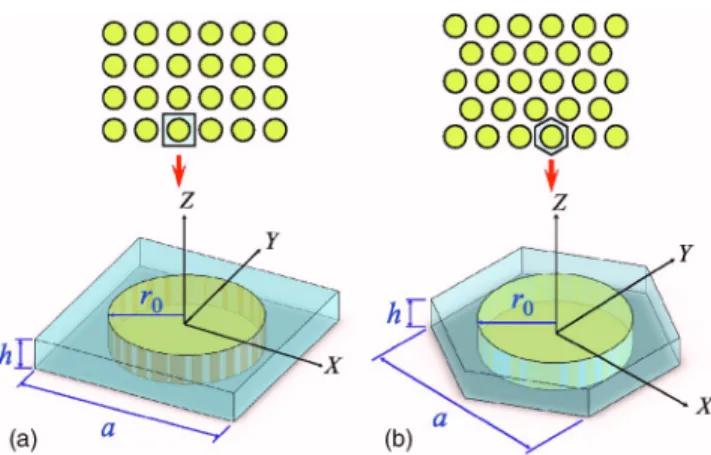
Schematic diagrams of a unit cell of PC plate are illus-trated in Fig. 1. Figures 1共a兲 and 1共b兲 refer to the two-dimensional square lattice 共SL兲 and triangular lattice 共TL兲, respectively. The XY plane is placed on the middle plane of the plate, and the Z axis is along the thickness direction. The lattice constant and the radius of the circular fillers are de-noted by a and r0, respectively. The plate thickness is h. In
the following calculations, the density of soft rubber is assumed as 1300 kg/ m3, and that of epoxy is 1180 kg/ m3. The phase velocities of longitudinal and transverse waves in soft rubber are cL= 33 m / s and cT= 5 m / s, respectively.10In epoxy, cL= 2534 m / s and cT= 1157 m / s, respectively.
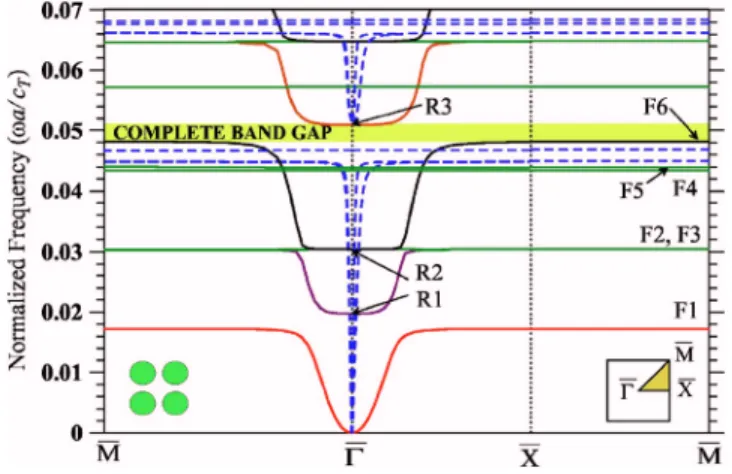
Figure2shows the band structure of Lamb waves in the SL rubber/epoxy plate with r0= 0.4a and h = 0.225a. These
a兲Author to whom correspondence should be addressed; electronic mail: [email protected]
FIG. 1.共Color online兲 Schematic diagrams of a unit cell of PC plate with 共a兲 SL and共b兲 TL, respectively.
APPLIED PHYSICS LETTERS 90, 201904共2007兲
0003-6951/2007/90共20兲/201904/3/$23.00 90, 201904-1 © 2007 American Institute of Physics
calculations along the boundary⌫¯-X¯-M¯ -⌫¯ of the irreducible first surface Brillouin zone employ 441 PWs, which have reached a convergent result with less than 5% deviation from the test by using 1089 PWs. The frequencies are given in the normalized unita / cT, where cT= 1157 m / s. In Fig.2it can be observed that many flat bands exist, which indicate the resonant frequencies of localized plate modes. For such low-frequency resonances, the band structure includes only the first three lowest-order Lamb modes without cutoff frequen-cies and their folding bands, while the higher-order Lamb modes with cutoff frequencies are in the much higher fre-quency region. These plate modes, unlike the bulk acoustic modes, are coupled modes that cannot be classified into the so-called in-plane and out-of-plane polarization modes; how-ever, the first few flexure-dominated branches, which have a larger out-of-plane component of displacement, can be dis-tinguished and labeled by F1–F6. These branches are sensi-tive to the variation of plate thickness, whereas the others, with a dominated in-plane vibration, are not. In addition, three frequencies of flexure-dominated modes with a zero group velocity near the⌫¯ point, which also present a local-ized pattern, are denoted by R1–R3, respectively. Because the Lamb modes in PC plate are coupled, to find a complete band gap one has to take all polarization modes into account. As a consequence, no low-frequency gap with respect to all of the modes is found in Fig.2. Nevertheless, the frequency bands of Lamb waves can be effectively shifted by tuning the plate thickness; it could be possible to have a complete band gap in such a low-frequency range with a different value of
h / a. By tuning down h to 0.115a, the calculated band
struc-ture is plotted in Fig.3. A complete band gap is opened up in the frequency range from 0.0481 to 0.050 95 which is two orders of magnitude lower than that resulting from Bragg scattering.
To further investigate the LR characteristics, the band structure referring to TL rubber/epoxy plate with r = 0.4a and
h = 0.115a is shown in Fig.4. Similar to the case of SL, the LR exhibiting in the behavior of flatbands and a low-frequency gap for all modes extending the low-frequency range from 0.0481 to 0.0515 are also found. In addition, by com-paring Fig.3 with Fig.4, a much more important and inter-esting observation is that, even though the lattice symmetry has been changed from SL into TL, the resonant frequencies keep nearly invariant with just several splittings when r0and
h remain unchanged. This is an important signature of their
resonant nature. Particularly, consider the upper and bottom edges of the complete band gaps appearing as h = 0.115a. The bottom-edge frequencies of the gaps are the same for both cases of SL and TL, so the bottom-edge frequencies relate to the resonance localized inside the rubber, where the associated eigenfrequencies are determined by the oscillation of rubber only but irrelevant to lattice symmetries. For the upper-edge frequencies of the gaps, the value is slightly shifted from 0.050 95 to 0.0515 as the SL is changed into TL. This implies that the frequencies of upper edges corre-spond to the resonant modes where hosting material epoxy is also involved and the neighboring rubber fillers are weakly coupled, therefore, the lattice symmetries can affect the reso-nance. This suggests that the LR and low-frequency gap will also appear in heterogeneous plates without lattice symmetry or periodicity. It is worth noting that the transmission spec-trum, which is unobtainable by this PWE formulation, is important for actual experiments of LR plates. To go further, other methods, such as multiple-scattering theory5,6,13 and finite-difference time-domain method,4,8 should be suitable to be applied to the theoretical analysis of transmission prop-erties of LR PC plates.
In order to give a physical insight, a simplified con-tinuum model—flexural vibration of a circular thin plate with a thickness h and radius r0—is introduced to explain the
LR characteristics of PC plate. The wave equation for the thin plate is16
FIG. 2.共Color online兲 Band structure of Lamb waves in a PC plate com-posed of SL rubber in epoxy. r0= 0.4a and h = 0.225a.
FIG. 3.共Color online兲 Band structure of Lamb waves in a PC plate com-posed of SL rubber in epoxy. r0= 0.4a and h = 0.115a.
FIG. 4.共Color online兲 Band structure of Lamb waves in a PC plate com-posed of TL rubber in epoxy. r0= 0.4a and h = 0.115a.
201904-2 J.-C. Hsu and T.-T. Wu Appl. Phys. Lett. 90, 201904共2007兲
Eh3 12共1 −2兲ⵜ 4u Z+h 2u Z t2 = 0, 共1兲
where E and are Young’s modulus and Poisson’s ratio, respectively, and uZis the flexural displacement. In the PC plate, though the rubber fillers are surrounded by epoxy which is not perfectly rigid, the displacements taking place at the rubber-epoxy interfaces are much smaller than that in the interiors of rubber fillers because of the high contrast be-tween their elastic stiffness. To simplify our discussion, the edges of the circular thin plate are assumed to be clamped. Equation 共1兲 with the clamped boundary conditions then leads to following relation:
nm4 =
12nm2 r04共1 −2兲
Eh2 , 共2兲
wherenm is an eigenvalue associated to a specific normal
mode of the plate, and nm is the corresponding
eigenfre-quency. This relation qualitatively reveals the dependence between resonant frequency and geometrical parameters. In other words, for a particular resonant mode, the resonant frequency increases as h is increased; on the other hand, it decreases when r0 becomes larger.
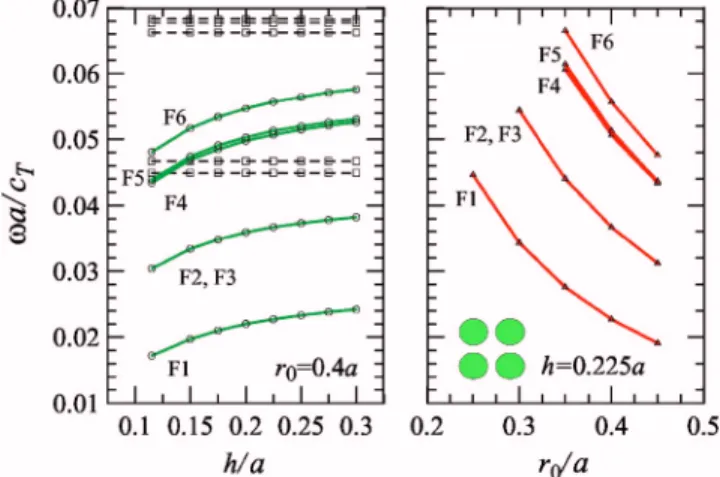
To further show that the observed resonances are local-ized, Fig.5 demonstrates the dependences of the resonance frequencies on h and r0. Figure5共a兲illustrates the frequency
variations of the resonant modes in the SL rubber/epoxy PC plate as a function of h / a, where r0= 0.4a. The resonant
fre-quencies of the modes with dominated in-plane vibrations
共dashed lines兲 remain constants as h/a changes; this exhibits that these resonance modes are not at all sensitive to the change of h / a. In contrast, the resonant frequencies of those flexure-dominated modes 共solid lines兲 are gradually in-creased as h / a increases. On the other hand, Fig.5共b兲shows the r0/ a dependence of resonance frequencies in the SL plate
with h = 0.225a. Clearly, in Fig.5共b兲the resonant frequencies of F1–F6 modes decrease as r0 increases, and the decreases
are relatively more rapid. The above geometrical-dependence properties of resonant frequency agree with the anticipations given by Eq.共2兲, which correspond to the fact that the reso-nances of the PC plate are localized in the rubber fillers.
To summarize, we have studied the propagation of Lamb waves in the LR PC plate composed of rubber fillers in ep-oxy. Numerical calculations show that the resonant frequen-cies of the flexure-dominated modes significantly depend not only on the radius of the rubber inclusions but also on the thickness of the composite plate. These properties can be explained by the vibration of a circular thin plate. By tuning the h / a ratio properly, complete band gaps in an extremely low-frequency range are found to exist. The LR PC plates are also suggested to serve as promising elements in the vi-bration shielding of plate structures.
The authors gratefully acknowledge the financial support from the National Science Council of Taiwan 共Grant No. NSC 95-2221-E-002-223兲.
1M. S. Kushwaha, P. Halevi, L. Dobrzynski, and B. Djafari-Rouhani, Phys. Rev. Lett. 71, 2022共1993兲.
2M. M. Sigalas and E. N. Economou, J. Sound Vib. 158, 377共1992兲. 3T.-T. Wu, Z.-C. Hsu, and Z.-G. Huang, Phys. Rev. B 71, 064303共2005兲. 4T.-T. Wu, C.-H. Hsu, and J.-H. Sun, Appl. Phys. Lett. 89, 171912共2006兲. 5A. Modinos, N. Stefanou, I. E. Psarobas, and V. Yannopapas, Physica B
296, 167共2001兲.
6Z. Liu, C. T. Chan, and P. Sheng, Phys. Rev. B 65, 165116共2002兲. 7Z. Liu, X. Zhang, Y. Mao, Y. Y. Zhu, Z. Yang, C. T. Chan, and P. Sheng,
Science 289, 1734共2000兲.
8C. Goffaux, J. Sánchez-Dehesa, A. Levy Yeyati, Ph. Lambin, A. Khelif, J. O. Vasseur, and B. Djafari-Rouhani, Phys. Rev. Lett. 88, 225502 共2002兲.
9M. Hirsekorn, Appl. Phys. Lett. 84, 3364共2004兲.
10C. Goffaux and J. Sánchez-Dehesa, Phys. Rev. B 67, 144301共2003兲. 11G. Wang, X. Wen, J. Wen, L. Shao, and Y. Liu, Phys. Rev. Lett. 93,
154302共2004兲.
12X. Zhang, T. Jackson, E. Lafond, P. Deymier, and J. Vasseur, Appl. Phys. Lett. 88, 063118共2006兲.
13R. Sainidou and N. Stefanou, Phys. Rev. B 73, 184301共2006兲. 14A. Khelif, B. Aoubiza, S. Mohammadi, A. Adibi, and V. Laude, Phys.
Rev. E 74, 046610共2006兲.
15J.-C. Hsu and T.-T. Wu, Phys. Rev. B 74, 144303共2006兲.
16P. M. Morse, Vibration and Sound 共McGraw-Hill, New York, 1948兲, Chap. V, Sec. 21, pp. 208–211.
FIG. 5.共Color online兲 共a兲 Thickness dependence of resonant frequencies in SL with r0= 0.4a. F1–F6 modes共solid lines兲 and modes with dominated in-plane vibrations共dashed lines兲. 共b兲 Variations of resonant frequencies F1–F6 in SL with h = 0.225a as a function of r0/ a.
201904-3 J.-C. Hsu and T.-T. Wu Appl. Phys. Lett. 90, 201904共2007兲