An electrically tunable optical zoom system with separated focusing
and zooming functions
Ming-Syuan, Po-Ju Chen, and Yi-Hsin Lin
Department of Photonics, National Chiao Tung Unversity, 1001 Ta Hsueh Rd., Hsinchu 30010,
Taiwan
*
Corresponding author: [email protected]
ABSTRACT
In this paper, we demonstrated an electrically tunable optical zoom system with separated focusing and zooming functions. The optical mechanism is discussed. The focusing distance and magnification of the image can be controlled separately by focusing lenses and zooming lenses. As a result, the zoom ratio is independent of objective distance and only depends on the tunable range of the lens power of the active-optical elements. This study helps designing many applications with an optical zoom function, such as cell phones, holographic projectors, pico projectors and endoscopes.
Keywords: Liquid crystal lens; Electrically tunable zoom lens; Focusing function; Zooming function
1. INTRODUCTION
An electrically tunable optical focusing and zooming system is important in many applications, such as cell phones, pico projectors, holographic projection systems, and endoscopes.1-5 For a conventional optical zoom system, the focusing function and zooming function are controlled by the mechanical movement of the solid lenses. Usually, two groups of the solid lenses in the zoom system: one group is in charge of focusing function and the other is in charge of zooming function. By controlling the relative distance of the solid lenses in the groups, we can adjust the objective distance which is clearly imaged to the image sensor and also the magnification of the images. However, the optical zoom system with the mechanical movement of the solid lenses is too bulky for portable devices. By adopting the active-optical elements, we can realize the electrically tunable-focusing optical zoom system. The active-optical elements can be liquid lenses6-7, deformable mirrors8 and liquid crystal (LC) lenses.9-12 The first theoretical analysis of electrically tunable zoom system using LC elements was proposed in 1992.12 Based on the theory, several optical system using two LC lenses are realized, but the objective distance of those systems is fixed, not tunable.13-14 In 2011, we experimentally realized an electrically tunable-focusing optical zoom system using two composite LC lenses.15 The zoom ratio of the optical zooming system reaches ~ 7.9:1 and the object can be zoomed in or zoomed out continuously at the objective distance of infinity to 10 cm. However, the focusing function and zooming function of such a system can not be separated. In this paper, we discussed theoretically an electrically tunable optical system with separated focusing function and zooming function based on three active-optical elements. Many factors are discussed, such as the tunable range of the lens power of active elements, the
relative position of active elements, the magnifications, the focusing distance of the object and the zoom ratio of the system. By comparing the properties of the active optical elements, we can properly choose the type of active optical elements to realize the system. This study can help us to design an electrically tunable optical zooming system with separated focusing and zooming function for the portable devices.
2. OPERATING MECHANISM
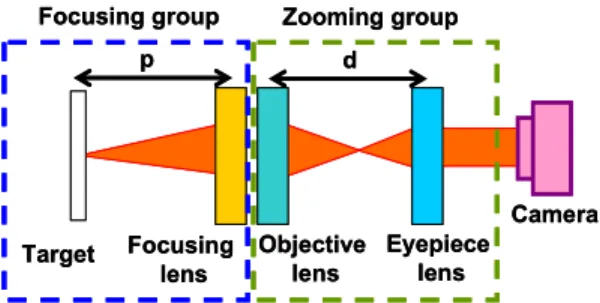
To separate the focusing function and zooming function, the designed electrically tunable optical zoom system consists of a focusing group, a zooming group and a camera, as shown in Fig. 1. The focusing group consists of a target (or an object), and a focusing lens. The zooming group is made up of an objective lens and an eyepiece lens. Among the components, the focusing lens, the objective lens and the eyepiece lens are active-optical elements whose focal lengths are electrically tunable. The lens powers of the focusing lens, the objective lens, and the eyepiece lens are
φ
f ,φ
o, ande
φ
, respectively. The objective distance between the target and the focusing lens is p. The distance between objective lens and eyepiece lens (or the length of the zooming group) is d. The focusing lens and objective lens are attached to each other and then the distance between those two lenses is around zero. Without three active-optical elements, the camera was set that the target is imaged to the image sensor of the camera when the target is at infinity (>1km).Target Focusing lens Objective lens Eyepiece lens Camera p d
Focusing group Zooming group
Target Focusing lens Objective lens Eyepiece lens Camera p d
Focusing group Zooming group
Fig. 1 The structure of the electrically tunable-focusing optical zoom system using three active-optical elements.
Next, we prove the optical mechanism of the zoom system in Fig. 1. The following optical discussions are based on approximation of thin lenses and the first-order optical design. When the incident light passes through three active-optical elements, the lens power of the focusing lens is electrically adjusted in order to maintain the position of the formed image. We define the distance between the formed image and the focusing lens as pz which is a constant for the system. According to thin lens equation, to maintain the formed image in the same position no matter what objective distance p is, the lens power (
φ
f ) of the focusing lens should be:f
p
p
1
1 −
=
φ
(1)Eq.(1) indicates that we can design the tunable lens power of focusing lens
φ
f according to the range of the objective distance p and the designed formed image distance pz. Once pz is decided, we can start to design the zooming group in Fig. 1. The zooming function we designed is based on a confocal system. The confocal system means the formed image of the objective lens is located at the front focal plane of the eyepiece lens. We then derive the relations among pz, the lens power of the objective lensφ
oand the lens power of the eyepiece lensφ
ein Eq. (2)⎪ ⎪ ⎩ ⎪⎪ ⎨ ⎧ = + − = + e e o o o z s s d s p φ φ 1 1 1 1
(2)
where so is the image distance to the objective lens for the objective distance of pz, and se is the image distance to the eyepiece lens which is infinity because of the confocal system. Combining two relations of Eq.(2), we obtain Eq.(3):
o e e z d p
φ
φ
φ
= − ⋅ + 1 1 . (3)For a confocal system, the magnification of the image depends of the angular magnification. The magnification of two active-optical elements in a finite objective distance can be expressed as 16
(
o z)
z ep
p
M
×
−
×
=
φ
φ
1
(4)According to Eq. (3) and Eq. (4), we can expressed the magnification as a function of
φ
eor as a function ofφ
oo z z z o
p
d
d
p
p
M
φ
φ
×
×
−
+
=
)
(
(5) ed
M
(
φ
e)
=1
−
×
φ
(6)When the image is erect, the magnification is positive. According to tunable range of the lens power of the active-optical elements, the magnification of the system is confined in a range between minimum magnification Mmin and maximum magnification Mmax. The zoom ratio (ZR) of an optical zooming system is defined as the ratio of Mmax to Mmin. From Eq. (1) and Eq. (4), we can adjust
φ
f to achieve focusing function without affecting the magnification when objective distance changes. We can also adjustφ
o andφ
eto achieve zooming function without affecting the focusing distance. Thus, the focusing function and zooming function of this system are separable.ralstrareareV4iiiiiiir
4,404-4tetede
#.,o,.4rae4rgpr4tP-.,ar#.'4wW.ePr.ire.4lP-4i--, ese40,401r...
.... ter
41,3. SIMULATION RESULTS AND DISCUSSION
3.1 Lens power of focusing lens
From Eq. (1), the lens power of focusing lens depends on the objective distance p and the designed formed image distance pz. When the objective distance ranges from pmin to pmax, the tunable lens power of the focusing lens
Δ
φ
f can be expressed as: max min1
1
p
p
f=
−
Δ
φ
(7)From Eq. (7),
Δ
φ
f does not change as pz changes. Theφ
f as functions of p and pz is calculated and plotted in Fig. 2.Fig. 2 The relation among the lens power of the focusing lens(
φ
f ), objective distance (p) and the formed image distance (pz) By choosing the range of the objective distance between pmin to pmax and the designed formed image distance pz, we can obtain the corresponding range of lens power of the focusing lens which is also the tunable focusing range. For example, if the objective distance p is set from 10cm to infinity and pz equals to 10cm, the tunable range of lens power of focusing lens should be from -10m-1 to 0 m-1. But if pz equal to 5cm, the tunable range would be from -20 m-1 to -10 m-1. For both of the cases, the value ofΔ
φ
f (=10m-1) does not change.3.2 Lens power of objective lens and eyepiece lens
In this section, we discuss the range of the lens powers for the objective lens and the eyepiece lens to obtain different zoom ratio (ZR) of the system related to pz and d. From Eq. (5), the lens power of the objective lens can be expressed as: z o
p
d
M
M
1 +
1
⋅
−
=
φ
. (8)From Eq. (6), the lens power of eyepiece lens
φ
ecan be expressed as:d
M
e−
=
1
φ
. (9)The zoom ratio (ZR) is the ratio of Mmax to Mmin. To simplify the discussion, we assume Mmax equals to inverse of Mmin. (i.e.Mmax =1Mmin= ZR). From Eq. (8), the tunable lens power of the objective lens
Δ
φ
o can be written as:d ZR ZR d M M M M d M M d M M o / 1 1 1 min max min max min min max max = − ⋅ ⋅ − = ⋅ − − ⋅ − = Δ
φ
. (10)From Eq. (9), the tunable lens power of eyepiece lens
Δ
φ
e can be written asd ZR ZR d M d M e / 1 1 1− min − − max = − = Δ
φ
. (11)From Eq. (10) and Eq. (11),
Δ
φ
o equals toΔ
φ
e depending on ZR and d. According to Eq. (9), Eq. (10) and Eq. (11), we can see thatφ
e,Δ
φ
o andΔ
φ
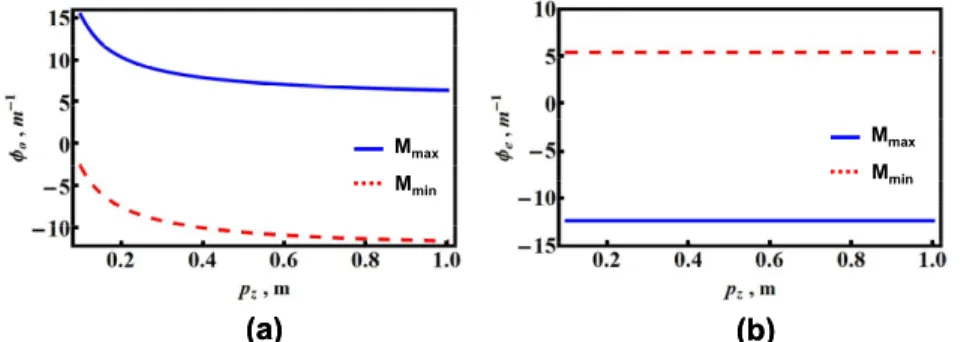
edo not change no matter what pz is. When the zoom ratio of the system ZR is 5 and the length of the zooming group d is 10cm, we can calculate and plot the lens powers of the objective lens and the eyepiece lens as a function of pz , as shown in Fig. 3(a) and 3(b). From Fig. 3(a) and Fig. 3(b), the differences between two curves(the blue line and the red dotted line) remain the same ~17.9m-1. This meanso
φ
Δ
andΔ
φ
e are maintained around 17.9m-1 as pz increases. For designing the zoom system with separated focusing function and zooming function, pz should be fixed. We can choose one specific pz depending on the tunable lens power of active optical elements which should be capable of switching between negative lens and positive lens.(a) (b) Mmax Mmin Mmax Mmin (a) (b) Mmax Mmin Mmax Mmin
Fig. 3 (a)The lens power of the objective lens as a function of the formed image distance pz and (b) the lens power of the eyepiece lens as a function of the formed image distance pz for magnification Mmax and Mmin . ZR=5 and d=10cm.
50 ; 0 é- -50 -100 0.02 0.04 0.06 0.08 0.10 (a) (b) Mmax Mmin Mmax Mmin (a) (b) Mmax Mmin Mmax Mmin (a) (b) Mmax Mmin Mmax Mmin
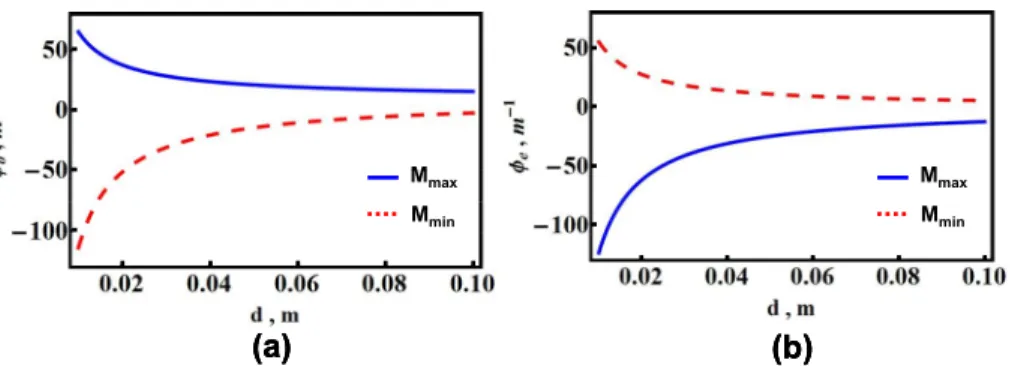
Fig. 4 (a)The lens power of the objective lens as a function of the length of zooming group d and (b) the lens power of the eyepiece lens as a function of the length of zooming group d for magnification Mmax and Mmin . ZR=5 an pz =10cm.
Next, we discuss the effect caused by length of zooming group d. From Eq. (8) to Eq. (11), the absolute value of
φ
o andφ
e ,Δ
φ
o andΔ
φ
e increase as d decreases. When the zoom ratio of the system is 5 and pz is 10cm, the lens power of active-optical elements in zooming group as a function of d are calculated and are shown in Fig. 4(a) and 4(b).Δ
φ
o andΔ
φ
e increase from 17.9m-1 to 179.9m-1 when d decreases from 10cm to 1cm. For applications on portable devices, a small d is preferred which means large tunable lens power of active-optical elements are very important to design the optical zoom system. For further improving the zoom ratio of the system, from Eq. (10) and Eq.(11), we also need to increase the tunable lens power range of active optical elements. For example,Δ
φ
o andΔ
φ
e should be 284.6 m-1 if the length of zooming group d is 1cm and the zoom ratio ZR is 10.4. CONCLUSION
We demonstrated an electrically tunable optical zoom system with separated focusing and zooming functions. The system includes two lens groups: one is focusing group, the other is zooming group. We can separately control the focusing distance and magnification of the image by electrically tuning the lens power of active-optical elements in focusing group and zooming group. For applications on portable devices, we prefer a short system length and a large zoom ratio. According to the calculation, large tunable lens power of active optical elements is required. We can choose different active-optical elements, such as deformable mirrors, liquid lenses and liquid crystal lenses to realize the system.6-12 This study helps designing many applications with an optical zoom function, such as cell phones, cameras, holographic projectors and endoscope.
This research was supported by the National Science Council (NSC) in Taiwan under the contract no. 101-2112-M-009-011-MY3.
REFERENCE
[1] Zhao, H., Fan, X. W., Zou, G. Y., Pang, Z. H., Wang, W., Ren, G. R., Du, Y. F., and Su, Y., "All-reflective optical bifocal zooming system without moving elements based on defromable mirror for space camera application," Appl. Opt. 52, 1192 (2013)
[2] Lin, Y. H., Liu, Y. L., and Su, G. D. J., "Optical zoom module based on two deformable mirrors for mobile device applications," Appl. Opt. 51, 1804 (2012).
[3] Lin, Y. H., and Chen, M. S., "A pico projection system with electrically tunable optical zoom ratio adopting two liquid crystal lenses," J. Disp. Technol. 8, 401 (2012).
[4] Lin, H. C., Collings, N., Chen, M. S., and Lin, Y. H., "A holographic projection system with an electrically tuning and continuously adjustable optical zoom," Opt. Express 20, 27222 (2012).
[5] Chen, H. S., Lin, Y. H.,"An endoscopic system adopting a liquid crystal lens with and electrically tunable depth-of-field," Opt. Express 21, 18079-18088(2013).
[6] Peng, R., Chen, J., and Zhuang, S., “Electrowetting-actuated zoom lens with spherical-interface liquid lenses,” J. Opt. Soc. Am. A 25, 2644 (2009).
[7] Zhang, D. Y., Justus, N., and Lo, Y. H., “Fluidic adaptive zoom lens with high zoom ratio and widely tunable field of view,” Opt. Commun. 249, 175 (2005).
[8] Seidl, K., Nnobbe, J., and Grüger, H., “Design of an all-reflective unobscured optical-power zoom objective” Appl. Opt. 48, 4097 (2009).
[9] Wick, D. V., Martinez, T., Payne, D. M., Sweatt, W. C., and Restaino, S. R., “Active optical zoom system,” Proc. SPIE 5798, 151 (2005).
[10] Bagwell, B. E., Wick, D. V., Batchko, R., Mansell, J. D., Martinez, T., Serati, S., Sharp, G., and Schwiegerling, J., “Liquid crystal based active optics,” Proc. SPIE 6289, 628908 (2006).
[11] Martinez, T., Wick, D. V., Payne, D. M., Baker, J. T., and Restaino, S. R., “Non-mechanical zoom system,” Proc. SPIE 5234, 375 (2004).
[12] Tam, E. C., “smart electro-optical zoom lens,” Opt. Lett. 17, 369 (1992).
[13] Ye, M., Noguchi, M., Wang, B., and Sato, S., “Zoom lens system without moving elements realized using liquid crystal lenses,” Elec. Lett. 45, 646 (2009).
[14] Valley, P., Dodge, M. R., Schwiegerling, J., Peyman, G., and Peyghambarian, N., “Nonmechanical bifocal zoom telescope,” Opt. Lett. 35, 2582 (2010).
[15] Lin, Y. H., Chen, M. S., and Lin, H. C., "An electrically tunable optical zoom system using two composite liquid crystal lenses with a large zoom ratio," Opt. Express 19, 4714 (2011).
[16] Lin, Y. H., Chen, M. S., Lin, H. C., "Electrically-tunable optical zoom system by using liquid crystal lenses," Proc. SPIE 8280, 82800Q (2012).