
全球旅行地行銷機構網站評估 - 政大學術集成
91
0
0
全文
(2) Web site evaluation of national destination marketing organizations. Student: Alena Hausteinova Advisor: Professor Tsung-Jen Shih. A Thesis Submitted to International Master’s Program in International Communication Studies National Chengchi University In partial fulfillment of the Requirement For the degree of Master of Arts. December 2013.
(3)
(4) EVALUATING DESTINATION MARKETING WEB SITES. i. Acknowledgements All the time that I was writing my thesis, I couldn’t wait for it to be finished. I couln’t wait to experience the feeling of freedom after I write the last word in it. Now, that my thesis is done, I feel relief, but I also feel a strange kind of sadness. Sadness that by finishing my thesis, I am closing one chapter of my life. I came to Taiwan two years ago without any deeper knowledge of this country, and during my stay here I fell in love with the country and its people. Finishing my master’s degree scares me that I will have to leave Taiwan for good, and that I don’t know when will I be able to come back and go my beloved night market and smell stinky tofu again, climb the mountains, swim in the waterfalls, watch 101 from the Elephant mountain, feel the hassle of Taipei busy streets, meditate at its temples, ride the bike along rivers and slalom on the crowded pavements, and enjoy the sincere smiles of Taiwanese people wherever I go. Firstly, I want to thank my advisor professor Shih, who gave me such a valuable feedback and helped me very much in refining the topic of my thesis, who made sure that everything I write makes sense, and who was so attentive even to the slightest mistakes I made. I also want to thank professor Kuo and professor Liu for being great committee members and especially for suggesting me to evaluate photos on the Web sites as well. This suggestion made my thesis much more fun to do and, by making me look at all the beautiful photos, allowed me to discover many countries that I did not know much about before. Thanks to this I could also fantasize about travelling around the world and dream about my future holidays in some of these countries, all of this while writing my thesis..
(5) EVALUATING DESTINATION MARKETING WEB SITES. ii. Next, I want to thank my parents for their endless support in my decision to come to Taiwan and everything related to it. They supported me all the time with their love and advice, not only about my personal life, but also when I was lost, demotivated and did not know how to continue with my thesis. They were always there with a good advice, and especially my dad who helped me with the timeconsuming inter-coder reliability test when I was in a time press. I also want to thank my friends, both in Taiwan and in the Czech Republic. They were there for me when I was struggling with motivation. In those hard times, I found their never ending questions about how I’m getting on with my thesis irritating and annoying. Only now when my thesis is ready, I can see that it was their way of motivating me to focus and finish it and I am very grateful for it. I want to name my good friends Joby, Alena and Lukas, not only for helping me with translating my Chinese abstract, statistics and inter-coder reliability, but also for supporting me and making me laugh when I needed it. Finally, I want to thank my dearest Martin who was always there for me when I needed him. He patiently listened to me everytime I needed to clarify some thought and he always actively helped me to find a solution to my problem, even if it meant he would miss his favourite series on TV. Thanks to his support, awesome ideas and great suggestions, I am much happier about my thesis..
(6) EVALUATING DESTINATION MARKETING WEB SITES. iii!. Abstract This thesis focuses at destination marketing Web sites, specifically Web sites run by official tourism bodies such as tourism boards, national tourism agencies, ministries of tourism etc., and examines what features are important in a successful Web site by combining a number or studies on Web site evaluation and destination marketing theory, thus creating a comprehensive destination marketing Web site evaluation tool. This study also looks at the photograph themes used on the Web sites. The analysis further discovers that there is a strong relationship between the quality of national destination Web sites and the development level of the country.. 治 政 大 on these found The thesis discusses the possible causality and other influences 立立 relationships and offers suggestions for future research in this area.. •‧ 國. ㈻㊫學. Finally, photographs present on the Web sites are examined to find out what. •‧. themes are most commonly present. The evaluation reveals that there is a clear pattern. y. sit. io. n. al. er. theory.. Nat. between the photograph themes and that these findings comply with the post-colonial. Ch. engchi. i n U. v. Key words: destination marketing, tourism marketing, Web site evaluation, tourism photographs, post-colonial theory, country development.
(7) EVALUATING DESTINATION MARKETING WEB SITES. v.
(8) EVALUATING DESTINATION MARKETING WEB SITES. v. Table of Contents. Web site evaluation strategy for destination marketing organizations ..........................1 Chapter organization ................................................................................................3 Literature review ............................................................................................................5 Destination and destination marketing organizations ..............................................5 Studies on evaluation of tourism related Web sites .................................................7 Web site evaluation methods .................................................................................10 The role of images and self-presentation in destination marketing .......................17 Destination marketing Web sites and country development level.........................19 Research questions.......................................................................................................23 Methodology ................................................................................................................25 Destination marketing Web site sample.................................................................25 Unit of analysis ......................................................................................................26 Operationalization of evaluated variables..............................................................27 Operationalization of predictor and consequence variables ..................................29 Inter-coder reliability .............................................................................................31 Results..........................................................................................................................35 Discussion ....................................................................................................................55 Limitations .............................................................................................................58 Conclusion .............................................................................................................60 References....................................................................................................................62.
(9) EVALUATING DESTINATION MARKETING WEB SITES. vi. List of Tables. Table 1: The extended model of internet commerce adoption.....................................11 Table 2: Description of unified key evaluation factors................................................12 Table 3: Added factors for Web site evaluation ..........................................................14 Table 4: Results of ReCal 0.1 Alpha test of inter-coder reliability of the Web site evaluation........................................................................................... 32 Table 5: Results of ReCal 0.1 Alpha test of inter-coder reliability of the photograph themes ............................................................................................ 34 Table 6: Results of the Web site evaluation by dimension ..........................................35 Table 7: Results of the Web site evaluation by Web site attributes.............................40 Table 8: Photograph themes on national destination marketing Web sites ................ 43 Table 9: Pearson Correlation results for Web site performance and development variables ...................................................................................................................... 46 Table 10: ANOVA Table for HDI groups and Web site performance ........................47 Table 11: Post-hoc test of HDI groups and Web site performance .............................49 Table 12: Results of Pearson Correlation for photograph themes and HDI ................52 Table 13: Photograph themes according to HDI groups..............................................53.
(10) EVALUATING DESTINATION MARKETING WEB SITES. vii. List of Figures. Figure 1: Thesis framework .......................................................................................... 3 Figure 2: Li and Wang’s model for Web site evaluation.............................................17 Figure 3: Sample Web sites selection procedure .........................................................26.
(11) EVALUATING DESTINATION MARKETING WEB SITES. viii. List of Appendices. Appendix A: Coding sheet...........................................................................................67 Appendix B: List of countries and their official Web site URL ..................................72 Appendix C: Web site evaluation scores of countries by dimension...........................77.
(12) EVALUATING DESTINATION MARKETING WEB SITES. 1. Web site evaluation of national destination marketing organizations The availability of information on the Internet and the emergence of electronic intermediaries revolutionise distribution of tourism products, as destinations and their local suppliers increasingly improve their ability to reach their strategic objectives by the use of online marketing (Buhalis, 2000). As Buhalis (2000) states, taking advantage of the new technologies and the Internet enables destinations to enhance their competitiveness. Nowadays, using new technologies and the Internet have become a survival necessity as an increasing number of people turn towards Internet to search for travel information (Varlow, 2008). A survey conducted by Global Market Insite in 2005 revealed that about 55% of its respondents from the main tourist source countries (China, India, Brazil, Canada, the United States and Western Europe) named a Web search engine as the main source of information when deciding where to go on holidays (Varlow, 2008). Along with the rapidly increasing popularity of the Internet as a main source for travel information, travel Web sites have become some of the most frequently visited online information providers by travel planners (Choi, Lehto & Oleary, 2007). Therefore, maintaining an effective Web site is vital for a business to strengthen its customer relationships and enlarge its market segment (Law, Qi & Buhalis, 2010). Successfully integrating information technology such as Web sites into the fabric of organizations and marketing strategies is critical for the survival of destination marketing organizations as promoters of destinations and brokers of information between tourism suppliers and consumers (Gretzel, Fesenmaier, Formica & O‘Leary, 2006). This is in line with Cronin’s (1995) opinion that effective Web-based marketing requires taking full advantage of Web sites as a communication medium..
(13) EVALUATING DESTINATION MARKETING WEB SITES. 2. However, maintaining an effective Web site is not only important for tourism business, but also for the destinations themselves. Although destination Web sites can reach potential tourists quickly and directly, their efficacy depends on capturing visitor’s attention long enough to tell the destination’s story (Gretzel et al., 2006). Hence, destination marketing organizations must design Web sites that meet potential tourists‘ information needs and will appeal to visitors‘ emotions, needs, and interests to capture visitors‘ attention (Luna-Nevarez & Hyman, 2012). Destination marketing Web sites generally fall into one of the following categories - national tourism authorities/organizations; regional, provincial or state destination marketing organizations; and local destination marketing organizations who are responsible for management and marketing of tourism based on a smaller geographic area or city/town (World Tourism Organization, 2004). On the national level, destination marketing organizations’ Web sites have become an information gateway to the countries they represent (Choi et al., 2007), and these Web sites may often be one of the first Web sites that potential tourist visits when considering a trip to the country. These findings suggest that national tourism Web sites should take great care that they represent their country in the best possible way, are attractive and send the right message to its visitors, as they may win or lose the potential visitor. A highly functional, enlightening, and appealing Web site would encourage and facilitate destination visits (Luna-Nevarez & Hyman, 2012). To ensure that Web sites perform at their best, Web site evaluation is important to identify potential shortcomings and room for improvement (Park & Gretzel, 2007). Hence, the goal of this thesis is to evaluate the degree of sophistication of the Web sites of official destination marketing organizations worldwide and to understand whether some official destination marketing.
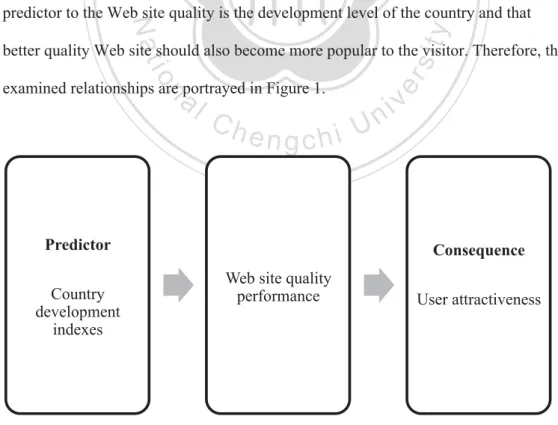
(14) EVALUATING DESTINATION MARKETING WEB SITES. 3. organizations use Web sites better than others and what could be the cause of the differences. The results will not only be beneficial for the destination marketing organizations, but also provide insight for destination marketers and tourism organizations in their marketing efforts.. Chapter organization The thesis proceeds as follows. The following chapter clarifies what is meant by destination and destination marketing organizations, and how these organizations use their Web site as a marketing tool. This section is followed by the review of previous studies evaluating destination marketing Web sites and their findings, and the most commonly studied success factors of the Web sites, with a summary and characterisation of methods used in previous studies to evaluate the effectiveness of the Web sites are discussed. Literature review further explains that a potential predictor to the Web site quality is the development level of the country and that better quality Web site should also become more popular to the visitor. Therefore, the examined relationships are portrayed in Figure 1.. Predictor Country development indexes. Figure 1. Thesis framework. Consequence Web site quality performance. User attractiveness.
(15) EVALUATING DESTINATION MARKETING WEB SITES The next section presents the research questions and hypothesis, and is followed by methodology where a content analysis and a coding sheet are explained. Finally, the results and hypothesis tests are presented in the Results section, followed by a discussion of the findings.. 4.
(16) EVALUATING DESTINATION MARKETING WEB SITES. 5. Literature Review Destination and destination marketing organizations Destinations are regarded as well-defined geographical areas, such as a country, an island or a town (Hall, 2000). According to Martini (2002), tourist destinations have some unique features according to which it is possible to distinguish a tourist destination from a simply local offering of a product or a service. These characteristics are a well-defined geographic area with identifiable borders and a territorial identity; a tourist offering consisting of attractions and services specifically catering to tourists in the location, and the presence of numerous operators with different perspectives and objectives that makes it necessary to devise a shared strategy in presenting the offering; an understanding of the nature of the potential demand for the tourist products offered; awareness of the need to balance tourism’s exploitation of resources with ecological, environmental and community stewardship (Martini, 2002). The role of tourism marketing revolves around the creation of awareness of the nature of a tourist destination and creation of the destinations image. The role of marketing in the process of tourism development has historically been the promotion of destinations in order to attract an even greater number of tourists (Ryan, 1991). Destination marketing organizations are organizations that have been established to promote specific destinations to potential travellers (Gartrell, 1994). Morrison, Bruen & Anderson (1998) suggest five primary functions of a destination marketing organization - economic driver, community marketer, industry coordinator, quasi-public representative, and a builder of community pride. The destination marketing organizations act as both leaders and mediators in their destinations to meet the needs of professionals, tour operators and individual visitors (Li & Wang, 2010)..
(17) EVALUATING DESTINATION MARKETING WEB SITES. 6. To promote a destination, a destination marketing organization needs to present an integrated destination product that encompasses all specific tourist attractions and services provided at that destination, and create a favourable destination image. Destination image is defined as an individual’s mental representation of knowledge (beliefs), feelings and overall perception of a particular destination (Fakeye & Crompton, 1991). Destination image plays two important roles in behaviours influencing the destination choice decision-making process and conditioning the postdecision-making behaviours including participation (on-site experience), evaluation (satisfaction) and future behavioural intentions (intention to revisit and willingness to recommend) (Bigne, Sanchez & Sanchez, 2001). The literature therefore suggests, that the destination marketing organizations are responsible for the attractiveness of the destination and related influx of tourists into a destination, their satisfaction with the destination and recommending the destination, and therefore further increasing the popularity of the destination. A destination marketing organization Web site is the central point from which it directs online visitors to attractions and other providers of other relevant services, such as hotels and restaurants (Gretzel, Yuan & Fesenmaier, 2000). This is typically a hub and spoke model, with the destination marketing organization serving as the nerve centre of links and information about service providers such as accommodations, attractions, dining/nightlife, and maps, etc. (Gretzel et al., 2000). According to Kim, Shaw & Schneider (2003), destination marketing organizations Web sites are important for two reasons. First, as Web sites are the main interface between a destination and potential tourists, Internet users believe such Web sites represent destinations. Second, because such Web sites allow the visitors to evaluate the products, services, and experiences (e.g. events, attractions, places to.
(18) EVALUATING DESTINATION MARKETING WEB SITES. 7. visit, culture) offered by a destination (Kim et al., 2003). A highly functional, enlightening, and appealing Web site would encourage and facilitate destination visits (Luna-Nevarez & Hyman, 2012).. Studies on evaluation of tourism related Web sites Law et al. (2010) analyzed tourism studies published from 1996 to July 2009 that pertain to tourism Web site evaluation. Based on their findings, of all Web site evaluation studies conducted within this time period were about 46% concerned with hospitality Web sites, only 23% focused at destination marketing Web sites, while the rest looked at online travel magazines and blogs (Law et al., 2010). From the studies evaluating destination marketing organization’s Web sites, Cano & Prentice (1998) analyzed Web sites providing information about specific regions within Scotland, by using a content analysis evaluating the generic information, information about activities, environment and geography, Scottish culture and socio-economic factors, and found that the Web sites placed a strong emphasis on providing general information about Scotland rather than its local region. Beldona & Cai (2006) evaluated the content, interactivity and promotional value of rural tourism Web sites in the USA and concluded that the Web sites demonstrated poor interactivity and should better exploit the interactive capabilities of the Internet to capture tourist imagination. Doolin et al. (2002) focused at New Zealand’s Regional Tourism Organizations Web sites by evaluating their stages of Web site development and discovered that these Web sites generally displayed moderate to high levels of interactivity by offering opportunities for the consumer to interact with the Web site through value-added features such as sending electronic postcards, recording experiences and reading others’ experiences in guest books. Gupta, Jones.
(19) EVALUATING DESTINATION MARKETING WEB SITES. 8. & Coleman (2004) studied tourism organizations in Wales on access, information, e-commerce/immediacy and customer relationship and found that only 1 out of 131 Web sites offered customized promotion, and a vast majority of the Web sites scored low on updating information. Kaplanidou &Vogt (2006) evaluated the navigation, content, accessibility, performance and Web site usage and satisfaction of Michigan’s destination marketing Web sites through questionnaires based on perceptions and impressions and found that all evaluations were towards the positive end of the scales, however elements to improve were keeping information up-to-date, include more maps and pictures, provide links that lead users in the right pages and provide text that is appealing to the users and promotes the destination. Aaberge, Grøtte, Haugen, Skogseid & Ølnes (2004) studied technical functionality and user judgment of regional destination marketing Web sites in Western Norway and recommended that these Web sites should integrate maps and booking forms. Kao, Louvieris, PowellPerry & Buhalis (2005) analyzed Singapore’s Tourism Board Web site and Taiwanese customer satisfaction towards the Web sites by using an e-satisfaction model that measured information quality, system quality, intention or reuse the Web site, intention to recommend the Web site, intention to actual visit Singapore and Web satisfaction, and found that users desired more information regarding transport, local maps and accommodation, but also that Web site satisfaction was positively correlated to the intention to reuse and recommend the Web site to other users. Kerr et al. (2009) compared private and government destination marketing Web sites based on the extended Model of Internet Adoption (explained in the next section) in Hong Kong and found that private Web sites offered broader Internet offerings, and also scored higher on functionality measures. Li & Wang (2010) have done two studies of Provincial Tourism Administration Web sites in China and of American.
(20) EVALUATING DESTINATION MARKETING WEB SITES. 9. destination marketing organizations’ Web sites by measuring their functional and technical merit, and discovered that Chinese Web sites were generally missing links to further information on weather, shopping and entertainment, travel tips, FAQ section or email newsletter, and featured no multiple language options, while American Web sites were strong in providing information, but failed to incorporate feedback forms, surveys or FAQ sections. Tu (2011) selected destination marketing organization Web sites in East Asia and Oceania for evaluation to find that most Web sites did not include “fun stuff” features such as e-cards, 360° panoramic views of attractions, video clips, maps etc. Sadeghein, Khoshalhan & Homayoun (2012) evaluated Web sites of travel agencies in Iran by a check list of features considering the range of information and Web site facilities provided, and found that non of the Web sites used the concept of customization and personalization, and only 5% of the Web sites facilitated checking availability of the products and, therefore, also failed to incorporate online transactions. From a perspective of the scope of the sample Web sites, Law, Qi & Buhalis (2010) found that there is an imbalance regarding the region of Web site evaluation, where over 30% of all evaluation studies focus at European Web sites, while only 1 study was found to examine African Web sites. Studies that extended their scope worldwide were, however, only few. Zhou & DeSantis (2005) employed content analysis to evaluate city tourism Web sites in North America, Europe, Asia, Australia and Africa, to examine Web site design and usability issues, and came to a conclusion that European cities scored lowest in including photo gallery into their Web sites, while Asian Web sites scored the best (70%) at offering multilingual options. Han & Mills (2006) evaluated a sample of 25 national tourism organization Web sites worldwide to test their proposed benchmarking instrument analyzing aesthetic,.
(21) EVALUATING DESTINATION MARKETING WEB SITES. 10. informative and interactive features, and found that European Web sites scored the highest in creating online communities and featured best Web design, while African Web sites were the most likely to include travel planner. And finally, Luna-Nevarez & Hyman (2012) examined Web sites of top global destinations by number of international arrivals based on visual presentation style, navigation and interactivity, textual information, advertising, social media and travel aids, and found that these Web sites can be divided into three groups – highly attractive, avant-garde, aestheticsoriented Web sites; moderately commercial, simplistic, information-oriented Web sites; and highly detailed, mostly commercial, transaction-oriented Web sites; and identified shortcomings of each of the groups. From this overview of studies involved in destination marketing Web site evaluation, non of these studies have focused at national destination marketing Web sites to study them in detailed and comprehensive manner.. Web site evaluation methods According to Ip et al. (2011), Web site evaluation takes place in several ways. It is either evaluation by stages or by features (Web site content and design). The evaluation by stages recognizes three stages with various characteristics, and as Web sites fulfill these characteristics, they move into higher stages. For instance, the basic stage consists of the provision of basic information and the basic functionality, moving on to a higher stage with richer information and low interactivity, until reaching a final stage of high interactivity and processing. The stages are further explained in Table 1 below..
(22) EVALUATING DESTINATION MARKETING WEB SITES. 11. Table 1 The Extended Model of Internet Commerce Adoption Stages and Layers Stage 1 Layer 1. Layer 2 Stage 2 Layer 1 Layer 2. Layer 3. Stage 3. Characteristics Promotion (Inception Phase) has two levels. Sites consist of a simple home page providing basic information such as company name, physical address and other contact information details (phone and fax numbers) and area of business. Sites contain the information listed in Level 1 sites plus other extensive information about the company in the form of annual reports, e-mail contact, detailed information on the company’s products/service offerings. Provision of Information and Service Phase is the most complex and is comprised of 3 levels of functionality. Sites involve lower levels of interactivity and include a basic product catalogue, hyperlink to further information, and online inquiry. Sites involve medium interactivity characterized by higher-level product catalogues, customer support (e.g., FAQ, site maps), and industry-specific value-added features. Sites involve higher interactivity and include features such as chat rooms, discussion forums, multimedia, newsletters or updates by email. Other characteristics at these sites include a travel planner, passport/visa requirements, safety information, online tourism magazines, currency converters and language options. Processing–In this phase, the web site has reached maturity and become a “fully-fledged” site. At this stage, the sites are more transaction-based and are characterized by secure on-line transactions, order status and tracking, interaction with corporate servers.. Source: Burgess, Cooper & Alcock (2001). On the other hand, evaluation by Features is a more common approach. There have been many studies that attempted to identify the most relevant features for Web site evaluation (Eschenfelder, Beachboard, McClure & Wyman, 1997; Wan, 2000; Liu, Arnett & Litecky, 2000; Smith, 2001; Abeleto, 2002; Au Yeung & Law, 2006; Kim et al., 2003; Hashim, Murphy & Law, 2007). Only later on, Park & Gretzel (2007) conducted a meta-analysis of the findings of these past studies on Web site evaluation in order to draw conclusions about the factors that drive Web site success. Based on this meta-analysis they developed a list of 9 unified factors that were the.
(23) EVALUATING DESTINATION MARKETING WEB SITES. 12. most common in the reviewed studies. These were “Ease of use, Information Quality, Responsiveness, Fulfillment, Security/Privacy, Personalization, Visual Appearance, Trust and Interactivity” (Park & Gretzel, 2007). By comparing their findings from the tourism and non-tourism studies, Park & Gretzel (2007) also found that for example “Visual Appearance” was a much more common success measure in non-tourism studies, and also “Customization” was a factor that was commonly used in nontourism studies but not at all in tourism-related Web evaluation efforts. Table 2 provides an overview of the common factors with a brief description for each.. Table 2 Description of unified key evaluation factors Key Factors Ease of use Responsiveness. Fulfillment Security/Privacy Personalization Visual Appearance Information Quality. Trust. Interactivity Source: Park & Gretzel (2007). Description Usability, accessibility, navigability Accessibility of service representatives, e-mail service, reply to online reservations Order process, accuracy of service promises, billing accuracy Online booking process and confirmation On-time delivery Protecting information during transmission and subsequent storage Personalized or individualized attention Customization of offerings and of information Attract attention Convey image Variety, scope, currency, conciseness, accuracy of information, authority, reliability, uniqueness of information Brand recognition Consistency Intentions Credibility Interactive features such as virtual tours Interactive communication (FAQs, guest books, chat).
(24) EVALUATING DESTINATION MARKETING WEB SITES. 13. Park & Gretzel (2007) point out that although fulfillment refers to the delivery of products and services with a service level promise (Field, Heim & Sinha, 2004) and destination marketing organizations have traditionally not engaged in the selling of products, almost all mail brochures, many offer online booking capabilities, and some even provide virtual souvenir shops on their Web sites. Thus, measuring a destination marketing organizations’ Web site’s performance in terms of fulfillment becomes important. Werthner & Klein (1999) pointed out that tourism marketing messages serve four distinct purposes – Information, Education, Advertising/Persuasion and Entertainment. Park & Gretzel (2007) stated that whereas the first purpose is reflected in their unified model of Web site success factors, the other three were only somewhat captured. Indeed, the qualitative meta-analysis done by Park & Gretzel (2007) shows that existing Web site evaluation frameworks generally fail to fully integrate measures necessary to detect such shortcomings. Park & Gretzel (2007) state that this is partly due to misconceptions of the Web as a purely informational and functional medium that still largely prevail in the tourism field. Therefore they suggested three more additional factors, which are “Advertising/Persuasion, Playfulness and Technological Integration” (see Table 3). However, although these additional factors were also drawn from the meta-analysis findings, only a small number of studies examined these factors..
(25) EVALUATING DESTINATION MARKETING WEB SITES. 14. Table 3 Added factors for Web site evaluation Factors. Description. Advertising/Persuasion Marketing mix, incentives Playfulness Enjoyment, fun, pleasure, flow Technology Integration New technology, integration Source: Park & Gretzel (2007). However, there have been other approaches to Web site evaluation as well. Chiou, Lin & Perng (2010) have conducted an extensive meta-analysis of tourism and non-tourism studies on Web site evaluation published between the years 1995 and 2006 and identified two approaches to Web site evaluation – IS-approach and marketing-approach. The IS-approach adopted the technical factors of Web site evaluation. According to Chiou et al. (2010), nearly every Web site evaluation study (97%) included ease of use as a factor and the most frequently used criteria were navigation, logical structure, user-friendly interface, loading speed, searching mechanism, ease of access, and ease in finding targeted information. Information quality was the second most used factor in Web site evaluation studies (82%). Its criteria included relevancy, usefulness, comprehensive coverage, currency, readability, and accuracy. Visual appearance also often appeared (53%), with factor mostly relating to interface design criteria (aesthetics, consistent style, and proper multimedia presentation) (Chiou et al., 2010). However, Chiou et al. (2010) also identified that most technical evaluations ignore the fact that the typical Web visitor is not only a Web user but also a potential customer who needs product information, attractive promotional activities, convenient order process, and after-sales service. Chiou et al. (2010) named studies concerned.
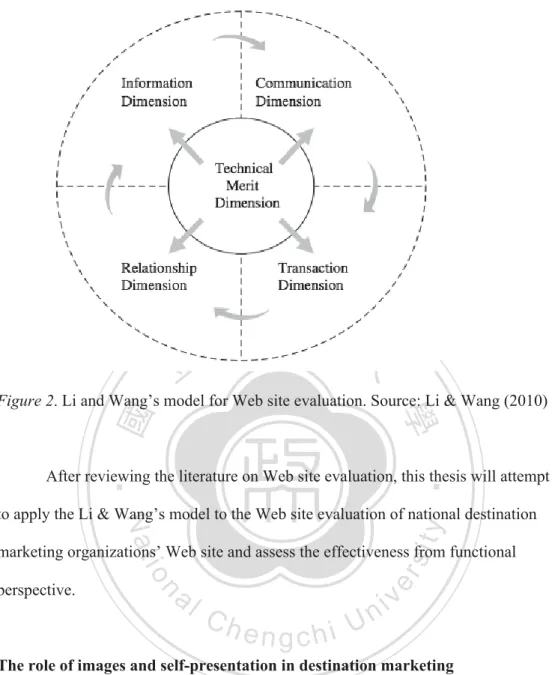
(26) EVALUATING DESTINATION MARKETING WEB SITES. 15. with these aspects as the marketing-approach framework studies. Within this marketing-approach, Chiou et al. (2010) identified that fulfillment factor was by over 90% of the marketing studies, while most IS studies did not consider it as a crucial dimension. The most frequently used criteria for fulfillment were online transaction and order status tracking. Information quality was another factor mostly used in marketing studies (90%) and emphasized more commercial-oriented criteria, such as product and price details. Advertising/persuasion was also a commonly used factor in marketing studies (80%) but not in IS or combined studies. Its criteria were mainly promotional campaigns (i.e., discount or free trial), and company/brand recognition. Finally, Chiou et al. (2010) identified a third group of studies – the combined approach that emphasizes the degree of importance of both IS and marketing factors in the framework. The top three factors that these studies focused at were the ease of use (97%), information quality (92%), and responsiveness (87%). Information quality was defined as either an IS or a marketing factor because it involves both accuracy, currency, or variety, etc. and price details and product description. Responsiveness mostly related to customer service support. However, Chiou et al. (2010) point out that in the combined-approach framework, simply joining IS and marketing criteria will result in confusion because some criteria can be both IS and marketing oriented, but concluded that there is a need to develop a hybrid approach that would consider the role of IS as a support factor for marketing, rather than two separate approaches. Li & Wang (2010) developed such framework that integrates both technology and marketing principles as Chiou et al. (2010) mentions. According to them, a Web site should be evaluated on five dimensions, including information, communication, transaction, relationship and technical merit (ICTRT model). Among the five dimensions, technical merit dimension directly affects the effectiveness of the other.
(27) EVALUATING DESTINATION MARKETING WEB SITES. 16. four marketing dimensions (See Figure 2). At the basic marketing level, destination marketing organizations’ Web site must provide tourists with timely information about the destination. Once the information function has been sufficiently implemented, destination marketing organizations should then consider the communication function, which involves all areas of promotion and marketing research. At this stage, email and contact information are distributed, allowing for a direct exchange of information between the destination marketing organizations and consumers which paves the way for future relationship building. The transaction function enables destination marketing organizations to generate revenue for both internal use and external stakeholders. The relationship component of the model considers maintaining current users and converting visitors to repeat customers, because Web site loyalty dramatically lowers the cost of retaining website traffic (Hanson, 2000). In addition, while maintaining loyal customers, destination marketing organizations have more opportunity to communicate with them, to expose the destination marketing organizations’ advertising, and to increase the customers’ level of involvement..
(28) EVALUATING DESTINATION MARKETING WEB SITES. 17. Figure 2. Li and Wang’s model for Web site evaluation. Source: Li & Wang (2010). After reviewing the literature on Web site evaluation, this thesis will attempt to apply the Li & Wang’s model to the Web site evaluation of national destination marketing organizations’ Web site and assess the effectiveness from functional perspective.. The role of images and self-presentation in destination marketing Recent studies have especially addressed the importance of virtually transporting the consumers of travel information to the destination to support the formation of concrete expectations (Rozier-Rich & Santos, 2010). Since actual product trial in tourism is impossible, being able to vividly imagine what a destination is like is the next best alternative if the goal is to form concrete expectations (Goossens, 1995). Past research has revealed that imagery can be stimulated by.
(29) EVALUATING DESTINATION MARKETING WEB SITES. 18. various external advertising elements such as pictures, concrete words, sound effects, and instructions to imagine (Babin & Burns, 1997). Importantly, pictures trigger imagination that can lead to self-sell and therefore greater desire to visit the pictured destination (Tormala & Petty, 2004). Research on imagery has provided strong evidence that elaborate imagery processing may positively influence decision outcomes (Babin & Burns, 1997). From the perspective of consumer research, a consumer’s mental image of a tourism product can be the main source of information available to enhance expectations and facilitate purchasing decisions (Walters, Sparks, & Herington, 2007). As the literature suggests, when imagery is encouraged through vivid product images, it strongly influences consumers’ attitudinal judgments (McGill & Anand, 1989). Therefore images and photos play a significant role in the destination marketing, and should become a part of the Web site examination, in order to evaluate the destination marketing Web site as a compact marketing tool, not only a part of it. Research on destination marketing proves, that destination marketing organizations realize the importance of photos, and are concerned with the creation of the correct image for their destination. Pictures are one of the major features through which a destination image is created, therefore, a way of self-presentation of the destination. Dominick (1999, p. 647) defined self-presentation as the “process by which individuals attempt to control the impressions others have of them” and suggested that personal Web sites can be viewed as carefully constructed selfpresentations. Fursich and Robins (2002) have extended this notion to include selfpresentation by nations and states as countries use the Web for self-presentation as well..
(30) EVALUATING DESTINATION MARKETING WEB SITES. 19. Therefore, as national destination marketing organizations are concerned with presentation of their states, they need to know what images dominate the Internet and whether these images are consistent with the information projected by the destination itself, so that they can reinforce positive images or counter unfavorable images, if necessary (Stepchenkova & Zhan, 2011).. Destination marketing Web sites and country development Studies mentioned above focus on the Web site evaluation from the users’ point of view. Only a few studies suggested a possible relationship between the Web site quality and the development level of the country. Guseva (2009) suggests that it is necessary to take into account the level of development in the target country in designing Web sites. For instance, people from less developed countries prefer short structure and poorer design and people from more developed countries prefer multistage hierarchy and richer design (Guseva, 2009). Stankov (2009) as well suggests that the Internet penetration in a country is the most important indicator of Internet and Web site development. These findings suggest that the Web site quality may depend on some of the development indicators of a country. However, up to this date there have not been any studies done that would examine whether there is a relationship between the development level of the country and the Web site quality. Previous studies concerned with the destination image creation in a relation to the development level of the country analyzed tourism photographs from various sources to identify, what marketing images First World and Third World countries adopt. For instance, Fursich and Robins (2002) examined the official Web sites of sub-Saharan African countries and found that these nations often construct the nation.
(31) EVALUATING DESTINATION MARKETING WEB SITES. 20. as a brand and its citizens position as exotic and indigenous people who can be marketed to tourists and investors, despite the ongoing struggle of the countries for development and modernization. Echtner and Prasad (2003) collected a sample of 223 brochures from 47 North American travel agencies and analyzed pictures used to present selected Third world destinations. They found that descriptions of modernity were almost exclusively reserved for the portrayals of gateway cities, as they were inevitably described as a meeting place for the ancient and modern, and were portrayed as the staging points to enter the unchanged Orient beyond. Finally, Caton and Santos (2008) analyzed photos made by students on a study abroad cruise trip to a Third World country along the five dimensions: traditional/ modern, subject/object, master/servant, center/periphery, and devious-lazy/moral-industrious. They concluded that the photos conform to the socio-cultural ideologies of Western power and dominance and that Western tourists often refer to visiting the Third world destinations as e.g. mysterious, exotic, sensual, splendid, cruel, despotic, sly and backward (Caton & Santos, 2008). These studies often linked the self-representation of nations to the postcolonial theory. The post-colonial theory (Gandhi, 1998) emerges out of a fundamental belief that colonialism has been, and remains, one of the most compelling influences on the West’s interpretations of and interactions with people from different (mainly from non-Western) cultures (Echtner & Prasad, 2003). Furthermore, according to Echtner and Prasad (2003), post-colonial theory provides a critical perspective that draws attention to the power structures constructed and maintained by forms of discourse. Mishra and Hodge (1991) explain that the form of discourse popularized during the colonial eras of expansion and exploitation continues to dominate any form of representation of the Third World by the First.
(32) EVALUATING DESTINATION MARKETING WEB SITES. 21. World. They content that although the formal territorial control of much of the Third World ended with the rise of independent nationhood in the 20th century, the ideological domination of the West is still a continuing reality (Mishra & Hodge, 1991). Prasad (1997) pointed that this marginalization occurs by creating binary oppositions such as colonizer/colonized, First World/Third World, developed/developing, civilized/primitive, scientific/superstitious, industrialized/undeveloped, active/passive, disciplined/unrestrained, normal/exotic, etc. Following these findings, the literature suggests that there is an influence of colonialism still seen today, especially in the representation of Third world countries by First world countries in the tourism brochures and texts. However, up to this date there is no comprehensive study looking at the self-presentations of these countries, whether they attempt to change this post-colonial representation or whether they consciously or unconsciously comply with it..
(33) EVALUATING DESTINATION MARKETING WEB SITES. 22. Research Questions Based on the rationale preceding literature review, stating that official national destination Web sites are some of the most important representative online sources of information about a particular country, as they serve as a gateway to the outside world and create national images in the perceptions of people around the world, the first research question is as follows: RQ 1a: How do the national marketing Web sites perform in the technical merit dimension? RQ 1b: How do the national marketing Web sites perform in the information dimension? RQ 1c: How do the national marketing Web sites perform in the communication dimension? RQ 1d: How do the national marketing Web sites perform in the relationship dimension? RQ 1e: How do the national marketing Web sites perform in the transaction dimension?. The literature further demonstrated the importance of photographs in the destination marketing, and the design of destination image in order to create an attractive presentation of the destination. Therefore, the second research question is as follows: RQ 2: What photograph themes do countries use on their destination marketing Web sites?. In the current state of research, there are several studies that suggest that the Web site performance may relate to the development level of the country or the Internet.
(34) EVALUATING DESTINATION MARKETING WEB SITES. 23. penetration of the country. This thesis therefore, will attempt to test this relationship by using various development indexes. To test this relationship, the following hypothesis is as follows: H 1a: There is a relationship between the Web site performance and the development index of the country. H 1b: There is a relationship between the Web site performance and the literacy of the country. H 1c: There is a relationship between the Web site performance and the number of Internet users in the country.. 治 政 大 and the level H 1d: There is a relationship between the Web site performance 立立 of corruption control in the country.. •‧ 國. ㈻㊫學. H 1e: There is a relationship between the Web site performance and the availability. •‧. of information on public budget.. sit. y. Nat. io. er. Literature also suggests that Third World and First World countries tend to represent themselves in a different ways, based on the post-colonial division of the world.. n. al. Ch. Therefore, the following hypothesis is:. engchi. i n U. v. H 2a: Countries with Very High HDI will use modern photos to represent themselves. H 2b: Countries with Low HDI will use traditional photos to represent themselves.. Finally, literature about the Web site quality often mentions that a quality Web sites will be more attractive and enjoyable to its visitors. Following this argument, the final hypothesis is: H 3a: The average time spent on the Web site will increase with higher Web site performance..
(35) EVALUATING DESTINATION MARKETING WEB SITES. 24. H 3b: The number of daily page views per visitor will increase with higher Web site performance..
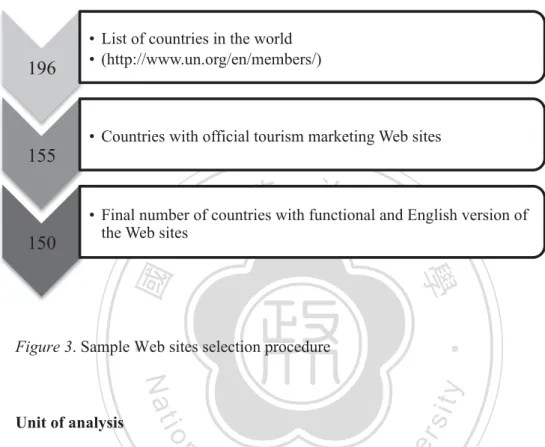
(36) EVALUATING DESTINATION MARKETING WEB SITES. 25. Methodology Among the studies identified by Law et al. (2010), content analysis was the most adopted instrument, followed by user judgment being the next, while 12,5% have conducted no actual evaluation. This thesis also uses a content analysis to evaluate the official national destination marketing Web sites of countries in the world. This section describes the variables used in the coding sheet, sample size, unit of the analysis, and operationalization of the variables.. Destination marketing Web sites sample A list of countries of the world was obtained from the United Nations (2013) list of members, with 3 more countries listed as non-member observing states. Therefore, according to the United Nations (2013), there are currently 196 countries in the world. Firstly, a process of identification of the official destination marketing Web sites for all the countries listed took place. The search was done on Google search by using the name of the country with terms “official”, “national”, “tourism”, “tourist”, “website”. From these identified Web sites, only Web sites that were identified to be either run by the government, or government appointed body such as national tourism and tourist boards, national tourism agencies etc. were selected. Web sites of ministries of tourism were not accepted as destination marketing Web sites as, although they often contained similar information to destination marketing Web sites, their purpose was mostly information oriented rather than marketing oriented. Through this process, out of the 196 countries, 155 Web sites complied with the conditions. Out of these 155 Web sites, 3 more Web sites were excluded for not featuring English version and 2 Web site was excluded for being under construction..
(37) EVALUATING DESTINATION MARKETING WEB SITES. 26. The process of Web site identification for the content analysis is pictured in Figure 3. The final sample size therefore is 150 national destination marketing Web sites that are listed in Appendix B.. 196. 155. 150. • List of countries in the world • (http://www.un.org/en/members/). • Countries with official tourism marketing Web sites. • Final number of countries with functional and English version of the Web sites. Figure 3. Sample Web sites selection procedure. Unit of analysis Destination Web site homepage (i.e. first page presented when entering a Web site) is the unit of analysis. Because destination Web sites vary by amount of information, navigation structure, and depth (the number and amount of information on secondary pages), the homepage is the most convenient unit. Further, as LunaNevarez & Hyman (2012) pointed out, when visitors enter the homepage, they either explore the Web site or depart Web sites, depending on their initial impression. Kim & Fesenmaier (2005) found that people form initial impressions within several seconds, destination Web site homepage is the most important aspect of the whole Web site. Thus, destination Web site homepages were chosen as the unit of analysis..
(38) EVALUATING DESTINATION MARKETING WEB SITES. 27. Operationalization of evaluated variables The set of criteria for destination marketing Web site evaluation was taken from Li & Wang (2010), however their list had to be modified to suit evaluation of the homepage only. Web site performance. This is a variable that is created by adding scores of the following four variables - Technical Merit Dimension, Information Dimension, Communication Dimension and Relationship Dimension. Technical Merit. This variable is measured by the presence of Web site features that contribute to the easy of use of the Web site: Navigation bar, Search tool, Site map or Index page, Multiple languages, Downloading time 10 to 30 s with no missing elements, URL contains name of the destination, Page size (Small (1 – 2 screens) = 1, Large (3 or more screens = 0), Page layout (Balanced (center) = 1, Unbalanced (left/right) = 0), Stream audio/music, Spelling or grammatical errors. If the feature was present on the Web site, the code was Yes = 1, otherwise No = 0. Information Dimension. This variable measures the depth, breadth and variety of the information provided on the Web site: News section, Information on transportation, Information on accommodation, Information on attractions, Information on food, Information on festivals and events, Information on weather and climate, Information on entertainment, Information on shopping, Information on arts, Information on tours, Information by market segment (family, business etc.), Maps provided, Links to lower level tourism organizations (provinces, cities) Web sites, Visitor center information, Frequently Asked Questions. If the feature was present on the Web site, the code was Yes = 1, otherwise No = 0. Communication Dimension. This variable measures the level of interactivity and communication between the organization and visitor: Destination logo/trademark.
(39) EVALUATING DESTINATION MARKETING WEB SITES. 28. shown, Identification as an official source, About Us section, Links to social media, Online comment form, Chat facilities, Interactive travel planner, Visual postcards, Virtual tours, Phone number listed, Address listed, E-mail hyperlink, Feedback form. If the feature was present on the Web site, the code was Yes = 1, otherwise No = 0. Relationship Dimension. This variable measures whether the Web site makes an attempt to create a relationship with its visitors: Option to log in, Newsletter sign up, Contests, Information regarding deals and discounts, Free online applications (e.g. navigation systems, guide books, photos, music, wallpapers etc.). If the feature was present on the Web site, the code was Yes = 1, otherwise No = 0. Transaction Dimension. This variable measures the Web site’s attempts to generate revenue. These variables are: Online reservation of accommodation, Online reservation of transport / car rental, Event tickets, Attraction tickets, Shopping cart. If the feature was present on the Web site, the code was Yes = 1, otherwise No = 0.. Photograph Categories. Categories developed by Stepchenkova and Zhan (2013) will be used to evaluate the themes in the photographs presented on the national destination marketing Web sites, to identify the main attributes pictured in the photos. Stepchenkova and Zhan (2013) used these categories to evaluate and compare images of Peru presented on Peru’s national destination marketing Web site and photos uploaded by tourists on Flickr. For the use of this thesis, these categories are taken as a basis of evaluation, however are slightly refined to fit the needs of evaluating national Web sites and to capture better signs of post-colonial theory. Therefore, these categories are: Flora and Fauna, Transport and Infrastructure, Nature and Landscape, Urban Landscape,.
(40) EVALUATING DESTINATION MARKETING WEB SITES. 29. Agricultural Landscape, Architecture, Art Object, Historical Sites, Tourism Facilities, Way of Life, Traditional Clothing, Modern Clothing, Entertainment, Outdoor Activities and Adventure, Relaxation Activities, and Food. The list of categories with their description can be found in Appendix A. However, because photos are complex entities that cannot be easily and reliably broken down into single category, each photo will be coded into several categories (no more than 3), to capture more aspects of the photo.. Operationalization of predictor and consequence variables Human development index. Human development index is an index calculated by United Nations that measures development by combining indicators of life expectancy, educational attainment and income. The data will be obtained from United Nations (2012) Human Development Report 2013, and countries will be divided into 4 groups already proposed by the UN – Very High Human Development, High Human Development, Medium Human Development and Low Human Development. Literacy rate. This variable is taken from The World Bank’s (2013) world development indicators and from the CIA World Factbook (2013). These organizations provides several indicators of literacy, for the use of this thesis, the indicator of male adult literacy between years 2005 – 2011 is used. Internet users. This variable shows the number of Internet users per 100 people in the country. Internet users in this variable are defined as “people with access to the worldwide network” (World Bank, 2013b). The data is obtained for each country from The World Bank’s Web site for year 2012..
(41) EVALUATING DESTINATION MARKETING WEB SITES. 30. Control of corruption. Control of corruption reflects perceptions of the extent to which public power is exercised for private gain. This includes both petty and grand forms of corruption, as well as "capture" of the state by elites and private interests. Higher values correspond to better governance outcomes. Corruption rate may influence the quality of the Web sites as the task of creating the national Web site may be given to a company based on corrupted decision, not on the company’s abilities. This index by Transparency International (2013) is for year 2012, and ranges from 0 (highly corrupt) to 100 (very clean). Open budget index. The open budget index assesses the availability of eight key budget documents in every country, as well as the comprehensiveness of the data contained in them. It is an index by Transparency International (2013) as well, and it examines the extent of effective oversight provided by legislatures and supreme audit institutions, as well as the opportunities available to the public to participate in national budget decision-making processes. Scores range from 0 (scant or no information) to 100 (extensive information). First World /Third World countries. This variable is based on the Human Development Index variable, and represents a different definition of the country development level. Countries in a Very High HDI group are considered as First World, countries in a Low HDI group are taken as Third World counties. Other groups of the HDI are not taken into account in this variable. Average time spent on the Web site. This variable shows the average time that visitors spend on the Web site, from the moment they enter, till the moment they leave, and therefore, show how engaged the visitors are with the site’s content. It is measured by a Web site http://www.siteprice.org that provides this information free of charge..
(42) EVALUATING DESTINATION MARKETING WEB SITES. 31!. Daily page views per visitor. This variable estimates daily unique page views per visitor on the site, also found at http://www.siteprice.org.. Inter-coder reliability A random sample of 15 Web sites, making 10% from the population of the study, was selected for inter-coder reliability test. Two coders were involved. One of them is the author of this thesis, the second one is a graduate student from the University of Birmingham with a tourism management and marketing background. Instructions were given prior to the Web site evaluation. The coders evaluated. 治 政 大 process, ten Web sites one Web site together, and after clarification of the evaluation 立立 were evaluated separately.. •‧ 國. ㈻㊫學. Inter-coder reliability test was run by an online utility ReCal, using percentage. •‧. agreement and Krippendorff’s Alpha as a measure of reliability. The percentage. sit. y. Nat. agreement ranged from 86.7% to 100%, with the average of 98.6 %,. io. al. n. agreement, see Table 4.. er. and Krippendorff’s Alpha with the average of 0.95. Both coders had substantial. Ch. engchi. i n U. v.
(43) EVALUATING DESTINATION MARKETING WEB SITES. 32!. Table 4 Results of ReCal 0.1 Alpha test of inter-coder reliability of the Web site evaluation Variable. Variable Name. V.4.1 V.4.2 V.4.3 V.4.4. Navigation bar Search tool Site map or Index page Multiple languages Dowloading time - 10 – 30 s with no missing elements URL contains name of the destination Page size Page layout Stream audio/music Stream video Spelling or grammatical errors Date last updated News section Information on transportation Information on accommodation Information on attractions Information on food Information on festivals and events Information on weather and climate Information on entertainment Information on shopping Information on arts Information by market segment Information on tours Map provided Links to lower level tourism organization (provinces, cities) Web sites Visitor centre information Frequently Asked Questions Destination logo/trademark shown Identification as an official source About Us section Links to social media Online comment form Chat facilities Interactive travel planner Visual postcards Virtual tours Phone number listed. V.5.16 V.5.17 V.6.1 V.6.2 V.6.3 V.6.4 V.6.5 V.6.6 V.6.7 V.6.8 V.6.9 V.6.10. al. n. V.5.15. 1. 100 100 100 100 100 100 100 100 100 100 100. 1 1 1 1 1 1 1 1 1 1 1. Ch. engchi. 100 100 100 100 100 93.3 100. y. 100. sit. io. V.5.9 V.5.10 V.5.11 V.5.12 V.5.13 V.5.14. 100. 政 治 大. Nat. V.5.8. 1. •‧. V.5.7. 立立. 100. ㈻㊫學. V.4.7 V.4.8 V.4.9 V.4.10 V.4.11 V.5.1 V.5.2 V.5.3 V.5.4 V.5.5 V.5.6. Krippendorff's Alpha 1 1 0.71 1. er. V.4.6. •‧ 國. V.4.5. Percent Agreement 100 100 86.7 100. i n U. v. 1 1 1 1 1 1 0.87 1. 93.3. 0.77. 100 100 100 86.7 100 100 100 100 100 100 100 100. 1 1 1 0.67 1 1 1 1 1 1 1 1.
(44) EVALUATING DESTINATION MARKETING WEB SITES V.6.11 V.6.12 V.6.13 V.7.1 V.7.2 V.7.3 V.7.4 V.7.5 V.8.1 V.8.2 V.8.3 V.8.4 V.8.5 Average. Address listed E-mail hyperlink Online information request Option to log in Newsletter sign-up Contests Information regarding deals and discounts Free online applications (e.g. navigation systems, guide books, photos, music, wallpapers etc.) Online reservation of accommodation Online reservation of transport/car rental Events tickets Attraction tickets Shopping cart. 立立. 33!. 100 100 86.7 100 100 93.3. 1 1 0.67 1 1 0. 93.3. 0.86. 93.3. 0.87. 100. 1. 100. 1. 100 100 100 98.6. 1 1 1 0.95. 政 治 大. •‧ 國. ㈻㊫學. The inter-coder reliability test for the coding of photograph themes had to be rerun twice, each time on a different set of photographs. After the first test, it was. •‧. clear that there had to be some categories added, as the previous list of categories did. Nat. sit. y. not include all the possible range of photos, and some photos could not be classified.. n. al. er. io. Therefore, a second inter-coder reliability test had to be run which showed. i n U. v. a substantial agreement, with the percentage agreement ranging from 86.7 %. Ch. engchi. to 100 %, with the average of 95.8 %, and Krippendorrf’s Alpha with the average of 0.8 (see Table 5)..
(45) EVALUATING DESTINATION MARKETING WEB SITES. 34!. Table 5 Results of ReCal 0.1 Alpha test of inter-coder reliability of the photograph themes. Theme. 100 93.3 93.3 100 100 93.3 93.3 86.7 100 93.3 100 100 100 93.3 100 86.7 95.8. 1 0 0.82 1 1 0 0.77 0.67 1 0.77 1 1 1 0.64 1 0.67 0.8. 政 治 大. •‧. •‧ 國. 立立. Krippendorff's Alpha. ㈻㊫學. Flora and Fauna Transport and Infrastructure Nature and Landscape Urban Landscape Agricultural Landscape Architecture Art Object Historical Sites Tourism Facilities Way of Life Traditional Clothing Modern Clothing Food Entertainment Outdoor Adventure Relaxation Activities Average. Percent Agreement. n. er. io. sit. y. Nat. al. Ch. engchi. i n U. v.
(46) EVALUATING DESTINATION MARKETING WEB SITES. 35. Results Research question 1 in this study explores how the national marketing Web sites perform overall based on the proposed dimensions. The highest possible score in the analysis was 51 points, however the average score was 25.05 meaning that countries on average scored only half of the points they could possibly get (see Table 6). Even the Web site with highest score, Malta (for scores of all the Web sites see Appendix C), reached 38 points, therefore still with plenty room for improvement. Web site with the lowest score was the Web site of Afghanistan with only 10 points, meaning that this Web site is practically useless as a source of information for planning a trip to the destination, as the amount of information and features is very limited. The difference between these two minimum and maximum scores suggests that there were large differences between the scores of individual Web sites, with standard deviation being 5.041.. Table 6 Results of the Web site evaluation by dimensions Highest possible. Real mean score. Real score min.. Real score max.. Std. Deviation. Technical Merit. 11. 8.27. 4. 11. 1.329. Information. 17. 9.93. 3. 16. 2.679. Communication. 13. 4.73. 2. 10. 1.697. Relationship. 5. 1.48. 0. 4. 1.079. Transaction. 5. .63. 0. 4. .908. Total performance. 51. 25.05. 10. 38. 5.041. Dimension.
(47) EVALUATING DESTINATION MARKETING WEB SITES. 36. The technical merit dimension was one of the dimensions with lower standard deviation (1.329), however there were still large differences between individual Web sites. The minimum scored points in this dimension were 4 points and maximum were 11 points out of 11 ( = 8.27). Among the most common variables in this dimension were a navigation bar being present at 97 % of the analyzed Web sites; URL containing name of the destination on 93 % of the Web sites; a balanced page layout on 95 % of the Web sites and no grammatical or spelling errors which was correct in 99 % of the Web sites (see Table 7). On the other hand, variables that were the least common on the national destination marketing Web sites were the presence of stream audio and music with only 7 %, suggesting that the national destination marketing Web sites are silent, rather than vibrant and entertaining. However, video was present on 49 % of the Web sites, showing attempts to make the Web site more attractive. Another variable with low score was the presence of a site map (54 %). This might be a problem for a visitor who is searching for particular information on the Web site, in the case that the desired information is not clearly visible on the Web site or the Web site may seem chaotic for the visitor. In this situation, site map is a useful tool, and considering the vast amount of information usually presented on the national destination marketing Web sites, site maps may be necessary to ease the orientation on the Web site. Furthermore, 85 % of the Web sites had their homepage size within three page downs, however for the remaining 15 % of the Web sites it was necessary to scroll down through never ending amounts of various articles and text which made the search for information confusing, and with a slower connection it may become even problematic to load such Web site..
(48) EVALUATING DESTINATION MARKETING WEB SITES. 37. The information dimension was the one with the highest deviation of 2.679. Out of 17 possible points, the mean score was 9.93, the highest reached score was 16 points, while the lowest was only 3 points, pointing out a large difference between individual Web sites. Majority of Web site included on their Web sites information about accommodation (91 %) and attractions (97 %), however only about half of the Web sites provided information about tours (57 %), arts (56 %), shopping (53 %) or weather (48 %). An interesting fact was that only 61 % of the Web sites included a map of the destination and only 69 % of the Web sites provided links or information about the various regions within the country, which may be one of the most important information that visitors may be seeking on these Web sites. Besides, one of the variable with the lowest presence on the Web sites in the information dimension overall was the FAQ section, with the presence only on 25 % Web sites, which may further impede the search for desired information on the Web site and may force the Web site visitors to search for this information elsewhere. Web sites were also weak in sorting their information by market segment (e.g. families, budget, business etc.), only 33 % of the Web sites allowed its visitors to use this feature and find information tailored to their needs. Another interesting finding is that only 10 % of the Web sites provided information about visitor information centers in the country. With this information missing, visitors who seek this information would be forced to search for this information on different Web sites for each of their destination, rather than finding it all in one place. The standard deviation of the communication dimension was 1.697 with the average score of 4,73 points out of 13 possible. Web sites were generally good.
(49) EVALUATING DESTINATION MARKETING WEB SITES. 38. at including their logo on the Web site with 93 % Web sites featuring their logo. 85 % of the Web sites linked their destination marketing Web sites with various social media, which is a quite large proportion, however nowadays, when the social media are creating a large buzz, the rest of the Web sites with no links to social media may be losing visitors. The rest of the variables in this dimension was very poorly present on the Web site, suggesting that Web sites are not very good at creating a communication connection with their visitors, for instance a way to directly contact the tourism bureau or the tourism agency was given to the Web site visitors very scarcely – online comment forms were present only on 17 % of the Web sites, chat facilities on 5 % or online information request forms were present only on 19 % of the Web sites. These findings may suggest that destination marketing Web sites currently serve mostly as a one-way communicator of information, rather than a helpful and forthcoming information provider. Few Web sites also featured interactive travel planners (25 %), which may prove to be very useful when planning a trip and classifying information extracted from the Web site. Only 17 % of the Web sites also featured virtual tours and 20 % featured virtual postcards, which may be characteristics that enhance fantasy and imagination of the destination, and therefore as a result increase the destinations attractiveness. The highest possible score in the relationship dimension was 5 points, however some of the Web sites did not score one single point. The largest proportion of Web sites offered free downloads (53 %) in the form of mobile applications, guidebooks, music, wallpapers etc., and the possibility to sign up for newsletter (46 %). On the other hand, only 29 % of the Web sites featured information about.
(50) EVALUATING DESTINATION MARKETING WEB SITES. 39. deals and discounts available within the destination, and only 2 % of the Web sites had some contests and competitions going on to increase the number of its visitors. While these features may not be among the most important once that visitors may be seeking from these Web sites, they certainly may enhance the enjoyable experience of using the Web site and visitors satisfaction and image of the destination. The transaction dimension ended with an average score of .63 points, meaning that Web sites on average did not score any single point in this dimension. The low score in this dimension may also be given due to the fact that features in this dimension require the highest sophistication in their making. In contrast from the information dimension where it is enough to write up the information on the Web site. Variables in this dimension require a complex system of connecting the Web site server with servers of other providers who are involved in the booking (such as hotels, car rentals, tour operators etc.), servers of payment security etc. The most common feature in the transaction dimension was online reservation of accommodation being present on 34 % of the Web sites, followed by online reservation of transport and car rental being present on 23 % of the Web sites. On the other hand, the possibility to book tickets to events or attractions were very limited, being present only on 2 % of the Web sites for events tickets bookings (for example tickets for theatre shows) and 3 % of the Web sites featuring the possibility to book attraction tickets (such as museums, historical heritage entrance tickets etc.). Shopping cart variable, in the form of online souvenir shop was present only on 1 % of the Web sites. Web sites who managed to incorporate these online purchase facilities to buy event and attraction tickets in advance, including for example discounted seasonal tickets for local transport etc., would make the trip planning for the potential visitor much easier, convenient and in addition would make.
(51) EVALUATING DESTINATION MARKETING WEB SITES. 40. a revenue on these purchases to fund their online presence, thus being more sustainable.. Table 7 Results of the Web site evaluation by Web site attributes Web site attributes. Percent of Web sites. Technical Merit Dimension Navigation bar Search tool Site map or index page Multiple languages Downloading time - 10 - 30 s with no missing elements URL contains name of the destination Page size Page layout Stream audio/music Stream video Spelling or grammatical errors Information Dimension Date last updated News section Information on transportation Information on accommodation Information on attractions Information on food Information on festivals and events Information on weather and climate Information on entertainment Information on shopping Information on arts Information by market segment Information on tours Map provided Links to lower level tourism organization (provinces, cities) Web sites Visitor centre information Frequently Asked Questions Communication Dimension Destination logo/trademark shown Identification as an official source About Us section Links to social media. Number of Web sites (out of 150). 97 81 54 68. 146 122 81 102. 99. 149. 93 85 95 7 49 99. 140 128 143 11 74 149. 3 67 83 91 71 71 84 48 87 53 56 33 57 61. 5 101 125 137 107 107 126 72 131 80 84 50 86 92. 69. 104. 10 25. 15 38. 93 86 47 85. 140 129 71 128.
數據

相關文件
Página vazia Blank
For those establishments not using computer, 84 intended to install computer in 2003; among which 36 establishments would connect to the Internet, 14 would set up web page or web
(2)Ask each group to turn to different page and discuss the picture of that page.. (3)Give groups a topic, such as weather, idols,
As students have to sketch and compare graphs of various types of functions including trigonometric functions in Learning Objective 9.1 of the Compulsory Part, it is natural to
The PE curriculum contributes greatly to enabling our students to lead a healthy lifestyle with an interest and active participation in physical and aesthetic
These strategies include hands-on and minds-on exploratory activities that allow students to integrate and apply knowledge and skills, sustain their interests in science
In Hong Kong, our young people’s understanding of the importance of the Basic Law as the constitutional document of the Hong Kong Special Administrative Region (HKSAR),
It provides details about promoting Language across the Curriculum at the secondary level, the learning and teaching of language arts and the four language skills, namely
