1114 IEEE COMMUNICATIONS LETTERS, VOL. 15, NO. 10, OCTOBER 2011
Signal Remodulation Ring WDM Passive Optical Network with
Rayleigh Backscattering Interferometric Noise Mitigation
C. H. Yeh, Member, IEEE, and C. W. Chow, Member, IEEE
Abstract—We propose and demonstrate a novel and simple signal remodulation ring-based wavelength division multiplexed passive optical network (WDM-PON) scheme with the capability to mitigate the Rayleigh backscattering (RB) beat noise in colorless signal remodulation operation. The effects of RB can be avoided since the backscattering effects and upstream signals travel in opposite directions. Here, 10 Gb/s DPSK downstream is used to launch into reflective optical semiconductor amplifier (RSOA)-based optical network unit (ONU) for signal remodu-lation at 1.25 or 2.5 Gb/s on-off keying (OOK). Moreover, the network performance has also been analyzed and discussed.
Index Terms—Rayleigh backscattering, WDM, passive optical network (PON), DPSK, OOK, sensitivity.
I. INTRODUCTION
S
INCE the demand for broadband services is increasingrapidly, the last mile data access network must provide high data rate in a more economic way. Time division multi-plexed passive optical network (TDM-PON) and wavelength division multiplexed PON (WDM-PON) have been widely developed for the access networks [1], [2]. Meanwhile WDM-PON technologies can also provide symmetric bandwidth connections at very high data rates, in the 1-10 Gbps range per end-user [3]. Here, new ”colorless” ONU designs can be leveraged to help reduce WDM-PON costs as well, i.e., by obviating the need for wavelength-specific lasers using technologies such as reflective semiconductor optical amplifier (RSOA) or Fabry-Perot laser diodes (FP-LD) [4]. However, colorless ONU can lead to Rayleigh backscattering (RB) interferometric beat noise, which is produced at the receiver at central office (CO). The RB beat noise could degrade the received signal to noise ratio (SNR) and reduce the received sensitivity [5]. To avoid and mitigate the RB noise in WDM-PONs, several technologies have been developed and reported, such as using phase and bias-current dithering, advanced modulation formats, and wavelength shifting [6]-[9]. However, the above methods either need to use complicated modulation schemes or employ dithering techniques to broaden the up-stream wavelength, which would decrease the dispersion tol-erance. In addition, these proposed techniques are most suited for use in tree-architecture WDM-PONs. In this paper, a ring-architecture WDM-PON with RB noise mitigation is proposed and experimentally investigated. A new module design in each
Manuscript received September 29, 2010. The associate editor coordinating the review of this letter and approving it for publication was A. Shami.
C. H. Yeh is with the Information and Communications Research Labo-ratories, Industrial Technology Research Institute (ITRI), Chutung, Hsinchu 31040, Taiwan (e-mail: [email protected]).
C. W. Chow is with the Department of Photonics and the Institute of Electro-Optical Engineering, National Chiao Tung University, Hsinchu 30010, Taiwan.
Digital Object Identifier 10.1109/LCOMM.2011.082611.101838
CO 1 2 TRx 3 2 1 3 OC FBGi OC OC 2 3 1 ONUi ONU1 ONUn ONU2
ONUi‐1 ONUi+1
ONUn‐1
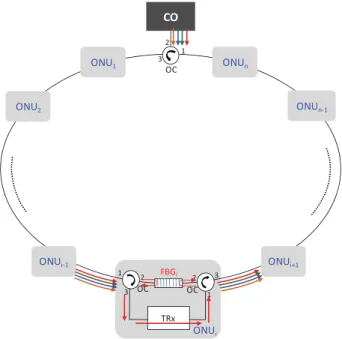
Fig. 1. Proposed ring-architecture WDM-PON system to mitigate the Rayleigh backscattering noise.
RSOA-based ONU is used to produce the downstream and upstream traffic in the two different directions and advanced modulation techniques are not required to avoid RB noise. Moreover, the 10 Gb/s differential phase shift keying (DPSK) downstream and 1.25 Gb/s (or 2.5 Gb/s) remodulated on-off keying (OOK) upstream traffic are achieved in the proposed PON system.
II. EXPERIMENT ANDDISCUSSION
Fig. 1 illustrates the proposed ring-based WDM-PON to mitigate RB beat noise. The WDM downstream signals will transmit via optical circulator (OC) into each ONU in coun-terclockwise (CCW) direction. Here, each ONU is consisted of two OCs, an optical transceiver (TRx), and a fiber Bragg grating (FBG), which is used to filter and reflect the corre-sponding downstream wavelength into TRx for upstream sig-nal remodulation, as shown in Fig. 1. Hence, the remodulated upstream signal also will be reflected by FBG and transmit through the same CCW direction into the CO. Based on the proposed network architecture, the downstream and upstream wavelengths could propagate in two different directions to mitigate RB noise.
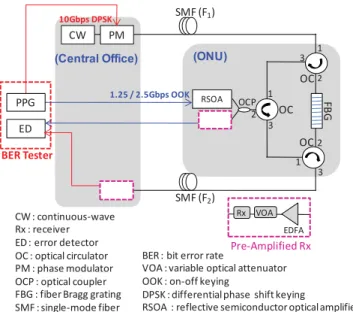
Fig. 2 shows the experimental setup for the proposed ring-based WDM-PON. In the CO, we use a 1550.1 nm
continuous-wave (CW) light to launch into a LiNbO3 phase modulator
(PM) to generate the 10 Gb/s DPSK downstream signal
YEH and CHOW: SIGNAL REMODULATION RING WDM PASSIVE OPTICAL NETWORK WITH RAYLEIGH BACKSCATTERING INTERFEROMETRIC. . . 1115 1 2 3 2 1 3 OC FB G OC (ONU) CW PM SMF (F1) SMF (F2) 10Gbps DPSK (Central Office) 1.25 / 2.5Gbps OOK 1 2 3 OCP ED BER Tester PPG EDFA VOA Pre‐Amplified Rx Rx RSOA CW : continuous‐wave Rx : receiver ED : error detector OC : optical circulator PM : phase modulator OCP : optical coupler FBG : fiber Bragg grating SMF : single‐mode fiber OC BER : bit error rate VOA : variable optical attenuator OOK : on‐off keying DPSK : differential phase shift keying RSOA : reflective semiconductor optical amplifier Fig. 2. Experimental setup for the proposed ring-based WDM-PON system.
@ 25km Transmission Injection Power (dBm) -24 -22 -20 -18 -16 -14 -12 -10 -8 BER 10-10 10-9 10-8 10-7 10-6 10-5 10-4 10-3 10-2 10-1 100 Rx Sensitivity (dBm) -30 -29 -28 -27 -26 -25 -24 [email protected]/s [email protected]/s [email protected]/s [email protected]/s
Fig. 3. Measured performances of BER and Rx sensitivity under different injected power levels for the RSOA-based ONU in 25 km fiber transmission.
by encoding with a differentially precoded nonreturn-to-zero (NRZ) data stream with231−1 pattern length. Here, the ONU
is constructed by three OCs, a FBG, a RSOA, a50 : 50 optical coupler (OCP), a receiver (Rx) and a delay interferometer (DI). The reflection and central wavelength of FBG used are 99.5/% and 1550.16 nm, respectively. The operation current of the RSOA is operated at 80 mA. The two single-mode fibers (SMFs) of F1 and F2 are the downstream and upstream
transmission paths, respectively, as seen in Fig. 2. The total
maximum fiber lengths of F1 and F2 are around 25.5 km
for downstream and upstream traffic. This experimental setup basically reflects an all-optical signal re-modulation scenario. Since the downstream DPSK signal is phase modulated with constant intensity, the upstream OOK signal can be easily re-modulated onto the DPSK signal.
In the experiment, the combinations of the F1and F2should
be 0.5 km+ 25 km, 10 km + 10 km and 25 km + 0.5 km,
respectively, for downstream and upstream measurements. The downstream DPSK signal will be reflected by the FBG and launched into the RSOA via an OC, and the residual 50/% optical power can be received by an optically pre-amplified
receiver. Namely, this receiver consists of a variable optical attenuator (VOA), erbium-doped fiber amplifier (EDFA), a delay interferometer (DI) for DPSK demodulation, and a 10-Gb/s PIN. The rest of the downstream power is launched into the RSOA to generate the upstream signal. The upstream signal of RSOA can be remodulated at 1.25 and 2.5 Gb/s OOK format with the NRZ pseudo random binary sequence
(PRBS) with pattern length of 231 − 1. Carefully note that
the data rate is limited by the RSOA and that the proposed scheme can achieve higher speeds.
To investigate the relationship of downstream injected-power level and output performance of remodulated upstream signal first, different powers of DPSK downstream signal are injected into the RSOA for upstream remodulation. Fig. 3 shows the measured bit-error rates (BERs) and receiver sensi-tivities of the upstream signal under different injected-power levels at 1.25 and 2.5 Gb/s OOK modulation, respectively, in 25 km single-mode fiber (SMF) transmission. Fig. 3 shows that improved BER performance depends upon larger injection powers. Besides, in order to achieve the 1.25 and 2.5 Gb/s
signal remodulation at the BER of 10−9, the downstream
injection must be 16 and 10 dBm and the Rx sensitivity are measured at 28.7 and 26.4 dBm after 25 km SMF link, respectively, as shown in Fig. 3. We can observe in Fig. 3 that when the injected power is low, the BER and receiver sensitivity are very stable. When the injected power increases from 18 dBm (at 1.25 Gb/s) and 12 dBm (at 2.5 Gb/s), the BER and the receiver sensitivity decrease and finally saturate. We then measure the 10 Gb/s DPSK downstream signal at
the ONU for fiber lengths F1 of 0.5, 10 and 25 km. For the
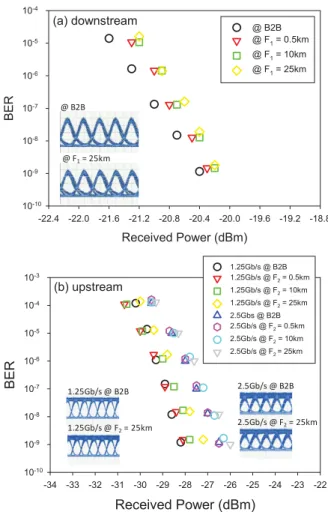
upstream traffic, the RSOA is injected by the residual power (90/%) of downstream signal and can be directly modulation at 1.25 and 2.5 Gb/s by NRZ PRBS format, for F2 fiber length of 0.5, 10 and 25 km. As a result, Fig. 4(a) and Fig. 4(b) show the measured BER performances for the downstream and upstream traffic under different fiber lengths link. Fig. 4(a) shows the 10 Gb/s downstream power penalty of ¡0.2 dB at a BER of 10-9 under different F1 lengths. Meanwhile the measured maximum power penalties at 1.25 Gb/s and 2.5 Gb/s are 1 dB and 0.8 dB respectively, as shown in Fig. 4(b). We believe the slight difference in power penalty may be due to experimental error. We can conclude that the power penalties at 1.25 Gb/s and 2.5 Gb/s are similar. Moreover, the inserts in Figs. 4(b) and 4(b) show the corresponding eye diagrams in DPSK and OOK formats. Overall, the measured eyes are clear and wide opening at back-to-back and 25 km transmission. Since the downstream DPSK signal and upstream OOK signals are traveling in two different fibers, the Rayleigh backscattering can be avoided. We can observe that the upstream signals are not affected by the RB noise since the proposed architecture allows the back-reflected RB noise and the upstream signal travel in opposite directions. Finally, we have taken into account the signal losses of optical fibers at 0.5 km, 10 km and 25 km in Figs. 4(a) and 4(b). These locations could represent the remote nodes (RNs) located at the near end and far end of the 25 km ring network. And we can achieve error-free transmission as shown in Figs. 4(a) and 4(b). Although we have just used one RN in the experiment (as illustrated in Fig. 2), by considering the insertion losses
1116 IEEE COMMUNICATIONS LETTERS, VOL. 15, NO. 10, OCTOBER 2011 (a) downstream Received Power (dBm) -22.4 -22.0 -21.6 -21.2 -20.8 -20.4 -20.0 -19.6 -19.2 -18.8 BER 10-10 10-9 10-8 10-7 10-6 10-5 10-4 @ B2B @ F1 = 0.5km @ F1 = 10km @ F1 = 25km @ B2B @ F1= 25km (b) upstream Received Power (dBm) -34 -33 -32 -31 -30 -29 -28 -27 -26 -25 -24 -23 -22 BER 10-10 10-9 10-8 10-7 10-6 10-5 10-4 10-3 1.25Gb/s @ B2B1.25Gb/s @ F 2 = 0.5km 1.25Gb/s @ F2 = 10km 1.25Gb/s @ F2 = 25km 2.5Gbs @ B2B 2.5Gb/s @ F2= 0.5km 2.5Gb/s @ F2 = 10km 2.5Gb/s @ F2= 25km 2.5Gb/s @ B2B 2.5Gb/s @ F2= 25km 1.25Gb/s @ B2B 1.25Gb/s @ F2= 25km
Fig. 4. Measured BER performances for the (a) downstream and (b)upstream traffic under different fiber lengths link. The inserts are corresponding eye diagrams.
for FBG pass-band and the two optical circulators in each RN are 0.1 dB and 1 dB respectively, we can calculate that each transmitted wavelength channel will experience an insertion loss of 1.1 dB at each RN. If the power budget for the whole network is much higher than the receiver sensitivities shown in Figs. 4(a) and 4(b), we believe that the insertion loss for the RN will not affect the signal performance. Here, we assume the optical power of the downstream signal and the receiver sensitivity (without using an optical pre-amplified receiver) are 7 dBm and 15 dBm respectively. And the insertion losses of each RN, 25 km SMF and the 1 2 optical coupler before
the RSOA are 1.1, 5 and 3 dB respectively, as illustrated in Fig. 1. Hence, eight RNs can be supported in the proposed access network when nearly 10 dBm optical injection power can be launched into the RSOA (error-free upstream signal generation as shown in Fig. 3) at eighth ONU.
III. CONCLUSIONS
We have proposed and experimentally investigated a ring-based signal remodulation WDM-PON system to mitigate RB beat noise. In this proposed network, a new ONU is designed to generate two propagating directions for downstream and upstream traffic. Hence, RB can be suppressed in the proposed system since the RB and the upstream channel are transmitting in opposite directions. Moreover, 10 Gb/s DPSK downstream traffic and 2.5 Gb/s OOK upstream remodulation can be achieved in the WDM access network.
REFERENCES
[1] H. Shinohara, “Overview of Japanese FTTH market and NTT’s strate-gies for entering full-scale FTTH era,” in APOC 2007, invited paper, paper FTTH2.1.
[2] “10Gb/s Ethernet Passive Optical Network,” IEEE 802.3av, Sep. 2009. [3] C. H. Yeh, C. W. Chow, and S. Chi, “Using 10 Gb/s remodulation DPSK signal for self-restored colorless WDM-PON system,” Opt. Fiber
Technol., vol. 15, pp. 274-278, 2009.
[4] C. H. Yeh, C. W. Chow, F. Y. Shih, C. H. Wang, Y. F. Wu, and S. Chi, “Wavelength tunable laser for signal remodulation in WDM access networks using DPSK downlink and OOK uplink,” IEEE Photon.
Technol. Lett., vol. 21, pp. 1710-1712, 2009.
[5] Z. Li, Y. Dong, Y. Wang, and C. Lu, “A novel PSK-Manchester modulation format in 10-Gb/s passive optical network system with high tolerance to beat interference noise,” IEEE Photon. Technol. Lett., vol. 17, pp. 1118-1120, 2005.
[6] P. J. Urban, A. M. J. Koonen, G. D. Khoe, and H. de Waardt, “Rayleigh backscattering-suppression in a WDM access network em-ploying a reflective semiconductor optical amplifier,” in Proc.
Sympo-sium IEEE/LEOS Benelux Chapter, pp. 147-150, 2007.
[7] C. W. Chow, G. Talli, and P. D. Townsend, “Rayleigh noise reduction in 10-Gb/s DWDM-PONs by wavelength detuning and phase-modulation-induced spectral broadening,” IEEE Photon. Technol. Lett., vol. 19, pp. 423-425, 2007.
[8] A. Chowdhury, H.-C. Chien, M.-F. Huang, J. Yu, and G.-K. Chang, “Rayleigh backscattering noise-eliminated 115-km long-reach bidirec-tional centralized WDM-PON with 10-Gb/s DPSK downstream and re-modulated 2.5-Gb/s OCS-SCM upstream signal,” IEEE Photon. Technol.
Lett., vol. 20, pp. 2081-2083, 2008.
[9] C. H. Wang, C. W. Chow, C. H. Yeh, C. L. Wu, S. Chi, and C. Lin, “Rayleigh noise mitigation using single sideband modulation generated by a dual-parallel MZM for carrier distributed PON,” IEEE Photon.