Novel Analytical Results on Performance of
Bit-Interleaved and Chip-Interleaved DS-CDMA
With Convolutional Coding
Yu-Nan Lin and David W. Lin, Senior Member, IEEE
Abstract—We present a unified performance analysis for the
conventional bit-interleaved direct-sequence (DS) code-division multiple access (BIDS-CDMA) and the more recently proposed chip-interleaved DS-CDMA (CIDS-CDMA), both with channel coding. Simple CIDS-CDMA treats a set of bits at a time and in-terleaves their chips together for transmission. But bit interleaving may also be used on top of chip interleaving (thus abbreviated BCIDS-CDMA) to enhance performance. For simplicity, we first tackle flat-faded synchronous transmission, in which we treat both the condition with perfect power control and that where the received signal is subject to Rayleigh fading. We then extend the analysis to asynchronous and multipath channels, with the latter treated only briefly. By approximating the correlation among the spreading codes (rather than the ensuing interfer-ence) as Gaussian, we obtain novel and relatively simple results for the various conditions above. In general, BCIDS-CDMA performs best, followed by simple CIDS-CDMA and then by BIDS-CDMA. Within simple CIDS-CDMA and BIDS-CDMA, long-code spreading performs better than short-code spreading. For BCIDS-CDMA with perfect interleaving that fully random-izes the fading coefficients, the performance is not affected by the spreading code period. The above ordering of performance follows the amount of diversity each scheme exploits, where the diversity may come from spectrum spreading, channel coding, and independence in fading of different paths. Simulation results agree well with the theoretical analysis.
Index Terms—Bit interleaving, chip interleaving, convolutional
codes, direct-sequence code-division multiple access (DS-CDMA), performance.
I. INTRODUCTION
E
ARLIER direct-sequence code-division multiple access (DS-CDMA) systems employ long codes to spread user signals. More recent systems also make use of short codes [1]. A short code has its code period equal to the spreading factor. On the other hand, a spreading code with (ideally) infinitely long period is termed a long code. The inevitable correlation among different users’ spreading codes leads to multiple-access interference (MAI) that limits the performance of a DS-CDMA system.Theoretical analyses of DS-CDMA system performance frequently assume use of random spreading codes. Besides the
Manuscript received April 15, 2004; revised November 11, 2004. This work was supported by the National Science Council of the Republic of China under Grant NSC 92-2219-E-009-018. The review of this paper was coordinated by Dr. Y.-P. E. Wang.
The authors are with the Department of Electronics Engineering and Center for Telecommunications Research, National Chiao Tung Univer-sity, Hsinchu, Taiwan 30010, R.O.C. (e-mail: [email protected]; [email protected]).
Digital Object Identifier 10.1109/TVT.2005.844654
well-known Gaussian approximation to MAI, more accurate ana-lytical characterizations of the performance of unchannel-coded conventional DS-CDMA under random-code spreading have been attempted. In [2], the density function of the MAI is studied extensively, from which arbitrarily tight upper and lower bounds on bit error rates (BERs) can be obtained. Based on [2], some have proposed simplified methods for performance calculation [3]–[6]. Comparatively, there are fewer publications devoted to the performance analysis of channel-coded DS-CDMA. For long-code systems, an approximate analysis is simpler than for short-code systems due to the random correlations among spreading codes. For short-code systems, the analysis is more difficult. In [7], the authors employ computer simulation to obtain the histogram of signal-to-interference ratios (SIRs). However, from thesimulation resultsitis somewhat difficult toderivesimple intuitive insights concerning the SIR distribution. Similarly in [8], simulation results are used to determine the probability density function (pdf) of SIRs numerically. In [9], many observations of the difference between short-code and long-code systems with and without channel coding are made. But the analysis is through Monte Carlo simulation where the BERs can only be calculated as the spreading sequences are known and the distribution of SIRs can only be known through extensive computation.
In this paper, we consider an analytical approach. By ap-proximating the correlation among the spreading codes (rather than the ensuing interference) as Gaussian, we obtain novel, simple results concerning the transmission performance under various conditions. Unlike the conventional Gaussian approx-imation, the results are quite accurate for short-code systems under channel coding.
Another motivation of this paper comes from the fol-lowing observation concerning the underlying mechanism that leads to the performance difference between long-code and short-code spreading in channel-coded DS-CDMA. With random spreading codes, the distribution of their correlations in a symbol interval is the same regardless of whether long-code or short-code spreading is used. In the absence of channel coding, this results in a similar average error performance for both kinds of spreading. In the presence of channel coding, however, we have a different picture. With long-code spreading, the correlations among different users’ spreading codes change from symbol to symbol. In maximum-likelihood decoding, it is the total MAI in the Viterbi decoding delay (or the total MAI in the span of a codeword in the case of block coding) that affects the error performance. Thus if the channel code’s minimum Hamming distance is large, then by the law of large
numbers, all users will be subject to a total MAI of substantially similar statistics and hence have similar error performance in equal noise. With short-code spreading, on the other hand, the correlations of the spreading codes remain the same over time. Hence the law of large numbers is not at work in the temporal direction as it is in a long-code system. Thus the MAI has a greater variance. Or, from another viewpoint, a proportion of the users will experience high MAI over an extended period of time. This results in poor decoding performance for these users as well as a poorer average error performance over all users when compared with a long-code system. Since this effect comes from the correlation among spreading codes, bit interleaving (the conventional way to deal with bursty errors) does not give a fully satisfactory solution.
Recently, some researchers have considered chip-interleaved DS-CDMA (CIDS-CDMA). Originally, CIDS-CDMA was pro-posed to combat bursty noise [10], [11]. By spreading out the chips of a modulated symbol in time, CIDS-CDMA can disperse the effect of bursty noise to many bits and thereby reduce the BER. Some aspects of CIDS-CDMA receiver design have been discussed in the literature [12], [13]. In multiple-access commu-nication, CIDS-CDMA has been demonstrated to promise supe-rior performance to conventional DS-CDMA [14]–[17]. How-ever, a rounded performance analysis for channel-coded CIDS-CDMA is still wanting. In this paper, we also present an analysis in this vein. As is for conventional DS-CDMA, both short-code and long-code spreading are considered.
Actually, there are two approaches to chip-interleaved trans-mission for multiuser communication. One considers chip interleaving as a means to mitigate MAI and intersymbol interference (ISI) effects [16], [17]. The other considers CIDS-CDMA as a way to increase diversity in fading channels. In the latter sense, [18] touches briefly on the performance of chip-interleaved systems with long-code spreading. However, the authors do not address some important structural details of CIDS-CDMA that bear consequence on complexity and performance. In contrast to their approach, we separate the interleaving function into the bit type and the chip type, and inspect the implications of each.
In summary, we present an analysis of the performance of conventional and chip-interleaved DS-CDMA systems with convolutional coding. Since, in transmission over fading chan-nels, a conventional channel-coded DS-CDMA system needs to interleave the coded bits to guard against the deleterious effect of fading on code performance, we shall refer to it as bit-interleaved DS-CDMA (BIDS-CDMA) for convenience. We consider both long-code and short-code spreading. For ease of explanation, we treat flat-faded synchronous transmission first, wherein we consider both the condition with perfect power control and that where the received signal is subject to Rayleigh fading. We then extend the results to asynchronous and multipath channels. To limit the paper length, the case of multipath channels is treated only briefly, leaving more rounded discussions to a future paper.
The remainder of this paper is organized as follows. Sec-tion II describes the signal models for BIDS-CDMA and CIDS-CDMA systems. Section III analyzes the performance of BIDS-CDMA systems while Section IV that of CIDS-BIDS-CDMA systems,
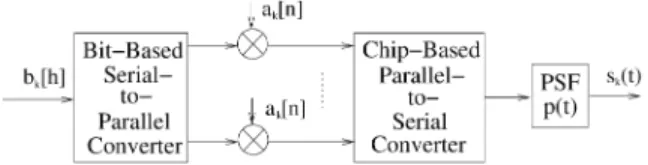
Fig. 1. Structure of CIDS-CDMA transmitter.
both under flat-faded synchronous transmission. Section V ex-tends the analysis to asynchronous and multipath channels. Sec-tion VI presents some simulaSec-tion results. They verify the accu-racy of the theoretical analysis. Finally, Section VII gives the conclusion.
II. SIGNALMODELS
Consider DS-CDMA employing binary phase-shift keying modulation. In conventional DS-CDMA, the baseband signal transmitted for the th user is given by
(1)
with
(2) where and are the bit and the chip periods, respectively, is the user datum, is the spreading wave-form of the th user during the th bit period,
is the corresponding spreading code, is the spreading factor, and is a square pulse of chip duration that is normalized so that . For short-code systems,
.
In CIDS-CDMA systems, bits are first spread as in conven-tional DS-CDMA and are then transmitted with interleaved chips. Fig. 1 shows the structure of a CIDS-CDMA transmitter. The low-pass-equivalent transmitted signal for the th user is given by
(3) where is the block length (in number of bits) for chip inter-leaving and is the block index. Since the interleaver groups together the first chip of a number of information bits and then the second chip, the third chip, and so on, it may look like that we have spread the spreading code with the information bits.
Random spreading codes are assumed throughout the anal-ysis, that is, is a binary random sequence taking values 1 and 1 with equal probability. Although in syn-chronous short-code systems, other kinds of spreading codes (such as the orthogonal codes) may yield lower interference, random codes have advantage in addressing the influence of asynchronism. Indeed, uplink transmission is usually asyn-chronous. Hence we assume random codes.
In synchronous CDMA, since all user signals are aligned, the received signal at the base station can be expressed as
(4)
where is the normalized signal amplitude, are the channel coefficients, and is white Gaussian noise with power spectral density equal to . Two kinds of channel are considered: perfectly power-controlled and Rayleigh fading. In the former case, we let (for all ) for convenience. In the latter case, are time-varying zero-mean complex-valued Gaussian random variables, and we let
for all . In both cases, the value or the expected value of the received signal power for each user is simply and no user is at a disadvantaged position. The signal-to-noise ratio (SNR) or average SNR is given by . The Rayleigh fading case may be viewed as a system with perfect long-term power control.
III. ANALYSIS OFSYNCHRONOUSBIT-INTERLEAVED
DS-CDMA
Assume that the receiver employs conventional matched fil-tering and despreading. Without loss of generality, take user 0 as the desired user. Assume perfect channel estimation. Then the despread signal for the th bit is given by
(5) We analyze the performance in the two channel conditions in two sections.
A. Perfectly Power-Controlled Channels
Consider first the case of perfectly power-controlled chan-nels, where the channel coefficients have a similar, constant amplitude but random phases. Without loss of generality, let
and for . Then the decision
signal for bit is given by
(6) where
(7) is the MAI, with being the correlation between
and defined as
(8) and being the value of (assumed constant during the bit period), and
(9)
is the noise in the despread signal. Since is white, we get .
1) Short-Code Spreading: With short-code spreading, becomes independent of . Hence we drop the time index . Conventional analysis takes , , and all as random variables and models as zero-mean Gaussian. Thus, with random spreading codes, the variance of is given by
(10) For analysis of average uncoded BER, this expression is appli-cable to both long- and short-code systems and leads to quite accurate results. For channel-coded systems, however, the de-coding requires observing the received signal over a time in-terval spanning multiple bit periods. The corresponding per-formance analysis thus needs the interference statistics (e.g., joint pdf) over such a multiple-bit period, but the above vari-ance only characterizes the interference statistics in individual bit periods. In a short-code system, suppose a user is assigned a spreading code that has high correlation values with other users’ spreading codes. Then this user’s signal will suffer from high interference. In a synchronous system, this condition will per-sist until the assigned spreading codes are changed. (In an asyn-chronous system, the condition may change when the relative delays among the users are changed.) Bit interleaving does not help in this situation. Therefore, the transmission performance is worse than that predicted using (10) with the usual assumption of independent interference in different bit periods. The mathe-matics below provides more insights.
While our discussion concentrates on convolutional coding with soft-decision Viterbi decoding, the situation with block coding can be addressed in a related fashion. Assume the mod-ulator maps channel coder output values 0 and 1 to 1 and 1, respectively. Consider the all-zero code sequence. The proba-bility of erroneously decoding it to a trellis path that remerges with the all-zero path and differs from it in code bits can be expressed as
Prob (11)
where the index runs over the set of bits in which the two paths differ. The superscript “ ” has been used to simplify the notation because these bits may not be consecutive in time. Term a pairwise error probability for convenience. By (6)
Conditioned on a set of , the quantity can be modeled as a Gaussian random variable if is large. The conditional variance of can be computed as
(13) Therefore, the resultant signal-to-(interference-plus-noise) ratio (SINR) conditioned on can be expressed as
(14) and the conditional pairwise error probability given by
(15) where is the Gaussian function. The main difference in (13) from (10) is that no expectation over is taken and hence the impact of constant correlations among the spreading codes over the remerging distance is not overlooked.
To find the unconditional error probability, we need the pdf of . With random spreading codes, the code correlations
observe the binomial distribution given by
(16) By the central limit theorem, is approximately Gaussian when is large. Then is the sum-square value of 1 Gaussian random variables of zero mean and unit variance. Thus is a standard central random variable with 1 degrees of freedom, where the pdf of a standard central random variable with degrees of freedom is
(17) with being the gamma function defined as
(18) Though Gaussian approximation of is not exact in the tail part of the pdf, it does not have a major effect on the accuracy of the analysis, as later numerical results will demonstrate. Thus, the unconditional pairwise error probability can be obtained as
(19) Often, BER is more useful than the pairwise error probability, but is less easy to obtain. Conditioned on , an upper bound on the BER is given by
(20)
TABLE I
MAXIMUMPATHDISTANCE INBER ESTIMATION FOR THEEXAMPLECODE
where is the weight spectrum and is the minimum free distance. Exact weight spectra of some low-rate convolutional codes can be found in [20]. Since (20) is a union bound, it seri-ously overestimates the corresponding BER when the pairwise error probability is high. As a result, its average, i.e.,
(21) merely gives a very loose bound on the average BER. Burr [21] presents approximate weight distributions of convolutional codes that are useful for BER below 10 . Since the pairwise error probabilities in our problem may spread over a greater range, the approximations in [21] are not tight enough. To get a tighter bound, we simulate transmission over additive white Gaussian noise channels under different SNRs and find the least number of weight spectrum terms required to bound the simu-lated BER. Let be the resulting maximum path distance that need be considered to bound the decoded BER at SNR at decoder input. Then the tighter bound on average BER can be evaluated as
(22) where is as given in (14). Further, we find that, when the summation in (22) contains more than one term, a better approx-imation to the BER can be obtained if we replace by 2 for the maximum-distance term. This is used in our numerical results presented later.
Table I lists for the rate-1/2, constraint length-7 convo-lutional code with generator vectors and . It has . Since numerical results show that the influ-ence of is hardly significant, we simply neglect them.
The techniques to obtain the unconditional pairwise error probability and the BER bound from the conditional pairwise error probability are mostly similar in all the other conditions discussed in subsequent sections. Hence we shall omit their discussion unless the difference warrants it.
2) Long-Code Spreading: For long-code spreading, consider first a system where the period of spreading codes is an integer times the spreading factor. Thus where “%” denotes the modulo operation. There are a total of 1 different correlation values between any user’s spreading code and the other (interfering) users’ spreading codes. If these values occur the same number of times within the remerging distance of the channel code’s trellis, the conditional variance of the interference in (12) is changed to
The case where the correlation values do not repeat an equal number of times within the remerging distance of the channel code’s trellis requires tedious mathematics to charac-terize precisely. Later simulation results will show that the per-formance is only slightly different from that calculated using the last equation.
Like , the quantity 1 is a random variable, but with 1 degrees of freedom. Hence the conditional SINR is given by
(24)
From this the corresponding pairwise error probabilities (con-ditional and uncon(con-ditional) and BER can be obtained in a way similar to that for short-code spreading.
We note parenthetically that the unconditional pairwise error probability is given by
(25) For large (ideal long-code spreading has ), 1 has very concentrated pdf (result of the law of large numbers) that decays faster than the Gaussian function for
values of away from . In this case
(26) Thus, in the limit, we obtain the same result as that obtained under conventional Gaussian approximation.
B. Rayleigh Fading Channels
Now consider Rayleigh fading channels. We assume a fully bit-interleaved, quasi-static condition where the fading coeffi-cients for different users at different bit times are uncorrelated and stay unchanged during a bit period. Consequently, the max-imal-ratio combined signal in the convolutional decoder can be expressed as
(27)
where
(28)
is the MAI and
(29)
is the additive noise. Since
(30) the variance of can be computed as
(31) The variance of , however, depends on which type of spreading code is used.
1) Short-Code Spreading: Under short-code spreading, we have (32) Rewrite (33) Then (34) Since is uniformly distributed in [0,2 ) under the Rayleigh fading assumption and with equal probability, is Gaussian. Given and , is the combination of Gaussian random variables and is hence also Gaussian. Taking expectation over the “relative fading coefficients” , we get
(35) where we have used the fact that due to the earlier assumption that . Consequently, we can express the SINR as
(36) Note that the numerator of is a (normalized) random variable of degree 2 and the denominator is a (normalized) random variable of degree 1 plus a constant. In Appendix I,
are independent random variables of degrees and , respectively, with being an even number, and is a constant, the pdf of is given by
(37) When , reduces to the well-known distribution with degrees of freedom [19, p. 946]. We thus term the dis-tribution of the distribution for convenience. In this term, observes the 1,2 distribution, which reduces to the distribution with (2 1) degrees of freedom in interference-limited operation where the effect of noise can be neglected.
2) Long-Code Spreading: Under long-code spreading, the cross-correlation between spreading codes change with bits. Thus we have
(38) where the last approximation comes from that for long-code spreading, approaches its mean due to the law of large numbers, as in perfectly power-controlled channels. The SINR can be expressed as
(39)
where has the 2 -degree distribution.
IV. ANALYSIS OFSYNCHRONOUSCHIP-INTERLEAVED
DS-CDMA
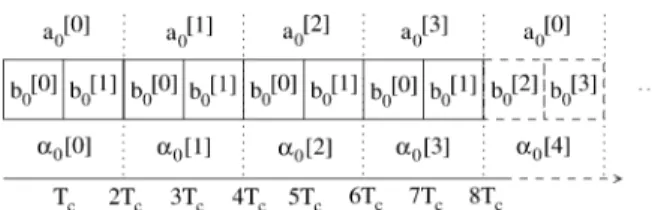
We concentrate on Rayleigh fading channels in this section, for the performance of CIDS-CDMA in perfectly power-con-trolled channels is similar to that of conventional BIDS-CDMA. Note first that, in despreading of each bit, the component chips are aggregated. To get the maximal diversity gain in fading channel transmission, these chips should be subject to in-dependent fading. Thus the chip-interleaving depth should be set to about the length of the channel’s coherence time, so that within a section of interleaved chips the channel can be considered unchanged, but between sections the channel coef-ficients are uncorrelated and observe Rayleigh fading statistics. Below we analyze the performance of CIDS-CDMA under this ideal condition. Fig. 2 illustrates the temporal relations among
Fig. 2. A CIDS-CDMA signal example, and its temporal relation with the channel coefficients in perfect chip interleaving.
various variables in CIDS-CDMA for the case where
and .
A. Simple CIDS-CDMA
1) Short-Code Spreading: Consider short-code spreading first. The despread signal for bit of user 0 is given by
(40)
For convenience we let be the time index
of the th chip of , which is the th bit in the ( 1)th data block; that is, . The noise term is given by
(41)
Besides, we have defined
(42)
and
(43)
Similar to BIDS-CDMA, we can show that is Gaussian distributed because is Rayleigh and is uniform. Therefore, given the set , is also a Gaussian random variable. With optimal chip interleaving, both and are composed of uncorrelated fading coefficients and, therefore, there is an th-order diversity for each bit.
With the despread signal given by (40), it remains to ana-lyze the channel decoding results. Under convolutional coding, the path metric corresponding to a remerging path distance is given by
(44)
Assume that the bits are contained in one chip-interleaving block. This will be the case most of the time when the chip-in-terleaving depth is much larger than the time period spanned by the bits. Then similarly indexed chips in these bits will experience similar fading because they are grouped together
after chip interleaving. Let
de-note the fading coefficients for user associated, one each, with the groups of interleaved chips of these bits.
Then we can rewrite and
, which are independent of . Thus
(45)
Given and , by conditional Gaussianness of , is a combination of Gaussian random variables and hence is also Gaussian distributed. Accordingly, the pairwise error probability for the remerging path at distance is given exactly by
.
The variance of the additive noise can be found to be (46)
Conditioned on a set of and , the variance of can be computed as
(47)
where and the second equality
holds since by the assumption that
. Consequently, the conditional SINR is given by
(48)
Since depends on and , is a
condi-tional error probability. To get the uncondicondi-tional pairwise error probability, we need the distribution of . When is large,
can be approximated as Gaussian. Then is 2 1 2 distributed.
2) Long-Code Spreading: Now consider long-code spreading. Under it
(49)
Unlike short-code systems, even though the fading coefficients associated with each bit in the remerging path are the same, the corresponding is still a function of because the spreading codes for different bits are different. The MAI is then given by
(50)
By the assumed independence among for different and , its conditional variance is
(51)
The conditional SINR is thus
(52)
where is the sum-square value of 2 independent Gaussian random variables and therefore follows distribution of degree 2 . So the use of long code breaks the dependence of SINR on
In this case, we can obtain a closed-form expression for the unconditional pairwise error probability as [22, p. 781]
(53) Moreover, when is large, the pdf of becomes concen-trated about its mean. In this condition,
will be an accurate expression for the BER [see discussion about (21)].
B. Joined Bit- and Chip-Interleaved DS-CDMA
In simple CIDS-CDMA, since the fading coefficients remain unchanged within a section of interleaved chips, the signal strength is the same for all the bits in one interleaved block. Hence these bits fade together, albeit to a smaller extent thanks to the diversity gain from chip interleaving. For a coded system, this is undesirable because the bits are degraded in bursts to the detriment of the system’s error-correcting capability. Con-sequently, bit interleaving is also beneficial in coded CIDS-CDMA systems for diversity over the bits in a decoding delay under convolutional coding (or over the bits in a codeword under block coding). We use the shorthand BCIDS-CDMA to denote a system with both bit and chip interleaving, keeping CIDS-CDMA for a system without bit interleaving.
Again, we first examine the case of short-code spreading. With perfect bit interleaving, the sets of fading coefficients associated with successive coded bits are different. Under convolutional coding, therefore, there are uncorrelated fading coefficients in the path metrics for each user. Redefine as these fading coefficients for user ’s signal and rewrite
and . Given
and , is Gaussian distributed and its conditional variance is
(54) The difference between (54) and (51) consists in the differ-ence in number of uncorrelated fading coefficients. Similarly, the noise variance is obtained as
(55)
Therefore, the conditional pairwise sequence error probability is determined by the SINR
(56) where is -distributed with 2 degrees. In summary, the joint bit-and-chip interleaving effects a diversity order equal to the product of the spreading factor and the free distance of the convolutional code.
Usually, we expect , which may cause some compu-tational difficulty if we evaluate the unconditional pairwise error probability by a way similar to (53). An alternative is given by [23, App. 7.1]
(57)
Note that our chip-interleaving scheme in Fig. 2 can be viewed as a row-input column-output block interleaver of size . In [18], a single interleaver following the spreading function is used to interleave the output chips. For convenience, call it direct CIDS-CDMA. Let be the coherence time, in number of chips, of the fading channel. From earlier discussion, a good interleaver size to obtain sufficient intrabit diversity in CIDS-CDMA is . To fully exploit the interbit diversity under convolutional coding, the block size of the bit interleaver in BCIDS-CDMA should be about , where is the Viterbi decoding delay. A typical choice of is 5 , where is the constraint length of the code. With BCIDS-CDMA, therefore, the combined interleaver size is 5 . In contrast, direct CIDS-CDMA needs an interleaver of size 5 to attain the same performance. BCIDS-CDMA is thus more efficient in terms of implementation.
Moreover, in [18], long codes are used. However, from the above analysis, we can see that long-code spreading has no advantage in perfectly interleaved BCIDS-CDMA. In conven-tional BIDS-CDMA, the role of long-code spreading is to vary the correlation among different users’ bits over the convolu-tional decoding delay (or, in block coding, over the length of a codeword). In perfectly interleaved BCIDS-CDMA, an equiv-alent effect is achieved by causing the interfering bits from dif-ferent users to be associated with independent fading coeffi-cients via bit interleaving.
C. Summary
Table II summarizes the conditional SINRs that govern the pairwise sequence error probabilities in Rayleigh fading channels for different systems in the interference-limited
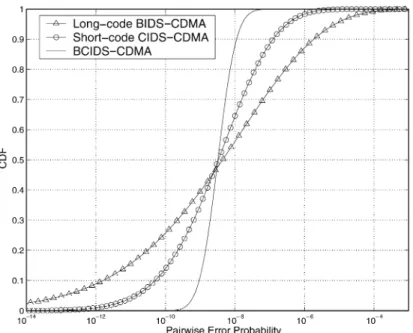
Fig. 3. CDFs of pairwise error probability of different DS-CDMA schemes in Rayleigh fading atN = 32, d = 10, and K = 20, under interference-limited operation.
TABLE II
SINRSTHATGOVERNPAIRWISESEQUENCEERRORPROBABILITIES INRAYLEIGHFADINGCHANNELS FORDIFFERENTSYSTEMSUNDER
INTERFERENCE-LIMITEDOPERATION
situation, where denotes a random variable that ob-serves the -degree distribution. In this situation, the corresponding average SINRs (or SIRs to be more exact) have simple mathematical expressions, which are also given in the table. Note that, when is large (i.e., when the users are many), the average SIRs are nearly the same and are exactly or approximately equal to (2 1), which is the SIR of long-code BIDS-CDMA in perfectly power-controlled channels. The difference among the systems consists in the difference in distribution of the conditional SIRs, which reflects the difference in the diversity orders that they exploit.
The above difference can be further appreciated by exam-ining the outage probability in each case, which is the proba-bility that the desired user cannot attain the target performance. Fig. 3 shows the theoretical cumulative distribution functions (cdfs) of the pairwise error probabilities of different systems in
Rayleigh fading at , , and , in
inter-ference-limited operation. The BCIDS-CDMA has very sharp slopes along its cdf curve, which means that it behaves much like transmission over an unfaded channel although the channel is actually subject to fading. Take 10 as the target pairwise error probability, for example. The outage probability is 0.12 for BCIDS-CDMA, whereas it is 0.36 for short-code CIDS-CDMA and 0.44 for long-code BIDS-CDMA. This further demonstrates that BCIDS-CDMA has the best performance.
V. PERFORMANCE INASYNCHRONOUS ANDMULTIPATH
CHANNELS
In previous sections, we analyzed the performance of syn-chronous CDMA in flat fading. However, in practical wide-band systems, the user signals are often subject to interference from asynchronous transmission or multipath propagation. We briefly consider their influence on performance in this section.
Let the received signal be given by
(58)
where is user ’s asynchronous delay, is the maximum number of multipaths for each user, and is the th path coefficient of user . Without loss of generality, let , so that gives the relative delay of user ’s signal with respect to user 0’s signal in number of chips. And let , , be integers that are independent and uniformly distributed over [0, 1] for conventional BIDS-CDMA and over [0, 1] for CIDS-CDMA. To limit the paper length, for multipath channels we make the simplifying assumption that is normalized so
that . A more complete treatment of
multipath channels is left to a future paper. Further, we assume use of a rake receiver with fingers.
A. BIDS-CDMA Systems
In flat-faded synchronous transmission, the interference is determined solely by “full-bit” correlations of the spreading codes as given in (8). For a flat-faded asynchronous system with nonzero , each interfered bit of user 0 may be partially over-lapping in time with two successive interfering bits of user . The amount of interference thus depends on whether the in-terfering bits have equal or unequal signs [24]. In this condi-tion, most sets of codes, including the Gold, the Kasami, and
the m-sequences, have performance close to that of random se-quences [25]. In fact, this is also one reason why random codes are considered in our work, aside for simplicity in analysis.
The above dependence of interference on bit patterns adds one degree of freedom per bit per interfering propagation path (in multipath channels) per interfering user signal. In multipath propagation, the output of each rake finger for user 0’s signal contains interference from all paths of each interfering user signal. It also contains the interpath interference (IPI) from the 1 other paths of its own signal. The number of interference terms in the rake combiner output is therefore
2 1 2 1 , where gives the
spreading code period in number of chips. (Thus cor-responds to short-code spreading whereas long-code spreading.) However, some of the terms correspond to the same relative path delays and hence are not independent. In total, for each interfering user, there are only 2 1 distinct relative de-lays; and for IPI, there are only 2 2 distinct relative delays. Hence the total degrees of freedom in interference are reduced
to .
Accordingly, we can obtain an approximate SINR expression for BIDS-CDMA under perfect power-control as
(59)
where 2 1 1 is a variable of degree
2 2 1 1 . Appendix II-A gives some further details of the derivation of (59).
In fading channels, the presence of multipaths not only in-creases the degree of randomness in interference but also adds to the path diversity. Appendix II-B shows that, for a short-code system, the SINR can be approximated as
(60)
where follows the 2 2 2 1 1 4 2
1 distribution and, for a long-code system with infinite code period
(61)
where obeys the 2 -degree distribution. B. CIDS-CDMA Systems
We consider only Rayleigh fading channels in this section, for the performance of CIDS-CDMA in perfectly power-controlled channels is similar to BIDS-CDMA.
As revealed by (45), the performance of short-code CIDS-CDMA has to do with the combination of the interfering bits within the remerging distance. Consequently, for asynchronous transmission over multipath channels, the degree of freedom in bit combinations is increased by 2(2 1) times as discussed previously. Via a similar derivation as that for short-code
BIDS-CDMA in multipath Rayleigh fading, we obtain the SINR for short-code CIDS-CDMA in multipath Rayleigh fading as
(62)
where is 2 2 2 1 1 4 2 1
distributed.
For long-code CIDS-CDMA and BCIDS-CDMA, neither the spreading code correlations nor the data combinations affect the performance. As shown in Appendix III, the SINR for long-code CIDS-CDMA is changed to
(63) A similar derivation yields
(64) as the SINR for BCIDS-CDMA.
VI. SIMULATIONRESULTS ANDDISCUSSION
In this section, we compare the performance of different inter-leaving schemes by way of computer simulation. We also com-pare the simulation results with analysis. The rate-1/2 convolu-tional code of constraint length seven with generators
and is used in all simulations. We employ soft-de-cision Viterbi decoding with traceback length . The simulation results are obtained through 10 simulation runs, where in each run the spreading codes of the users are generated randomly. Perfect channel estimation is assumed.
We first consider the ideal condition where there is perfect interleaving. Then we consider the more realistic condition of correlated Rayleigh fading.
A. Perfectly Interleaved Transmission
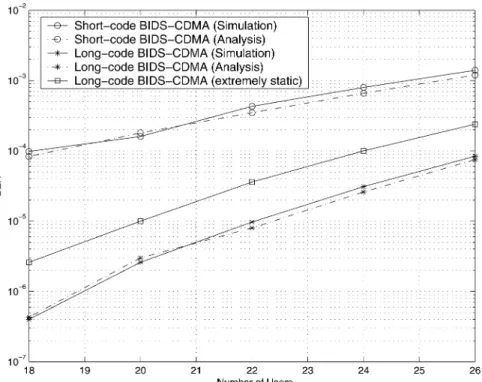
1) Synchronous Transmission: To start, consider con-ventional BIDS-CDMA under perfectly power-controlled synchronous transmission. Fig. 4 shows the BER performance versus number of users at spreading factor and SNR dB. Clearly, long-code spreading has a much superior performance to short-code spreading and the difference in BER can exceed two orders of magnitude toward the lower end in number of users. The figure also shows that our analysis matches well with the simulation results. For comparison, we further simulate long-code BIDS-CDMA in random static channels, where not only the amplitudes but also the phases of the channel coefficients remain unchanged over all time. The corresponding curve (marked “extremely static”) in Fig. 4 shows that the performance is worse than in channels with time-varying phases. The reason is that the “channel coefficient correlations” , , in (12) are now constant over time and thus some large values in the set will result in permanently high interference. The underlying mechanism is closely parallel to what has made the difference between short-and long-code systems. Therefore, for BIDS-CDMA systems, phase variations are beneficial to system performance, provided that the receiver can track them.
Fig. 4. Average BER of synchronous BIDS-CDMA under perfect power control as function of user number, whereN = 32, = 13 dB, and long-code spreading employs an infinite code period.
Fig. 5. Average BER of synchronous BIDS-CDMA under perfect power control as function of the spreading code periodN in number of bits, where N = 16, = 13 dB, and K = 10.
To see how the long-code period (in number of bits) affects the performance of synchronous BIDS-CDMA, Fig. 5 shows the results for user number , , and dB. As pre-dicted, BER decreases monotonically with . The performance nearly flattens beyond . This is reasonable because 32 is already close to the rule-of-thumb decoding delay 35.
Next, consider BIDS-CDMA in Rayleigh fading, for which
some results at and dB are presented in
Fig. 6. Again, long-code spreading outperforms short-code.
In-terestingly, the performance difference is much smaller than in perfectly power-controlled channels. While this can be appre-ciated from the analytical results, it can also be understood in-tuitively by noting that, due to fading, the correlation among received user signals is not solely determined by the spreading codes but also by the fading coefficients. The independent vari-ation of fading coefficients due to perfect bit interleaving yields an averaging effect that improves the performance of short-code spreading relative to long-code.
Fig. 6. Average BER of synchronous BIDS-CDMA in Rayleigh fading as function of user number, whereN = 32, = 13 dB, and long-code spreading employs an infinite code period.
Fig. 7. Average BER of different types of synchronous chip-interleaved DS-CDMA in Rayleigh fading, whereN = 16 and = 16 dB.
Now we turn to CIDS-CDMA. Fig. 7 compares the perfor-mance of different interleaving schemes in Rayleigh fading, at and dB. Clearly, BCIDS-CDMA is by far the best. Long-code CIDS-CDMA is better than short-code. The theoretical analysis again agrees well with the simulation results.
2) Asynchronous and Multipath Channels: Now we turn to the asynchronous, multipath channel condition and present some results for illustration purpose.
Fig. 8 compares the results for several long-code systems
Fig. 8. Average BER of different asynchronous DS-CDMA systems in multipath Rayleigh fading atN = 32, L = 3, and = 16 dB.
Fig. 9. Average BER of asynchronous short-code systems as function of multipath number, whereN = 32, K = 20, and = 16 dB. PC = perfect power control; RF= Rayleigh fading.
BCIDS-CDMA obviously outperforms both BIDS-CDMA and simple CIDS-CDMA. Among the latter two, CIDS-CDMA has better performance. That CIDS-CDMA performs better than BIDS-CDMA is because the diversity in long-code BIDS-CDMA comes from bit interleaving and its order is equal to the free distance of the channel code. On the other hand, the diversity of long-code CIDS-CDMA comes from chip interleaving and its order is equal to the spreading factor. Since our spreading factor is larger than the free distance of the convolutional code, the long-code CIDS-CDMA has a higher
diversity gain. The results also demonstrate that even with path diversity for all systems, BCIDS-CDMA still has evident advantage.
Fig. 9 shows the BER performance, as a function of path number, of several short-code systems with 20 users. Again, the analysis agrees with the simulation data. Not surprisingly, BCIDS-CDMA again tops in performance, followed by per-fectly power-controlled transmission (for which BIDS-CDMA and CIDS-CDMA have the same performance). As the path number increases, the performance of BCIDS-CDMA degrades
Fig. 10. Average BER in interference-limited situation with different interleaver sizes in Rayleigh fading, whereN = 16.
very slightly, while that of the others improves, with dimin-ishing marginal gains. The disparity in performance among the systems narrows with increase in path number. Nevertheless, compared to BIDS-CDMA, CIDS-CDMA has much less per-formance loss when the channel is subject to fading.
B. Correlated Rayleigh Fading Channels
Now we consider a more realistic channel condition. We gen-erate correlated Rayleigh fading channels using the baseband Doppler filtering method [26]. Let the Doppler spread be
Hz (corresponding to, e.g., a 2-GHz carrier and a 120-kmph moving speed). Let . Then the coherent
time is chips [26, p. 166]. Fig. 10
shows the results in interference-limited situation under dif-ferent interleaver sizes, where the block sizes given for BCIDS-CDMA are the sum of that of the bit and the chip interleavers. It is clear that, with proper design of the interleaver, the per-formance under perfect interleaving can be approached. An in-terleaving depth close to the coherence time does yield good performance as previously discussed. Also as discussed, at sim-ilar BER, BCIDS-CDMA needs a smaller interleaver size than direct CIDS-CDMA. Thought not shown here, similar observa-tions can also be made when asynchronous multipath channels are considered.
VII. CONCLUSION
We presented a novel performance analysis for conventional channel-coded, bit-interleaved DS-CDMA (BIDS-CDMA) under short- and long-code spreading in perfectly power-con-trolled and Rayleigh fading channels. The theoretical results have relatively simple mathematical expressions. It was shown that long-code spreading had much superior performance to
short-code, because the latter suffered from some persistent high interference induced by some highly correlated spreading codes whereas the former was able to average down such interference. The difference between short- and long-code systems became smaller in Rayleigh fading because the different fading processes experienced by different users randomized the correlation among the received user signals. A good choice of the spreading code period is the Viterbi decoding delay for convolutional coding (or the channel codeword length for block coding). Note that we may view independent fading of different user signals as providing another “dimension” of diversity that can be exploited to the benefit of transmission performance.
We also addressed the performance of the more recently proposed chip-interleaved DS-CDMA (CIDS-CDMA) with channel coding. Chip interleaving yields intrabit diversity whereas bit interleaving yields interbit diversity. Theoret-ical expressions for the performance under both short- and long-code spreading were derived and verified by simulation. It was shown that simple CIDS-CDMA could yield better perfor-mance than BIDS-CDMA, and joint bit-and-chip-interleaved DS-CDMA (BCIDS-CDMA) performed better than both. In addition, while the performance of BIDS-CDMA and simple CIDS-CDMA depended on the length of the spreading code period, that of BCIDS-CDMA did not. Combined bit-and-chip interleaving yielded a diversity order equal to the product of the spreading factor and the free distance of the convolutional code. This large diversity gain can turn a fading channel into a nearly static one and thus accurate fast power control becomes less important.
To limit the paper length, we have only briefly addressed the situation of multipath fading channels, leaving a more rounded discussion to a future paper.
APPENDIX I
THE DISTRIBUTION
Let and be two independent random variables with degrees and , respectively, where is an even number. We derive the pdf of the random variable
(65) To start, note that the joint pdf of and can be written as
(66) Let . Then the joint pdf of and and that of and
are related by
(67) where is the Jacobian of the transformation given by
(68) Thus, the pdf of can be found to be
(69) where
(70)
Letting , we can manipulate the last
integration into
(71) where the last equality is by definition of the gamma function. Therefore, the pdf of is given by
(72)
APPENDIX II
SINROFBIDS-CDMAINASYNCHRONOUSMULTIPATH
CHANNELS A. Perfectly Power-Controlled Channels
With rake receiving, the despread signal for the th bit of user 0 is given by
(73) where
(74) is the interference from user and
(75) is the IPI, with being the correlation between user ’s th path and user 0’s th path. Due to the independence among , the conditional variance of (which is the interference in the channel decoder output) is given by
(76) As analyzed above (59), there are totally 2 2 1 dif-ferent for each interfering user . Although the dif-ferent do not occur the same number of times in the above sum, we find that a simple and reasonable approximation can be obtained by assuming that they occur an equal number of times. In this regard, let the different be denoted
. Then
(77) Also as analyzed above (59), for IPI there are 2 2 different relative path delays and they result in 2 2 2 distinct cor-relations . Employing a similar notational designation as above, we get
Thus
(79) and (59) can be obtained accordingly.
B. Rayleigh Fading Channels In fading channels
(80)
where is
Gaussian distributed and independent of both and . There-fore, for a short-code system
(81)
The variance of IPI can be found in a same way and hence the SINR can be computed as
(82) We thus arrive at (60).
When infinitely long spreading codes are used, due to the law of large numbers, approaches its mean given
by . Thus, the SINR for a long-code
system is distributed and has the expression (61). APPENDIX III
SINROFLONG-CODECIDS-CDMAINASYNCHRONOUS
MULTIPATHCHANNELS
For long-code CIDS-CDMA, the interference from user can be expressed as
(83)
where
(84) with and denoting the bit and the chip indexes of the inter-fering signal at bit and chip of the interfered signal. The form of is quite similar to (49) except that here we have kept the interfering bits inside the summation rather than having them outside as in (50). This is because in asynchronous or multipath channels, we may have two bits interfering with two different sections of the desired bit. Given ,
are Gaussian variables which are independent of and . Without bit interleaving, we have, thanks to the use of long codes
(85)
where , , denote the fading
co-efficients associated with the th user’s th path within the re-merging distance.
Employing similar arguments, we can derive the conditional variance of IPI as
The SINR is thus obtained as
(87)
ACKNOWLEDGMENT
The authors would like to thank the anonymous reviewers for their constructive comments that led to significant enhancement of this paper.
REFERENCES
[1] Technical Specification Group Radio Access Network 3GPP, “Spreading and modulation (FDD),” Doc. 3G TS 25.213 ver. 4.1.0, 2001. [2] J. S. Lehnert and M. B. Pursley, “Error probabilities for binary
direct-sequence spread-spectrum communications with random signature se-quence,” IEEE Trans. Commun., vol. COM-35, pp. 87–98, Jan. 1987. [3] R. K. Morrow, “Accurate CDMA BER calculations with low
computa-tional complexity,” IEEE Trans. Commun., vol. 46, pp. 1413–1417, Nov. 1998.
[4] J. M. Holtzman, “A simple accurate method to calculate spread-spec-trum multiple-access error probabilities,” IEEE Trans. Commun., vol. 40, pp. 461–464, Mar. 1992.
[5] R. K. Morrow, “Bit-to-bit error dependence in slotted DS/CDMA packet systems with random signature sequences,” IEEE Trans. Commun., vol. 37, pp. 1052–1061, Oct. 1989.
[6] J. Cheng and N. C. Beaulieu, “Accurate DS-CDMA bit-error probability calculation in Rayleigh Fading,” IEEE Trans. Wireless Commun., vol. 1, pp. 3–15, Jan. 2002.
[7] S. Vembu and A. J. Viterbi, “Two different philosophies in CDMA—A comparison,” in IEEE 46th Veh. Technol. Conf., Apr. 1996, pp. 869–873. [8] B. Ünal and Y. Tanik, “Code-hopping as a new strategy to improve per-formance of S-CDMA cellular systems,” in Conf. Rec. IEEE Global
Telecommun. Conf., Nov. 1996, pp. 1316–1319.
[9] S. Parkvall, “Variability of user performance in cellular DS-CDMA-long versus short spreading sequences,” IEEE Trans. Commun., vol. 48, pp. 1178–1187, Jul. 2000.
[10] X. Gui and T. S. Ng, “A novel chip-interleaving DS SS system,” IEEE
Trans. Veh. Technol., vol. 49, pp. 21–27, Jan. 2000.
[11] S. Unawong, S. Miyamoto, and N. Morinaga, “A novel receiver de-sign for DS-CDMA systems under impulsive radio noise environments,”
IEICE Trans. Commun., vol. E82-B, no. 6, pp. 936–943, Jun. 1999.
[12] X. Gui, E. Gunawan, and V. K. Dubey, “Noncoherent delay-lock tracking loop for chip-interleaving DS SS system,” Electron. Lett., vol. 35, no. 25, pp. 2179–2181, Dec. 1999.
[13] H. A. Cirpan and M. K. Tsatsanis, “Chip interleaving in direct CDMA systems,” in Proc. IEEE Int. Conf. Acoustics Speech Signal Processing, vol. 5, Apr. 1997, pp. 3877–3880.
[14] Y.-N. Lin and D. W. Lin, “Multiple access over fading multipath chan-nels employing chip-interleaving code-division direct-sequence spread spectrum,” IEICE Trans. Commun., vol. E86-B, no. 1, pp. 114–121, Jan. 2003.
[15] , “Chip-interleaving for performance improvement of coded DS-CDMA systems in Rayleigh fading channels,” in IEEE 58th Veh.
Technol. Conf., Oct. 2003, pp. 1323–1327.
[16] S. Zhou, G. B. Giannakis, and C. L. Martret, “Chip-interleaved block-spread code division multiple access,” IEEE Trans. Commun., vol. 50, pp. 235–248, Feb. 2002.
[17] R. H. Mahadevappa and J. G. Proakis, “Mitigating multiple access interference and intersymbol interference in uncoded CDMA systems with chip-level interleaving,” IEEE Trans. Wireless Commun., vol. 1, pp. 781–792, Oct. 2002.
[18] P. Frenger, P. Orten, and T. Ottosson, “Coded-spread CDMA using maximum free distance low-rate convolutional codes,” IEEE Trans.
Commun., vol. 48, pp. 135–144, Jan. 2000.
[19] H. Abramowitz and I. A. Stegun, Handbook of Mathematical
Func-tions. New York: Dover, 1964.
[20] J. Conan, “The weight spectra of some short low-rate convolutional codes,” IEEE Trans. Commun., vol. 32, pp. 1050–1053, Sep. 1984. [21] A. G. Burr, “Bounds and approximations for the bit error probability of
conventional codes,” Electron. Lett., vol. 29, no. 14, pp. 1287–1288, Jul. 1993.
[22] J. G. Proakis, Digital Communications, 3rd ed. New York: McGraw-Hill, 1995.
[23] Y. Akaiwa, Introduction to Digital Mobile Communication. New York: Wiley, 1997.
[24] M. B. Pursley, “Performance evaluation for phase-coded spread-spec-trum multiple-access communication—Part I: System analysis,” IEEE
Trans. Commun., vol. COM-25, pp. 795–799, Aug. 1977.
[25] K. H. A. Karkainen and P. A. Leppanen, “Comparison of the per-formance of some linear spreading code families for asynchronous DS/SSMA systems,” in Conf. Rec. IEEE Military Commun. Conf., Nov. 1991, pp. 784–790.
[26] T. S. Rappaport, Wireless Communications Principles and
Prac-tice. Upper Saddle River, NJ: Prentice-Hall, 1996.
Yu-Nan Lin was born in Taichung, Taiwan, R.O.C.,
in 1975. He received the B.S. degree in electronics engineering from National Chiao Tung University, Hsinchu, Taiwan, in 1998, where he was accepted into the M.S. degree program and transferred to the Ph.D. degree program in 2000. He is expecting to receive the Ph.D. degree in June, 2005.
His current research interests include CDMA sys-tems, multiuser detection and channel estimation.
David W. Lin (S’79–M’81–SM’88) received the
B.S. degree from National Chiao Tung University, Hsinchu, Taiwan, R.O.C., in 1975 and the M.S. and Ph.D. degrees from the University of Southern Cali-fornia, Los Angeles, in 1979 and 1981, respectively, all in electrical engineering.
He was with Bell Laboratories during 1981–1983 and with Bellcore during 1984–1990 and 1993–1994. Since 1990, he has been a Professor in the Depart-ment of Electronics Engineering and the Center for Telecommunications Research, National Chiao Tung University, except for the leave in 1993–1994. He has conducted research in digital adaptive filtering and telephone echo cancellation, digital subscriber line and coaxial network transmission, speech and video coding, and wireless com-munication. His research interests include various topics in communication en-gineering and signal processing.