A NOVEL BLOCK TRUNCATION CODING OF COLOR IMAGES BY USING
QUATERNION-MOMENT-PRESERVING PRINCIPLE
Soo-Chang Pei’ Ching-Man C h e n g
‘Department of Electrical Engineering, National Taiwan University, Taipei, Taiwan, R. 0. C. Email address: [email protected]
2Telecommunication Lab, Ministry of Communications, Taiwan, R.O.C.
ABSTRACT
To compress color-pixel blocks, a novel color BTC algo- rithm, called the quaternion-moment block truncation cod- ing (QMBTC), is presented in this paper. The QMBTC are derived by using the quaternion arithmetic and mo- ment-preserving principle. T h e proposed color BT C algo- rithm can adaptively truncate a pixel block into one or two output classes according to the distribution of color val- ues inside the blocks. The experimental results show that the compression ratio will increase as compared with exist- ing color BT C algorithms and the picture quality of recon- structed images is satisfactory.
1. INTRODUCTION
Block truncation coding (BTC) was first proposed by Delp and Mitchell [l] to compress monochrome images. Unlike other image compression methods such as transform coding and vector quantization, the B TC requires less computation efforts. I t also has good capability of combating against channel-errors. Lema and Mitchell
[a]
have extended the B TC method to color images by applying the BTC tech- nique to each of color planes. Since the BTC is a two-level quantizer that adapts to local properties of the image, the three resultant bit-maps produced by method[a]
will be quite similar or almost identical. This motivates the usage of one bit-map to quantizer all three of the color planes in order to save the o ut p ut bit rate.Several single bit-map color B TC algorithms [3,4,5] have thus been proposed. However, they process on only one transformed component of input color d a t a and truncate each pixel block into two o utp ut classes for transmitting a
bit-map. Different from these color B TC algorithms, we propose in this paper a novel color B TC algorithm, called the quaternion-moment block truncation coding (QMBTC). T he QMBTC generalizes conventional monochrome BTC [I] to color BTC by expressing input color space as a quaternion-valued space. Through the definition of quater- nion moments of input color d a t a , QMBTC extends the moment-preserving principle of [l] from one-dimensional (1D) monochrome d a t a t o three-dimensional (3D) color data. One feature of the QMBTC is that it can determine the number of o ut p ut classes according t o the distribution of color values inside the pixel block. The pixel block with similar color values produces only one output class and the associated bit-map can be replaced by one-bit reference in- dicating one color clustering happened. Thus the QMBTC can achieve better compression ratio than the algorithms of
[3,4,51.
0-7803-3073-0/96/$5 .OO ‘1996
IEEE
2. QUATERNION MOMENTS
The algebra of the quaternions is the generalization of complex numbers [6]. Considering a 4D real-valued d a t a set
H
= { ( q o ( n ) , n ( n ) , ~ ( n ) , q3(n))}f=1, a quadruple data point ( y o ( n ) , q l ( n ) , y 2 ( n ) , y3(n)) can be expressed as a quaternion number @ ( n )@ ( n ) = ~ o ( n ) + q 1 ( n ) . i + ~ z ( n ) . j + q s ( n ) . ~ ( 1 )
with z , 3 , and
k
denote the operation units of quaternion number. Any vector v E R3, can be expressed as a quater- nion with yo set to be zero. For example, a color value( R , G, B ) can be shown as a quaternion with y1 = R, y2 =
G, y3 =B, yo = 0. And any vector v E R can be expressed like a complex number. A quaternion can also be denoted as
a(.)
=<
a , b > where a = (ql(n),qz(n),q3(n)) andb = y o ( n ) . The operation of quaternion number has the following properties:
a) The addition and subtraction rules of the quaternions
are the same as for complex numbers.
b ) Using the cross product of vector space ( x ) one can define multiplication of two quaternions, @ and J’, as
2
@.@’
=< a, b >
. <
a’, b’>=<
a x a’+b.a’+b‘.a, b.b’-a.a’>
(’4
c) The conjugate @ * of @ is defined as@* = -
< a , b
>= qo
- (91 . i + q 2 . j + q , . k ) (3) and the norm of the quaternion is denoted as 11tj1I2 =i .
tj*.d) T h e reciprocal of @ is
..* (@)-I ==
P
11@112
(4)With the help of the ( @ ) - I , the division of the quaternions
is denoted as
(5) Based on the above definition of the quaternion, we will designate the quaternion moments as follows in order to ex- plicitly express the statistical parameters of 4D d a t a point:
with E[*] representing the expectation.
Th e definitions of 7321 and 7322 are the extension of com- plex moments. And the definition of third order quaternion moment 7323 is adopted from the high order statistics.
3. QUATERNION-MOMENT BLOCK TRUNCATION CODING
In this section, we present the QMBTC algorithm and its
3.1 The Algorithm
T he QMBTC can be described as followsi
Step 1. Divide input color image into small non- overlapping blocks, M x M size.
Step .%?‘Express the color value of each pixel, (11,12,13), by the quaternion number denoted by (1) where q1 = 11,
Qz = 1 2 , 93 = 13, Po = 0.
Step 3. Obtain two quantized levels, i o and i l , for each
pixel block by solving the quaternion-moment-preserving equations
application to d o color image compression.
PO . i o
+
pl . i l = hlpo
.
i o . i ;+
p1.
i l.
i ; = m 2 (7)= m3
po . i o . io*. i o + p 1 . i 1 . i ; . i l
p o + p 1 = 1
where PO and p1 denote the probabilities of each pixel being assigned as i o and
P I ,
respectively.Step
4.
Choose the hyperplaneI’
perpendicular to and bisecting the line segmentioil
as the decision boundary of the pixel block.Step 5. Construct a class-indicating bit-map such that
each pixel location is coded as a “one” or a “zero” depend- ing on whether t h a t pixel is on the right of the decision boundary or not.
In Step 3, moment-preserving principle is employed in order to keep the first three quaternion moments of the pixel block, 7321, 7322, 7323, unchange after i o and i l are ob-
tained. Instead of using i o an d .&, we select in this paper the centroid of each out p ut class as reproduction colors of the truncated block in order t o reduce the minimum mean square error.
To illustrate coding a pixel block, we select a 4 x
4 pixel block from an image and arrange the color values,(Il, 1 2 , 1 3 ) = ( R , G, B ) , in the block as a quaternion- valued matrix X. In X, each element ( q o , q i , q 2 , q a ) is set to (0, R, G, B ) of the corresponding pixel location.
1
( 0 , 2 2 8 , 1 3 3 , 1 0 5 ) ( 0 , 2 3 0 , 1 3 2 , 1 1 1 ) ( 0 , 2 2 8 , i 3 6 , izo)(o, 229, 136,110) (0, 230, 136, 111)(0, 226, 130, 97)(0, 231, 137, 113)(0, 232, 135, 115) ( 0 , 234, 138, 115)(0, 329, 137, 99)(0, 229, 131, 9 8 ) ( 0 , 230, 133,106)x=[.
( 0 , 230, 143, 117)(0, 231, 141, 105)(0,228, 136, iiz)(o,zas, 131, 106) so i o = (0.,229.6,135.5,109.2) i l = (0.,206.1,87.6,9.4)and the bit-map is
This example shows that only one ou tn u t class is generated. Another example will demonstrate a case of two output classes:
1
( 0 , 147, 79, 90)(0,134, 74, 9 3 ) ( 0 , 144, 79, 101)(0, 150, 86, 99) ( 0 . 157, 83, 98)(0,148,63, 90)(0, 16, 18, 39)(0, 147, 91, 106) ( 0 , 142, 89, 9 2 ) ( 0 , 13,14, 34)(0, 15, 17,.38)(0, 155, 97, 117)x =
[
1 7 2 l4, 19)(0,145, 93, 93)(0, 143, 92, 117)(0, 142, 90, 122) so i o = (0.,146.0,85.2,102.2) 91 ( 0 . , 1 4 . 1 , 1 3 . 3 , 2 9 . 3 )and the bit-map is
3.2 Application to Color Image Compression
As it is known, the RGB space has extensive correlation among color components. Besides, pixels within the block are likely to have spatial correlation, which results in sim- ilar color values, except for the edge blocks. These two factors cause too many one-class pixel blocks by applying the QMBTC on the RGB space. Even though the compres- sion ratio is high in this space, the picture quality of the reconstructed image is not acceptable from our empirical results. To alleviate this situation, we first transform the RGB space to Yrg space.
( R + G + B ) 3 Y = R
( R
+
G+
B ) r = G ( R+
G+
B ) 9 =In this space, the color components are decorrelated into two parts, the achromatic and chromatic components. T he achromatic Y component represents intensity of image and approximates the principal axis of the KL transform on the RGB space. The r and g chromatic components represent the normalized chromatic information respectively.
Then, the weights wv for the associated color compo- nents, (11,4,13) = (Y, T , g ) , are determined by the smooth- ness of Y values inside the pixel block. If sample mean value of Y inside the pixel block is denoted as Y, w, are defined
as T P w1 = l - e x p ( - - ) (9) T = - x I ( Y ( n ) - Y I 1 N
685
where p is a scaling factor and Y(n) is the Y value of nth pixel in t h e block. T h e weighted color components are thus
w u
.Iu,
which are applied t o the QMBTC. From (9), we seet hat T indicate the variation of Y values inside the pixel block. When the case of T = 0 is happened, there is a con- stant Y value inside t he pixel block. T h e CCC algorithm [3], which processes
Y
component only, would not produce satisfactory results in this situation since there might be dif- ferent colors existed within the pixel block. Nevertheless, the weighted color component approach of th e QMBTC can solve this problem. From (9), we understand that the weighted r and g components would dominate QMBTC and help it judge whether pixels inside the block should be trun- cated into two different classes or not.4. E X P E R I M E N T A L R E S U L T S A N D C O N C L U S I O N S
In Table I, we illustrate the distribution of thresholded pixel blocks by using the QMBTC on four test images, when the input color spaces are the RGB space and weighted Yrg
space with p = 3.0, respectively. T h e choice of p is based on empirical results t hat p = 3. is a good compromise between bit rate and APSNR performance. p = 3. is also selected in the following experiments of the proposed QMBTC. It
can b e seen from Table I th at the arrangement of wv by (9) assists in improving t he situation of too many one-class pixel blocks for each test image.
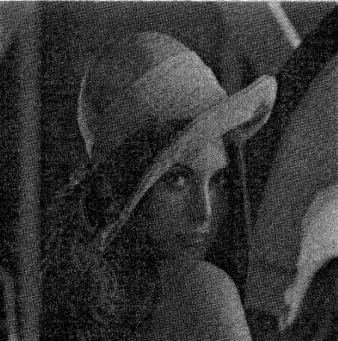
To evaluate the performance of applying the QMBTC t o color image compression, we conducted th e experiments on four test images. Table I1 illustrates the performance com- parison among the QMBTC, C C C algorithm [3] and Kurita and Otsu’s algorithm [5]. We observe that the bit rate will save 30% on average by t h e proposed QMBTC algorithm as compared with t he other testing algorithms. However, the Average Peak Signal-to-Noise-Ratio (APSNR) of the pro- posed algorithm is close t o those of the other testing algo- rithms. In addition, Fig. 1 shows the reconstructed images created by using these color B T C algorithms on ‘Lena’. It is noticed t h a t there is no significant image quality degrada- tion between the reconstructed image produced by the prc-
posed algorithm and those of the other testing algorithms. Therefore, t h e proposed QMBTC is a n efficient color B T C which can produce good compression ratio and output picture quality.
REFERENCES
[I]
E.
J. Delp and 0. R. Mitchell, “Image Compression Us- ing Block Truncation Coding,” I E E E Trans. Commu., vol. COMM-27, pp. 1335-1341, Sep. 1979.[2] M. D. Lema and 0. R. Mitchell, “Absolute Moment Block Truncation Coding and Application to Color Im- age,” IEEE Trans. Commu., vol. COMM-32, pp. 1148- 1157, Oct. 1984.
[3] G. Campbell, T. A. Defanti, J. Frederiksen, S . A. Joyce, A. L. Lawrence, J. A. Lindberg, and D. J . Sandin,
“TWO
Bit/Pixel Full Color Encoding
,”
Comput. Graph., vol. 20, no. 4, pp. 215-223, Aug. 1986.[4] Y. Wu and D. C. Coll, “Single Bit-Map Block Trunca- tion Coding of Color Images,” I E E E Journal on Selected Areas an Commu., vol. 10, no. 5, pp. 952-959, Jun. 1992. [5] T. Kurita and
N.
Otsu, “A Method of Block Truncation Coding for Color Image Compression,” I E E E Trans. Commu., vol. COMM-41, pp. 1270-1274, Sep. 1993.[6] J. 3. Fraleigh, A Fzrst Course zn Abstract Algebra, Addison-Wesley, 1982.
Images Color One-Class Two-Class
Spaces Blocks Blocks
I 11858 4526 Lena I1 9408 6976 I 12199 4185 Peppers I1 9408 6976 I 10396 5988 Scene I1 7576 8808
I
11430 4954 Jet I1 9670 6714Table 1. Thresholded blocks d i s t r i b u t i o n of the
QMBTC under d i ffe re n t color spaces: I
-
RGB, I1-
Yrg. 1 1 I 32.2 4.0 Lena I1 32.3 4.0 IT1 32.0 2-56 I 31.1 4.0 Peppers I1 31.6 4.0 I11 30.8 2.56 I 28.1 4.0 Scene I1 28.2 4.0 I11 28.2 2.84 ~ . _ I 31.8 4.0 Jet I1 32.0 4.0 111 32.2 2.52Table 2. Performance c o m p a r i s o n of various color
BTC a lg or i th ms : I - CCC a l g o r i t h m [3], I1
-
Ku-r i t a and Otsu’s a l g o r i t h m [ 5 ] , 111- the QMBTC al- gorithm.
Fig. 1. Original and reconstructed images of ‘Lena’. (a) original image.