
Association Thesaurus Construction for Interactive Query Expansion based on Association Rule Mining
6
0
0
全文
(2) Int. Computer Symposium, Dec. 15-17, 2004, Taipei, Taiwan.. synonym-based thesaurus, a set of synonym terms should be identified from a dictionary of words. However, term co-occurrence data are not considered within the synonym-based thesaurus. As for similarity thesaurus [10], term similarity (termto-term relationship, such as term co-occurrence) is determined and then the thesaurus for a term i is created from terms with high similarity to term i. To expand a query effectively, we believe that the query logs of users are useful. That is, the results of a query can be refined precisely when useful information is derived from the query logs containing selected web pages (or documents) of users. When a user enters a query term, he or she will be presented with search results (for example, web pages or documents). Accordingly, some of these web pages (or documents) are selected by the user. Consequently, the entire information about the entered query term, such as selected web pages, user id, and query term, is recorded in the query logs. For example, a query term ‘A’ can be expanded with term ‘B’ according to the high correlation between terms ‘A’ and ‘B’ in selected web pages of users. Such useful information can be viewed as the term co-occurrence data, which can be mined from the selected web pages of users. Thus, this paper presents an interactive query expansion method based on association thesaurus, which is created by mining association rules [1] from a set of query terms. The selected web pages (or documents) of users in the query logs are transferred into ‘sets of query terms’ and then used for term correlation mining. Accordingly, various association thesauruses concerning different query terms are constructed from these term correlations. Consequently, the proposed method combines the original query term specified by a user with the corresponding thesaurus to offer the user more precise results. This approach takes advantages of both automatic and interactive query expansion methods because the query is expanded automatically and users are involved implicitly for query expansion. Moreover, the generated association thesauruses offer properties of both similarity thesauruses and synonym-based thesauruses, such as term cooccurrence and synonym-like terms determined implicitly by users. The query expansion mechanism is implemented within the Query Agent of a course recommendation system, Coursebot [21]. Experimental results have shown that the performance, precision ratio and recall ratio, of the system is increased when the proposed method is applied. The rest of this paper is structured as follows. Section 2 briefly reviews the concept of association rule mining. Section 3 gives a framework to describe the proposed approach used for constructing association thesaurus. Section 4. presents the Query Agent of a course recommendation system, Coursebot, within which the proposed query expansion method is implemented. Experimental results are reported in Section 5. Finally, Section 6 concludes.. 2. Association rule mining This section briefly reviews the concept of association rule mining adopted for constructing association thesaurus. Mining association rules from a large collection of data has gained great popularity in information retrieval since it was proposed in 1993 [1]. Similar to decision rules, association rules are used to describe the relationships between sets of items. Let I be a set of items (binary attributes). An association rule is generally stated as the following expression [1]: X → Yc,. (1). where X ⊂ I , Y ⊂ I , X ∩ Y = φ , and c is a constant indicating the confidence of the rule. In marketing research, for example, the researchers analyze the past transaction records and then derive some useful information for making proper decisions. An association rule mined from the transaction records may be described as follows. Rule r1: 88% of the people who buy dried milk also buy beer. The antecedent and the consequent of rule r1 are dried milk and beer respectively, and the confidence of rule r1 is 88%. Clearly, with high confidence, rule r1 is somehow helpful for decision-making. Wur and Leu [17] proposed an effective Boolean algorithm, named Sparse-Matrix approach (BSM), for mining association rules in large databases. In this approach, two tables, IT and TT, are created to generate frequent item sets [17]. Each row in ITk-1 represents a frequent item set and each ‘1’ in ITk-1 represents an item in item set I. Each ‘1’ in TTk-1 represents a record that contains the corresponding item set in ITk-1. Accordingly, logic OR operation is employed on any two rows in ITk-1 to generate a k-item set; meanwhile, logic AND operation is employed on the corresponding rows in TTk-1 to generate TTk. Then, using logic AND and XOR operations, interesting association rules are derived from the frequent item sets in all ITs and TTs. Consider a simple database with a set I of five items {A, B, C, D and E}, as shown in Table 1. Each row in Table 1 represents a record; for example, row one represents a record (T100) that contains three items (A, D, and E).. 363.
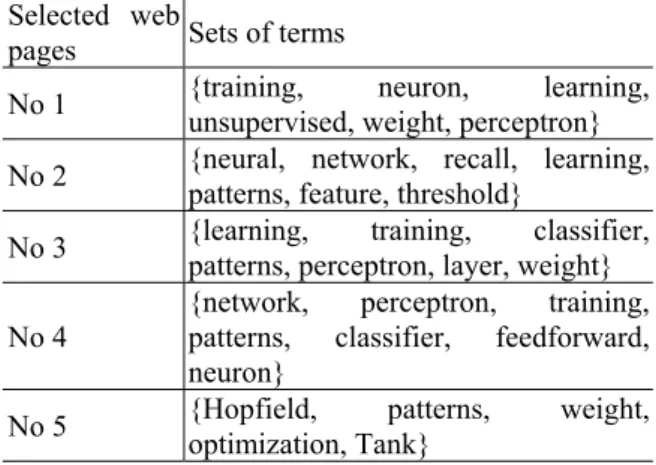
(3) Int. Computer Symposium, Dec. 15-17, 2004, Taipei, Taiwan.. expansion. When a user enters a query term, he or she will be presented with search results (for example, web pages or documents). Accordingly, some of these web pages (or documents) are selected by the user. Consequently, the entire information about the entered query term, such as selected web pages, user id, and query term, is recorded in the query logs. As mentioned earlier, these records will be used further for association thesaurus generation. In general, the above selected web pages (or documents) consist of many words (terms). Thus, sets of terms, which are informative in selected web pages (or documents) and useful for the mining tasks, should be identified from selected web pages (or documents). To accomplish this, a value, named Q, is introduced as follows.. Table 1 A simple database Record number Items T100 ADE T200 BDE T300 BCDE T400 AE By using the BSM approach [17], 14 association rules, as listed in Table 2, are derived from the above database. Notably, each rule i is represented with two indicators: ‘Support’ and ‘Confidence’, where ‘Support’ is the fraction of records that contain the corresponding item sets in both the antecedent and the consequent of rule i; Let Wi denote the records that contain the item sets in the antecedent of rule i. ‘Confidence’ is the fraction of Wi that contain the item sets in the consequent of rule i.. m. Qj =. Table 2 14 association rules obtained from Table 1 Antecedent Consequent Support Confidence {A} {E} 50% 100% {B} {D} 50% 100% {B} {E} 50% 100% {B} {DE} 50% 100% {D} {B} 50% 67% {D} {E} 75% 100% {D} {BE} 50% 67% {E} {A} 50% 50% {E} {B} 50% 50% {E} {D} 75% 75% {E} {BD} 50% 50% {BD} {E} 50% 100% {BE} {D} 50% 100% {DE} {B} 50% 67%. ∑ tf i =1. m. ij. (2). × df j. where Qj denotes the average term frequency and document frequency of term j, tfij is the frequency of occurrence of term j in selected page i, dfj is the frequency of occurrence of term j in all selected pages, and m is the total number of selected pages. Clearly, terms with high value of Q(greater than a threshold θ) are informative in selected pages. In this work, these terms are collected as sets of terms and further used for term correlation mining. Table 3 Five sets of terms extracted from five selected web pages with the initial query term ‘neural network’ Selected web Sets of terms pages {training, neuron, learning, No 1 unsupervised, weight, perceptron} {neural, network, recall, learning, No 2 patterns, feature, threshold} {learning, training, classifier, No 3 patterns, perceptron, layer, weight} {network, perceptron, training, No 4 patterns, classifier, feedforward, neuron} {Hopfield, patterns, weight, No 5 optimization, Tank}. This work applies the above-mentioned BSM approach for mining association rules from sets of query terms (words). The above logic OR, AND and XOR operations are helpful for the mining tasks in the proposed approach. Accordingly, these association rules are used to create association thesaurus for query expansion. The next section will further detail this idea.. 3. Architecture of association thesaurus generation This section describes a framework, as shown in Figure 1, to generate association thesaurus for query. Query Logs. Term Correlation Mining. Term Selection Sets of Terms. Figure 1. Architecture of association thesaurus 364. Association Thesaurus.
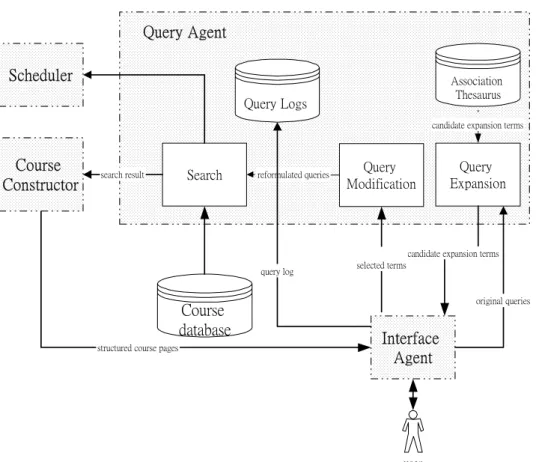
(4) Int. Computer Symposium, Dec. 15-17, 2004, Taipei, Taiwan.. Table 4 Three examples of association rules Rule Query Candidate Support Confidence term expansion term r1 neural network 26.43% 97.34% r2 neural neuron 14.91% 27.25% r3 neuron neural 11.88% 36.73%. Through the above procedure for term selection, various pages ‘selected by users’ will be transferred into sets of terms (i.e., sets of query terms). For example, as listed in Table 3, five sets of terms may be extracted from five selected web pages respectively, corresponding to the initial query term ‘neural network’ entered by a user. Accordingly, the above-mentioned BSM algorithm (see Section 2) is applied on these term sets for term correlation mining. Here, different association rules of terms are derived as the following form. rk: ti → tj ( s, c ) ,. 4.Query Agent with association thesaurus The proposed query expansion method with association thesaurus is implemented within the Query Agent of a course recommendation system, Coursebot [21]. Figure 2 describes the architecture of the Query Agent. To find the desired course pages, a user has to specify a query term via the Interface Agent. Consequently, the Query Expansion module retrieves and ranks candidate expansion terms from the association thesaurus database by using a SQL (Structure Query Language) form (as shown in Table 5); the user is then presented with these expansion terms. Accordingly, the candidate expansion terms selected by the user are combined with the original query for query modification. Finally, the reformulated query is applied again to generate structured course pages for the user.. (3). where ti and tj are the antecedent (term) and the consequent (term) of rule rk, respectively; meanwhile, s and c are the support and the confidence of rule rk, respectively. Table 4 gives three examples of association rules. Notably, these association rules are asymmetrical [17]; for example, the confidence of rule r3 ( neuron → neural ) exceeds the confidence of rule r2 ( neural → neuron ).. Query Agent Scheduler. Association Thesaurus. Query Logs. candidate expansion terms. Course Constructor. Search. search result. reformulated queries. Query Modification. Query Expansion. candidate expansion terms query log. selected terms. original queries. Course database. Interface Agent. structured course pages. user. Figure 2. Architecture of the Query Agent. 365.
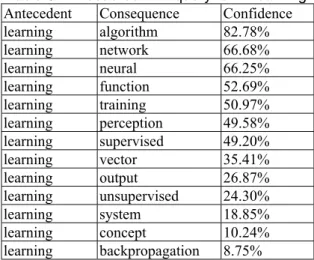
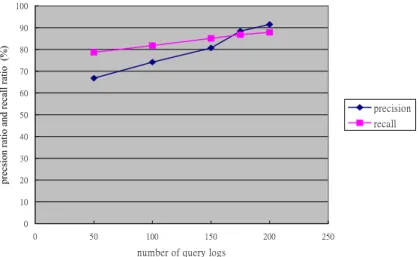
(5) Int. Computer Symposium, Dec. 15-17, 2004, Taipei, Taiwan.. Table 5 SQL form SELECT * FROM THESAURUS WHERE QUERY = QT AND COURSE = Ck ORDER BY CONFIDENCE DESC where THESAURUS is the database of association thesaurus (rules), QUERY is the antecedent of an association rule, QT is the original query term, COURSE is the course that an association rule belongs to, Ck is the id number of course specified by the user, and CONFIDENCE is the confidence of an association rule.. (That is, the antecedent (term) of each association rule in the thesaurus is ‘learning’). Table 6 A thesaurus with query term ‘learning’ Antecedent Consequence Confidence learning algorithm 82.78% learning network 66.68% learning neural 66.25% learning function 52.69% learning training 50.97% learning perception 49.58% learning supervised 49.20% learning vector 35.41% learning output 26.87% learning unsupervised 24.30% learning system 18.85% learning concept 10.24% learning backpropagation 8.75% The proposed approach for interactive query expansion was evaluated by using two ratios, precision ratio and recall ratio, which are defined as follows [13]. (Relevant documents are identified by an expert in “Neural Network”). 5. Experimental Results As stated above, the proposed query expansion method with association thesaurus is implemented within the Query Agent of Coursebot [21]. Here, 203 query logs of the course ‘Neural Network’ (The course includes 321 web pages.) in Coursebot was used to demonstrate the performance of the proposed approach. Each query log consists of a query term entered by a user and corresponding selected web pages of the user (The average number of selected web pages in a query is 4.1).. Precision=. minimum support = 4%. Recall=. 300. number of association rules. 200 150 100 50 0 0.1. 0.2. 0.3. 0.4. 0.5. 0.6. 0.7. 0.8. 0.9. Numberof Retrievaland RelevantDocuments (5) Numberof Total RelevantDocuments. Table 7 compares the precision ratio and the recall ratio when the proposed approach was applied or not. The precision ratio is increased from 61.8% to 91.5%. Also, the recall ratio is increased from 71.7% to 87.9%. Table 7 Comparison of the precision ratio and the recall ratio The proposed The proposed Methods approach is not approach is applied applied Precision ratio (%) 61.8 91.5 Recall ratio (%) 71.7 87.9. 250. 0. Numberof Retrievaland RelevantDocuments (4) Numberof Total RetrievalDocuments. 1. threshold of term selection. Figure 3. Relationship between the threshold used for term selection and the number of association rules. Moreover, Figure 4 represents the relationship between the above two ratios and the total number of query logs used for mining association rules. It is easily seen that these two ratios can be improved when the total number of query logs used for the mining tasks is increased to a certain degree. This approach takes advantages of both automatic and interactive query expansion methods because the query is expanded automatically and users are involved implicitly for query expansion. Moreover, the generated association thesauruses offer properties of both similarity thesauruses and synonym-based thesauruses, such as term co-occurrence and synonym-like terms determined implicitly by users.. According to the above-mentioned procedure for term selection (see Section 3), the selected web pages in the above 203 query logs were transferred into sets of terms (i.e., 203 sets of terms). Consequently, various association rules were mined from these 203 term sets. Figure 3 represents the relationship between the number of association rules and the thresholds used for term selection. When querying through the Query Agent of Coursebot, the user will be presented with a thesaurus constructed from the association thesaurus database. For example, Table 6 represents a thesaurus with query term ‘learning’. 366.
(6) Int. Computer Symposium, Dec. 15-17, 2004, Taipei, Taiwan.. 100. precsion ratio and recall ratio (%). 90 80 70 60. precision. 50. recall. 40 30 20 10 0 0. 50. 100. 150. 200. 250. number of query logs. Figure 4. Relationship between the number of query logs used for mining association rules and the two performance ratios of the proposed approach. Query Processing,” Data & Knowledge Engineering, 35, 2000, pp. 239-257. [7] M. Magennis and C.J. van Rijsbergen, “The Potential and Actual Effectiveness of Interactive Query Expansion,” Proc. of the 20th Annual International ACM SIGIR Conference on Research and Development in information Retrieval, 1997, pp.324-332. [8] J. McDonald, W. Ogden, and P. Foltz, “Interactive Information Retrieval using Term Relationship Networks,” Proc. of the 6th Text Retrieval Conference, 1997. [9] G. A. Miller, “WordNet: A Lexical Database,” Comm. ACM, 38(11), 1993, pp. 39-41. [10] Y. Qiu and H. P. Frei, “Applying a Similarity Thesaurus to a Large Collection for Information Retrieval,” Technical Report. Dept. Computer Science, Swiss Federal Institute of Technology (ETH), Jan 1995. [11] Y. Qiu and H. P. Frei, “Concept Based Query Expansion,” Proc. of the 16th ACM SIGIR International Conference on Research and Development in Information Retrieval, 1993, pp. 160-169. [12] J. J. Rocchio, “Relevance feedback in information retrieval,” In the SMART Retrieval System-- Experiments in Automatic Document Processing, pp. 313-323, Englewood Cliffs, NJ, 1971. Prentice Hall, Inc. [13] G. Salton and M. J. McGill, “Introduction to Modern Information Retrieval,” McGraw-Hill, 1983. [14] B. R. Schatz, E. H. Johnson, and P. A. Cochrane, “Interactive Term Suggestion for Users of Digital Libraries: Using Subject Thesauri and Co-occurrence Lists for Information Retrieval,” Proc. of the 1st ACM International Conference on Digital Libraries, 1996, pp. 126-133. [15] F. Sebastiani, “Automated Generation of Category-Specific Thesauri for Interactive Query Expansion,” Proc. of the 9th International Databases Conference on Heterogeneous and Internet Databases, 1999, pp. 429-432. [16] A. Spink, “Term Relevance Feedback and Query Expansion: Relation to Design,” Proc. of the 17th Annual International ACM SIGIR Conference on Research and Development in information Retrieval, 1994, pp. 81-90. [17] S. Y. Wur and Y. Leu, “An Effective Boolean Algorithm for Mining Association Rule in Large Databases,” Proc. of the 6th International Conference on Database Systems for Advanced Applications, 1998. [18] Altavista, available at http://www.altavista.com [19] Excite, available at http://www.excite.com [20] Google, available at http://www.google.com [21] The Coursebot, available at http://coursebot.et.ntust.edu.tw [22] The Emerging Digital Economy, available at http://www.ecommerce.gov. 6. Conclusions This paper proposed an interactive query expansion method with association thesaurus, which is mined from the selected web pages of users in the query logs. The selected web pages of users in the query logs are transferred into sets of terms and then used for term correlation mining. Then, various association thesauruses concerning different query terms are constructed from these term correlations. Consequently, the proposed method combines the original query term specified by a user with the corresponding thesaurus to offer the user more precise results. The query expansion mechanism is implemented within the Query Agent of a course recommendation system, Coursebot. The proposed approach for interactive query expansion was evaluated by using two ratios, precision ratio and recall ratio. Experimental results have shown that the performance of the course recommendation system is improved a lot when the proposed approach is applied.. References [1]. [2]. [3] [4]. [5]. [6]. R. Agrawal, T. Imielinki, and A. Swami, “Mining Association Rule Between Sets of Items in Large Database,” Proc. of the 1993 ACM SIGMOD International Conference on Management of Data, 1993, pp. 207-216. E. N. Efthimiadis, “A User-centred Evaluation of Ranking Algorithms for Interactive Query Expansion,” Proc. of the 16th Annual International ACM SIGIR Conference on Research and Development in Information Retrieval, 1993, pp. 146-159. C. Fellbaum, An Electronic Lexical Database, MIT Press, Cambridge, Mass., 1998. B. Jansen and A. Spink, “Methodological Approach in Discovering User Search Patterns Through Web Log Analysis,” Bulletin of the American Society for Information Science and Technology, 27(1), 2000, pp. 15-17. K. Jarvelin, J. Kristensen, T. Niemi, E. Sormunen, and H. Keskustalo, “A Deductive Data Model for Query Expansion,” Proc. of the 19th Annual International ACM SIGIR Conference on Research and Development in Information Retrieval, 1996, pp. 235-243. W. S. Li, and D. Agrawal, “Supporting Web Query Expansion Efficiently Using Multi-Granularity Indexing and. 367.
(7)
數據
相關文件
Midpoint break loops are useful for situations where the commands in the loop must be executed at least once, but where the decision to make an early termination is based on
Start with a STUN header, followed by a STUN payload (which is a series of STUN attributes depending on the message type).
Sam Shui Natives Association Huen King Wing School Ma Tau Chung Government Primary School (Hung Hom Bay).. Home is where the
[3] Haosong Gou, Hyo-cheol Jeong, and Younghwan Yoo, “A Bit collision detection based Query Tree protocol for anti-collision in RFID system,” Proceedings of the IEEE
Since the sink is aware of the location of the interested area, simple greedy geographic routing scheme is used to send a data request (in the form of
Srikant, Fast Algorithms for Mining Association Rules in Large Database, Proceedings of the 20 th International Conference on Very Large Data Bases, 1994, 487-499. Swami,
cementum in close association with the tooth root complex odontoma usually asymptomatic and do not cause bone expansion osteoblastoma Not presence of radiopaque nidussurrounded
In addition to asthma, diseases associated with low bone turn over, such as hypothyroidism, can lead to increased stress on tooth roots following applied orthodontic loads and lead
