Jong Yih Kuo* and Wei Xiou Lin
Department of Computer Science and Information Engineering, National Taipei University of Technology Taipei City 106, Taiwan ROC
Graduate Institute of Applied Science and Engineering, Fu Jen Catholic University Taipei County 242, Taiwan ROC
Received 4 December 2006; Revised 23 March 2007; Accepted 24 March 2007
Abstract. This paper examines the Argumentation Negotiation of agent as a mechanism for solving the course-scheduling problem. We integrated multi-agent automatic negotiation mechanism and argumentation reasoning to apply in course scheduling problem. We want to evolve the belief of the agents by argumentation-based negotiation, so that agents can have more information of the environment, and select better action to do.
Keyword: intelligent agent, argumentation reasoning, belief evolution, course scheduling, multi-agent system.
1 Introduction
An increasing number of computer systems are being viewed in terms of multiple interacting autonomous agents. This is because the multi-agent paradigm offers a powerful set of metaphors, concepts and techniques for conceptualizing, designing, implementing and verifying complex distributed systems [1]. The most fundamental and powerful mechanism for managing inter-agent dependencies at run-time is negotiation - the process by which a group of agents come to a mutually acceptable agreement on some matter [2]. Negotiation underpins attempts to cooperate and coordinate and is required both when the agents are self interested and when they are cooperative.
The problem of those primitive negotiation mechanisms [3][4] is the lack of an expressive formalism to capture all the prominent issues arising in a negotiation context, and the absence of a sound inference mechanism to reason about the preferential changes during a negotiation session [5]. In real life negotiation situations, the purpose of exchanging information among different agents is not purely information but also persuasive. Conventional trading negotiation techniques have some limitation. The only feedback that can be made to a proposal is a counter-proposal, which itself is another point in the space, or an acceptance or withdrawal. It is hard to change the set of issues under negotiation in the course of a negotiation. The argumentation-based negotiation is to remove these limitations [6].
Course scheduling is actually a coordination and combinatorial problem to find an appropriate timetable for each course to be scheduled while simultaneously avoiding conflicts. Due to the high-dimensional and multi-constraint features, the course scheduling problem is NP-hard [7]. Many papers proposed different and valid approaches to solve this tough problem [8][9][10]. In recent years, agent technology has been developed quickly to deal with this problem [11][12][13][[14]. In this paper, the mobile agent technology based on argumentation-based negotiation is applied to examine the feasibility and flexibility in the course scheduling problem. Each teacher is regarded as a mobile agent called course negotiation agent. Through the negotiation among the entire course negotiation agents, a course timetable are expected to be scheduled suitably [15].
The following section will detail the proposed approach. Section 2 is the argumentation-based negotiation model. Section 3 describes the negotiation process. Section 4 presents the results of the experiment. Section 5 draws conclusions from this work.
* Correspondence author
2 Argumentation-Based Negotiation
Fig. 1. The architecture of argumentation-based negotiation
In our agent model, an agent can be completely specified by the events that it can perceives, the actions it may performs, the beliefs it may holds, the goals it may adopts, and the plans that give rise to fulfill its intentions [5]. According to the user preference, agents apply fuzzy theory to model their belief. The alternative proposal of agents is derived by their belief. When negotiation among agents is broken, argumentation process will begin to evolve the belief of agents. This makes it possible for the next proposal to getting to close the agreement of the other agents. This session describes our proposed argumentation-based negotiation architecture as shown in Fig. 1. Our ontology of belief is described with OWL [16].
2.1 Agent Belief Model
Users’ preferences are represented by epistemic entrenchment ordering of beliefs. With negotiation, information about opponents’ preferences attached to a counter offer can be evaluated, and the corresponding beliefs can be revised into an agent’s knowledge base [5][17]. Thus, all agents may make an agreement quickly. The beliefs of an agent can be represented as formula (1).
Belief = Preference | Fact | Belief∧Belief (1) The belief of agent may be a preference of user or the fact of the environment. For car business example, preference of the customer is high horsepower. He thinks the exhaust value of the car proposed by seller is low. The belief of agent is represented as follow.
Belief = Preference(HorsePower(Car)) is High ∧ ExhaustValue(Car) is Low
We can apply the fuzzy soft requirement [17] so as to represent the agent belief formally. We use Zadeh’s test-score semantic [18] to represent the user preference. The basic idea underlying test-test-score semantics is that a proposition p in a natural language may be viewed as a collection of elastic constraints, C1, ..Ck, which restricts
the values of a collection of variables X =(X1, ..Xn). In fuzzy logic, this is accomplished by representing P in the
canonical form:
Preference ⇒ R(P) IS A
In which A is a fuzzy predicate. The canonical form of G implies that the possibility distribution of R(P) is equivalent to the membership function of A, namely Π R(P) = µA. For course scheduling example, a teacher wish
the school days the less the better. We can represent it as follow canonical form. G ⇒ DaysOfCourse(CourseSchdule) IS Low
in which, Low is a fuzzy predicate. Its fuzzy set is shown as Fig. 2.
Fuzzy modeling
Proposal
Generator
Negotiation process
Argumentation process
Belief evolution
Proposal
Belief
User preference
Fig. 2. Fuzzy set of Low
The fact is a specialization of the soft preference, of which the membership function of fuzzy predicate is 1.0.
2.2 Proposal Generator
Negotiation can be viewed as a distributed search through a space of potential agreements. The search terminates when the required number of participants find a mutually acceptable point in the agreement space [2]. The dimensionality and topology of this space is determined by the structure of the negotiation object. Indeed, each issue of the negotiation object has a separate dimension. The alternative proposal of agent is a negotiation object including the set of issue and its value pair. The alternative proposal (P) is represented as equation (2).
P= {(issue.name, issue.value)|∀issue∈NO} (2) Where NO is Negotiation Object. Take car business for example, seller proposes an alternative including exhaust value, cost, and equipment to achieve the customer requirement. The proposed alternative can be represented as follow.
P={(ExhaustValue, 1800 C.C.), (Cost, 60 NT), (Equipment , DVD Player )}
By research [19] , we can generate the alternative proposal. According to the belief of agent, the best alternative proposal is selected from the negotiation space. We use the fuzzy set to model the user preference (that is, belief of agent). The evaluation functions are shown as equation (3) and (4). The fuzzy operator is max.
N issue P Utility j i M i N j k( ) ( max ( ))/ 1 µ
∑
= = (3) L P Utility P Utility L k k( ))/ ( ) ( 1∑
= = (4)In the equation (3) and (4), L, M, and N are used to individually represent the number of preference, the number of negotiation issue, and the number of agent. An agent can get the self-benefit proposal by calculating the equation (3). With the information given by the other agents, the agent can evaluate the best proposal by equation (4).
Fig. 3. Argument-based negotiation process Proposal Selection Argumentation Belief evolution Agree No Yes Success No Yes 30 50 100 Utility Low Normal High
0 1
2.3 Argumentation-Based Reasoning
The basic idea behind the argumentation-based approach allows additional information to be exchanged, over and above proposals [20][21]. Thus in addition to rejecting a proposal, an agent could offer a critique of the proposal to explain why it is unacceptable. Similarly, an agent can accompany a proposal with an argument which says why the other agent should accept it. The argumentation content A is represented as a formula.
A = {(rule) | ∀ rule ∈ KB} (5) In the formula, rule is the inference rule to represent the knowledge base of an agent. For the car business, we assume that if the preference of the customer is high horsepower, but seller proposes a car with low exhaust value. The customer couldn’t like the car recommended by the seller. Thus, the argumentation process must be started. The argumentation content of the customer can be described as formula (6).
{HorsePower(Car) is High ∧ ExhaustValue(Car) is Low ⇒ Preference(Customer) is Low} (6) The argumentation mechanism we employ is logic-based on [2][22][23] and builds on working in argumentation as an approach to handle defeasible reasoning. This makes it possible for agents to handle contradictory statements without collapsing into triviality. The priority of rule allows conflicting arguments to be resolved. The argumentation content is generated by the belief of agent. After argumentation reasoning, the belief of agent will be evolved by modifying the belief. Argumentation system is formulated as equation (7).
AS = (A(KB), Belief_relation, Rule_priorityk, Agent_ID) (7) A(KB) is the argumentation content based on the given knowledge. Belief_relation is the relationships between rules. Rule_priority is the priority of the rule.
3 Negotiation Process
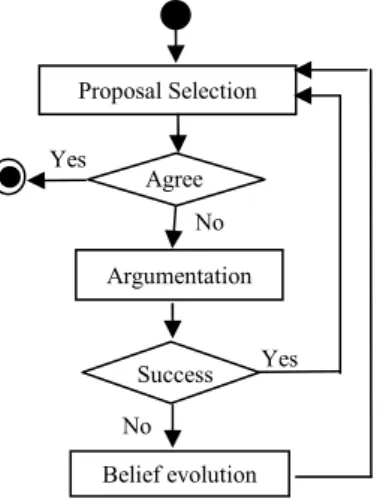
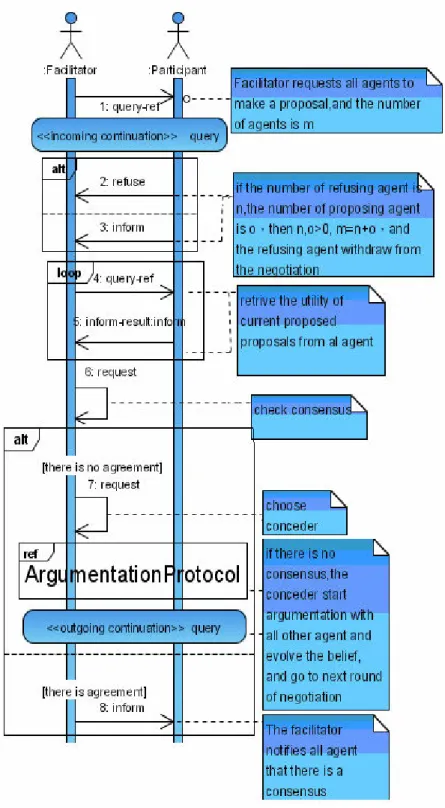
The argument-based negotiation process is shown as Fig. 3. The argumentation-based negotiation protocol is modeled by UML in Fig. 4.
3.1 Argumen-based negotiation protocol
The argument-based negotiation process describes as follow. (1) Enter the first round to negotiate.
(2) Facilitator asks all agents to proposal their alternatives.
(3) Each agent selects a best alternative from the negotiation space. (4) If the proposal set is empty, then the agent withdraws from negotiation.
(5) For a alternative proposal, all agents compute the agreement set. If the agreement set is non-empty, the negotiation process will be terminated.
(6) When the agreement set is empty, the facilitator asks all agents to compute the conceding risk.
(7) The agent that should concede is the one for whom conceding represents the least risk. The conceding agent must begin the argumentation with other agents.
(8) When the argumentation process is over, the conceding agent regenerates his negotiation space and selects a best proposal from the new negotiation space. The process goes to step 1 for next round.
Fig. 4. Argumentation-based negotiation protocol
3.2 Argumentation reasoning
The argument of proposal is to support the proposal provided by the agent. The argumentation system selects the candidate rules based on the belief of agents and the negotiation state. So that appropriate argument will be generated. According to the priority of the rules in the argumentation system, the system can determine which agent wins and which agent loses. If the agent who should concede loses in the argumentation, it will evolve its belief according to the argument that the other agents made. The process of the argumentation is described as follow.
(1) The one who should concede makes the argument to support its proposal, and sends it to all other agents to persuade them.
(2) The one who should concede receive the argument of the other agents.
(3) The one who should concede request the facilitator to decide whether it wins or not in this argumentation. (4) The facilitator decides the winner in this argumentation according to the knowledge in arguments of both
side and the priority of the knowledge.
(5) If the one who should concede has been refuted, it evolves its belief according the argument that is made be the other side.
(6) Return to step (1) until the argumentation with all agents has been done.
An agent accompanies a proposal with an argument which says why the other agent should accept it. This makes it possible to change the other agent’s belief. For our course scheduling example, a course negotiation agent can get more about the preferences of another agent.
4 Example and Results
In this paper, we build a simple course scheduling system to illustrate our approach by Java and ADK (Agent Development Kit)[13]. A negotiation agent in this system represents a teacher. We get an appropriate school timetable by agent negotiation. During the negotiation process, a negotiation agent will retrieve other negotiators’ criterion for making a proposal, and make a better proposal in the next round to get a common consensus as soon as possible.
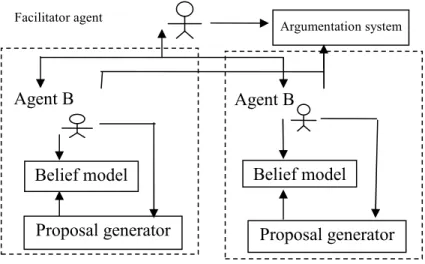
Fig. 5. System architecture
4.1 System Architecture
Our system architecture is illustrated as Fig. 5. The negotiation process is guiding by the facilitator. All negotiator use their proposal generator to make appropriate proposals, send the chosen proposals to the facilitator to decide who conceder is, and evolve their belief after generating and evaluating the arguments by argumentation system.
4.2 Initial Argumentation Negotiation
Table 1 Courses information
Agent Course name
Kuo OOSE JAVA
Huang Algorithm analysis Machine learning Mei WWW Design Wireless system Hsu GUI design Knowledge
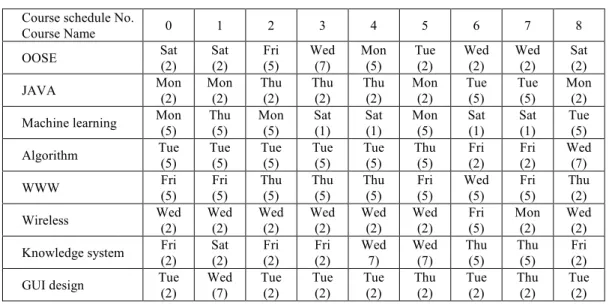
The information of the courses that will be delivering is described in Table 1. The purpose of the system is putting the time of the course in order, so the issues in negotiation proposal are the time of all courses. Nine of the candidate proposals are described in Table 2, by introducing what day and what time the courses are delivered. Facilitator agent
Agent B
Belief model
Proposal generator
Argumentation systemAgent B
Proposal generator
Belief model
Table 2 Alternative Course Schedule Course schedule No.
Course Name 0 1 2 3 4 5 6 7 8 OOSE Sat (2) Sat (2) Fri (5) Wed (7) Mon (5) Tue (2) Wed (2) Wed (2) Sat (2) JAVA Mon (2) Mon (2) Thu (2) Thu (2) Thu (2) Mon (2) Tue (5) Tue (5) Mon (2) Machine learning Mon
(5) Thu (5) Mon (5) Sat (1) Sat (1) Mon (5) Sat (1) Sat (1) Tue (5) Algorithm Tue (5) Tue (5) Tue (5) Tue (5) Tue (5) Thu (5) Fri (2) Fri (2) Wed (7) WWW Fri (5) Fri (5) Thu (5) Thu (5) Thu (5) Fri (5) Wed (5) Fri (5) Thu (2) Wireless Wed (2) Wed (2) Wed (2) Wed (2) Wed (2) Wed (2) Fri (5) Mon (2) Wed (2) Knowledge system Fri
(2) Sat (2) Fri (2) Fri (2) Wed 7) Wed (7) Thu (5) Thu (5) Fri (2) GUI design Tue
(2) Wed (7) Tue (2) Tue (2) Tue (2) Thu (2) Tue (2) Thu (2) Tue (2)
Table 3 Initial agent belief Agent Belief content
Kuo
Preference:(Time, Thu) Preference:(Time, Fri)
Fact: alternative satisfaction degrees Huang
Preference:(Time, Thu) Preference:(Time, Tue) Preference:(Time, Afternoon) Fact: alternative satisfaction degrees Mei
Preference:(Time, Wed) Preference:(Time, Morning) Fact: alternative satisfaction degrees Hsu
Preference:(Time, Wed) Preference:(Time, Tue)
Fact: alternative satisfaction degrees
The agent belief includes time preference for all teachers, and how much the agents are satisfied by the proposal. The time preference includes what day and what time the course is delivered. The membership function of the preference is illustrated by Fig. 6. Before negotiating with other agent, the agent knows the preference of itself only. The initial belief of all agents is described in Table 3.
Fig. 6. Membership functions for preference
The argumentation system provides the service of the preference, so that the agents can make appropriate argument by input information. In addition, there is also information about the undercut relation and priority of knowledge. In the example, there are two conflicting knowledge whether the agent is satisfied with time. The undercut relation is described by formula (8).
undercut(TimeIsGood(Agi, Pj), TimeIsBad(Agi,Pj) (8)
Agi represents the ith agent, and Pj is the jth proposal course schedule. By belief evolution, agents can modify
their wrong belief. For the inference rule, agent can decide whether the school timetable is good or not according
morning Afternoon night
3 5 7 9 1
to their preferences, and then let the other side understand that has since already assessed the standard. Those rules in our example are described by formula (9) and (10).
(Preference(Agi) is A) ∧ (FitDegree(Agi, Pj) is High) ⇒TimeIsGood(Agi, Pj) (9)
(Preference(Agi) is A) ∧ (FitDegree(Agi, Pj) is Low) ⇒TimeIsBad(Agi, Pj) (10)
To offer the agents to refute the other side’s motion, the priority of formula (7) is higher than (8).
4.3 Argumentation Negotiation Process
When negotiation process starts, every agent calculates satisfaction of all proposal candidates. For example, the time preference of professor Huang is Tuesday, Thursday, and afternoon, and the courses he wants to deliver are Machine Learning (ML) and Algorithm Analysis (AA), then the personal utility of professor Huang can be calculated as follows:
N
issue
P
Utility
j i M i N j Huang(
)
(
max
(
))
/
1µ
∑
==
= (max(
µ
Thu(AA),
µ
Thu(ML)) +max(
µ
Tue(AA),
µ
Tue(ML))+ max((
µ
Afternoon(AA),
µ
Afternoon(ML)))/3
Table 4 Satisfaction proposal and risk value of agents on round 1
Agent Kuo Huang Mei Hsu
Proposal No. 2 1 0,1,2,3,4,5,8 4
Seniority 5 13 11 5
Priority 0.3 0.72 0.62 0.3
Risk value 0.3 0.24 0 0.15
Table 5 Agents’ argumentation content on round 1 Agent Argumentation content
Kuo (Preference(Kuo) is Thu) ∧ (FitDegree(Kuo, 8) is Low) ⇒TimeIsBad(Kuo,8) (Preference(Kuo) is Tue) ∧ (FitDegree(Kuo, 8) is Low) ⇒TimeIsBad(Kuo,8) Huang No
Hsu (Preference(Hsu) is Wed) ∧ (FitDegree(Kuo, 8) is Low) ⇒TimeIsBad(Hsu,8) (Preference(Hsu) is Thu) ∧ (FitDegree(Kuo, 8) is Low) ⇒TimeIsBad(Hsu,8)
In each round of negotiation, every agent chooses the best proposal in accordance with the result of evaluation, and the conceder retrieves the preference of other agents through argumentation, and then chooses new course timetable in order to get a agree consensus. The best proposal of all agents is described in table 4. We add a seniority issue to calculate the risk value of each agent. For the seniority, we define two fuzzy sets as Fig. 7.
Fig. 7. Membership functions for seniority 5 10 15 20 0 1 Seniority Low year Seniority High 0
For the priority, we define tow fuzzy sets as Fig. 8.
Fig. 8. Membership functions for seniority
We define tow fuzzy rules:
If the seniority is low then the priority is low. If the seniority is high then the priority is high.
Fig. 9. Results of agent evolution Priority High 0 0.2 0.4 0.6 0.8 0 1 1 Priority Low Priority
After the fuzzy reasoning, we can get the priority of each agent in the Table 4 and use the priority value to calculate the risk value of each agent. For example, we calculate the risk value of Agentkuo as the following
equation.
Riskkuo= prioritykuo*{Utilitykuo(2)-min(Utilitykuo(1), Utilitykuo (8), Utilitykuo (4))/ Utilitykuo (2)}
The risk value of Agentkuo is 0.3.
Obvious in first round no candidate proposal satisfies all agents, so we must choose an agent to make a concession. The risk value of all agents after first round of negotiation is described in Table 4.
Then Professor Mei will make a concession and propose an argumentation with other agents. Then he can choose a new proposal. Because Professor Mei knows nothing about other teachers, so he cannot propose persuading on the other side dialectically. Then he evolves his belief according to other agent’s arguments. In this argumentation, Professor Mei gets information about professor Kuo and Hsu.
Finally, Professor Mei knows the preference of the two teachers, so he will get different result while evaluating all proposal candidates. All agents’ arguments are described in Table 5. Professor Huang can not make an argument to refute Professor Mei because he has high degree of satisfaction on the 8th proposal. If Professor Mei understands the preference of professor Kuo, then the total utility of a candidate school timetable will be calculate as follow:
Utilitytotal(P)=(Utilitytotal(P)+ Utilitytotal(P))/2
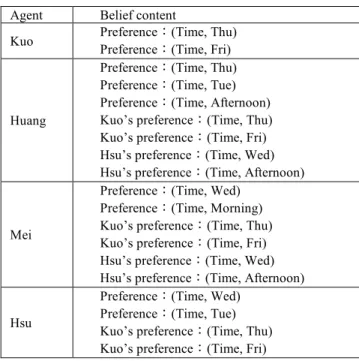
After eight round of negotiation, we get a agree consensus on the proposal with number 2. Fig. 9 shows the process of the negotiation. Table 6 shows the belief of agents after the negotiation. Through argumentation negotiation and the judgment of the facilitator, the negotiators successfully evolve their belief and get a agree consensus on the school timetable.
Table 6 Agent belief after the negotiation Agent Belief content
Kuo Preference:(Time, Thu) Preference:(Time, Fri)
Huang
Preference:(Time, Thu) Preference:(Time, Tue) Preference:(Time, Afternoon) Kuo’s preference:(Time, Thu) Kuo’s preference:(Time, Fri) Hsu’s preference:(Time, Wed) Hsu’s preference:(Time, Afternoon)
Mei
Preference:(Time, Wed) Preference:(Time, Morning) Kuo’s preference:(Time, Thu) Kuo’s preference:(Time, Fri) Hsu’s preference:(Time, Wed) Hsu’s preference:(Time, Afternoon) Hsu
Preference:(Time, Wed) Preference:(Time, Tue) Kuo’s preference:(Time, Thu) Kuo’s preference:(Time, Fri)
5 Conclusions
In multi-agent system environment, incomplete information may impact the effectiveness of agent's decision during negotiation. In this paper we proposed an argumentation negotiation approach to make the agents getting more knowledge about other agents in the environment. We applied argumentation reasoning to evolve the agent’s belief. The user preferences are modeled by fuzzy theory as the criteria of evaluation for negotiation proposals. We also used a course scheduling problem to explain our approach. In the future, we will establish a mechanism to dynamically change the agents’ preference to make the negotiation more successfully.
5.1 Future Work
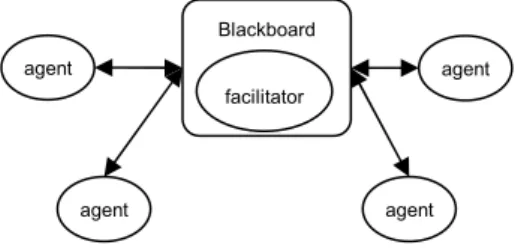
Blackboard-based coordination: using the blackboard the share the information, it would help users to coordinate none-simultaneously in negotiation. The coordination mechanism will improve us method. The users no longer participate in the negotiation at the same time.
In Fig. 10, facilitator in the blackboard will coordinate the information between agents.
Fig. 10. Architecture of blackboard-based coordination
But, this method may cost much time to finish a negotiation. In a round of a negotiation, it would cost much time to notify each agent the information. We should set a limit time to perform it.
Acknowledgements
This work was supported by the Ministry of Economic Affair under grant 96-EC-17-A-02-S1-029 and the National Science Council under grant NSC95-2752-E-008-002-PAE.
References
[1] N. R. Jennings, “An agent-based approach for building complex software”, Communication of ACM, Vol.44, No 4, pp.35–41, April 2001.
[2] N. R. Jennings, P. Faratin, A. R. Lomuscio, S. Parsons, C. Sierra and M. Wooldridge, “Automated negotiation: prospects, methods and challenges”, International Journal of Group Decision and Negotiation, Vol.10, No.2, pp.199-215, 2001.
[3] V. Baber, R. Ananthanarayanan, and K. Kummamuru, “Evolutionary algorithm approach to bilateral negotiations”, in Proceedings of the 4th European Conference on Genetic Programming, EuroGP 2002, also in LNCS Vol. 2278, pp. 203-212, 2002.
[4] D. Zeng and W. Wong, “A Web-based negotiation agent using CBR”, in Proceedings of the 2nd Workshop on AI in Electronic Commerce 2000, Melbourne, Australia, pp. 183-197, 2000.
[5] J. Y. Kuo, S. J. Lee and C. L. Wu, N. L. Hsueh, J. Lee, “Evolutionary Agents for Intelligent Transport Systems”, International Journal of Fuzzy Systems, Vol.7, No.6, pp.85-93, June 2005.
[6] I. Rahwan, S. D. Ramchurn, N. R. Jennings, P. McBurney, S. Parsons, and L. Sonenberg, “Argumentation-based negotiation”, The Knowledge Engineering Review, Vol.18, No.4, pp.343-375, 2003.
[7] M.R. Garey and David S. Johnson, Computers and Intractability: A Guide to the Theory of NP-Completeness, W. H. Freeman, 1979.
[8] J. A. Ferland, F. Charles, A decision support system for course scheduling, Interfaces, Vol.24, No.2, pp.105-115, 1997. [9] A. V. Ramon, E. Crespo, J.M. Tamarit, “Design and implementation of a course scheduling system using Tabu Search”,
European Journal of Operational Research, Vol. 137, pp. 512-523, 2002.
agent agent
Blackboard
agent agent facilitator
[10] Y. Z. Wang, “Using genetic algorithm method to solve course scheduling problems”, Expert Systems with Applications, Vol. 25, pp. 39-50, 2003.
[11] J. Budenske, J. Newhouse, J. Bonney, J. Wu, “Agent-Based Schedule Validation and Verification”, in Proceedings of IEEE International Conference on Systems, Man & Cybernetics, Vol. l, pp. 616-621, 2001.
[12] M.H. Ho, Y.S. Chang, S.M. Yuan, “Multi-agent based Teacher-Cooperated Course Scheduling”, in Proceedings of the ISATED International Conference Intelligent Systems And Control 2001, pp. 232-237, 2001.
[13] H. Xu and S. M. Shatz, ADK, “An Agent Development Kit Based on a Formal Design Model for Multi-Agent Systems”, Journal of Automated Software Engineering, Vol.10, No.4, pp. 337-365, October 2003.
[14] Y. Yang, R. Paranjape, L. Benedicenti, “An examination of mobile agents system evolution in the course scheduling problem”, in Proceedings of 2004 Canadian Conference on Electrical and Computer Engineering, Vol. 2, pp.657-660, 2004.
[15] J. Y. Kuo, S. H Chen, “An Examination of Argumentation Negotiation Agent for Course Scheduling”, in Proceedings of International Computer Symposium 2006 (CD-ROM), 2006.
[16] J. Y. Kuo, “Ontology supported fuzzy intelligent agent”, in Proceeding of the 15th Workshop on Agent Mediated Electronic Trading, Berlin, pp.70-90, 1999.
[17] J. Y. Kuo and J. Lee “Evolution of Intelligent Agent in Auction Market”, in Proceeding of the IEEE International Conference on Fuzzy Systems. Budapest, 2004.
[18] L. A. Zadeh, “Test-score Semantics as a Basis for a Computational Approach to the Representation of Meaning”, Literacy Linguistic Computing, Vol. 1, No.1, pp. 24-35, 1986.
[19] M. Wooldridge, S. Bussmann, and M. Klosterberg, “Production sequencing as negotiation”, in Proceedings of the First International Conference on the Practical Application of Intelligent Agents and Multi-Agent Technology, pp. 709-726, 1996.
[20] R. Y .K. Lau, B. Essam, S. Y. Chan, “Belief revision for adaptive negotiation agents”, in Proceeding of IEEE/WIC International Conference on Intelligent Agent Technology 2003, pp. 196-202, 2003.
[21] J. H. You, X. Wang, L. Y. Yuan, “Non monotonic reasoning as prioritized argumentation”, IEEE Transactions on Knowledge and Data Engineering,Vol. 13, No. 6, pp.968-979, 2001.
[22] L. Amgoud, C. Cayrol, D. Le Berre, “Comparing Arguments Using Preference Orderings for Argument-Based Reasoning”, in Proceedings of the Eighth IEEE International Conference on Tools with Artificial Intelligence, pp. 400-403, 1996.
[23] L. Amgoud, N. Maudet, S. Parsons, ”Modeling dialogues using argumentation”, in Proceedings of Fourth International Conference on Multi-Agent Systems, pp.31-38, 2000.
[24] N. Ito, K. Shinoda, K. Nakagawa, K. Iwata, X. D. N. Ishii. Action decision with incomplete information: a temporal database approach”, in Proceedings of 1999 IEEE International Conference on Systems, Man, and Cybernetics,Vol.6, pp.722-727, 1999.