IEEE 802.21 Buffer Predicting Seamless Handoff (BPSH)
Scheme for WAVE-WiMAX Heterogeneous Handoff
*TIN-YU WU, YA-CHUN LI, WEI-TSONG LEE, JEN-WEN DING+AND YU-CHIN WANG
Department of Electrical Engineering Tamkang University
Taipei, 251 Taiwan
E-mail: {tyw; wtlee}@mail.tku.edu.tw, [email protected]
+
Department of Information Management National Kaohsiung University of Applied Sciences
Kaohsiung, 807 Taiwan E-mail: [email protected]
Since Wireless Access in Vehicular Environment (WAVE) is a draft amendment to the IEEE 802.11 standard, the integration of WAVE (IEEE 802.11p) and Wireless Met-ropolitan Area Network (IEEE 802.16) becomes a concerned issue to mobile network users. During the roaming between the two heterogeneous wireless networks, the quality of multimedia services for users depends heavily on seamless handover, which should be pro-vided by the middleware between IP and MAC protocol stack. For this reason, we design the heterogeneous handoff of WAVE-WiMAX by seamless handoff scheme from buffer pre-diction of IEEE 802.21. IEEE 802.21 is designed to provide the basic platform for seam-less heterogeneous handoff. Due to the integration function provided by IEEE 802.21, users are able to use the original services between heterogeneous wireless networks. In this paper, a dynamically adjusted buffer component with an algorithm to predict the buffer size is proposed to enhance the functionality of IEEE 802.21. The services and communication flows among service specific layer, buffer and IEEE 802.21 Media Inde-pendent Handover (MIH) function are described and analyzed. According to the analysis of the connection process and simulation, buffer prediction and pre-allocation indeed can reduce the influence of handover between heterogeneous wireless networks.
Keywords: heterogeneous handoff, seamless handoff, media independent handover (MIH),
IEEE 802.11p, WiMAX
1. INTRODUCTION
With the evolution of wireless network technology, the integration of mobility and information services has become an urgent issue in the modern world. In this paper, wireless communication network handover studies involve two IEEE family members, IEEE 802.11p (WAVE) and IEEE 802.16 (WiMAX). The network device may also change the multimedia service to suit an user’s habit when the user is using mobile de-vices from the open space into the vehicle, and vice versa.
Since the cover scopes of these two systems are quite different, in order to avoid the interruption of network services, while a mobile device moves from one to another, the network service has to exchange promptly, and this is known as heterogeneous handoff. To solve these heterogeneous handover problems, IEEE proposed the IEEE 802.21 [2]
standard that proposes a middle ware function called Media Independent Handover func-tion (MIH) as the platform for heterogeneous wireless networks. The purpose of this function is to make network users feel no distribution of network service exchange among heterogeneous handovers. In this paper, the IEEE 802.21 MIH based service sys-tem is proposed. This syssys-tem presents a Service Specific Layer, which is composed of a network selector and a buffer management device. Within this system, the buffer man-agement will predict the handoff time, and inform the buffer device to store the required data to serve users during the handovers. Also, by this system, we can approach the pur-pose of MIH function.
The rest of this paper is organized as the following. Section 2 introduces the MIH system; section 3 presents our system architecture and the algorithm of the handoff time prediction system; the following section 4 describes the experiment of our studies; and the final section concludes this paper and discusses the future works.
2. OVERVIEW OF MEDIA INDEPENDENT HANDOVER
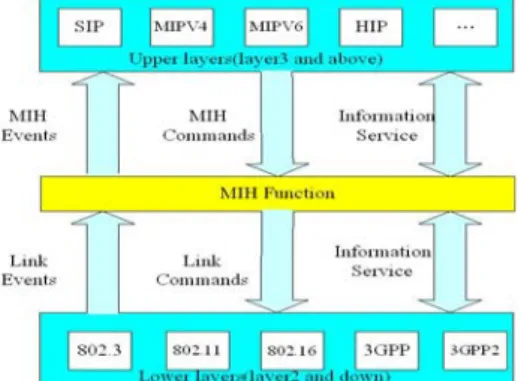
The first standard of IEEE 802.21 [1] was adopted in 2006. The purpose of the IEEE 802.21 is to achieve the seamless handoff among heterogeneous communication systems. The basic architecture of IEEE 802.21 establishes a Media Independent Hand- over function (MIH) between Layer 2 (MAC Layer) and Layer 3 (Network layer), as shown in Fig. 1.
Fig. 1. Architecture of MIH function.
The Media Independent Handover function provides a Service Access Point (SAP) on the bottom in order to communicate with the physical layers (Layers 1 and 2). Further, the above layer (Layer 3 above) can ask for required information through the Media Independent Handover function. The Media Independent Handover function generally provides three types of services: Event Service, Command Service, and Information Service. The MIH Event Service (MIES) provides services including event classification and event filtering. The MIH Information Service (MIIS) has the capability for obtaining necessary information for the handover that includes neighboring maps, link layer information, and services availability. The MIH Command Service (MICS) accepts the
management and control command from the above layers and enables MIH users to manage and control link behaviors relevant to handovers and mobility.
Many researches are based on IEEE 802.21 standard [2-8], and paper [7] is taken as an example. This paper proposed a SCTP-based IEEE 802.21 middleware to achieve seamless handover and handoff decision device that assists to solve network selecting problems, operates the IEEE 802.21 executing handover procedures and collation, and evaluates information of server provider.
3. SYSTEM ARCHITECTURE AND IMPLEMENTATION
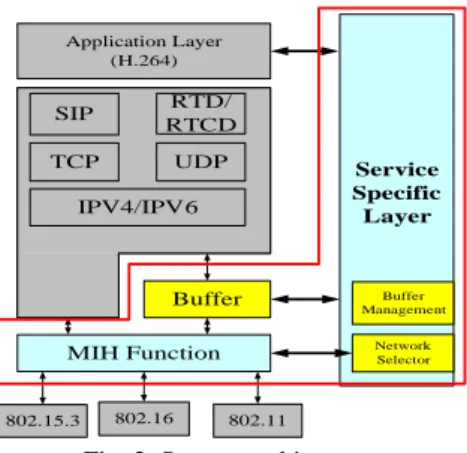
With the purpose of media independent handover between heterogeneous networks, this paper proposes an IEEE 802.21 based middleware device, which is composed of three sub-areas: Service Specific Layer (SSL), Buffer Device, and MIH Function, as shown in Fig. 2. Service Specific Layer MIH Function 802.15.3 802.16 802.11 Application Layer (H.264) Buffer SIP TCP RTD/ RTCD UDP IPV4/IPV6 Network Selector Buffer Management
Fig. 2. System architecture.
When a mobile device moves from a network service to another, the Service Specific Layer can get the information of new network service provider by the Infor- mation Service of MIH. When the handoff event triggers, MIH will send the MIH_ Event to Service Specific Layer by Event Service. Next, the Network Selector will eva- luate which network service to select, and the Buffer Management will predict the buffer size. After the evaluation and calculation, the Buffer Management device will inform the buffer device to store data that user needs when the handover is proceeding.
3.1 Service Specific Layer
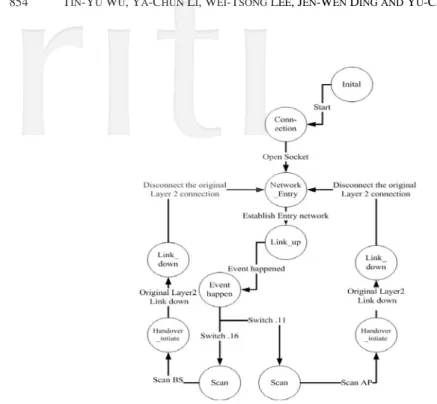
Heterogeneous handoff includes IEEE 802.16 and IEEE 802.11p networks services to explain the state process of Service Specific Layer during the handover, as shown in Fig. 3 that illustrates the states of the middleware device. The procedure starts at the first state (INITIAL), and then establishes IP connection (CONNECTING). The third state is to establish an initial network connection (NETWORK_ENTRY), and next the Layer 2 connection (LINK_UP). At this moment, if an event is triggered, it will start evaluating
Fig. 3. The middleware state process.
for network selection (Network Select_State). After the evaluation of our algorithm, Ser- vice Specific Layer will decide if the handover is necessary. If it is, Service Specific Layer will communicate with the new service provider (SCAN state) and the handoff will be performed (Handover_Initiate state). Service Specific Layer will disconnect from the previous network service (Link Down state) and return to the procedure of network connection establishing state (NETWORK_ENTRY state).
3.2 Function and Architecture of Service Specific Layer
In multi-network services, a device has to decide whether the handover should be executed or not, and this is Service Specific Layer. In order to reduce the transmission time and to accelerate the handover decision, Service Specific Layer is established be-tween MIH layer and the upper layer. Service Specific Layer connects to the upper lay-ers and accepts the Information Elements from MIH. When the handover event trigglay-ers or the handoff command is proposed, Service Specific Layer will choose the most suit-able network according to the Information Elements.
The most important two parts of Service Specific Layer are Network Selector and Buffer Management. When the handoff event triggers, Network Selector will evaluate the network condition and choose the most suitable network service. On the other hand, Buffer Management will predict the buffer size according to our proposed algorithm. Afterwards, buffer management adjusts the buffer device to a suitable size to store users’ needed data during the handoff. As mentioned before, during the handoff, there will be service disconnection in one time period, which makes users uncomfortable. The pur-pose of seamless handover is for users to ignore the handoff progress.
3.3 Network Selector Device
The network selecting strategy is to set IEEE 802.11p as high priority. In other word, if two kinds of network services, IEEE 802.16 and IEEE 802.11p, coexist, IEEE 802.11p network service will be adopted, and IEEE 802.16 network service will be taken as the backup network service.
3.3 Buffer Device
When the handoff is executing, the network service will be disconnected in certain time period and data cannot be transmitted. At this moment, users may sense the inter-ruption of the service. Thus, the purpose of seamless handover is to let users not con-scious of the interruption during the handoff and for this reason, Buffer Device is estab-lished. During the handover, users’ required data will be stored in the buffer device and users will not be aware of any change of the service quality.
4. BUFFER MANAGEMENT AND SIZE PREDICTION
As mentioned previously, during the handoff, the service disconnection in one time period will make users uncomfortable. The aim of seamless handover is to make users ignore the handover progress.
4.1 Buffer Size Prediction Algorithm
Fig. 4 illustrates the proposed buffer size prediction scheme that consists of four ba-sic components: Buffer Device, Buffer Management Device, Service Specific Layer (SSL) and MIH function (MIH). Buffer Device is used to pre-store the data for the handoff and Buffer Management Device is responsible for executing the prediction rules for the buffer efficiency. As the role of middleware to communicate with MIH function, SSL has the network selector device to evaluate which network is worth changing. In addition, the MIH function is the implementation of the IEEE 802.21 to work for seamless handoff.
When MIH LINKUP event triggers, the SSL network selector will evaluate the new network and the current network. If the handoff is necessary, SSL will send the buffer management device a command to initial the buffer size prediction process, and buffer management then will predict the buffer size with the following three main steps:
Step 1: Once receiving the initial command from SSL, the buffer management device
calculates the required network service exchange time that is recorded as “TH” (the unit for TH is micro seconds) during the handoff.
Step 2: The buffer management device then calculates the required data volume
corre-sponding to the TH value. The required pre-stored data volume will be ex-pressed as “BH” (the unit for BH is byte.) After calculating the BH value, buffer management will send buffer device a BM_BS.IND message to inform the buffer device to adjust the buffer size and get ready to pre-store the required BH volume data.
calculate and predict the required data size, and then dynamically adjust the buffer de-vice to store the required data during the handoff. From the original network serde-vice is disconnected to the new network service is established completely, users will not sense the interference of the service. With this system, we further approach the purpose of seamless handoff.
REFERENCES
1. IEEE P802.21/D11.0, “Draft standard for local and metropolitan area networks: me-dia independent handover services,” IEEE P802.21/D11.0, 2008.
2. M. G. Williams, “Directions in media independent handover,” IEICE Transactions
on Fundamentals of Electronics, Communications and Computer Sciences, Vol.
E88-A, 2005, pp. 1772-1776.
3. L. Vollero and F. Cacace, Managing Mobility and Adaptation in Upcoming 802.21
enabled devices, ACM Press, NY, 2006.
4. A. Garg and K. C. Yow, “Determining the best network to handover among various IEEE 802.11 and IEEE 802.16 networks by a mobile device,” in Proceedings of the
2nd International Conference on Mobile Technology, Applications and Systems,
2005, pp. 1-6.
5. Y. M. Chen, M. Y. Lai, S. C. Lin, S. C. Chang, and T. Y. Chung, “Sctp-based hand-off based on MIH triggers,” Information in Campus Networks, in Proceedings of the
8th International Conference Advanced Communication Technology, Vol. 2, 2006,
pp. 1297-1301.
6. W. C. Wang, C. H. Hsu, Y. M. Chen, and T. Y. Chung, “SCTP-based handover for VoIP over IEEE 802. 11 WLAN using device virtualization,” in Proceedings of
IEEE International Conference on Advanced Communication Technology, 2007, pp.
1073-1076.
7. C. T. Tsai, Y. T. Lien, R. H. Jan, and Z. T. Chou, “Realization of media independent handover process: an IEEE 802.16 network service as example,” Mobile Computing
Workshop, 2007.
8. X. Yang and T. J. Owens, “Intersystem soft handover for converged DVB-H and UMTS networks,” IEEE Transactions on Vehicular Technology, Vol. 57, 2008, pp. 1887-1898.
9. S. Choi, M. S. Alouini, K. A. Qaraqe, and H. C. Yang, “Finger replacement schemes for RAKE receivers in the soft handover region with multiple base stations vehicular technology,” IEEE Transactions on Vehicular Technology, Vol. 57, 2008, pp. 2114- 2122.
10. S. Lee, K. Sriram, K. Kim, Y. H. Kim, and N. Golmie, “Vertical handoff decision algorithms for providing optimized performance in heterogeneous wireless net-works,” IEEE Transactions on Vehicular Technology, Vol. 58, 2009, pp. 865-881. 11. C. S. Chiu and C. C. Huang, “Combined partial reuse and soft handover in OFDMA
downlink transmission,” IEEE Transactions on Vehicular Technology, 2008, pp. 1707-1711.
12. M. Aguado, J. Matias, E. Jacob, and M. Berbineau, “The WiMAX ASN network in the V2I scenario,” in Proceedings of the 68th IEEE Vehicular Technology
Confer-ence, 2008, pp. 1-5.
13. S. Bangoae, C. Bell, and E. Qi, “Performance study of fast BSS transition using IEEE 802.11r,” in Proceedings of International Conference on Communications and
Mobile Computing, 2006, pp. 737-742.
14. T. Y. Wu, R. W. Jhang, and H. C. Chao, “Efficient architecture and handoff strategy used for VoIP sessions in SIP based wireless networks,” Wireless Personal
Commu-nications, Vol. 43, 2007, pp. 201-214.
Tin-Yu Wu (吳 庭 育 ) currently works as an Assistant Professor in the Department of Electrical Engineering, Tamkang University, Taipei, Taiwan. He received his M.S. and Ph.D. degrees in the Department of Electrical Engineering, National Dong Hwa University, Hualien, Taiwan in 2000 and 2007 respe- ctively. His research interests focus on the next-generation inter- net protocol, mobile computing and wireless networks.
Ya-Chun Li (李亞峻) was born in Taipei, Taiwan, in 1986. He was graduating from Tamkang University in the end of 2008. Currently he serves the country in air force as electronically officer and he is still a member of the embedded system Lab in the Department of Electrical Engineering of Tamkang University.
Wei-Tsong Lee (李維聰) received B.S., M.S. and Ph.D. degrees in Electrical Engineering from National Cheng Kung University, Tainan, Taiwan. In 2003, he joined the department members of Electrical Engineering of Tamkang University as Associate Professor, and reached professor in 2007. His research interests are computer architecture, micro-processor interface and computer network.
Jen-Wen Ding (丁建文) is an Associate Professor of the Department of Information Management, National Kaohsiung University of Applied Sciences, Kaohsiung, Taiwan. He received his B.S., M.S., and Ph.D. degrees in Engineering Science from National Cheng Kung University, Tainan, Taiwan, in 1996, 1998, and 2001, respectively. His research interests include video streaming and multimedia communications. He has authored/ co-authored over 30 refereed papers in journals, conference, and workshop proceedings. He also holds several patents in multime-dia storage and communications. He received the Best Paper Award of 2007 Asia-Pacific Workshop on Visual Information Processing (VIP 2007). Dr. Ding was the Editor of the proceeding of 2008 Pacific-Rim Conference on Multimedia (PCM 2008) and the Guest Editor of the Special Issue on Ubiquitous Multimedia Com-puting: Systems, Networking, and Applications for International Journal of Ad Hoc and Ubiquitous Computing (IJAHUC). He has been invited to serve on technical program committee at many national and international conferences. He is also a member of the IEEE as well as IEEE Circuits and Systems Society.
Yu-Chin Wang (王裕欽) was born in Kaohsiung, Taiwan, in 1983. He received B.S. and M.S. degrees in Electrical Engi-neering from Tamkang University in 2008. Currently he is an associate engineer of Department of Mobile Phone in Inventec, http://www.inventec.com/.