全球客家研究,2014 年 5 月 第2 期,頁 301-336
301
The Timorese Hakka in Australia:
Community and the Internet
Daniel Chew
*Visiting Research Fellow, Institute of East Asian Studies, Universiti Malaysia Sarawak, Malaysia
J. Sonia Huang
Associate Professor, Department of Communication and Technology, National Chiao Tung University
The Timorese (also known as East Timorese) Hakka diaspora in Aus-tralia is a consequence of recent waves of migration sparked by civil war and subsequent Indonesian intervention and rule on the island from 1975 to 1999. This paper examines how the Timorese Hakka re-established and imagined themselves as a community in Australia, particularly in Melbourne. It is argued that the imagined community of the Timorese Hakka in Australia is shaped by a mix of historical and cultural factors. Portuguese colonial rule, the role of Taiwan’s assistance in providing Chinese education, Indonesian rule and recent migration to Australia are historical influences on the imag-ined community. Cultural markers for the Timorese Hakka are the Hakka
lan-* E-mail: [email protected] Date of Submission: January 30, 2014 Accepted Date: April 8, 2014
guage and Mandarin, and mixed cultural forms influenced by a long period of Portuguese colonial rule on East Timor. Finally, social associations set up by the community after arriving in Australia, and still functioning vibrantly, enable individuals and families to establish social bonds and relations in a new environment.
Historical and cultural factors influence the Timorese Hakka to imagine themselves as a distinct community in Australia. However there are also indi-cations that the Timorese Hakka use the Internet to reinforce these feelings of a community sharing a common background. The Internet has a role in help-ing to shape the cultural identity of the Timorese Hakka in Australia. The first generation Timorese Hakka elders, who are concerned with the loss of their cultural identity, have been adept in connecting their real and virtual commu-nities through the Internet and relying on conventional physical interactions through the social associations.
Keywords: Timorese Hakka, imagined community, history, cultural identity, social associations, the Internet
The Timorese Hakka in Australia
303
東帝汶客家人在澳洲:社群與網路
周丹尼
* 馬來西亞砂拉越大學東亞研究所客座研究員黃靜蓉
國立交通大學傳播與科技學系副教授 東帝汶客家人在澳洲是一種被迫的流離失所。長期接受葡萄牙殖民 統治的東帝汶於1975 年被印尼入侵和占領,有長達 25 年的時間,當地 內戰不斷,造成數以萬計的人民死亡。其中不少華人(客家人居多)因 印尼排華政策,紛紛以難民或移民的身分,投奔到鄰近的澳洲。因此本 研究企圖檢驗東帝汶客家人在澳洲如何重建和想像自己成為一個共同 體,我們發現東帝汶客家人受到過去歷史和文化,如葡萄牙殖民政策、 臺灣中文教育、和印尼佔領等因素交錯影響,逐步形塑其特有的想像共 同體。當然,澳洲活躍的社團組織也為離鄉背井的個人和家庭提供社交 和娛樂的新環境。 除了歷史和文化的多元背景塑造東帝汶客家人在澳洲的想像共同體 外,我們也發現網際網路在覆蓋率相當高的澳洲,扮演促進東帝汶客家 文化認同的重要角色。其中,第一代移居澳洲的東帝汶客家人危機感最 強,紛紛透過自修或者子女,學習如何使用網路,企圖運用網路無遠弗 屆的特性連結實體和虛擬社群,持續建構屬於他們自己的想像共同體。 關鍵字:東帝汶客家、想像共同體、歷史、文化認同、社會組織、網際 網路 * 投稿日期:2014 年 1 月 30 日 接受刊登日期:2014 年 4 月 8 日Introduction
The Hakka, one of the many sub-ethnic Chinese speech groups in Aus-tralia, come from mainly Southeast Asia, arriving on the continent in more recent times since the dismantling of the White Australia policy in the early 1970s. The White Australia policy prohibited Asian immigration to Australia, aroused by racism fears that Asian immigration would overwhelm the small Anglo-Celtic population. The policy was abolished by a new incoming Labor government in the 1970s which was more sympathetic towards Asians wish-ing to come to Australia. These changes in immigration policies made it eas-ier for Asians to move to Australia and it is against this background that the story of the Timorese Hakka in Australia unfolds. The Timorese Hakka, one of the smallest Chinese communities in Australia began to settle in Australia after 1975 when there was civil war followed by Indonesian intervention and rule on the former Portuguese colony of East Timor. The objective of this paper is to examine how the Timorese Hakka re-established themselves in a new environment, and the basis for their community formation and identity. A thematic approach is taken to illustrate how the Timorese Hakka formed an imagined community in Australia. The movement of the Timorese Hakka to Australia, it will be argued here, fits in within the framework of an imagined community (Anderson 1991), a community that re-organized itself on the ba-sis of a shared history and shared culture in a new destination. According to Anderson (1991: 6)
The Timorese Hakka in Australia
305
face-to-face contact (and perhaps even these) are imagined. Communities are to be distinguished, not by their falsity/ genuineness, but by the style in which they are imagined.
The circumstances, almost the mass re-location of the Timorese Hakka in Australia, make it appropriate as a case study to examine how disparate individuals and families re-establish themselves in an alien environment. Borrowing from and building on Anderson’s (1991) model, we examine what constitutes this imagined community of Timorese Hakka. The authors of this paper define the imagined community as a sum of historical and cultural factors emanating from East Timor, shaped further by the use of the Internet. This “imagining” process of community building is manifested in the strong presence of social associations, a common feature found in ethnic Chinese communities overseas, and through the efforts of key individuals in keeping the Timorese Hakka identity alive through both physical and cyber pathways. Being a part of this imagined community of Timorese Hakka also means identifying oneself as Timorese hailing from Timor, of persons who speak Hakka, and Mandarin to some extent, at home and in interactions among themselves. This marks the imagined community of Timorese Hakka from “others” in Australia which has a majority European population and many communities or groups from Asia and the rest of the world.
The paper begins with the historical background of the Hakka in East Timor. The community’s cultural identity carried over to Australia may be likened to “a process of nation-ness and nationalism comprising communities created by a distillation of historical forces which are modular and capable of
being transplanted to various social terrains.” (Anderson 1991: 4) This trans-planting process brought along with it “cultural artefacts” (term borrowed from Anderson), a term broadly defined here as including languages, social organizations, celebrations of milestone occasions like birthdays and new year, and intangible feelings of being Timorese Hakka, cultural forms which help to define cultural identity.
The ethnic Chinese in East Timor are overwhelming Hakka, comprising 95 % to 97% of the total number of Chinese, originally from Meixian ( 梅縣 ) with a small minority of Cantonese. Even those who are Cantonese are accul-turated to the Hakka and speak Hakka, or may have married Hakka spouses. About 5500 Timor-born Hakka live in Australia according to the 2011 census (Community Relation Section, Department of Immigration and Citizenship 2014) with only a small number still in Timor. This research on the Timorese Hakka examines the circumstances for Hakka identity formation in an envi-ronment outside its homeland, the homeland here not being the original place of origin, Meixian, but the second “homeland” of East Timor, now known as Timor Leste. This two-step process of migration is not peculiar to the Ti-morese Hakka as there are Hakka from Malaysia, Vietnam and Singapore, and even from Taiwan who have moved on to another country like Australia. Fieldwork for this study was undertaken from 10 to 14 September 2013 in Melbourne which is one of the main city centres where Timorese Hakka re-side (see Appendix for a list of interviewees). The discussions in this paper pertain to Timorese Hakka who live in Melbourne. The terms Timor and East Timor are used interchangeably, as well as Timorese Hakka and Timorese Chinese, since the later are mostly Hakka.
The Timorese Hakka in Australia
307
The Hakka in East Timor
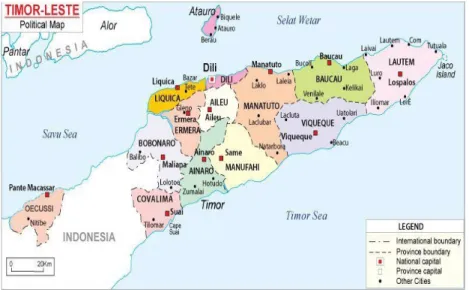
The longue duree (long duration) of East Timor’s past was influenced by the interstices of geography and the peopling of the island at the crossroads of maritime Southeast Asia, west of which was the Indonesian archipelago; to the north lay the continental landmass of East Asia, and to the south, the Australian continent (Figure 1). The original inhabitants of the island were from the east of the island comprising people of Melanesian background, and from the west, people of Malay/Indonesian heritage.
Figure 1: The Map of Timor-Leste
Colonialism brought in the Portuguese in the 16th century while the
Chinese who first came to trade in sandalwood in the 14th century, arrived in
TECC Vic (Timor Ethnic Chinese Community of Victoria) was asked about the livelihoods of the Timorese Hakka he said:
Mostly trading, small shops, milk bar type of business. Timor is a small country. Some people work as employees, teachers, some work for the Portuguese government. Not many farmers. A lot of poor people…My father was a car mechanic. Mother was a housewife. She makes cakes, she sells. Also betul nuts, banana fritters. (Li Lai, 2013/09/10)
These three main groups of people, the small band of Portuguese co-lonialists, the Chinese minority traders and the majority natives, co-existed under the auspices of Portuguese colonialism from 1502 until 1975. The small and single Portuguese enclave on East Timor surrounded to the west by the vast Indonesian archipelago, previously under the Dutch, was an ab-erration. The sudden collapse of the Portuguese government in 1974 and the dismantling of its colonial empire which led to a unilateral declaration of independence of East Timor in 1975, invited a swift Indonesian military re-sponse concerned with the prospect of an independent nation at its doorstep. The years of Indonesian rule between 1975 and 1999 destabilised the small island state with ongoing guerrilla war resistance waged against Indonesian rule. This period of turmoil and war has been described as responsible for the direct and indirect deaths of more than 200,000 people, a third of the population (Wikipedia 2014). These well documented events bear brief rep-etition here for they were responsible for the almost mass re-location of the
The Timorese Hakka in Australia
309
Timorese Hakka population to Australia.
From our interviews with the Timorese Hakka who lived through this period, memories of hardship and of differences of life under the previous Portuguese colonialists are gleaned. A privileged life of occupying an inter-mediate social status between the Portuguese and the indigenes is remem-bered. With Indonesian rule from 1975 to 1999 this social standing was lost when Indonesia as an occupying force and ruler became an unwanted and disliked colonizer. According to a newspaper article dated March 13, 1999: “The Chinese population in Dili, East Timor’s capital was targeted for se-lective killings. Five hundred were put to death on the first day of the attack, East Timorese exiles and survivors say.” ( http://atimes.com.com/se-asia, accessed on 16 January 2014). Linda Kuo remembered the hardship of life under Indonesian rule:
When Indonesia invaded Timor, everyone fled. They come and search for rebels all the time. Life was hard. I remem-ber when they first came, in the first year, we had nothing to eat, just rice porridge. People loot the shops. (Linda Kuo, 2013/09/02)
The brutality of the Indonesian soldiers who would not hesitate to kick the local people on the shins if not attended to immediately is recalled by the Timorese Hakka we met at TECC Vic in September 2013. There was also a propensity on the part of the soldiers to take goods without payment, and to ask for exorbitant prices for the supply and sale of goods. Used to
the law and order regime of the Portuguese, life under the Indonesians was described as chaotic with little respect for rules and regulations. Ironically, it was this disregard for the rule of law that allowed the Hakka to leave the island for Australia through the bribery of officials. “In Indonesia no matter what happens, money is almighty. Our people in major towns went to Portu-gal, they bribe, they leave. The Indonesians take the money, they let you go (2013/09/12),” said Susan Lai. While Indonesian rule was regarded as harsh there was acknowledgement of a positive change as in road building accord-ing to Lai. “Indonesia improved the roads. Portuguese have been in Timor for four hundred years, not much improvement.”
Faced with hardship and an ongoing guerrilla war, and a general dis-dain for the new Indonesian masters, many Timorese Hakka chose to leave. The proximity of Australia to East Timor and its sympathetic response to the plight of the Timorese who wanted to leave Timor opened up opportu-nities for a new life in Australia. The first refugee boats from Timor arrived in Darwin in 1975. Susan Lai who was recruited by the Australian govern-ment went to Dili the island’s capital to help identify the Timorese who had applied and had been accepted to come to Australia. Slowly the numbers of Timorese Hakka who were able to come, increased, and they fanned out to the cities of Darwin in the north, Brisbane in the northeast, and to the eastern cities of Melbourne and Sydney. A referendum in 1999 unanimously rejected Indonesian rule and favoured independence, and East Timor became an inde-pendent nation. Pro-Indonesia militia targeted Chinese residences for arson and this prompted another wave of movement among the Timorese Hakka towards Australia.
The Timorese Hakka in Australia
311
We next consider the pertinent components of Timorese Hakka identity, the cultural artefacts (Anderson 1991) carried over to the new destination, Australia. An essential element is cultural content, in particular the Hakka language that defines who the Timorese Hakka are, and how they construct an imagined community.
Cultural Artefacts of the Timorese Hakka
My grandfather spoke Hakka to my father and expected him to speak Hakka, and in turn my father spoke to me in Hakka and expected me to speak Hakka. I speak Hakka to my sons. (Ni Tec Leong, 2013/09/14)Our grandparents pass on the tradition to us. We still carry on. We speak Hakka at home. (Lucilia Lim, 2013/09/12) I speak Hakka at home. Parents speak Hakka to me. In the community, everyone speaks Hakka. (Linda Kuo, 2013/09/12)
The ability to speak Hakka and its transmission to succeeding genera-tions is identified as a cultural marker of being a Hakka. Ni Tec Leong, the President of TECC Vic (Timor Ethnic Chinese Community, Victoria) was adamant on this, and with it, the ability to speak Mandarin for those who claimed to be ethnic Chinese. Li Lai concurred with the above views, saying,
“Hakka have very strong Chinese identity, we speak the Hakka language (2013/09/10).” Ni Tec Leong explained how Chinese schools reinforced the Hakka identity in East Timor:
In Timor, strong Chinese culture. You have to go to Chinese school first. Two hundred years ago, where got Chinese school? Timor Hakka sent for teachers, books from Meixian. Until 1975, more than 20 Chinese primary schools. Timor is a small island. Even five families build a school. Business people support us well. (Ni Tec Leong, 2013/09/14)
Anderson (1991: 44-45 ) postulates that the invention of print-languages laid the bases for national consciousness in distinct ways which facilitated exchange and communication, gave fixity to language and conferred power upon those who attained fluency in the language. Mandarin with its written forms, and with the emphasis given to it in Chinese schools by Timorese Hakka, fits into this defining role of consciousness raising. However, fluency in Mandarin is just another layer of identity and among the Chinese overseas it is possible to have multiple identities (Wang 1988: 11). It would appear that Hakka is the more commonly used language at home and in communication outside the home, a self- definition of who is a Timorese Hakka. Speaking Hakka at home was true in the past in East Timor and even now in Australia. Mandarin is the formal language which is used officially and to some extent in daily life. Hakka and Mandarin are not mutually exclusive languages and language switching in communication is possible. Fluency in Mandarin can
The Timorese Hakka in Australia
313
create a situation of power differential especially for those individuals who benefited from going to Taiwan for higher education.
Among the older generation Timorese Hakka in Australia there is a com-petent level of fluency in Mandarin. Taiwan played a big role in encouraging fluency in the language. Taiwan had a consulate in Dili the capital until 1975 and it supported the only Chinese middle school in East Timor with Chinese textbooks and teachers. Before Mandarin was introduced, Hakka was used in the schools. To continue with further education beyond middle school, promising students were encouraged to go to Taiwan for their further stud-ies. Two active community leaders we met in Melbourne, Van Lay and Vitor Jong, were educated in Taiwan although the later had to forgo his studies due to financial reasons with the events and unfolding turmoil of 1975 in East Timor. The initiator of the Timorese Facebook group Timorlo Club, Nenica Rose Chung, went to Taiwan to study as a young child. Indeed, many of the postings in Timorlo Club are in Mandarin. Taiwan lost its role in East Timor in 1975, closed down its consulate and ceased its assistance to the Timorese Chinese in education but the long term impact of its past involvement can be felt today with key persons in the community attaining Mandarin fluency.
Although Hakka is an exclusive language albeit with some Indonesian and local words creeping in according to Linda Kuo, the older Timorese Chi-nese learned and mastered other languages like Portuguese, and when Indo-nesia ruled the island, learning the IndoIndo-nesian language. When we were in-vited by Anita Lim and Lai Kuet Him to their home for a meal, we found out that they had karaoke songs in Indonesian when we adjourned for karaoke singing. When their niece Lucilia Lim visited later in the evening, she sang
Indonesian songs. Some interviews conducted by the researchers at TECC Vic and the East Timor Chinese Middle and Aged Association were done in Indonesian.
A local indigenous language, Tetum, is another language which the Hakka claimed fluency in for dealings with the indigenes in East Timor and this was a necessity for trading transactions. Upon coming to Australia, a new language, English had to be learned. The multi-lingual fluency of the Timorese Hakka is similar to that of Hakka in Sarawak, Malaysia where it is the norm to speak several languages, Hakka, Mandarin, Malay and other in-digenous languages. According to Li Lai, “most overseas Chinese speak mul-tiple languages” (2013/09/10) and Lai himself can speak some Portuguese, French, Indonesian and Tetum, in addition to fluency in Hakka, Mandarin and English.
Two key persons Linda Kuo and Susan Lai, who assisted us much in this project by arranging contacts for us to meet, are multi-linguists who speak Hakka, Mandarin, English, Tetum and Indonesian, and both are ac-credited interpreters who do a lot of interpreting and translating work for the community.
While the first generation Timorese Hakka in Australia have managed to retain much of the cultural artefact of speaking Hakka, and to an extent Mandarin, Hakka language transmission to the children born in and exposed to Australia remains an issue. There is unanimity of views among the elders that the young Timorese Hakka do not show much enthusiasm for mastering Hakka, let alone speak the language. “Oh, don’t talk about the young people, they are not interested. They are more interested in Australia,” (2013/08/2)
The Timorese Hakka in Australia
315
lamented Liong Cuet Liong, Secretary of the Northern Territory Timor Chi-nese Association in Darwin when asked for his views on young Timorese Hakka speaking Hakka. Practical reasons have been given for this lack of in-terest such as the English speaking environment in schools and the children’s preference for speaking English rather than Hakka. To encourage the usage of Hakka, Van Lay runs a Hakka radio programme which is aired once a week. Several of our interviewees highlighted this problem of lack of fluency in Hakka among the younger generation Timorese Hakka.
I have a cousin, aged 25 years. She does not speak Hakka. Uncle and Aunty were busy at work. The children grew up by themselves. Parents were uneducated. When children bring back school homework, they don’t know what to do. The parents speak Hakka to them, they reply in English. Uncle’s and Aunty’s English is not good. (Linda Kuo, 2013/09/12)
When asked further what parents in such a situation would do, Linda Kuo’s reply is: ‘They can’t do anything. They did not receive education during the war. Children control the parents. The elders’ view is “it is up to them, I didn’t go to school.’ (2013/09/12) Another example from Lucilia Lim illustrates the difficulty of communicating in Hakka to younger Timorese Hakka:
in Hakka they answer in English. I try to trick a friend’s daughter. When she asked me a question in English I pre-tend I don’t understand her. I said, “talk to me in Hakka.” She thinks and thinks, “ You don’t understand me, that’s okay, I will look for my mummy.” (Lucilia Lim, 2013/09/12)
The dilemma of the first generation Timorese Hakka who only speak Hakka and Mandarin while the second and third generation descendants speak English is summed up by Ni Tec Leong:
Like him, him [pointing to Fujing Cu and Tchon Tchen Hau, Vice Presidents of TECC Vic] they cannot speak English, how to speak to the children in English. Your children have to speak in Hakka to communicate with daddy. With grand-son have to speak Hakka with the granddad. (Ni Tec Leong, 2013/09/14)
Notwithstanding the generational language issues, there is a willingness among the elders to learn other languages and with it a readiness to absorb cultural elements from other cultures. Due to the long period of Portuguese rule on the island, there was conversion to Catholicism and taking on some western customs. From our understanding there was only one temple in Dili dedicated to Kuan Ti ( 關帝 ). Western celebrations like the English new year, 1th January had taken a hold on the Timorese Hakka, a practice which
The Timorese Hakka in Australia
317
ty today instead of any of the Chinese cycle of festivals. It was explained to us that the lunar Chinese New Year was not observed in Dili although outside the capital the Chinese celebrated the occasion and Li Lai who lived in a small town outside the capital “visited every house during Chinese new year” (2013/09/10). When queried about the observance of the calendrical cycle of Chinese festivals in Australia we were told it was done but individually at home or in the association premises.
While there appears to be strong strands of western influences on the Timorese Hakka, we were informed that elements of Chinese culture stood alongside the Catholic religious influences in the case of life events like fu-nerals where it was acceptable to have Catholic rites alongside the Chinese rites which followed the former.
In our observations, it seems that mixed forms of cultural identity are evident, speaking multiple languages on top of the core Hakka language and taking on western celebrations such as new year and birthdays. The bigger question is how historical factors and “cultural artefacts” in Anderson’s words, constitute the imagined community of the Timorese Hakka. For this we turn next to the social organizations where the Timorese Hakka interact with each other to maintain their feeling of belonging to an imagined com-munity. There is a Timorese identity, of being Timor lo or Timor ngin which is encapsulated in the Timorese Chinese social organizations which become cultural markers distinguishing them from other Chinese, indigenous Ti-morese and Australians. The TiTi-morese Hakka are just as conscious of the fact that as they hail from Timor they have a Timorese identity as well as being Hakka. The concept of layers of identity is useful to apply here, for people
can assume multiple identities. They can be Australian, Asian-Australian, Timorese Chinese or Hakka, or Timorese, and which identity or identities they assume would depend on circumstances. For the virtual community, Timorlo Club, meant for Timorese all over the world, the Timorese identity is stressed. In contrast, in the context of the associations in Melbourne, the Timorese Hakka can have identities of being Timorese Chinese or Timorese Hakka, if the semantics of the names of the associations are examined: Timor Ethnic Chinese Community, Victoria, East Timor Chinese Middle and Aged Association, and the newest association, the Federation of Timor Hakka As-sociations.
Imagining the Community through
Social Associations
“With the associations, it looks like they have nothing in there, but they are solid.” (Linda Kuo, 2013/09/1) Social organizations for the Chinese overseas serve a role in bringing people together for social interactions and to meet their needs especially if they are living in and adjusting to new unfa-miliar surroundings. This was the case for the Timorese Hakka in Melbourne where there are three associations, including a newly set up organization. Although one of the smallest Chinese communities in Melbourne, they are arguably one of the most active in terms of membership and organized ac-tivities. This activism could be due to the efforts of the Timorese Hakka in constituting their imagined community. The first two associations established by the Timorese Hakka in the early 1980s were the Timor Ethnic Chinese
The Timorese Hakka in Australia
319
Community (TECC Vic) Association of Victoria and the East Timor Chinese Middle and Aged Association and both associations organise similar social activities. The initial objectives of the associations, with government assis-tance, were to assist the new Timorese Hakka arrivals adjust themselves to new surroundings, learn the English language, handle daily issues in housing and transport, and deal with government bureaucracy, in short, dealing with the myriad issues necessary to live in a new country. Besides handling these challenges of a new life in Australia, the associations were useful as vehicles for the Timorese Hakka to forge their cultural identity.
The existence of multiple associations with similar objectives and activ-ities was explained to us as due to language, age and personal differences. As related by Alfredo Sam, interestingly a Teochew and claiming to belong to only one of three Teochew families, and he was a past President of the Timor Chinese Middle and Aged Association and now the Vice President of the newly established Federation of Timor Hakka Associations:
We talk when we meet but different. Middle and Aged Asso-ciation are for those above 40 years. They are mostly Chi-nese educated, and many went to Taiwan to study. TECC Vic has younger members, some are Chinese educated, others have Indonesian and Australian education. (Alfredo Sam, 2013/09/14)
Li Lai explained the role and functions of the association he once head-ed, TECC Vic:
We organise father’s day, mother’s day, new year’s day. On the first day of the first month of the year, about 2,000 peo-ple turned up, now only 700. New year’s gathering is the biggest, from 6 pm til the next morning, dancing, singing, eating. It is the only time for people to meet… We have a birthday gathering every month. There is eating, dancing. Everyone comes in with kids. Every year we have scholar-ships to give to top students. When someone dies, we sent out letters to inform people. (Li Lai, 2013/09/10)
Anderson (1991: 141) argues that attachments or feelings, the “natural ties” making up the “beauty of gemeinscahft” contribute to the imagining of a community. In a new environment it is much easier to forge friendships and feelings of belonging to a common background. An individual we met at the East Timor Middle and Aged Association who preferred to remain anony-mous, related; “we are closer here than in East Timor.” Such feelings contrib-ute to the building of a “gemeinscahft”, where people sharing a background of coming from Timor and now living in a new land, feel a strong need to bond together. The active role of the associations in organising social activ-ities such as monthly birthdays and the English new year, 1th January, where
both old and young Timorese Hakka can meet and celebrate, can be said to bring out these feelings of being Timorese Hakka where they can make mer-ry through eating typical Timorese Hakka and other types of food, dance and sing. Announcements and the celebrations of these social activities captured on photos and videos, are posted in the Facebook web sites of the
The Timorese Hakka in Australia
321
tions. Feelings of nostalgia on the East Timor homeland are vividly shown on the Facebook web sites such as postings on Timorese Chinese who were af-fected by the civil war and Indonesian rule, the physical beauty of the island and its touristic appeal, prominent landmarks, and of the people living there. One Timorlo Club posting reminisced: “some of the old memory growing up in TL (Timor Leste), life was full of challenges and adventures!!! Crossing so many rivers (ribeiras) from Dili before reaching our destinations, home-towns, Baucau and Viqueque.” (Arlindo Mu, Timorlo Club, 13 July 2013)
The associations actively organize social activities but there is an un-derlying objective, which is to keep the Timorese Hakka identity alive. As Li Lai explained, “we worry we lose our identity and bought a centre, a hall.” (2013/09/10) Ni Tec Leong elaborated on how TECC Vic tries to maintain Timorese Hakka identity:
Every month we have the birthday event. There at the centre we get young people, the old people together to keep our culture. Everyone speak Hakka at the birthday party. No Mandarin. (Ni Tec Leong, 2013/09/14)
Although forming exclusive organisations, the Timorese Hakka social activities are open to others, and it is possible for the Timorese Hakka to be members of more than one association. There are three separate associations, and members and any Timorese Chinese for that matter can take part in the activities of the different organizations. The two Presidents of TECC Vic and the East Timor Chinese Middle and Aged Association, Ni Tec Leong
and Francisco Leong respectively, participate in each other’s activities. The Timorese Hakka can also join other Hakka associations such as the pan Hak-ka Association of Victoria with members drawn from Malaysia, Singapore, Vietnam and other countries. A Melbourne Hakka association with mainly Taiwanese Hakka members has some Hakka from other countries including those from Timor joining in. These are far smaller organisations which are not as active as the Timorese Hakka organisations. We argue that due to cir-cumstances (of war and Indonesian occupation) and historical and cultural factors the Timorese Hakka have been more active and successful in estab-lishing their imagined community.
The vibrancy of the social organizations, the fact that the Timorese Hakka have been successful in constructing their imagined community, has turned into a weakness with internal bickering and latent rivalry among mem-bers. Just as we were leaving Melbourne in mid-September 2013, a break-away group from the Timor Chinese Middle and Aged Association formed a Federation of Timorese Hakka Associations. The name suggested associa-tions which were members of a Federation with a Hakka identity, although the two organisations described above, TECC Vic and the East Timor Chi-nese Middle and Aged Association are separate entities. When Vice President Alfredo Sam of the Federation was queried as to the choice of the Federation name with a Hakka emphasis, he said the move was to capitalize on network-ing with the global Hakka diasporic associations, where he hoped to be able to host future global Hakka meetings such as the business and networking meetings, which are rotated between cities. TECC Vic has around 700 mem-bers, the East Timor Middle and Aged Association has about 600 memmem-bers,
The Timorese Hakka in Australia
323
while the Federation of Timor Hakka Associations has approximately 400 members, a third of whom are said to be younger people. Allowing for cross membership where it is possible to join more than one association and the fact that are estimates of only a few thousand Timorese Hakka in Melbourne, membership figures in relation to the community size may be said to be high.
Imagining the Community through the Internet
So far, this paper has concentrated on historical and cultural factors from which the Timorese Hakka construct their imagined community. Community elders who fear the loss of cultural identity among the younger generation who are more attracted to an Australian identity have responded to the chal-lenge and have realized that they can make use of the Internet just as they have utilized social activities in their quest to uphold their cultural identity. A situation of imagining the community in the cyber world has arisen which is linked to the real, physical world. The last part of our paper is on the role of the Internet, in the construction of an imagined community. Anderson’s imag-ined community model looks at the past and cultural factors but ignores the present especially the role of the Internet in shaping the imagined community. When Anderson constructed his influential model of imagined communities in the early 1980s, the Internet was not commercially and universally avail-able yet, as it is today. Hence we feel there is a need to explore the use of the Internet in the making of an imagined community. Variously described as vir-tual communications and cyberspace where there is no necessity for face to face interactions in time-space compressions, it is argued here that the virtual
or cyber community mimics real communities (van Djik 1997) in functioning with leadership, resources and identity as necessary catalytic factors.
Internet usage appears to be widespread in Australia compared to other first world regions. There are still notable differences when Internet penetration and use are standardized according to the percentage of people living in different countries. In North America (78.6%), Oceania (67.6%) and Europe (63.2%), Internet penetration is much higher than in other areas. As far as Oceania is concerned, the usage is concentrated in Australia; i.e., 88.8 percent of its population was using the Internet, while 53.1 percent of the population had Facebook accounts (Internet World Stats 2014). Several people we interviewed confirmed the prevalence of Internet and Facebook penetration in Australia: “I’m on Facebook for four years.” (Vitor Jong, 2013/09/14) “I opened my [Facebook] account about five years ago.” (Lucilia Lim, 2013/09/12) “I don’t really remember. It’s about when Facebook started [2004].” (Linda Kuo, 2013/09/12)
From our interviews with Timorese Hakka and Hakka from other countries in Australia, the Internet played at least three roles in forming their imagined communities of Hakka: (1) facilitate real communities (i.e., aforementioned social organizations) to initiate virtual communities (e.g., Facebook groups or pages) (2) enable virtual communities to reach out to the real world, and (3) bridge virtual communities to interact with each other. Seemingly, the imagined community becomes a composite of the real and the virtual, which echoes Anderson’s assertion of a community as a distinguished rather than a genuine one.
The Timorese Hakka in Australia
325
virtual ones, many studies showed a clear generation effect: children use the Internet more than their parents (Bakker & Sadaba 2008), but contrary to our expectation, the ones who built or administrated virtual communities were not young people, say age under 30, but leaders of the real communities, who usually were in their 40s or more. For example, the President of Hakka Association, the President’s daughter of Timor Chinese Middle and Aged As-sociation, and Secretary of TECC Vic are in charge of their Facebook routine maintenance.
I’m not that good at Facebook, but my son teaches me how to post a photo on it. Every time we get new activities, we have photos, then we just put them on… I usually check Facebook 2-3 times a week. (Quang Hung Ong, 2013/09/11) I don’t know how to use a computer but nowadays I can handwrite on iPad or iPhone to get online. I feel my life is very different now. Since my father is the President of Mid-dle and Aged Association, I feel obligated to do something for the community. (Lydia Lay, 2013/09/13)
We got the Secretary of TECC Vic to do all the postings. He is more experienced with the computer, got more time, and more enjoyable to do it. He is forty years old…he does all the Facebook. (Ni Tec Leong, 2013/09/14)
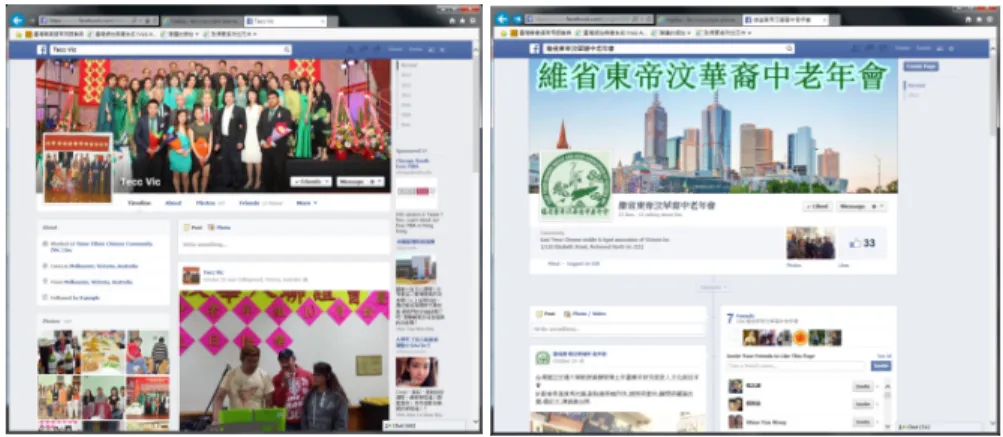
Possible reasons why young people were less involved in those Hakka communities, either real or virtual, are two. One is that most young Timorese Hakka have families, have children to look after, send to school, and pick them up after school, and so they are busy. The other is that most old Ti-morese Hakka had studied Chinese via Hakka until middle school, whereas younger ones who were born in Australia or came in their early age didn’t have the opportunity to learn Chinese and speak Hakka widely at home and beyond. As a result, younger Timorese Hakka may speak some Hakka, but may not speak Chinese, or read Facebook postings full of Chinese characters. Even though only few young people participate in the social lives of the Hakka communities including those from Timor, we found out that three social organizations in Melbourne have already set up their online presences, which were Timor Ethnic Chinse Community in 2009, Hakka Association in 2012, and Timor Chinese Middle and Aged Association in 2013. In other words, middle-aged people are the ones who actively use the Internet to pro-mote their Hakka identity. Figure 2 is an example of photos of the celebra-tions, announcements on birthday parties, etc. which show a close connection between the real and virtual worlds.
The Timorese Hakka in Australia
327
Figure 2: Facebook Page Screenshots of Timorese Hakka Associations Not only real communities but also online-only virtual communities take advantage of the Internet to help form the imagined community. A Face-book group, Timorlo Club, like its real community counterparts, helps to es-tablish the imagined community of the Timorese Hakka in Australia. Timorlo Club, launched in March 2012, though not the first one, had generated the most members (639 by January 2014) among other virtual communities of Timorese Hakka. The groups’ popularity had much to do with its administra-tor Nenica Rose Chung’s opening statement: “This group is for all Timorlo around the world. You are welcome to post parties, events details, or promote your business but not allowed to discuss politics, religion, and do personal attacks.” As a result, members of the group are not confined by geographical boundaries or physical associations. Besides, Chung is good at inviting local community leaders to the group, which creates network effects, that is, mem-bers benefit from the size of the group (Kung et al. 2008).
We didn’t join the Timorlo Club until Nenica added me be-cause she picked up people who had more friends. So far, I’ve added 60 local Timorese to the group. In the group, we talk things about Timorese, Timorese culture, Timorese parties so that you can go in there and see. (Vitor Jong, 2013/09/14)
Nenica was my classmate and she invited me to the group this year so that we can post many activities there. Also, I encourage my friends to stand up and do more postings for the community. (Lydia Lay, 2013/09/13)
The last but not least phenomenon which represents another impact of the Internet is more interactions are found between virtual communities than among real communities. According to our observation, most Timorese Hak-ka in Melbourne join one social organization at a time, and each organization host their own birthday parties, Christmas and New Year events and on so, and not many interactions may take place between organizations. Different from the real world, there are more links and shares on the Internet. For ex-ample, we found Timorlo Club links with Timor Ethnic Chinese Community; Timor Ethnic Chinese Community “friends” with Hakka Association; Hakka Association is a “fan” of Timor Chinese Middle and Aged Association. Mr Quang Hung Ong said: “Yes, we link with Timor associations. When they have any activity we can see it from our Facebook.” (Quang Hung Ong, 2013/09/11)
The Timorese Hakka in Australia
329
While the proliferation of Hakka online communities around the world would appear to be a search to connect with the real communities to un-derstand more about Hakka cultural heritage and identity, in the case of the Timorese Hakka, the initiative seems to have been undertaken by the virtual community which also has a real presence through their social associations, and community elders make use of the Internet and an online presence to help strengthen Timorese Hakka cultural identity.
Conclusion
The majority of the population of Timorese Hakka from the island na-tion of East Timor, now known as Timor Leste, has migrated to Australia due to civil war and Indonesian Occupation of the island from 1975 to 1999. The subject of this paper is on how the Timorese Hakka re-organised their new lives in their adopted environment of Australia.
Using the framework of an imagined community (Anderson 1991), his-torical and cultural factors, especially the cultural identity of speaking Hakka shape the new life experiences of the Timorese Hakka in Australia. Social associations which were set up, reinforce the cultural identity of being Hak-ka by getting members to gather and celebrate key calendar events like the English new year, 1th January and birthdays, and encourage the speaking of
Hakka by both the young and the old.
Present day influences by the Internet, not foreseen by Anderson, help to shape the real and virtual communities of the Timorese Hakka. The social associations and the Facebook group Timorlo Club, led by first generation
Timorese Hakka who are attuned to their historical past and Hakka cultural identity, attempt to connect both the physical and cyber communities of Ti-morese Hakka. At the same time, the TiTi-morese Hakka through both the Inter-net and real community interactions, hope to stem the decline of interest in Hakka cultural heritage.
As this paper is largely based on a short field trip, more research is needed to explore the interstices of interactions between the physical and vir-tual communities of the Timorese Hakka, and on the adaptations of Timorese Hakka cultural identity to Australia, especially among second generation Timorese Hakka born in Australia and who may have little notion of, or an interest in the imagined Hakka community of Timor and of its cultural past.
Acknowledgment
The authors would like to thank Chang Wei An, Dean of the College of Hakka Studies, National Chiao Tung University for his encouragement and University System of Taiwan for its financial support on this research. Our first Timorese contact in Melbourne, Felix Lay was instrumental in introducing Linda Kuo to us and this snowballed into more contacts. In particular we are grateful to Susan Lai and Eddy Chin who were very helpful and patient in bringing us around Melbourne and arranging for us to meet various key people in the community. We thank Nenica Rose Chung for introducing Facebook Timorlo Club members to us. We thank Quim Nhi Tam for his assistance and to Francisco Leong too for driving us all the way to
The Timorese Hakka in Australia
331
Kilmore to meet his daughter Lydia and husband Pedro. Last but not least a big thank you to all our interviewees, listed in the appendix, who opened themselves up to our questions and for their friendships, kindness and hospitality. The usual disclaimer applies and we alone are responsible for the interpretations in this paper.
Related References
Anderson, Benedict, 1991, Imagined Communities: Reflection on the Origins
and Spread of Nationalism. New York: Verso.
Bakker, Piet, and Charo Sádaba, 2008, “The Impact of the Internet on Users.”
In The Internet and the Mass Media, 86-102. London: SAGE
Publica-tions Ltd..
Community Relation Section, Department of Immigration and Citizenship , 2014, “Community Information Summary: Timor-Leste-born.” In
De-partment of Social Services, Australian Government. http://www.dss.
gov.au/sites/default/files/documents/02_2014/timor_leste.pdf (Date vis-ited: April 7, 2014).
Costa-Pinto, Maya and Andrea Whittaker, 2010, “East Timorese Women in Australia: Community, Gender, and Identity.” Asian and Pacific
Migra-tion Journal 19(4): 501-524.
Dunn, James, 2003, East Timor: A Rough Passage to Independence. Double Bay, New South Wales: Longueville Books.
Inbaraj, Sonny, “East Timor’s Chinese look forward to going home.” Asia
Times, March 13, 1999. http://atime.com/se-asia. Accessed on January
16, 2014.
Jardine, Matthew, 1995, East Timor: Genocide in Paradise. Tucson, Arizona: Odonian Press.
Küng, Lucy, Robert G. Picard, and Ruth Towse, 2008, “Theoretical Perspec-tives on the Impact of the Internet on the Mass Media Industries.” In
The Timorese Hakka in Australia
333
The Internet and the Mass Media, 17-45. London: SAGE Publications
Ltd..
Liao, Ching-Ting, 2007, “Constructing the Hakka Ethnic Identity in BBS: A case study of ‘Hakka Dream’ in the PTT.” Journal of Cyber Culture and
Information Society 13: 257-293.
Taylor, John, 1999, East Timor: The Price of Freedom. Annandale, New South Wales: Pluto Press.
Van Djik, A.G.M., 1997, “The Reality of Virtual Communications.” Trends in Communication, 1 (1): 39-63.
Wang, Gungwu, 1988, “The Study of Chinese Identities in Southeast Asia.” In Changing Identities of the Southeast Asian Chinese since World War
II, edited by Jennifer Cushman and Wang Gungwu, 1-22. Hong Kong:
Hong Kong University Press.
Wang, Wen-Chun, 2005, “Imagining the Hakka Community through the In-ternet.” Journal of Cyber Culture and Information Society 9: 155-184. Wikipedia, 2014, “East Timor.” In Wikipedia, the Free Encyclopedia, 20
Jan-uary. http://en.wikipedia.org/wiki/East_Timor (Date visited: January 21, 2014).