J.
PHYSIVFRANCE 7 (1997)Colloque C1, SupplCment au Journal de Physique I11 de mars 1997
Preparation and Magnetic Properties of BaFel,xCo,,SnxNiy0,9
Particles
C.H. Lin, P.C. Kuo and J.S. ShihDepartment of Materials Science, Tsing Hua University Hsinchu, Taiwan, China
*
Institute of Materials Science, Taiwan University Taipei, Taiwan, ChinaAbstract. BaFelp - z.Co.-,Sn,Ni,01 I hexagonal-plated-shaped barium ferrite powders mere prepared by chemical pri- cipitation and subsequent heat treatment to investigate the effects of Ni ion on the magnetic properties of the barium ferrite powders. Experimental results indicates that if the y value in the chemical formula is varied and the x value is maintained constant, i.e. the partial replacement of Co ion by Ni ion, the particle size and
a. of the powders sere reduced; furthermore, the BC value of the powders would be maximized at a certain y value. If the x value is varied and maintained y=O. 5x, the large the addition of (Co,~eNi,lrSn.) ions causes the more of a decrease in the o value, B e value, and curie temperature.
INTRODUCTION
Hexagonal-plated-shaped barium ferri tes are a highly promising material for perpendicular recording media,
if its Hc can be reduced for easier writing by the magnetic head. The HE of barium ferrites can be reduced
by simultaneously adding Co and Sn ions [l] to replace some FeeO3. Since Ni ion is a component of Ni-Zn
soft ferrites, adding Ni ions to replace some Co ions may affect the Hs value of barium ferrites. In this
report, the effects of magnetic properties of barium ferrites are examined by (1) partially replacing Ni
ion for Co ion at a fixed Sn ion, i. e. changing y value and maintaining the x value constant in BaFel 2-zx
C O ~ - ~ S ~ ~ N ~ , O I ~ , and (2) varying the x value and maintaining at y=0.5x. EXPERIMENTAL
Acidic aqueous solutions containing BaCl z -2Hz0, FeCla-GHzO, CoC12-Hz0, SnClr-5Hz0, and NiClz-6Hz0 were pre-
cipitated by adding NazCOa solution. Hexagonal-plated-shaped BaFe~z-z~Co~-,Sn~Ni~O~g particles were ob-
tained by washing, drying, and finally heating the precipates at 600-900°C for various times. RESULTS AND DISCUSSION
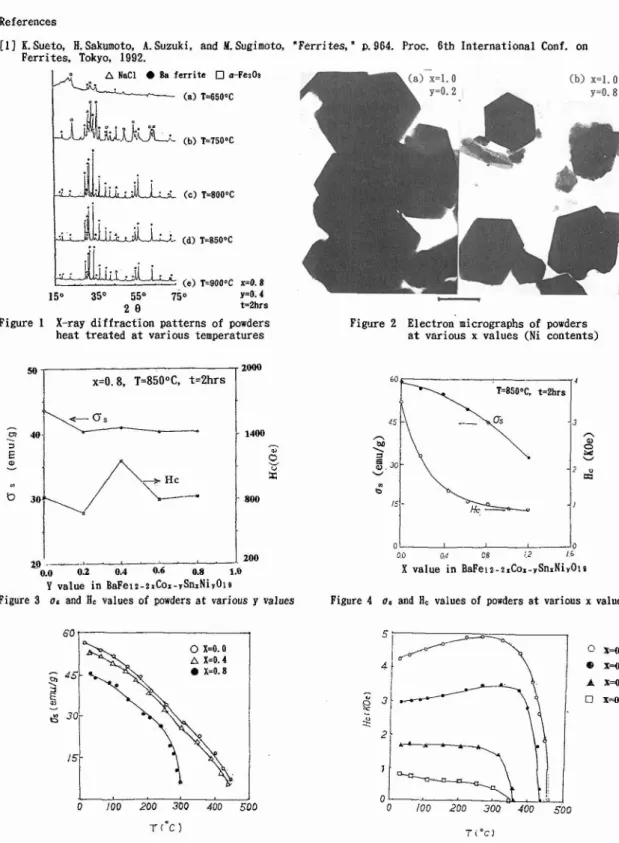
XRD analysis in Figure 1 indicates that the major phases of the precipitates after the heat treatment at 650°C is a-FezOo; barium ferrite phase starts forming at 750°C. Electron micrographs in Figure 2 reveal that the particle shape of the ferrite powders is hexagonal-plated. When the ferrite powders are heat treated at 850% for Ihr, the particle size of the ferrite powders ranges between 0.4~. to 0.25~. when the y value (Ni ion content) is between 0.2 to 0.8, while maintaining at x=1.0. Moreover adding Ni ion de- creases the particle size. While maintaining at x=0.8, adding Ni ion to partially replace Co ion, causes
the o value of the powders to decrease with the Ni ion concentration (Figure 3). However, adding Ni ion
maximizes the Hc value of the ferrite powders at y=0.4. Furthermore partially replacing Co ion by Ni ion
does not significantly affect the powders' magnetic properties. If the replacement of Co ion by Ni ion is
maintained at 50%, i. e. the formula is B a F e ~ z - z ~ C o , l ~ N i ~ / z S n ~ O ~ s, the o value and Hc value (Figure 4) de- crease with the x value, i. e. the concentration of (Co, Ni, Sn) ions. In particular the Hc value decrease
more sharply than the o value. Figures 5 and 6 also reveal that the o value and Hc value not only decrease
with the x value, but also decrease with the measuring temperatures. The curie temperature of the ferrite powders are found about 450°C for x=O and 350% for x=0.8.
C1-540
JOURNAL DE PHYSIQUE IV
References[l] K.Sueto, H.Sakumoto, A.Suzuki, and M.Sugimoto, "Ferrites," p.964. Proc. 6th International Conf. on
Ferrites, Tokyo, 1992.
A NaCl &, ferrite a-Fez03
(a) T=650°C
Figure 1 X-ray diffraction patterns of powders heat treated at various temperatures
Figure 2 ~lectron. micrographs of powders
at various x values (Ni contents)
0 L I lo
00 0L C8 12 16
X value in BaFe1z-z~Co.-~Sn=Ni~01o
...
Y value in BaFe1z-~=Co=-~Sn=Ni~019
Figure 3 oa and HC values of powders at various y values Figure 4 as and H, values of powders at various x values
T ( " c ) T t ' c )