J O U R N A L O F M A T E R I A L S S C I E N C E 3 4 (1 9 9 9 ) 1659 – 1665
A study on a Ti
52
Ni
47
Al
1
shape memory alloy
S. F. HSIEH, S. K. WU
Institute of Materials Science and Engineering, National Taiwan University, Taipei, Taiwan 106, Republic of China
E-mail: [email protected]
The Ti52Ni47Al1alloy has 16% volume fraction Ti2Ni particles in the B2 matrix with Ti2Ni
particles having a higher Al content than the B2 matrix. Transformation temperatures M∗
andA∗ of this alloy are lower than those of the Ti51Ni49 alloy due to the solid solution of the
Al atoms. M∗andA∗decrease with increasing aging time at 400◦C because the Al atoms diffuse slightly from the Ti2Ni to the B2 matrix. The hardness increment of this alloy is more
than that of the Ti51Ni49 alloy under the same degree of cold rolling. At the same time, M∗
andA∗ of this alloy can be more depressed by thermal cycling than those of the Ti51Ni49
alloy, especially in the first ten cycles. All of these features result from the fact that this alloy has a higher inherent hardness due to the solid solution of the Al atoms. This also causes the R-phase transformation to be more easily promoted by both cold rolling and thermal cycling in this alloy. The strengthening effects of cold rolling and thermal cycling on the M∗(Ms) temperature of this alloy follows the expression Ms= T0− K1σy, in whichK values
are affected by different strengthening processes. It is found that the higher the inherent hardness of the TiNi and TiNiX alloys, the higher theK values they have. °C 1999 Kluwer
Academic Publishers
1. Introduction
Near-equiatomic TiNi alloys are the most important shape memory alloys (SMAs) because of their supe-rior shape memory effect (SME) and pseudoelastic-ity (PE). TiNi alloys also have outstanding mechanical properties, biocompatibility and corrosion resistance. Substantial research has been conducted on the trans-formation behaviors and mechanical properties of TiNi binary alloys [1–4]. It has been confirmed that TiNi SMAs’ properties can be affected by various thermo-mechanical treatments, such as thermal cycling [5], ag-ing treatment in Ni-rich alloys [6–8] and cold rollag-ing [9, 10]. The transformation sequence of TiNi SMAs can
be B2→ B190 or B2→ R → B190 or simply B2→ R
under different thermal mechanical processing tech-niques composed of a high temperature cubic B2 phase,
a low temperature monoclinic B190phase and an
inter-mediate rhombohedral R phase.
The transformation behaviors and shape memory characteristics of Ti-rich TiNi binary alloys have been reported under various thermo-mechancial treatment processes [11]. Small amounts of Ti replaced by Al in
Ti50Ni50 SMA decreased the Ms temperature
signifi-cantly [12]. However, there are few reports on ternary Ti-Ni-Al SMAs. The transformation behaviors and the microstructures of the R-phase in Ti59.4Ni38.7Al1.9 alloy are affected by aging treatments [13, 14]. Additionally, the transformation sequence of Ni-rich Ti49.5Ni50.13Al0.37 and Ti47.5Ni50.65Al1.85 SMAs can
be affected by the precipitates Ti11Ni14 during the
aging [15]. To our best knowledge, the transformation behaviors and shape memory characteristics of Ti-rich
Ti-Ni-Al alloys with near equiatomic Ti/Ni ratio have not yet been reported. It is the aim of the present work to systematically investigate the general characteristics of Ti-rich Ti-Ni-Al SMAs with near equiatomic Ti/Ni ratio. The transformation behaviors and shape recovery of these alloys will be compared to those of Ti-rich TiNi binary alloys. The effects of aging, cold rolling and thermal cycling on them will also be discussed.
2. Experimental procedure
The conventional tungsten arc melting technique was employed to prepare Ti52Ni47Al1 and Ti51Ni48.5Al0.5 alloys (in at %). Titanium (purity 99.7%), nickel (purity 99.9%) and aluminum (purity 99.9%), totaling about 120 g, were melted and remelted at least six times in an argon atmosphere. A pure titanium button was used as a getter during the arc melting. Weight loss during melt-ing was negligibly small. The as-melted buttons were
homogenized at 950◦C× 72 h and then quenched in
water. The buttons were cut into several plates with a low speed diamond saw, and then solution-treated
at 850◦C× 2 h and quenched in water. After the
so-lution treatment, three experimental procedures were conducted. First, some plates were sealed in
evacu-ated quartz tubes and aged at 400◦C for 1 to 240 h
and then quenched in water. Second, some plates were cold-rolled at room temperature to 5, 10, 15 and 25% re-duction in thickness. Third, other plates were subjected
to thermal cycling N times from 0 to 200◦C with N=
1–100 cycles. Specimens for DSC measurements, hard-ness tests, shape recovery tests and microstructure ob-servations were carefully cut from plates treated by the °
above procedures. DSC measurements were made with a Dupont 9990 thermal analyzer equipped with a quan-titative scanning system 910 DSC cell for controlled heating and cooling runs on samples encapsulated in an aluminum pan. The running temperature range was
from −50◦C to +250◦C with a heating and cooling
rate of 10◦C/min. Specimens for the hardness test were first mechanically polished and then subjected to mea-surement in a microvickers hardness tester with 500 g load at room temperature. For each specimen, the aver-age hardness value was taken from at least five test read-ings. The microstructure observations were made by optical microscope (OM). The shape recovery measure-ment was performed as described earlier by Lin and Wu [16]. A quantitative analysis of alloys’ chemical com-position was performed by using a JOEL JXA-8600SX electron probe microanalyzer (EPMA) equipped with WDX analysis system.
3. Experimental results and discussion
3.1. Transformation behavior in Ti52Ni47Al1 alloy
Figs 1a and b show the experimental results of DSC measurements for the solution-treated Ti52Ni47Al1and Ti51Ni48.5Al0.5specimens in both forward and reverse
transformations, respectively. The peaks M∗ and A∗
appearing in Fig. 1 are associated with the first order
martensite transformation of B2↔ B190. The
transfor-mation behaviors of Ti51Ni48.5Al0.5alloy were found to
Figure 1 DSC curve for solution-treated (a) Ti52Ni47Al1 alloy and (b) Ti51Ni48.5Al0.5alloy.
be similar to those of the Ti52Ni47Al1alloy, therefore, experimental results and discussion of the former alloy are omitted in the rest of this paper.
The transformation temperatures of Ti52Ni47Al1 al-loy are higher than those of equiatomic or Ni-rich TiNi alloys [6, 17], but lower than those of Ti51Ni49 alloy (M∗= 70◦C, A∗= 110◦C) [11]. It is reported [12] that the As temperature of TiNi binary alloys increases lin-early as the Ti content increases up to 50.5 at % and then levels off at about 113◦C. The ratio of Ti/Ni in the Ti52Ni47Al1alloy is 1.106, which is higher than that in the Ti51Ni49alloy (1.041). Thus, the A∗and M∗ tem-peratures of the Ti52Ni47Al1alloy are lower than those of the Ti51Ni49alloy due to the aluminum atoms being solid-soluted in this alloy. However, this alloy still ex-hibits the same transformation sequence as Ti-rich TiNi alloys. Edmonds reported [13] that Al solid-soluted in TiNi alloy may result in different chemical free energy
between various phases, in which the A∗and M∗
tem-peratures can be depressed.
Based on Ti-Ni-Al ternary phase diagram at 900◦C
[18], Ti52Ni47Al1 alloy has a second phase Ti2Ni to equilibrate with the B2 matrix. Fig. 2 shows the OM microstructure of this alloy. A great number of second phase particles are found around grain boundaries of the B2 matrix. The chemical compositions of the B2
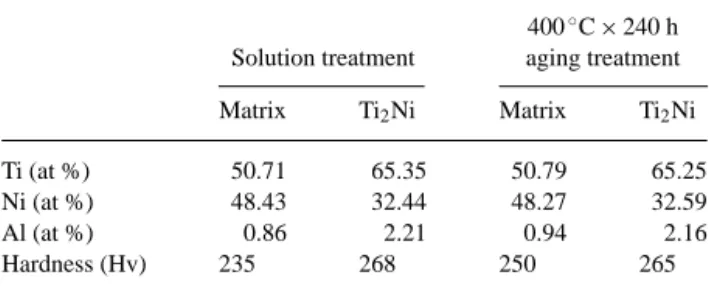
matrix and Ti2Ni particles by an EPMA analysis are
shown in Table I. Table I indicates that Al atoms solid-soluted in Ti2Ni particles are much more than those in the B2 matrix. Table I also shows that the hardness of Ti2Ni particles is greater than that of the B2 matrix.
The volume fraction of Ti2Ni has been estimated by an
image analyzer of OM to be about 16%.
Fig. 3 shows the shape memory characteristics of this alloy and the Ti51Ni49alloy. The volume fraction of the Ti2Ni in this alloy is much higher than that of the Ti51Ni49 alloy (about 10%). Despite the existence of many Ti2Ni particles, the Ti52Ni47Al1alloy still
ex-hibits good shape recovery which can reach ∼=50% at
the Aftemperature and gradually increase to ∼=80% at
300◦C. It is rather uncommon that the shape
recov-ery gradually increases with increasing temperature at Theating≥ Af. Lin has reported [16] that the shape recov-ery of the equiatomic or Ni-rich TiNi alloys can reach
∼
=90% after heating to the Aftemperature and only mi-nor recovery during subsequent heating. We believe that the above mentioned difference is closely related to the
existence of Ti2Ni particles and this phenomenon also
occurs in Ti51Ni49alloy. From Fig. 3, one can also find that the shape recovery of this alloy is much better than
T A B L E I The composition and hardness of matrix and Ti2Ni in thermomechanical-treated Ti52Ni47Al1alloy
400◦C× 240 h Solution treatment aging treatment Matrix Ti2Ni Matrix Ti2Ni
Ti (at %) 50.71 65.35 50.79 65.25
Ni (at %) 48.43 32.44 48.27 32.59
Al (at %) 0.86 2.21 0.94 2.16
Figure 2 OM microstructures of solution-treated Ti52Ni47Al1alloy.
Figure 3 Shape recovery vs. heating temperature for Ti52Ni47Al1and Ti51Ni49alloys.
that of Ti51Ni49alloy below 130◦C, but exhibits equal
behavior above 200◦C. This feature results from the
solid-solution hardening obtained by Al solid-soluted in the B2 matrix of the Ti52Ni47Al1alloy, as shown in Table I. Although the quantity of Ti2Ni particles in this alloy is much higher than that in the Ti51Ni49alloy, this feature also explains the reason why the shape recovery of this alloy does not decrease substantially.
3.2. Aging effect on Ti52Ni47Al1 alloy
The DSC measurements for the 400◦C aged
Ti52Ni47Al1 specimens show that the transformation
sequence is B2→ B190martensitic transformation and
the experimental A∗and M∗ temperatures are plotted
in Fig. 4a. The A∗and M∗temperatures gradually
de-crease with increasing aging time at 400◦C. The
chem-ical composition of Ti2Ni particles and the B2 matrix
by EPMA analysis for 400◦C× 240 h aged specimen is
also shown in Table I. From Table I, Al atoms are found to diffuse from the higher Al-content of Ti2Ni particles to the lower one of the B2 matrix. Therefore, Al atoms
soluted in the B2 matrix increase slightly during the aging at 400◦C. This feature results in the decrease of
A∗ and M∗ temperatures and the increase of matrix
hardness during the aging. It has been reported that the shape recovery of TiNi alloys can be increased by differ-ent thermo-mechanical strengthening treatmdiffer-ents [16].
Figure 4 (a) A∗and M∗temperature, (b) shape recovery and hardness, vs. aging time for Ti52Ni47Al1alloy.
Figure 5 DSC curve for 5% cold-rolled Ti52Ni47Al1alloy.
Therefore, the shape recovery of this alloy can also in-crease during the aging because Al atoms diffuse into the B2 matrix and cause the matrix to be harder, as
shown in Fig. 4b. The shape recovery can reach ∼=90%
for the specimens aged at more than 60 h at 400◦C.
3.3. Cold rolling effect on Ti52Ni47Al1 alloy The effects of cold rolling on the martensite trans-formation of equiatomic TiNi binary alloy have been systematically studied. The phenomenon of martensite stabilization was observed in the cold rolled TiNi martensite [17]. In this study, the Ti52Ni47Al1alloy un-derwent plastic deformation when cold-rolled at room temperature. Fig. 5 shows the DSC curve for the 5% cold-rolled Ti52Ni47Al1 alloy. In Fig. 5, peak A∗1
ap-pears at+115◦C on the first heating cycle from room
temperature to+250◦C. The duplex peak appears on
the following cooling cycle from+250◦C to−50◦C
in which M∗is at+32◦C and R∗(B2→ premartensite
R-phase) is at+46◦C. Peak A∗2 appears at+70◦C on
the second heating cycle from−50 to +250◦C. Peaks
A∗1, M∗and A∗2are all associated with the martensitic transformation. The DSC curves for other cold-rolled specimens (10–25%) similar to that shown in Fig. 5
and therefore are omitted here. The peak A∗1
temper-ature signficantly increases with an increasing degree of cold-rolling. This feature exhibits the phenomenon of martensite stabilization, as that observed in the cold-rolled equiatomic TiNi and Ti51Ni49alloys [11, 17]. Af-ter the occurrence of the first reverse martensitic
trans-formation of B190→ B2, the martensite stabilization
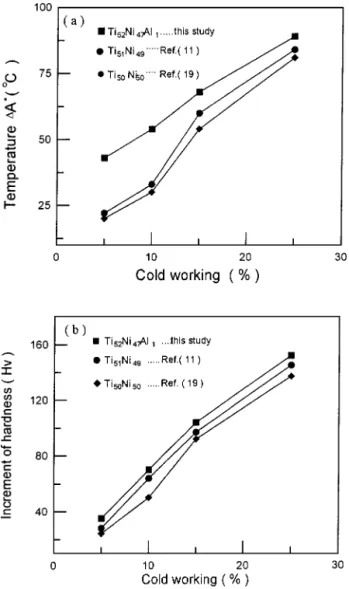
dies out and A∗2temperatures are lower than A∗1 peratures. In Fig. 6a, the difference between peak tem-perature A∗1 and A∗2, 1A∗, stands for the degree of
martensite stabilization. From Fig. 6a, the1A∗of the
Ti52Ni47Al1 alloy (1A∗= 89◦C) is larger than that
of the equiatomic TiNi alloy (1A∗= 82◦C) [19] and
Ti51Ni49 alloy (1A∗= 84◦C) [11] for the same 25% cold-rolled specimen. Fig. 6b shows the increment of hardness at the same degree of cold rolling is about 150 Hv for the Ti52Ni47Al1alloy, which is larger than that of TiNi alloy (1Hv = 136) [19] and Ti51Ni49
al-loy (1Hv = 143) [11]. This feature results from the
as-solid-soluted Ti52Ni47Al1 alloy being harder than
Figure 6 (a) The degree of martensite stabilization (1A∗) and (b) the in-crement of hardness (1Hv) vs. degree of cold rolling for the Ti52Ni47Al1 alloy.
the equiatomic TiNi and Ti51Ni49 alloys, as shown in
Table II. At the same time, the dislocation /defect
move-ment can be more hindered by harder Ti2Ni particles
during plastic deformation in the Ti52Ni47Al1 alloy. Hence, the harder Ti52Ni47Al1 alloy has a higher in-crement of hardness and a higher degree in martensite stablization under the same degree of cold rolling, as shown in Fig. 6.
The DSC curve for Ti51Ni49alloy cold-rolled at more than 20% in thickness appears the duplex peak in the cooling curve. However, as shown in Fig. 5, the R-phase can be induced in the 5% cold-rolled Ti52Ni47Al1 specimen. This feature shows that the R-phase can be
T A B L E I I The K value for different strengthening process and the solution-treated hardness of TiNi shape memory alloys
Solution-treated K value Composition hardness
(in at %) (Hv) Thermal cycling Cold rolling
Ti50Ni50 200 0.52 0.28
Ti51Ni49 228 0.62 0.42
Ti52Ni47Al1 235a 0.65 0.44 Ti41.5Ni48.5Zr10 285 0.68 0.58
Figure 7 Hardness and peak temperatures of A∗1, M∗, and R∗vs. number of thermal cycles (N ) for solution-treated Ti52Ni47Al1alloy.
promoted by Al atoms soluted in TiNi alloys, a be-havior similar to Fe soluted in TiNi alloys [20]. In our previous study on Ni-rich Ti49.5Ni50.13Al0.37 and Ti47.5Ni50.65Al1.85 alloys [15], it was also found that the solid-soluted Al atoms in these two alloys can also induce R-phase transformation.
3.4. Thermal cycling effects on Ti52Ni47Al1alloy
Fig. 7 shows peak temperatures M∗, A∗ and hardness
Hv vs. thermal cycle N for solution-treated Ti52Ni47Al1 alloy. In Fig. 7, the M∗and A∗temperatures decrease, but the hardness Hv with increasing thermal cycling. It has been proposed that this feature comes from the
dis-locations induced by thermal cycling [3]. The A∗and
M∗ decrease quickly for the first ten cycles with the
decrement being about 18◦C at N= 10, which is larger
than that of Ti51Ni49alloy (∼=10◦C) [21]. The increase
in hardness of this alloy (1Hv = 29) is also greater
than that of the Ti51Ni49alloy (1Hv = 23) at the same N= 10 cycles. This indicates that Ti52Ni47Al1alloy can induce many more dislocations than can the Ti51Ni49 al-loy in the early thermal cycling. We suggest that the vol-ume change during the martensitic transformation can produce a complex stress field at the interface of Ti2Ni
particles and B2/B190 matrix during thermal cycling.
This complex stress field can enhance the dislocation multiplication, which increases the hardness of the al-loy and depresses its M∗temperature. Fig. 8 shows that the R-phase transformation can also be promoted by the early ten cycles. Compared with Ti51Ni49alloy, which
needs more than N ∼= 100 cycles to appear the R-phase
transformation [21], we suggest that Ti52Ni47Al1alloy is easier to promote R-phase appearing than Ti51Ni49 al-loy during thermal cycling. In Fig. 7, after 50 cycles, the
M∗and A∗temperatures reach a constant value. This
may indicate that the quantities of induced dislocations reach a saturated value after 50 cycles in Ti52Ni47Al1 alloy.
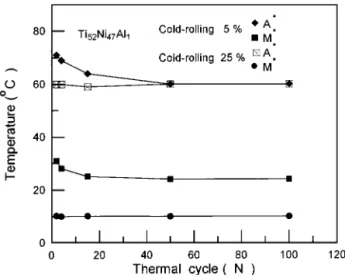
The cold-rolled Ti52Ni47Al1 specimens with 5 and 25% thickness reduction have also been subjected to thermal cycling tests, as shown in Fig. 9. For 5%
cold-rolled specimen, A∗and M∗temperatures are depressed
Figure 8 DSC curve for thermal cycled Ti52Ni47Al1alloy at N= 10.
Figure 9 Peak temperatures A∗ and M∗ of 5%, 25% cold-rolled Ti52Ni47Al1alloy vs. number of thermal cycles.
to lower temperatures as N increases, althougth the de-pression is less than in those of Fig. 7. This feature comes from the fact that 5% cold rolling can introduce dislocations and strengthen the alloy. Therefore, only a small quantity of extra dislocations can be induced dur-ing thermal cycldur-ing. This elucidates that the 5% cold-rolled specimen exhibits only a few of the effects of thermal cycling. If the degree of cold rolling reaches 25%, the specimen has been signficantly strengthened by cold rolling and the extra dislocations are diffi-cult to be induced during thermal cycling. Hence, for this heavy cold-rolled specimen, transformation tem-peratures keep nearly the same values even when the thermal cycling N reaches 100 cycles, as shown in Fig. 9.
3.5. Strengthening effects of cold-rolling and thermal cycling on martensitic transformation temperatures of Ti52Ni47Al1alloy
Figs 10a and b show the curves of peak temperature M∗
vs. hardness Hv for the cold-rolled and thermal-cycled Ti52Ni47Al1 alloy, respectively. The results of cold-rolled and thermal-cycled Ti50Ni50and Ti-rich Ti51Ni49 alloys are also shown in Fig. 10. It was pointed out that
Figure 10 M∗temperature vs. hardness for (a) cold-rolled and (b) ther-mal cycled Ti50Ni50, Ti51Ni49and Ti52Ni47Al1alloys.
any strengthening mechanism which impedes the trans-formation shear can lower the transtrans-formation temper-atures because the martensitic transformation involves a shear process [22, 23]. This feature can be expressed by the Equation 1.
Ms= T0− K1σy (1)
where the constant K contains the factors of propor-tionality between the critical shear stress and the yield stress1σy, the equilibrium temperature T0is a function
of the chemical composition, and the yield stress1σy
is regarded as proportional to the hardness.
In this study, both cold-rolling and thermal cycling
do not change the alloy’s composition, hence T0 is a
constant. In addition, both cold rolling and thermal cy-cling can strengthen the alloys by inducing dislocations, and therefore can raise the yield stress1σy. As derived
from Equation 1, this feature should cause the M∗and
A∗temperatures to be lowered by the strengthening ef-fect. This prediction is qualitatively consistent with the results of Fig. 10. In Fig. 10, the slope represents the constant K which is not the same for different strength-ening processes. These results indicate that processes of cold rolling and thermal cycling can provide dif-ferent strengthening mechanisms and exhibit difdif-ferent effects on transformation temperatures. As mentioned
above, strengthening processes can introduce disloca-tions in these alloys. However, dislocadisloca-tions induced by cold rolling come from the plastic deformation of martensite and those induced by thermal cycling come from the thermal stress and transformation shear
asso-ciated with B2→ B190. Carefully examine Fig. 10, the
constant K of Ti52Ni47Al1alloy is larger than that of Ti50Ni50 and Ti51Ni49 alloys for the same strengthen-ing process. We propose that the K value is related to the inherent hardness of solution-treated TiNi binary or TiNiX ternary alloys. The higher the original hardness, the larger the K value is. For example, as can be seen from Table II, the thermal cycled Ti41.5Ni48.5Zr10alloy has its solution-treated hardness at about 285 Hv and its K value is found to be 0.68◦C/Hv [24], which is larger than those of thermal cycled Ti51Ni49and Ti50Ni50 al-loys in Fig. 10. In other words, the depression of Ms
(M∗) and As ( A∗) temperatures by the strengthening
mechanism is stronger for the alloys having a higher solution-treated hardness. This also elucidates the rea-son why the K value of the Ti52Ni47Al1alloy is higher than those of the Ti50Ni50 and Ti51Ni49 alloys under the same strengthening process, as shown in Fig. 10. From Fig. 10, it can also be seen that the thermal cy-cled K value is larger than the cold-rolled one for each of the equiatomic TiNi, Ti51Ni49 and Ti52Ni47Al1 al-loys. These results mean that the strengthening effect of thermal cycling is larger than that of cold rolling for TiNi SMAs.
4. Conclusion
1. The solution-treated Ti52Ni47Al1 alloy undergoes
the first order B2→ B190 martensitic transformation.
Many second phase Ti2Ni particles with a 16% volume
fraction are found at the grain boundaries of the B2 ma-trix in which Al atoms are much more solid-soluted in
Ti2Ni particles than in the B2 matrix. Transformation
temperatures A∗ and M∗of this alloy are higher than
those of equiatomic or Ni-rich TiNi alloys, but lower than those of Ti51Ni49alloy due to Al atoms being solid-soluted in the B2 matrix.
2. A∗ and M∗ temperatures of this alloy decrease
slightly with increasing aging time at 400◦C because
Al atoms diffuse from Ti2Ni particles to the B2 matrix. At the same time, the shape recovery and hardness of this alloy increase with increasing aging time due to the Al atoms solution hardening in the B2 matrix.
3. Martensite stabilization of this alloy can be in-duced by cold rolling at room temperature. The hard-ness increment of this alloy is more than that of
equi-atomic and Ti51Ni49 alloys under the same degree of
cold rolling. In addition, 5% thickness reduction is enough to promote R-phase transformation in this alloy, but it needs at least 20% for Ti51Ni49alloy. Al atoms solid-soluted in TiNi alloys are suggested to account for these characteristics.
4. A∗and M∗temperatures decrease and the
hard-ness increases quickly in the first ten cycles of thermal
cycled Ti52Ni47Al1 alloy. Meanwhile, the decrement
of A∗temperatures of this alloy is larger than that of Ti51Ni49 alloy at the same N . R-phase transformation can also be more easily promoted in the thermal cycled
Ti52Ni47Al1alloy. Dislocations more easily induced by thermal cycling in this alloy can account for these fea-tures. For 25% cold-rolled Ti52Ni47Al1 alloy, M∗and
A∗ are found to be nearly unaffected by the thermal
cycling.
5. The strengthening effects of cold-rolling and ther-mal cycling on Ms (M∗) temperatures of Ti52Ni47Al1 alloy are found to follow the equation Ms= T0−K1σy. Strengthening processes of cold rolling and thermal cy-cling have their different K values. Experimental re-sults show that K values are associated with the inher-ent hardness of TiNi alloys. The Ti52Ni47Al1alloy has Al atoms solid-soluted in it and has a higher original hardness than the Ti51Ni49alloy, and thus has a higher K value.
Acknowledgement
The authors sincerely acknowledge the financial sup-port of this study by the National Science Council (NSC), Republic of China, under Grant NSC 83-0405-E002-029.
References
1. G. D. S A N D R O C K, J. A. P E K I N S and R. F. H E H E N M A N N, Metall. Trans. 2A (1971) 2769.
2. H. C. L I N GandR. K A P O W, ibid. 12A (1981) 2102. 3. S. M I Y A Z A K I,T. I M A I,Y. I G OandK. O T S U K A, ibid.
17A (1986) 115.
4. S. M I Y A Z A K I,Y. O H M I,K. O T S U K AandY. S U Z U K I, (ICOMAT-82), J. de Phys. 43 (1982) C4-255.
5. S. M I Y A Z A K I,Y. I G OandK. O T S U K A, Acta Metall. 34 (1986) 2045.
6. S. K. W U,H. C. L I NandT. S. C H O U, ibid. 38 (1990) 95. 7. M. N I S H I D A and T. H O N M A, Scripta Metall. 18 (1984)
1293.
8. Idem. ibid. 18 (1984) 1389.
9. Y.O K A M O T O,H.H A M A N A K A,F.M I U R A,H. T A M U R A andH. H O R I K A W A, ibid. 22 (1988) 517.
10. T. T O D O R O K IandH. T A M U R A, Trans. JIM. 28 (1987) 83. 11. H. C. L I N,S. K. W UandJ.C. L I N, Materials Chemistry and
Physics 37 (1994) 184.
12. K. H. E C K E L M E Y E R, Scripta Metall. 10 (1976) 667. 13. K. R. E D M O N D SandC. M. H W A N G, ibid. 20 (1986) 733. 14. C. M. H W A N G andC. M. W A Y M A N, Metall. Trans. 15A
(1984) 1155.
15. S. F. H S I E HandS. K. W U, J. Mater. Sci. 32 (1997) 989. 16. H. C. L I NandS. K. W U, Scripta Metall. 26 (1992) 59. 17. H. C. L I N,S. K. W U,T. S. C H O UandH.P. K A O, Acta
Metall. 39 (1991) 2069.
18. K. J. L E EandP. N A S H, J. of Phase Equilibria 12 (1991) 551. 19. H. C. L I N, PhD thesis, Institute of Materials Science and
Engi-neering, National Taiwan University, Taipei, Taiwan, 1992. 20. C. M. H W A N G,M. M E I C H L E, M. B. S A L A M O N and
C. M. W A Y M A N, Phil. Mag. 47 (1983) 9, 31, 177.
21. J. C. L I N, Masters’ thesis, Institute of Materials Science and Engineering, National Taiwan University, Taipei, Taiwan, 1991. 22. M. C O H E N,E. S. M A C H L I N and V. G. P A R A N J P E,
“Thermodynamics in Physical Metallurgy” (ASM, Metals Park, OH, 1950).
23. E. H O R N B O G E N, Acta Metall. 33 (1991) 595.
24. S. H. C H E N, Masters’ thesis, Institute of Materials Science and Engineering, National Taiwan University, Taipei, Taiwan, 1994.
Received 15 January 1997 and accepted 6 October 1998