
道歉認知之跨文化研究–情境變因、文化接觸、種族和語言之影響
100
0
0
全文
(2) 摘要 本研究旨在探討台灣與美國大學生語言行為中,情境因素、第二語言接觸程度、冒犯對 象之種族以及道歉所使用之語言,對於道歉行為之認知的影響。語料之搜集以五點尺度 量表(SRQ)為主,共蒐集 9600 筆 120 位台、美大學生之漢、英母語語料以及 60 位台灣大 學生外語語料。結果發現, 兩組學生之部分道歉相關的認知行為相似,也有部分道歉認 知有其文化以及其因不同變因而產生的特殊性。其中,四項內在變因中,「嚴重程度評 斷」、「道歉可能性」、「道歉困難度」有跨文化的顯著差異;外在變因則有跨文化相 似性也有相異性。在跨文化相似性部分,兩組人皆覺得冒犯陌生人和女性比較不嚴重, 比較會和熟識度普通或陌生人、地位相當的人道歉,以及對男性道歉較不易等;而顯著 文化差異性則表現在低冒犯程度事件、對於冒犯同儕的嚴重度的認知以及在大部份為其 冒犯行為「道歉可能性」、「道歉困難度」認知等。道歉時冒犯對象的種族以整體來說 並沒有顯著影響。若將台灣大學生分為高與低外語接觸組時,低接觸組在冒犯行為的「嚴 重程度評斷」以及「道歉可能性」都顯著較高;在道歉所使用的語言之影響部分,台灣 學生對冒犯行為的「嚴重程度評斷」在使用中文時顯著較高,「道歉困難度」則在使用 英文時顯著較高,若分為高以及低外語接觸組別時,使用語言為英文時,低接觸組的「嚴 重程度評斷」、「道歉可能性」以及「道歉被接受度」都較高,這樣的結果推論道歉所 使用的語言及文化學習程度對學習者的語言認知是有顯著影響的,將來的研究應更進一 步分析這些認知的差異是否影響著學習者的行為,將可對學習者中介語行為有更深與更 廣的認識。. ii.
(3) ABSTRACT This study investigated the effects of contextual factors, participants’ exposure to the target language, interlocutors’ ethnicity and task language on Chinese and English speakers’ perception of the speech act of apology. The data were collected from sixty English L1 speakers, 60 Chinese L1 speakers and 60 Chinese EFL speakers. They consisted of responses on and of apology to a Scaled-response Questionnaire (SRQ). The SRQ data showed both similarities and significant differences between the two L1 groups under different contextual factors. First, the two groups differed in terms of all the four context-internal factors; i.e. severity of the offense, likelihood to apologize, difficulty of the apology and the acceptability of the apology. As for the SRQ answers concerning the five context-external factors, social distance, social status, speaker gender, interlocutor gender and imposition, there were both similarities and differences between the two L1 groups. For example, both groups considered it less severe to offend strangers and were more likely to apologize to acquaintances and people of equal status. Furthermore, both groups found it more severe to offend and more difficult to apologize to male than to female interlocutors. On the other hand, cross-cultural differences were found in the perception of the severity on low imposition situations and on people of equal status and acquaintances. There were also various cross-cultural differences in the likelihood to apologize and difficulty of the apology perception ratings. Ethnicity did not yield significant results among Chinese L1s. However, low-exposure group rated severity and likelihood to apologize higher than high-exposure group did. Severity of the offense was significantly higher and the difficulty of the apology was significantly lower when the participants were using Chinese L1. When compared with the high exposure group, low exposure group’s perception ratings were higher in the severity of the offense, likelihood to apologize and acceptability of the apology. The results may infer that ethnicity and task language play important roles in learners’ perceptions. Future researches could focus on the. iii.
(4) relationship between learners’ perception and production to broaden and deepen the understanding of learner language.. iv.
(5) ACKNOWLEDGEMENTS. This study could not be accomplished without the “Interlanguage Speech Act Project” conducted by Professor Yuh-Huey Lin, which is supported by National Science Council (NSC 93-2411-H-017-011; NSC 94-2411-H-110-010) and National Sun Yat-sen University. Therefore, I would like to express my deepest gratitude to my advisor, Professor Yuh-Huey Lin, for her advice and guidance throughout the research and her continuing support that are undoubtedly the most important ingredients to the completion of this thesis and the success of the project.. I would also like to extend my appreciation to my committee members: Professor Tsailing Liang and Professor Taihsiung Yang. They have given me invaluable comments and suggestions, which significantly improved the quality of the thesis.. My sincere appreciation is extended to all the people who helped accomplish the study: the participants of the study in Taiwan and from the US; members at the Center for Speech Act Studies at the Department of Foreign Languages and Literature of National Sun Yat-sen University, Xiang-Ling Chen, Chia-Hui lee, Po-Chin Ho, Miao-Tzu Chen and Amy Shih, for always being there for “us”; friends from the Chinese Med Club at NSYSU; and all of my friends and colleagues, for their pieces of love and caring.. Most of all, I would also like to extend my deepest gratitude to my family. Without their encouragement, I would not be who I am today. This thesis would not have been possible without their endless love, patience and understanding support.. v.
(6) TABLE OF CONTENTS ABSTRACT ..........................................................................................................iii ACKNOWLEDGEMENTS.................................................................................. v TABLE OF CONTENTS .....................................................................................vi LIST OF TABLES................................................................................................. x LIST OF FIGURES..............................................................................................xi CHAPTER 1 INTRODUCTION....................................................................... 1 1.1 Background and Motivation. 1. 1.2 Purpose of the Study. 5. 1.3 Organization of the Thesis. 6. CHAPTER 2 LITERATURE REVIEW .......................................................... 7 2.1 Politeness. 8. 2.1.1 Western Politeness ............................................................................... 9 2.1.2 Eastern Politeness ..............................................................................10 2.1.2.1 Gu .............................................................................................. 11 2.1.2.2 Mao ............................................................................................12 2.2 Speech Act. 12. 2.2.1 Interlanguage Pragmatics (ILP).........................................................13 2.2.2 Pragmalinguistics vs. Sociopragmatics .............................................15 2.2.3 CCSARP ............................................................................................15 2.3 Apology. 16. 2.3.1 Definition ...........................................................................................16 2.3.2 Apology Strategies.............................................................................17 vi.
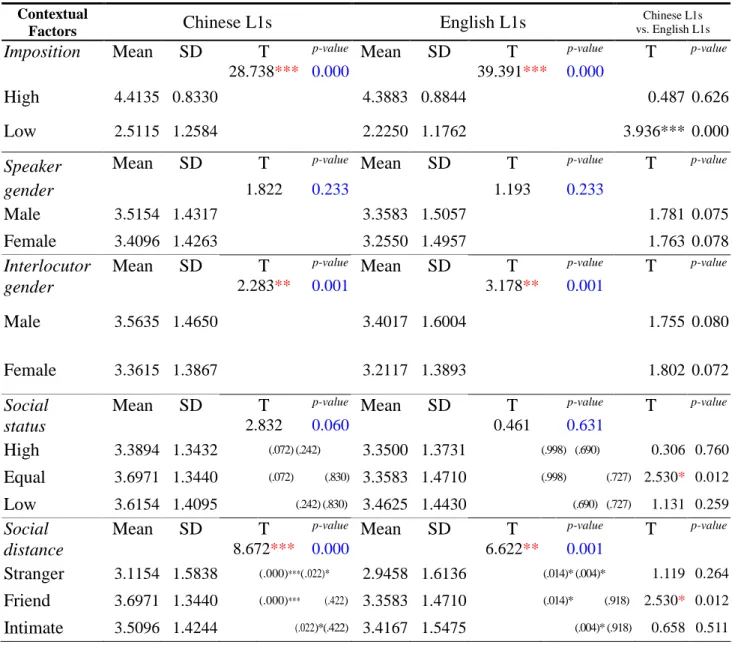
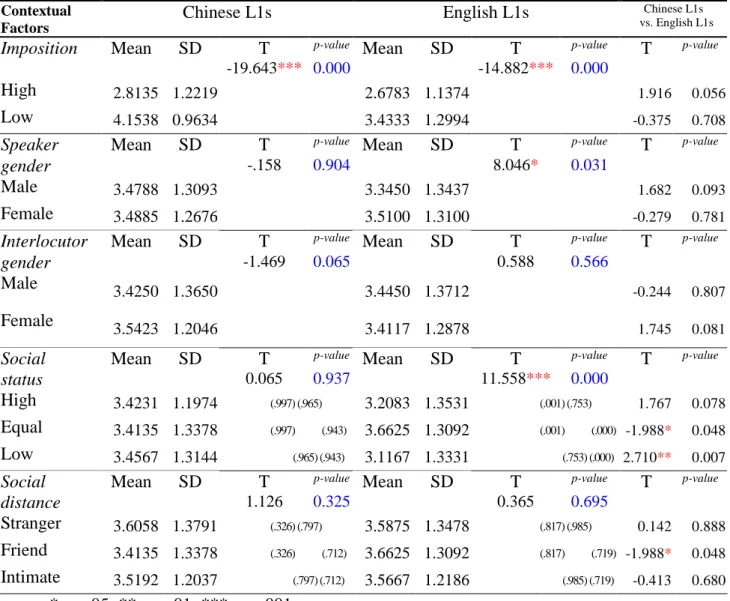
(7) 2.3.3 Previous Studies on Apology.............................................................20 2.3.3.1 Studies on First Languages........................................................21 2.3.3.2 Cross-cultural and Interlanguage Studies..................................22 2.4 Summary. 24. CHAPTER 3 METHOD...................................................................................26 3.1 Participants. 26. 3.2 Materials. 27. 3.2.1 Scenarios ............................................................................................28 3.2.2 Perception Task: Scaled-response Questions.....................................30 3.2.3 Production Task: Discourse Completion Tasks .................................31 3.3 Procedure. 31. 3.4 Data Analysis. 32. CHAPTER 4 RESULTS AND DISCUSSION................................................33 4.1 Chinese L1 Data vs. English L1 Data. 33. 4.2 Chinese L1 Data vs. English L1 Data and Contextual Factors. 35. 4.2.1 Severity of the Situation ....................................................................36 4.2.1.1 Imposition ..................................................................................37 4.2.1.2 Speaker Gender..........................................................................38 4.2.1.3 Interlocutor Gender....................................................................38 4.2.1.4 Social Status...............................................................................38 4.2.1.5 Social Distance ..........................................................................39 4.2.2 Likelihood to Apologize ....................................................................39 4.2.2.1 Imposition ..................................................................................41 vii.
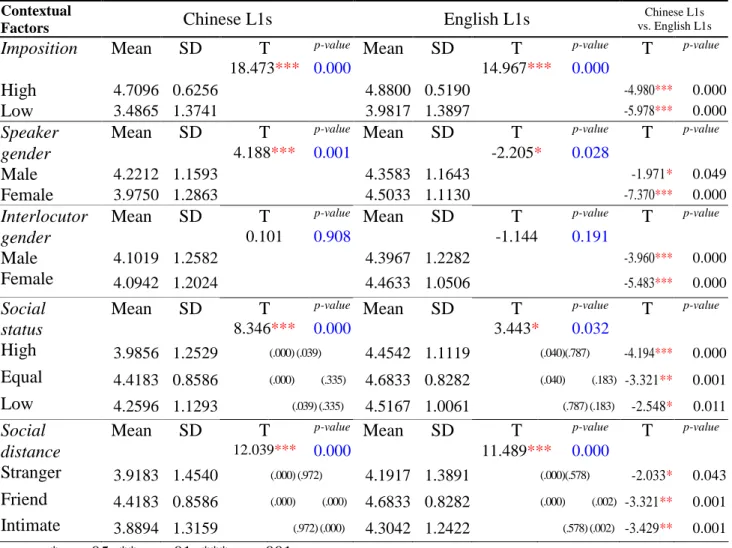
(8) 4.2.2.2 Speaker Gender..........................................................................41 4.2.2.3 Interlocutor Gender....................................................................42 4.2.2.4 Social Status...............................................................................42 4.2.2.5 Social Distance ..........................................................................43 4.2.3 Difficulty of the Apology...................................................................44 4.2.3.1 Imposition ..................................................................................45 4.2.3.2 Speaker Gender..........................................................................46 4.2.3.3 Interlocutor Gender....................................................................47 4.2.3.4 Social Status...............................................................................47 4.2.3.5 Social Distance ..........................................................................47 4.2.4 Acceptability of the Apology .............................................................48 4.2.4.1 Imposition ..................................................................................49 4.2.4.2 Speaker Gender..........................................................................50 4.2.4.3 Interlocutor Gender....................................................................50 4.2.4.4 Social Status...............................................................................50 4.2.4.5 Social Distance ..........................................................................50 4.3 Interlocutor’s Ethnicity. 51. 4.4 Questionnaire Language. 52. 4.5 Exposure to the Target Language / Culture. 54. 4.5.1 Ethnicity.............................................................................................54 4.5.2 Language............................................................................................55 CHAPTER 5 CONCLUSION .........................................................................58. viii.
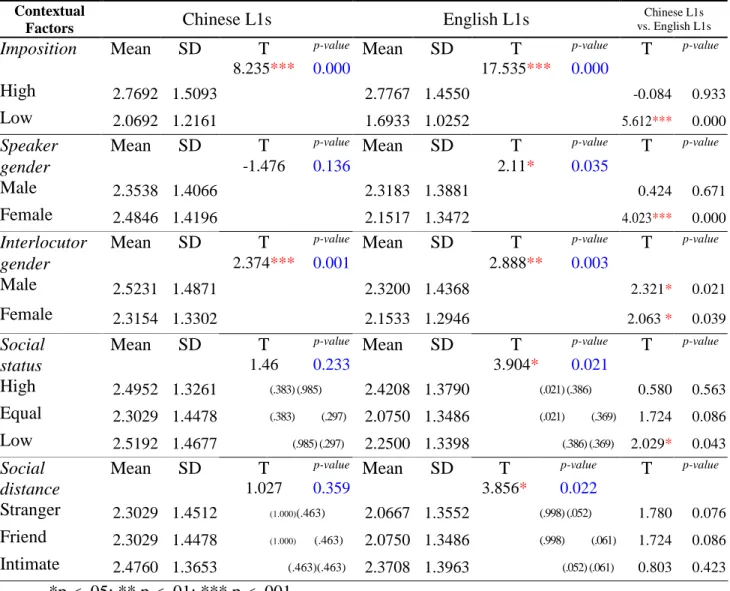
(9) 5.1 Summary. 58. 5.2 Implications and Suggestions. 60. 5.3 Limitation of the Study. 61. REFERENCES ....................................................................................................62 APPENDIX ..........................................................................................................73 I.. Background Questionnaire for Chinese. 73. II.. Chinese SRQ + DCT Questions (Order 1). 74. III. English SRQ + DCT Questions (Order 2). 81. IV. Offense Types (Holmes, 1990, 1998; Deutschmann, 2003). 88. V.. Shih’s (2006) Overall Occurrence Number and Percentage Frequency of the Eight Main Apology Strategies Used by Chinese L1s and English L1s. ix. 89.
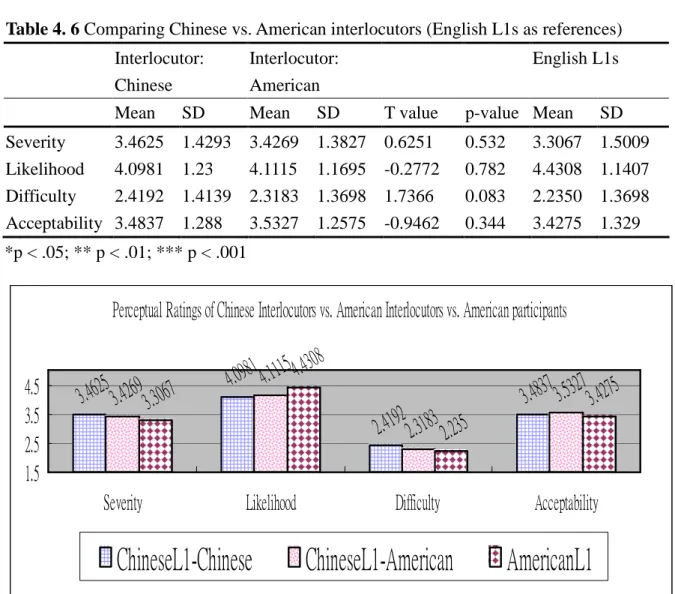
(10) LIST OF TABLES Table 3. 1 Contextual factors embedded in the scenarios...................................................... 29. Table 4. 1 Means of the ratings on "severity of the situation", likelihood to apologize", "difficulty of the apology" and "acceptability of the apology" by Chinese L1s & English L1s............................................................................................................. 33 Table 4. 2 Means and standard deviation according to the contextual factor - Severity of the situation .................................................................................................................. 37 Table 4. 3 Means and standard deviations according to the contextual factor - Likelihood to apologize ................................................................................................................ 40 Table 4. 4 Means and standard deviations according to the contextual factor - Difficulty of the apology ................................................................................................................... 45 Table 4. 5 Means and standard deviations according to the contextual factor - Acceptability of the apology ............................................................................................................. 49 Table 4. 6 Comparing Chinese vs. American interlocutors (English L1s as references)....... 51 Table 4. 7 Comparing language used in questionnaire: Chinese vs. English (English L1 as references) .............................................................................................................. 52 Table 4. 8 Means and standard deviation of the four contextual factors of L2 culture exposures between High and Low exposure groups ............................................................... 54 Table 4. 9 Means and standard deviations of the four contextual factors on L2 language exposures between High and Low groups.............................................................. 56. x.
(11) LIST OF FIGURES Figure 2. 1 FTA Model .......................................................................................................... 10 Figure 2. 2 Aijmer's Apologizing strategies (1996:83).......................................................... 19 Figure 4. 1 Means of the ratings on "severity of the situation", "likelihood to apologize", "difficulty of the apology" and "acceptability of the apology" by Chinese L1 & English L1 .......................................................................................................... 34 Figure 4. 2 Conceptual ratings on Chinese vs. American interlocutors ................................ 51 Figure 4. 3 Perceptual ratings of Chinese learners when using Chinese vs. English with English L1 results as references ......................................................................... 53 Figure 4. 4 High and Low exposures groups’conceptual ratings on Chinese vs. American interlocutors (Chinese L1 and English L1 data provided as references)............ 55 Figure 4. 5 Perceptual ratings of Chinese High and Low exposure learners when using Chinese vs. English (Chinese L1 and English L1 data provided as references) 56. xi.
(12) CHAPTER 1 INTRODUCTION. 1.1 Background and Motivation Misunderstandings occur between people of different cultures. To avoid cross-cultural conflicts, cultural differences have attracted many researchers’ attention.. On one hand, cultural studies emphasize the differences in communication of different cultural groups (Gudykunst, 2003; Hofstede, 1997). On the other hand, interlanguage researches study the differences in language used by language learners (Kasper & Blum-Kulka, 1993). Second language users are usually the subjects in the studies of cross-cultural differences. Cultural studies observed native language users’ cultural behaviors while interlanguage studies involved the performance of second language learners. Most cultural studies adopt ethnographic method that tries to clearly analyze interactions or breakdowns among cultures (Brown & Levinson, 1969; Coulmas, 1981; Gao & Ting-Toomey, 1998; Goffman; 1956, 1969, 1971). Interlanguage studies adopt sociological methodologies and they systematically investigate and report second language users’ language behaviors (Bergman & Kasper, 1993; Kasper & Blum-Kulka, 1993; Olshtain & Cohen, 1989; Scollon & Scollon, 1995; Takahashi & Beebe, 1987; Trosborg, 1987, 1994, 1995; Yu, 1997). Numerous Cultural studies indicated different characteristics among cultural groups and interlanguage studies provided implications that are of significant help to language teaching and learning (Cobb, 2003). Cultural studies and interlanguage findings have made tremendous contributions to intra-cultural and inter-cultural understandings. However, it is a pity that cultural studies usually report cultural “differences” which may lead to “stereotyping” that are usually the extreme performances of individual cultural group (Barron, 2003) or even misconceptions. On the other hand, interlanguage studies are mostly. 1.
(13) limited to “visible” language productions that lead to less concern on non-verbal aspects of language (Barron, 2003). According to previous studies on the speech act of apology, cultural studies observed that apology is an integral part of Northern Americans’ everyday talk and the speakers use it to everyone in social contexts, which is very hard for Chinese newcomers to the United States to understand (Gao & Ting-Toomey, 1998). For an outsider to understand such observations from cultural studies, dialogues like the following are usually presented to characterize cultural differences. For example, to understand pragmalinguistic difference between cultures, there might be dialogues like the following: Common Chinese greeting: A: Have you eaten? B: Yes, I am full. Common American greeting: A: What’s up? B: Not much.. Learners usually try very hard, but can only capture a vague understanding of the differences in language performance and those who read such dialogues for cultural understanding and intercultural communications usually find the communication in reality to be very different from what they have understood (Barron, 2003). Interlanguage researches usually study language under the effect of different contextual factors (gender, power status, social distnace, age, etc.) and systematically report the appropriate strategies used in a certain context. However, as a post-event act that one must perform to maintain social harmony (Goffman, 1971), apology strategies do not differ much among cultures (Bergman & Blum-Kulka, 1993; Ellis, 2003). The simple treatment of apology as an universal speech act did not solve miscommunications between cultures or help cross-cultural understandings. The 2.
(14) past and recent international political conflicts such as the South China Sea incident between the United States and Mainland China or the recent visit of Presidnet Chen of Taiwan to the United States are good examples of cultural clash (Gries & Peng, 2002). In order to capture a broader and more comprehensive view of cultural differences, more empirical studies should be conducted and more observations into speakers’ perception could be integrated into interlanguage studies. Only two studies on the speech act of apology have attempted to incorporate cultural perception into their studies of second language learners. In Bergman & Kasper’s (1993) study, correlations of four context-internal questions (severity of offense, obligation to apologize, likelihood of the apology acceptance and offender’s face-loss) between American and Thai participants were examined and the results were used as explanations for positive and negative transfer of the speakers’ langauge production. The results showed that more than half of the differences between Thai-English and American-English in usage of apology strategies were due to negative pragmatic transfer. In the study of Maeshiba et al., an “Assessment Questionnaire” in which each apology scenario contains seven perceptual questions was used along with a “Dialog Construction Questionnaire” that requires an apology and an apology response for judgments of positive and negative transfer. The assessment results showed an overall agreement on the perception of the contexts among the subjects in the study. However, they found that native Japanese learners of English at the intermediate level were three times more likely to apply their native apologetic behaviors to the target language than the more advanced learners. Most of the previous empirical studies of speech acts mainly adopted the DCT (Discourse Completion Task) for data collection and analysis. However, only the above two studies slightly involved speakers’ perception of apology. Moreover, there have not been enough attention to the correlation of contextual factors and speakers’ perception while the effect of different contextual factors on language performance has been spotlighted in cross-cultural 3.
(15) studies. Although proficiency was a critical factor, these two studies did not probe into participants’ perception towards interlocutors of different ethnicity and task langauge in the questionnaires, which are vital elements to a culture (Gao & Ting-Toomey, 1998). There are also no studies regarding the Chinese’s perception of apology. Thus, this study aimed to compare the Chinese L1 speakers’ and the English L1 speakers’ perception of apology of different impositions and to people of different backgrounds such as gender, social status and social distance. The influence of interlocutors’ ethicnicity and task languages were also topics in this study. Furthermore, apology is the speech act under study for it is considered to generate the least variations across culutres and groups of people (Kasper & Blum-Kulka, 1993; Ellis, 2003), on the assumption that apology is not a pre-event but a post-event act imposed on the speaker and he or she does not have much choice on how or what to say (Austin, 1975; Bergman & Kasper, 1993; Ellis, 2003). The speech act of apology refers to the situation when one has offended someone during social interactions and some form of apolgoy must be performed to be excused or to be accepted in the society (Seale, 1969). For example, when breaking other’s property, a speaker would apologize or even offer a repair instead of choosing not to do anything. No apology in such an offending situation would break a relationship or even people’s respect and dignity in a soceity (Searle, 1969; Gao & Ting-Toomey, 1998). It is suggested that more speech act studies on apology could be conducted, especially those on cross-linguistic differences, which may well reveal the notions of offense and obligation that are cultural specific and must become an object of study in themselves to prevent misunderstandings (Bergman & Kasper, 1993; Barron, 2003). Barron (2003) echoed Wolfson et al.’s (1989) previous claim that most textbooks are organized based on the writers’ intuition rather than implications from empirical studies, even so nowadays. Therefore, more empirical studies are required for better cross-cultural understanding in order to prevent. 4.
(16) “intuitive correctness” in intercultural communicaitons which may be stereotypes or individual perceptions (Barron, 2003; Gao &Ting-Toomey, 1998).. 1.2 Purpose of the Study In order to understand and learn more about how people of different cultures think and whether their perceptions vary when encountering people of different social backgrounds and ethnic identities and when using different task languages. This study attempts to address the following research questions: 1. Are there differences between Chinese and English speakers’responses to the apology generating situations with regard to a. Severity of the offense b. Likelihood to apologize c. Difficulty of the apology d. Acceptability of the apology 2. Are there differences between how the contextual factors such as gender, status and distance affect Chinese speakers’and English speakers’perceptions of the apology? 3. Does the ethnicity of the interlocutor affect speakers’ perception of the apology situations? 4. Could task language variation (Chinese and English versions of questionniare) be a factor affecting Chinese EFL learners’responses to the apology generating situations? 5. How does exposure to the target language influence Chinese EFL speakers’ responses to the apology generating situations?. 5.
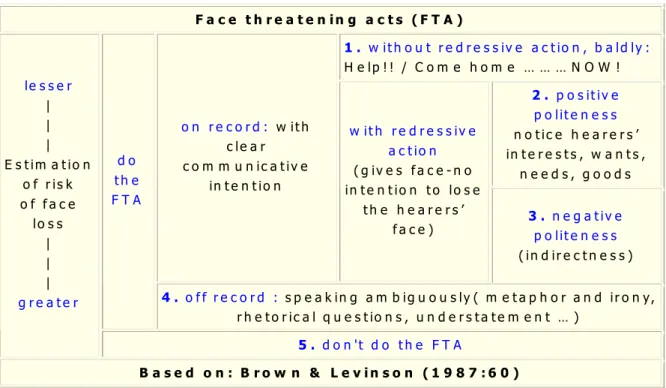
(17) 1.3 Organization of the Thesis This study attempts to examine Chinese L1 speakers’ (eastern) perceptions compared with English L1 speakers’ (western). Chapter two presents a brief introduction to the two different politeness frameworks- western and eatern politeness. In addition, the concepts of speech act and the speech act of apology, including the definition of apology and previous studies on apology, are reviewed. Chapter three describes the design of the study, including the participants, instruments, procedure, and data analysis. Chapter four demonstrates the geneal results and findings. Chapter five gives answers to the research questions, the limitations and suggestions for further research.. 6.
(18) CHAPTER 2. LITERATURE REVIEW. Chapter two introduces the basic concepts of politeness, the theoretical background of speech act, the definition of the speech act of apology and previous studies on apology. Politeness is the foundation of interpersonal interactions as well as a crucial theoretical framework of cultural and cross-cultural studies (Brown & Levinson, 1969; Leech, 1983; Scollon & Scollon, 1995; Searle, 1975). According to Brown & Levinson (1987), the politeness system explains the appropriate communicative styles in any given context. This claim was universally accepted until recently when some non-western scholars proposed that not all of the politeness theories are applicable to non-western contexts, such as the Chinese society and the Japanese culture (Gu, 1990, 1992; Mao, 1994; Matsumoto, 1988). Thus, eastern politeness was proposed and has posed challenge to the universal view of Brown & Levinson’s (1987) politeness. Human behavior is governed by their perceptions about what is appropriate and polite in a certain context. The concept is especially useful and important in studying a speech act. Researches in various areas have noticed the importance of the effects a speech act may bring. One important field is the second language acquisition (SLA). The study of second language users’ language of speech acts is called “interlanguage pragmatics (ILP)”. ILP is the “study of nonnative speakers’ use and acquisition of linguistic action patterns in a second language (L2)” (Kasper & Blum-Kulka, 1993: 3). Interlanguage was first defined by Selinker (1972) and Corder (1981) from observing the similar patterns of learner errors and learner progresses from overcoming one kind of error to another. They, along with other researchers, found that learners’ error is a sort of hybrid between the L1 and L2 (Corder, 1981) which may be the natural process of langauge learning. Learners undergo. 7.
(19) constant change along an interlanguage continuum. Such priceless value and inspiring claim have encouraged plenty followers. Most ILP studies are based on the project of Cross-Cultural Speech Act Realization Project (CCSARP) led by Blum-Kulka, House & Kasper (1989), which is the first study that investigated the speech acts of request and apology cross-culturally. Till today, researchers have been dedicated to the field of interlanguage pragmatics for over thirty years. However, most of the studies focus on the learners’ “linguistic” output. The linguistic output are usually categorized into strategies adopted to perform speech acts. For apology studies, the complete strategy list, a speech act set, is quite comprehensive and complete (Olshtain, Elite & Cohen,1983; Trosborg, 1987, 1995) but only two studies on apology (Bergman & Kasper, 1993; Maeshiba et al., 1996) concern the non-linguistic aspects such as the speakers’ perceptions. The factors of ethnicity of and task language for interaction with the interlocutors, which may carry very distintive cultural triats, was neglected. Therefore, the following sections will review politeness theories, interlangauge pragmatics and the speech act of apology.. 2.1 Politeness “Politeness” is a basic principle observed in daily life. It denotes the notion that interpersonal interactions should observe the social norms of the society. Politeness is often the theme or even guidelines for the studies on cross-cultural communication. It is certainly important for the study of pragmatics across cultures (Brown & Levinson 1978, 1987; Blum-Kulka, 1982; Blum-Kulka & Olshtain, 1984; Fraser, 1980; Gu, 1990; Holmes, 1993; House & Kasper, 1981; Janney & Arndt, 1993; Leech, 1983). It is said to be the main factor governing human interactions and “fundamental to human relationships” (Bharuthram, 2003: 1531). Though Brown & Levinson (1978) and Leech (1983) have originally put forth the politeness theory as a “universal” concept, many cross-cultural researches have shown a lack of 8.
(20) consistency on politeness perceptions and performances across cultures (Blum-Kulka, House & Kasper, 1989; Fraser, 1990; Gu, 1990; Mao, 1994; Sugimoto, 1998; Trosborg, 1987, 1995). Most of the inconsistency were found in cross-cultural researches. It may be necessary to look at how people of different cultures view the concept of politeness. Eastern vs. western cultural differences were the mostly discussed themes (Gudykunst, 2003; Hofstede, 1997). The following presents the concepts of western and eastern politeness.. 2.1.1 Western Politeness The most famous western politeness system is the Brown & Levinson’s (1978) Politeness Theory. Borrowing from Goffman’s (1967) face work, Brown & Levinson (1987) tried to account for deviations from Grice’s (1975) Cooperative Principle and its’ four Conversational Maxims. Politeness strategies are adopted by speakers to maintain or achieve politeness intentions among speakers. Following Goffman’s (1956, 1967) categorization of politeness system, Brown & Levinson (1987) identified positive politeness and negative politeness. Positive politeness is warm friendly behavior toward others, which is designed to meet the face needs for another person. Negative politeness is the avoidance of imposition on others, which is designed to protect the other person’s face when the negative face needs are threatened (Brown & Levinson, 1987). According to Brown & Levinson (1987), all speech acts are potentially face-threatening acts and politeness strategies in speech involve attempts to minimize the face-threat generated during interactions. Brown & Levinson’s (1987) model is presented as follows: (Fig. 2.1). 9.
(21) F a c e t h r e a t e n in g a c t s ( F T A ) 1 . w i t h o u t r e d r e s s iv e a c t io n , b a l d l y : H e lp ! ! / C o m e h o m e … … … N O W ! le s s e r | | | E s tim a tio n o f r is k o f fa c e lo s s |. 2 . p o s it i v e p o l it e n e s s. o n r e c o r d : w ith c le a r. do th e FTA. w it h r e d r e s s iv e a c t io n ( g iv e s f a c e - n o in te n t io n to lo s e. c o m m u n ic a tiv e in t e n t i o n. n o tic e h e a r e r s ’ in t e r e s t s , w a n t s , n eeds, goods. th e h e a re rs ’ fa c e ). 3 . n e g a tiv e p o l it e n e s s ( in d ir e c t n e s s ). | |. 4 . o f f r e c o r d : s p e a k in g a m b ig u o u s ly ( m e t a p h o r a n d ir o n y, r h e t o r i c a l q u e s t io n s , u n d e r s t a t e m e n t … ). g re a te r. 5 . d o n 't d o t h e F T A B a s e d o n : B r o w n & L e v in s o n ( 1 9 8 7 :6 0 ). Figure 2. 1 FTA Model The five strategies above are briefly explained inside the figure (Figure 1). For example, when someone is seeking the right politeness strategies, she/he will consider whether she/he wants to perform the act (do the FTA) or not (do not do the FTA). If yes, she/he will either choose to be speaking clearly (1, 2 &3) or ambiguously (4). When speaking clearly, she/he will have to be either “bold” (1) or “redressive” (2 &3), which means either with positive politeness or negative politeness. Though this is a western model, it is applicable to other cultures. Olshtian & Cohen (1989) reviewed speech act behavior across different languages and concluded that Brown & Levinson’s (1978) politeness taxonomy would appear to contribute to cross-linguistic studies by helping to characterize different cultures (Olshtian & Cohen, 1989). However, Gu (1990, 1992) and Mao (1994) suggested the need to introduce eastern politeness.. 2.1.2 Eastern Politeness The claim for universality of Politeness Theory (Brown & Levinson, 1978) has been 10.
(22) challenged when the system is applied to other cultures, especially eastern cultures (Gries & Peng, 2002; Gu, 1990; Hill et al., 1986; Ide, 1989, Ide et al., 1992; Matsumoto, 1988; Mao, 1994; Spencer-Oatey, 2000). Gu (1990) said that politeness may indeed be a universal phenomenon, i.e. it is found in every culture, however, what counts as polite behavior is cultural-specific and language specific. Therefore, Gu (1992) suggested the need in extending on Brown & Levinson’s (1987) Politeness Theory. This study presents two politeness notions that wish to explain phenomena which Brown & Levinson’s Politeness theory (1987) could not fully explain (Gu, 1990, 1992; Mao, 1994). One of the notions is Gu’s (1990) concepts of Chinese lĭmào and the other is Mao’s (1994) discussion on face.. 2.1.2.1 Gu Gu (1990, 1992) investigated the modern concept and historical origin of politeness in China and compared them to western notions of face and politeness. According to Gu (1990: 239), the following four maxims may be more suitable to explain Chinese or eastern values of politeness ( lĭmào ). Four notions of Chinese lĭmào: (excerpted from Gu, 1990: 239): 1. Respectfulness: positive appreciation or admiration of other concerning the other’s face, social status and so on. 2. Modesty: self-denigration. 3. Attitudinal warmth: demonstration of kindness, consideration and hospitality to other. 4. Refinement: self’s behavior to other which meets certain standards.. Gu (1990) noted that “denigrating self and respecting other remain at the core of the modern conception of lĭmào” (Gu, 1990: 238). He also pointed out that the two cardinal principles of lĭmào are sincerity and balance (Gu, 1990). In Chinese society, polite behavior must be enacted sincerely and that sincerity calls for similar polite behavior in return called 11.
(23) huánlĭ (to return politeness) (Gu, 1990). That is to say, that Chinese concept of face emphasizes the balance between self and others in social relationships, which is different from Brown & Levinson’s (1987) notion of face that focuses on the face of the individual.. 2.1.2.2 Mao In contrast to Brown & Levinson’s (1987) face-saving model, Mao (1994) proposed “the relative face orientation construct”. The construct, as Mao (1994: 484) stated, is “based on the assumption that face is a public image that every individual member wishes to claim for himor herself” and “such an image embodies an underlying direction that either emulates an ideal social identity or aspires toward an ideal individual autonomy”, which shapes the content of face in Chinese or eastern community. In sum, Mao (1994) considered western politeness oriented towards “ideal individual autonomy” while eastern politeness towards the “ideal social identity”. It is obvious that both Gu (1990) and Mao (1994) pointed out the differences between “individualistic” characteristic in western politeness theories and the “public” or “collective” value in eastern politeness. The contrastive eastern and western politeness concepts govern the speech act behaviors of the people cultivated under the two different cultures.. 2.2 Speech Act Speech act is a “minimal unit of speech that has rules in terms both of where and when they may occur and of what their specific features are.” set forth by Hymes at 1962 (Wolfson, 1989: 109). Noticing speech act is a speech that acts, speech act theory was put forward and became the first important theory in pragmatics (Austin, 1975). As Austin (1975: 1) said “the phenomenon to be discussed is very widespread and obvious, and it cannot fail to have been. 12.
(24) already noticed, at least here and there, by others. Yet I have not found attention paid to it specifically”. Till today, there has been more and more studies on speech acts. One of the most contributing field is interlanguage pragmatics (ILP). In ILP studies, speakers’ speech used to perform speech acts is categorized into strategies. Cross-Cultural Speech Act Realization Project (CCSARP) led by Blum-Kulka, House & Kasper(1989) was the first study that investigates ILP. Most later ILP research methods and themes were based on this project (Kasper & Dahl, 1991). The following section will provide the background of ILP and the CCSARP project.. 2.2.1 Interlanguage Pragmatics (ILP) The term interlanguage was first mentioned by Selinker (1972). Selinker believes that learner’s language was a sort of hybrid between learner’s L1 and the target language (Corder, 1981). Thus, Selinker and Corder, along with many other scholars have shifted their conception of learner “errors” to the learner “interlanguage continuum” (Selinker, 1972). Findings showed that learners’ “errors” follow the natural order of language learning, similar to that of L1 learning process. This is true across learners and languages. Thus, researchers doing interlanguage believe learner errors are not merely L1 transfer or unsuccessful learning of the target language, but are natural processes in language learning (Austin, 1975; Corder, 1981; Selinker, 1972). “Errors” are evidence of learners hypothesizing, testing, internalizing and eliminating their knowledge of the target language. Learners do not suddenly master another target language. They would experience the continuum between their mother tongue and the target language. Thus, Selinker (1972) called the interval “interlanguage”. The term “interlanguage pragmatics” first appeared in Kasper’s “Pragmatische Aspekte in der Interimsprache” in 1981. This book is an introduction to SLA interlanguage pragmatics, in which interlanguage pragmatics was announced to be an aspect in doing SLA researches. Since 13.
(25) then, significant findings and impacts in interlanguage pragmatics have been thriving (Al-Zumor, 2003; Kim, 2003; Lin, 2005; Liu, 1997). The term was not recognized until the “English” thesis called “Interlanguage Pragmatics” was published (Kasper & Blum-Kulka, 1993). After that, abundant studies have been carried with a focus on various topics and aspects within this area. The main concern of ILP was to know how and to what extent non-native speakers are different from native speakers in terms of sociopragmatic and pragmalinguistic aspects in different social contexts (Kim, 2003). Liu (1997) has a very clear classification of studies in interlanguage pragmatics. He concluded that most researches in ILP can be categorized into eight themes, which are (1) discussions on the pragmatic comprehension of the speech acts of the target language (2) L2 Learners’ speech act behaviors (3) development and acquisition of L2 pragmatic competence (4) L1 transfer in pragmatic perception, production and acquisition (5) transferbility from L1 (6) the choosing of a pragmatic norm (7) the role of teaching in the development of L2 pragmatic competence and (8) the methodology of ILP research. Among the 8 themes or topics, most researches focus on the first two topics (Liu, 1997: 96-7). Studies in ILP concluded that the differences between learners’ and native speakers’ sociopragmatic perceptions of comparable speech events are systematical and pragmatic transfer is evident among all learners regardless of their target language pragmatic proficiency. ILP researches also found directness and verbosity of learners in less controlled speech situations. They also noticed the need to study the instrument for data collection. (Liu, 1997: 97). Dr Liu (1997) suggested that future pragmatic researches need to explore into learners’ previous pragmatic knowledge and their “comprehension, production and acquisition of target language pragmatic knowledge”, as well as L1 pragmatic transfer, competence and the research methodology (Liu, 1997: 97).. 14.
(26) 2.2.2 Pragmalinguistics vs. Sociopragmatics Pragmatics can be distinguished into more specific aspects – pragmalinguistics and sociopragmatics. They are the main concerns of ILP in knowing how and to what extent non-native speakers are different from natives in different social contexts. Pragmalinguistics deals with the strategies in particular speech act. They involve pragmatic strategies, direct and indirect expressions, formulaic expressions, linguistic forms, etc. Sociopragmatics is “the socio-logical interface of pragmatics” (Leech, 1983). They deal more with the social factors, such as social power and distance, affecting language use. As suggested by Olshtain & Cohen (1989), when comparing apologies across languages, it is suggested to compare similar situations with respect to types of participants, their social status and familiarity and the content, namely, types and severity of infraction which has also been the main concern of CCSARP (Blum-Kulka, House & Kasper, 1989).. 2.2.3 CCSARP Cross-Cultural Speech Act Realization Project (CCSARP) was designed to investigate cross-cultural variations in the speech acts of request and apology. It is considered the most comprehensive project (Cohen, 1996) for it discussed various factors such as social context, gender, etc. It also included data from eight different ethnic groups for cross-cultural comparisons. The studies in CCSARP compared the performance of native speakers with that of L2 learners. One of the major findings is that the “strategy types” of the acts are universal for every culture, however, their conceptualization and verbalization can vary to a great extent across cultures and languages (Blum-Kulka, House & Kasper, 1989). That is to say that human beings, in any language, have the access to the same range of strategies to perform speech acts. However, the strategies L2 learners choose to perform in the language may differ from the native speakers of that language. L2 learners must pay special attention to L2 socialcultural norms in order to be pragmatically competent (Scollon & Scollon, 1995). Therefore, studies of 15.
(27) the differences in combination of the universally existing strategies have became the major concern in ILP studies. To study the differences of the strategies and strategy combinaitons among the cultures, researchers discussed the differences of pragmatic performances between L1s of two cultures, between learners’s L1 and L2 or simply focused on the behaviors of participants’native langauge. In 2.3, apology definition and strategy categorizations from former researchers will be presented. Studies in L1, corss-cultural studies, interlanguage studies and studies of Chinese subjects of the speech act of apology will then follow.. 2.3 Apology Apology as the the main theme of the study, the definitions from various sources will be provided. Offensive types that arouse apology will also be discussed in the study. Following that, the study will introduce sets of apology strategies. Though many scholars have provided different apology strategy sets, they are similar in nature. Finally, there will be a briefly report on some important and representative studies and findings, which served as the framework for the present study.. 2.3.1 Definition Many studies and relevant documents have stated their definition of apology. Most of the statements seem alike but are slightly different. The reason may be due to how different era views “apology”. The original meaning of apology in Greek is “explanation”, which is one of the most powerful strategies nowadays. In Oxford English Dictionary (OED), the definition states “a defense, a justification, an excuse”, which are also apology strategies recognized by studies.. 16.
(28) Recent studies on apology have defined apology in similar fashions but differ slightly according to different aspects. Goffman (1971) views apologies as “remedial interchanges, remedial work serving to reestablish social harmony after a real of virtual offense” (Bergman & Kasper, 1993: 82). Some adopted Brown & Levinson’s (1987) definition and view apology as a “communicative act in the production of which an apologizer has to act politely, both in the vernacular sense and in the more technical sense of paying attention to the addressee’s face wants” (Al-Zumor, 2003: 1). The famous L1 apology researcher Janet Holmes (1995: 155) defined apology as “a polite speech act used to restore social relations following an offense” and thus “restore equilibrium between A and B (where A is the apologizer, and B is the person offended)” (Holmes, 1990, 1995, 1998). Kramer-Moore and Moore (2003) have defined apology based on the apologizers’ state of mind and claimed that “when perceived as sincere, an apology entails the admittance of guilt” and “apologizing releases the stress produced by guilt feelings, thus serving as a defense mechanism” (Kramer-Moore and Moore, 2003: 165). In this study, There are situations that require apologies. There is a, participant A (apologizer) who has done something (X) not in the best interest of B (apology receiver). A would remedy by saying something based on A’s judgment of the social norms.. 2.3.2 Apology Strategies To systematically understand apology behavior, most of the researches tackle on the strategy and the strategy combinations used under different offense types, according to different degrees of impositions and to different characteristics of the offended person. Depending on the aspects from which the researchers want to discuss the strategies, many sets of apology. 17.
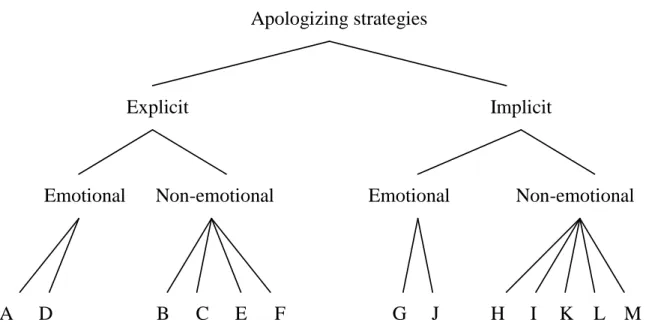
(29) strategies have been proposed. Fraser (1981:263) listed 9 strategies and suggested that people usually used more than one of them in each apology. They are:. Strategy 1: Announcing that you are apologizing Strategy 2: Stating one’s obligation to apologize Strategy 3: Offering to apologize Strategy 4: Requesting the hearer accept an apology Strategy 5: Expressing regret for the offense Strategy 6: Requesting forgiveness for the offense Strategy 7: Acknowledging responsibility for the offending act Strategy 8: Promising forbearance from a similar offending act Strategy 9: Offering redress. Trosborg (1987) also proposed a very systematical set of apology strategy and later refined it as follows (Trosborg, 1995):. Strategy 0: Complainee does not take on responsibility Evasive strategies: Strategy 1: Minimizing the degree of offense Indirect apologies: Strategy 2: Acknowledgement of responsibility Strategy 3: Explanation or account Direct apologies: Strategy 4: Expression of apology Remedial support: Strategy 5: Expressing concern for hearer Strategy 6: Promise of forbearance Strategy 7: Offer of repair Aijmer (1996:83) has distinguished apologizing strategies as explicit or implicit and emotional or non-emotional. The diagram designed by Aijmer is reproduced as follows (Figure 2.2):. 18.
(30) Apologizing strategies. Explicit. A. Implicit. Emotional. Non-emotional. D. B. C. E. Emotional. F. G. J. Non-emotional. H. I. K. L M. Figure 2. 2 Aijmer's Apologizing strategies (1996:83) A: Explicitly apologizing B: Expressing regret C: Offering one’s apology D: Acknowledging a debt of apology E: Demanding forgiveness F: Explicitly requesting the hearer’s forgiveness G: Giving an explanation or account H: Expressing emotion I: Self-denigration or self-reproach J: Minimizing responsibility K: Acknowledging responsibility for the offending act L: Promising forbearance from a similar offending act M: Offering redress. Perhaps the most famous and most widely accepted apology strategy set is the one generated by CCSAPR (1983) (Al-Zumor, 2003; Bergman & Kasper, 1993; Blum - Kulka & Olshtain, 1984; Holmes, 1990, 1998; Lipson, 1994; Sbisa, 1999; Suszczynska, 1999; Vollmer & Olshtain, 1989). It has appeared in numerous literature in similar forms. A simplified version is reproduced below:. 19.
(31) 1. Illocutionary force indicating devices (IFIDs) 2. Explanation or Account 3. Taking on Responsibility 4. Concern for the hearer 5. Offer of repair 6. Promise of Forbearance. 2.3.3 Previous Studies on Apology Over the last two to three decades, pragmatic researches have been growing rapidly and different researches focus on different languages or cultures and discuss different variables affecting the speech act. Rojo (2005) has summarized the following major categories: politeness strategies employed (e.g. Brown and Levinson, 1978; García, 1989), cultural values reflected in the apology realization (e.g. Suszczyńska, 1999), gender, factors affecting the choice/use of a particular strategy (e.g. Cohen & Olshtain, 1981; Fraser, 1981; Olshtain & Cohen, 1983, etc.), strategies used by native and non-native speakers (García, 1989; Trosborg 1987) and others. Sub-categories such as social distance, social power/status and age may also serve as the focus of individual research. Languages and socio-cultural groups, as well as the sub-categories under, may also be of concern. Some studies may discuss only one language, either paritcipants’ L1 or L2 while other studies may focus on comparing two or more languages or participants with same or different backgrounds. In speech act researches, L1 data usually serve as the baseline for intercultural or cross-cultural comparison and are usually not the main concern in doing “second language acquisition” researches. Thus, most of the designs may include learners’ L1 and L2 performances for transfer studies, learners’ L2 and native speakers’ performances for miscommunication studies and L1s of different socio-cultural groups for cultural studies. Some of the major studies are introduced below under the categorizations of participants’L1 or L2.. 20.
(32) 2.3.3.1 Studies on First Languages In addition to Austin’s (1962) and Goffman’s study (1971), perhaps the most famous recent L1 study is Janet Holmes’ (1989, 1990, 1998) studies on New Zealanders. She collected natural occurring data and analyzed the strategy distributions by offense types and by the relationships between the participants, such as gender (Holmes, 1989), status and distance (Holmes, 1990). She employed Brown & Levinson’s (1978) politeness notions and Wolfson’s bulge model (1989) of social relations applicable to the strategy selections and distributions in apologizing. She found that women apologize more than men and the sex of both speaker and recipient of an apology has an impact on the apology realization (Holmes, 1989, 1990, 1998). Vollmer & Olshtian (1989) investigated apologies of German with a DCT and also found that social status, social distance and the severity of the offense are the main factors determining the apology strategies. Obeng (1999) investigated Akan apologies also in natural interactions. The data was analyzed according to the formality of the situations, speakers’ status relations and social group differences. He suggested that Akan apologies may be more complex than as described in other studies. Notions and combinations of explicit and implicit apology strategies were the main discussion in the paper (Obeng, 1999). Deutschmann (2003) investigated explicit apologies in the spoken data of the British National Corpus in his PhD thesis. There were three main focuses: shape and function of the apologies, distribution of the total frequency and the different types of apologies among speakers of different social groupings in the BNC, and the effect of the conversational setting on the apology frequency and the types of apologies produced. Deutschman (2003) concluded that apology is so complex and can be discussed from many aspects. Even though there are many apology speech act researches of different L1s, very few of them study Chinese apology. In 1989, Blum-Kulka, House & Kasper said “clearly, there is a definite need for studies examining speech act realization in a wider spectrum of target. 21.
(33) languages and cultures, if interlanguage pragmatics is to contribute to solving one of the central problems of second language acquisition research, viz., which aspects of nonnative language development are universal and which are language-specific” (Blum-Kulka, House& Kasper, 1989: 10). Eight languages were studied and great findings are still contributive to many people. Over the last twenty years, not many Chinese researchers have studied and reported on EFL apology and other speech acts systematically. Most of them are more like “experience sharing” essays. However, compared to the rapid growth done in other languages, there is a need to carry out more research on Chinese .. 2.3.3.2 Cross-cultural and Interlanguage Studies There are many more cross-cultural and interlanguage studies than L1 studies on apology. The rapid growth of the need to learn the pragmatic aspects of a language for cross-cultural communication and the differences in languages and cultures are realized as critical issues to L2 speakers and cross-cultural communications (Cohen, Olshtain & Rosenstein, 1986; Barron, 2003). For cross-cultural and interlanguage apology studies, most previous methods encompassed several data gathering methods and thus discussed different aspects in their studies. Bergman & Kasper (1993) pointed out that studies of interlanguage apologizing have essentially addressed one research question - the accessibility of apology strategies to non-native speakers. Yet, they have examined this issue by means of different data-gathering procedures. Thus, different researches results should be treated with caution in inferencing speech acts. Therefore, to gain a comprehensive and objective view in determining results in studies of rare themes like this study, cross-cultural and interlanguage studies on apology in the literature are described chronologically below.. 22.
(34) Cohen & Olshtain (1981) investigated the communicative act of apologizing as realized in the speech of Danish learners of English compared with Hebrew native speakers’performance. This paper also provided an outline of apology strategies and an analysis of native/non-native communicative behavior for later studies. For example, Olshtain (1983) examined apology with role-plays by native speakers of American English (NS AE), Russian (NS Rus), and Hebrew (NS Heb) and by American and Russian learners of Hebrew (IL E-HEB, IL Rus-Heb) and find not only L1 transfer but also stereotypes exist in learners choice in performing speech act of apology in L2. Cohen, Olshtain & Rosenstein (1986) found that even advanced learners of English overgeneralized specific strategies and do not always provide the appropriate “social lubricant” in apologizing. Trosborg (1987) examined NS of British English (NS BE), NS of Danish (NS Dan) and three groups of Danish learners of English at different levels of proficiency with role-plays. Trosborg is more famous for her apology strategies categorization and often adopted as the model or pre-model in other speech act of apology researches. Mir (1992) examined apology strategies used by Spanish learners of English with variables such as severity, age and distance of the interlocutors. The results revealed cultural dissimilarities, strategies transfer and intensification differences. Kasper (1993) examined the perception of contextual factors by Thai and American informants. She also discussed the question of how the selection of apology strategies is determined by contextual factors. Rintell & Mitchell (1989) used both written DCT and oral DCT data-collecting methods and did not find significant differences. Sbisà (1999) compared Italian with other languages’ apology. She also discussed the disagreements among the findings and pointed out that apology strategies may be universal and cross-cultural but they may mean different things and have different degrees in force. Not many similar apology research to the above are conducted in Chinese. Thus, to discuss the speech act of apology in Chinese, there is a need broaden the field in reviewing the 23.
(35) literature. Observed from cultural studies, the most famous cross-cultural apology lately should be the Hainan Island incident. This seemingly simple incident was so complicated and brought popular discussions at the time. It was as the following said in Gries & Peng that “ China insisted on an American apology, ‘because they think it’s very appropriate to apologize because people died. To Americans, an ‘apology’ is a legal issue where you admit you did something wrong.’ China’s standard was moral … Chinese diplomats tended to look at the incident holistically, searching for greater causes, while Americans found that discussion irrelevant to the event at hand” (Gries & Peng, 2002: 1). The UCLA study is more similar to ILP studies. The UCLA Studies discussed a little on three Chinese learners’ performance. The Chinese deviated their language from the native speakers’ by saying too much or too little. They also used many more intensifications in apology than any other ethnic groups did in the same study.. 2.4 Summary In reviewing the literature of the concept of Chinese politeness, it seems that the taxonomy of individual-oriented western politeness values and other-oriented eastern politeness values are important in discussing the results of this study. For example, the results of apology perceptions toward people of different social status between Chinese and American participants reveal very different cultural values. However, speech act of apology in L1 or L2 yielded less but important variance across cultural groups and contextual factors than other acts. The influential factors are offense imposition, interlocutor and speaker gender, social status, social distance, etc. To examine those themes, the CCSARP project is the most suitable and most commonly adopted model in providing methods and factors for modifications. The study integrated the traditional methods commonly seem in ILP studies with some innovative themes such as language used and 24.
(36) nationality of the interlocutors. This will be further introduced in the following sections.. 25.
(37) CHAPTER 3 METHOD. This study is part of the Chinese-English Interlanguage Speech Acts Research Project, which started from August 2004 and was sponsored by National Science Council (NSC 93-2411-H-017-011; NSC 94-2411-H-110-010) and National Sun Yat-sen University. The corpus consists of speech act data obtained from native speakers of Chinese (Chinese L1), native speakers of English (English L1), and Chinese EFL learners by means of three elicitation methods— Discourse Completion Test (DCT), Scaled-response Questionnaire (SRQ) and role-play.. Speech acts investigated in this research project include refusals, requests,. apologies, disagreements, complaints and expressions of gratitude.. For the purpose of the. present study, only the SRQ data obtained for the speech act of apology will be considered and analyzed in the following discussion.. 3.1 Participants Most researches have involved several to thirty subjects per individual grouping and claimed to have significant results (Cohen & Olshtain, 1981; Kasper & Dahl, 1991; Lipson, 1994; Maeshiba et al., 1996; Olshtain & Cohen, 1983; Suszcynska, 1999). There were 60 Chinese national-university-level students (3rd grade and up Chinese students at National Sun-Yat-Sen University and National Kaoshiung Normal University in Taiwan) 1 and 60 American university level students (3rd grade and up Caucasian students at University of Illinois at Urbana-Champaign, Harvard University or MIT) between the ages of 20 to 31 participated in this study. The Chinese students were grouped according to their gender (30 male – 30 female). 1. These two universities usually rank among the best 20 universities in Taiwan. (MOE) 26.
(38) and their proficiency and exposure to English (30 English majors and 30 non-English majors) and the 60 American participants were grouped according to their gender (30 males and 30 females). Background questionnaires were given to the participants to make sure the Chinese participants were not with special English exposure and the English speakers were all Caucasians. This study hoped that all the possible factors concerning the participants’selection were well controlled (See Appendix I & III for the background questionnaires for Chinese L1 and English L1 participants).. 3.2 Materials There were three questionnaires for the Chinese informants and one for the American informants along with a simple background questionnaire. The questionnaires for both ethnic groups were pilot tested and proofread by two native speakers of English who were familiar with both Chinese and American cultures to ensure that the scenarios in the questoinnaires were culturally equivalent. The questionnaires were designed to be equal in contents but different in the task language used in the questionnaires and in the ethnicity of the interlocutors offended for the purpose of cross-cultural and cross-linguistics comparisons and discussions. There were three sets of questionnaires. The Chinese participants answered all the three sets and the American participants only answered set C, which is in English. Detailed descriptions are as follows:. 1. Set A: in Chinese -interlocutors in the scenarios are Chinese; —for Chinese L1 data. 2. Set B: in Chinese -interlocutors in the scenarios are Americans—for comparison of interlocutor ethnicity 3. Set C: in English -for English L1 data and Chinese EFL data.. 27.
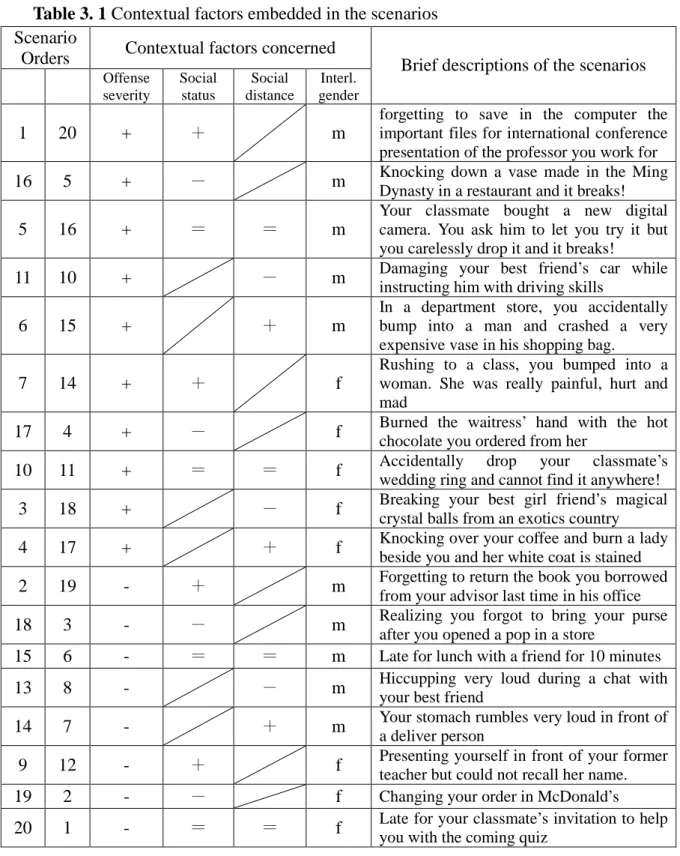
(39) Each set was made into two different orders to avoid possible test-effects. The questionnaires have been piloted by several students in the same schools of the participants and also by several other students in universities located in other parts of the island. Since the contents of the research design have been carefully designed and carefully examined by members of the NSYSU Center for Speech Act Studies, the main focus of the pilot was to make sure the situations were common, imaginable and the factors were clear, and that the data collection method of the SRQ and DCT were not a burden to the participants.. 3.2.1 Scenarios In the questionnaires, the first part was an offending scenario that required the participants to apologize. The participants answered two SRQ questionas followed by a DCT and then two more SRQs. The following is a sample scenario from the English version of the questionnaires. Situation 1: Your classmate Laura Johnson is a good student. When you talk about the coming quiz, she invites you to her house to study together. Somehow, you were late for nearly 10 minutes. (Questionnaire Order 2) severity of the situation is ---------------------------------------high---- 5 4 3 2 1 ---- low-the possibility of you apologizing is ---------------------------high---- 5 4 3 2 1 ---- low-I would say:. difficulty of the apology for me is -----------------------------high---- 5 4 3 2 1 ---- low-likelihood of the apology accepted is -----------------------high---- 5 4 3 2 1 ---- low-(See Appendix II and III for the complete sets of the questionnaires) In the study, there were 20 unintentional offending scenarios in each set of the questionnaires. Different offense types were designed into the situations according to common offense situations (Appendix IV). Kasper & Dahl (1991: 16) suggested that 20 scenarios “serve as a rough guide” for decisions on common sociolinguistic factors and more factors may post much load on the participants. The 20 scenarios were designed to elicit data for discussoin on 28.
(40) common sociolinguistic factors in pragmatic studies and for arousing perceptive ratings and productive remedial exchanges to meet the social norms. They are offense severity / imposition gender, social status and social distance. The organization of the scenarios and factors is presented below in Table 3.1: Table 3. 1 Contextual factors embedded in the scenarios Scenario Contextual factors concerned Orders Brief descriptions of the scenarios Offense severity. Social status. Social distance. Interl. gender. 1. 20. +. +. m. 16. 5. +. -. m. 5. 16. +. =. 11. 10. 6. =. m. +. -. m. 15. +. +. m. 7. 14. +. +. f. 17. 4. +. -. f. 10. 11. +. =. 3. 18. 4. =. f. +. -. f. 17. +. +. f. 2. 19. -. +. m. 18. 3. -. -. m. 15. 6. -. =. 13. 8. 14. =. m. -. -. m. 7. -. +. m. 9. 12. -. +. f. 19. 2. -. -. f. 20. 1. -. =. =. f 29. forgetting to save in the computer the important files for international conference presentation of the professor you work for Knocking down a vase made in the Ming Dynasty in a restaurant and it breaks! Your classmate bought a new digital camera. You ask him to let you try it but you carelessly drop it and it breaks! Damaging your best friend’s car while instructing him with driving skills In a department store, you accidentally bump into a man and crashed a very expensive vase in his shopping bag. Rushing to a class, you bumped into a woman. She was really painful, hurt and mad Burned the waitress’ hand with the hot chocolate you ordered from her Accidentally drop your classmate’s wedding ring and cannot find it anywhere! Breaking your best girl friend’s magical crystal balls from an exotics country Knocking over your coffee and burn a lady beside you and her white coat is stained Forgetting to return the book you borrowed from your advisor last time in his office Realizing you forgot to bring your purse after you opened a pop in a store Late for lunch with a friend for 10 minutes Hiccupping very loud during a chat with your best friend Your stomach rumbles very loud in front of a deliver person Presenting yourself in front of your former teacher but could not recall her name. Changing your order in McDonald’s Late for your classmate’s invitation to help you with the coming quiz.
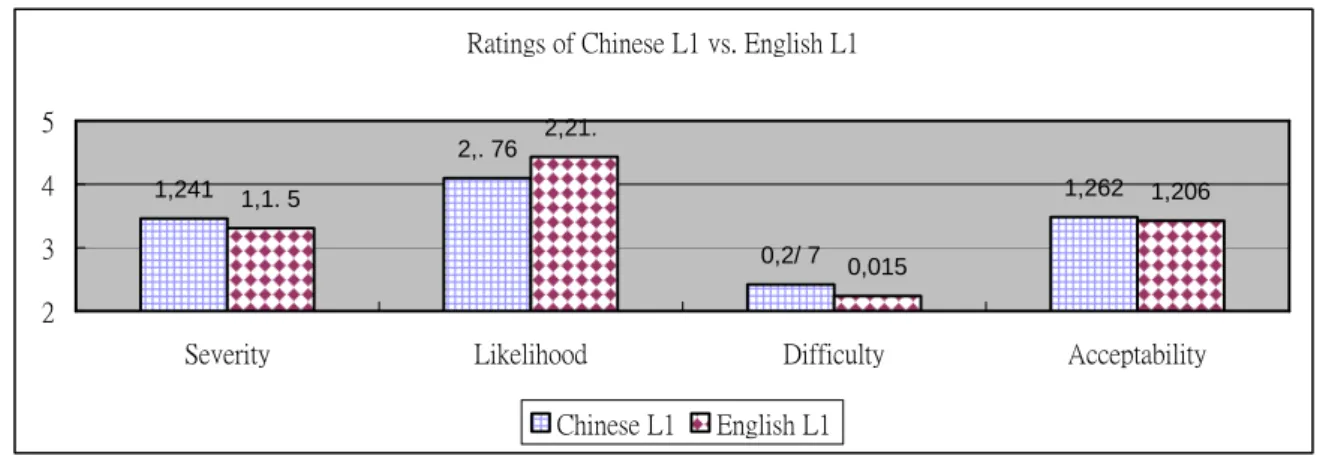
(41) 12. 9. -. -. f. 8. 13. -. +. f. Misunderstanding your advise, your best friend’s feelings was hurt Waiting in line to get a movie ticket, you accidentally step on a woman’s foot.. Note: Severity : +high / -low Status : +Status higher / =Status equal / -Status lower Distance : +Strange r/ =acquaintance / -close friend Gender m : male interlocutor / f female interlocutor. The factors in the scenarios are severity (high and low), status (high, equal and low), distance (stranger, acquaintance and close friend) and genders. The study designed and revised the scenarios according to the piloted results and through interviewing experts and the pilot subjects. The severity-high scenarios were situations like breaking valuable properties of someone or physically hurting someone. Severity low scenarios were social gaffe or late for a short period of time. Status high interlocutors were professors. Status equal interlocutors were classmates or acquaintances. Status low interlocutors were waiters. Distance far interlocutors were strangers. Distance equal interlocutors were acquaintances and distance close interlocutors were close friends.. 3.2.2 Perception Task: Scaled-response Questions In order to understand the performance or actual speech of learners, learners’ perception of the “situation” must be clarified. Bergman & Kasper (1993) have realized there are cultural perception differences between cultures and thus constructed a DCT with four “context-internal” rating questions – severity of offense, offender’s obligation to apologize, likelihood for the apology to be accepted, and offender’s face loss. Following this pattern, this study adopted the first three questions to examine learners’ perception of apologies over different “context-external” factors – social distance, social status, gender and severity. “Face loss” was replaced by the difficulty of the apology for face loss was not the main concern in this study, but remedy to maintain interpersonal harmony was. Therefore, it is also 30.
(42) the aim of this study to know the difficulty of the apology, because the act is a highly face-threatening act and may post great load on the apologizer.. 3.2.3 Production Task: Discourse Completion Tasks After two context-internal SRQ questions, severity of the offense and obligation to apologize, then a strategy eliciting question was asked, followed by two more context-internal SRQ questions, difficulty and acceptability of the apology. The sequence has been pilot-tested and were found to be more logical and easier in filling in the questionnaires. The aim was to make the sequence of the questions logical and user(filler)-friendly. The written DCT was used to generate the strategies used by Chinese in L1 and L2 and English in L1. Comparing the results of the questionnaire sets among the groups of participants, the study was able to discuss and answer the research questions. The study was able to probe into cultural differences between Chinese L1s and English L1s by comparing the results from questionnaire set A with the results from English L1s in questionnaire set C. By comparing questionnaire set A and set B, the study could investigate the effects of different ethnicity and through comparing questionnaire set B and set C, the study could discuss the effects of language used in the task.. 3.3 Procedure After piloting, the questionnaires were distributed to participants through adequate period of intervals either in class or taken home after specific instructions. In order to avoid practice effects, the three questionnaire sets were distributed to the Chinese participants in three or more different weeks with at least one or two weeks of interval and.the participants were free to stop participating whenever they wish to.. 31.
(43) The instructions for the questionnaires were made before distributing the questionnaires. Neutral and objective instructions were preferred and given. The instructors giving the questionnaires also told the participants that spontaneous responses were preferred. Before the participants took the next set one or more weeks later, they were asked once more if they were willing to participate in the study and if they remembered the scenarios claerly in the previous questionnaire. To avoid test-effect, the second set of questionnaires were only distributed to those who did not have vivid memory of the previous questionnaire... 3.4 Data Analysis To analyze the SRQ and DCT, SRQ results were keyed-in and double checked by a different researcher. The DCT results were analyzed by two raters in the Chinese-English Interlanguage Speech Acts Research Project. After the DCT were analyzed into apology strategies, they were also keyed-in for statistical figures. The statistics software used in this study was SPSS. It was convinent for calculating T-test, pair test and ANOVA in this study.. 32.
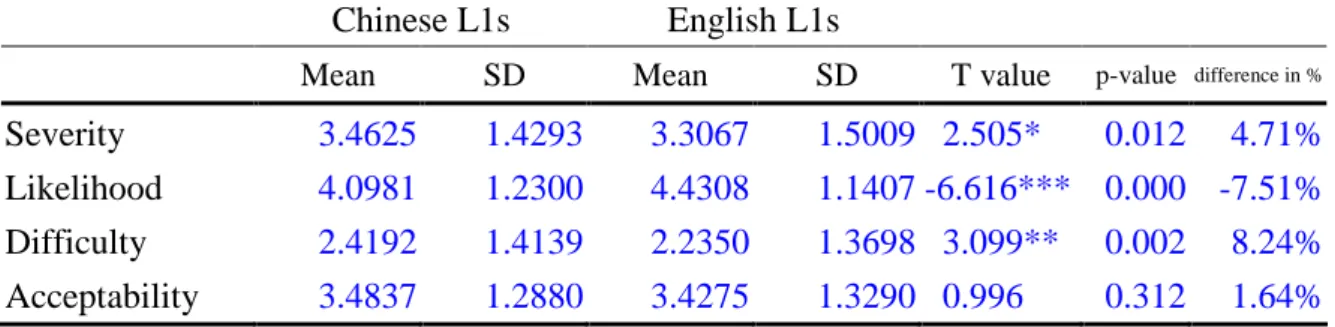
(44) CHAPTER 4. RESULTS AND DISCUSSION. Chapter four focused on the perceptions of different participant groups – Chinese L1s vs. English L1s. The comparisons between the perceptions of the four context-internal questions of Chinese L1s and English L1s are presented in section 4.1. Detailed discussions of the context-external factors, severity, gender, status and distance under the four context-internal questions are presented in section 4.2. Section 4.3 reports the perception differences toward interlocutors of different ethnicity. Section 4.4 reports the perception differences in using different task languages. Section 4.5 compares the perceptions of highly L2 exposed Chinese speakers with the lowly L2 exposed Chinese speakers.. 4.1 Chinese L1 Data vs. English L1 Data To discuss whether perception differences exist in the speech act of apology between cultures or not, the study asked the participants to rate four context-internal questions of 20 different offense scenarios. The means of the ratings are presented in Table 4.1 and Figure 4.1. Table 4. 1 Means of the ratings on "severity of the situation", likelihood to apologize", "difficulty of the apology" and "acceptability of the apology" by Chinese L1s & English L1s Chinese L1s Mean. Severity Likelihood Difficulty Acceptability. 3.4625 4.0981 2.4192 3.4837. SD. 1.4293 1.2300 1.4139 1.2880. English L1s Mean. 3.3067 4.4308 2.2350 3.4275. *p < .05; ** p < .01; *** p < .001. 33. SD. T value. 1.5009 2.505* 1.1407 -6.616*** 1.3698 3.099** 1.3290 0.996. p-value. difference in %. 0.012 4.71% 0.000 -7.51% 0.002 8.24% 0.312 1.64%.
(45) Ratings of Chinese L1 vs. English L1 5 4. 4.098 3.463. 4.430 3.484. 3.307. 3. 2.419. 3.428. 2.237. 2 Severity. Likelihood. Difficulty. Chinese L1. Acceptability. English L1. Figure 4. 1 Means of the ratings on "severity of the situation", "likelihood to apologize", "difficulty of the apology" and "acceptability of the apology" by Chinese L1s & English L1s. As can be noted in Table 4.1 and Figure 4.1, Chinese L1 participants rated the severity of the offense higher than English L1 participants. The results matched Mao’s (1994) distinction between the “ideal social identity” in Chinese soceity and the “ideal individual autonomy” in western society. That is to say, when a Chinese offended others, their “ideal social identity” is threatehned highly comparing to the same situation happening to an English L1. This may explain why English L1 speakers viewed the severity of the offense situations 4.71% lower than the Chinese L1 speakers on average. Americans also care about social harmony. It did not show in the severity rating, like the Chinese participants did, but in the likelihood to apologize. According to chapter two of the present study, apology is a remedial work that one must perform to remain social harmony (Goffman, 1971). The American participants chose to redeem the social harmony with their apologies. This corresponds with the DCT results obtained fom the same corpus (Lin & Shih, 2006; Shih, 2006) which showed that Chinese L1s used less apology strategies (2609) than English L1 speakers (2897) under the same 20 scenarios (Appendix V). Chinese L1 speakers’ rating of the difficulty to apologize is significantly different (p<.01) from English L1 speakers. Chinese L1s’ perception of the difficulty to apologize is 8.24% higher than that of English L1 speakers’ rating. That is to say that apologizing is more difficult 34.
數據
+7
相關文件
Building on the strengths of students and considering their future learning needs, plan for a Junior Secondary English Language curriculum to gear students towards the
Language Curriculum: (I) Reading and Listening Skills (Re-run) 2 30 3 hr 2 Workshop on the Language Arts Modules: Learning English. through Popular Culture (Re-run) 2 30
Expecting students engage with a different level of language in their work e.g?. student A needs to label the diagram, and student B needs to
“I don’t want to do the task in this
3 The teaching modes of ELA in English include collaboration between non-language subject teachers and English Language teachers to conduct cross-curricular English
Developing Students’ Multimodal Literacy in the Secondary English Language Classroom is a resource package produced by the English Language Education Section,
(d) While essential learning is provided in the core subjects of Chinese Language, English Language, Mathematics and Liberal Studies, a wide spectrum of elective subjects and COS
If the students are very bright and if the teachers want to help prepare these students for the English medium in 81, teachers can find out from the 81 curriculum
