Strong anisotrpoic maganetoresistance and magnetic interaction in La 0.7 Ce 0.3 Mn O
3 La 0.7 Ca 0.3 Mn O 3 p - n junction
H. Chou, Z. Y. Hong, S. J. Sun, J. Y. Juang, and W. J. Chang
Citation: Journal of Applied Physics 97, 10A308 (2005); doi: 10.1063/1.1850378 View online: http://dx.doi.org/10.1063/1.1850378
View Table of Contents: http://scitation.aip.org/content/aip/journal/jap/97/10?ver=pdfcov Published by the AIP Publishing
Articles you may be interested in
Unusual resistivity hysteresis in a bulk magnetoresistive ferromagnetic/ferrimagnetic composite ( La 0.7 Ca 0.3 Mn O 3 Mn 3 O 4 ) : Role of demagnetization effects
Appl. Phys. Lett. 91, 062514 (2007); 10.1063/1.2768883
Tunnel magnetoresistance in La 0.7 Ca 0.3 Mn O 3 Pr Ba 2 Cu 3 O 7 La 0.7 Ca 0.3 Mn O 3 Appl. Phys. Lett. 88, 022512 (2006); 10.1063/1.2162674
Crossover from negative to positive magnetoresistance in La 0.7 Ce 0.3 Mn O 3 - Sr Ti O 3 - Nb heterojunctions Appl. Phys. Lett. 87, 032501 (2005); 10.1063/1.1995960
Picosecond photoelectric characteristic in La 0.7 Sr 0.3 Mn O 3 Si p - n junctions Appl. Phys. Lett. 86, 241915 (2005); 10.1063/1.1946901
Photovoltaic effect in La 0.7 Ce 0.3 Mn O 3 Sr Ti O 3 Nb heterojunction and its oxygen content dependence Appl. Phys. Lett. 85, 37 (2004); 10.1063/1.1769079
[This article is copyrighted as indicated in the article. Reuse of AIP content is subject to the terms at: http://scitation.aip.org/termsconditions. Downloaded to ] IP: 140.113.38.11 On: Thu, 01 May 2014 03:03:54
Strong anisotrpoic maganetoresistance and magnetic interaction
in La
0.7Ce
0.3MnO
3/ La
0.7Ca
0.3MnO
3p
-
n
junction
H. Choua兲and Z. Y. Hong
Department of Physics and the Center for Nanoscience and Nanotechnology, National Sun Yat-Sen University, No. 70 Lian Hai Road, Kaohsiung, Taiwan, Republic of China
S. J. Sun
Department of Applied Physics, National University of Kaohsiung, Kaohsiung, Taiwan, Republic of China
J. Y. Juang and W. J. Chang
Institute and Department of Electrophysics, National Chiao-Tung University, ChinChu, Taiwan, Republic of China
共Presented on 9 November 2004; published online 28 April 2005兲
The p-n junction made by colossal magnetoresistance materials, such as La0.7Ce0.3MnO3/ La0.7Ca0.3MnO3, has great interest for its potential applications. However, the physics of the magnetic state and transport properties of the interface still remains open. In this article, bilayer La0.7Ce0.3MnO3/ La0.7Ca0.3MnO3/ STO films with a nearly perfect interface were
studied. The p-n interface possibly becomes an antiferromagnetion-insulating layer as their parent compound, LaMnO3, and confines the bias current flowing only on the top layer. The top and bottom
layers interact with each other in a way that a strong anisotropy in magnetoresistance measurements was observed. © 2005 American Institute of Physics.关DOI: 10.1063/1.1850378兴
La0.7Ce0.3MnO3 共LCeMO兲 and La0.7Ca0.3MnO3
共LCaMO兲 are known as n- and p-type colossal magnetore-sistance 共CMR兲 materials with similar crystal structure and physical properties.1–5 They experience the same paramagnetic-insulator–to–ferromagnetic-metal transition across the ferromagnetic-paramagnetic transition temperature 共TC兲 and metal-insulator transition temperature 共TP兲. Their
parent compound LaMnO3 with a pure Mn3+ configuration
forms a canted antiferromagnetism 共AFM兲 below 150 K.6 When they are grown into a bilayer structure, a depletion layer due to carrier neutralization around the vicinity of the interface is expected. The potential application for a p-n junction by realizing rectifying function has been demon-strated elsewhere.3–5However, due to uncertain effects at the p-n interface, the incomplete depletion layer did not provide a perfect insulator layer as p-n junctions need. Excess insu-lator, such as a SrTiO3共STO兲 thin layer, was inserted to act
as an artificial barrier for tunneling. Because the ferromag-netic property of CMR is mainly governed by the double exchange coupling mechanism,7–9 the hopping of itinerant carriers across the interface is crucial. Though in a current perpendicular to the plane measurements of a p-n junction, an incomplete insulating characteristic3,4 was observed, the magnetic state of the depletion layer and its interaction with the lateral ferromagnetic layers and the possible interaction between the lateral layers has not been studied systemati-cally.
In this article, single LCeMO and LCaMO films and bilayer films were grown on SrTiO3 共100兲 substrates by a
pulse laser ablation system at 700– 750 ° C and PO2
= 300 mTorr. The thickness of films was calibrated to the number of pulses. The structure and compositional profile
are analyzed by a x-ray diffractometer and by an Auger elec-trometer. The transport and magnetic properties were mea-sured by a standard four points probe and by superconduct-ing quantum interference device共SQUID兲 measurements.
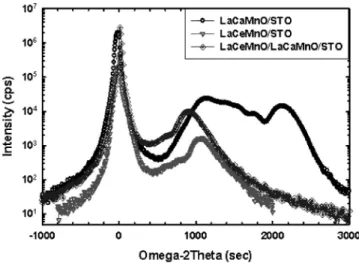
Because of the lattice mismatch between the substrate and films, the strong tensile strain expands the in-plane lat-tice for films below a certain thickness.1,10–14To reduce the strain effect on the films that would suppresses the transition temperature of films, all single layers were grown up to a thickness of 100 nm. The bilayer films consisted of two 100 nm thick layers. According to the x-ray diffraction pat-terns as shown in Fig. 1, all films experience minor strain
a兲Electronic mail: [email protected]
FIG. 1. The x-ray diffraction patterns, omega-2 theta scan, for the single-layer LCaMO film共black circles兲, the single-layer LCeMO film 共black re-verse triangles兲, and the bilayer films 共the gray diamonds兲 around the 共002兲 peak of SrTiO3 共STO兲. The peaks of all films locate consistently around 1000 s on the right-hand side of STO共002兲 peak. This indicates a minor strain effect of the STO substrate on the films.
JOURNAL OF APPLIED PHYSICS 97, 10A308共2005兲
0021-8979/2005/97共10兲/10A308/3/$22.50 97, 10A308-1 © 2005 American Institute of Physics
[This article is copyrighted as indicated in the article. Reuse of AIP content is subject to the terms at: http://scitation.aip.org/termsconditions. Downloaded to ] IP: 140.113.38.11 On: Thu, 01 May 2014 03:03:54
effect by the substrates, the 共002兲 of LCaMO and LCeMO single layer films and the LCeMO / LCaMO bilayer film shift consistently only 1000 s from the 共002兲 peak of STO. This implies a match in the lattice and a possible epitaxial growth of the bilayer film. Auger electrometer profile of the compo-sition content of the bilayer film is shown in Fig. 2. A very clean interface with no traceable interdiffusion or reaction between LCeMO and LCaMO layers can be observed. Therefore, the possible interdiffusion or reaction suspected by C. Mitra et al.3,4can be neglected.
The current in-plane transport measurements for the re-sistance as a function of temperature were carried out at zero magnetic field and are shown in Fig. 3. The LCaMO film exhibits the highest metal-insulator transition temperature of 256 K with the lowest peak resistivity of 63⍀ cm. The single-phase LCeMO film can only be grown in a very nar-row gnar-rowth window and yields a lower transition tempera-ture of 213 K with a medium peak resistivity of 133⍀ cm. The bilayer LCeMO / LCaMO film shows a medium transi-tion temperature of 234 K and the largest peak resistivity of 365⍀ cm. The higher transition temperature of the bilayer film to the single layer LCeMO film could be because of the
better lattice match between LCeMO on LCaMO than on STO. The total thickness of the bilayer equals the sum of each single layer, then the resistivity of the bilayer should be lower than any single film. However, the resistivity of the bilayer film moved in the opposite direction, indicating larger resistivity, which implies that the bilayer is separated by a high resistance interface layer. The current is then con-strained to flow in the top layer with a reduced cross section or with a stronger spin fluctuation and yields a higher resis-tivity.
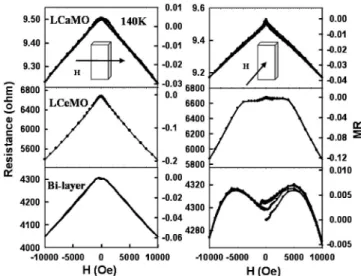
The magnetoresistance 共MR兲 data for the parallel and vertical configurations and for the applied field parallel to or perpendicular to the substrate as shown in the diagram in Fig. 4, at 140 K indicates a strong anisotropic characteristic. In the parallel configuration, two single-layer films and the bilayer films have very similar MR response within 10 000 Oe. The LCeMO film shows the largest negative MR compared to the other films, which is believed due to the internal stress for single-phase LCeMO film on STO. In ver-tical configuration, the LCaMO film exhibits a similar MR curve. The smaller MR reading in the vertical configuration compared with the parallel configuration is due to the strong demagnetization effect of the ferromagnetic films. LCeMO film experiences a strong pinning at low field, which can be quenched for fields higher than 4500 Oe at 140 K. For the bilayer, an unexpected positive MR at low field is observed. The MR increases as field in both directions until a critical field of 6000 Oe is reached. Beyond the critical field, the diverse moments at the top layer start to align along the applied field and lower the MR to the negative region. The anisotropy could originate from the coupling between the top layer with the possible antiferromagnetism interlayer or with the bottom layer.
Though a SQUID can hardly sense the signal from the antiferromagnetic layer in between two ferromagnetic layers, the magnetic moment configuration of the top and bottom layers can be realized. In Fig. 5, the zero field cooled共ZFC兲 and field cooled 共FC兲 magnetizations as a function of tem-FIG. 2. The compositional profile of the bilayer film. The interface between
LCeMO and LCaMO forms a clean interface with neither interdiffusion nor chemical reaction.
FIG. 3. The-T characteristics measured at zero field condition. Due to the small growth window for LCeMO films and the large lattice mismatch with STO substrate, it exhibits lowest TC. This mismatch was eased by growing LCeMO on the top of the LCaMO layer.
FIG. 4. The magnetoresistance of films as a function of applied field. All films show similar MR curves in the parallel configuration. In the vertical configuration, they have very different MR curves in the entire temperature range.
10A308-2 Chouet al. J. Appl. Phys. 97, 10A308共2005兲
[This article is copyrighted as indicated in the article. Reuse of AIP content is subject to the terms at: http://scitation.aip.org/termsconditions. Downloaded to ] IP: 140.113.38.11 On: Thu, 01 May 2014 03:03:54
perature in both configurations are plotted. In parallel con-figuration, the ZFC curve at low temperature goes to nega-tive due to the diamagnetic nature of the substrate. Compare with the FC curve at low temperature which is positive, 1 ⫻10−3emu, the top and bottom layers form an
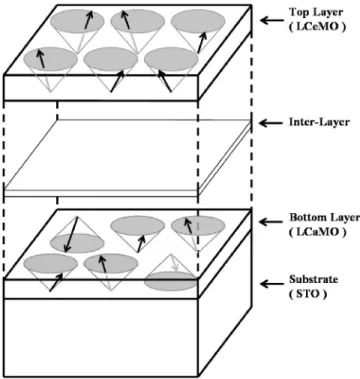
antiferromag-netic共AFM兲 configuration along the direction parallel to the surface of the substrate. However, the AFM configuration can be easily quenched by a weak field of 200 Oe. In the vertical configuration, due to the demagnetization effect, the diamagnetic nature of the substrate is not strong enough to overcome the weak ferromagnetism in the direction perpen-dicular to the surface of substrate. The possible moment con-figuration of the system could be as shown in the Fig. 6. At low temperature, the top and bottom layers form an incom-plete AFM configuration along the perpendicular direction and a nearly complete one in the parallel direction.
In this article we have grown bilayer films consisting of n- and p-type CMR layers with a very clean interface with-out noticeable interdiffusion or chemical reaction. The inter-face due to the carrier neutralization forms a high resistance depletion layer that confines the parallel current to flow on the top layer only. Because the parent compound of both types of compositions is a canted AFM insulator, the deple-tion layer has a high probability to yield similar properties as the parent compound. As a result of this, the lateral ferro-magnetic layers forms weak AFM coupling via the depletion layer along the surface of films. The AFM coupling can be
quenched easily by a weak field of 200 Oe and produces the strong anisotropy in magnetic and electric transport measure-ments.
1
S. Jin, T. H. Tiefel, M. McCormack, R. A. Fastnacht, R. Ramesh, and L. H. Chen, Science 264, 413共1994兲.
2
J. M. D. Coey, M. Viret, and S. von Molnar, Adv. Phys. 48, 167共1999兲. 3
C. Mitra, P. Raychaudhuri, G. Köbernik, K. Dörr, K.-H. Müller, L. Schultz, and R. Pinto, Appl. Phys. Lett. 79, 2408共2001兲.
4
C. Mitra, P. Raychaudhuri, J. John, S. K. Dhar, A. K. Nigam, and R. Pinto, J. Appl. Phys. 89, 524共2001兲.
5
P. Mandal and S. Das, Phys. Rev. B 56, 15073共1997兲. 6
J. Zaanen, G. A. Sawatzky, and J. W. Allen, Phys. Rev. Lett. 55, 418 共1985兲.
7
C. Zener, Phys. Rev. 82, 403共1951兲. 8
P. W. Anderson and H. Hasegawa, Phys. Rev. 100, 675共1955兲. 9
P. G. de Gennes, Phys. Rev. 118, 141共1960兲. 10
J. O’Donnell, M. S. Rzchowske, J. N. Eckstein, and I. Bozovic, Appl. Phys. Lett. 72, 1775共1998兲.
11
S. Freisem, A. Brockhoff, D. G. de Groot, B. Dam, and J. Arats, J. Magn. Magn. Mater. 165, 380共1997兲.
12
E. Gommert, H. Cerva, J. Wecker, and K. Samwer, J. Appl. Phys. 85, 5417共1999兲.
13
F. Tsui, M. C. Smoak, T. K. Nath, and C. B. Eom, Appl. Phys. Lett. 76, 2421共2000兲.
14
B. Vengalis, A. Maneikis, F. Anisimovas, R. Butkute, L. Dapkus, and A. Kindurys, J. Magn. Magn. Mater. 211, 35共2000兲.
FIG. 5. The ZFC and FC magnetization curves of the bilayer film at 200 Oe in the parallel and vertical configuration. The small and negative ZFC mag-netization and the huge difference between ZFC and FC magmag-netization at low temperature indicates a weak AFM coupling between the top and bot-tom layers and a strong anisotropy in the parallel and vertical configurations.
FIG. 6. The illustration of the possible magnetic state in the p-n bilayer. The magnetic coupling between the top and bottom layer is basically AFM at zero field along the direction of film surface, and yet forms a weak FM along the perpendicular direction.
10A308-3 Chouet al. J. Appl. Phys. 97, 10A308共2005兲
[This article is copyrighted as indicated in the article. Reuse of AIP content is subject to the terms at: http://scitation.aip.org/termsconditions. Downloaded to ] IP: 140.113.38.11 On: Thu, 01 May 2014 03:03:54