
人格特質在網路消費者抱怨行為及服務補救期望上所扮演之角色
70
0
0
全文
(2) 國立交通大學 管理科學系 博 士 論 文 No.033 人格特質在網路消費者抱怨行為及服務補救期望上 所扮演之角色 The Role of Personalities in Online Consumer Complaint Behavior and Service Recovery Expectation 研. 究. 生:張巧真. 研究指導委員會:黃仁宏 楊. 指. 導. 教. 教授. 千. 教授. 林君信. 教授. 授:黃仁宏. 教授. 中 華 民 國 九 十 七 年 四 月.
(3) 人格特質在網路消費者抱怨行為及服務補救期望上所扮演之角色. The Role of Personalities in Online Consumer Complaint Behavior and Service Recovery Expectation. 研 究 生:張巧真. Student:Chiao-Chen Chang. 指導教授:黃仁宏. Advisor:Dr.Jen-Hung Huang. 國 立 交 通 大 學 管 理 科 學 系 博 士 論 文. A Dissertation Submitted to Department of Management Science College of Management National Chiao Tung University in Partial Fulfillment of the Requirements for the Degree of Doctor of Philosophy in Management April 2008 Hsin-Chu, Taiwan, Republic of China. 中華民國九十七年四月.
(4) 人格特質在網路消費者抱怨行為及服務補救期望上所扮演之角色. 研 究 生:張巧真. 指導教授:黃仁宏 教授. 國立交通大學管理科學系博士班. 摘. 要 過去許多研究多半在探討一般實體商店的消費者抱怨行為及服務補救之議題,顯少. 有學者針對網路服務疏失對消費者抱怨行為及其服務補望期望的影響作進一步的探 討。本研究以網路服務疏失為背景,針對消費者個人的人格特質是否會對抱怨行為及服 務補救期望造成調節效果加以探討。研究問卷發放 320 份於曾使用網路購物的消費者, 詢問填答者對網路服務疏失發生時,其抱怨行為的可能反應,及對業者所做的服務補救 之看法。由 ANOVA 分析指出,在程序型的服務疏失發生時,A 型且為外控人格的消費 者較易有主動向業者抱怨的行為產生,並且會期待業者給予心理上的服務補救方法來降 低其不滿意的程度;另一方面,在結果型的服務疏失發生時,A 型且為外控人格的消費 者則傾向於從事積極性抱怨行為,並且希望業者能運用實質補償的服務補救方法來挽回 消費者。此外,根據研究結果提出理論上及實務上之建議。. 關鍵詞:A型人格、內外控、服務疏失、抱怨行為、服務補救。. i.
(5) The Role of Personalities in Online Consumer Complaint Behavior and Service Recovery Expectation. Department of Management Science National Chiao Tung University Student: Chiao-Chen Chang. Advisor: Dr. Jen-Hung Huang Abstract. Although service failure and recovery issues have received considerable attention in the literature, these topics have received only limited attention in the context of online retailing. This study investigates the relationship between type of service failures in online environment and their effect on consumer complaint behaviors and service recovery expectations. In addition, we explore the impact of personality factors — in terms of Type A behavior patterns and external locus of control — on the relationships between e-service failures with consumer complaint behaviors and service recovery expectations. Data were collected by using a questionnaire from 320 respondents. Results of ANOVA analysis show that e-service process failures are more likely than e-service outcome failures to lead to voice responses of consumer complaint behaviors. For e-service process failures, consumers with Type A/External locus of control are more inclined to voice their dissatisfaction and more likely to expect an apology than are other types of consumers. For e-service outcome failures, they are more prone to present private responses and third-party responses than to voice their dissatisfaction and more likely to ask for a monetary service recovery than for a psychological service recovery. Practical and research implications are offered. Keywords: Type A Behavior Pattern, Locus of Control, e-Service Failure, Consumer Complaint Behavior, Service Recovery. ii.
(6) 誌. 謝. 口試結束的這一天,細細回想在交大讀書的時光,從資格考、論文發表,一關一關 地闖,終於到了開花結果的時刻,心中滿是感慨。從漫無目的搜尋論文題目開始,恩師 黃仁宏教授引領我走到確定自己的研究方向階段,不論遇到任何的阻礙,恩師總能給予 最大的鼓勵與支持,誠摯感謝恩師讓我學習到身為學者的風範與氣度。每當遇到寫論文 的瓶頸,耳邊總會縈繞恩師一句“要沉得住氣”的叮嚀,以及用詼諧的語氣逗笑我們要趕 緊加油,深深感念恩師的耐心指導與啟迪,使本論文得以順利完成。 論文口試期間承蒙口試委員們撥冗的細審與殷切指正,讓我獲益良多。感謝楊千教 授提供理論與實務結合的卓越見解、林君信主任的真知灼見,以及遠從花蓮趕來口試的 兩位東華大學老師,碩士班時期對我照顧有加的論文指導教授張國忠教授的指點迷津, 及許芳銘教授的悉心斧正,使本論文更臻完善。 感謝在交大修課時的授課老師丁承教授與謝國文教授的豐富學識,使我對統計方法 的思惟與運用更躍進一步。感謝東華大學陳啟斌教授的提攜與幫助,以及彭玉樹教授的 關懷與激勵,使我能在求學路上感受到莫大的溫暖。 博士班學業生涯中,慶幸得到諸多貴人的幫忙,使我能以更堅強的心來克服一切的 磨鍊。感謝黃家班的佳燕學姊與宥欽學姊夫身兼我的幕後軍師,在我遇到最沮喪的時 刻,給予協助與勉勵,生活上也是給予百分百的照料,因為有你們的義氣相挺,這條學 術之路更有了希望。感謝宜棻學姊給予的關心與肯定,背後有你和小楚的貼心加油,空 虛的寫論文時期頓時感到欣慰。感謝登泰學長與我無所不談,為我分憂解惑,總可指引 我找到統計問題的針結點。感謝淑婷學姊、育如學姊、玉芬學姊、佳誼學長對我的問候 與照應。感謝同窗『學友』Marc 陪我走過一同修課、作報告、準備資格考的歷程,並 時常啟發我諸多的人生智慧。感謝系上葉姐辛苦處理我們的庶務,時常給予提點。. iii.
(7) 感謝超過十五年的陳年好友 Vivian,生活有你的相伴,再多的無助感都能得以解除。 感謝知交 Ingmar,在我最焦慮、最恐慌的階段,總能和我心靈相依,是我的最佳心靈導 師。感謝人生中不同階段所遇到的後援會成員們,簡叔叔、胡氏家族(郁珮、兆偉、 Ethan) 、魏氏家族(慧菁、慈德大哥、堯章) 、娜婷學姊、苑咨、武平、Syu、Rick、Boyi, 你們的支持與祝福始終是我生活中不可或缺的精神依靠。 最後,由衷感謝爺爺新森、奶奶仁治、父親建明、母親玉棉,自始至終對我無私的 付出與栽培,以及妹妹巧青與弟弟伯綸的手足之情、互相寬待,才能成就今日的我。感 謝自稱是 Aka 後援會會長的 Jerry 如同家人般對我的包容、扶持、安慰、照顧,總在第 一時間分享我的喜怒哀樂,陪伴我走過研究過程的辛酸與煎熬,期待你的夢想也能早日 達成。 謹將此論文獻給我最敬愛的雙親,希望在我拿到學位的這一刻,能帶給您們無比的 喜悅與感動。. 張巧真(Aka) 于. iv. 人間四月天.
(8) Table of Contents Chinese Abstract. ……………………………………………………………………....... i. Abstract. ……………………………………………………………………...... ii. Acknowledgement ……………………………………………………………………...... iii Table of Contents. ……………………………………………………………………....... Lists of Tables. ……………………………………………………………………...... vi. Lists of Figures. ……………………………………………………………………...... vii. Chapter 1. Introduction……………………………………………....................... 1. 1.1. Research Background……………………………………………....... 1. 1.2. Research Objective………………………………………………....... 2. 1.3. Organization of the Dissertation…………………………………....... 2. Literature Review…………………………………………………….. 4. 2.1. E-service Failures…………………………………………………….. 4. 2.2. Consumer Complaint Behaviors…………………………………....... 6. 2.3. Service Recovery Expectations………………………………………. 8. 2.4. Moderating Role of Personalities……………………………………. 10. Chapter 2. Chapter 3. v. Methodology...…………………………………………..................... 15. 3.1. Research Framework………………………………………………... 15. 3.2. Research Design……………………………………………………... 17. 3.3. Sample and Procedure…………………………………...................... 17. 3.4. Measures…………………………………………………………...... 19. Chapter 4. Results…………………………………………………...................... 25. 4.1. Relationships with Consumer Complaint Behaviors………………... 25. 4.2. Relationships with Service Recovery Expectations…………………. 25. 4.3. Relationship with Personalities……………………………………… 26. Chapter 5. Discussion and Implications………………………………………… 30. 5.1. Managerial Implications…………………………………………...... 32. 5.2. Limitations and Future Research Directions………………………… 33. References. …………………………………………………………...................... 34. Appendix A. …………………………………………………………...................... 43. Appendix B. …………………………………………………………...................... 47. Appendix C. …………………………………………………………...................... 51. Appendix D. …………………………………………………………...................... 56 v.
(9) List of Tables Table 1. Characteristics of sample…………………………………………... 18 Table 2. Results of Type A and reliability analysis..………………………… 20 Table 3. Results of LOC and reliability analysis…..………………………… 21 Table 4. Summary of exploratory factor analysis results for consumer complaint behavior measure using maximum likelihood estimation….………………………………………………………... 23 Table 5. Realism of scenarios……………………………………………….. 24 Table 6. One-way ANOVA of consumer’s dissatisfaction, based on service failure type……………………………………………...................... 25 Table 7. One-way ANOVA of service recovery expectation, based on service failure type………………...................................................... 26 Table 8. 2°4 ANOVA of consumer’s dissatisfaction, based on service failure type and personality…………………………………………. 28 Table 9. 2°4 ANOVA of service recovery expectation, based on service failure type and personality…………………………………………. 28 Table 10. Summary of results for hypotheses………………………………... 29. vi.
(10) List of Figures Figure 1. Research flow chart. ……………………………………………... 3. Figure 2. Research framework ……………………………………………... 16. vii.
(11) Chapter 1 Introduction 1.1 Research Background With the emergence of the Internet as an important channel, traditional brick-and-mortar retailers are also forced to offer their products on the Internet. Service failures are inevitable even in the best-run online retailers. They may be quite different from the problems typically at the root of traditional service failures, such as delivery problems and online credit card security problems. However, failure problems can be categorized as process failures and outcome failures, differentiated by how the customer receives the core service and what the customer actually receives from the core service (Smith, Bolton, & Wagner, 1999; Mohar & Bitner, 1995; Hoffman, Kelly, & Rotalsky, 1995). Empirical evidence has confirmed that consumers would have a different response to certain types of failures because e-service processes and e-service outcome failures influence different categories of loss (Smith, Bolton, & Wagner, 1999). After experiencing an e-service failure, consumers would evaluate their loss by mental accounting and respond accordingly. In particular, consumers may perceive bad feelings from emotional loss (or social loss), e.g., a self-esteem injury, or economic loss, e.g., consumers’ rights are lost. Therefore, online retailers not only have to understand how different e-service failure types affect consumer complaint behaviors, but also need to put forth service recovery efforts to reduce consumer complaints (Holloway & Beatty, 2003). Typically, a psychological service recovery (i.e., an apology) and a monetary service recovery (i.e., a remedy) can meet a dissatisified consumer’s needs and expectations (Schweikhart, Strasser, & Kennedy; 1993). We develop an analytical model in this paper to ascertain the influence of e-service failures on consumer complaint behaviors and service recovery expectations.. -1-.
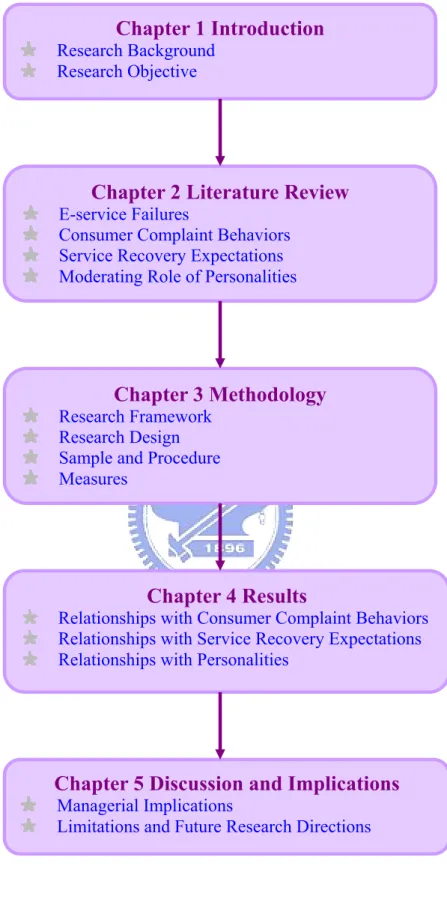
(12) 1.2 Research Objective From a managerial perspective, learning how to perform effective service recovery based on type of customer is even more valuable. Individual differences in personality act to influence behavior across a diverse array of situations and are expected to be related to the responses of complaint behaviors and service recovery expectations after complaining. The research aims to shed light on the moderating effects of personalities on the relationships between e-service failures with consumer complaint behaviors and service recovery expectations.. 1.3 Organization of the Dissertation This dissertation is organized in the following manner, as showed in Figure 1: Chapter 1 presents the motive and objective of the study. Chapter 2 reviews the relevant literature, thus forming a conceptual framework and hypotheses. Chapter 3 gives a brief introduction of methods. Chapter 4 shows the results of the study. Chapter 5 provides the detailed discussion for this study.. -2-.
(13) Chapter 1 Introduction Research Background Research Objective. Chapter 2 Literature Review E-service Failures Consumer Complaint Behaviors Service Recovery Expectations Moderating Role of Personalities. Chapter 3 Methodology Research Framework Research Design Sample and Procedure Measures. Chapter 4 Results Relationships with Consumer Complaint Behaviors Relationships with Service Recovery Expectations Relationships with Personalities. Chapter 5 Discussion and Implications Managerial Implications Limitations and Future Research Directions. Figure 1. Research flow chart. -3-.
(14) Chapter 2 Literature Review This chapter reviews the theoretical background of service failures and e-service failures. Reviews of customers’ responses to dissatisfaction and service recovery strategies are presented. Other concepts discussed include the personalities in terms of Type A behavior pattern, locus of control, and the moderating role of personalities.. 2.1 E-Service Failures A major service failure is defined as a mistake, problem or error that occurs in the delivery of the service (Bitner, Booms, & Tetreault; 1990; Colgate & Norris, 2001; Hoffman, Kelley, & Rotalsky, 1995). Service failures can occur anytime during the customer’s relationship with a service provider (Kelley & Davis, 1994). Such failures resulted in significant costs to the retailers, such as lost customers and negative word of mouth (Bitner, Brown, & Meuter, 2000; Mattila, 2001), reduced customer loyalty (Shankar, Smith, & Rangaswamy, 2003), and service switching (McCollough, Berry, & Yadav, 2000; Roos, 1999). Although these studies have examined mutual customer evaluations, none has employed an analytical framework for dealing with the types of service failures that may exist in the relationships with consumer complaint behaviors and service recovery expectations. Service failures cause loss of customers, which must be of concern to companies — especially within the online environment, where it is relatively easy to switch to another vendor (Goetzinger, Park, & Widdows; 2006). Holloway and Beatty (2003) observed significant online failure problems. These include delivery problems, web site design problems, customer service problems, payment problems, security problems, miscellaneous, and other problems. Among the problems, some service failures existed in the online context only. Examples include deferred delivery problems and complex online service communications.. -4-.
(15) The services marketing literature classifies two types of service encounter failures: process and outcome (Hoffman, Kelley, & Rotalsky, 1995; Mohr & Bitner, 1995; Smith, Bolton, & Wagner, 1999). The process perspective involves how consumers receive the service; that is, the manner in which it is delivered (Gronroos, 1988; Parasuraman, Ziethaml, & Berry, 1985). The outcome context of a service encounter contains what consumers actually receive from the service. Further, social exchange indicates that exchange relationships should be balanced; indeed, resources should be exchanged in an equilibrium amount (Walster at al., 1978). Service failures can bring about a disequilibrium amount in the exchange relationship between retailers and customers (Jayasimha, Nargundkar, & Murugaiah; 2007). To restore equilibrium, the retailers must offer the customers a gain of an amount sufficient to cover the loss (Yi & Lee, 2005). Among the disequilibrium exchanges, process failures give rise to symbolic exchanges such as status, esteem, or empathy, whereas outcome failures result in utilitarian exchanges such as money, goods, or time (Bagozzi, 1975; Smith, Bolton, & Wagner, 1999). In other words, in the event of e-service process failures, the delivery of the core service is flawed or deficient in some way. For instance, the customer forms a bad attitude toward an online retailer because of the unresponsiveness on the part of the retailer when the customer attempts to contact the retailer. In such instances, the failures result in customers’ negative mental perception, which is a symbolic exchange. In the event of e-service outcome failures, the organization does not fulfill the basic service need or perform the core service. For example, an item the customer ordered online is unavailable for delivery because of a stock-out. It has been considered that this is connected with physical damage to a consumer’s property or right during the purchase experience, related to utilitarian exchanges. Due to different failure types that generate different damaged effects this work anticipates that. -5-.
(16) service failure types influence consumer complaint behaviors and service recovery expectations.. 2.2 Consumer Complaint Behaviors Consumer complaint behavior is defined as any expression of dissatisfaction with the service providers’ service, product, advertisement or policy by oral or written communication that requires some action by the service provider beyond the initial contact (Day, 1977; Singh, 1988). Crie (2003) pointed out that consumer complaint behavior really constitutes a subset of all possible responses to dissatisfaction around a purchase experience, during consumption or during possession of the good (or service). A dissatisfied customer may use multiple options when responding to complaints; the options are not mutually exclusive (Blodgett, Hill, & Tax, 1997). Numerous attempts have been made to categorize the possible responses to consumer dissatisfaction (Bearden & Teel, 1980; Best & Andreasen, 1977; Day, 1984; Singh & Howell, 1985). Day and Landon (1977) indicated consumer complaint behavior as a two-step process, where the first level distinguishes behavioral responses from non-behavioral responses, and the second level groups behavioral responses into either public or private responses. Over the years, some efforts have been made regarding some modifications on the actions of dissatisfied consumers. Singh (1988) took a further step and found empirical support for the dimensional taxonomy in which the response of consumer complaint behaviors could be generally viewed as falling into one of three categories: voice responses, private responses, and third-party responses. Voice responses were directed to objects that are external to the consumer’s social circle and were directly involved in the dissatisfying exchange (e.g., seeking redress from the seller); private responses were those in which the objects are not external to the consumer’s social circle and were not directly involved in the dissatisfying experience (e.g., word-of-mouth communication or exit); and third-party responses included -6-.
(17) objects that were external to the consumer but not directly involved in the unsatisfying transaction (e.g., reporting to a consumer agency or taking legal action). Generally, four sets of responses can be summarized from the literature. First, a dissatisfied consumer can take no actions following a bad buying experience. Doing nothing or not repurchasing a firm’s products or services were legitimate responses to dissatisfaction (Day, 1984; Day et al., 1981; Richins, 1983). Singh (1990) classified consumers engaging in such behavior as “passive”. Second, consumers can also take some form of private action. Phau and Sari (2004) indicated that private actions referred to actions involving only people inside the consumer’s group in informal ways. This may include changing the brand/supplier, ceasing to use the product or service, or warning family and friends. Private actions were more likely to be driven by “getting even and punitive aims” (Singh & Wilkes, 1996). This group was classified as “voices” (Singh, 1990). Third, consumers can take some form of public action. Public actions involved people and organizations outside the consumer’s group in more formal ways (Phau & Sari, 2004). The main purpose of these consumer complaints was to “recover economic loss by getting an exchange or a refund and rebuild self-image” (Krapfel, 1985). This group was classified as “irates” (Singh, 1990). Finally, consumers can take a variety of different private and public actions. Consumers may blame sellers and manufacturers for their unsatisfactory product or service (Phau and Sari, 2004). This last group was classified as “activists” (Singh, 1990). E-service failures bring about different consumer complaint responses depending on what loss occurred. Smith, Bolton and Wagner (1999) found that e-service process failures would influence personal social resource (e.g., status, esteem) loss, whereas e-service outcome failures would bring about customer’s economic loss (e.g., the loss of time or. -7-.
(18) money).. In contrast to e-service outcome failures, we predict that e-service process failures. tend to lead to consumers’ voice responses (e.g., customers express their dissatisfaction to online retailers) because they need to maintain their self-respect and request the retailer to improve after complaining. In addition, e-service outcome failures might increase the consumer’s purchasing cost and concern with their economic loss, which directly leads to customer switching behavior (McCollough, Berry, & Yadav, 2000; Roos, 1999). We infer that if consumers encounter e-service outcome failures, they will not give a second chance to online retailers and will refrain from their complaint behaviors. Thus, the first hypothesis is proposed: Hypothesis 1. E-service process failures would be more likely than e-service outcome failures to lead to voice responses of complaint behaviors.. 2.3 Service Recovery Expectations As stated earlier, e-service failure is bound to occur at some point in time for online retailers in the online service industry. Though it is unlikely that online retailers can eliminate all e-service failures, they can learn to effectively respond to failures once they do occur. This response is often referred to as service recovery. It is defined as the process by which a service provider attempts to rectify a service delivery failure (Kelley & Davis, 1994). Goetzinger, Park and Widdows (2006) showed that although service failures and complaints are a challenge, the service provider can also view it as an opportunity if treated correctly. In order to provide subsequent service recoveries, online retailers should adopt a customer’s perspective and not merely a provider’s perspective — inasmuch as adequate service expectations were highlighted as “the level of service the customer will accept” (Zeithaml, Berry, & Parasuraman; 1993). From a customer’s perspective, service recovery expectation is defined as “the method by which the subject believes the service failure should be solved” (Harris, et al., 2006, p. 427). Service recovery expectations consist of consumer -8-.
(19) predictions of how effectively the service provider will resolve service failures once they occur (Kelley & Davis, 1994). Effective service recovery will prevent customer defections, enhance customer satisfaction, increase repurchase intentions, and build customer relationships (Fornell & Wernerfelt, 1987; Spreng, Harrell, & Mackoy, 1995). Many attempts have been made to categorize the service recovery (Kelley, Hoffman, & Davis; 1993; Kelley & Davis, 1994; Hui & Au, 2001). Kelley, Hoffman and Davis (1993) focused on the classification of the recoveries reported by the retailer’s respondents. These recovery strategies included discount, correction, manager/employee intervention, correction plus, replacement, apology, refund, customer initiated correction, store credit, unsatisfactory correction, failure escalation, and nothing. They found that the higher recovery effect came from discount strategy, and the lower recovery effect came from the nothing strategy. Hoffman and Kelley (1996) classified the service recoveries in the service encounters as compensatory, refund, replacement, corrective, managerial intervention, apologetic, and disregard. Lewis and McCann (2004) examined a hotel’s effective service recovery listing of ten recovery actions, showing that an apology was the most commonly used strategy. Schweikhart et al. (1993) indicated that the recovery activities undertaken during the immediate and follow-up recovery phases took two forms: psychological and tangible. Hart, Heskett and Sasser (1990) proposed that service recovery can involve compensation, response speed, and apology. Levesque and McDougall (2000) suggested that service recovery strategies typically consisted of three types of actions that are used either singly or in combinations: (1) apologize (acknowledging the problem), (2) assistance (fixing the problem), and (3) compensation (paying for the costs of the problem). Smith and Bolton (1998) manipulated three levels of compensation and two levels of apology (present or not present) to measure the expected service failure recovery. Boshoff (1999) developed an instrument (RECOVSAT) that measures satisfaction with transaction-specific service recovery, including. -9-.
(20) communication, empowerment, feedback, atonement, explanation, and tangibles. Therefore, the recovery efforts are generally categorized into two main forms: psychological (e.g., an apology) and monetary compensation (e.g., a remedy). The most common and frequently used service recovery actions are apology and remedy (Bitner, Booms, & Tetreault, 1990; Hart et al., 1990; Hoffman, Kelley, & Rotasky, 1995). Smith, Bolton and Wagner (1999) found that customers evaluate recovery efforts differently depending on whether a failure occurred in the service process (i.e., the service delivery) or in the service outcome (i.e., the core service). If a service failure leads to social resource loss, they will prefer to receive a social resource as part of a psychological recovery effort (e.g., an apology). If a service failure leads to a loss of economic resources, they will want to receive a monetary recovery effort (e.g., a remedy). The following hypotheses are proposed: Hypothesis 2a. For e-service process failures, dissatisfied consumers would expect a psychological service recovery more than a monetary service recovery. Hypothesis 2b. For e-service outcome failures, dissatisfied consumers would expect a monetary service recovery more than a psychological service recovery.. 2.4 Moderating Role of Personalities To understand why consumers behave the way they do, it is important to look at what factors affect individuals’ subsequent behaviors. For example, personality characteristics have been found to be important within the realms of consumer behavior (Bodey & Grace, 2006). Previous research has linked personality with complaint behavior. For instance, Bodey and Grace (2007) indicated that intrinsic factors, such as personality traits, are instrumental in affecting the degree of complaints. Complainers have been characterized as more risk assertive (Richins, 1983), more aggressive (Richins, 1983; Keng, Richmond, & Han, 1995; Bennett, 1997), more self-monitoring (Bearden & Crockett, 1981), more self-confident - 10 -.
(21) (Gronhaug & Zaltman, 1981), and more individualistic (Keng, Richmond, & Han, 1995) than those who do not complain. These overall characteristics can be described as Type A personalities (Bennett, 1997). Type A Behavior Pattern (TABP) TABP has its origin in Friedman and Rosenman’s (1974) description of behaviors made from observations carried out in the 1950s. A Type A behavior pattern is characterized by competitive-achievement striving, time urgency, hostility-aggression, and impatience (Keltikangas-Jarvinen & Jokinen, 1989; Nay & Wagner, 1990). Among the characteristics included in TABP were: competitiveness, aggressiveness, irritability, work orientation, worrying about deadlines, and urgency. Behaviors that were highly characteristic of Type A included rapid speech, frequent interruptions of others, and polyphonic activity (e.g., doing several things at once). Conversely, Type B characteristics were found to exhibit the opposite pattern of personality traits and behaviors (Jex et al., 2002). Several studies have confirmed that Type A people are much more likely than are Type B people to lose their tempers and/or take on aggressive encounters (Baron & Byrne, 1994; Berman, Gladue, & Taylor, 1993; Jex et al., 2002). In the complaint behavior context, Type A person might be considered more likely than the Type B person to engage in aggressive complaints, although how he or she will interact with the supplying company after complaining is unclear (Bennett, 1997). Locus of Control (LOC) Originally developed within the framework of Rotter’s (1954) social learning theory, the locus of control construct refers to the degree to which an individual believes the occurrence of reinforcements is contingent on his or her own behavior. The factors involved with reinforcement expectancy are labeled as “external” and “internal” control. Internal locus of control refers to the perception of positive or negative events as being a consequence of one’s own actions and thereby under one’s own personal control, while external locus of control. - 11 -.
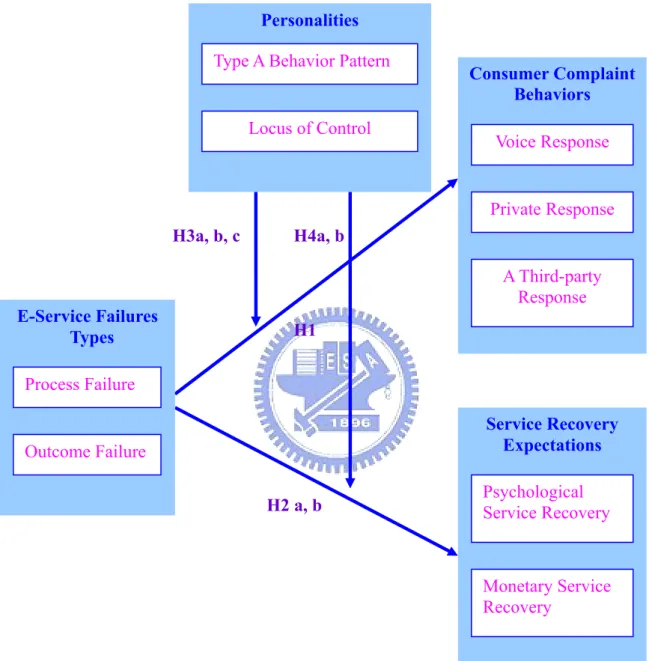
(22) refers to the perception of positive or negative events as being unrelated to one’s own behavior in certain situations and thereby beyond personal control. As a general principle, the locus of control variable may be thought of as affecting behavior as a function of expectancy and reinforcement within a specific circumstance (Carlise-Frank, 1991). For example, Busseri, Lefcourt and Kerton (1998) proposed that shoppers with internal locus of control may come to view successful shopping as less difficult than would externally-oriented shoppers. Externally-oriented shoppers evaluated negative service encounters more unfavorably than did internally-oriented shoppers. Consumers with external locus of control believed in fate, luck or chance and relied on the power of others, and thus were likely to hire legal professionals to address the failed service (Rinehart, 1998). In short, consumers with external locus of control inherently have a more negative effect on attitude toward the service firm than will consumers with internal locus of control (Gotlieb et al., 2004). In the context of service failures, consumers with external locus of control would reinforce the negative attitude.. - 12 -.
(23) A Typology Resulting from Type A/B and External/Internal locus of control Kirkcaldy et al. (1993, 1994) propose the four-fold classification of A/B and E/I: Type A/External locus of control, Type A/Internal locus of control, Type B/External locus of control, and Type B/Internal locus of control. 1. Type A/External locus of control: This group consists of people who are clearly deeply frustrated types. Although competitive, achievement-oriented, aggressive and frenetic, they believe this success is beyond their control; it is either in the hands of fate or powerful others. 2. Type A/Internal locus of control: The combination of Type A, achievement-orientation and competitiveness with internality is likely to make these people relatively satisfied; they believe that with effort and ability they can achieve what they want. 3. Type B/External locus of control: These types are likely to feel relatively helpless or hopeless. They are not competitive or achievement-oriented, possibly because they believe success in life is frequently a matter of chance or fate. 4. Type B/Internal locus of control: These types are not particularly achievement-oriented and striving, yet have a strong feeling that they are in control in their lives. Thus they are likely to be relaxed. From an applied point of view, consumers with Type A/External locus of control are clearly deeply frustrated types (Kirkcaldy, Cooper, & Furnham, 1999) and anxiety-oriented (Novack & Sassenrath, 1980). Although e-service failures lead to consumer complaint behaviors, some people would keep silent and others would engage in aggressive responses. When consumers complain to retailers, the group of Type A/External locus of control would be inclined to be nervous. Their responses may be more aggressive than the others. We expect that the group consumers would reinforce the significant effects produced by the relationship between e-service failures and service recovery expectations. Indeed, they need a. - 13 -.
(24) psychological service recovery from retailers to redeem their social resource loss from e-service process failures; they also expect a monetary service recovery to restore their economic loss from e-service outcome failures. Thus, we also predict that Type A/External locus of control group would experience greater stress and have less satisfaction than would other groups when they perceive dissatisfaction from service failures. That is, personalities of Type A/External locus of control would intensify their consumer complaint behaviors and service recovery expectations. The hypotheses are proposed: Hypothesis 3a. When e-service process failures occur, customers with Type A/External locus of control are more likely to engage in voice responses of complaint behaviors than others. Hypothesis 3b. When e-service outcome failures occur, customers with Type A/External locus of control are more likely to engage in private responses of complaint behaviors than others. Hypothesis 3c. When e-service outcome failures occur, customers with Type A/External locus of control are more likely to engage in third-party responses of complaint behaviors than others. Hypothesis 4a. In the context of e-service process failures, dissatisfied consumers with Type A/External locus of control are more likely to expect a psychological service recovery than others. Hypothesis 4b. In the context of e-service outcome failures, dissatisfied consumers with Type A/External locus of control are more likely to expect a monetary service recovery than others.. - 14 -.
(25) Chapter 3 Methodology This chapter presents the research framework and describes the research design and the procedures used to achieve the research objectives. The first section develops the research framework based on previous literature. The second section reviews research methods for the study of service recovery and presents the research design for the study. The third section discusses the population and sample for the study. The fourth section discusses instrument development, measurement of variables, and a description of the test. Descriptions of the data collection procedures and data analyses are then presented.. 3.1 Research Framework Figure 2 introduces a research framework, depicting the relationships between e-service failures with consumer complaint behaviors and service recovery expectations. The first part of the framework discusses the e-service failure types. The second part of the framework indicates the relationship between e-service failures and consumer complaint behaviors. The third part of the framework emphasizes the personality traits of Type A and locus of control. These traits are selected because they are theoretically related to consumer complaint behaviors and service recovery expectations. The moderating effects of Type A and locus of control of customers are also discussed.. - 15 -.
(26) Personalities Type A Behavior Pattern. Locus of Control. Consumer Complaint Behaviors Voice Response. Private Response H3a, b, c. E-Service Failures Types. H4a, b A Third-party Response H1. Process Failure Service Recovery Expectations. Outcome Failure. Psychological Service Recovery. H2 a, b. Monetary Service Recovery. Figure 2. Research framework. - 16 -.
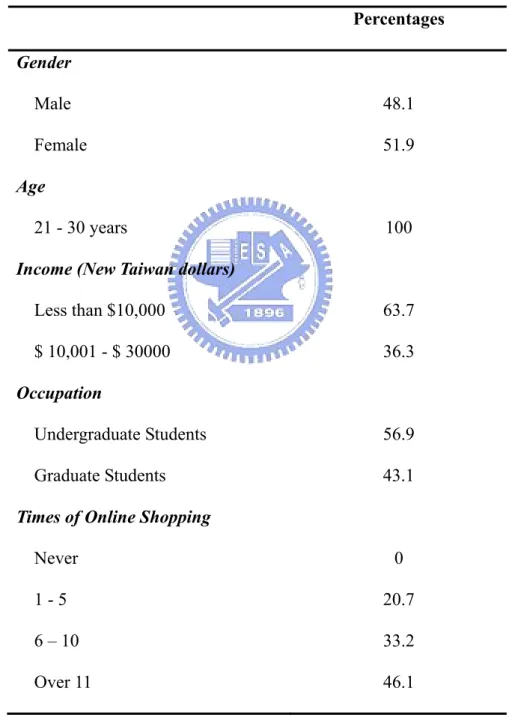
(27) 3.2 Research Design A two-group quasi-experimental research design was used in an effort to capture the difference in e-service failure types. Respondents in Group 1 evaluated an e-service process failure and completed a questionnaire regarding what complaint behavior they would react with and what recovery they would expect from online retailers. In Group 2, respondents evaluated an e-service outcome failure and complete the same questionnaire as did Group 1. The two different scenarios were manipulated for purchasing a digital camera on the website (refer to Appendix A & B for English version and Appendix C & D for Chinese version). The scenario-based method can minimize a participant’s memory bias, which is common in self-reports of service failure (Smith, Bolton, & Wagner, 1999). We used the Friedman and Rosenman (1974) scale and the Barnett and Lanier (1995) scale to measure Type A/B and External/Internal locus of control and divided the respondents into the four groups: Type A/External, Type A/Internal, Type B/External, Type B/Internal.. 3.3 Sample and Procedure A total of 320 undergraduate students from a university in northern Taiwan participated in the experiment. The use of a student sample was considered appropriate as similar studies have used student samples (e.g., Bennett, 1977; Bodey & Grace, 2006; 2007). Each subject was randomly assigned to one of the two scenarios: e-service process failure and e-service outcome failure. In this study the two sample groups possessed the essential personal and setting characteristics (i.e., at least one more online shopping time) that defined respondents in the same target population. Table 1 presents the sample characteristics of basic demographic variables. The sample consisted of 48.1 % male and 51.9 % female. The ages of the subjects ranged from 21 to 30 years old. For respondents’ personality characteristic categories, Kirkcaldy, Cooper and Furnham (1999) suggested that a median-split was used to categorize four groups for Type A/B and External/Internal locus of control. Thus, we used - 17 -.
(28) splitting below and above 65.0 for TABP and 5 for LOC ( n = 80 for Type A/External locus of control, n = 82 for Type A/Internal locus of control, n = 77 for Type B/External locus of control, and n = 81 for Type B/Internal locus of control) to generate four Type A/B and External/Internal locus of control groups.. Table 1. Characteristics of sample Percentages Gender Male. 48.1. Female. 51.9. Age 21 - 30 years. 100. Income (New Taiwan dollars) Less than $10,000. 63.7. $ 10,001 - $ 30000. 36.3. Occupation Undergraduate Students. 56.9. Graduate Students. 43.1. Times of Online Shopping Never. 0. 1-5. 20.7. 6 – 10. 33.2. Over 11. 46.1. - 18 -.
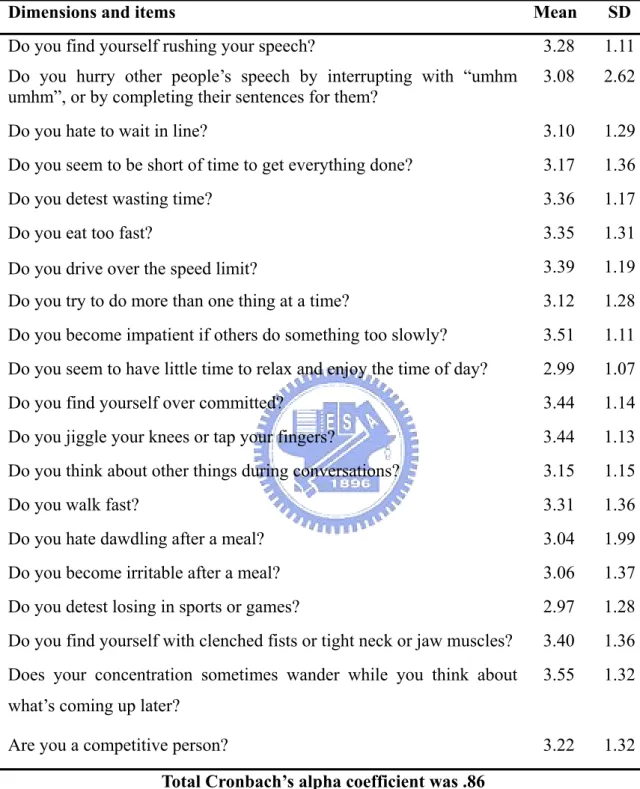
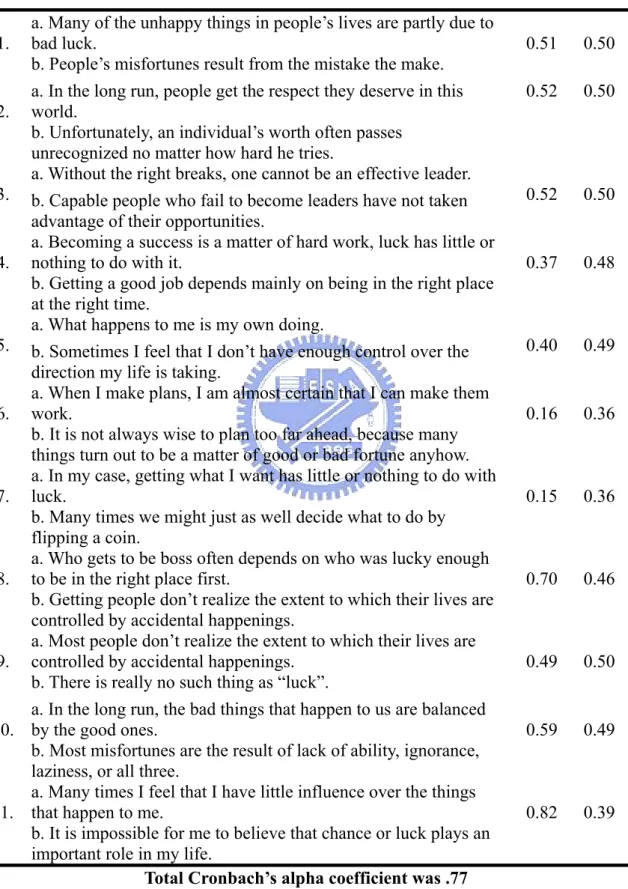
(29) 3.4 Measures The questionnaire was divided into four sections. In the first and second sections, respondents were asked to respond to their complaint actions and service recovery expectations following e-service failure situations. In the third section, respondents were presented with questions that measured their personalities, including Type A behavior pattern and locus of control. The fourth section contained questions regarding demographic characteristics of the respondents, such as their gender, age, educational level and disposable income per month. Type A Behavior Pattern. A revised version of the Friedman and Rosenman Scale was used to assess TABP (Friedman & Rosenman, 1974). The participants indicated their responses to each item on a five-point “always-never” Likert-type scale. Higher scores indicated high TABP. The high and low groups were obtained by a split at the overall mean value ( M = 64.91). One item with low item-to-total correlations was deleted from the final measurement instruments. The Cronbach’s alpha coefficient for the items was .86 (Table 2).. Locus of control. Locus of control was measured by items adapted from Rotter’s scale, which consists of two subscales (Rotter, 1966). The full version of locus of control contains 29 items and was considered too lengthy for this work. An alternative abbreviated locus of control constructs was assessed using the 11-item Barnett-Lanier locus of control scale (Barnett & Lanier, 1995). This scale requires yes-no responses from respondents, with higher scores indicating more external locus of control. Similar to Type A, the high and low groups were obtained by a split at the overall mean value ( M = 5.2). Barnett and Lanier (1995) indicated that single-factor solutions provided higher internal consistency and easier interpretability. The internal consistency of this scale for the sample in this study was .77 (Table 3).. - 19 -.
(30) Table 2. Results of Type A and reliability analysis Dimensions and items. Mean. SD. Do you find yourself rushing your speech?. 3.28. 1.11. Do you hurry other people’s speech by interrupting with “umhm umhm”, or by completing their sentences for them?. 3.08. 2.62. Do you hate to wait in line?. 3.10. 1.29. Do you seem to be short of time to get everything done?. 3.17. 1.36. Do you detest wasting time?. 3.36. 1.17. Do you eat too fast?. 3.35. 1.31. Do you drive over the speed limit?. 3.39. 1.19. Do you try to do more than one thing at a time?. 3.12. 1.28. Do you become impatient if others do something too slowly?. 3.51. 1.11. Do you seem to have little time to relax and enjoy the time of day?. 2.99. 1.07. Do you find yourself over committed?. 3.44. 1.14. Do you jiggle your knees or tap your fingers?. 3.44. 1.13. Do you think about other things during conversations?. 3.15. 1.15. Do you walk fast?. 3.31. 1.36. Do you hate dawdling after a meal?. 3.04. 1.99. Do you become irritable after a meal?. 3.06. 1.37. Do you detest losing in sports or games?. 2.97. 1.28. Do you find yourself with clenched fists or tight neck or jaw muscles?. 3.40. 1.36. Does your concentration sometimes wander while you think about. 3.55. 1.32. 3.22. 1.32. what’s coming up later? Are you a competitive person? Total Cronbach’s alpha coefficient was .86. - 20 -.
(31) Table 3. Results of LOC and reliability analysis Dimensions and items a. Many of the unhappy things in people’s lives are partly due to bad luck. b. People’s misfortunes result from the mistake the make. a. In the long run, people get the respect they deserve in this 2. world. b. Unfortunately, an individual’s worth often passes unrecognized no matter how hard he tries. a. Without the right breaks, one cannot be an effective leader. 3. b. Capable people who fail to become leaders have not taken advantage of their opportunities. a. Becoming a success is a matter of hard work, luck has little or 4. nothing to do with it. b. Getting a good job depends mainly on being in the right place at the right time. a. What happens to me is my own doing. 5. b. Sometimes I feel that I don’t have enough control over the direction my life is taking. a. When I make plans, I am almost certain that I can make them 6. work. b. It is not always wise to plan too far ahead, because many things turn out to be a matter of good or bad fortune anyhow. a. In my case, getting what I want has little or nothing to do with 7. luck. b. Many times we might just as well decide what to do by flipping a coin. a. Who gets to be boss often depends on who was lucky enough 8. to be in the right place first. b. Getting people don’t realize the extent to which their lives are controlled by accidental happenings. a. Most people don’t realize the extent to which their lives are 9. controlled by accidental happenings. b. There is really no such thing as “luck”. a. In the long run, the bad things that happen to us are balanced 10. by the good ones. b. Most misfortunes are the result of lack of ability, ignorance, laziness, or all three. a. Many times I feel that I have little influence over the things 11. that happen to me. b. It is impossible for me to believe that chance or luck plays an important role in my life. Total Cronbach’s alpha coefficient was .77 1.. - 21 -. Mean. SD. 0.51. 0.50. 0.52. 0.50. 0.52. 0.50. 0.37. 0.48. 0.40. 0.49. 0.16. 0.36. 0.15. 0.36. 0.70. 0.46. 0.49. 0.50. 0.59. 0.49. 0.82. 0.39.
(32) Consumer Complaint Behaviors. The revised form of consumer complaint behavior constructs by Singh (1988) is a 10-item five-point scale with scoring range of 1 (strongly disagree) to 5 (strongly degree). After participants read an e-service process failure or e-service outcome failure description, they were asked to rate on a five-point (1-5) scale the possible complaint actions. Using maximum likelihood estimation followed by a varimax rotation and with a screen plot being used to determine the numbers of factors, produced three subscales (Table 4). The factor loadings and communality values can be inspected. The subscales were named and were consistent with the Singh (1988) scale, consisting of “voice responses” (item 1, item 2, and item 4), “private responses” (item 3, item 5, and item 6), and “third-party responses” (item 7, item 8, item 9, and item 10). An average score on each subscale was computed for each respondent. For each of the three subscales, greater scores indicate higher levels of voice responses, private responses, and third-party responses. The Cronbach’s alphas of consumer complaint behaviors were .83 for voice responses, .92 for private responses, and .96 for third-party responses, showing acceptable construct validity.. - 22 -.
(33) Table 4. Summary of exploratory factor analysis results for consumer complaint behavior measure using maximum likelihood estimation ( N = 320) Factor Loadings Item. Third-Party. Private. Voice. Responses. Responses. Responses. Forget about the incident and do nothing.*. 0.55. 0.34. 0.81. Definitely complain to the store manager on. 0.51. 0.19. 0.79. 0.54. 0.79. 0.32. Go back to the store immediately to complain.. 0.70. 0.39. 0.79. Speak to friends and relatives about the bad. 0.45. 0.93. 0.31. 0.44. 0.95. 0.32. 0.92. 0.50. 0.64. Write a complaint letter to the local newspaper.. 0.90. 0.49. 0.59. Report to the consumer agency so they can. 0.98. 0.47. 0.67. 0.93. 0.45. 0.63. the next trip. Decide not to shop that store/manufacturer again.. experience. Convince friends and relatives not to shop the store again. Complain to a consumer agency and ask them to force the store to take care of the problem.. warn other consumers. Take some legal action against the store. * Reverse coded item. Notice: Values for items with greater weight and greater intercorrelation are highlighted in bold items.. - 23 -.
(34) Service Recovery Expectations. The service recovery expectation construct is assessed using a 4-item five-point rating scale ranging from very dissatisfied to very satisfied. The most frequently used elements of service recovery were an apology and compensation (Harris, Mohr, & Bernhardt, 2006; Kelley, Hoffman, & Davis, 1993). Thus, two service recovery expectations were chosen in this study: a psychological strategy and a monetary strategy. In the psychological recovery scenario, customers were offered an apology only by phone or e-mail, while the monetary recovery scenario was operationalized as a 20% discount on the next purchase, or a tangible gift.. Realism Checks. Researchers have suggested realism checks to make sure that research participants perceive the scenarios realistically (Goodwin & Ross, 1992; Sundaram et al., 1997). To evaluate the perceived realism of scenarios, participants were asked to respond to two items: “I think that a similar problem would occur to someone in real life” and “I think the situations given in the scenario are: (very unrealistic to very realistic)”. Mean scores of 5.31 (process e-service failure scenario) and 5.79 (outcome e-service failure scenario) on the 7-point scale suggest that the respondents perceived the scenario as highly realistic. Table 5 lists means and standard deviations of realism of scenarios. Table 5. Realism of scenarios Mean. Standard Deviation. Process E-Service Failure Scenario. 5.31. 0.55. Outcome E-Service Failure Scenario. 5.79. 0.56. - 24 -.
(35) Chapter 4 Results The purpose of this chapter is to present the findings from the survey that was conducted. SPSS 15.0 is performed to help us analyze these data. This chapter presents the results of ANOVA analyses to test the research hypotheses.. Relationships with Consumer Complaint Behaviors To test Hypothesis 1, a series of one-way ANOVA were computed over the two types of e-service failures, with consumer complaint behaviors as the dependent variable. Table 6 indicates that e-service process failure with regards to voice responses (P < .05) yielded significant differences, thus Hypothesis 1 was supported. As compared with e-service outcome failures, e-service process failures would lead to more consumers’ voice responses than private responses and third-party responses. In other words, e-service outcome failures have no significant effects among different responses of complaint behaviors because of reluctant dissatisfaction and switching behavior. Table 6. One-way ANOVA of consumer’s dissatisfaction, based on service failure type Failure Type P -value F(1,318) Process. Outcome. Complaints Voice Responses 3.82 5.91 0.02* 4.01 Private Responses 3.90 3.96 0.81 0.37 Third-Party Responses 3.21 3.05 1.49 0.22 High scores indicate high complaint responses; bold print signifies the highest group mean score. * P < .05. 4.2 Relationship with Service Recovery Expectations Using service recovery expectations as the dependent variables, one-way ANOVA was computed over the two types of e-service failures. Table 7 shows that different types of e-service failures significantly affected psychological and monetary service recovery expectations. E-service process failures appeared to influence psychological service recovery expectations ( M = 4.28) more strongly than monetary service recovery expectations ( M = - 25 -.
(36) 3.31), thus Hypothesis 2a was supported. For the sample of e-service outcome failures, both psychological and monetary service recovery expectations were significant ( F(1,318) = 609.87,. P < .001). E-service outcome failures had more significant effects on monetary service recovery expectations ( M = 4.83) than psychological service recovery expectations ( M = 3.23). Hypothesis 2b thus was supported. Table 7. One-way ANOVA of service recovery expectation, based on service failure type Failure Type P -value F(1,318) Process Outcome Service Recovery Psychological Recovery 3.31 273.45 0.000*** 4.28 Monetary Recovery 3.23 609.87 0.000*** 4.70 High scores indicate high service recovery expectations; bold print signifies the highest group mean score. *P < .05; **P < .01; ***P < .001. 4.3 Relationship with Personalities Results of the 2°4 ANOVA are summarized in Table 8. Across all consumer complaint behavior subscales, the highest levels of voice responses were reported by individuals with a combination of Type A personality and an External locus of control in the context of e-service process failures, whereas the highest levels of private responses and third-party responses were presented by the same group in the context of e-service outcome failures. Thus, Hypothesis 3a, Hypothesis 3b, and Hypothesis 3c were supported. The fourth stage of our analysis was the computation of four separate 2 ° 4 ANOVA, using the two subscales of service recovery expectations as dependent variables and personality Type A/B and External/Internal locus of control as the main effect variables (Table 9). In the context of e-service process failures, consumers with Type A/External locus of control have a more moderating effect on psychological service recovery expectations than the others. In the context of e-service outcome failures, they also have a more moderating effect on monetary service recovery expectations than the other groups. Thus, Hypothesis 4a. - 26 -.
(37) and Hypothesis 4b were supported. This study finds that when e-service process failures occur, consumers prefer a psychological service recovery. However, consumers expected a monetary service recovery to reduce their dissatisfactions when they met e-service outcome failures. These findings would more significant among Type A/External locus of control group than among the other groups. Finally, Table 10 presents summary of results for hypotheses testing.. - 27 -.
(38) Table 8. 2°4 ANOVA of consumer’s dissatisfaction, based on service failure type and personality (Type A/B behavior pattern and External/Internal locus of control)a AE (N = 80). Complaints Voice Responses Private Responses Third-Party Responses. AI (N = 82). BE (N = 77). BI (N = 81). Process. Outcome. Process. Outcome. Process. Outcome. Process. Outcome. 4.73 3.88 4.13. 4.56 4.83 4.82. 4.02 4.08 4.10. 3.37 3.58 3.04. 3.32 3.79 2.11. 4.30 3.89 2.96. 4.01 3.85 2.44. 3.83 3.56 1.36. F (Failure type). 15.10*** 1.54 8.08**. F (Type A/B ° External/Internal locus of control). 128.79*** 33.13*** 483.99***. F (Failure type ° Type A/B ° External/Internal locus of control). 85.76*** 40.50*** 106.35***. High scores indicate high complaint responses; bold print signifies the highest group mean score. * P < .05; ** P < .01; *** P < .001 a The last three columns summarize F scores (1, 318) for failure type, personality and their interaction.. Table 9. 2°4 ANOVA of service recovery expectation, based on service failure type and personality (Type A/B behavior pattern and External/Internal locus of control)a AE (N = 80). Service Recovery Psychological Recovery Monetary Recovery. AI (N = 82). BE (N = 77). BI (N = 81). Process. Outcome. Process. Outcome. Process. Outcome. Process. Outcome. 4.81 3.71. 3.75 4.80. 4.57 2.94. 3.05 4.46. 3.99 3.21. 3.00 4.78. 3.73 3.06. 3.45 4.76. F (Failure type). 562.21*** 745.81***. F (Type A/B ° External/Internal locus of control). 73.96*** 16.62***. High scores indicate greater levels of service recovery expectations; bold print signifies the highest group mean score. * P < .05; ** P < .01; *** P < .001 a The last three columns summarize F scores (1, 318) for failure type, personality and their interaction.. - 28 -. F (Failure type ° Type A/B ° External/Internal locus of control). 40.54*** 6.24***.
(39) Table 10. Summary of results for hypotheses Hypotheses. Result. Hypothesis 1. E-service process failures would be more likely than. Supported. e-service outcome failures to lead to voice responses of complaint behaviors.. Hypothesis 2a. For e-service process failures, dissatisfied consumers would. Supported. expect a psychological service recovery more than a monetary service recovery.. Hypothesis 2b. For e-service outcome failures, dissatisfied consumers. Supported. would expect a monetary service recovery more than a psychological service recovery.. Hypothesis 3a. When e-service process failures occur, customers with Type. Supported. A/External locus of control are more likely to engage in voice responses of complaint behaviors than others.. Hypothesis 3b. When e-service outcome failures occur, customers with. Supported. Type A/External locus of control are more likely to engage in private responses of complaint behaviors than others.. Hypothesis 3c. When e-service outcome failures occur, customers with. Supported. Type A/External locus of control are more likely to engage in third-party responses of complaint behaviors than others.. Hypothesis 4a. In the context of e-service process failures, dissatisfied. Supported. consumers with Type A/External locus of control are more likely to expect a psychological service recovery than others.. Hypothesis 4b. In the context of e-service outcome failures, dissatisfied consumers with Type A/External locus of control are more likely to expect a monetary service recovery than others.. - 29 -. Supported.
(40) Chapter 5 Discussion and Implications Our findings support the hypothesis that e-service process failures will cause consumers to voice their dissatisfaction more often than through private responses and third-party responses. The result is inconsistent with Mohr and Bitner’s (1995) argument in the brick-and-mortar setting that sometimes the outcome of a purchase can produce more important effects than process variables (e.g., employee courtesy). One possible reason is that e-service process failures may result in consumer loss of social resources (e.g., an online retailer’s rude service injures someone’s esteem) in the purchase process. When receiving impolite treatment from online retailers, consumers tend to express their dissatisfaction actively to retain their self-respect. Further, Bodey and Grace (2006) proposed that given potentially damaging effects, such as negative word-of-mouth and switching (Blodgett, Granbois, & Walters 1993; Keaveney, 1995), the service provider should understand what factors do influence consumers to voice their complaints. In addition, Maxham III and Netemeyer (2002) suggest that service providers should focus on the various service failures and service recoveries because customers will likely experience multiple failures over the course of a provider-customer relationship. Our findings show that e-service process failures require a psychological service recovery to remedy a customer’s negative mental perception, whereas e-service outcome failures need a monetary service recovery to decrease dissatisfaction. This finding is in agreement with Tuli, Kohli and Bharadwaj (2007), who proposed that a customer problem solution should be an integrated combination of business and customer aspects. This work fills the void in the literature by showing that dissatisfied customers may expect a psychological service recovery or a monetary service recovery, owing to either e-service process failures or e-service outcome failures. As for personalities, Type A/External locus of control has a moderating effect on the relationship between e-service process failures and consumer complaint behaviors. - 30 -.
(41) Consumers with Type A/External locus of control have competitive, achievement-oriented characteristics; they believe that success is beyond their control. To maintain respect, their frustrated personality prompts them to voice their dissatisfaction with the purchase process. On the other hand, e-service outcome failures influence economic or time loss directly, so unhappy consumers will prefer to exit the service rather than voice their grievances to online retailers. They may express an unsatisfactory purchasing experience to their friends or to third-parties. This is because they tend to depend on the existence of powerful others, such as family or friends and expert opinions. In addition, the findings of this study, apart from the Type A/External locus of control group, show that some consumers in other groups are prone (Kirkcaldy et al., 1993; Kirkcaldy, Furnham, & Cooper 1994; 1999; Kirkcaldy, Shephard, & Furnham, 2002); the impact of these characteristics upon consumer complaint behaviors and service recovery expectations was less clearly established. Another noteworthy finding is that personality also has significant moderating effects on the relationship between e-service failures and service recovery expectations. Consumers with Type A/External locus of control expect a psychological service recovery for e-service failures and a monetary service recovery for e-service outcome failures more strongly than do other types of consumers. One possible explanation is Type A’s “speed and impatience” characteristics (Nakano, Mochizuki, & Sato, 1996). These make Type A people intolerant of process failure problems. When they encounter e-service outcome failures, their hostility-aggression orientation makes them reluctant to face a benefit conflict. This type of consumer tends to be aggressive regarding a claim to protect their rights. Thus, compensation can match complaint recovery expectations well. This result is congruent with the findings of Smith, Bolton and Wagner (1999), who indicated that customers may not be homogeneous or consistent in their response tendencies toward service failure/recovery encounters.. - 31 -.
(42) 5.1 Managerial Implications Based on our findings, specific suggestions are presented for online retailers. The first suggestion is to take consumer personalities into account when developing consumer complaint behaviors and service recovery strategies. This proposition is consistent with the suggestions of Bennett (1997), who indicated that complaint behavior can be influenced by personality characteristics. Thus, online retailers have to be circumspect and realize that some customers may be uncomfortable with the whole process of complaining — choosing to exit rather than voice their complaints. We suggest that online retailers should design an online customer questionnaire and offer incentives (i.e., a coupon or a purchase discount) to customers for providing personality data in advance. Although different e-service failure types can occur, online retailers can perform effective service recoveries according to their customers’ different personalities, which determine how to reduce their levels of dissatisfaction. Because some customers, such as consumers with Type A/External locus of control, are likely to expect high service recovery efforts, online retailers should provide efficient service recoveries to meet the dissatisfied customers’ wants and expectations. In addition, if e-service failures occur, online shoppers are more likely to spread negative word-of-mouth communications in the online community than will offline shoppers (Sun et al., 2006 ) to avoid engaging in aggressive behaviors — because they believe that by doing so they will face a conflict. Although personality is the major factor influencing individual behaviors (Teng, Huang, & Tsai, 2007), few studies have examined the combination effects of Type A and locus of control on consumer’s behaviors. Previous studies had discussed such personality characteristics in organizational behaviors (Bodey & Grace, 2006). The second managerial suggestion is that online retailers should provide a self-recovery mechanism to online shoppers for solving consumer problems as early and as quickly as possible. - 32 -.
(43) 5.2 Limitations and Future Research Directions The present study illustrates the importance of knowing individual differences when understanding consumer complaint behaviors and service recovery expectations in the context of service failures. However, one limitation of this work is that this study employed hypothetical service failure scenarios instead of real failure situations that the respondents actually encountered. Because respondents were not actually in the online retail setting, they might not have worried as much about a complex service connection and product unavailability as they would in the real world. Future studies can extend this study to include actual complaint experiences and outcomes. This study also concentrated on analyzing one product category (online groceries). This could mean that the results may suffer from a lack of generalizability when other product categories are considered (Shim et al., 2001). A large cross-section of product categories should be studied to improve the generalizability of the results. In addition, samples large enough to split by demographic factors could be used in future research. Evidence in other consumer research has suggested that demographic effects can indeed be significant in understanding the impact of service failure on consumer dissatisfaction and service recovery expectation.. - 33 -.
(44) References Bagozzi, R. P. (1975), “Marketing as Exchange,” Journal of Marketing, 39 (4), 32-39. Baron, R. A. and Byrne, D. (1994), Social Psychology: Understanding Human Interaction (7th ed.), Boston, MA: Allyn & Bacon. Barnett, T. and Lanier, P. A. (1995), “Comparison of Alternative Response Formats for an Abbreviated Version of Rotter’s Locus of Control Scale,” Psychological Reports, 77, 259-264. Bearden, W. O. and Crockett, M. (1981), “Self-monitoring, Norms, and Attitudes as Influences on Consumer Complaining,” Journal of Business Research, 9 (3), 255-266. Bearden, W. and Teel, J. E. (1983), “Selected Determinants of Consumer Satisfaction and Complaint Reports,” Journal of Marketing Research, 20 (1), 21-28. Bennett, R. (1997), “Anger, Catharisis, and Purchasing Behavior Following Aggressive Customer Complaints,” Journal of Consumer Marketing, 14 (2), 156-172. Berman, M., Gladue, B., and Taylor, S. (1993), “The Effects of Hormones, Type A Behavior Pattern and Provocation on Aggression in Men,” Motivation and Emotion, 17, 125-138. Best, A. and Andreasen, R. (1977), “Consumer Responses to Unsatisfactory Purchases: A Survey of Perceived Defects, Voicing Complaints, and Obtaining Redress,” Law and. Society Review, 11 (4), 701-742. Bitner, M. J., Booms, B. H., and Tetreault, M. S. (1990), “The Service Encounter: Diagnosing Favorable and Unfavorable Incidents,” Journal of Marketing, 54 (1), 71-84. Bitner, M. J., Brown, S. W., and Meuter, M. L. (2000), “Technology Infusion in Service Encounters,” Journal of the Academic of Marketing Science, 28 (1), 138-149. Blodgett, J. G., Granbois, D. H., and Walters, R. G. (1993), “The Effects of Perceived Justice on Complainants’ Negative Word-of-Mouth Behavior and Repatronage Intention,”. Journal of Retailing, 69 (4), 399-428. - 34 -.
(45) Blodgett, J.G., Hill, D.J., and Tax, S.S. (1997), “The Effects of Distributive, Procedural and Interactional Justice on Postcomplaint Behavior,” Journal of Retailing, 73 (2), 185-210. Bodey, K. and Grace, D. (2006), “Segmenting Service ‘Complainers’ and ‘Non-complainters’ on the Basis of Consumer Characteristics,” Journal of Services Marketing, 20 (3), 178-187. Bodey, K. and Grace, D. (2007), “Contrasting ‘Complainers’ with ‘Non-complainers’ on Attitude toward Complaining, Propensity to Complain, and Key Personality Characteristics: A Nomological Look,” Psychology & Marketing, 24 (7), 579-594. Boshoff,. C.. (1999),. “RECVSAT:. An. Instrument. to. Measure. Satisfaction. with. Transaction-specific Service Recovery,” Journal of Service Research, 1 (3), 236-249. Busseri, M. A., Lefcourt, H. M., and Kerton, R. R. (1998), “Locus of Control for Consumer Outcomes: Predicting Consumer Behavior,” Journal of Applied Social Psychology, 28 (12), 1067-1087. Carlisle-Frank, P. (1991), “Examining Personal Control Beliefs as a Mediating Variable in the Health-damaging Behavior of Substance Use: An Alternative Approach,” The Journal of. Psychology, 125 (4), 381-397. Colgate, M. and Melissa, N. (2001), “Developing a Comprehensive Picture of Service Failure,” International Journal of Service Industry Management, 12 (3), 215-235. Crie, D. (2003), “Consumers’ Complaint Behavior. Taxonomy, Typology and Determinants: Towards a Unified Ontology,” Journal of Database Marketing and Customer Strategy. Management, 11 (1), 60-66. Day, R. L. (1977), “Extending the Concept of Consumer Satisfaction,” Advances in Consumer. Research, 4, 149-154. Day, R. L. (1984), “Modeling Choices among Alternative Responses to Dissatisfaction,” in Thomas C. Kinnear, ed., Advances in Consumer Research, 11, 496-499.. - 35 -.
(46) Day, R. L., Grabicke, K. S., Thomas, S., and Stanbach, F. (1981), “The Hidden Agenda of Consumer Complaining,” Journal of Retailing, 57 (3), 86-106. Fornell, C. M., Nicholas, M. D., and Wernerfelt, B. (1987), “Defensive Marketing Strategy by Customer Complaint Management: A Theoretical Analysis,” Journal of Marketing. Research, 24 (4), 337-346. Friedman, M. H. and Rosenman, R. H.(1974), Type A Behavior and Your Heart, New York: Knopf. Goetzinger, L., Park, J. K., and Widdows, R. (2006), “E-customers’ Third Party Complaining and Complimenting Behavior,” International Journal of Service Industry Management, 17 (2), 193-206. Goodwin, C. and Ross, I. (1992), “Consumer Responses to Service Failures: Influence of Procedural and Interactional Fairness Perceptions,” Journal of Business Research, 25 (2), 149-163. Gotlieb, J., Levy, M., Grewal, D., and Lindsey-Mullikin, J. (2004), “An Examination of Moderators of the Effects of Customers’ Evaluation of Employee Courtesy on Attitude toward the Service Firm,” Journal of Applied Social Psychology, 34 (4), 825-847. Gronhaug, K. and Zaltman, G. (1981), “Complainers and Non-complainers Revisited: Another Look at the Data,” Advances in Consumer Research, 8, Kent Monroe, ed., 83-87. Gronroos, C. (1988), “Service Quality: The Six Criteria of Good Perceived Service Quality,”. Review of Business, 9, 10-13. Harris, K. E., Grewal, D., Mohr, L. A., and Bernhardt, K. L. (2006), “Online Service Failure, Consumer Attributions and Expectations,” Journal of Services Marketing, 20 (7), 453-458. Hart, C. W., Heskett, J. L., and Sasser, Jr. W. E. (1990), “The Profitable Art of Service Recovery,” Harvard Business Review, 68 (July/August), 148-156.. - 36 -.
數據
+6




相關文件
substance) is matter that has distinct properties and a composition that does not vary from sample
develop a better understanding of the design and the features of the English Language curriculum with an emphasis on the senior secondary level;.. gain an insight into the
We explicitly saw the dimensional reason for the occurrence of the magnetic catalysis on the basis of the scaling argument. However, the precise form of gap depends
Miroslav Fiedler, Praha, Algebraic connectivity of graphs, Czechoslovak Mathematical Journal 23 (98) 1973,
z gases made of light molecules diffuse through pores in membranes faster than heavy molecules. Differences
Microphone and 600 ohm line conduits shall be mechanically and electrically connected to receptacle boxes and electrically grounded to the audio system ground point.. Lines in
The remaining positions contain //the rest of the original array elements //the rest of the original array elements.
[This function is named after the electrical engineer Oliver Heaviside (1850–1925) and can be used to describe an electric current that is switched on at time t = 0.] Its graph
