This article was downloaded by: [National Chiao Tung University 國立交通大學] On: 25 April 2014, At: 19:18
Publisher: Taylor & Francis
Informa Ltd Registered in England and Wales Registered Number: 1072954 Registered office: Mortimer House, 37-41 Mortimer Street, London W1T 3JH, UK
Liquid Crystals
Publication details, including instructions for authors and subscription information: http://www.tandfonline.com/loi/tlct20
Synthesis of laterally substituted
α‐methylstilbene‐tolane liquid crystals
Chin‐Yen Chang a , Szu‐Yuan Chien a , Chain‐Shu Hsu a , Sebastian Gauza b & Shin‐Tson Wu b
a
Department of Applied Chemistry , National Chiao Tung University , Hsinchu, Taiwan 30010, ROC
b
College of Optics and Photonics , University of Central Florida , Orlando, FL 32816, USA Published online: 03 Jan 2008.
To cite this article: Chin‐Yen Chang , Szu‐Yuan Chien , Chain‐Shu Hsu , Sebastian Gauza & Shin‐Tson Wu (2008) Synthesis of laterally substituted α‐methylstilbene‐tolane liquid crystals, Liquid Crystals, 35:1, 1-9, DOI: 10.1080/02678290701743027 To link to this article: http://dx.doi.org/10.1080/02678290701743027
PLEASE SCROLL DOWN FOR ARTICLE
Taylor & Francis makes every effort to ensure the accuracy of all the information (the “Content”) contained in the publications on our platform. However, Taylor & Francis, our agents, and our licensors make no
representations or warranties whatsoever as to the accuracy, completeness, or suitability for any purpose of the Content. Any opinions and views expressed in this publication are the opinions and views of the authors, and are not the views of or endorsed by Taylor & Francis. The accuracy of the Content should not be relied upon and should be independently verified with primary sources of information. Taylor and Francis shall not be liable for any losses, actions, claims, proceedings, demands, costs, expenses, damages, and other liabilities whatsoever or howsoever caused arising directly or indirectly in connection with, in relation to or arising out of the use of the Content.
This article may be used for research, teaching, and private study purposes. Any substantial or systematic reproduction, redistribution, reselling, loan, sub-licensing, systematic supply, or distribution in any
form to anyone is expressly forbidden. Terms & Conditions of access and use can be found at http:// www.tandfonline.com/page/terms-and-conditions
Synthesis of laterally substituted a-methylstilbene-tolane liquid
crystals
CHIN-YEN CHANG{, SZU-YUAN CHIEN{, CHAIN-SHU HSU*{, SEBASTIAN GAUZA{ and SHIN-TSON WU{
{Department of Applied Chemistry, National Chiao Tung University, Hsinchu, Taiwan 30010, ROC {College of Optics and Photonics, University of Central Florida, Orlando, FL 32816, USA
(Received 4 July 2007; accepted 3 October 2007 )
Three series of a-methylstilbene-tolane liquid crystals, 4-[2-(4-alkylphenyl)-1-ethynyl]-49-fluoro-a-methylstilbene (3a–3e), 4-[2-(4-alkylphenyl)-1-ethynyl]-29-methyl-49-fluoro-a-methylstilbene (4a–4e) and 4-[2-(4-alkylphenyl)-1-ethynyl]-39-methyl-49-fluoro-a-methylstil-bene (5a–5e), were synthesized and their phase transition temperatures characterized. All the a-methylstilbene-tolane liquid crystals exhibit an enantiotropic nematic phase. Compounds 5a–5e, which contain a lateral methyl group at the 3 position of the middle phenyl ring, display low melting points, a wide nematic range and a small enthalpy of fusion. Their potential applications for displays and laser-beam steering are noted.
1. Introduction
High birefringence (Dn) liquid crystals are attractive materials for applications in reflective liquid crystal displays (LCDs) [1], infrared spatial light modulators [2], polymer-dispersed liquid crystals (PDLCs) [3], cholesteric LCDs (Ch-LCDs) [4], holographic switching devices [5], polarizers and directional reflectors [6, 7] and laser beam steering [8]. In PDLCs and Ch-LCDs, high Dn improves display brightness and contrast ratio. In addition, high Dn and low viscosity compounds are particularly essential for colour sequential displays.
It is well known that a high Dn value can be achieved by increasing the molecular conjugation length [9]. Several molecular structures with high Dn values, e.g. diphenyldiacetylene [10–12], biphenyltolane [13], bisto-lane [14, 15], naphthalene tobisto-lanes [16], naphthyl-bistolanes [17] and thiophenylacetylene [18, 19] have be widely studied. However, a general problem for these highly conjugated molecules is their high melting points. Some symmetric bistolanes have been reported in the literature [20–23], but their melting points are extra-ordinarily high (.200uC). How to lower the melting temperatures of these compounds is a major challenge. The general approach is to introduce a lateral fluoro or alkyl group onto the mesogenic core to lower the melting points of tolane and bistolane liquid crystals [23–29]. Recently, Spells et al. [30] reported the synthesis
of fluorinated stilbene-tolane liquid crystals, but their melting points were higher than 220uC.
In this paper, we report the synthesis of three series of fluorinated a-methylstilbene-tolane compounds. We introduced the a-methylstilbene group and lateral methyl substituent to lower the melting point. The mesomorphic properties as well as optical anisotropies of the synthesized liquid crystals are discussed. The general chemical structure of the compounds studied is shown in figure 1. In this study, n was limited to 2–6 for low viscosity considerations.
2. Experimental 2.1. Materials
4-Fluoro-a-methylstyrene, 4-bromoaniline, 4-bromo-2-methylaniline, 4-bromo-3-4-bromo-2-methylaniline, palladium acetate, tri-o-tolylphosphine and other reagents were purchased from Aldrich and used as received. Dichloromethane and triethylamine were dried over CaH2, tetrahydro-furan was dried over LiAlH4 and distilled before use.
*Corresponding author. Email: [email protected]
Figure 1. Structure of the a-methylstilbene-tolane materials studied.
Liquid Crystals
ISSN 0267-8292 print/ISSN 1366-5855 online # 2008 Taylor & Francis http://www.tandf.co.uk/journals
DOI: 10.1080/02678290701743027
4-n-Alkylphenylacetylenes were synthesized according to the method described by Li and Wen [29].
2.2. Characterization techniques 1
H NMR spectra (300 MHz) were recorded on Varian VXR-300 spectrometer. Thermal transitions and ther-modynamic parameters were determined by using a Seiko SSC/6200 differential scanning calorimeter equipped with a liquid nitrogen cooling accessory. Heating and cooling rates were 1uC min21
. Transition temperatures reported here were collected during the second heating and first cooling scans. A Carl Zeiss Axiphot polarizing optical microscope equipped with a Mettler FP 82 hot stage and a FP 80 central processor was used to observe the thermal transitions and analyse the anisotropic textures.
2.3. Synthesis of fluorinated a-methylstilbene-tolanes Scheme 1 illustrates the procedure used to synthesize the fluorinated a-methylstilbene-tolane compounds. 2.3.1. 4-Fluoro-49-iodo-a-methylstilbene, 49-fluoro-4-iodo-29-methyl-a-methylstilbene and 4-fluoro-49-iodo-39-methyl-a-methyllstilbene (2a–2c) [24, 28]. Compounds 2a–2c were prepared by analogous methods. The synthesis of compound 2a is described below.
Fluoro-a-methylstyrene (1.63 g, 0.012 mmol), 4-bromoaniline (1.72 g, 10 mmol), palladium(II) acetate (22.4 mg, 0.1 mmol), and tri-o-tolylphosphine (91.2 mg, 0.3 mmol) were dissolved in a mixed solvent of triethylamine (9 ml) and acetonitrile (4 ml). The reaction mixture was stirred at 100uC for 48 h under nitrogen atmosphere. After cooling to room temperature, the solution was concentrated by a rotary evaporator, and the residue was dissolved in 100 ml of diethyl ether. The diethyl ether solution was washed with water and dried over anhydrous MgSO4. After the solvent was removed the crude product 1a was isolated.
The crude product 1a was redissolved in THF (30 ml) and cooled to 0uC. A mixture of concentrated HCl (2.5 ml) and aqueous sodium nitrite (2.07 g in 7 ml of H2O) aqueous solution was added. The reaction mix-ture was stirred at 0uC for 10 min and then treated with KI (5 g in 5 ml of H2O) aqueous solution. The mixture was stirred at 0uC for 3 h, and 50 ml of saturated sodium thiosulfate aqueous solution was added. The reaction mixture was extracted with ethyl acetate. The collected organic layer was washed with brine and water, and dried over anhydrous MgSO4. After the solvent was removed, the crude product was purified by column chromatography (silica gel, hexane as eluent) to yield 2.2 g (54%) of white crystals, m.p.594.5uC.
For 2a, 1H NMR (CDCl3): d2.23 (s, 3H, Ph(CH3)C5CHPh), 6.78 (s, 1H, Ph(CH3)C5CHPh), 7.00–7.06 (t, 2 aromatic protons), 7.36–7.39 (d, 2 aromatic protons), 7.46–7.49 (d, 2 aromatic protons), 7.68–7.70 (d, 2 aromatic protons).
For 2b, yield 38%. 1H NMR (CDCl3): d2.04 (s, 3H, Ph-CH3), 2.21 (s, 1H, Ph(CH3)C5CHPh), 6.63 (s, 3H, Ph(CH3)C5CHPh), 6.91–6.94 (d, 1 aromatic proton), 7.00–7.06 (t, 2 aromatic protons), 7.38–7.50 (m, 4 aromatic protons), colourless oil.
For 2c, yield 53%. 1H NMR (CDCl3): d2.43 (s, 3H, PhCH3), 2.23 (s, 1H, Ph(CH3)C5CHPh), 6.63 (s, 3H, Ph(CH3)C5CHPh), 6.91 (s, 1H, aromatic proton), 7.00–7.06 (t, 2 aromatic protons), 7.14–7.18 (d, 1 aromatic proton), 7.42–7.48 (d, 2 aromatic protons), 7.75–7.78 (d, 1 aromatic proton), colourless oil. 2.3.2. 4-[2-(4-Alkylphenyl)-1-ethynyl]-49-fluoro-a-methyl-stilbene (3a–3e), alkylphenyl)-1-ethynyl]-29-methyl-49-fluoro-a-methylstilbene (4a–4e) and 4-[2-(4- alkylphenyl)-1-ethynyl]-39-methyl-49-fluoro-a-methylstil-bene (5a–5e). All the compounds, 3a–3e, 4a–4e and 5a– 5e, were prepared by Cadiot–Chodkiewicz coupling [25] of a 4-alkylphenylacetylene with compounds 2a–2c, res-pectively. The compounds were purified several times by column chromatography until purities were higher than 99%. The synthesis of compound 3a is described below. 4-Ethylphenylacetylene (0.13 g, 1.00 mmol), 4-fluoro-49-iodo-a-methylstilbene (0.34 g, 1.00 mmol), triphenyl-phosphine (13 mg, 0.05 mmol), copper iodide (2 mg, 0.01 mmol) and bis(triphenylphosphine)palladium dichloride (7 mg, 0.01 mmol) were dissolved in 10 ml of triethylamine. The reaction mixture was stirred at 40uC for 5 h. After the solvent was removed under vacuum, the residue was dissolved in 30 ml of dichloromethane. The dichloromethane solution was washed three times with 10% HCl aqueous solution and water. The organic layer was dried over anhydrous MgSO4 and again concentrated by rotary evaporation. The resulting solid was recrystallized from chloroform to yield 0.32 g (95%) of light yellow crystals.
For 3a, IR (KBr) nmax/cm21: 3028, 2950, 2929, 2859, 1599, 1508, 1234, 837.1H NMR(CDCl3): d 1.15–1.20 (t, 3H, –CH3), 2.21 (s, 3H, Ph(CH3)C5CHPh), 2.59–2.67 (q, 2H, PhCH2CH3), 6.69 (s, 1H, PhC(CH3)5CHPh), 7.03–7.08 (t, 2 aromatic protons), 7.15–7.18 (d, 2 aromatic protons), 7.32–7.35 (d, 2 aromatic protons), 7.44–7.54 (m, 6 aromatic protons). HRMS: m/z calculated for C25H21F, 382.2097; found 382.2091. Elemental analysis: calculated for C25H21F, C 88.2, H 6.22; found C 88.24, H, 6.42%.
For 3b, yield 94%.1H NMR (CDCl3): d 0.92–0.97 (t, 3H, CH3), 1.62–1.69 (m, 2H, –CH2CH3), 2.28 (s, 3H,
2 C.-Y. Chang et al.
Ph(CH3)C5CHPh), 2.58–2.63 (t, 2H, PhCH2–), 6.76 (s, 1H, Ph(CH3)C5CHPh), 7.03–7.09 (t, 2 aromatic pro-tons), 7.15–7.18 (d, 2 aromatic propro-tons), 7.32–7.35 (d, 2 aromatic protons), 7.44–7.54 (m, 6 aromatic protons). HRMS: m/z calculated for C26H23F, 396.2253; found 396.2251. Elemental analysis: calculated for C26H23F, C 88.1, H 6.54; found C 88.09, H 6.53%. For 3c, yield 95%.1H NMR (CDCl3): d 0.91–0.96 (t, 3H, –CH3), 1.32–1.40 (m, 2H, –CH2CH3), 1.56–1.66 (m, 2H, PhCH2CH2–), 2.28 (s, 3H, Ph(CH3)C5CHPh), 2.60–2.65 (t, 2H, PhCH2–), 6.76 (s, 1H, Ph(CH3)C5CHPh), 7.03–7.09 (t, 2 aromatic protons), 7.15–7.18 (d, 2 aromatic protons), 7.32–7.35 (d, 2 aromatic protons), 7.44–7.54 (m, 6 aromatic protons). Elemental analysis: calculated for C27H25F, C 88.01, H, 6.84; found C 88.11, H 6.84%.
For 3d, yield 95%.1H NMR (CDCl3): d 0.87–0.92 (t, 3H, –CH3), 1.31–1.35 (m, 4H, –(CH2)2CH3), 1.57–1.62
Scheme 1: Synthesis of a-methylstilbene-tolane liquid crystals.
(m, 2H, PhCH2CH2–), 2.28 (s, 3H, Ph(CH3)C5CHPh), 2.57–2.62 (t, 2H, PhCH2–), 6.76 (s, 1H, Ph(CH3)C5CHPh), 7.03–7.09 (t, 2 aromatic protons), 7.15–7.18 (d, 2 aromatic protons), 7.44–7.54 (m, 6 aromatic protons). Elemental analysis: calculated for C28H27F, C 87.92, H 7.11; found C 87.91, H 7.16%.
For 3e, yield 95%.1H NMR (CDCl3): d 0.85–0.91 (t, 3H, –CH3), 1.28–1.32 (m, 6H, –(CH2)3CH3), 1.57–1.63 (m, 2H, PhCH2CH2–), 2.28 (s, 3H, Ph(CH3)C5CHPh), 2.60–2.64 (t, 2H, PhCH2–), 6.75 (s, 1H, Ph(CH3)C5CHPh), 7.03–7.09 (t, 2 aromatic protons), 7.15–7.18 (d, 2 aromatic protons), 7.32–7.35 (d, 2 aromatic protons), 7.44–7.54 (m, 6 aromatic protons). Elemental analysis: calculated for C29H29F, C 87.84, H 7.37; found C 87.6, H 7.35%.
For 4a, yield 93%. IR (KBr) nmax/cm21: 3026, 2959, 2930, 2872, 1596, 1508, 1230, 828.1H NMR (CDCl3): d 1.20–1.25 (t, 3H, –CH3), 2.09 (s, 3H, PhCH3), 2.27 (s, 3H, Ph(CH3)C5CHPh), 2.60–2.69 (t, 2H, PhCH2–), 6.74 (s, 1H, Ph(CH3)C5CHPh), 7.05–7.15 (t, 2 aro-matic protons), 7.20–7.34 (m, 3 aroaro-matic protons), 7.36–7.51 (m, 6 aromatic protons). HRMS: m/z calculated for C26H23F, 354.1794; found 354.1800. Elemental analysis: calculated for C26H23F, C 88.10, H 6.54; found C 88.11, H 6.93%.
For 4b, yield 95%.1H NMR (CDCl3): d 0.90–0.96 (t, 3H, –CH3), 1.59–1.67 (m, 2H, –CH2CH3), 2.09 (s, 3H, PhCH3), 2.27 (s, 3H, Ph(CH3)C5CHPh), 2.56–2.61 (t, 2H, PhCH2–), 6.74 (s, 1H, Ph(CH3)C5CHPh), 7.05– 7.15 (t, 2 aromatic protons), 7.20–7.34 (m, 3 aromatic protons), 7.36–7.51 (m, 6 aromatic protons). HRMS: m/ z calculated for C27H25F, 368.1940; found 368.1947. Elemental analysis: calculated for C27H25F, C 88.01, H 6.84; found C 87.93, H 7.17%. For 4c, yield 95%.1H NMR (CDCl3): d 0.86–0.94 (t, 3H, –CH3), 1.24–1.38 (m, 2H, –CH2CH3), 1.53–1.61 (m, 2H, PhCH2CH2–), 2.09 (s, 3H, PhCH3), 2.27 (s, 3H, Ph(CH3)C5CHPh), 2.58–2.63 (t, 2H, PhCH2–), 6.74 (s, 1H, Ph(CH3)C5CHPh), 7.05–7.15 (t, 2 aromatic pro-tons), 7.20–7.34 (m, 3 aromatic propro-tons), 7.36–7.51 (m, 6 aromatic protons). HRMS: m/z calculated for C28H27F, 382.2087; found 382.2079. Elemental analysis: calculated for C28H27F, C 87.92, H 7.11; found C 87.90, H 7.28%. For 4d, yield 94%.1H NMR (CDCl3): d 0.85–0.90 (t, 3H, –CH3), 1.28–1.33 (m, 4H, –(CH2)2CH3), 1.53–1.62 (m, 2H, PhCH2CH2–), 2.09 (s, 3H, PhCH3), 2.27 (s, 3H, Ph(CH3)C5CHPh), 2.57–2.62 (t, 2H, PhCH2–), 6.74 (s, 1H, Ph(CH3)C5CHPh), 7.05–7.15 (t, 2 aromatic pro-tons), 7.20–7.34 (m, 3 aromatic propro-tons), 7.36–7.51 (m, 6 aromatic protons). HRMS: m/z calculated for C29H29F, 396.2231; found 396.2222. Elemental analysis: calculated for C29H29F, C 87.84, H 7.37; found C 87.69, H 7.58%.
For 4e, yield 96%.1H NMR (CDCl3): d 0.84–0.87 (t, 3H, –CH3), 1.24–1.29 (m, 6H, –(CH2)3CH3), 1.55–1.59 (m, 2H, PhCH2CH2–), 2.09 (s, 3H, PhCH3), 2.27 (s, 3H, Ph(CH3)C5CHPh), 2.57–2.62 (t, 2H, PhCH2–), 6.74 (s, 1H, Ph(CH3)C5CHPh), 7.05–7.15 (t, 2 aromatic pro-tons), 7.20–7.34 (m, 3 aromatic propro-tons), 7.36–7.51 (m, 6 aromatic protons). HRMS: m/z calculated for C30H31F, 410.2380; found 410.2377. Elemental analysis: calculated for C30H31F, C 87.76, H 7.61; found C 87.65, H 7.77%.
For 5a, yield 95%. IR (KBr) nmax/cm21: 3028, 2952, 2929, 2856, 1597, 1507, 1233, 836.1H NMR (CDCl3): d 1.20–1.26 (t, 3H, –CH3), 2.26 (s, 3H, Ph(CH3)C5CHPh), 2.51 (s, 3H, PhCH3), 2.59–2.68 (q, 2H, PhCH2–), 6.71 (s, 1H, Ph(CH3)C5CHPh), 7.01– 7.06 (t, 2 aromatic protons), 7.14–7.20 (m, 4 aromatic protons), 7.43–7.48 (m, 5 aromatic protons). HRMS: m/ z calculated for C26H23F, 354.1783; found 354.1773. Elemental analysis: calculated for C26H23F, C 88.10, H 6.54; found C 88.14, H 6.71%.
For 5b, yield 94%. 1H NMR: d 0.90–0.95 (t, 3H, –CH3), 1.60–1.67 (m, 2H, –CH2CH3), 2.26 (s, 3H, Ph(CH3)C5CHPh), 2.51 (s, 3H, PhCH3), 2.56–2.61 (t, 2H, PhCH2–), 6.71 (s, 1H, Ph(CH3)C5CHPh), 7.01– 7.06 (t, 2 aromatic protons), 7.14–7.20 (m, 4 aromatic protons), 7.43–7.48 (m, 5 aromatic protons). HRMS: m/ z calculated for C27H25F, 368.1943; found 368.1952. Elemental analysis: calculated for C27H25F, C 88.01, H 6.84; found C 87.07, H 7.02%. For 5c, yield 95%.1H NMR (CDCl3): d 0.89–0.94 (t, 3H, –CH3), 1.32–1.37 (m, 2H, –CH2CH3), 1.52–1.62 (m, 2H, PhCH2CH2–), 2.26 (s, 3H, Ph(CH3)C5CHPh), 2.51 (s, 3H, PhCH3), 2.58–2.63 (t, 2H, PhCH2–), 6.71 (s, 1H, Ph(CH3)C5CHPh), 7.01–7.06 (t, 2 aromatic pro-tons), 7.14–7.20 (m, 4 aromatic propro-tons), 7.43–7.48 (m, 5 aromatic protons). HRMS: m/z calculated for C28H27F, 282.2097; found 282.2089. Elemental analysis: calculated for C28H27F, C 87.92, H 7.11; found: C 87.89, H 7.25%. For 5d, yield 96%.1H NMR (CDCl3): d 0.85–0.90 (t, 3H, –CH3), 1.29–1.33 (m, 2H, –(CH2)2CH3), 1.58–1.63 (m, 2H, PhCH2CH2–), 2.26 (s, 3H, Ph(CH3)C5CHPh), 2.51 (s, 3H, PhCH3), 2.57–2.63(t, 2H, PhCH2–), 6.71 (s, 1H, Ph(CH3)C5CHPh), 7.01–7.06 (t, 2 aromatic pro-tons), 7.14–7.20 (m, 4 aromatic propro-tons), 7.43–7.48 (m, 5 aromatic protons). HRMS: m/z calculated for C29H29F, 396.2274; found 396.2283. Elemental analysis: calculated for C29H29F, C 87.84, H 7.37; found C 87.81, H 7.49%.
For 5e, yield 96%.1H NMR (CDCl3): d 0.85–0.89 (t, 3H, –CH3), 1.28–1.30 (m, 6H, –(CH2)3CH3), 1.51–1.60 (m, 2H, PhCH2CH2–), 2.26 (s, 3H, Ph(CH3)C5CHPh), 2.51 (s, 3H, PhCH3), 2.58–2.63 (t, 2H, PhCH2–), 6.71 (s,
4 C.-Y. Chang et al.
1H, Ph(CH3)C5CHPh), 7.01–7.06 (t, 2 aromatic pro-tons), 7.14–7.20 (m, 4 aromatic propro-tons), 7.43–7.48 (m, 5 aromatic protons). HRMS: m/z calculated for C30H31F, 410.2410; found 410.2421. Elemental analysis: calculated for C30H31F, C 87.76, H 7.61; found C 87.77, H 7.76%.
3. Results and discussion
3.1. Effect of terminal alkyl chain
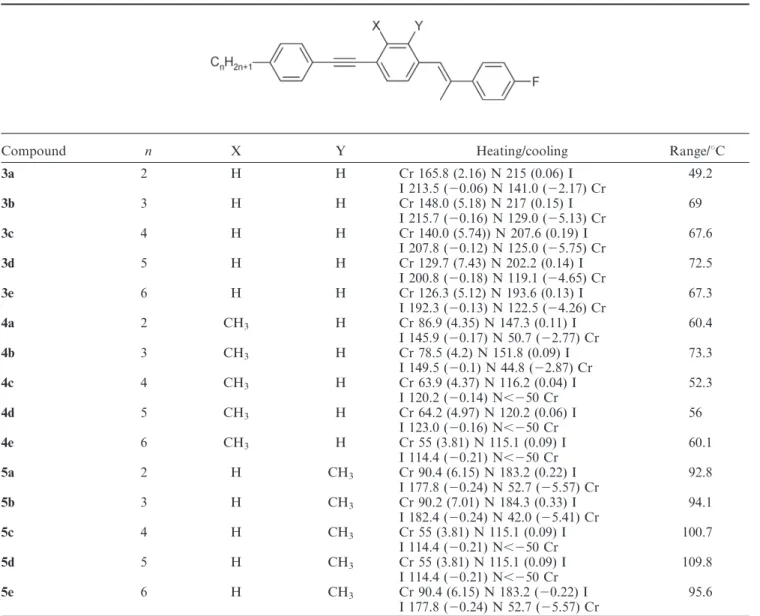
The phase transition temperatures and corresponding enthalpy changes for compounds 3a–3e, 4a–4e and 5a– 5e are listed in table 1. All the compounds exhibit an enantiotropic nematic phase. Figure 2 shows a typical nematic texture exhibited by compound 5d.
Compounds 3a–3e posses the same mesogenic core; the only difference is the length of the terminal alkyl groups at each end. On going from 3a to 3e, the terminal alkyl chain length increases from ethyl to hexyl. Figure 3 shows a plot of phase transition temperatures versus the carbon number (n) of the alkyl group. Both melting and clearing temperatures decrease gradually with increasing carbon number of the terminal alkyl chain. This series of compounds exhibits high melting temperatures ranging from 126.3 to 165.8uC and high clearing temperature ranging from 193.6 to 217.0uC. Each compound also gives a very wide temperature range (.49.2uC) for the nematic phase.
Compounds 4a–4e possess the same mesogenic core with a lateral methyl group on the 2-position of
Table 1. Phase transition temperatures (uC) and associated enthalpy data (kcal mol21, in parentheses) for the
a-methylstilbene-tolane materials.
Compound n X Y Heating/cooling Range/uC
3a 2 H H Cr 165.8 (2.16) N 215 (0.06) I 49.2 I 213.5 (20.06) N 141.0 (22.17) Cr 3b 3 H H Cr 148.0 (5.18) N 217 (0.15) I 69 I 215.7 (20.16) N 129.0 (25.13) Cr 3c 4 H H Cr 140.0 (5.74)) N 207.6 (0.19) I 67.6 I 207.8 (20.12) N 125.0 (25.75) Cr 3d 5 H H Cr 129.7 (7.43) N 202.2 (0.14) I 72.5 I 200.8 (20.18) N 119.1 (24.65) Cr 3e 6 H H Cr 126.3 (5.12) N 193.6 (0.13) I 67.3 I 192.3 (20.13) N 122.5 (24.26) Cr 4a 2 CH3 H Cr 86.9 (4.35) N 147.3 (0.11) I 60.4 I 145.9 (20.17) N 50.7 (22.77) Cr 4b 3 CH3 H Cr 78.5 (4.2) N 151.8 (0.09) I 73.3 I 149.5 (20.1) N 44.8 (22.87) Cr 4c 4 CH3 H Cr 63.9 (4.37) N 116.2 (0.04) I 52.3 I 120.2 (20.14) N,250 Cr 4d 5 CH3 H Cr 64.2 (4.97) N 120.2 (0.06) I 56 I 123.0 (20.16) N,250 Cr 4e 6 CH3 H Cr 55 (3.81) N 115.1 (0.09) I 60.1 I 114.4 (20.21) N,250 Cr 5a 2 H CH3 Cr 90.4 (6.15) N 183.2 (0.22) I 92.8 I 177.8 (20.24) N 52.7 (25.57) Cr 5b 3 H CH3 Cr 90.2 (7.01) N 184.3 (0.33) I 94.1 I 182.4 (20.24) N 42.0 (25.41) Cr 5c 4 H CH3 Cr 55 (3.81) N 115.1 (0.09) I 100.7 I 114.4 (20.21) N,250 Cr 5d 5 H CH3 Cr 55 (3.81) N 115.1 (0.09) I 109.8 I 114.4 (20.21) N,250 Cr 5e 6 H CH3 Cr 90.4 (6.15) N 183.2 (20.22) I 95.6 I 177.8 (20.24) N 52.7 (25.57) Cr
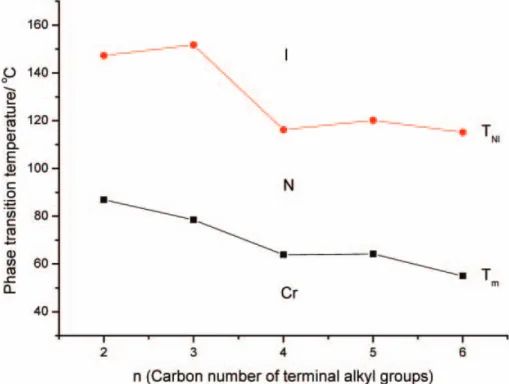
the middle phenyl ring. On going from 4a to 4e, the terminal alkyl chain length increases from ethyl to hexyl. Figure 4 shows a plot of the phase tran-sition temperatures versus carbon number (n) of the terminal alkyl chain. As shown in figure 3, the melting points decrease gradually with increasing alkyl chain length and the isotropization temperature shows an odd–even effect with increasing alkyl chain length.
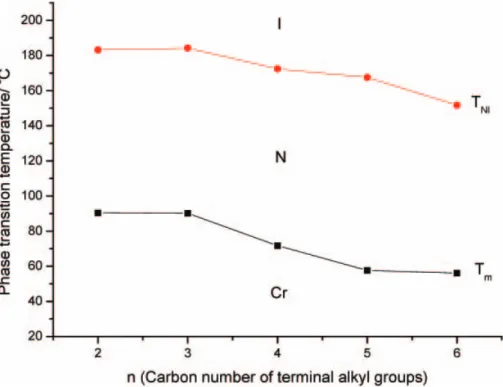
For compounds 5a–5e, which contain a lateral methyl group on the 3-position of the middle phenyl ring in the mesogen, phase transition temperatures are plotted against carbon number (n) of the terminal alkyl group in figure 5. Both melting and clearing temperatures decrease with increasing carbon number of the terminal alkyl group.
3.2. Effect of a-methyl group in stilbene unit
In 2002, Spells et al. reported the synthesis and characterization of the fluorinated stilbene-tolane liquid crystals [30]. If we compare the chemical structures of our compounds 3a–3e with those of their compounds 4a–4e, the only difference is the a-methyl group in the stilbene unit. However, the compounds 3a–3e exhibit at least a 60uC lower melting point, a 40uC lower clearing temperature and a 20uC wider nematic range. The results demonstrate that introducing the a-methyl group onto the stilbene unit can dramatically decrease the melting points of the synthesized liquid crystals. 3.3. Effect of lateral methyl group
In a previous study [25], we showed that the introduc-tion of a lateral methyl group on the middle phenyl ring of bistolane compounds could dramatically decrease their phase transition temperatures. A similar phenom-enon was observed for compounds 4a–4e and 5a–5e. According to the data listed in table 1, homologues 4a– 4e exhibit much lower melting temperatures (from 55.0 to 86.6uC) and clearing temperatures (from 115.1 to 147.3uC) in comparison with those of compounds 3a– 3e. This is because the lateral methyl group increases the molecular width, which, in turn, decreases the packing density of the liquid crystal molecules. As a result, the temperatures required to melt the crystals and to clear the liquid crystal phase are much lower. Homologues 5a–5e also exhibit much lower melting temperatures ranging from 56.1 to 90.4uC, which are very close to those of compounds 4a–4e. However, their clearing points do not decrease as much as those of homologues 3a–3e. This indicates that homologues 5a–5e exhibit a much wider nematic temperature range (.92.8uC). Figure 2 shows the typical nematic texture for com-pound 5d on heating at 100uC and cooling at 25uC. In the cooling process, the solidification temperature was found to be below 250uC. This result shows that the position of the lateral methyl group also plays an impor-tant role in tuning the mesomorphic temperature range. Some homologues (e.g. compounds 5d and 5e) exhibit particularly low melting points (,58uC), small fusion enthalpies (,7.8 kJ mol21) and a wide nematic range (.90uC). As a result, they are useful for formulating eutectic mixtures with a wide nematic range. The Dn values of 5d and 5e are estimated to be around 0.4 in the visible spectral region according to our previous reports [12, 13].
4. Conclusion
Three series of a-methylstilbene-tolane liquid crystals have been synthesized and their phase transition
Figure 2. Optical texture of the nematic phase (a) on heating at 100uC (3006) and (b) on cooling at 25uC for compound 5d (506).
6 C.-Y. Chang et al.
temperatures characterized. All the synthesized a-methylstilbene-tolane compounds display an enantio-tropic nematic phase. The terminal alkyl groups have a
profound effect on the phase transition temperatures of the a-methylstilbene-tolane; both melting and clearing temperatures decrease as the alkyl chain length
Figure 3. Melting (Tm, &) and isotropization (TNI,
N
) temperatures of 3a–3e as a function of the carbon number (n) of the alkylgroup.
Figure 4. Melting (Tm, &) and isotropization (TNI,
N
) temperatures of 4a–4e as a function of the carbon number (n) of the alkylgroup.
increases. The lateral methyl group plays an important role in lowering the melting temperature. Some homo-logues possess low melting points and high clearing temperatures and small enthalpies of fusion. These a-methylstilbene-tolane liquid crystals could find useful application in PDLC displays, reflective displays employing cholesteric liquid crystals and laser beam steering employing liquid crystal-based optical phase arrays.
Acknowledgement
The authors are grateful to the National Science Council of the Republic of China for financial support of this work.
References
[1] J.L. Fergason. SID Dig. ’86, 68 (1986).
[2] S.T. Wu, U. Efron, J. Grinberg, L.D. Hess. SID Tech. Dig., 16, 262 (1985).
[3] J.W. Doane, N.A. Vaz, B.G. Wu, S. Zumer. Appl. Phys. Lett., 48, 269 (1986).
[4] J. Li, C. Hoke, D.S. Fredly, P.J. Bos. SID Symp. Dig., 96, 265 (1996).
[5] R.L. Sutherland, L.V. Natarajan, V.P. Tondiglia, T. Bunning. J. Chem. Mater., 5, 1533 (1993).
[6] C.C. Bowley, H. Yuan, G.P. Crawford. Mol. Cryst. liq. Cryst., 331, 209 (1999).
[7] T. Tokumaru, K. Iwauchi, Y. Higashigayi, M. Matsuura. In Proceedings of the Anglo-Japanese Seminar on Liquid Crystals, p. 72 (1999).
[8] P.F. Mcmanamon, E.A. Watson, T.A. Dorschner, L.J. Barnes. Opt. Engng, 32, 2657 (1993).
[9] S.T. Wu. Mol. Cryst. liq. Cryst., 261, 79 (1995). [10] S.T. Wu, J.D. Margerum, B. Meng, L.R. Dalton, C.S.
Hsu, S.H. Lung. Appl. Phys. Lett., 61, 630 (1992). [11] S.T. Wu, M. Neubert, S.S. Keast, D.G. Abdallah, S.N.
Lee, M.E. Walsh, T.A. Dorschner. Appl. Phys. Lett., 77, 957 (2000).
[12] T.M. Juang, Y.N. Chen, S.H. Lung, Y.H. Lu, C.S. Hsu, S.T. Wu. Liq. Cryst., 15, 529 (1993).
[13] Y.M. Liao, N. Janarthanan, C.S. Hsu, S. Gauza, S.T. Wu. Liq. Cryst., 33, 1199 (2006).
[14] C. Sekine, N. Konya, M. Minai, K. Fujisawa. Liq. Cryst., 28, 1495 (2001).
[15] S.T. Wu, C.S. Hsu, K.F. Shyu. Appl. Phys. Lett., 74, 344 (1999).
[16] A.J. Seed, K.J. Toyne, J.W. Goodby, M. Hird. J. Mater. Chem., 10, 2096 (2000).
[17] Y.M. Liao, H.L. Chen, C.S. Hsu, S. Gauza, S.T. Wu. Liq. Cryst., 34, 507 (2007).
[18] C. Sekine, N. Konya, M. Minai, K. Fujisawa. Liq. Cryst., 28, 1361 (2001).
[19] C. Sekine, M. Ishitobi, K. Iwakura, M. Minai, K. Fujisawa. Liq. Cryst., 29, 355 (2002).
[20] C. Viney, D.J. Brown, C.M. Dannels, R.J. Twieg. Liq. Cryst., 13, 95 (1993).
[21] Y. Xu, Y. Hu, Q. Chen, J. Wen. J. Mater. Chem., 5, 219 (1995).
[22] R.J. Twieg, V. Chu, C. Nguyen, C.M. Dannels, C. Viney. Liq. Cryst., 20, 287 (1996).
Figure 5. Melting (Tm, &) and isotropization (TNI,
N
) temperatures of 5a–5e as a function of the carbon number (n) of the alkylgroup.
8 C.-Y. Chang et al.
[23] S.T. Wu, C.S. Hsu, Y.Y. Chuang. Jap. J. appl. Phys., 38, L286 (1999).
[24] O. Catanescu, L.C. Chien. Liq. Cryst., 33, 115 (2006). [25] C.S. Hsu, K.F. Shyu, Y.Y. Chuang. Liq. Cryst., 27, 283
(2000).
[26] S.T. Wu, C.S. Hsu, K.F. Shyu. Jap. J. appl. Phys. Lett., 74, 344 (1999).
[27] S.T. Wu, C.S. Hsu, Y.Y. Chuang. Jap. J. appl. Phys., 39, L38 (1999).
[28] Y.H. Yao, L.R. Kung, S.W. Chang, C.S. Hsu. Liq. Cryst., 33, 33 (2006).
[29] H. Li, J. Wen. Liq. Cryst., 33, 1127 (2006).
[30] D.J. Spells, C. Lindsey, L.R. Dalton, S.T. Wu. Liq. Cryst., 29, 1529 (2002).