Self-assembly of hierarchical MoS
x
/CNT
nanocomposites (2,x,3): towards high
performance anode materials for lithium
ion batteries
Yumeng Shi1, Ye Wang1, Jen It Wong1, Alex Yuan Sheng Tan1, Chang-Lung Hsu2,3, Lain-Jong Li2,4, Yi-Chun Lu5& Hui Ying Yang1
1Pillar of Engineering Product Development, Singapore University of Technology and Design, Singapore 138682, Singapore, 2Institute of Atomic and Molecular Sciences Academia Sinica, Taipei 10617, Taiwan,3Department of Materials Science & Engineering, National Chiao Tung University, HsinChu 300, Taiwan,4Department of Physics Natonal Tsing Hua University, HsinChu 300, Taiwan,5Department of Mechanical and Automation Engineering, The Chinese University of Hong Kong, Hong Kong SAR, China.
Two dimension (2D) layered molybdenum disulfide (MoS2) has emerged as a promising candidate for the anode material in lithium ion batteries (LIBs). Herein, 2D MoSx(2 # x # 3) nanosheet-coated 1D multiwall carbon nanotubes (MWNTs) nanocomposites with hierarchical architecture were synthesized via a high-throughput solvent thermal method under low temperature at 200
6
C. The unique hierarchicalnanostructures with MWNTs backbone and nanosheets of MoSxhave significantly promoted the electrode performance in LIBs. Every single MoSxnanosheet interconnect to MWNTs centers with maximized exposed electrochemical active sites, which significantly enhance ion diffusion efficiency and accommodate volume expansion during the electrochemical reaction. A remarkably high specific capacity (i.e.,
.1000 mAh/g) was achieved at the current density of 50 mA g21, which is much higher than theoretical numbers for either MWNTs or MoS2along (,372 and ,670 mAh/g, respectively). We anticipate 2D nanosheets/1D MWNTs nanocomposites will be promising materials in new generation practical LIBs.
A
dvanced energy storage technology is the key to manage the energy supply and demand. Lithium ion batteries (LIBs) have attracted increasing research interests and become one of the main power sources for portable electronic devices and electric vehicles due to its high energy densities, no memory effect, and good cycling stability compared to other alternatives1. In commercial LIBs, graphite and lithium metal oxides are commonly employed as the negative (anode) and positive (cathode) electrode materials, respectively. Lithium is the lightest metal that delivers high energy density per electron with a theoretical electrochemical capacity of Li to Li1is 3860 mAh/g2. However, further advancements in the state-of-the art LIBs are still bottlenecked by the limitation in the anode materials associated with limited capacity (i.e., graphite, ,372 mAh/g), lack of shape flexibility and low ion/electron conductivity3,4. In the past few years, substantial research efforts have been devoted in developing high performance LIBs electrodes. Various carbon nanomaterials, such as one dimension (1D) carbon nanotubes (CNTs)5,6, two dimension (2D) graphene nanosheets7,8, three dimension (3D) graphene foam9,10, have all been investigated as the anode materials in reversible storage of Li1, due to their outstanding electronic conductivities, high charge mobilities and large specific surface areas. As one of the crystalline form of carbon, 1D CNTs has high electric conductivity, good mechanical property, chemical stability and reversible redox reaction capability, which makes it a promising candidate as lithium insertion hosts for LIBs.The nanostructured multifunctional heterostrucutres have been proved to work synergistically with both high capacity and good cyclability11–14. Molybdenum disulfide (MoS
2), an inorganic graphite analogue, belongs to the
layered transition-metal dichalcogenide (LTMDs) family. The weak van der Waals interaction between MoS2
layers allows the Li1ions to diffuse without a significant increase in volume expansion and prevent the
pulver-ization problem of active materials caused by the repeatly lithiation and delithiation process. The promising potential of MoS2serving as an anode materials for LIBs is widely reported in the literature due to its attractive
specific capacity15–21. Theoretically the conversion reaction between Li ions and MoS
2leads to four moles of
SUBJECT AREAS:
MATERIALS FOR ENERGY AND CATALYSIS TWO-DIMENSIONAL MATERIALS NANOSCALE MATERIALS BATTERIES Received 18 March 2013 Accepted 25 June 2013 Published 9 July 2013 Correspondence and requests for materials should be addressed to H.Y.Y. (yanghuiying@ sutd.edu.sg)
lithium incorporation per mole of MoS2accounting for 670 mA h g–1
lithium storage capacity that is ,1.8 times higher than the graphite electrode20. With all these significant advantages, MoS
2has attracted
lots of research interests and became a promising material as an anode material in LIBs17–19. Various methods have been reported
for the synthesis of MoS2 including the gas-phase reaction of
MoO3with H2S or S vapor22,23, thermal decomposition of
ammo-nium thiomolybdate24,25, and solvent thermal method26,27.
The solvent thermal process is an important wet chemistry syn-thesis method and has been widely used to prepare various nanoma-terials or nanocomposites. It has been reported CNTs favored the growth of the tubular MoS2on the surface of carbon nanotube side
walls and promoted the formation of tubular MoS2layers with high
crystallinity27–29, CNTs/MoS
2composites have also been prepared by
the simple solvothermal method30,31. For example, tubular MoS
2
layers coating on CNTs were synthesized by the hydrothermal reac-tion between Na2MoO4and CS(NH2)2with the presence of CNTs12.
The surface area of MoS2is limited by the surface area of CNTs.
Nevertheless, when aqueous solvent is used, CNTs need to be treated by refluxing in high concentrated strong acid in order to improve the wetting between CNTs and MoS2precursor28. This acidic treatment
will introduce defects in CNTs and negatively affect the electrical properties of CNTs. MoS2/CNTs with a design of 2D MoS2
nano-flakes surrounded by a coating of CNTs was synthesized by using Na2MoO4and KSCN as reactant and ethylene glycol as solvent in the
presence of CNTs27. These composites show higher capacity and
improved cycling stability compared to pure MoS2. The MoS2
nano-flakes synthesized are relatively thick and randomly attached to CNTs, which causes a continues capacity fading during cycles27.
Wang et al. prepared MoS2overlayers supported on coaxial CNTs
by wet-chemistry process and studied the reversible lithium-storage behaviors of this composite32. A reversible capacity of 400 mAh/g
was achieved; however this value is much smaller than the non-coaxial MoS2/CNTs composite.
Results
Herein, we report a unique MoSx/CNTs (2 # x # 3) nanostructure
synthesized by simple solvent thermal method at low temperature (200uC) using (NH4)2MoS4as single reactant and
N,N-dimethylfor-mamide (DMF) as solvent in the presence of MWNTs. The synthe-sized MoSx/MWNTs composites are different from the previous
report for MoS2 sheath/CNT-core nanoarchitecture32, the MoSx
layers are not confined to the MWNTs surface, but extend the layered structure out of the cylindrical tubules (as shown in Figure S1). To understand the forming of hierarchical architecture, the morphology and lattice structure of as prepared MoSx/MWTNs composite was
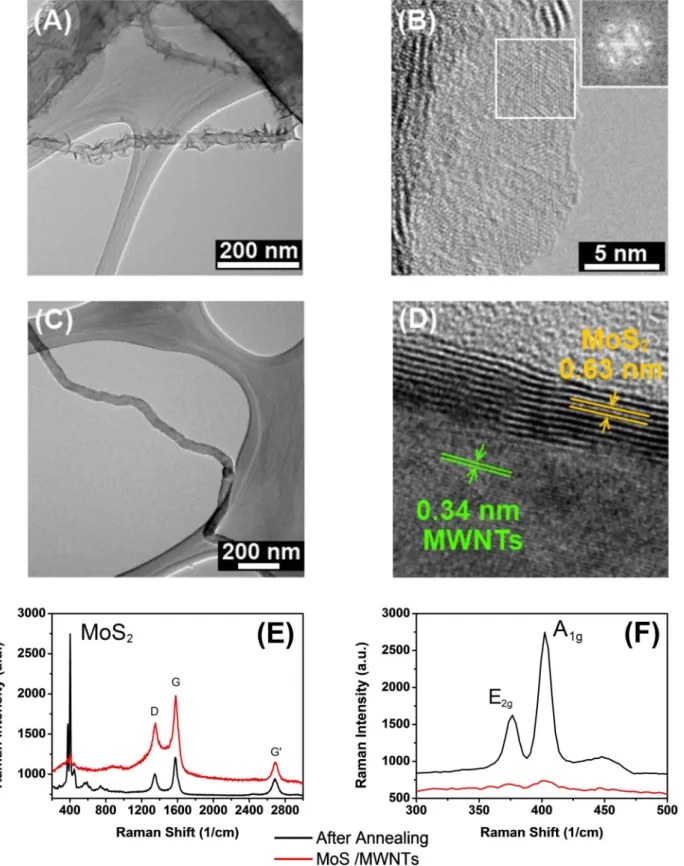
compared with the samples treated under elevated temperature. Figure 1 (A), (B) show the TEM images of MoSxcoated MWNTs
prepared by the solvent thermal method. The HRTEM in Figure 1 (B), gives a close-up view of the MoSxbranch attached on MWNTs
surface. The inset shows a fast Fourier transform (FFT) pattern taken from the marked area in Figure 1 (B). The HRTEM and FFT results indicate the semi-crystalline nature of the MoSxlayers. As seen in
Figure 1 (C) and (D) MoS2sheath/CNT-core nanoarchitecture was
obtained by thermal annealing at 800uC under Ar protecting envir-onment. The two layered spacing can be identified to be around ,0.62 and ,0.34 nm, which are in good consistence with the value for MoS2layers and the lattice spacing between the graphitic planes
of MWNTs. Figure 1 (E) and (F) compare the Raman spectra taken from the as obtained MoSx/MWNTs samples and thermal treated
MoS2 sheath/CNT-core nanocomposites. The Raman Peaks at
around 1347 and 1576 cm21belong to MWNTs. The G9 band of
MWNTs locates at 2686 cm21. The Raman Peaks of MoS
2appear
at 376 and 402 cm21. It was also found that the Raman signature of
MoS2dramatically increased after thermal annealing, which suggests
the formation of highly crystallized MoS2layers. This is agreed with
the result of HRTEM.
X-ray photoelectron spectroscopy (XPS) was used to investigate the chemical states of Mo and S in the MoSx/MWNTs
nanocompo-sites. Figure 2 displays the XPS characterization of the samples before and after thermal annealing at 800uC under Ar protecting envir-onment. The high-resolved XPS spectra shows the binding energies of Mo 3d 3/2, Mo 3d 5/2, S 2p K and S 2p 3/2 peaks in the thermal annealed MoSx/MWNTs are located at 232.4, 229.2, 163.3 and
162.1 eV, respectively, indicating that Mo41existed in the annealed
MoSx/MWNTs32. The stoichiometric ratio of S:Mo estimated from
the respective integrated peak area of XPS spectra is ,2.125 suggest-ing the structure is close to MoS2. For the as prepared MoSx/MWNTs
two broaden peaks centered at ,232.5 and ,228.9 eV, in addition to the XPS peaks for MoS2 structure, other sets of peaks are also
observed. The higher energy shift of Mo 3d3/2 and 3d5/2 doublet
are associated with higher valence states. The observation of Mo 3d3/2 and Mo 3d5/2peaks at 233.6 and 230.5 eV with separation
energies close to 3.1 eV can be attributed to the presence of Mo51
ions33,34. For the non-annealed MoS
x/MWNTs the S 2p spectra can
be interpreted in terms of two doublets, with S 2p3/2 binding energies of 161.7 and 163.2 eV. Compared to the thermal annealed samples, the additional S 2p1/2 and 2p3/2 energies located at 164.3 and 163.2 eV can be assigned to the binding energies of apical S22or
bridging disulfide S222 ligands. The S 2p spectrum that can be fit
with two S 2p doublets, which is similar to those of amorphous MoS335,36. The presence of bridging apical S22or bridging S222is in
good consistence with the TEM analyses in Figure 1 (B), which reveals that the MoSx obtained are basically semicrystalline.
Furthermore, the S/Mo elemental ratio estimated from the integrated peak area of XPS spectra is ,3.0 which also suggests the as grown MoSxis stoichiometrically close to MoS3. The thermal
decomposi-tion of (NH4)2MoS4is accompanied by molybdenum-sulfur redox
processes, which include the oxidation of S22ligands of the MoS
422
anion and the reduction of Molybdenum metal from MoVIto MoIV,
and various thermal decomposition intermediate may exist37. The
XPS results confirm the presents of MoS3while the Raman spectra
from the as prepared samples show smaller but visible Raman Peaks of MoS2at 376 and 402 cm21(as shown in Figure 1(E)). Therefore,
the exact phase of the MoSx/MWNTs compound is suggested to be a
mixture of MoS2and MoS3.
The growth mechanism of MoSx/MWNTs layered structures were
also investigated by varying the Mo/Carbon ratio in the precursor. Figure 3 (A), (B) and (C) show the TEM images of typical MoSx/
MWNTs composites prepared with Mo/Carbon ratio of 1540, 1520 and 1510. Figure 3 (D) proposes the growth mechanism of the MoSx/
MWNTs composites. With limited amount of MoSxprecursor the
MoSxforms small segments on the sidewall of MWNTs. The
hier-archical structure of MoSx forms and the MoSx layer structure
extruding from the sidewall of MWNTs with the increase of Mo/C ratio. For the high concentration precursor, the MoSxlayers form
uniformly on MWNTs. It has been reported CNTs favored the growth of the tubular MoS2on the surface of carbon nanotube side
walls and promoted the formation of tubular MoS2layers with high
crystallinity27,28, therefore at elevated temperate the MoS
xconverted
to MoS2and form MoS2sheath/CNT-core nanoarchitecture32. Discussion
Compared to the conventional MoS2/MWNTs structure, the novel
MoSx/carbon composite has a three dimensional (3D) hierarchical
structure, where the 1D multi wall carbon nanotube (MWNTs) as back bones, while the 2D MoSx layers grown on the surface of
MWNTs with a partially free standing branch like feature, which provide a large surface area of the active material to accommodate Li1. The hierarchical structure of MoS
x/CNTs, could effectively
com-bine the merits of the good electrical conductivity of CNTs and
excellent electrochemical performance of individual MoSx layer
throughout cycling. Due to the excess of sulphur in MoSx an
increased layer distance of S–Mo–S can be expected, which results in less strain and smaller intercalation barrier of Li ions. Meanwhile,
the CNTs used in this work have a long tube length, which creates large internal voids in the composites that could absorb and buffer the mechanical stress which caused by the local volume variation during lithium insertion and extraction.
Figure 1|(A) and (C) Low-magnification TEM image of MoSx/MWNTs with hierarchical nanostructure and MoSx/MWNTs after annealing at 8006C
under Ar protection, (B) and (D) HRTEM images of a free standing monolayer MoSxand the side wall of the composite after annealing. Inset in
Figure 1 (B) shows the FFT pattern taken from the marked area. (E) Raman spectra of the MoSx/MWNTs. Figure 1 (F) compares the magnified Raman
Considering the electrodes with special hierarchical nanocompo-sites are advantageous to LIBs, we investigate the lithium storage properties of as-prepared MoSx/MWNTs using half-cell
configura-tion. Figure 4 shows the electrochemical performance of MoSx/
MWNTs as anode materials. Figure 4 (A) illustrates the first, second, fifth and tenth discharge/charge voltage profiles of the MoSx/
MWNTs composite electrode in the voltage range of 0.01 to 3 V (vs. Li/Li1). During the first discharge, the initial discharge capacity
between 2.0 to 1.5 V can be attributed in part to the reaction of residual carbon (MWNTs) surface functional group38and in part
to lithium insertion into the MoSx/MWNTs composites forming
LinMoSx(0 , n , 4)39, according to the reaction MoSx1nLi11
ne2
R LinMoSx27,40. We note that it is previously proposed that a
better formulation for MoS3would be MoV2(S222)(S22)4, therefore,
the reduction of sulfur during initial discharge can also be considered here39. Following this, the capacity between 1.0 to 0.5 V can be
attributed to the conversion reaction process MoSx12xLi112xe2
R Mo 1 xLi2S41–43. The metal sulfide reacts with lithium ions
form-ing metal nanoparticles and insoluble Li2S matrix20. It was argued
that the nanosized metal particles promote the reversible reaction which is responsible for the reversible lithium-storage capacity, therefore the phase segregation of transition metals should be limited in order to improve the cycling stability32. The sloping plateau at the
lower voltage region (below 0.5 V) includes the contribution from
Figure 3|(A),(B) and (C) Low-magnification TEM images of MoSx/MWNTs with synthesized with increasing MoSx/MWNTs ratio (1540, 1520,
1510), (D) shows the proposed growth mechanism for forming MoSx/MWNTs hierarchical structure.
Figure 2|Chemical composition analysis by X-Ray photoemission spectroscopy (XPS) for Mo and S. The lower and upper cures display the corresponding spectrum taken from the as obtained and 800uC annealed MoSx/MWNTs samples respectively.
the formation of a solid electrolyte interface (SEI) and the gel-like polymeric layer on the surface of the active materials44. In the
sub-sequent charge process, a plateau at ,1.3 V and the sloping region above 2.2 V are attributed to the oxidation of Mo particles to MoSx
and the oxidation of Li2S to form S, respectively42,45,46. We note that
lithium extraction from the LinMoSxphase should also be considered
here27,39,40. The initial discharge and charge capacities are found to be
1549 and 1159 mAhg21, respectively. (with a Coulombic efficiency of
74.8%).The irreversible capacity loss of approximately 25.1% in the 1stcycle can be mainly attributed to the irreversible processes
includ-ing the electrolyte decomposition and inevitable formation of the SEI, which have been observed for nanosized anode materials47.
During the 2nd cycle, the discharge capacity decreases to
1154 mAh/g with a corresponding charge capacity of 1126 mAh/g, leading to a much higher Coulombic efficiency of 97.5%. This value further increased to 99.6% in the 5thcycle and still maintained above
98.6% at the 10thcycle. To further clarify the electrochemical process
of the MoSx/MWNTs composite, cyclic voltammograms (CV)
mea-surement of the first three cycles in the voltage range of 3.0 – 0.01 V with a scan rate of 0.1 mVs21was shown in Figure 4 (B). In the first
cycle a very small reduction peak at ,1.80 V was found, which can be related to the reaction of residual carbon surface functional group38, in part to lithium insertion into the MoS
xstructure forming
LinMoSx39, and the reduction of traced sulfur39. A pronounced
reduc-tion peak at ,0.50 V was observed in the first cycle, however for the subsequent cycles, the peak at ,0.50 V disappeared. This process has been attributed to the decomposition of MoSxinto Mo nanoparticles
embedded in a Li2S matrix through the conversion process42,43. Upon
the anodic scan, the oxidation peak at ,1.5 V can be in part attrib-uted to the oxidation of Mo to MoS2followed by a anodic peak at
2.3 V associated with the oxidation of Li2S into S42,43,45. In addition,
lithium extraction from LinMoSxcould contribute to these anodic
processes depending on the stoichiometry of the LinMoSx39. During
the 2ndCV scan, a pair of reduction peak at ,1.3 V and ,1.80 V
together with two corresponding oxidation peaks at , 1.5 and 2.3 V for the MoSx/MWNTs composite became distinct. The reduction
peak at ,1.3 V can be related to the intercalation of Li1into the
MoSx lattice While, the oxidation peaks at ,1.48 V and 2.28 V
correspond to the extraction of Li1 from Li
nMoSxlattice and the
oxidation of Li2S, respectively40.
Figure 4 (C) shows the cycling stability of the MoSx/MWNTs
electrode compared to the pristine MWNTs. The specific capacity of the MoSx/MWNTs composite with a Mo/C molar ratio of 151 is
above 1000 mAh/g which is more than 4 times larger than the pris-tine MWNTs electrodes under current density of 50 mA/g. The specific capacities of MoSx/MWNTs composites with various Mo/
C molar ratios are shown in supporting information Figure S2. Figure 4 (D) shows the rate capability of the MoSx/MWNTs
compo-sites at various current densities. The electrode shows the 10th-cycle
discharge capacities of 1119, 904, 659, 358 and 197 mAhg21at
cur-rent densities of 50, 200, 500, 1000 and 2000 mAg21, respectively.
Even at a very high current density of 1000 mAg21, the composite
electrode can still deliver a capacity of 358 mAhg21, which is
com-parable with the theoretical capacity of graphite (372 mAh g21).
Furthermore, after the current density returns from 2000 mAg21
to 50 mAg21, the specific capacity of MoS
x/MWNTs electrode can
recover to 1087 mAhg21and remain 1098 mAhg21after 10 cycles.
Our MoSx/CNTs have shown a remarkably high reversible specific
capacity (i.e., . 1000 mAh/g) at the current density of 50 mA g21,
which is much larger than the ‘‘theoretical’’ capacity value of MoS2
Figure 4| (A) Voltage profiles of MoSx/MWNTs charged-discharged at 50 mA g21, (B) Representative cyclic voltammograms of MoSx/MWNTs
composite for the first 5 cycles at a scan rate of 0.5 mVs21between 0.01 V and 3 V. (C) comparison of cycling stability between MoS
x/MWNTs and
MWNTs charged-discharged at 50 mA g21), and (D) Rate capability of MoS
(670 mAh/g assuming 4 lithium ions per MoS2) and CNTs along.
We note that specific capacity of MoS2higher than 670 mAh/g is
well-documented in the literature45,48,15. It was shown that MoS
2can
take up to 8 lithium ions with major capacity between 0.01 to 1.0 V vs. Li/Li1 15, which corresponds to a theoretical capacity up to
1334 mAh/g. It is believed that the lithium ions can be stored in different defect sites of the MoS2depending on the morphology of
the material15. In addition, Kartick et al. reported that MoS
2/CNT
composites prepared by dry grinding method can achieve a reversible storage capacity around 1000 mAh/g49and X. Cao et al. reported that
the MoS2layers grown on CVD-G has a reversible capacity above
1000 mAh/g50. We believe that the high capacity observed in our
study is associated with the unique material structure and defect distribution of MoSx/CNT. It worth mentioning that the MoSx/
MWNTs composites had better rate performance compared to the reported single-layer MoS2-graphene composites40 and much
improved cycling stability than the MoS2electrodes27,40. As
demon-strated by the schematical illustration image in Figure 5, the high rate capability can be attributed to the unique hierarchical nanoarchitec-ture of MoSx/MWNTs which provide structural stability and
trans-port advantages for both electrons and lithium ions. The Li1ion from
the surrounding of MoSx/MWNTs have sufficient contact with the Li
accommodate layers, and the exposed MoSxedges provides
abund-ant intercalations tunnels. The MWNTs provide fast electronic con-duction channels and ensure the individual high specific MoSx
layerelectrically connected during charge/discharge cycles, mean-while the Li1are accommodated in the metal sulfide layers.
In conclusion, the outstanding performance of hierarchical com-posites based anode material is attributable to the unique synergy at the nanoscale between 1D CNT and Li1hosting 2D nanoseets . The
CNTs provide high conductance channels and ensure the individual high specific MoSx layerelectrically connected during
charge/dis-charge cycles, meanwhile the Li1are accommodated in the metal
sulfide layers. Moreover, the designed hierarchical structure with maximized surface and increased layer distance of S–Mo–S have resulted in less strain and smaller intercalation barrier of Li ions, which maintain the high lithium storage in reversible capacities, stable cycling lifetime, and excellent rate performances. Other prom-ising applications are also anticipated to arise that take advantage of the abundant active MoSxedges as catalysts51–54.
Methods
Preparation of MoSx/MWNTs nanocomposite.The multi-walled carbon nanotubes (MWNTs), L-MWNTs-60100, were purchased from Shen-zhen Nanotech Port Co., Ltd, Shenzhen, China. The (NH4)2MoS4powder and N,N-dimethylformamide (DMF) were purchased from Sigma-Aldrich. All chemicals and raw materials were directly used without further purification. The MWNTs/MoS2hybrid was prepared by a solvent thermal process. In a typical experiment, 220 mg (NH4)2MoS4powder (Sigma-Aldrich) and 100 mg MWNTs were mixed and dispersed into 30 ml of N,N-dimethylformamide (DMF) in a 40 ml Teflon autoclave. After that, the solution was sonicated at room temperature for approximately 10 mins until homogeneous solution was achieved. Then the autoclave was sealed tightly and heated at 200uC for 10 hours under autogenous pressure without intentional control of ramping and cooling rate. After cooled down to room temperature, the product was extracted by centrifugation at 10,000 rpm for 5 min. To remove the unreacted molecules and most of the DMF residuals the product was dispersed in DI water and recollected by centrifugation, this washing step was repeated for at least 5 times, the final products was MWNTs/MoSxnano composite.
Materials characterization.X-ray photoelectron spectroscopy (XPS) analysis was performed on a KRATOS AXIS ULTRA-DLD spectrometer with a monochromatic Al Ka1radiation (hv 5 1486.6 eV). The morphologies and microstructures of the products were characterized by transmission electron microscopy (TEM) and high resolution TEM (HRTEM) on a JEM 2100F microscope. The Raman spectra were obtained by using WITec CRM 200 confocal Raman microscopy system with a laser wavelength of 488 nm and spot size of 0.5 mm. To calibrate the wavenumber, the Si peak at 520 cm21was used as a reference.
Electrochemical measurements.The electrochemical performance of MWNTs/ MoSxnanocomposites electrode was measured with a half-cell lithium ion battery (LIBs) configuration. The 2032 coin-type cells were assembled in an argon-filled glove-box with both of the moisture and oxygen level less than 1 ppm. The working
Figure 5|Schematic illustration of the diffusion of electron and Li. The Li ion can diffuse into the hierarchical MoSX/MWNTs nanocomposites easily
from the open space between neighboring. Hierarchical structures enhance the contact area, shorten the Li ion diffusion length in the nanosheets, and ensure that Li and electron diffuse with little resistance.
electrode material slurry were prepared by mixing MWNTs/MoSx, carbon black and poly(vinyldifluoride) (PVDF) at a weight ratio of 80510510, several drops of N-methylpyrrolidone (NMP) solvent was added into the mixture to prepare the active materials slurry. The resulting slurry was then uniformly pasted onto Ni foam , with mass loading of 4 , 6 mg. Lithium sheet was used as anodes and 1 M LiPF6in a 1/1 (volume ratio) mixture of ethylene carbonate (EC)/dimethyl carbonate (DMC) as electrolyte. CegardH 2400 was used as the separator of the battery. The cells were tested on a NEWARE multi-channel battery test system with galvanostatic charge and discharge in the voltage range between 0.01 and 3.0 V vs. Li/Li1at various current
density at room temperature. The cyclic Voltammetry (CV) and electrochemical impedance spectroscopy (EIS) were tested on an electrochemical workstation (VMP3, Bio-Logic).
1. Armand, M. & Tarascon, J. M. Building better batteries. Nature 451, 652–657 (2008).
2. Cheng, F., Tao, Z., Liang, J. & Chen, J. Template-Directed Materials for Rechargeable Lithium-Ion Batteries{. Chem Mater 20, 667–681 (2007). 3. Tarascon, J. M. & Armand, M. Issues and challenges facing rechargeable lithium
batteries. Nature 414, 359–367 (2001).
4. Etacheri, V., Marom, R., Elazari, R., Salitra, G. & Aurbach, D. Challenges in the development of advanced Li-ion batteries: a review. Energy & Environmental Science 4, 3243–3262 (2011).
5. Wang, K. et al. Super-Aligned Carbon Nanotube Films as Current Collectors for Lightweight and Flexible Lithium Ion Batteries. Adv Funct Mater 23, 846–853 (2013).
6. Venkatachalam, S. et al. In-Situ Formation of Sandwiched Structures of Nanotube/CuxOy/Cu Composites for Lithium Battery Applications. ACS Nano 3, 2177–2184 (2009).
7. Wu, Z.-S. et al. Graphene Anchored with Co3O4 Nanoparticles as Anode of Lithium Ion Batteries with Enhanced Reversible Capacity and Cyclic Performance. ACS Nano 4, 3187–3194 (2010).
8. Zhu, X., Zhu, Y., Murali, S., Stoller, M. D. & Ruoff, R. S. Nanostructured Reduced Graphene Oxide/Fe2O3 Composite As a High-Performance Anode Material for Lithium Ion Batteries. ACS Nano 5, 3333–3338 (2011).
9. Zhang, W. et al. A facile approach to nanoarchitectured three-dimensional graphene-based Li–Mn–O composite as high-power cathodes for Li-ion batteries. Beilstein Journal of Nanotechnology 3, 513–523 (2012).
10. Ji, H. et al. Ultrathin Graphite Foam: A Three-Dimensional Conductive Network for Battery Electrodes. Nano Lett 12, 2446–2451 (2012).
11. Zhu, G.-N. et al. Binary Li4Ti5O12-Li2Ti3O7 Nanocomposite as an Anode Material for Li-Ion Batteries. Adv Funct Mater 23, 640–647 (2013). 12. Liang, J., Zhao, Y., Guo, L. & Li, L. Flexible Free-Standing Graphene/SnO2
Nanocomposites Paper for Li-Ion Battery. Acs Appl Mater Interfaces 4, 5742–5748 (2012).
13. Hassoun, J., Lee, K.-S., Sun, Y.-K. & Scrosati, B. An Advanced Lithium Ion Battery Based on High Performance Electrode Materials. J Am Chem Soc 133, 3139–3143 (2011).
14. Hosono, E., Kudo, T., Honma, I., Matsuda, H. & Zhou, H. Synthesis of Single Crystalline Spinel LiMn2O4 Nanowires for a Lithium Ion Battery with High Power Density. Nano Lett 9, 1045–1051 (2009).
15. Feng, C. et al. Synthesis of molybdenum disulfide (MoS2) for lithium ion battery applications. Mater Res Bull 44, 1811–1815 (2009).
16. Xiao, J. et al. Exfoliated MoS2 Nanocomposite as an Anode Material for Lithium Ion Batteries. Chem Mater 22, 4522–4524 (2010).
17. Chang, K. & Chen, W. l-Cysteine-Assisted Synthesis of Layered MoS2/Graphene Composites with Excellent Electrochemical Performances for Lithium Ion Batteries. ACS Nano 5, 4720–4728 (2011).
18. Hwang, H., Kim, H. & Cho, J. MoS2 Nanoplates Consisting of Disordered Graphene-like Layers for High Rate Lithium Battery Anode Materials. Nano Lett 11, 4826–4830 (2011).
19. Zhang, C., Wang, Z., Guo, Z. & Lou, X. W. Synthesis of MoS2–C One-Dimensional Nanostructures with Improved Lithium Storage Properties. Acs Appl Mater Interfaces 4, 3765–3768 (2012).
20. Sen, U. K. & Mitra, S. High-Rate and High-Energy-Density Lithium-Ion Battery Anode Containing 2D MoS2 Nanowall and Cellulose Binder. Acs Appl Mater Interfaces 5, 1240–1247 (2013).
21. Wang, M., Li, G., Xu, H., Qian, Y. & Yang, J. Enhanced Lithium Storage Performances of Hierarchical Hollow MoS2 Nanoparticles Assembled from Nanosheets. Acs Appl Mater Interfaces 5, 1003–1008 (2013).
22. Lin, Y.-C. et al. Wafer-scale MoS2 thin layers prepared by MoO3 sulfurization. Nanoscale 4, 6637–6641 (2012).
23. Zhan, Y., Liu, Z., Najmaei, S., Ajayan, P. M. & Lou, J. Large-Area Vapor-Phase Growth and Characterization of MoS2 Atomic Layers on a SiO2 Substrate. Small 8, 966–971 (2012).
24. Shi, Y. et al. van der Waals Epitaxy of MoS2 Layers Using Graphene As Growth Templates. Nano Lett 12, 2784–2791 (2012).
25. Liu, K. K. et al. Growth of Large-Area and Highly Crystalline MoS2 Thin Layers on Insulating Substrates. Nano Letters 12, 1538–1544 (2012).
26. Zhou, W. et al. Synthesis of Few-Layer MoS2 Nanosheet-Coated TiO2 Nanobelt Heterostructures for Enhanced Photocatalytic Activities. Small 9, 140–147 (2013).
27. Wang, S. et al. Solvothermal Synthesis of MoS2/Carbon Nanotube Composites with Improved Electrochemical Performance for Lithium Ion Batteries. Nanoscience and Nanotechnology Letters 4, 378–383 (2012).
28. Ma, L., Chen, W. X., Xu, Z. D., Xia, J. B. & Li, X. Carbon nanotubes coated with tubular MoS2 layers prepared by hydrothermal reaction. Nanotechnology 17, 571–574 (2006).
29. Koroteev, V. O. et al. Charge Transfer in the MoS2/Carbon Nanotube Composite. The Journal of Physical Chemistry C 115, 21199–21204 (2011).
30. Ma, L., Chen, W.-X., Xu, Z.-D., Xia, J.-B. & Li, X. Carbon nanotubes coated with tubular MoS 2 layers prepared by hydrothermal reaction. Nanotechnology 17, 571 (2006).
31. Song, X. C., Zheng, Y. F., Zhao, Y. & Yin, H. Y. Hydrothermal synthesis and characterization of CNT@MoS2 nanotubes. Mater Lett 60, 2346–2348 (2006). 32. Wang, Q. & Li, J. Facilitated Lithium Storage in MoS2 Overlayers Supported on
Coaxial Carbon Nanotubes. The Journal of Physical Chemistry C 111, 1675–1682 (2007).
33. Baker, M. A., Gilmore, R., Lenardi, C. & Gissler, W. XPS investigation of preferential sputtering of S from MoS2 and determination of MoSx stoichiometry from Mo and S peak positions. Appl Surf Sci 150, 255–262.
34. Wang, H. W., Skeldon, P. & Thompson, G. E. XPS studies of MoS2 formation from ammonium tetrathiomolybdate solutions. Surface and Coatings Technology 91, 200–207 (1997).
35. Merki, D., Fierro, S., Vrubel, H. & Hu, X. Amorphous molybdenum sulfide films as catalysts for electrochemical hydrogen production in water. Chemical Science 2, 1262–1267 (2011).
36. Chang, Y.-H. et al. Highly Efficient Electrocatalytic Hydrogen Production by MoSx Grown on Graphene-Protected 3D Ni Foams. Adv Mater 25, 756–760 (2013). 37. Weber, T., Muijsers, J. C. & Niemantsverdriet, J. W. Structure of Amorphous
MoS3. J Phys Chem 99, 9194–9200 (1995).
38. Chang, K. & Chen, W. Single-layer MoS2/graphene dispersed in amorphous carbon: towards high electrochemical performances in rechargeable lithium ion batteries. J Mater Chem 21, 17175–17184 (2011).
39. Scott, R. A. et al. Reactions of molybdenum trisulfide, tungsten trisulfide, tungsten triselenide, and niobium triselenide with lithium. Metal cluster rearrangement revealed by EXAFS. Inorg Chem 25, 1461–1466 (1986).
40. Wang, Z. et al. CTAB-assisted synthesis of single-layer MoS2-graphene composites as anode materials of Li-ion batteries. Journal of Materials Chemistry A 1, 2202–2210 (2013).
41. Wang, G. X., Bewlay, S., Yao, J., Liu, H. K. & Dou, S. X. Tungsten disulfide nanotubes for lithium storage. Electrochem. Solid State Lett. 7, A321–A323 (2004). 42. Yang, L. et al. Hierarchical MoS2/Polyaniline Nanowires with Excellent
Electrochemical Performance for Lithium-Ion Batteries. Adv Mater 25, 1180–1184 (2013).
43. Fang, X. et al. Lithium storage performance in ordered mesoporous MoS2 electrode material. Micropor Mesopor Mater 151, 418–423 (2012). 44. Chang, K. & Chen, W. X. L-Cysteine-Assisted Synthesis of Layered MoS2/
Graphene Composites with Excellent Electrochemical Performances for Lithium Ion Batteries. ACS Nano 5, 4720–4728 (2011).
45. Xiao, J. et al. Electrochemically Induced High Capacity Displacement Reaction of PEO/MoS2/Graphene Nanocomposites with Lithium. Adv Funct Mater 21, 2840–2846 (2011).
46. Fang, X. et al. Mechanism of Lithium Storage in MoS2 and the Feasibility of Using Li2S/Mo Nanocomposites as Cathode Materials for Lithium–Sulfur Batteries. Chemistry – An Asian Journal 7, 1013–1017 (2012).
47. Owejan, J. E., Owejan, J. P., DeCaluwe, S. C. & Dura, J. A. Solid Electrolyte Interphase in Li-Ion Batteries: Evolving Structures Measured In situ by Neutron Reflectometry. Chem Mater 24, 2133–2140 (2012).
48. Chang, K. & Chen, W. In situ synthesis of MoS2/graphene nanosheet composites with extraordinarily high electrochemical performance for lithium ion batteries. Chem Commun 47, 4252–4254 (2011).
49. Bindumadhavan, K., Srivastava, S. K. & Mahanty, S. MoS2-MWCNT hybrids as a superior anode in lithium-ion batteries. Chem Commun 49, 1823–1825 (2013). 50. Cao, X. et al. Preparation of MoS2-Coated Three-Dimensional Graphene
Networks for High-Performance Anode Material in Lithium-Ion Batteries. Small, doi:10.1002/smll.201202697 (2013).
51. Kibsgaard, J. et al. Cluster2Support Interactions and Morphology of MoS2 Nanoclusters in a Graphite-Supported Hydrotreating Model Catalyst. J Am Chem Soc 128, 13950–13958 (2006).
52. Laursen, A. B., Kegnaes, S., Dahl, S. & Chorkendorff, I. Molybdenum sulfides-efficient and viable materials for electro - and photoelectrocatalytic hydrogen evolution. Energy & Environmental Science 5, 5577–5591 (2012).
53. Bian, X. et al. Nanocomposite of MoS2 on ordered mesoporous carbon nanospheres: A highly active catalyst for electrochemical hydrogen evolution. Electrochem Commun 22, 128–132 (2012).
54. Li, Y. et al. MoS2 Nanoparticles Grown on Graphene: An Advanced Catalyst for the Hydrogen Evolution Reaction. J Am Chem Soc 133, 7296–7299 (2011).
Acknowledgements
This work is supported by SMART innovation grant and SUTD-ZJU research grant ZJURP1100104.
Author contributions
Y.S. and H.Y.Y. conceived the project. Y.S., Y.W. and H.Y.Y. designed and carried out research, analyzed data. Y.S. and H.Y.Y. wrote the paper. A.Y.S.T., J.I.W. and C.L.H. contributed in material characterization and discussion. Y.C.L. and L.J.L. provide scientific advice. All authors contributed to the writing and editing.
Additional information
Supplementary informationaccompanies this paper at http://www.nature.com/ scientificreports
Competing financial interests:The authors declare no competing financial interests. How to cite this article:Shi, Y. et al. Self-assembly of hierarchical MoSx/CNT
nanocomposites (2,x,3): towards high performance anode materials for lithium ion batteries. Sci. Rep. 3, 2169; DOI:10.1038/srep02169 (2013).
This work is licensed under a Creative Commons Attribution 3.0 Unported license. To view a copy of this license, visit http://creativecommons.org/licenses/by/3.0