Abstract
The wireless mobile ad hoc network (MANET) has received a lot of attention recently. This paper considers the channel assignment problem in a MANET which has access to multiple channels. Although a MANET does not have the infrastructure of base stations, interestingly its channel assignment can be conducted ef®ciently in a way very similar to that in cellular systems (such as GSM). In this paper, we propose a new location-aware channel assignment protocol called GRID-B (read as GRID with Channel Borrowing), which is a sequel of our earlier GRID protocol [Location-aware channel assignment for a multi-channel mobile ad hoc network, Technical Report NCU-HSCCL-2000-02, 2000]. The protocol assigns channels to mobile hosts based on the location information of mobile hosts that might be available from the positioning device (such as GPS) attached to each host. According to our knowledge, no location-aware channel assignment protocol has been proposed before for MANETs. Several channel borrowing strategies are proposed to dynamically assign channels to mobile hosts so as to exploit channel reuse and resolve the unbalance of traf®c loads among different areas (such as hot and cold spots). We then propose a multi-channel MAC protocol, which integrates GRID-B. Extensive simulation results are presented to show the advantage of the new GRID-B protocol. q 2002 Elsevier Science B.V. All rights reserved.
Keywords: Channel management; Communication protocol; Location-aware protocols; Medium access control; Mobile ad hoc network; Wireless commu-nication
1. Introduction
A mobile ad-hoc network (MANET ) is formed by a cluster of mobile hosts without the infrastructure of base stations. Due to the transmission range constraint of trans-ceivers, two mobile hosts may communicate with each other either directly, if they are close enough, or indirectly, by having other intermediate mobile hosts relay their packets. Since no base station is required, one of its main advantages is that it can be rapidly deployed. The applications of MANETs appear in places where pre-deployment of network infrastructure is dif®cult or unavailable (e.g. ¯eets in oceans, armies in march, natural disasters, battle ®elds, festival ®eld grounds, and historic sites). A working group called MANET [1] has been formed by the Internet Engi-neering Task Force (IETF) to stimulate research in this direction. Issues related to MANET have been studied intensively [10,13,17,20,25,26,28,29,32].
A medium access control (MAC) protocol is to address
how to resolve potential contention and collision on using the communication medium. Many MAC protocols have been proposed for wireless networks [7,9,15,16,21,22], which assume a common channel shared by mobile hosts. We call such protocols single-channel MAC protocols. A standard that has been widely accepted based on the single-channel model is the IEEE 802.11 [2]. One common problem with such protocols is that the network perfor-mance will degrade quickly as the number of mobile hosts increases, due to higher contention/collision.
One approach to relieve the contention/collision problem is to utilize multiple channels. With the advance of technology, empowering a mobile host to access multiple channels is already feasible. We thus de®ne a multi-channel MAC proto-col as one with such capability. Using multiple channels has several advantages. First, while the maximum throughput of a single-channel MAC protocol will be limited by the band-width of the channel, the throughput may be increased imme-diately if a host is allowed to utilize multiple channels. Second, as shown in Refs. [3,25], using multiple channels will experi-ence less normalized propagation delay per channel than its single-channel counterpart, where the normalized propagation
0140-3664/02/$ - see front matter q 2002 Elsevier Science B.V. All rights reserved. PII: S0140-3664(01)00397-8
* Corresponding author.
delay is de®ned to be the ratio of the propagation time over the packet transmission time. Therefore, this reduces the probabil-ity of collisions. Third, since using a single channel is dif®cult to support quality of service (QoS), it is easier to do so by using multiple channels [23].
Here, we use `channel' upon a logical level. Physically, a channel can be a frequency band (under FDMA), or an orthogonal code (under CDMA). How to access multiple channels is thus technology-dependent. Disregarding the transmission technology (FDMA or CDMA), we can cate-gorize a mobile host based on its capability to access multi-ple channels as follows:
² Single-transceiver. A mobile host can only access one channel at a time. The transceiver can be simplex or duplex. Note that this is not necessarily equivalent to the single-channel model, because the transceiver is still capable of switching from one channel to another channel.
² Multiple-transceiver. Each transceiver could be simplex or duplex. A mobile host can access multiple channels simultaneously.
A multi-channel MAC typically needs to address two issues: channel assignment and medium access. The former is to decide which channels to be used by which hosts, while the later is to resolve the contention/collision problem when using a particular channel. These two issues are sometimes addressed separately, but eventually one has to integrate them to provide a total solution.
In this paper, we propose to resolve the channel assign-ment problem based on the location information of mobile hosts. As far as we know, existing works related to channel assignment for MANET [14,25,28] are all non-location-aware. Since a MANET should operate in a physical area, it is actually very natural to exploit location information in such an environment. Indeed, location information has been exploited in several issues in MANET (such as location-aware routing [17±20] and location-aware broadcast [26]), but not on channel assign-ment. Global System for Mobile Communications (GSM) is an instance which uses location information (based on a cellular structure) to exploit channel reuse, but MANET has quite different features (e.g. host has mobility and there is no base station). The availability of the physical location of a mobile host may be obtained from a posi-tioning device such as GPS (global posiposi-tioning systems) receiver attached to the host through an RS-232 port. GPS receivers are appropriate for outdoor use, and the posi-tioning accuracy ranges in about a few tens of meters. To improve the accuracy, assistance from ground stations can be applied. Such systems, called differential GPS (DGPS), can reduce the error to less than a few meters [19]. Recently, a new law has been passed by the US govern-ment to eliminate the Selective Availability (SA)
constraint on GPS, which is expected to signi®cantly improve the positioning accuracy by about an order [31]. The channel assignment protocol proposed in this paper is called GRID-B (read as GRID with channel borrowing). Similar to the cellular structure in GSM, the physical area covered by the MANET is ®rst partitioned into a number of squares called grids. A mobile host, on needing a channel to communicate, will dynamically compute a list of channels based on the grid where it is currently located. The list of channels is in fact sorted based on location information. We propose four strategies for the sorting: sequential-sender-based borrowing, sequential-receiver-sequential-sender-based borrowing, distance-sender-based borrowing, and distance-receiver-based borrowing. The basic idea is that we will assign to each grid a default channel, and a list of channels owned by its neighboring grids from which it may borrow. The purpose is twofold: (i) we dynamically assign channels to mobile hosts so as to take care of the load unbalance problem caused by differences among areas (such as hot and cold spots), and (ii) we sort channels based on mobile hosts' current locations so as to exploit larger channel reuse. This work is in fact a sequel of our previous work [33], where a protocol called GRID was proposed. In GRID, channels are assigned to grids statically, and we ®nd that using a dynamic assignment in GRID-B can further improve the throughput of channels.
We then propose a medium access protocol, which inte-grates the above channel assignment strategies. The MAC protocol is characterized by the following features: (i) it follows an `on-demand' style to access the medium and thus a mobile host will occupy a channel only when neces-sary, (ii) the number of channels required is independent of the network topology, and (iii) no form of clock synchro-nization is required. On the contrary, most existing proto-cols assign channels to a host statically even if it has no intention to transmit [6,12,14], require a number of chan-nels which is a function of the maximum connectivity [6,10,12,14], or necessitate a clock synchronization among all hosts in the MANET [14,28]. Extensive simula-tion results are presented to investigate the performance of the proposed protocols.
The rest of this paper is organized as follows. Section 2 discusses our dynamic channel assignment and borrowing strategies. Section 3 integrates our channel assignment stra-tegies into a MAC protocol. Simulation results are presented in Section 4. Conclusions are drawn in Section 5.
2. Channel assignment principles
As mentioned earlier, a multi-channel MAC protocol needs to address two issues: channel assignment and medium access. In this section, we discuss the channel assignment part. We ®rst review our GRID protocol [33], which assigns channels statically. Then we present our new GRID-B protocol.
2.1. GRID: a static channel assignment protocol
In this section, we brie¯y review the location-aware channel assignment scheme GRID that we proposed earlier [33]. We assume that each mobile host is installed with a positioning device such as GPS, by which a mobile host can determine its current location. The MANET is assumed to operate in a pre-de®ned geographic area. The area is parti-tioned into 2D logical grids as shown in Fig. 1. Each grid is a square of size d £ d: Grids are numbered x; y following the conventional xy-coordinate. To be location-aware, a mobile host must be able to determine its current grid coordinate. Thus, each mobile host must know how to map a physical location to the corresponding grid coordinate.
The channel assignment works as follows. We assume that the system is given a ®xed number, n, of channels. For each grid, we will assign a channel to it. When a mobile host is located at a grid, say x; y; it will use the channel assigned to grid x; y for transmission. The assignment of channels to grids should follow two rules: (i) we should avoid interference among grids by assigning different chan-nels to neighboring grids, and (ii) the grids which use the same channel should be spatially separated appropriately so as to exploit the largest frequency reuse.
The above formulation turns out to be similar to the channel arrangement in the GSM system. One heuristic to
do the assignment is to let m dpne: We ®rst partition the grids vertically into a number of bands such that each band contains m columns of grids. Then, for each band, we sequentially assign the n channels to each row of grids, in a row-by-row manner. In Fig. 1, we show this assignment when n 9 and n 14: It can readily be seen that when n is a square of some integer, each channel will be regularly separated in the area.
To conclude, GRID assigns a channel to a host based on the grid where the host is currently located. Thus, beside the positioning cost, there is no communication cost for our channel assignment (no message will be sent for this purpose).
2.2. GRID-B: a dynamic channel assignment protocol In the above GRID protocol, channels are assigned to grids statically. In real world, some grids could be very crowded and thus `hot', while some could be `cold'. Appar-ently, it will be more ¯exible if channels can be borrowed among grids to resolve the contention in hot spots. This issue has been studied quite a lot in the area of cellular systems [4,5,8,24,27,34]. Applying similar strategies to ad hoc networks with dynamically moving mobile hosts would certainly be an interesting problem. This has motivated us to investigate the possibility of dynamically assigning channels to grids in this paper.
What we have done in the GRID protocol is to carefully arrange the usage pattern of each channel so as to exploit the largest channel reuse (and thus the throughput of each channel). As channels are borrowed among grids, the usage pattern will be disturbed and thus the channel usage
Fig. 1. Assigning channels to grids in a band-by-band manner: (a) n 9 and (b) n 14: In each grid, the number on the top is the channel number, while those on the bottom are the grid coordinate. Here, we number channels from 1 to n.
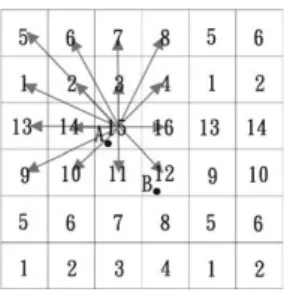
Fig. 2. An example to determine the channel borrowing sequences in our strategies. The arrows radiated from A and B indicate the values of the
pattern will not be so `compact.' For example, in Fig. 1, if grid (0,2) borrows channel 1, the two grids (0,0) and (0,3) may be deprived of the right of using that channel, due to possible interference. Thus the potential number of users of channel 1 may be decreased (of course, the lending grids may be `cold' and do not need that channel). This is the cost of ¯exibility. As a result, the borrowed channels should always be returned to the owner grids whenever necessary to maintain a compact channel usage pattern.
In this work, we will let channels be borrowed among grids such that when looking from a global view, the usage pattern of each channel is as compact as possible. However, no global channel usage status will be collected. In the following, we propose four channel borrowing stra-tegies. Let A be a mobile host located at grid x; y who intends to communicate with a mobile host B located at grid x0; y0: The channels that may be borrowed by A are
given different priorities as follows.
1. sequential-sender-based borrowing (denoted as GRID-Bss). Let i be the channel assigned to grid x; y: Host A
will try to borrow channels i 1 1; i 1 2; ¼; n; 1; 2; ¼; i 2 1; in that order. Intuitively, this will make all grids who also use channels i to borrow channels in the same order. 2. sequential-receiver-based borrowing (denoted as GRID-Bsr). Let i be the channel assigned to grid x0; y0: Host A
will try to borrow channels i 1 1; i 1 2; ¼; n; 1; 2; ¼; i 2 1; in that order.
3. distance-sender-based borrowing (denoted as GRID-Bds). For convenience, let us denote by c p; q the channel
assigned to grid p; q: For each channel i, de®ne a distance function as follows:
dist1 i min ; p;q < c p;qc x;y{ p 2 x21 q 2 y2 q }: Intuitively, this is the distance from x; y to the nearest grid that is also assigned the same default channel. Then we sort all channels that can be borrowed by A based on a descending order of their distance functions. The under-lying idea of the borrowing is to incur as little interfer-ence to A's neighborhood as possible.
4. distance-receiver-based borrowing (denoted as GRID-Bdr). This is similar to the distance-sender-based
borrow-ing, except that we will de®ne for each channel i, a different distance function based on where B is located: dist2 i min ; p;q < c p;qc x0;y0{ p 2 x021 q 2 y02 q }: Then we sort all channels that can be borrowed by A based on a descending order of their distance functions. The underlying idea of the borrowing is to incur as little interference to B's neighborhood as possible.
For example, Fig. 2 shows a scenario where A wants to communicate with B in a MANET with n 16 channels. The channels to be used, from higher priority to lower prior-ity, for the four strategies are (note that the default channel is always at the beginning of the list):
² GRID-Bss: {15,16,1,2,3,4,5,6,7,8,9,10,11,12,13,14};
² GRID-Bsr: {12,13,14,15,16,1,2,3,4,5,6,7,8,9,10,11};
² GRID-Bds: {15,5,1,6,8,9,7,13,2,4,10,12,3,11,14,16};
² GRID-Bdr: {12,2,1,3,6,14,4,10,5,7,13,15,8,9,11,16}.
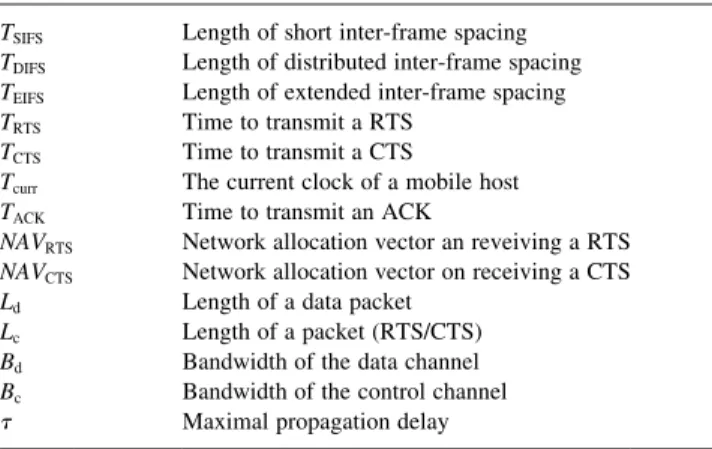
Table 1
Meanings of variables and constants used in our protocol TSIFS Length of short inter-frame spacing TDIFS Length of distributed inter-frame spacing TEIFS Length of extended inter-frame spacing
TRTS Time to transmit a RTS
TCTS Time to transmit a CTS
Tcurr The current clock of a mobile host
TACK Time to transmit an ACK
NAVRTS Network allocation vector an reveiving a RTS NAVCTS Network allocation vector on receiving a CTS
Ld Length of a data packet
Lc Length of a packet (RTS/CTS)
Bd Bandwidth of the data channel
Bc Bandwidth of the control channel
t Maximal propagation delay
Fig. 4. Timing to determine whether a channel will be free after a successful exchange of RTS and CTS packets. Table 2
Experimental parameters
Physical area 1000 £ 1000
Number of hosts 200
Transmission range r 200
Maximum number of retrials to send a RTS 6
Length of DIFS 50 ms
Length of SIFS 10 ms
Backoff slot time 20 ms
Additional waiting time after TDIFS 20 ms
Control packet length Lc 100 bits
We comment that the proposed GRID-B protocol is based on RTS/CTS handshaking to guarantee the safety (freedom of interference) in using a borrowed channel. The loan period of a borrowed channel is not long and is equal to the transmission time of the packet to be sent. To use the same channel again, the host should compete again with RTS/CTS dialogues. Also, the host chooses channels to borrow based on the priority assignment discussed above. 3. The MAC protocol
This section presents the medium access part of our protocol by integrating the channel assignment part in Section 2. The channel model is as follows. The overall bandwidth is divided into one control channel and n data channels D1; D2; ¼; Dn: Each channel, including control and
data ones, has the same bandwidth. This is exempli®ed in Fig. 3, based on a FDMA model. (If CDMA is used, then each channel owns one CDMA code.) The purpose of data channels is to transmit data packets, while that of the control
channel is to schedule and synchronize the use of data chan-nels among hosts.
Each mobile host is equipped with two half-duplex trans-ceivers, as described below.
² Control transceiver. This transceiver will operate on the control channel to exchange control packets and acknowledgements with other mobile hosts and to obtain rights to access data channels.
² Data transceiver. This transceiver will dynamically oper-ate on one of the data channels, according to our channel assignment strategy, to transmit data packets.
Each mobile host X maintains the following data struc-ture.
² CULA: This is called the channel usage list. Each list entry CULi keeps records of how and when a host neighboring to X uses a channel. CULi has four ®elds:
CULi:host: A neighbor host of X.
CULi:ch: A data channel used by CULi:host:
CULi:type: `RTS' or `CTS', indicating that CULi:host is sending data (RTS) or receiving data (CTS).
CULi:rel_time: When channel CULi:ch will be released by CULi:host:
Note that this CUL is distributedly maintained by each mobile host and thus may not contain the precise informa-tion.
² FCL. This is called the free channel list, which is dyna-mically computed from CUL.
The main idea of our protocol is as follows. For a mobile host A to communicate with host B, A will send a RTS (request-to-send) to B. This RTS will carry a list of available channels that A may use based on its neighborhood status. On receiving the RTS, B will match the list with its CUL[ ] to choose a channel for their subsequent communication by replying a CTS. How the channel is selected will depend on the channel borrowing strategy. The purposes of the RTS/
CTS dialogue are thus: (i) to exchange A's and B's channel usage information to select an appropriate channel, and (ii) to warn the neighborhood of A and B not to interfere their subsequent transmission on the channel they selected to use. The complete protocol is shown below. Table 1 lists the variables/constants used in our presentation.
(1) On a mobile host A having a data packet to send to host B, it ®rst checks whether the following two condi-tions are true:
(a) B is not busy after a successful exchange of RTS and CTS packets. That is, B is not equal to any CULi:host such that
CULi:rel_time . Tcurr1 TDIFS1 TRTS1 TSIFS1 TCTS:
(b) There is at least one sending-available channel Dj
for A after a successful exchange of RTS and CTS packets, where a channel Djis sending-available for
A if Djis not used for receiving by any neighbor of A.
Formally, to be a sending-available, Djmust satisfy the
following statement for all i:
CULi:ch Dj ^ CULi:type `CTS' ) CULi:rel_time # Tcurr1 TDIFS1 TRTS 1 TSIFS1 TCTS:
Intuitively, this is to ensure that Djis either not currently
being used for receiving by any neighbor of A, or currently being occupied by some neighbor(s) but will be released after a successful exchange of RTS and CTS packets. (Fig. 4 shows how the above timing is calculated.)
If both of the above conditions hold, A puts all Dj's
satis-fying condition (b) into its FCL. Otherwise, A must wait at step 1 until these conditions become true. Note that if the borrowing strategy is GRID-Bssor GRID-Bds, then the FCL
should be sorted appropriately.
(2) Then A can send a RTS(FCL, Ld) to B, where Ldis the
length of the yet-to-be-sent data packet. Also, following
the IEEE 802.11 style, A can send this RTS only if there is no carrier on the control channel in a TDIFSor TEIFSplus a
random backoff time period. If the control channel is busy, A has to go back to step 1. Note that the waiting time will be TDIFSif the FCL contains A,s default channel;
otherwise, the waiting time should be TEIFS. The goal is to
preserve a higher priority for the owners of default chan-nels, and to enforce a lower priority for those who intend to use borrowed channels.
(3) On a host B receiving the RTS(FCL,Ld) from A, it has
to check whether there is any receiving-available channel Djfor B, where a channel Djis receiving-available for B if
no neighbor of B will be sending data using Djafter a
successful exchange of RTS and CTS packets. Formally, Djmust satisfy the following statement for all i:
CULi:ch Dj ^ CULi:type `RTS` ) CULi:rel_time # Tcurr1 TSIFS1 TCTS: This is to ensure that Djis either not currently being used
for sending by any neighbor of B, or currently being
occupied by some neighbor(s) but will be released after a successful exchange of RTS and CTS packets. If the borrowing strategy is GRID-Bss or GRID-Bds, B picks the
®rst available channel Dj. If the borrowing strategy is
GRID-Bsror GRID-Bdr, B picks the available channel Djbased on
its borrowing strategy.
Then B replies a CTS(Dj, NAVCTS) to A after a TSIFSperiod,
where
NAVCTS Ld=Bd1 TACK1 2t:
Then B tunes its data transceiver to Dj.
On the contrary, if no receiving-available channel is found, B replies a CTS(Test) to A, where Testis the minimum
estimated time that B's CUL will change minus the time for an exchange of a CTS packet:
Test min{;i; CULi:rel_time} 2 Tcurr2 TSIFS2 TCTS: (4) On an irrelevant host C ± B receiving A's RTS(Dj,Ld),
it has to inhibit itself from using the control channel for a period
NAVRTS0 TSIFS1 TCTS1t:
This is to avoid C from interrupting the RTS/CTS dialo-gue between A and B. Then, C appends an entry CUL[k] to its CUL such that:
CULk:host A; CULk:ch Dj;
CULk:type `RTS`;
CULk:rel_time Tcurr1 NAVRTS1
where
NAVRTS1 Tcurr1 Ld=Bd1 TACK1t:
(5) Host A, after sending its RTS, will wait for B's CTS with a timeout period of TSIFS1 TCTS1 2t. If no CTS is
received, A will retry until the maximum number of retries is reached.
(6) On host A receiving B's CTS(Dj, NAVCTS), it performs
the following steps:
(a) Append an entry CUL[k] to its CUL such that CULk:host B; CULk:ch Dj;
CULk:type `CTS`;
CULk:rel_time Tcurr1 NAVCTS
(b) Send its DATA packet to B on the data channel Dj.
On the contrary, if A receives B's CTS(Test), it has to wait
for a time period Testand go back to step 1.
(7). On an irrelevant host C ± A receiving B's CTS(Dj,NAVCTS), C updates its CUL. This is the same
as step 6a except that
CULk:rel_time Tcurr1 NAVCTS1t:
On the contrary, if C receives B's CTS(Test), it ignores this
packet.
(8) On B completely receiving A's data packet, B replies an ACK on the control channel if there is no carrier in a TSIFSperiod.
Also, note that although our protocol will exchange timing information by packets, these are only relative time intervals. No absolute time is sent. So there is no need of clock synchronization in our protocol.
4. Simulation results
We have implemented a simulator to evaluate the performance of our GRID-B protocol. In our simulation, we consider two bandwidth models.
² Fixed-channel-bandwidth. Each channel (data and control) has a ®xed bandwidth. Thus, with more channels, the network can potentially use more bandwidth.
² Fixed-total-bandwidth. The total bandwidth offered to the network is ®xed. Thus, with more channels, each channel will have less bandwidth.
We comment that the ®rst model may re¯ect the situation in CDMA, where each code has the same bandwidth, and we may utilize multiple codes to increase the actual bandwidth of the network. On the contrary, the second model may re¯ect the situation in FDMA, where the total bandwidth is ®xed, and our job is to determine an appropriate number of channels to best utilize the given bandwidth.
The parametersusedinour experimentsare listed inTable 2. Packets arrived at each mobile host in an Poisson distribution with arrival ratelpacket/s. For each packet arriving at a host, we randomly chose a host at the former's neighborhood as its receiver. If the ®xed-channel-bandwidth model is assumed,
each channel's bandwidth is 1 Mbps. If the ®xed-total-band-width model is assumed, the total band®xed-total-band-width is 1 Mbps. In the following, we make observations from four aspects.
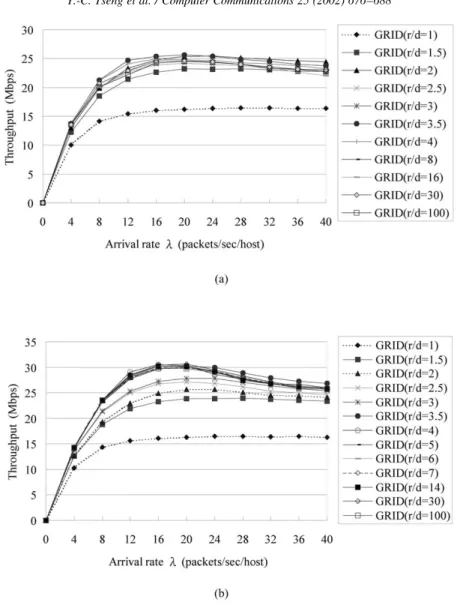
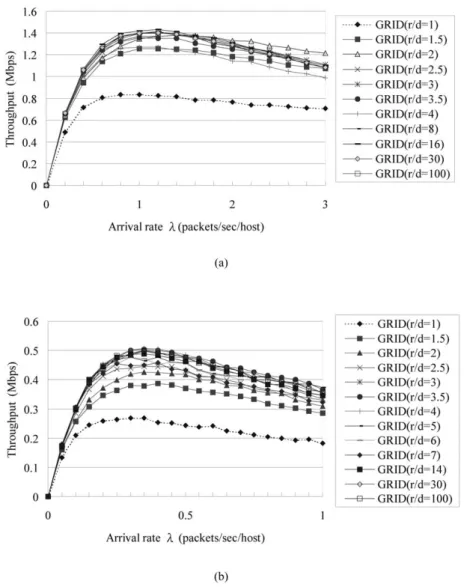
(A) Determining the grid size. Let the radio transmission distance be r and the grid size be d £ d: According to our experience in Ref. [33], the ratio of r=d has signi®cant impact to the network throughput. So here we repeat some of the simulation results in Ref. [33] to avoid confusion. In this experiment, we change the r/d ratio to observe the effect. Fig. 5 shows the network throughput with different loads under the ®xed-channel-bandwidth model. We see that GRID will deliver the highest throughput at r=d pn=2 2 in Fig. 5(a) and r=d pn=2 3:5 in Fig. 5(b). Fig. 6 shows the similar experiment under the ®xed-total-bandwidth model. The highest throughput is still at r=d pn=2 2 in Fig. 6(a) and r=d pn=2 3:5 in Fig. 6(b). According to our experience, the best performance appears at about r=d pn=2: So in the rest of the presentation, this implicit r/d ratio will be used by both GRID and GRID-B protocols.
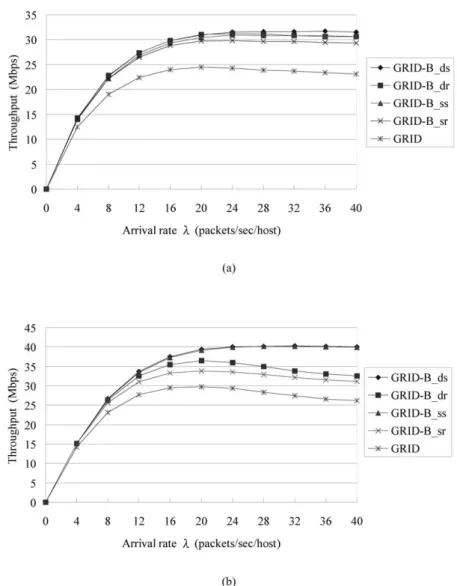
(B) GRID-Bvs. GRID. Inthisexperiment, we investigate the throughput improvement of GRID-B over GRID. Here we use n 16 and 49 data channels to show the improvement in different situations. Recall that the physical area is 1000 £ 1000: We simulate a hot spot of 200 £ 200 located at the center of the area, which will be resident by one forth of the mobile hosts. Fig. 7 shows the result under the ®xed-channel-band-width model. GRID-B has around over 25% increase in throughput. Among the four borrowing strategies, the distance-sender-basedandsequential-sender-basedborrowing strategies have the best performance. We believe it is because the channel reuse pattern is better for these two strategies.
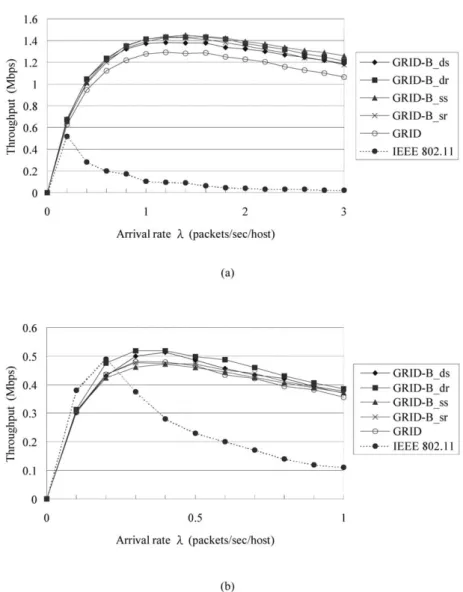
Fig. 8 shows the same simulation under the ®xed-total-bandwidth model. We see that the throughput improvement is not as large as those under the ®xed-channel-bandwidth model. GRID-B only outperforms GRID by about 10% increase in throughput under the ®xed-total-bandwidth model. We conjecture that this is because channel borrowing will disturb the channel reuse pattern, and under the ®xed-total-bandwidth model, the disturbance will sustain for longer time (each channel has less bandwidth under this model).
Also, as a referential point, we show the performance of the IEEE 802.11 in Fig. 8. This helps us to see the motivation of using multiple channels when we are given a ®xed amount of bandwidth. Fig. 8 veri®es the bene®ts of using multiple
channels over single channel. In the single-channel environ-ment, any packet collision will waste the whole bandwidth of the channel. While in the multi-channel environment, a colli-sion will only waste a faction of the total bandwidth. Taking n 9 as an example, only one tenth (one control channel and nine data channels) of the total bandwidth will be wasted. This effect is more signi®cant when the arrival rate enlarges, where more contentions will happen.
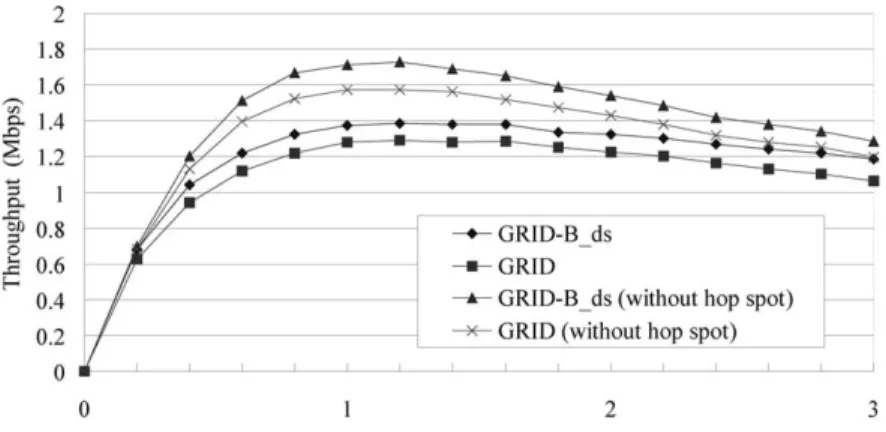
(C) Effect of hot spots. To understand the effect of the existence of hot spots, Fig. 9 shows the throughput of GRID and GRID-B under the ®xed-channel-bandwidth model. The design of hot spots is the same as the previous experiment. Hot spots will in fact decrease the performance of both GRID and GRID-B because the channel reuse pattern will be disturbed. As shown in Fig. 9(a), the throughput degra-dation (peak throughput) is about 15% in GRID, and about 10% in GRID-B. In Fig. 9(b), the throughput degradation is about 15% in GRID, and about 11% in GRID-B. It indicates that our GRID-B protocol is more resilient to hot spots.
Fig. 10 shows the same simulation under ®xed-total-bandwidth model. Similarly, we see a degradation of 18% (Fig. 10(a)) and 16% (Fig. 10(b)) in GRID if there are hot spots, and a degradation of 12% (Fig. 10(a)) and 13% (Fig. 10(b)) in GRID-B if there are hot spots.
(D) Packet turnaround time. The packet turnaround time
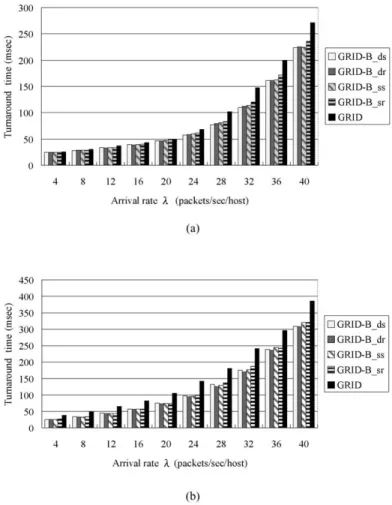
is the time interval from a packet being initiated to the packet being completely received. We are interested in the impact of channel borrowing on the turnaround time. Fig. 11 shows the results under the ®xed-channel-bandwidth model. We can see that turnaround time is proportional to traf®c load for all schemes. GRID-B does have shorter turnaround time than GRID in addition to its higher throughput. It's because GRID-B will borrow channels when the default channel is not free. That is, stations using GRID-B usually start their transmission earlier and ®nish earlier. This shows the effectiveness of channel borrowing. Fig. 12 shows the same simulation under the ®xed-total-bandwidth model. We see that the improvement of turnaround is not as large as those in Fig. 11. We believe that the reason is similar to that conjectured in part B of this section.
5. Conclusions
We have proposed a new channel assignment and medium access GRID-B protocol for MANET that is characterized by
interesting on-demand, dynamic, and location-aware proper-ties. Most existing protocols do not have these properproper-ties. Simulation results show signi®cant improvements, in both throughput and delay, over the GRID protocol, which uses static channel assignment. For future research, we are currently considering using multiple channels to provide Quality-of-Service guarantees for real time traf®c. As to posi-tioning devices, GPS is quite satisfactory for outdoor use. How to provide accurate indoor positioning (such as Refs. [11,30]) and how to integrate location-aware protocols with such posi-tioning systems deserve further investigation.
Acknowledgements
This research is supported in part by the Ministry of Education, ROC, under grant 90-H-FAO7-1-4 (Learning Technology) and the National Science Council, ROC, under grants 009-093, NSC89-2218-E-009-094 and NSC89-2218-E-009-095.
[6] A. Bertossi, M. Bonuccelli, Code assignment for hidden terminal interference avoidance in multihop radio networks, IEEE/ACM Transactions on Networks 3 (4) (1995) 441±449.
[7] V. Bharghavan, A. Demers, S. Shenker, L. Zhang, MACAW: a medium access protocol for wireless LANs, Proceedings of SIG COMM '94 (1994) 212±225.
[8] X. Doug, T.H. Lai, An ef®cient priority-based dynamic channel allo-cation strategy for mobile cellular networks, Proceedings of IEEE INFO COM (1997) 1997.
[9] C.L. Fullmer, J.J. Garcia-Luna-Aceves, Floor acquisition multiple access (FAMA) for packet-radio' networks, Proceedings of SIG COMM '95 1995.
[10] J.J. Garcia-Luna-Aceves, J. Raju, Distributed assignment of codes for multihop packet-radio networks, Proceedings of IEEE MILCOM '97 1997.
[11] A. Harter, A. Hopper, A distributed location system for the active of®ce, IEEE Network 8 (1) (1994).
[12] L. Hu, Distributed code assignment for CDMA packet radio networks, IEEE/ACM Transactions on Networks 1 (6) (1993) 668±677. [13] D. Johnson, D. Maltz, in: T. Imielinski, H. Korth (Eds.), Dynamic
Source Routing in Ad Hoc Wireless Networks in Mobile Computing, Kluwer Academic Publishers, Dordrecht, 1996, pp. 153±181. [14] J.-H. Ju, V.O.K. Li, Scheduling dedsign of multihop packet radio
networks based on latin squares, IEEE Journal on Selected Areas in Communications 17 (8) (1999) 1345±1352.
[15] P. Karn, MACA Ð a new channel access method for packet radio, ARRL/CRRL Amateur Radio 9th Computer Networking Confer-ence1990, pp. 134±140.
[16] L. Kleinrock, F.A. Tobagi, Packet switching in radio channels: part I Ð carrier sense multiple access modes and their throughput-delay characteristics, IEEE Translations on Communications 23 (12) (1975) 1417±1433.
[24] S. Nanda, D. Goodman, Dynamic resource acquisition: distributed carrier allocation for TDMA cellular systems, Proceedings of IEEE Globe Corn (1991) 1991.
[25] A. Nasipuri, J. Zhuang, S.R. Das, A multichannel CSMA MAC proto-col for multihop wireless networks, Proceedings of WCNC `99 1999. [26] S.-Y. Ni, Y.-C. Tseng, Y.S. Chen, J.-P. Sheu, The Broadcast Storm Problem in a Mobile Ad Hoc Network, Proceedings of ACM MOBI-COM '99, 99 1999 pp. 151±162.
[27] S.-H. Oh, et al., Prioritized channel assignment in a cellular radio network, IEEE Transactions on Communications 40 (1992) 1259± 1269.
[28] Z. Tang, J.J. Garcia-Luna-Aceves, Hop-reservation multiple access (HRMA) for ad-hoc networks, Proceedings of IEEE INFO COM '99 1999.
[29] C.-K. Toh, Associativity-based routing for ad-hoc mobile networks, Proceedings of IF CCC '96 1996.
[30] R. Want, A. Hopper, V. Falcao, J. Gibbons, The active badge location system, ACM Transactions on Information Systems 10 (1) (1992) 91± 102.
[31] White House of®ce of The Press Secretary, Improving the Civilian Global Positioning System (GPS), http://www.igeb.gov/sa/whfact-sheet.txt.
[32] S.-L. Wu, S.-Y. Ni, Y.-C. Tseng, J.-P. Sheu, Route maintenance in a wireless mobile ad hoc network, Telecommunication Systems (2001) in press.
[33] S.-L. Wu, Y.-C. Tseng, C.-M. Chao, J.-P. Sheu, Location-aware chan-nel assignment for a multi-chanchan-nel mobile ad hoc network, Technical Report NCU-HSCCL-2000-02, Department of Computer Science and Information Engineering, National Central University, 2000. [34] M. Zhang, T.-S. Yum, The non-uniform compact pattern allocation
algorithm for cellular mboile systems, IEEE Transactions on Vehicular Technology VT-40 (1991) 387±391.