國
立
交
通
大
學
資訊學院
資訊工程學系
博士論文
IEEE 802.11 無線區域網路與 IEEE 802.16e 無線
都會網路上省電協定之設計
Design of Power Saving Protocols for IEEE 802.11
WLANs and IEEE 802.16e WMANs
研 究 生 :黃世昌
指 導 教 授 :簡榮宏教授
IEEE 802.11 無線區域網路與 IEEE 802.16e 無
線都會網路上省電協定之設計
研究生:黃世昌 指導教授:簡榮宏 博士
國立交通大學 資訊工程系
摘
要
隨著無線網路的蓬勃發展,越來越多無線存取技術在不同的應用層面與需求下 被提出來。在眾多的無線技術當中,IEEE 802.11 無線區域網路與 IEEE 802.16 無線 都會網路是兩個最直接影響到使用者存取網際網路的技術。前者提供一個簡單、廉 價的方案讓使用者建構自己的無線區域網路。後者提供一個無線存取方案來替代目 前有線網路中以電纜或ADSL 存取網際網路的方式。由於在無線網路中大部份的行 動裝置都是由電池供應電力,節省電源以延長的運作時間是一個非常重要的議題。 因此,在此篇論文當中,我們分別針對IEEE 802.11 無線區域網路的基礎建置模式(infrastructure mode)、隨意網路模式(ad hoc mode)、與 IEEE 802.16e 無線都會網路設 計相應的省電機制。 對於IEEE 802.11 無線區域網路的基礎建置模式,我們提出一個新方法來安排 休眠主機(sleep stations)醒來的時間,所提出的方法企圖讓每一個信標區間(beacon interval)中醒來的主機數量得以更加平均。藉由這個方法來降低封包相撞的機率,讓 主機避免重傳資料來節省電力。此外,我們也考慮控制所要通知之醒來主機的數量 以及他們之間的存取順序,藉以避免過多醒來的主機在發現擷取點(Access Point)上
有暫存的資料之時,同時發送 PS-Poll 訊框存取網路而造成嚴重的封包衝撞。在設 計上我們提供三種不同的選取機制來控制所要通知的主機數,通知機制為分別為只 選一台主機、或是根據聯結識別碼(AID)、或預存資料長度來選取主機數。模擬的結 果證實我們提的方法能有效的節省電力。 對於IEEE 802.11 無線區域網路的隨意網路模式,我們提出一個能自我組態的 省電方法,稱為 SCPS。每一台主機如同基礎建置模式一樣,可以選取自己的休眠 時間長度。當有一台主機進入或離開省電模式時,SCPS 會讓其他在省電模式下的 主機去調整它們醒來的排程,這樣的調整可以平衡在每一個信標區間裡醒來的主機 數量,使得能源因傳輸媒介的競爭與衝撞而耗損的問題可以進一步的改善。模擬的 結果顯示 SCPS 成功的平衡了每一個信標區間裡醒來的主機數量、增加休眠時間的 百分比、同時也降低主機彼此之間封包衝撞的機率。 對於IEEE 802.16e 無線寬頻網路,我們提出幾個能源效率高的排程方法,這些 排程方法考慮的是多台行動主機(MSS),而非像目前大多數的研究僅考量單一行動 主機的排程方式,所考量的資料流都是有服務品質延遲限制的常數速率資料流,所 提出的方法同時考量能源使用的效益與頻寬利用率。我們提出的方法分為兩類,一 是定期的自主休眠週期(PASC),另一則為定期的相同休眠週期(PUSC)。在 PASC 中,所有行動主機的資料流所限定的服務品質限制直到它們加入前都未知,每一個 行動主機都使用自己的休眠週期來節省電力。若是每一個行動主機的服務品質限制 可以事先得知,則可以用PUSC 方式讓行動主機的排程更有效率,因為在 PUSC 中 所有的行動主機都使用相同的休眠週期,基地台可以很簡單的安排行動主機醒來的
時間。模擬結果顯示PUSC 與 PASC 皆有不錯的省電效能,特別是在 VOIP 的應用
Design of Power Saving Protocols for IEEE
802.11 WLANs and IEEE 802.16e WMANs
Student:Shih-Chang
Huang
Advisor:Dr. Rong-Hong Jan
Department of Computer Science, National Chiao Tung University
Abstract
Recently, wireless networks have widely developed. Many different wireless technologies have been proposed for different network aspects. Among all of the wireless technologies, the IEEE 802.11 WLANs and the IEEE 802.16 WMAN directly influence the internet access of end users. The former provides easy and low cost solution for people to build their own local area networks and the latter provides a wireless internet access solution to substitute the last-mile internet accessing in the wired networks. Because most of the mobile devices in the wireless networks are powered by battery, saving power to extend the operation time is a critical issue. Therefore, we design several power saving protocols for the infrastructure and ad hoc mode of IEEE 802.11 WLANs and for the IEEE 802.16e WMANs.
For the infrastructure mode of IEEE 802.11 WLANs, a novel method is presented to schedule the listening duration of sleeping stations and to balance the amount of wakeup stations in each beacon interval. This method saves stations’ power by reducing the probability of collision. We also control the amount of wakeup stations which can send the PS-Poll frames to get back their buffered data to avoid contention. Three different mechanisms, single wakeup stations, the smallest association ID, and the smallest queue length, are proposed for to control the access order of wakeup stations. Our simulation results show that the proposed methods are effective in the power-saving.
For the ad hoc mode of IEEE 802.11 WLANs, a novel self-configuring power-saving protocol, called as SCPS, is proposed. Stations choose their listening intervals as the infrastructure mode. Besides, all stations in the PS mode can adjust their wakeup schedules whenever a station enters or exits the PS mode. The adjustment can balance the amount of wakeup stations in each beacon interval so that both the contention for transmission medium and the collisions in transmission can be ameliorated, which results in more efficient energy usage. Simulation results show that SCPS successfully balances the amount of wakeup stations in each beacon interval, increases the sleep ratio, and reduces the collision probability.
For the IEEE 802.16e broadband wireless networks, we proposed several energy efficient scheduling approaches. Instead of considering a single Mobile Subscriber Station (MSS) as most of the current researchers do, multiple MSSs are considered in our work. We consider constant bit rate traffic with QoS delay constraint. The proposed approaches address both energy efficiency and bandwidth utilization. Two classes of scheduling approaches are proposed, the periodical autonomic sleeping cycle (PASC) and the periodical uniform sleeping cycle (PUSC) approaches. In the PASC, the QoS information of all MSSs needs not to know beforehand. Each MSS uses its own sleeping cycle for power saving. While the possible QoS requirement of the MSSs can be known beforehand, the efficiency of the scheduling can be improved further. Thus, the PUSC approaches let all MSSs use the same length of sleeping cycle for their wakeup schedule. BS simply schedules the MSSs’ wakeup time. Simulation results show that both PUSC and PASC can have higher power efficiency. Besides, the PUSC approaches are superior to the PASC approach on the bandwidth utilization under the application of VoIP.
Acknowledgements
Special thanks goes to my advisor Professor Rong-Hong Jan for his guidance in my dissertation work and the instructions on writing articles. Thanks also to all members of Computer Network Lab for their assistance and kindly help in both the research and the daily life during these years. Finally, I will dedicate this dissertation to my families for their love and support.
Contents
Abstract (in Chinese) ... i
Abstract (in English)... iii
Acknowledgements ... v
Contents ... vi
List of Tables... viii
List of Figures... ix
Chapter 1 Introduction... 1
Chapter 2 Reviews and Related Works... 7
2.1 Power saving protocols for 802.11 WLANs ... 7
2.1.1 Infrastructure mode... 7
2.1.2 Ad hoc mode... 10
2.2 Power saving protocols for 802.16e WMANs... 12
Chapter 3 Power Saving Protocols for IEEE 802.11 Infrastructure Mode ... 15
3.1 Problem statement... 16
3.2 Load-aware wakeup scheduling... 17
3.3 Contention avoidance traffic scheduling ... 19
3.3.1 Multiple wakeups single access ... 20
3.3.2 Multiple wakeups multiple accesses... 22
3.4 Simulation and results... 25
3.4.1 Performance metrics and environment setup... 25
3.4.2 Results and discussion ... 27
3.5 Summary ... 29
Chapter 4 Power Saving Protocols for IEEE 802.11 Ad Hoc Mode ... 31
4.1 Problem statement... 32
4.2 The SCPS approach ... 33
4.2.1 The wakeup information of other stations ... 33
4.2.2 Timer synchronization ... 36
4.2.3 Maintaining a consistent wakeup table ... 37
4.2.4 A station enters the PS mode ... 40
4.2.5 A station exits the PS mode ... 44
4.4 Summary ... 56
Chapter 5 Power Saving Protocols for IEEE 802.16e WMANs... 57
5.1 Autonomic sleep cycle... 58
5.2 Uniform Sleeping Cycle ... 65
5.2.1 Multiple MSSs Power-Saving Scheduler (MMPS) ... 66
5.2.2 MMPS with Fragment Collection (MMPS-FC) ... 67
5.2.3 MMPS with Boundary Free (MMPS-BF)... 69
5.2.4 Maximize the bandwidth utilization of MMPS-BF ... 70
5.3 Simulation Results ... 72
5.3.1 Environment setup ... 72
5.3.2 Numerical results ... 73
5.4 Summary ... 78
Chapter 6 Conclusions and Future Works ... 79
List of Tables
TABLE 3-1 DETAIL SIMULATION CONFIGURATIONS... 26
TABLE 4-1 THE WAKEUP INFORMATION TABLE... 34
TABLE 4-2 THE NUMBER OF BEACON INTERVALS NEEDED OR THE CLOCK TO DRAFT FOR A
DIFS... 36 TABLE 4-3 A SEQUENCE OF WI(T) AND N(T)... 38 TABLE 4-4 A SEQUENCE OF WI(T) AND N(T)... 41 TABLE 4-5 A SEQUENCE OF WI(T) AND N(T) FOR STATION J WITH FIRST WAKEUP TIME T =5 . 41 TABLE 4-6 A SEQUENCE OF WI(T) AND N(T) FOR STATION C EXISTING THE PS MODE AT TIME
T=5 ... 45
TABLE 4-7 A SEQUENCE OF WI(T) AND N(T) WHEN C EXISTS THE PS MODE AT TIME T=5... 45 TABLE 5-1 THE AVERAGE REQUIRED BUFFERED SIZE FOR EACH MSS ... 78
List of Figures
FIGURE 2-1 THE POWER SAVING MECHANISM OF IEEE802.11 INFRASTRUCTURE MODE... 9
FIGURE 2-2 THE POWER SAVING MECHANISM OF IEEE802.11 AD HOC MODE... 10
FIGURE 2-3 THE THREE POWER SAVING CLASSES OF IEEE802.16E WMANS... 13
FIGURE 3-1 A SEQUENCE OF WI(T) AND N(T), N(T)J: THE N(T) AFTER J IS INCLUDED... 16
FIGURE 3-2 MULTIPLE WAKEUP SINGLE ACCESS... 21
FIGURE 3-3 AN EXAMPLE OF SMALLEST AID FIRST METHOD... 22
FIGURE 3-4 AN EXAMPLE OF THE SMALLEST QUEUE LENGTH FIRST METHOD... 24
FIGURE 3-5 THE AVERAGE SLEEPING TIME... 27
FIGURE 3-6 THE AVERAGE THROUGHPUT FOR EACH SCHEME... 28
FIGURE 3-7 THE LATENCY OF A SUCCESSFUL TRANSMISSION FOR EACH SCHEME... 29
FIGURE 3-8 THE IMPROVING RATE OF SLEEPING RATIO... 29
FIGURE 4-1 THE POWER-SAVING OPERATION OF SCPS ... 32
FIGURE 4-2 THE FORMAT OF STATION WAKEUP INFORMATION (SWI) ... 35
FIGURE 4-3 THE AVERAGE AND THE MAXIMUM WAKEUP STATIONS IN AN ATIM WINDOW... 49
FIGURE 4-4 THE RELATIONSHIP OF THE SLEEP RATIO AND THE TOTAL NUMBER OF STATIONS50 FIGURE 4-5 THE RELATIONSHIP OF AVERAGE PACKET QUEUING DELAY AND THE TOTAL STATION NUMBER... 51
FIGURE 4-6 THE RELATIONSHIP OF PACKET DROP RATIO AND THE TOTAL NUMBER OF STATIONS... 52
FIGURE 4-7 THE RELATIONSHIP BETWEEN SLEEPING RATIO AND TRAFFIC GENERATION RATE (60 STATIONS; PACKET SIZE:8000 BITS) ... 53
FIGURE 4-8 THE RELATIONSHIP BETWEEN SLEEPING RATIO AND TRAFFIC GENERATION RATE ... 53
FIGURE 4-9 INFLUENCE OF PACKET SIZE (60 STATIONS; TRAFFIC GENERATION RATE:8 PACKETS/S)... 54
FIGURE 4-10 THE THROUGHPUT AND SLEEP RATIO AS FUNCTIONS OF THE LISTEN-INTERVAL IN SCPSB (60 STATION; TRAFFIC GENERATION RATE:8 PACKETS/S) ... 55
SCPSB... 55
FIGURE 5-1 EXAMPLE OF PERIODICAL AUTONOMIC SLEEPING CYCLE APPROACH... 60
FIGURE 5-2 AN EXAMPLE OF MMPS SCHEDULING... 67
FIGURE 5-3 EXAMPLE OF MMPS WITH FRAGMENT COLLECTION... 68
FIGURE 5-4 ALGORITHM OF MMPS-FC APPROACH... 69
FIGURE 5-5 A MMPS EXAMPLE WITH BOUNDARY FREE... 70
FIGURE 5-6 BANDWIDTH UTILIZATION... 73
FIGURE 5-7 THE NUMBER OF SERVICED MSSS... 74
FIGURE 5-8 COMPARISON OF SLEEPING RATIOS (16MBPS) ... 76
FIGURE 5-9 THE BANDWIDTH UTILIZATION AND SLEEPING RATIO UNDER THE CASE OF 1.6MBPS RATE... 77
Chapter 1
Introduction
In the traditional wired network, the locations to attach networks are limited by the hubs which are the entrances to the backhaul networks connected by the physical electrical wires. This inconvenient network accessing mechanism results in the popularity of the mobile devices and the development of wireless communication technologies. Nowadays, wireless communication has become an indispensable ability for mobile devices to attach the networks. Among all of the current wireless communication technologies, the IEEE 802.11 WLANs [1] is the widest adapted technology to build the personal wireless local area network and the IEEE 802.16 WMANs [2] is the most expected technology to bridge the traffic between the local area networks and the public networks.
The IEEE 802.11 WLANs standard has been released by the IEEE LAN Standards Committee since 1997 for wireless local area network. This standard defines the medium access control (MAC) and physical (PHY) layers for a wireless LAN operating on 5 GHz and 2.4 GHz public spectrum bands. Because of the simple and low cost characteristics, the IEEE 802.11 WLAN has been widely deployed at the company, family, airport, and etc. Everyone can easily and freely deploy his own wireless LAN via the low cost
facilities of this standard. Serial contents are specified in this standard such as the basic MAC level access control and data delivery services[1], the mobility of devices between multiple wireless LANs[3], the physical layer signaling techniques and interfaces[4-6], privacy and security of user data transferring[7], and etc.
The IEEE 802.16 WMANs standard which was first approved in December 2001 specifies point to multipoint broadband wireless transmission. It is developed to replace the current last-mile internet access mechanism which is relied on the cable or ADSL in the wired networks. It can also provide service to a large amount of Mobile Subscriber Stations (MSSs). In the standard of IEEE 802.16 MAC protocol, two main duplex modes, frequency division duplex (FDD) mode and time division duplex (TDD) mode, are specified for the communication between a Base Station (BS) and a MSS. In order to support various applications, such as Voice over IP (VoIP), video streaming, web browsing, etc., the IEEE 802.16e defines four kinds of service classes: Unsolicited Grant Service (UGS), Real-Time Polling Service (rtPS), Non-Real-Time Polling Service (nrtPs), and Best Effort (BE).
The IEEE 802.16 WMANs standard also standardizes the PHY and the MAC as the IEEE 802.11 WLANs. The specified contents in this standard include mobility and power saving [8], mobility management [9], bridging [10], multi-hop relay [11], and etc. More amendments of IEEE 802.16 WMANs are still under proceeding.
No matter the IEEE 801.11 WLANs or the IEEE 802.16 WMANs, the power source of the mobile devices usually comes from the equipped batteries. A mobile device will lose its availability when all equipped batteries exhaust energy. With the popularity of
devices gradually becomes an important issue that can not be neglected. Considering the slow progress in developing high capacity battery, making good use of the battery’s power seems to be more practical way to prolong the operation time of mobile devices.
In a mobile device, the wireless communication component is one of the main power consumption sources. Designing the power saving (PS) communication protocols can efficiently extend the operation time of mobile devices. Thus, many efforts have been done to save the power consumed by message communication. In physical and MAC layers, the designed PS protocols can save power by using traffic-aware bit-rate selector [12-15], power control mechanisms [16-18], or adapting the activity periods of communication [19-25]. Besides, the power saving protocols can also be designed by considering frame aggregation [44] or reducing the possible retransmission [23]. Power saving protocols designed for network and TCP layers usually consider applying power-aware routing approaches [26-28] or dynamically changing the beacon interval size based on the TCP traffic [29]. Furthermore, the beacon interval size can also be adapted dynamically based on the users’ behavior [25]. Among all of the power saving mechanism, the most efficient way to save power is to prevent mobile devices from idly wake up and let they stay in low power mode as long as possible. The lower power mode is also called as sleep mode.
The standard of IEEE 802.11 WLANs also specifies a basic sleep mode mechanism for both the infrastructure mode and the ad hoc mode. However, due to the power saving mechanism in the standard is inefficient, many researches have been proposed to amend them. For the infrastructure mode, some proposed a TDMA-like mechanism [41] [42] to reduce the power wasted on idly listening and retransmission; others let the stations
flexibly adapt their listening interval length according to the traffic arrival time [17][43][45].
For the ad hoc mode, flexibly adapting the size of the beacon interval [20] and the size of ATIM window size are proposed [21-22] to save the power wasted on the idly listening and to increase the bandwidth utilization. All of these proposals focus on extending the sleep duration within a beacon interval. Stations still need to wake up in every beacon interval. For saving more energy, stations need to sleep more beacon intervals instead of one [30].
In this dissertation, we propose several power saving protocols for both the infrastructure mode and the ad hoc mode of IEEE 802.11 WLANs. For the infrastructure mode, we present a novel method to arrange wakeup schedule for sleeping stations. Our purpose is to balance the number of wakeup stations in each beacon interval. This method can reduce the probability of collision and thus the station can save more power. Next, we consider how to poll the wakeup stations to send the PS-Poll frame to get back their buffered data so that the contention can be avoided. Three different access scheduling mechanisms are proposed for the contention avoidance. In the first mechanism, only one of wakeup stations is scheduled to access the buffered data. The second and third mechanisms schedule a subset of wakeup stations to retrieve their buffered data within a beacon interval. The access sequences of the second and third mechanisms are based on the association ID (AID) and the queue length, respectively.
For the ad hoc mode, a self-configuration power-saving (SCPS) protocol for one-hop ad hoc networks is proposed. The proposed SCPS approach let stations sleep
transmission time). Furthermore, the SCPS protocol provides more flexibility for stations to select the length of listen-interval and each station can decide its own listen-interval as in the infrastructure mode. SCPS also attempts to evenly arrange stations to wake up in beacon intervals in order to reduce the medium-contention probability. When a station enters or exits the PS mode, stations in PS mode will arrange their wakeup schedule automatically. Its results are better then the Quorum based approach [30].
The IEEE 802.16 WMANs specifies its power saving mechanism in the standard of IEEE 802.16e [8]. Although the power saving mechanisms in IEEE 802.16e are designed for the central coordinated networks which is similar to the infrastructure mode of IEEE 802.11 WLANs, the existing power saving mechanisms for the IEEE 802.11 WLANs can not be applied to IEEE 802.16e directly. It results from that they have different medium access control mechanism (IEEE 802.11 WLANs is contention-based while the IEEE 802.16e is slot-based) and different QoS requirements (IEEE 802.11 WLANs are not emphasized as 802.16e).
Therefore, several researches have studied the power consumption in a power saving mode MSS [31-34]. New power-saving protocols are also proposed to determine the length of sleeping period [36-38]. Furthermore, a protocol that consider mixed mode of power saving classes is also proposed to improve the power saving efficiency [35].
In this dissertation, we consider the UGS traffic with QoS delay requirement and adapt the second power-saving class defined in IEEE 802.16e standard. Two kinds of power saving schedule approaches for multiple MSSs are proposed, the periodical autonomic sleeping cycle approach (PASC) and the periodical uniform sleeping cycle approach (PUSC). In the PASC, each MSS follows its own sleeping cycle to wake up. At
the same time, the bandwidth utilization in each OFDM frame is also considered. The BS will try to schedule the wakeup time of newly joined MSSs to a light load OFDM frames without preempting those MSSs which have been scheduled. So, the traffic load in each OFDM frame can be balanced and BS can allocate bandwidth to new MSS easily.
Thus, for serving more MSSs, we proposed the PUSC approach. The PUSC assumes that the possible minimum delay constraint of MSSs is known beforehand. So, the shortest sleeping cycle within all MSSs can be known. The allocated OFDM frames for each MSS are well controlled and overlap-free. We condense the bandwidth of each available OFDM frame to increase the bandwidth utilization.
The rest of this dissertation is organized as follows. The reviews of the power saving protocols of IEEE 802.11 and IEEE 802.16e are given in chapter 2. In the chapter 3 and 4, we present our proposed power saving protocols for IEEE 802.11 infrastructure mode and ad hoc mode, respectively. The IEEE 802.16e power-saving protocols are presented in chapter 5. Finally, the conclusions and future works are shown in chapter 6.
Chapter 2
Reviews and Related Works
Power saving mechanism is important for the mobile devices. Using a power saving wireless communication protocol can economize the power spending on the communication. Many researches have been done and we will review some of those important works in this chapter.
2.1 Power saving protocols for 802.11 WLANs
The standard of IEEE 802.11 specifies two operation modes, the infrastructure mode and ad hoc mode. The infrastructure mode is a centrally controlled network system. A special station, called as Access Point (AP), coordinates the communication between the other stations in this mode. On the contrary, the ad hoc mode is a completely distributed network system. There is no central coordinator and stations cooperated with others distributedly. In the following subsections, we detail the power saving operations of these two modes and their related researches.
2.1.1 Infrastructure mode
management state. After AP has the power management state of every station which has associated with it. AP can either deliver the arrival frames to the station if it is waking up or buffered it if the station is in PS mode.
AP periodically broadcasts the information of buffered frames to indicate its serviced stations to get back their data via the traffic indication map (TIM) in beacon frames. The TIM is a virtual bitmap in which each bit corresponds to a particular AID where AID is assigned by AP when a station associates to the AP.
Power-saving stations have to wake up to listen for beacon frames and check the TIM. By this way, a mobile station can determine whether the AP has buffered frames for it. If the AP seldom buffers frames for the station, the station does not require waking up to check every beacon frame. Instead, it wakes up every listen-interval to check the beacon frame. A listen-interval is a number of beacon intervals for which the mobile station may choose to sleep. If the station finds that the AP has buffered data for it, it will send a PS-Poll control frame to retrieve the buffered frames. When multiple stations have buffered frames, all stations with buffered frames contend the medium for sending PS-Poll. After sending the PS-Poll, a station has to awake until the buffered frames are received or the bit in the TIM corresponding to its AID is no longer set.
For example, as shown in Figure 2-1, a station, denoted as STA, is wakeup in the first beacon interval and receives the beacon frame in which the TIM indicates buffered data for it. Then, STA contends the medium for sending a PS-Poll frame to inform the AP that it is wakeup and ready to get back the buffered data. After AP receives the PS-Poll, it transmits a buffered frame to the STA. The STA returns an ACK frame to inform AP that
AP
STA
Beacon interval
TIM (in beacon) Data PS-POLL ACK
Figure 2-1 the power saving mechanism of IEEE 802.11 infrastructure mode
Idly listening reduces the possible sleeping time of stations. To improve the power saving mechanism of infrastructure mode in the standard, Ghazanfar et al proposed a MAC protocol which efficiently allocates the bandwidth of AP into multiple time slots[41] [42]. This protocol let the stations operate in the TDMA mode and AP coordinates the stations. Ghazanfar et al also provided more detailed analysis about the benefits that obtain from the TDMA operation mode in [42].
Although the TDMA like mechanism can efficiently save the energy wasted on idly waiting and on packet retransmission, it needs greatly modification to the standard. Thus, for minimizing the penalty on standard modification, Shuvo et al proposed an AMS protocol, which measures the average time between consecutive incoming packets under different VoIP applications for the voice traffic [43]. After then, the stations can conserve the maximum amount of energy by stay in the sleep state. Moreover it can also introduce as little additional delay as possible. It predicts exactly the time of the next packet transmission or packet arrival, and entering the awaken state just before this occurs. Similar mechanisms which adapt the listening interval length based on the traffic are also
2.1.2 Ad hoc mode
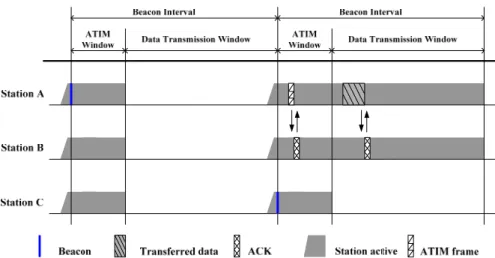
Figure 2-2 the power saving mechanism of IEEE 802.11 ad hoc mode
Design a power saving mechanism for ad hoc mode is more difficult than the infrastructure mode because there is no centralized coordinator. Stations must run the power saving mechanism distributedly. Figure 2-2 illustrates the power saving mechanism of the ad-hoc mode in the standard of IEEE 802.11. A beacon interval is divided into two parts, the ATIM window and the data transmission window. Every station has to wake up during the ATIM window. If a station has buffered data for another one, it sends an ATIM frame to notify the receiver. After successfully transmitting the ATIM frames, all stations compete for the transmission medium to send their buffered data during the data transmission window.
On the other hand, stations that have no data to send or receive go to sleep at the end of the ATIM window. It will not wake up until the next beacon interval. All other stations will wake up during the entire data transmission window. For example, in Figure 2-2, all three stations (A, B, and C) wake up in the first ATIM window. They do not send or
All three stations wake up again in the second ATIM window. Assume that station A has buffered data for station B at this time. It sends an ATIM frame to station B during the second ATIM window and sends the buffered data during the second data transmission window. Because station C does not have data to send or receive, it goes to sleep at the end of the second ATIM window.
The fix-length beacon interval in the ad hoc mode limits the bandwidth flexibility while bandwidth demands of stations change randomly. Thus, to improve the power saving mechanism in the ad hoc mode of 802.11 standard, Liu et al. proposed a variable-length beacon-interval mechanism [20]. The length of the transmission window was determined by all the stations that have succeeded in ATIM frame transfer. So the length of a beacon interval can be dynamically adjusted according to the demands of stations.
Similar to the fix-length beacon interval, the duration of the ATIM window is fixed and is determined when the system starts up in the 802.11. A fix-duration ATIM window results in low bandwidth utilization. Flexibly adapting the ATIM window to reduce the power wasted on idle listening is proposed [21, 22].
In [21], if a station discovers that the channel has been idle for more than a predefined amount of time, that station will assume that all other stations are idle. At this time, the ATIM window ends and the data transmission window starts. In [22], Jung and Vaidya proposed a dynamic ATIM window adaptation mechanism, called the dynamic
power saving mode (DPSM). DPSM dynamically adjusts the ATIM window based on the
number of transmission requests. This improves the sleep time and bandwidth utilization. However, stations still have to compete for the medium for transmitting ATIM frames
and data frames.
In order to soothe the contention, several distributed mechanisms have been proposed [25] [46] [47]. They suggest that stations first compete for transmitting ATIM frames. During the competition an order for transmitting data frames is established. The contention during the data transmission window is therefore avoided.
The above approaches only consider the transmission schedule within a beacon interval or adjust the ATIM window to fit the traffic load. Stations still have to wake up in every ATIM window even if they have no data to send or receive. In order to avoid waking up in every beacon interval, Chao et al. proposed the quorum-based energy conservation (QEC) protocol [30]. Before entering the power saving mode, each station creates an n × n grid. Each entry in this grid denotes a beacon interval. Each station randomly chooses one row and one column in this grid as its wakeup intervals. Therefore, any two stations will share at least two entries. They can communicate with each other during the beacon intervals denoted by the shared entries.
2.2 Power saving protocols for 802.16e WMANs
IEEE 802.16e standard [8] defines three power saving classes shown as figure 2-3. Each connection of a MSS can select a specific power-saving class. MSSs need to negotiate with the BS to decide the power-saving parameters such as listening period and sleeping period. A round of a sleeping period and a listening period is defined as one sleeping cycle.
Figure 2-3 the three power saving classes of IEEE 802.16e WMANs
In the first power-saving class, each MSS sleeps for a period of time and then wakes up to listen. During the listening period, if no packets are sent or received, the MSS doubles the length of its next sleep cycle. This kind of power-saving is suitable for web browsing or data access services. In the second power saving class, a MSS is required to repeat the sleeping and listening periods in a round-robin fashion. The length of both the sleeping and listening periods in the sleeping cycle is fixed. This sleep mode works well for real-time applications that have packets to send or receive periodically such as VoIP and video streaming services. The third power-saving class requires a predefined sleep period length. The MSS simply sleeps for a predefined period of time and then returns to normal operation.
Several studies have been proposed to analyze the power consumption for IEEE 802.16e while a MSS operates in the power-saving mode [48-52]. There are some scheduling mechanisms proposed to determine the length of sleeping period [36-38]. In [36], the length of the sleeping period is varied according to the traffic type. However, the
scenario is only valid under one MSS and the QoS delay constraint is not considered. In [37], although the QoS delay constraint is considered, the scenario can not be applied to multiple-MSS environment. In [38], a scheduling algorithm for multiple MSSs with QoS delay constraints is proposed. Authors classified the MSSs into two categories: primary and secondary MSSs. In order to save energy, the algorithm grants one primary MSS to use the bandwidth in burst mode. The other MSSs or we say secondary MSSs are only given the necessary bandwidth to meet the requirements of the QoS delay constraint. However, this algorithm works well only when all MSSs have light traffic load. In [39], an analysis is provided via semi-Markov Decision Processes (Semi-MDP) to find an optimal way to switch between Type I and II power saving modes while considering the mix modes operation. However, the discussion of bandwidth utilization is absent. It only considers how to select a suitable power saving class.
Thus, in this dissertation, we consider the UGS traffic which has QoS delay constraint and adapt the second power-saving class defined in IEEE 802.16e standard. We propose two kinds of power saving schedule approaches for multiple MSSs, the periodical autonomic sleeping cycle approach (PASC) and the periodical uniform sleeping cycle approach (PUSC). We will discuss them in the chapter 5.
Chapter 3
Power Saving Protocols for IEEE
802.11 Infrastructure Mode
This chapter presents a method to arrange the sleep schedule of stations in the infrastructure mode of IEEE 802.11 wireless local area networks (WLANs). The goal is to balance the number of wakeup stations in each beacon interval. This method reduces the probability of collision and thus the station can save more power. To avoid the contention, this method considers how to poll the wakeup stations to send the PS-Poll frame to get back their buffered data. Three different access scheduling mechanisms are proposed for the contention avoidance. In the first mechanism, only one wakeup station is scheduled to access the buffered data. The second and third mechanisms based on the smallest association ID (AID) first and the smallest queue length first, respectively, arrange a subset of wakeup stations to get back their buffered data within a beacon interval. Simulation results show that the proposed methods are effective in the power-saving.
The organization of this chapter is as follows. Problem statement is given in section 3.1. A new wakeup scheduling mechanism is considered in section 3.2 and the three contention avoidance mechanisms for polling wakeup stations are presented in section
3.3. In section 3.4, we give the simulation results to show the effectiveness of our proposed methods. Finally, a summary is given in section 3.5.
3.1 Problem statement
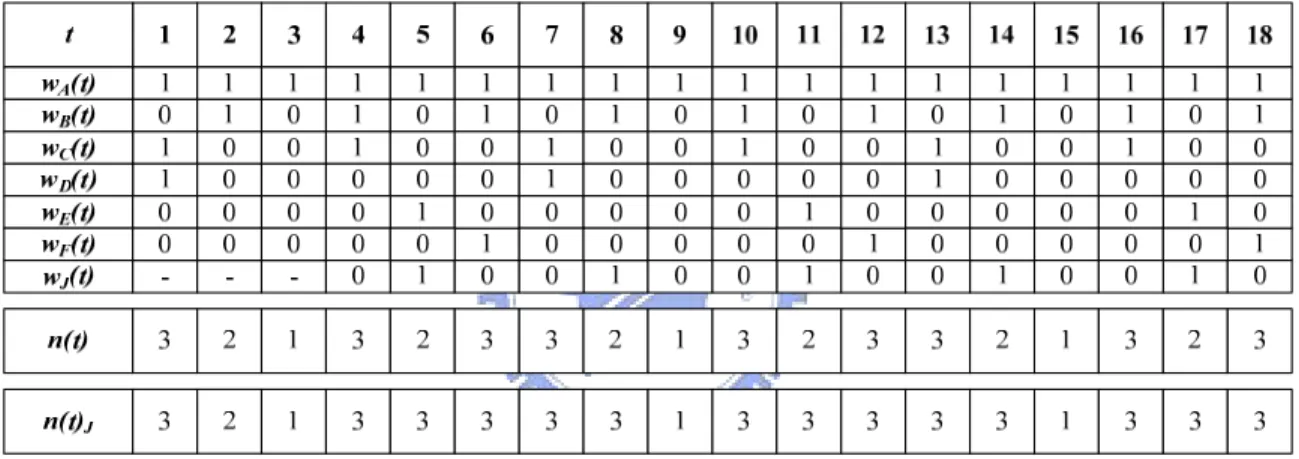
Considering the figure 3-1, there are six power-saving stations, A, B, C, D, E, and F, whose listen-intervals are 1, 2, 3, 6, 6, and 6. wi(t) is used to indicate the sleeping state of station i at beacon interval t. If wi(t) is 1, station is active, otherwise station is in sleep mode. n(t) is the total number of wakeup stations in beacon t.
Figure 3-1 a sequence of wi(t) and n(t), n(t)J : the n(t) after J is included
In order to trace the wakeup time of each station, AP needs to maintain a wakeup counter, denoted as , for each sleeping station i. indicates the remaining beacon interval that station i will wake up. Initially, AP sets =
) (t ci ci(t) ) (t ci li−1, where is the listen-interval of station i. Station i wakes up if become 0 and the counter will reset to = for further counting down. AP sets counter for beacon interval t+1 as follows: i l ) (t ci ) (t ci li−1 ci(t+1)
⎩ ⎨ ⎧ = − ≠ − = + 0 ) ( 1 0 ) ( 1 ) ( ) 1 ( t c if t c if t c t c i i i i i l
Thus, AP can find wi(t+k) for beacon interval t+k by
⎩
⎨
⎧
=
=
+
otherwise
k
if
k
t
w
i i0
0
mod
1
)
(
l
The wakeup scheduling problem (WSP) can be formulated as follows: Given a set of sleeping stations S at beacon interval t. Consisting m stations and each of the station i has wakeup count and listen-interval . For a new sleeping station j, we assign an initial value to such that the maximum value of
) (t ci li ) (t cj n(t+k)=
∑
i∈S∪{j}wi(t+k) , k = 1, 2, 3 . . . is minimized. In the next section, we present the mechanism of load-aware wakeup scheduling.3.2 Load-aware wakeup scheduling
By observing the sequence of n(t) in Figure 3-1, we find that a pattern repeats every six beacon intervals, e.g., (n(1), n(2), …, n(6)) = (n(7), n(8), …, n(12)) = (n(13), n(14), …, n(18)) = (3, 2, 1, 3, 2, 3). The length of this repeating pattern, r, can be found
by computing the least common multiple (lcm) of listen-interval , i∈S. For example, the listen-intervals of stations, A, B, C, D, E, and F are 1, 2, 3, 6, 6, and 6, respectively, in
i l
Figure 3-1. Then
r = lcm {1, 2, 3, 6, 6, 6} = 6
we want to add a new sleeping station j with listen-interval to the sleeping station set
S with repeating pattern size r and assign an initial value to c
j l
j(t). A stepwise solving method for the WSP problem is given as follows.
1. Find r = lcm{ , r} and a sequence of total number of wakeup stations (n(t + 1),
n(t + 2), …, n(t + r)) for the first r intervals for sleeping station set S ∪{j}. i
l
2. For i = lj − 1, …, 1, 0, perform the following operations: (a) Set cj(t) = i and find (wj(t + 1), wj(t + 2), …, wj(t + r));
(b) Set (n(t + 1), n(t + 2), …, n(t + r)) = (n(t + 1), n(t + 2), …, n(t + r)) + (wj(t + 1), wj(t + 2), …, wj(t + r));
(c) Find ni = max{n(t + 1), n(t + 2), …, n(t + r)}.
3. Find n* = min{ni | i = lj − 1, lj − 2, …, 0}, say n* = nk, and thus set cj(t) = k.
For example, six stations with r = 6 as given in Figure 3-1, station J with = 3 enters the sleeping mode. The AP applies the above solving method to determine the initial value of counter c
J l
J(t) for station J as follows.
1. r = lcm{3,6} = 6 and (n(t + 1), n(t + 2), …, n(t + 6)) = (3,2,1,3,2,3) 2. i = 2:
(a) Set cj(t) = 2 and find (wj(t + 1), wj(t + 2), …, wj(t + 6)) = (0,0,1,0,0,1);
(b) Set (n(t + 1),n(t + 2), …, n(t + 6)) = (3,2,1,3,2,3) + (0,0,1,0,0,1) = (3,2,2,3,2,4); (c) Find n2 = max{3,2,2,3,2,4} = 4.
i = 1:
(a) Set cj(t) = 1 and find (wj(t + 1), wj(t + 2), …, wj(t + 6)) = (0,1,0,0,1,0);
(b) Set (n(t + 1), n(t + 2), …, n(t + 6)) = (3,2,1,3,2,3) + (0,1,0,0,1,0) = (3,3,1,3,3,3); (c) Find n1 = max{3,3,1,3,3,3} = 3.
i = 0:
(a) Set cj(t) = 0 and find (wj(t + 1), wj(t + 2), …, wj(t + 6)) = (1,0,0,1,0,0);
(b) Set (n(t + 1), n(t + 2), …, n(t + 6)) = (3,2,1,3,2,3) + (1,0,0,1,0,0) = (4,2,1,4,2,3); (c) Find n0 = max{4,2,1,4,2,3} = 4.
3. Find n* = min{4,3,4} = 3, i.e., n* = n1, and thus set cj(t) = 1.
Note that according to IEEE 802.11 standard, if mobile station j has no data to send, it can send a Null data frame with Power Management bit set to 1. The AP begins to buffer frames and sends an ACK frame to the station after receiving the Null data frame. We can just modify this step to incorporate our wakeup scheduling in IEEE 802.11 standard as follows: The AP begins to buffer frames, determines cj(t) and sends an ACK frame with cj(t) value to station j after receiving the Null data frame. Then, the station j sets its wakeup counter to cj(t) and enters the sleeping mode.
3.3 Contention avoidance traffic scheduling
In the previous section, we arrange stations’ wakeup beacon intervals so that the number of wakeup stations in each beacon interval is balanced. In this section, we consider how to inform stations that frames are buffered such that the contention is
avoided. Three different access scheduling mechanisms are proposed for the contention avoidance problem. In the first mechanism, only one wakeup station is scheduled to access the buffered data in a beacon interval by marking one bit in TIM. The second and third mechanisms schedule multiple wakeup stations to get back their buffered data within a beacon interval. The access sequence within the beacon interval is according to their AIDs and the length of queuing data.
3.3.1 Multiple wakeups single access
One of the simple ways to avoid contention is that we only inform a station that AP has its buffered frames at each beacon interval. So there is no contention problem of sending PS-Poll frame to get back its buffered data. Let Sw(t) be the set including all stations waking up at beacon interval t. That is,
Sw(t)={i|i∈S, ci(t)=0}
where S is the set including all sleeping stations. Let Sb(t) be the set including all stations that frames are buffered in AP at beacon interval t. Thus, we can choose a station, say station v, from set Sw(t) ∩ Sb(t) with a largest listen-interval to inform that the AP has buffered frames for it.
v l
It is possible that some stations in set Sw(t) ∩ Sb(t) use small listen-interval and they are never chosen by AP. To avoid such a case, we associate each station v in Sw(t) ∩ Sb(t) with an age, denoted as av. Initially, the age of each station is set to zero. For each beacon interval, if a station in set Sw(t) ∩ Sb(t) is not selected to inform, AP increases its age by
one; otherwise, AP sets its age to zero. Thus, AP can choose a station, say station v, from set Sw(t) ∩ Sb(t) with a largest value of lv + av to inform. Here we denote lv + av as pv.
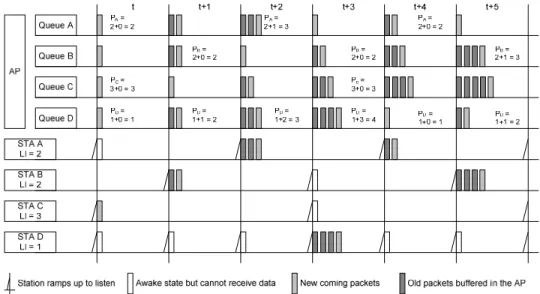
Figure 3-2 shows an example of this mechanism. Consider that there are four stations, A, B, C, and D, with listen-interval ( , , , ) = (2, 2, 3, 1). Suppose there are 1,1,1,1 packets send to station A, B, C, and D in every beacon interval. Packet arrival rate of each station is one frame per beacon interval. In beacon interval t, stations
A, C, and D wake up in which station C, has maximum p
A
l lB lC lD
C = lC + aC = 3 + 0, is indicated in TIM to inform it that the AP has buffered its data. Stations A and D are deferred to their next wakeup beacon intervals. The AP sets ages aA = aA + 1 and aD = aD + 1. In the beacon interval t + 1, stations B and D wake up. Because
+ a B
l B = B lC + aC = 2, the AP selects station B, arbitrarily, to inform it has buffered
frames. Similarly, station A is chosen to inform in beacon interval t + 2. At beacon interval t + 3, lB + aBB < lC + aC < lD + aD and thus station D is chosen to inform.
3.3.2 Multiple wakeups multiple accesses
Although the multiple wakeups single access mechanism avoids the contention among stations, it may lower the bandwidth utilization and increase the transmission delay. However, the AP knows how many frames it has buffered in queue, transmission rate and the length of beacon interval. Thus, the AP can determine how many frames it can transmit in a beacon interval and schedule the buffered frames by means of announcing the TIM. In the following, we give two methods to arrange the access sequence of stations.
3.3.2.1 The smallest AID first
Figure 3-3 an example of smallest AID first method
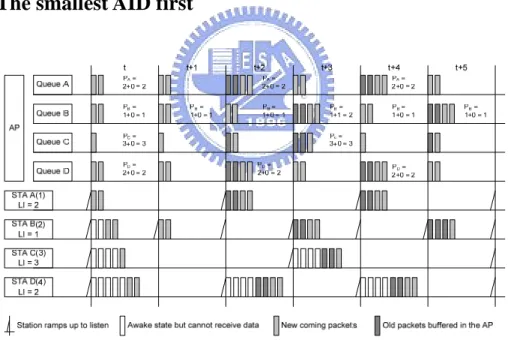
In order to control the traffic load in a beacon interval, AP selects a set of stations with an appropriate size from Sw(t) ∩ Sb(t) to inform them to retrieve the data. That is the total amount of buffered frames of selected stations should be less than the capacity of a
not get back its buffered data. Next, we modify the power management scheme of IEEE 802.11 WLANs such that a station retrieves the buffered frame according to the sequence of AID marked in TIM. That is, the station with smallest AID among the selected stations sends PS-Poll frame to retrieve buffered data first.
Figure 3-3 shows an example of the AID sequence method. There are four stations,
A, B, C, and D with listen-interval ( , , , ) = (2, 1, 3, 2) with under the service of an AP. Suppose there are 2, 2, 1, 2 packets send to A, B, C, D in each beacon interval. Their corresponding AIDs are 1, 2, 3, and 4 for stations A, B, C, and D, respectively. Suppose packet arrival rates of stations A, B, C, and D are 2, 2, 1, and 2 per beacon interval. The maximum number of frames that AP can transfer to stations in a beacon interval is 8. In beacon interval t, all of these four stations wake up. Because the number of buffered frames is 2 + 2 + 1 + 2 = 7 (7 < 8), the AP marks AIDs 1, 2, 3, and 4 in the TIM. The stations check the TIM in beacon frame. They learn that 4 stations will send PS-Poll to retrieve their buffered frames and every station knows which station precedes it in access sequence. For example, station C has to wait stations A and B finishing their access. In beacon interval t + 2, S
A
l lB lC lD
w(t + 2) ∩ Sb(t + 2) = {A, B, D} and the number of frames buffered for stations, A, B, and D is 10 (10 > 8). Thus, based on the values of pA and pD, the AP selects stations A and D to inform them to retrieve the buffered data.
3.3.2.2 The smallest queue length first
queue length receives a highest precedence and thus it can have a longer sleeping time. In this method, we need to add an information element, describes the access sequence, as a component of the beacon frame. The station checks this information element for the access sequence.
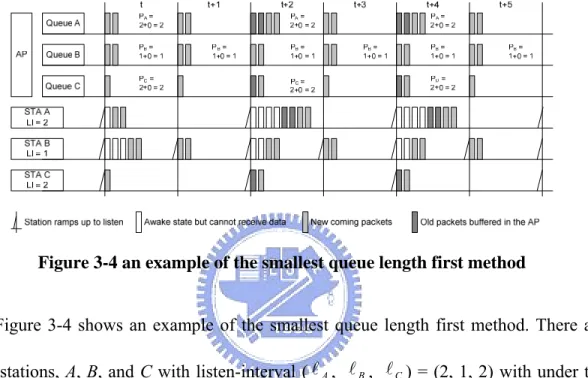
Figure 3-4 an example of the smallest queue length first method
Figure 3-4 shows an example of the smallest queue length first method. There are three stations, A, B, and C with listen-interval ( , , ) = (2, 1, 2) with under the service of an AP. Suppose packet arrival rates of stations A, B, and C are 2, 2, and 1 frames per beacon interval. The maximum frame size that AP can transfer to stations in a beacon interval is assumed to be 8. In beacon interval t, all of the three stations wake up. Because the number of buffered frames are 2+2+1=5 (5<8), the AP marks AIDs 1, 2, and 3 in the TIM and adds the access sequence C, A, and B in the beacon frame. In beacon interval t+2, the access sequence is C, B, and A. Note that if two stations have same queue length, AP uses their p
A
l lB lC
3.4 Simulation and results
3.4.1 Performance metrics and environment setup
In this section, we show the performance analysis for the proposed schemes: 1. Load-aware wakeup scheduling (LAWS);
2. LAWS with multiple wakeups single access (LAWS+MWSA);
3. LAWS with multiple wakeups multiple access and the smallest AID first (LAWS+SAF);
4. LAWS with multiple wakeups multiple access and the smallest queue length first (LAWS+SQLF).
Note that all of these four schemes are enhanced from the PS mode of 802.11. The LAWS arranges station’s wakeup time. The MWSA, SAF, and SQLF schemes can be used by AP to schedule the access sequence by marking the bits in TIM. We compare their performances against pure IEEE 802.11 PS mode by simulation. The performance metrics are given as follows:
1. Average sleeping time of the station: This measure is the duration that a station stays in the sleeping mode. If a scheme can make stations stay more time in sleeping, then stations will save more power.
2. Average throughput: This value shows the total amount of data successfully transmitting per second. If AP can efficiently schedule and distribute the access of its serving stations, it will have higher data throughput.
3. Average latency of a successful transmission: The latency is defined as the time duration starting while a packet is issued and buffered at AP and ending when the target station returns the acknowledge. An AP with a good scheduling scheme will make the latency as small as possible. Thus, the resources required for buffering data can be reduced.
Table 3-1 detail simulation configurations
Data rate 11Mbps MAC header 28 bytes IP header 20 bytes UDP header 20 bytes Beacon frame 28 bytes ACK frame 14 bytes PS-POLL frame 14 bytes
SIFS 0.00001 sec
DIFS 0.00005 sec
Slot time 0.00002 sec Beacon interval 0.1 sec
Our simulation uses an IEEE 802.11b wireless communication module with 11 Mbps data rate. An AP can serve at most 30 stations. Each station will randomly set 1 to 5 beacon intervals as its listen-interval size and its packet arrival rate is 3 packets per beacon interval. Packet size in our simulation is fixed and set to 1 Kbytes. Communication channel assumes to be clear and symmetric. The total simulation time is 3 minutes. The details of other simulation configurations such as header length, and inter-frame spaces (IFS) are listed in Table 3-1. Simulation results will compare the IEEE 802.11 PS mode with the proposed LAWS, LAWS+MWSA, LAWS+SAF, and LAWS+SQLF schemes.
3.4.2 Results and discussion
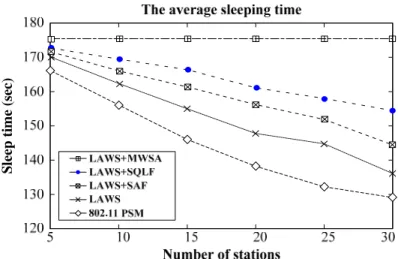
S le ep ti me (se c)Figure 3-5 the average sleeping time
Figure 3-5 shows the relation between average sleeping time and number of stations. Considering contention-based schemes, LAWS can have more sleeping time than IEEE 802.11 PS mode in any size of stations. By using LAWS+MWSA, LAWS+SAF, and LAWS+SQLF schemes to reduce the contention within a beacon interval, stations can have more time on staying in sleeping than LAWS and IEEE 802.11 PS mode. In this figure, it seems that LAWS+MWSA has better sleeping time than LAWS+SAF and LAWS+SQLF. However, we will find in figure 3-7 that it trades the transmission latency with the sleeping time.
Figure 3-6 shows the average throughput for each scheme. From this figure, we can explicitly find that the throughput of IEEE 802.11 PS mode falls down when station number is greater than 20. However, our proposed schemes, LAWS, LAWS+MWSA, LAWS+SAF, and LAWS+SQLF, are not influenced as number of station increases. This is because our schemes can efficiently avoid the data collision between stations.
Th
ro
ughp
ut (b
ps)
Figure 3-6 the average throughput for each scheme
In Figure 3-7, we show the average latency of a successful transmission for each scheme. For LAWS, LAWS+SAF, and LAWS+SQLF, all of their latency is smaller than 0.3 sec and increase slowly as number of stations grows. Because only one station is indicated within a beacon interval, the latency of LAWS+MWSA scheme is longer than the other proposed schemes. The pure IEEE 802.11 PS mode, however, will suffer the worst latency while number of stations increases.
Finally, Figure 3-8 shows the improving rate of sleeping time for each proposed scheme (compared to pure IEEE 802.11 PS mode). The improving rate Ri of scheme i is
defined as 100% 0 0 × − = S S S R i
i , where S0 and Si are the average sleeping times for pure IEEE 802.11 PS mode and the proposed scheme i, respectively. By efficiently scheduling the wakeup time of sleeping stations, the sleeping duration of LAWS, LAWS+MWSA, LAWS+SAF, and LAWS+SQLF schemes can be improved significantly.
Figure 3-7 the latency of a successful transmission for each scheme Im p rov in g r ate (%)
Figure 3-8 the improving rate of sleeping ratio
3.5 Summary
In this chapter, we propose a load-aware wakeup schedule scheme for infrastructure mode of IEEE 802.11 WLANs. The LAWS scheme balances the number of wakeup stations in each beacon interval to reduce the amount of contention stations. For avoiding
of the wakeup stations within a beacon interval. Simulation results show that comparing to IEEE 802.11 PS-mode, the proposed LAWS, MWSA, SAF, and SQLF schemes can efficiently improve the sleeping duration of each station, average throughput, and transmission delay.
The following two issues should be considered in the implementation of the proposed schemes:
1. An aging function should be implemented in the AP to determine when buffered frames are old enough to be discarded.
2. If the mobile station misses the beacon, it should remain awake until it receives the next beacon. The mobile station checks the beacon frame. If the bit corresponding to its AID is set to zero in the TIM, or else it has retrieved all buffered frames, the mobile station can resume the sleeping mode by asking AP for a new wakeup counter cj(t). In the LAWS+SAF and LAWS+SQLF schemes, the mobile station misses the beacon can not show up to retrieve the buffered data in its turn. The next station in the access sequence can send PS-Poll frames to get back its buffered data if it finds that the medium has been idle for longer than the distributed coordination function inter-frame space (DIFS).
Chapter 4
Power Saving Protocols for IEEE
802.11 Ad Hoc Mode
In this chapter, we give a novel self-configuring power-saving protocol for wireless one-hop ad hoc networks, the SCPS. According to IEEE 802.11 WLANs standard, a station may enter a special power-saving (PS) mode. SCPS allows all stations in the PS mode to adjust their wakeup schedules whenever a station enters or exits the PS mode. The adjustment can balance the number of wakeup stations in each beacon interval so that the contention for transmission medium and the collisions in transmission will be ameliorated, which results in more efficient energy usage. Simulation results show that SCPS successfully balances the number of stations that wake up in each beacon interval, increases the sleep ratio, and reduces the collision probability. The combined effect reduces total energy consumption.
This chapter is organized as follows. In Section 4.1, we state our research problem of power-saving in the ad hoc network. The proposed SCPS approach is presented in Sections 4.2. In Section 4.3, we present the simulation results of SCPS and the summary is in section 4.4.
4.1 Problem statement
The QEC [30] approach which mentioned in chapter 2 does not balance the number of wakeup stations in each beacon interval, it cannot avoid high packet collision rate. In order to balance the number of wakeup stations in beacon intervals, we need another mechanism approach which can allow every station not only to decide its own listen-interval as in the 802.11 infrastructure mode but also to choose a suitable wakeup schedule. Each station wakes up once per listen-interval, rather than per beacon interval. Thus, a station wakes up less frequently and sleeps longer. Besides, by efficiently balance the numbers of wakeup stations during beacon intervals, the collision (and hence re-transmission) of packets can be reduced.
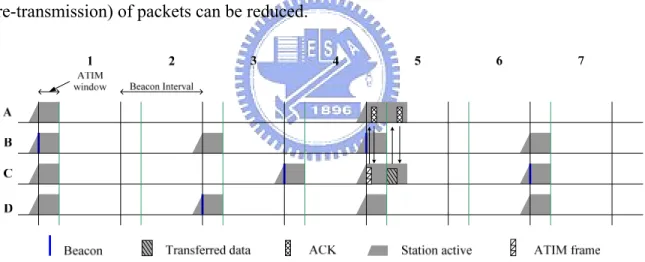
Figure 4-1 the power-saving operation of SCPS
As the Figure 4-1 shows, assume that there are four stations, A, B, C, and D with listen-intervals 4, 2, 3, and 2, respectively. That is, station A wakes up every 4 beacon intervals, B wakes up every 2 beacon intervals, and so on. Assume that, in the 4th beacon interval, C wishes to send data to A. Because A does not wake up in this beacon interval, C cannot transmit the data to A at this time. C needs to wait until the 5th beacon interval
beacon interval instead of waking up at every beacon interval to check A’s availability. To achieve the mechanism of Figure 4-1, every station has a copy of the wakeup schedule of every other station that is in the PS mode. Before we can use this mechanism, we need to deal with three issues. The first is synchronizing the timers. Because stations do not wake up in every beacon interval, stations’ timers may become out of synchronization. The second is maintaining a consistent wakeup table (which is the collection of the wakeup schedules of all stations in the PS mode) among all stations. Because there is not a central coordinator in an ad hoc network, a distributed mechanism is needed to keep all the copies of the wakeup table consistent. The third is evenly arranging stations to wake up in beacon intervals in order to alleviate the contention.
4.2 The SCPS approach
The motivation of SCPS comes from the observation of Figure 4-1. In the following subsections, we discuss how to conquer the three problems. Timer synchronizing is in section 4.2.2. Maintaining a consistent wakeup table (which is the collection of the wakeup schedules of all stations in the PS mode) among all stations is in section 4.2.3. And finally problem that evenly arranges stations to wake up in beacon intervals is in 4.2.4.
4.2.1 The wakeup information of other stations
In SCPS, every station needs to maintain the wakeup information of all the other stations, which is kept in the Wakeup Information Table (WIT). Table 4-1 is an example of WIT. Each entry comprises four fields: station ID (SID), MAC address, listen-interval
(l), and wakeup count (WC). SID is a unique value chosen by the station to identify itself. The range of a SID is 0–127. When a station enters the PS mode, it announces its SID to the network. Other stations can bind this SID to the announcer’s MAC address. The listen-interval, denote as , of a station is the number of beacon intervals for which the station sleeps between two adjacent wakeups. The wakeup count (WC) is the number of beacon intervals for which the station will sleep before the next wakeup. Note that WC cycles through from down to 0.
l
1 − l
Table 4-1 the wakeup information table
SID MAC address l WC
2 00-06-AE-EF-56-21 5 0
4 00-02-3B-D3-A6-21 4 3
8 00-06-4E-B7-65-67 4 0
5 00-03-E9-03-24-5F 4 2
9 00-01-D2-03-71-21 4 1
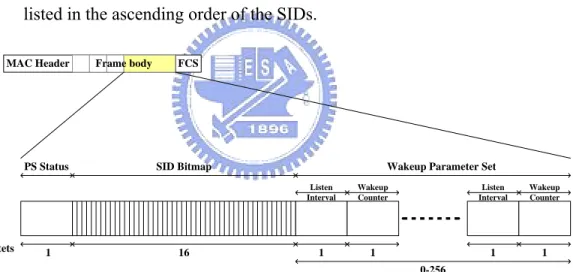
Since an ad hoc network lacks a central coordinator, WIT maintenance is done during the beacon process. We add a new piece of information, called the Station Wakeup Information (SWI), in the beacon frames (Figure 4-2). The station that wins the right to send a beacon frame broadcasts the SWI information, which contains the wakeup schedules of all stations in the PS mode. Thus, newly joined stations can obtain the wakeup schedules of other stations that are in the PS mode. We call the station that sends the beacon frame as the beacon sender. The SWI includes the following fields:
• PS (power-saving) status: This one-byte field indicates the state of the beacon sender. If the PS status is JOIN or LEAVE, it means that the beacon sender is going to enter or exit the PS mode, respectively; otherwise, its
status is NORMAL.
• SID bitmap: The SID bitmap is similar to the virtual bitmap in the traffic indication map (TIM) in the 802.11 infrastructure mode. It consists of 128 bits. Each bit is tied to a station ID. When a SID is occupied by a station (which must be in the PS mode), the bit tied to the SID is 1; otherwise, the bit is 0. In practice, a one-hop ad hoc network comprises 25–40 stations. Thus, 128 bits should be enough.
• Wakeup Parameter Set (WPS): This set includes the listen-interval and wakeup counter of every station that is in the PS mode. The information is listed in the ascending order of the SIDs.
FCS MAC Header Listen Interval Wakeup Counter Listen Interval Wakeup Counter
PS Status SID Bitmap Wakeup Parameter Set
1 16
0-256 Octets
Frame body
1 1 1 1
Figure 4-2 the format of station wakeup information (SWI)
In order to allow a station with new SWI information (such as those who want to enter or exit the PS mode) to preempt other stations when competing for the transmission medium, the rules for selecting a backoff window size are modified in SCPS. The station that wants to enter or exit the PS mode chooses its backoff window size randomly between 0 and ρ/2, where ρ is two times the minimum backoff
window size specified in IEEE 802.11. Other stations choose their backoff window sizes randomly betweenρ/2 and ρ.
Obviously, the WIT in each beacon frame consumes bandwidth. The size of a WIT is 1 + 16 + 2u bytes, where u is the number of stations in the PS mode. If the physical transmission rate is 1 Mbps, the extra time for transmitting the WIT is less than 2.2 ms when u =128 stations, which is about 2% of the bandwidth if a beacon interval lasts for 100 ms. For a common network (containing 25-40 stations) the overhead is 0.54-0.78% of the bandwidth.
4.2.2 Timer synchronization
In order to synchronize stations’ timers, we define the Timer Synchronization Beacon Interval (TSBI) as a beacon interval in which all stations will wake up and compete to serve as the beacon sender. All stations will synchronize their timers with that of the beacon sender. The beacon of TSBI is called as the Timer Synchronization Beacon. The number of beacon intervals between two consecutive Timer Synchronization Beacons is called the Timer Synchronization Period (TSP).
Table 4-2 the number of beacon intervals needed or the clock to draft for a DIFS
Accuracy 0.01% 0.005% 0.003% 0.002% 0.0016% 0.001% Beacon intervals 2.50 5.00 8.33 12.50 15.00 25.00
TSP affects the efficiency of power-saving operations and timer synchronization. Long TSP allows stations to sleep longer but also increases the failure probability on timer synchronization. Table 4-2 shows the number of beacon intervals needed for the clock to draft for more than the duration of a DIFS with various clock accuracy ratios
physical layer. The worst clock accuracy ratio specified in 802.11 is 0.01%. Because a station has to wait for a DIFS period before it counts down the (random) backoff time, we require the clock skew should not exceed a DIFS period. For instance, if the clock accuracy ratio is 0.001%, all the clocks should be synchronized every 25 (or less) beacon intervals. Determining a suitable TSP needs experiments. In our simulation study, the clock accuracy ratio is assumed to be 0.001%. Thus, TSP is 25 beacon intervals. The reason will be given in the simulation section. Note that the TSBI is for the sole purpose of timer synchronization. The stations will not send any frames except the Timer Synchronization Beacon frame during a TSBI. After that, the stations go to sleep.
4.2.3 Maintaining a consistent wakeup table
In this section, we show how to maintain a consistent wakeup table while stations enter or exit the PS mode. Before a new station, say Sj, enters the PS mode, it needs to be
a beacon sender to send SWI to all other stations. Then, Sj stays wakeup until it receives a
beacon frame with the NORMAL PS status. At that time, Sj knows that no station is
entering or exiting the PS mode. It then builds a WIT table based on the SWI fields of the received beacon frame. In the next beacon interval, Sj chooses a SID, sets the PS status to
JOIN, and prepares the SWI fields for the beacon frame. Sj uses [0, ρ/2] as the backoff
window size to compete for the medium for transmitting the beacon frame. Once Sj
successfully sends out its beacon frame, it will serve as the beacon sender for the next k beacon intervals (starting from the current beacon interval). Note that k should be large enough to ensure that all stations in the PS mode will wake up and receive Sj’s beacon
)
,
min(
l
maxω
=
k
where is the maximum listen-interval in the current WIT table and ω is the number of beacon intervals from the current beacon interval to the next TSBI. After k beacon intervals, all stations in the PS mode are notified and they can update their WIT tables. Other stations that also wish to be the beacon senders but fail to win the transmission medium need to wait for the next beacon frame with the NORMAL PS status.
max l
Similarly, when a station, say Se, wants to exit the PS mode, it removes its wakeup
schedule from the beacon frame, sets its PS status to LEAVE, and competes for the transmission medium with a backoff window size randomly chosen from [0, ρ/2].
Table 4-3 a sequence of wi(t) and n(t)
t 1 2 3 4 5* 6 7 8 9 10 11 12 wA(t) 0 1N 0 0 0 1 0 0 0 1 0 0 wB(t) 0 0 1 0 0 1 1L 1L 1L 1L - - wC(t) 0 0 1N 0 0 1 0 0 1 0 0 1N wD(t) 0 0 1 0 0 1N 0 0 1 0 0 1 wE(t) - - 1 1J 1J 0 1 0 0 0 1N 0 n(t) 0 1 4 1 1 4 2 1 3 2 1 2
After Se sends its beacon frame, it continues to serve as the beacon sender for the
next k beacon intervals to notify all other stations in the PS mode, where k is given in equation (1) above. When a station wakes up and receives a beacon frame with a JOIN or LEAVE PS status, it uses the SWI information in the beacon frame to update its own WIT table. Because the MAC address of the beacon sender is included in the beacon frame, other stations can bind the beacon sender SID to its MAC address.
Table 4-3 shows an example of a station entering and exiting the PS mode. We use English letters A, B, etc. to represent SIDs. In Table 2, wi(t) = 1 if station i wakes up at beacon interval t; wi(t) = 0, otherwise. For each beacon interval, we mark the beacon sender with its PS status as a superscript. That is, wi(t) = 1x indicates that, during interval t, station i is the beacon sender and the PS status is NORMAL (N), JOIN (J), or LEAVE
(L).
Let n(t) denote the number of stations waking up at beacon interval t. Then, n(t) can be found by :
∑
∈=
S i it
w
t
n
(
)
(
)
where S is the set of all stations in PS mode. There are 5 stations in this example. Assume that the 5th beacon interval is a TSBI. During the 1st beacon interval, 4 stations A, B, C, and D are in the PS mode. Their listen-intervals are 4, 3, 3, and 3, respectively. Assume that, at the 3rd beacon interval, station E wants to enter the PS mode with its listen-interval set to 4. Station E receives a beacon frame issued by station C with the NORMAL PS status. So it uses the SWI information in this beacon frame to update its WIT table. During the 4th beacon interval, station E adds its wakeup schedule to the beacon frame and sets the PS status to JOIN. It employs a short delay to win the opportunity to serve as the beacon sender. It continues to serve as the beacon sender until the 5th beacon interval, which is the TSBI. Note that in this case = 4, ω = 2; and that
k = min( , ω) = 2.
max l max
l
the medium. During the 6th beacon interval, B detects that the PS status of the beacon frame is NORMAL. It competes for the medium during the 7th beacon interval. Station B continues to serve as the beacon sender until the 10th beacon interval. Stations that wake up and receive the beacon frames from B make use of the SWI information to update their respective WIT tables. It is obvious that the number of wakeup stations in each beacon interval is not the same. If stations’ wakeup schedules are properly arranged so that the number of wakeup stations in each beacon interval is roughly the same, the contention for the transmission medium will be reduced. Therefore, we hope to balance the number of wakeup stations in each interval.
To balance the number of wakeup stations in each beacon interval, we need to adjust the WC of the sleeping stations when there is a station entering or exiting the PS mode. In the following subsections, we show how SCPS balances the number of stations.
4.2.4 A station enters the PS mode
Consider a wireless ad hoc network with six stations, A, B, C, D, E, and F. Assume they all are sleeping initially. Their listen-intervals are 4, 3, 3, 3, 3, and 4, respectively. We will use the sequence of wi(t)’s and the total number of wakeup stations n(t) for t =1, 2, . . . , 18, in Table 4-4 as our example.
Assume that the 12th beacon interval is a TSBI and the stations’ first wake up at the 4th, 3rd, 2nd, 1st, 1st, and 3rd beacon intervals, respectively. Assume that station J wants to
enter the PS mode at beacon interval 4. Furthermore, assume station J’s listen-interval is 3 and J randomly chooses a wakeup schedule (1, 0, 0) (this schedule means that J wakes up once every three beacon intervals). The row of n(t) shows the number of wakeup